LINE BALANCING
Line Balancing is deciding the best physical arrangement of all
resources within a facility
Goal:
• Every one doing the same amount of work to customer
requirement.
• Variation is smoothed.
• No one overburdened ,No one waiting.
• Every one worked together in a balanced fashion.
PROCEDURES TO CALCULATE LAYOUT
Step 1: Identify tasks & immediate predecessors
Step 2: Determine output rate
Step 3: Determine cycle time
Step 4: Compute the theoretical minimum number of stations the Line)
Step 5: assign tasks to workstations (balance
Step 6: compute efficiency, idle time & balance delay
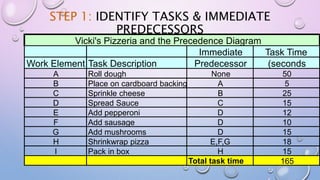
STEP 1: IDENTIFY TASKS & IMMEDIATE
PREDECESSORS
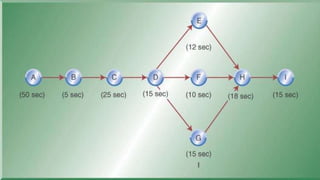
Vicki's Pizzeria and the Precedence Diagram
Immediate Task Time
Work Element Task Description Predecessor (seconds
A Roll dough None 50
B Place on cardboard backing A 5
C Sprinkle cheese B 25
D Spread Sauce C 15
E Add pepperoni D 12
F Add sausage D 10
G Add mushrooms D 15
H Shrinkwrap pizza E,F,G 18
I Pack in box H 15
Total task time 165
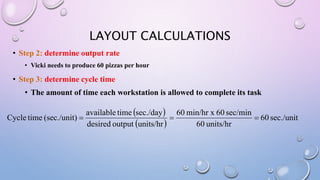
LAYOUT CALCULATIONS
• Step 2: determine output rate
• Vicki needs to produce 60 pizzas per hour
• Step 3: determine cycle time
• The amount of time each workstation is allowed to complete its task
 
 
sec./unit60
units/hr60
sec/min60min/hr x60
units/hroutputdesired
sec./daytimeavailable
)(sec./unittimeCycle 
LAYOUT CALCULATIONS CON’T
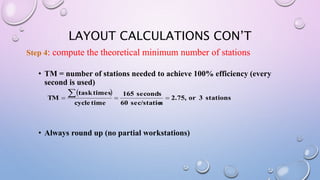
Step 4: compute the theoretical minimum number of stations
• TM = number of stations needed to achieve 100% efficiency (every
second is used)
• Always round up (no partial workstations)
 
stations3or2.75,
nsec/statio60
seconds165
timecycle
timestask
TM 

LAYOUT CALCULATIONS CONT.
Step 4: Assign task to work station
• Make sure the sum of task times at any station does not exceed the cycle time.
• There are rules that can be followed if there is a choice of task to assign to a station .
1.Number of follower rule
Select the task will have the most number of followers
2.Longest task time rule
Select the task with the longest task time.
Step 5: Assign tasks to workstations
Station Time Remaining Eligible Will fit Assign(Task
time)
Idle
1 60 A A A(50)
10 B B B(5)
5 C None None 5
2 60 C C C(25)
35 D D D(15)
20 E,F,G E,F,G G(15)
5 E,F None None 5
3 60 E,F E,F E(12)
48 F F F(10)
38 H H H(18)
20 I I I(15)
5 - - - 5
LAST LAYOUT CALCULATION
• Step 6: compute efficiency and balance delay
sec.100/60*sec.15timeidlePercent 
91.78.3%-100%Efficency 

Line balancing

  • 1.
    LINE BALANCING Line Balancingis deciding the best physical arrangement of all resources within a facility Goal: • Every one doing the same amount of work to customer requirement. • Variation is smoothed. • No one overburdened ,No one waiting. • Every one worked together in a balanced fashion.
  • 2.
    PROCEDURES TO CALCULATELAYOUT Step 1: Identify tasks & immediate predecessors Step 2: Determine output rate Step 3: Determine cycle time Step 4: Compute the theoretical minimum number of stations the Line) Step 5: assign tasks to workstations (balance Step 6: compute efficiency, idle time & balance delay
  • 3.
    STEP 1: IDENTIFYTASKS & IMMEDIATE PREDECESSORS Vicki's Pizzeria and the Precedence Diagram Immediate Task Time Work Element Task Description Predecessor (seconds A Roll dough None 50 B Place on cardboard backing A 5 C Sprinkle cheese B 25 D Spread Sauce C 15 E Add pepperoni D 12 F Add sausage D 10 G Add mushrooms D 15 H Shrinkwrap pizza E,F,G 18 I Pack in box H 15 Total task time 165
  • 5.
    LAYOUT CALCULATIONS • Step2: determine output rate • Vicki needs to produce 60 pizzas per hour • Step 3: determine cycle time • The amount of time each workstation is allowed to complete its task     sec./unit60 units/hr60 sec/min60min/hr x60 units/hroutputdesired sec./daytimeavailable )(sec./unittimeCycle 
  • 6.
    LAYOUT CALCULATIONS CON’T Step4: compute the theoretical minimum number of stations • TM = number of stations needed to achieve 100% efficiency (every second is used) • Always round up (no partial workstations)   stations3or2.75, nsec/statio60 seconds165 timecycle timestask TM  
  • 7.
    LAYOUT CALCULATIONS CONT. Step4: Assign task to work station • Make sure the sum of task times at any station does not exceed the cycle time. • There are rules that can be followed if there is a choice of task to assign to a station . 1.Number of follower rule Select the task will have the most number of followers 2.Longest task time rule Select the task with the longest task time.
  • 8.
    Step 5: Assigntasks to workstations Station Time Remaining Eligible Will fit Assign(Task time) Idle 1 60 A A A(50) 10 B B B(5) 5 C None None 5 2 60 C C C(25) 35 D D D(15) 20 E,F,G E,F,G G(15) 5 E,F None None 5 3 60 E,F E,F E(12) 48 F F F(10) 38 H H H(18) 20 I I I(15) 5 - - - 5
  • 9.
    LAST LAYOUT CALCULATION •Step 6: compute efficiency and balance delay sec.100/60*sec.15timeidlePercent  91.78.3%-100%Efficency 