Assembly line
balancing
INTRODUCTION
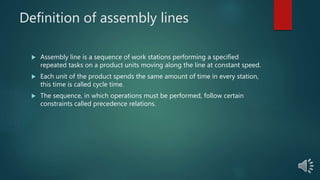
Definition of assembly lines
 Assembly line is a sequence of work stations performing a specified
repeated tasks on a product units moving along the line at constant speed.
 Each unit of the product spends the same amount of time in every station,
this time is called cycle time.
 The sequence, in which operations must be performed, follow certain
constraints called precedence relations.
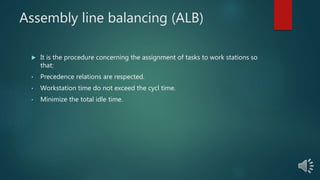
Assembly line balancing (ALB)
 It is the procedure concerning the assignment of tasks to work stations so
that:
• Precedence relations are respected.
• Workstation time do not exceed the cycl time.
• Minimize the total idle time.
Important relations
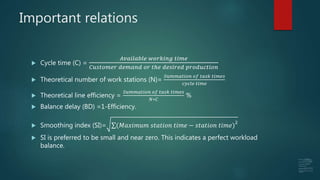
 Cycle time (C) =
𝐴𝑣𝑎𝑖𝑙𝑎𝑏𝑙𝑒 𝑤𝑜𝑟𝑘𝑖𝑛𝑔 𝑡𝑖𝑚𝑒
𝐶𝑢𝑠𝑡𝑜𝑚𝑒𝑟 𝑑𝑒𝑚𝑎𝑛𝑑 𝑜𝑟 𝑡ℎ𝑒 𝑑𝑒𝑠𝑖𝑟𝑒𝑑 𝑝𝑟𝑜𝑑𝑢𝑐𝑡𝑖𝑜𝑛
 Theoretical number of work stations (N)=
𝑆𝑢𝑚𝑚𝑎𝑡𝑖𝑜𝑛 𝑜𝑓 𝑡𝑎𝑠𝑘 𝑡𝑖𝑚𝑒𝑠
𝑐𝑦𝑐𝑙𝑒 𝑡𝑖𝑚𝑒
 Theoretical line efficiency =
𝑆𝑢𝑚𝑚𝑎𝑡𝑖𝑜𝑛 𝑜𝑓 𝑡𝑎𝑠𝑘 𝑡𝑖𝑚𝑒𝑠
𝑁∗𝐶
%
 Balance delay (BD) =1-Efficiency.
 Smoothing index (SI)= (𝑀𝑎𝑥𝑖𝑚𝑢𝑚 𝑠𝑡𝑎𝑡𝑖𝑜𝑛 𝑡𝑖𝑚𝑒 − 𝑠𝑡𝑎𝑡𝑖𝑜𝑛 𝑡𝑖𝑚𝑒)
2
 SI is preferred to be small and near zero. This indicates a perfect workload
balance.
Goals of ALB
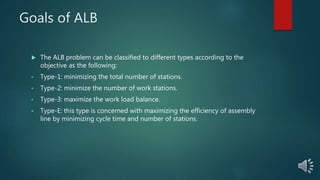
 The ALB problem can be classified to different types according to the
objective as the following:
• Type-1: minimizing the total number of stations.
• Type-2: minimize the number of work stations.
• Type-3: maximize the work load balance.
• Type-E: this type is concerned with maximizing the efficiency of assembly
line by minimizing cycle time and number of stations.
Example
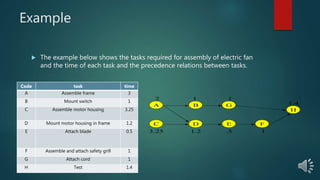
 The example below shows the tasks required for assembly of electric fan
and the time of each task and the precedence relations between tasks.
Code task time
A Assemble frame 3
B Mount switch 1
C Assemble motor housing 3.25
D Mount motor housing in frame 1.2
E Attach blade 0.5
F Assemble and attach safety grill 1
G Attach cord 1
H Test 1.4
A
C
B
D E F
G
H
2
3.25
1
1.2 .5
1
1.4
1
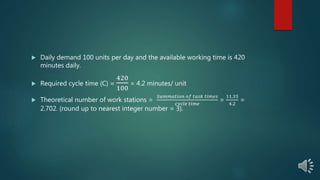
 Daily demand 100 units per day and the available working time is 420
minutes daily.
 Required cycle time (C) =
420
100
= 4.2 minutes/ unit
 Theoretical number of work stations =
𝑆𝑢𝑚𝑚𝑎𝑡𝑖𝑜𝑛 𝑜𝑓 𝑡𝑎𝑠𝑘 𝑡𝑖𝑚𝑒𝑠
𝑐𝑦𝑐𝑙𝑒 𝑡𝑖𝑚𝑒
=
11.35
4.2
=
2.702. (round up to nearest integer number = 3).
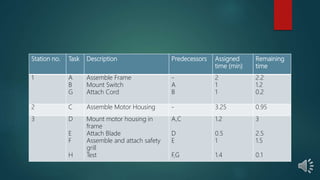
Station no. Task Description Predecessors Assigned
time (min)
Remaining
time
1 A
B
G
Assemble Frame
Mount Switch
Attach Cord
-
A
B
2
1
1
2.2
1.2
0.2
2 C Assemble Motor Housing - 3.25 0.95
3 D
E
F
H
Mount motor housing in
frame
Attach Blade
Assemble and attach safety
grill
Test
A,C
D
E
F,G
1.2
0.5
1
1.4
3
2.5
1.5
0.1
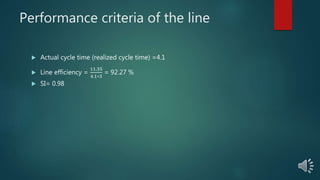
Performance criteria of the line
 Actual cycle time (realized cycle time) =4.1
 Line efficiency =
11.35
4.1∗3
= 92.27 %
 SI= 0.98
Thank you

Assembly line balancing

  • 1.
  • 2.
    Definition of assemblylines  Assembly line is a sequence of work stations performing a specified repeated tasks on a product units moving along the line at constant speed.  Each unit of the product spends the same amount of time in every station, this time is called cycle time.  The sequence, in which operations must be performed, follow certain constraints called precedence relations.
  • 3.
    Assembly line balancing(ALB)  It is the procedure concerning the assignment of tasks to work stations so that: • Precedence relations are respected. • Workstation time do not exceed the cycl time. • Minimize the total idle time.
  • 4.
    Important relations  Cycletime (C) = 𝐴𝑣𝑎𝑖𝑙𝑎𝑏𝑙𝑒 𝑤𝑜𝑟𝑘𝑖𝑛𝑔 𝑡𝑖𝑚𝑒 𝐶𝑢𝑠𝑡𝑜𝑚𝑒𝑟 𝑑𝑒𝑚𝑎𝑛𝑑 𝑜𝑟 𝑡ℎ𝑒 𝑑𝑒𝑠𝑖𝑟𝑒𝑑 𝑝𝑟𝑜𝑑𝑢𝑐𝑡𝑖𝑜𝑛  Theoretical number of work stations (N)= 𝑆𝑢𝑚𝑚𝑎𝑡𝑖𝑜𝑛 𝑜𝑓 𝑡𝑎𝑠𝑘 𝑡𝑖𝑚𝑒𝑠 𝑐𝑦𝑐𝑙𝑒 𝑡𝑖𝑚𝑒  Theoretical line efficiency = 𝑆𝑢𝑚𝑚𝑎𝑡𝑖𝑜𝑛 𝑜𝑓 𝑡𝑎𝑠𝑘 𝑡𝑖𝑚𝑒𝑠 𝑁∗𝐶 %  Balance delay (BD) =1-Efficiency.  Smoothing index (SI)= (𝑀𝑎𝑥𝑖𝑚𝑢𝑚 𝑠𝑡𝑎𝑡𝑖𝑜𝑛 𝑡𝑖𝑚𝑒 − 𝑠𝑡𝑎𝑡𝑖𝑜𝑛 𝑡𝑖𝑚𝑒) 2  SI is preferred to be small and near zero. This indicates a perfect workload balance.
  • 5.
    Goals of ALB The ALB problem can be classified to different types according to the objective as the following: • Type-1: minimizing the total number of stations. • Type-2: minimize the number of work stations. • Type-3: maximize the work load balance. • Type-E: this type is concerned with maximizing the efficiency of assembly line by minimizing cycle time and number of stations.
  • 6.
    Example  The examplebelow shows the tasks required for assembly of electric fan and the time of each task and the precedence relations between tasks. Code task time A Assemble frame 3 B Mount switch 1 C Assemble motor housing 3.25 D Mount motor housing in frame 1.2 E Attach blade 0.5 F Assemble and attach safety grill 1 G Attach cord 1 H Test 1.4 A C B D E F G H 2 3.25 1 1.2 .5 1 1.4 1
  • 7.
     Daily demand100 units per day and the available working time is 420 minutes daily.  Required cycle time (C) = 420 100 = 4.2 minutes/ unit  Theoretical number of work stations = 𝑆𝑢𝑚𝑚𝑎𝑡𝑖𝑜𝑛 𝑜𝑓 𝑡𝑎𝑠𝑘 𝑡𝑖𝑚𝑒𝑠 𝑐𝑦𝑐𝑙𝑒 𝑡𝑖𝑚𝑒 = 11.35 4.2 = 2.702. (round up to nearest integer number = 3).
  • 8.
    Station no. TaskDescription Predecessors Assigned time (min) Remaining time 1 A B G Assemble Frame Mount Switch Attach Cord - A B 2 1 1 2.2 1.2 0.2 2 C Assemble Motor Housing - 3.25 0.95 3 D E F H Mount motor housing in frame Attach Blade Assemble and attach safety grill Test A,C D E F,G 1.2 0.5 1 1.4 3 2.5 1.5 0.1
  • 9.
    Performance criteria ofthe line  Actual cycle time (realized cycle time) =4.1  Line efficiency = 11.35 4.1∗3 = 92.27 %  SI= 0.98
  • 10.