Lecture 1 work study according to amravati university syllabus
Work study is a systematic examination of work methods and processes to improve efficiency through optimal use of resources. It has three main components: more effective use of equipment, human effort, and evaluation of human work. Method study is a technique within work study that examines existing and proposed work methods to develop easier and more economical processes. The basic procedure for method study involves selecting work to study, recording the existing method, examining it critically, developing an improved method, defining and installing the new method, and maintaining it over time. The objectives of method study include improving manufacturing processes, working conditions, layouts, and safety standards to reduce effort and optimize resource use.
What is WorkStudy?
It is the systematic examination of the methods of carrying
out activities such as to improve the effective use of
resources and to set up standards of performance for the
activities carried out.
It s one of the most important management techniques which
is employed to improve the activities in production. The main
objective of WS is to assist the management in the optimum
use of the human & material resources.
Main aim of this WS is to finding the best & most efficient
way of using available resources i.e. men, material, money &
machinery.
3.
What is WorkStudy?
It is especially concerned with productivity. To increase
the productivity from a given quantity of resources.
Work study is a generic term for the techniques of
method study and work measurement. These
techniques are used in the examination of human work
in all its contexts. They lead systematically to the
investigation of all the factors which affect the efficiency
and economy at the work place in order to affect
improvement.
4.
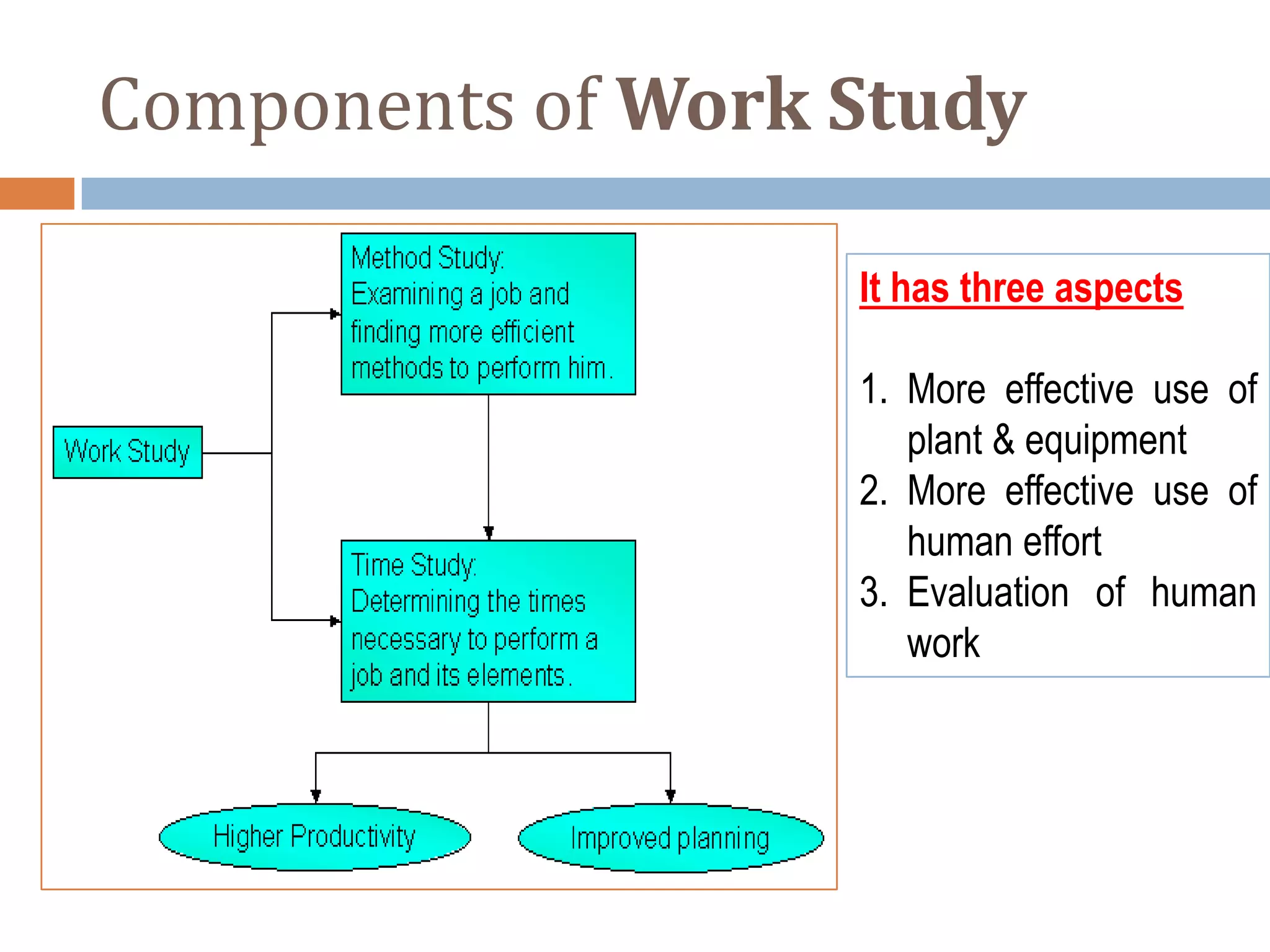
Components of WorkStudy
It has three aspects
1. More effective use of
plant & equipment
2. More effective use of
human effort
3. Evaluation of human
work
5.
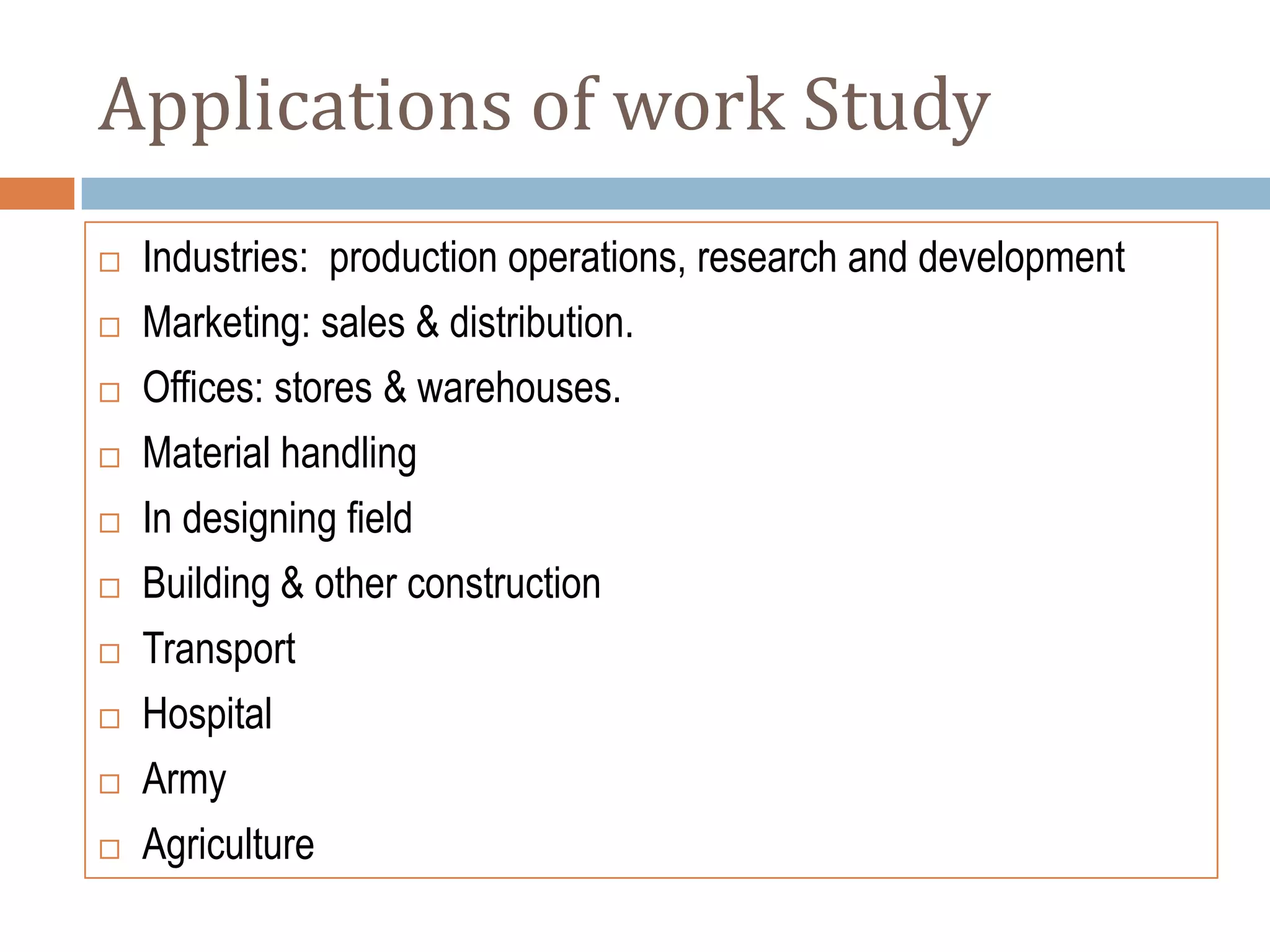
Applications of workStudy
Industries: production operations, research and development
Marketing: sales & distribution.
Offices: stores & warehouses.
Material handling
In designing field
Building & other construction
Transport
Hospital
Army
Agriculture
Method Study
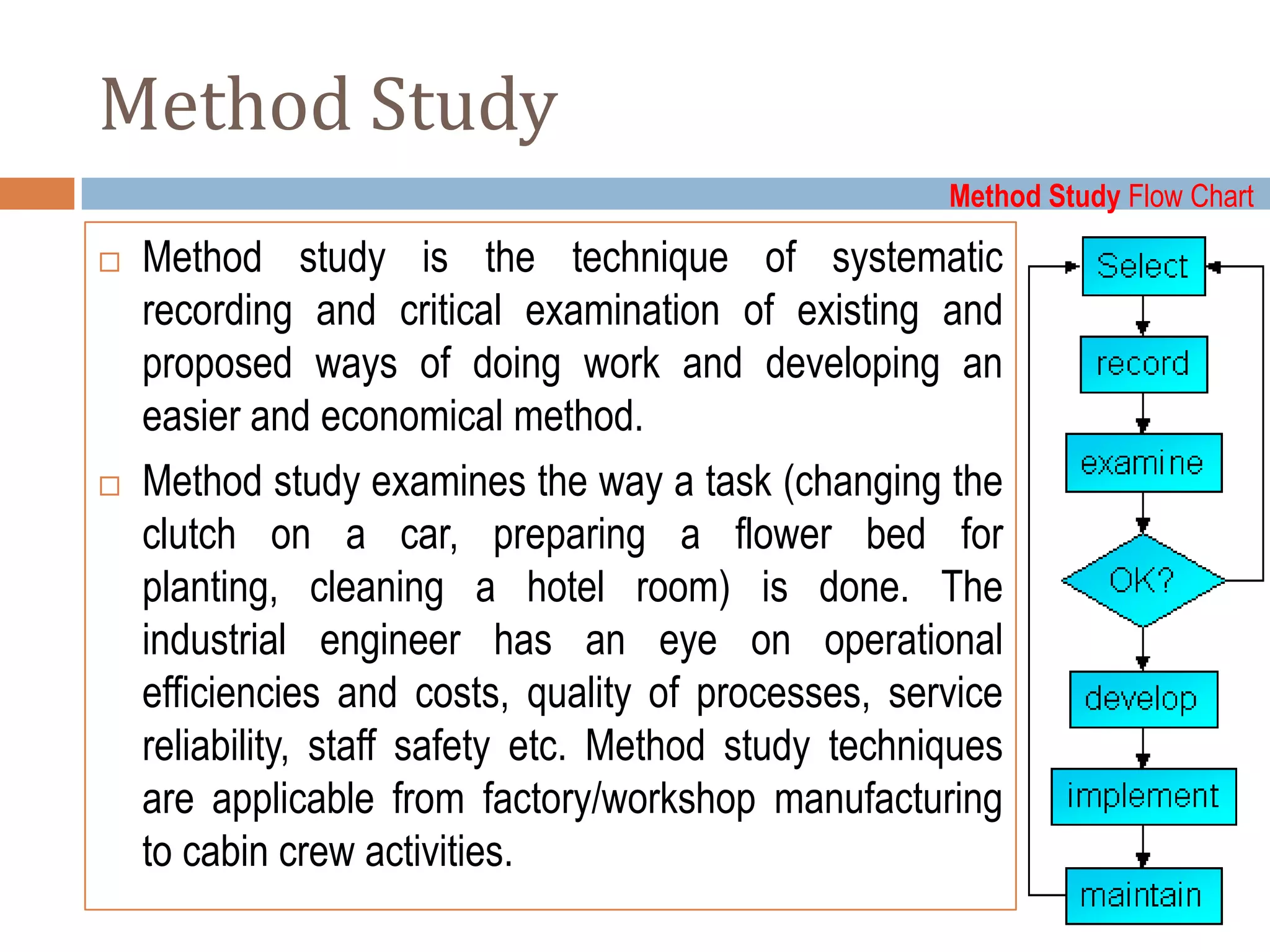
Method Study Flow Chart
Method study is the technique of systematic
recording and critical examination of existing and
proposed ways of doing work and developing an
easier and economical method.
Method study examines the way a task (changing the
clutch on a car, preparing a flower bed for
planting, cleaning a hotel room) is done. The
industrial engineer has an eye on operational
efficiencies and costs, quality of processes, service
reliability, staff safety etc. Method study techniques
are applicable from factory/workshop manufacturing
to cabin crew activities.
8.
BASIC PROCEDURE FORMETHOD
STUDY
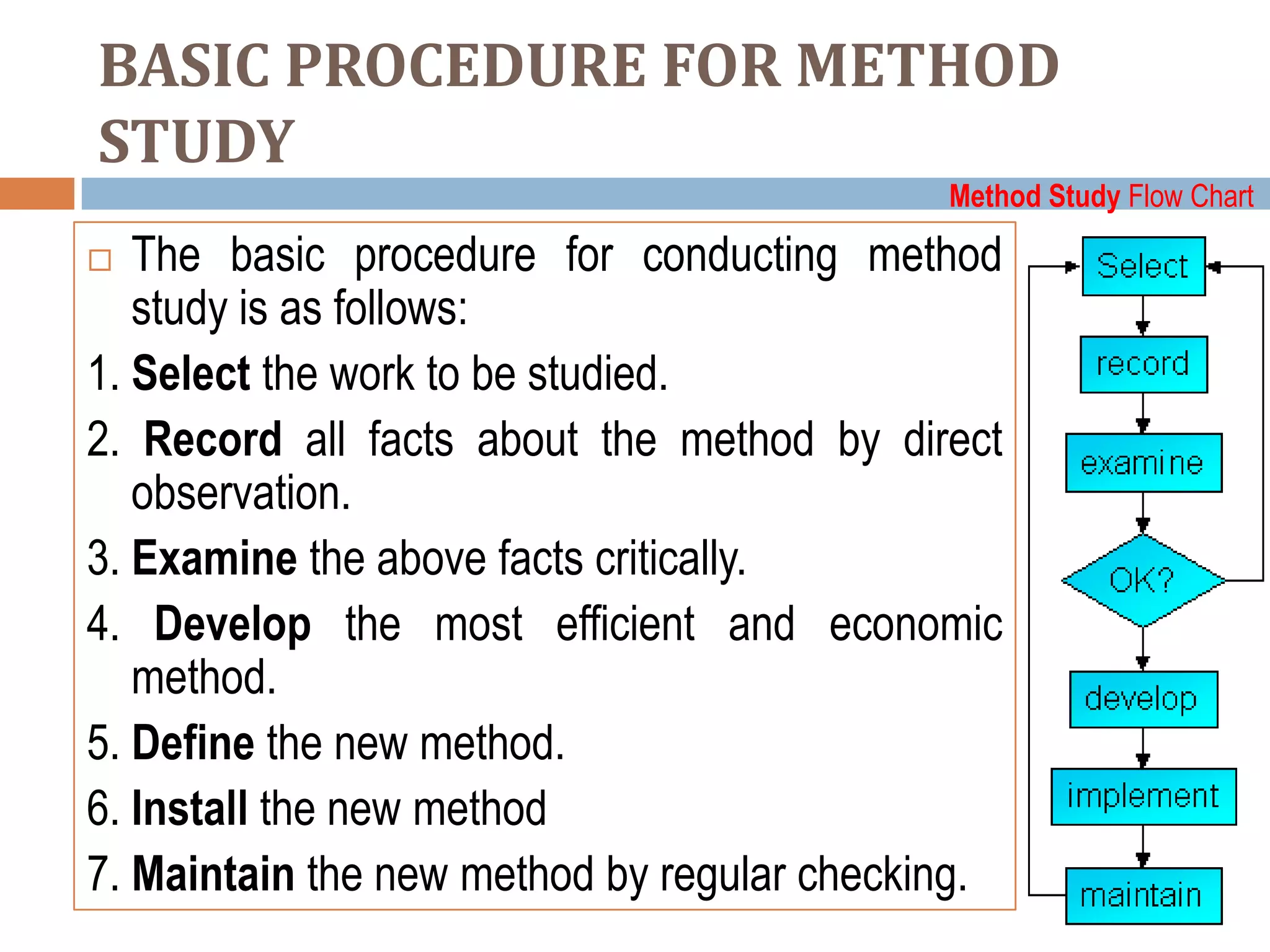
Method Study Flow Chart
The basic procedure for conducting method
study is as follows:
1. Select the work to be studied.
2. Record all facts about the method by direct
observation.
3. Examine the above facts critically.
4. Develop the most efficient and economic
method.
5. Define the new method.
6. Install the new method
7. Maintain the new method by regular checking.
9.
BASIC PROCEDURE FORMETHOD
STUDY
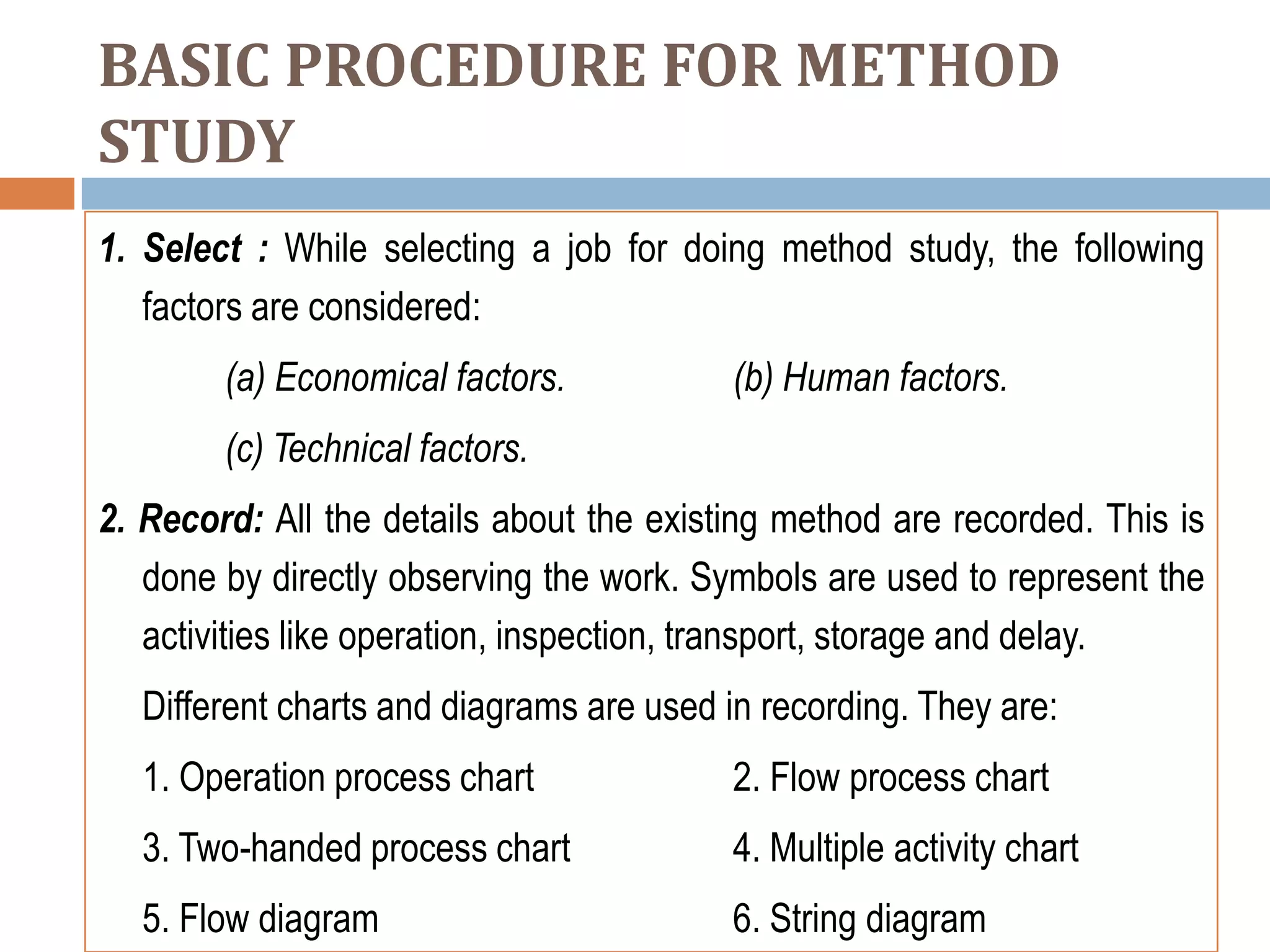
1. Select : While selecting a job for doing method study, the following
factors are considered:
(a) Economical factors. (b) Human factors.
(c) Technical factors.
2. Record: All the details about the existing method are recorded. This is
done by directly observing the work. Symbols are used to represent the
activities like operation, inspection, transport, storage and delay.
Different charts and diagrams are used in recording. They are:
1. Operation process chart 2. Flow process chart
3. Two-handed process chart 4. Multiple activity chart
5. Flow diagram 6. String diagram
10.
BASIC PROCEDURE FORMETHOD
STUDY
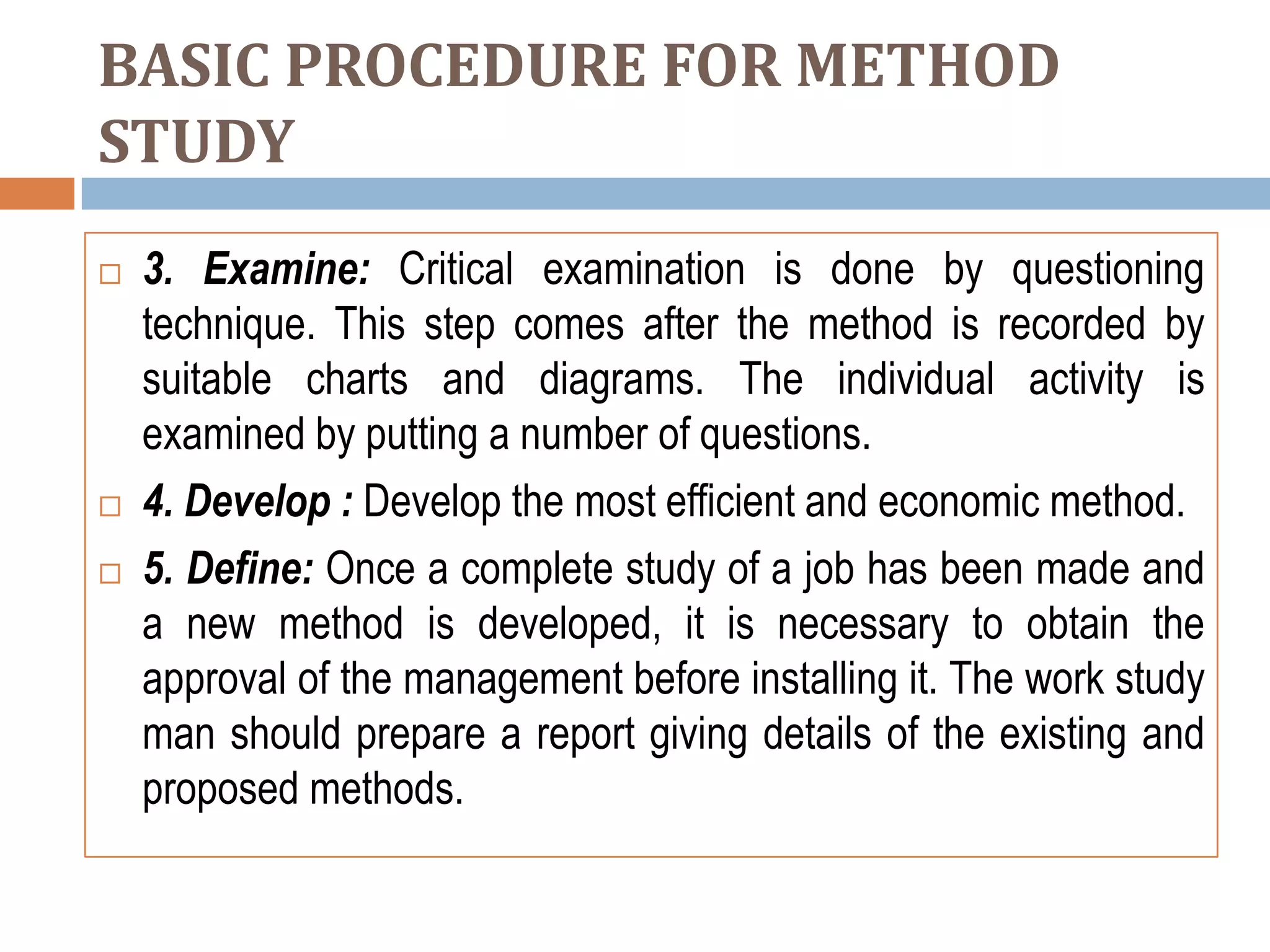
3. Examine: Critical examination is done by questioning
technique. This step comes after the method is recorded by
suitable charts and diagrams. The individual activity is
examined by putting a number of questions.
4. Develop : Develop the most efficient and economic method.
5. Define: Once a complete study of a job has been made and
a new method is developed, it is necessary to obtain the
approval of the management before installing it. The work study
man should prepare a report giving details of the existing and
proposed methods.
11.
BASIC PROCEDURE FORMETHOD
STUDY
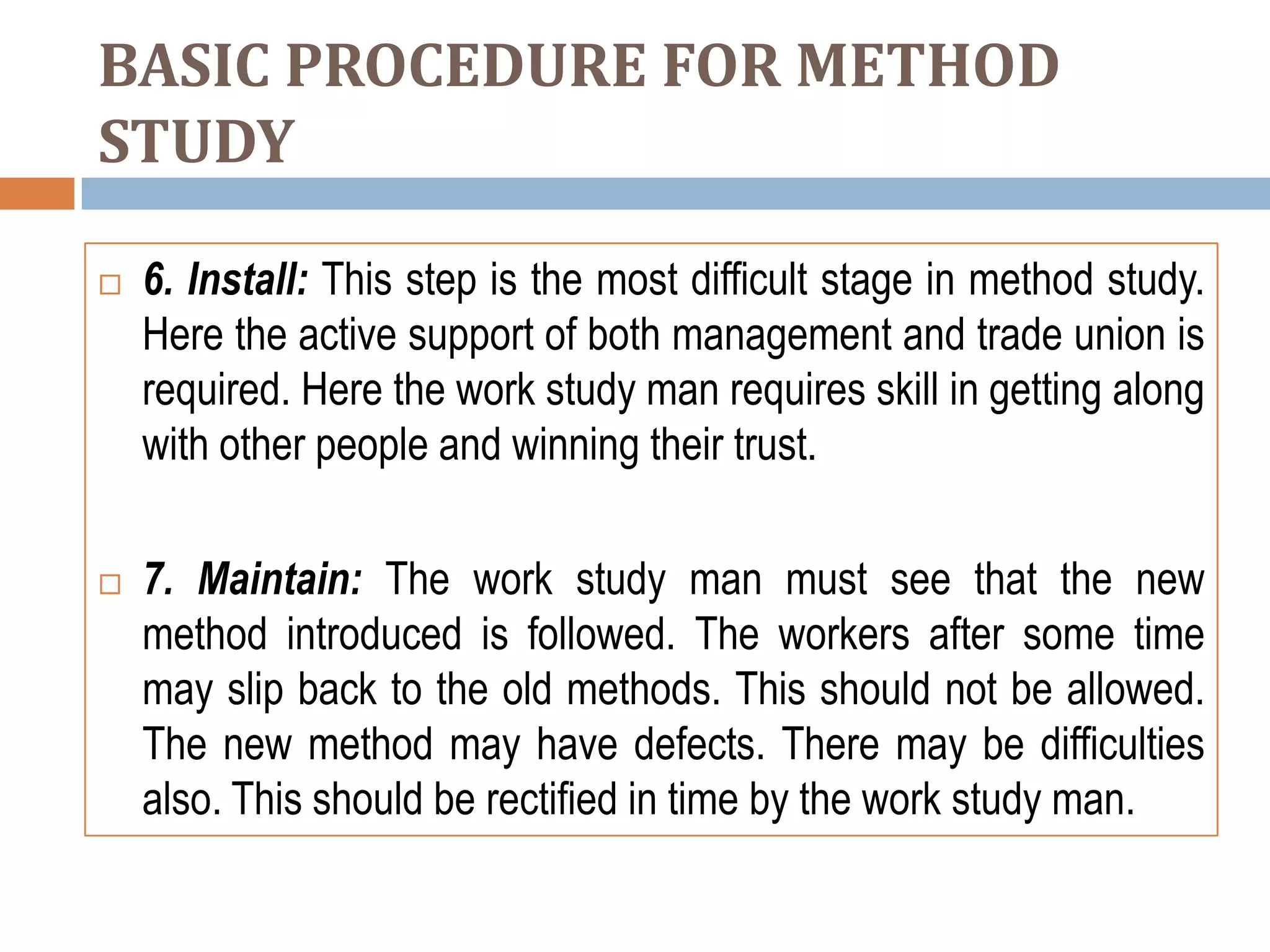
6. Install: This step is the most difficult stage in method study.
Here the active support of both management and trade union is
required. Here the work study man requires skill in getting along
with other people and winning their trust.
7. Maintain: The work study man must see that the new
method introduced is followed. The workers after some time
may slip back to the old methods. This should not be allowed.
The new method may have defects. There may be difficulties
also. This should be rectified in time by the work study man.
12.
Objectives of MethodStudy
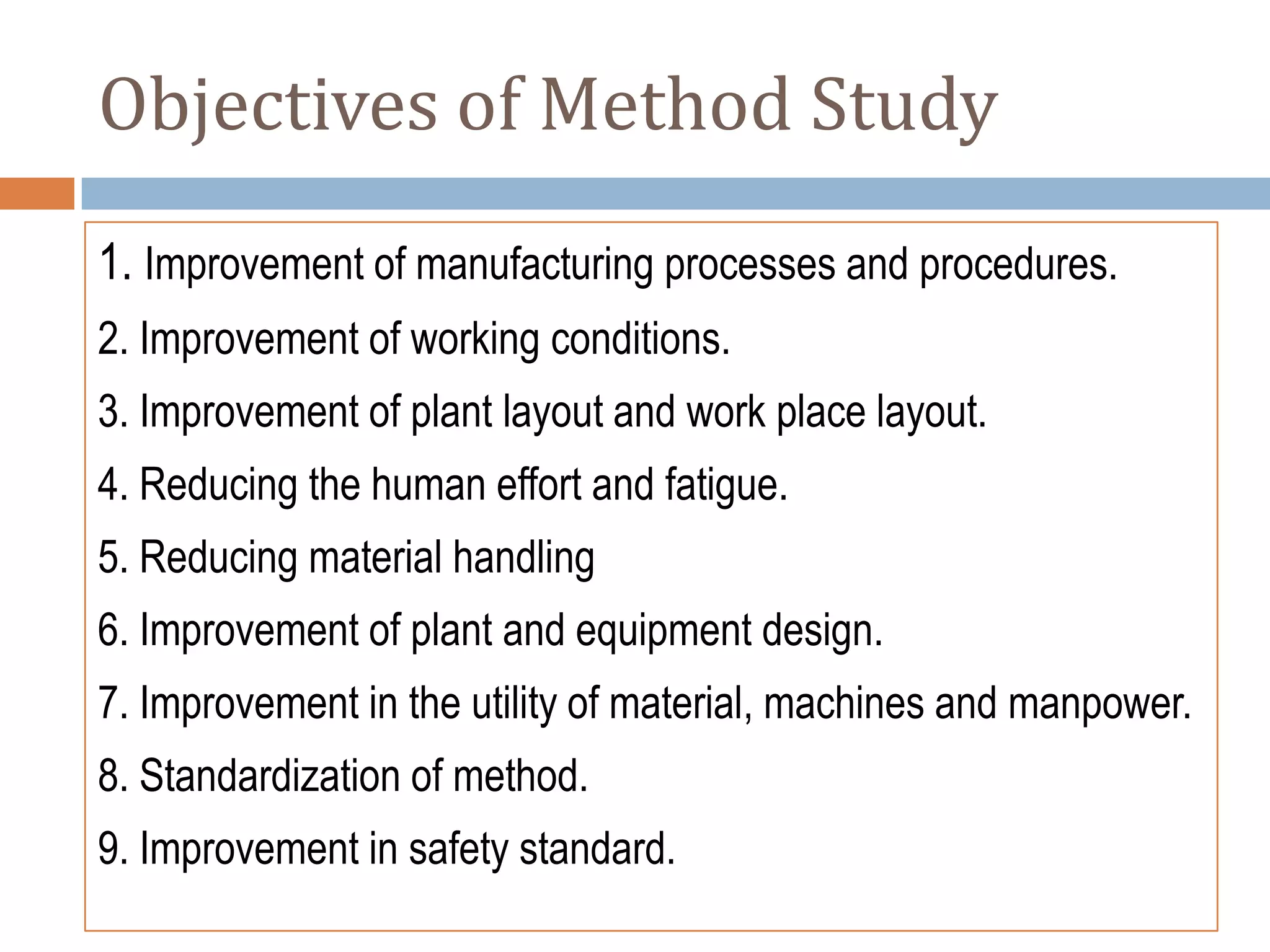
1. Improvement of manufacturing processes and procedures.
2. Improvement of working conditions.
3. Improvement of plant layout and work place layout.
4. Reducing the human effort and fatigue.
5. Reducing material handling
6. Improvement of plant and equipment design.
7. Improvement in the utility of material, machines and manpower.
8. Standardization of method.
9. Improvement in safety standard.