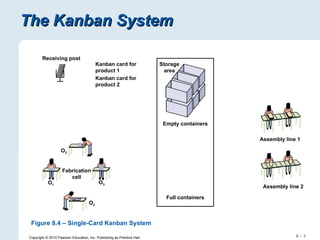
The Kanban System Copyright © 2010 Pearson Education, Inc. Publishing as Prentice Hall. Figure 8.4 – Single-Card Kanban System Receiving post Kanban card for product 1 Kanban card for product 2 Fabrication cell O 1 O 2 O 3 O 2 Storage area Empty containers Full containers Assembly line 1 Assembly line 2
The Kanban System Copyright © 2010 Pearson Education, Inc. Publishing as Prentice Hall. Storage area Empty containers Full containers Receiving post Kanban card for product 1 Kanban card for product 2 Figure 8.4 – Single-Card Kanban System Fabrication cell O 1 O 2 O 3 O 2 Assembly line 1 Assembly line 2
The Kanban System Copyright © 2010 Pearson Education, Inc. Publishing as Prentice Hall. Each container must have a card Assembly always withdraws from fabrication (pull system) Containers cannot be moved without a kanban Containers should contain the same number of parts Only good parts are passed along Production should not exceed authorization KANBAN Part Number: 1234567Z Location: Aisle 5 Bin 47 Lot Quantity: 6 Supplier: WS 83 Customer: WS 116
Number of Containers Two determinations Copyright © 2010 Pearson Education, Inc. Publishing as Prentice Hall. Number of units to be held by each container Determines lot size Number of containers  Estimate the average lead time needed to produce a container of parts Little’s law Average work-in-process inventory equals the average demand rate multiplied by the average time a unit spends in the manufacturing process
Number of Containers Copyright © 2010 Pearson Education, Inc. Publishing as Prentice Hall. WIP = (average demand rate)   (average time a container spends in the manufacturing process) + safety stock WIP =  kc kc  =  d  ( w  +  p  )(1 +  α ) k  =   d  ( w  +  p  )(1 +  α ) c where  k  = number of containers d   = expected daily demand for the part w  = average waiting time p  = average processing time c  = number of units in each container α  = policy variable
Number of Containers Formula for the number of containers Copyright © 2010 Pearson Education, Inc. Publishing as Prentice Hall. WIP = (average demand rate)(average time a container spends in the manufacturing process) + safety stock k  = Average demand during lead time + Safety stock Number of units per container
Other Kanban Signals Cards are not the only way to signal need Container system Containerless system Copyright © 2010 Pearson Education, Inc. Publishing as Prentice Hall.

Kanban

  • 1.
    The Kanban SystemCopyright © 2010 Pearson Education, Inc. Publishing as Prentice Hall. Figure 8.4 – Single-Card Kanban System Receiving post Kanban card for product 1 Kanban card for product 2 Fabrication cell O 1 O 2 O 3 O 2 Storage area Empty containers Full containers Assembly line 1 Assembly line 2
  • 2.
    The Kanban SystemCopyright © 2010 Pearson Education, Inc. Publishing as Prentice Hall. Storage area Empty containers Full containers Receiving post Kanban card for product 1 Kanban card for product 2 Figure 8.4 – Single-Card Kanban System Fabrication cell O 1 O 2 O 3 O 2 Assembly line 1 Assembly line 2
  • 3.
    The Kanban SystemCopyright © 2010 Pearson Education, Inc. Publishing as Prentice Hall. Storage area Empty containers Full containers Receiving post Kanban card for product 1 Kanban card for product 2 Figure 8.4 – Single-Card Kanban System Fabrication cell O 1 O 2 O 3 O 2 Assembly line 1 Assembly line 2
  • 4.
    The Kanban SystemCopyright © 2010 Pearson Education, Inc. Publishing as Prentice Hall. Storage area Empty containers Full containers Receiving post Kanban card for product 1 Kanban card for product 2 Figure 8.4 – Single-Card Kanban System Fabrication cell O 1 O 2 O 3 O 2 Assembly line 1 Assembly line 2
  • 5.
    The Kanban SystemCopyright © 2010 Pearson Education, Inc. Publishing as Prentice Hall. Storage area Empty containers Full containers Receiving post Kanban card for product 1 Kanban card for product 2 Figure 8.4 – Single-Card Kanban System Fabrication cell O 1 O 2 O 3 O 2 Assembly line 1 Assembly line 2
  • 6.
    The Kanban SystemCopyright © 2010 Pearson Education, Inc. Publishing as Prentice Hall. Storage area Empty containers Full containers Receiving post Kanban card for product 1 Kanban card for product 2 Figure 8.4 – Single-Card Kanban System Fabrication cell O 1 O 2 O 3 O 2 Assembly line 1 Assembly line 2
  • 7.
    The Kanban SystemCopyright © 2010 Pearson Education, Inc. Publishing as Prentice Hall. Storage area Empty containers Full containers Receiving post Kanban card for product 1 Kanban card for product 2 Figure 8.4 – Single-Card Kanban System Fabrication cell O 1 O 2 O 3 O 2 Assembly line 1 Assembly line 2
  • 8.
    The Kanban SystemCopyright © 2010 Pearson Education, Inc. Publishing as Prentice Hall. Each container must have a card Assembly always withdraws from fabrication (pull system) Containers cannot be moved without a kanban Containers should contain the same number of parts Only good parts are passed along Production should not exceed authorization KANBAN Part Number: 1234567Z Location: Aisle 5 Bin 47 Lot Quantity: 6 Supplier: WS 83 Customer: WS 116
  • 9.
    Number of ContainersTwo determinations Copyright © 2010 Pearson Education, Inc. Publishing as Prentice Hall. Number of units to be held by each container Determines lot size Number of containers Estimate the average lead time needed to produce a container of parts Little’s law Average work-in-process inventory equals the average demand rate multiplied by the average time a unit spends in the manufacturing process
  • 10.
    Number of ContainersCopyright © 2010 Pearson Education, Inc. Publishing as Prentice Hall. WIP = (average demand rate)  (average time a container spends in the manufacturing process) + safety stock WIP = kc kc = d ( w + p )(1 + α ) k = d ( w + p )(1 + α ) c where k = number of containers d = expected daily demand for the part w = average waiting time p = average processing time c = number of units in each container α = policy variable
  • 11.
    Number of ContainersFormula for the number of containers Copyright © 2010 Pearson Education, Inc. Publishing as Prentice Hall. WIP = (average demand rate)(average time a container spends in the manufacturing process) + safety stock k = Average demand during lead time + Safety stock Number of units per container
  • 12.
    Other Kanban SignalsCards are not the only way to signal need Container system Containerless system Copyright © 2010 Pearson Education, Inc. Publishing as Prentice Hall.