 ALKANES
 ALKENES
 ALCOHOLS
 CARBOXYLIC ACIDS
 MACROMOLECULES
ORGANIC CHEMISTRY
 PREPARED BY AHMED
SHAZEEL
ALKANES
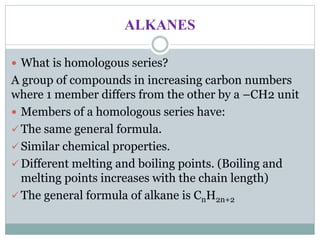
 What is homologous series?
A group of compounds in increasing carbon numbers
where 1 member differs from the other by a –CH2 unit
 Members of a homologous series have:
 The same general formula.
 Similar chemical properties.
 Different melting and boiling points. (Boiling and
melting points increases with the chain length)
 The general formula of alkane is CnH2n+2
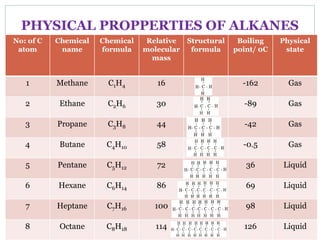
PHYSICAL PROPPERTIES OF ALKANES
No: of C
atom
Chemical
name
Chemical
formula
Relative
molecular
mass
Structural
formula
Boiling
point/ 0C
Physical
state
1 Methane C1H4 16 -162 Gas
2 Ethane C2H6 30 -89 Gas
3 Propane C3H8 44 -42 Gas
4 Butane C4H10 58 -0.5 Gas
5 Pentane C5H12 72 36 Liquid
6 Hexane C6H14 86 69 Liquid
7 Heptane C7H16 100 98 Liquid
8 Octane C8H18 114 126 Liquid
COMBUSTION & SUBSTITUTION
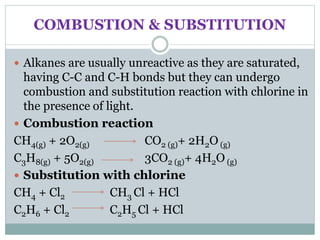
 Alkanes are usually unreactive as they are saturated,
having C-C and C-H bonds but they can undergo
combustion and substitution reaction with chlorine in
the presence of light.
 Combustion reaction
CH4(g) + 2O2(g) CO2 (g)+ 2H2O (g)
C3H8(g) + 5O2(g) 3CO2 (g)+ 4H2O (g)
 Substitution with chlorine
CH4 + Cl2 CH3 Cl + HCl
C2H6 + Cl2 C2H5 Cl + HCl
CRACKING
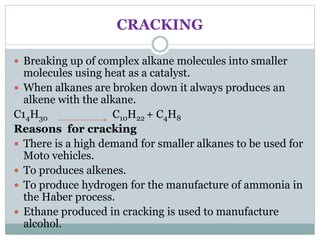
 Breaking up of complex alkane molecules into smaller
molecules using heat as a catalyst.
 When alkanes are broken down it always produces an
alkene with the alkane.
C14H30 C10H22 + C4H8
Reasons for cracking
 There is a high demand for smaller alkanes to be used for
Moto vehicles.
 To produces alkenes.
 To produce hydrogen for the manufacture of ammonia in
the Haber process.
 Ethane produced in cracking is used to manufacture
alcohol.
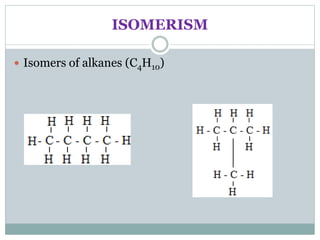
ISOMERISM
 Isomers of alkanes (C4H10)
ISOMERISM
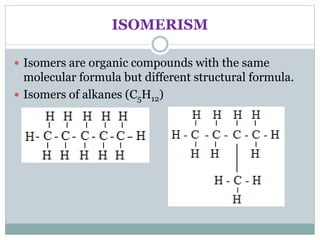
 Isomers are organic compounds with the same
molecular formula but different structural formula.
 Isomers of alkanes (C5H12)
ISOMERISM
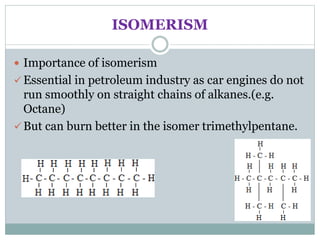
 Importance of isomerism
 Essential in petroleum industry as car engines do not
run smoothly on straight chains of alkanes.(e.g.
Octane)
 But can burn better in the isomer trimethylpentane.
ALKENES
 Group of hydrocarbons with C=C bonds.
 They form homologous series.
 Their general formula is CnH2n.
PHYSICAL PROPPERTIES OF ALKENES
No: of C
atom
Chemical
name
Chemical
formula
Relative
molecular
mass
Structural
formula
Boiling
point/ 0C
Physical
state
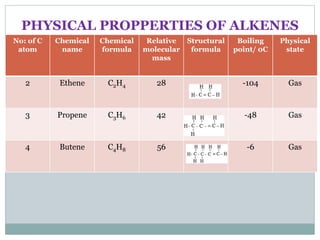
2 Ethene C2H4 28 -104 Gas
3 Propene C3H6 42 -48 Gas
4 Butene C4H8 56 -6 Gas
ISOMERISM
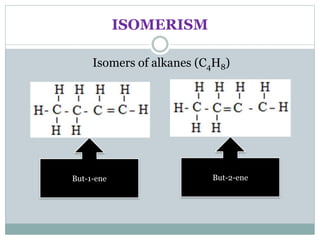
Isomers of alkanes (C4H8)
But-1-ene But-2-ene
ISOMERISM
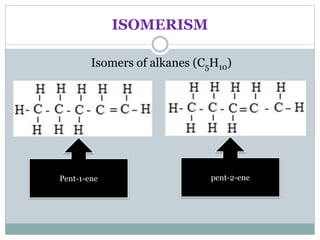
Isomers of alkanes (C5H10)
Pent-1-ene pent-2-ene
ISOMERISM
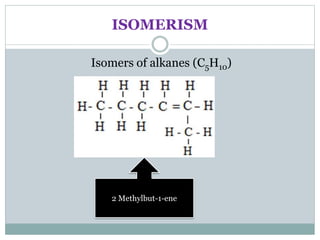
Isomers of alkanes (C5H10)
2 Methylbut-1-ene
PREPERATION OF ALKENES
Cracking
 High temperature and pressure needed to break up
the large molecules.
 Catalyst used; Alumina (Al2O3) and Silica (SiO2)
 Alkenes have C=C bonds, so they can undergo
addition reaction.
 Addition reaction is a reaction in which molecules
join together to form a single new molecular product.
ADDITION REACTIONS OF ALKANES
Addition of hydrogen
 Alkenes react with hydrogen to form alkanes. This
reaction is called hydrogenation.
 Nickel catalyst and high temperature must be used.
 Hydrogenation is used to change vegetable oil into
margarine.
ADDITION REACTIONS OF ALKANES
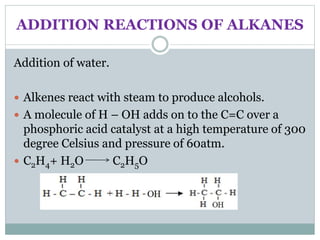
Addition of water.
 Alkenes react with steam to produce alcohols.
 A molecule of H – OH adds on to the C=C over a
phosphoric acid catalyst at a high temperature of 300
degree Celsius and pressure of 60atm.
 C2H4+ H2O C2H5O
ADDITION REACTIONS OF ALKANES
Addition of water.
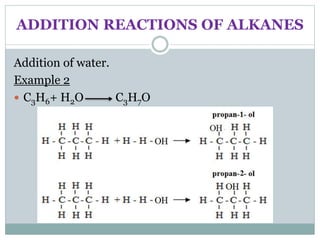
Example 2
 C3H6+ H2O C3H7O
ADDITION OF AQUEOUS BROMINE
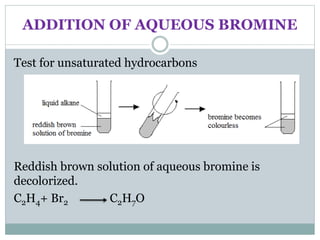
Test for unsaturated hydrocarbons
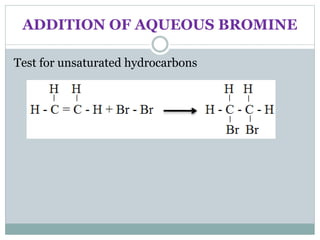
Reddish brown solution of aqueous bromine is
decolorized.
C2H4+ Br2 C2H7O
ADDITION OF AQUEOUS BROMINE
Test for unsaturated hydrocarbons
POLYMERIZATION
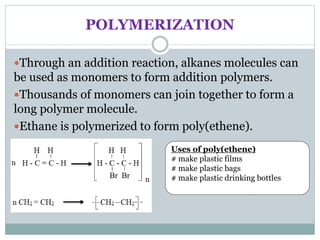
Through an addition reaction, alkanes molecules can
be used as monomers to form addition polymers.
Thousands of monomers can join together to form a
long polymer molecule.
Ethane is polymerized to form poly(ethene).
Uses of poly(ethene)
# make plastic films
# make plastic bags
# make plastic drinking bottles
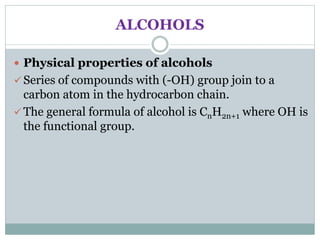
ALCOHOLS
 Physical properties of alcohols
 Series of compounds with (-OH) group join to a
carbon atom in the hydrocarbon chain.
 The general formula of alcohol is CnH2n+1 where OH is
the functional group.
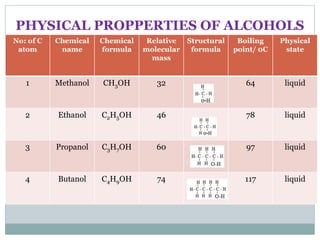
PHYSICAL PROPPERTIES OF ALCOHOLS
No: of C
atom
Chemical
name
Chemical
formula
Relative
molecular
mass
Structural
formula
Boiling
point/ 0C
Physical
state
1 Methanol CH3OH 32 64 liquid
2 Ethanol C2H5OH 46 78 liquid
3 Propanol C3H7OH 60 97 liquid
4 Butanol C4H9OH 74 117 liquid
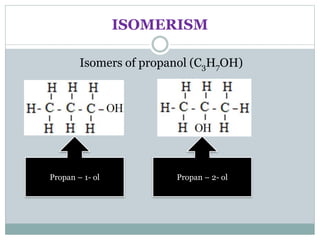
ISOMERISM
Isomers of propanol (C3H7OH)
Propan – 1- ol Propan – 2- ol
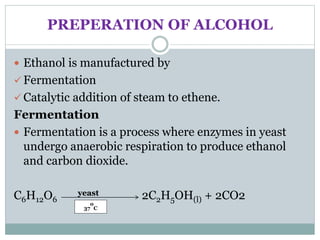
PREPERATION OF ALCOHOL
 Ethanol is manufactured by
 Fermentation
 Catalytic addition of steam to ethene.
Fermentation
 Fermentation is a process where enzymes in yeast
undergo anaerobic respiration to produce ethanol
and carbon dioxide.
C6H12O6
yeast 2C2H5OH(l) + 2CO2
37
o
C
PREPERATION OF ALCOHOL
 About a week later the fermented mixture is filtered
and the alcohol is extracted by fractional
distillation.
 The fermentation should be carried out in
anaerobic condition where there are no oxygen
available.
 This is to prevent from oxidation of alcohols to
(carboxylic/ethanoic) acid.
PREPERATION OF ALCOHOL
Addition of steam to ethane
 This is done in the presence of phosphoric acid
catalyst at 300 o
C and 60atm.
C2H4(g) + H2O(g) 2C2H5OH(l)
REACTION OF ALCOHOLS
 There are three importance of alcohols
 Combustion, Oxidation and esterification
Combustion
 Alcohols can undergo combustion reactions with
oxygen like alkanes and alkenes.
 Complete combustion produces carbon dioxide and
water
 Incomplete combustion produces carbon monoxide
and carbon soot.
C2H5OH(l) +3O2(g) CO2(g)+ H2O(g)
REACTION OF ALCOHOLS
Oxidation
 Alcohols can undergo oxidation to form carboxylic
acids.
 In this reaction alcohol will lose two hydrogen atoms and
gain 1 oxygen atom.
C2H5OH(l) + 2[O] (g) CH3COOH(l) + H2O(l)
REACTION OF ALCOHOLS
In this oxidation process we can use either:
 Amphoteric oxygen
 Acidified potassium dichromate (VI), which change from
orange to green.
 Purple acidified potassium manganate (VII), which is
decolorized.
Uses of Alcohols
 As constituents of alcoholic beverages.
 As solvents for medicines perfumes and detergents.
 As a fuel.
CARBOXYLIC ACID
 The general formula of carboxylic acid is CnH2n+1 COOH
(where n starts from 0 for the first compound in the
homologous series)
 The functional group is the carboxyl group –COOH.
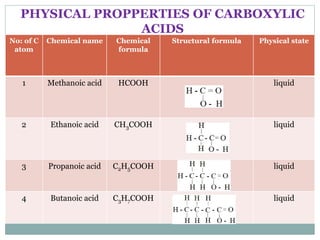
PHYSICAL PROPPERTIES OF CARBOXYLIC
ACIDS
No: of C
atom
Chemical name Chemical
formula
Structural formula Physical state
1 Methanoic acid HCOOH liquid
2 Ethanoic acid CH3COOH liquid
3 Propanoic acid C2H5COOH liquid
4 Butanoic acid C3H7COOH liquid
FORMATION OF CARBOXYLIC ACIDS
 Formation of ethanoic acid by oxidation of ethanol.
1. Using atmospheric oxygen.
C2H5OH(l) +O2(g) CH3COOH(l) + H2O(l)
2. Using acidified potassium dichromate.
C2H5OH(l) +2[O] (g) CH3COOH(l) + H2O(l)
 The orange potassium dichromate (VI) solution changes to
green.
REACTIONS OF ETHANOIC ACID
 There are two important acid reactions in this homologous
series. They are:
1. Acid reactions
2. Esterification
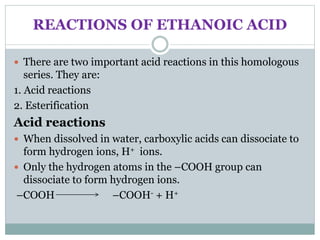
Acid reactions
 When dissolved in water, carboxylic acids can dissociate to
form hydrogen ions, H+ ions.
 Only the hydrogen atoms in the –COOH group can
dissociate to form hydrogen ions.
–COOH –COOH- + H+
REACTIONS OF ETHANOIC ACID
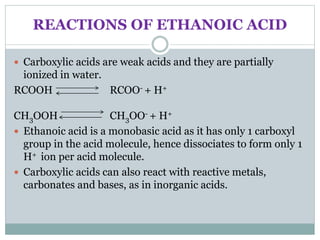
 Carboxylic acids are weak acids and they are partially
ionized in water.
RCOOH RCOO- + H+
CH3OOH CH3OO- + H+
 Ethanoic acid is a monobasic acid as it has only 1 carboxyl
group in the acid molecule, hence dissociates to form only 1
H+ ion per acid molecule.
 Carboxylic acids can also react with reactive metals,
carbonates and bases, as in inorganic acids.
REACTIONS OF ETHANOIC ACID
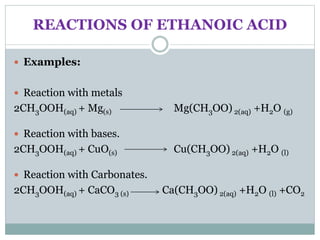
 Examples:
 Reaction with metals
2CH3OOH(aq) + Mg(s) Mg(CH3OO) 2(aq) +H2O (g)
 Reaction with bases.
2CH3OOH(aq) + CuO(s) Cu(CH3OO) 2(aq) +H2O (l)
 Reaction with Carbonates.
2CH3OOH(aq) + CaCO3 (s) Ca(CH3OO) 2(aq) +H2O (l) +CO2
ESTERIFICATION
 Alcohols and carboxylic acids react in the presence of
concentrated sulphuric acid to form esters.
 Example
 Ethanoic acid + ethanol ethyl ethanoate + water
2CH3OOH(aq) + C2H5 OH (l) CH3COOC2H5 +H2O (l)
MACROMOLECULES
 Macromolecules are giant molecules formed from
thousands of small monomers (sub units).
 The process of joining together small identical
units into a large macromolecule (polymer) is called
polymerization.
Types of polymers
 Synthetic polymers
 Natural macromolecules.
MACROMOLECULES
Synthetic polymers
 Synthetic polymers are man made that are formed
by:
1. Addition polymerization.
2. Condensation polymerization
 Polymers that are formed by addition
polymerization are called addition polymers and
those formed by condensation are called
condensation polymers.
MACROMOLECULES
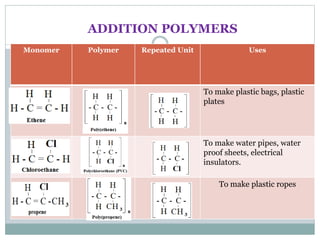
Addition polymers
Addition polymers are made from unsaturated
monomers through an addition reaction. You will see
some examples of addition polymers in the next slide
shows.
ADDITION POLYMERS
Monomer Polymer Repeated Unit Uses
To make plastic bags, plastic
plates
To make water pipes, water
proof sheets, electrical
insulators.
To make plastic ropes
MACROMOLECULES
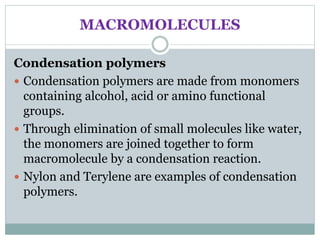
Condensation polymers
 Condensation polymers are made from monomers
containing alcohol, acid or amino functional
groups.
 Through elimination of small molecules like water,
the monomers are joined together to form
macromolecule by a condensation reaction.
 Nylon and Terylene are examples of condensation
polymers.
MACROMOLECULES
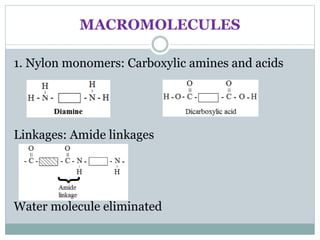
1. Nylon monomers: Carboxylic amines and acids
Linkages: Amide linkages
Water molecule eliminated
MACROMOLECULES
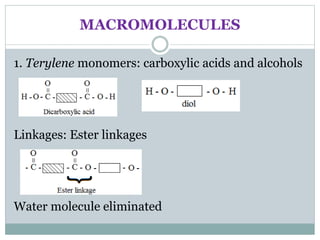
1. Terylene monomers: carboxylic acids and alcohols
Linkages: Ester linkages
Water molecule eliminated
MACROMOLECULES
Uses of nylon and terylene
 Both are made into synthetic fibres
 Nylon – used to make ropes, fishing lines and
cloths for making raincoats and parachutes.
 Terylene fibres are used to make cloths
Disadvantages of plastics
 Non – biodegradable cannot be decomposed by
bacteria so pollute the environment.
 Carbon based polymer which releases toxic fumes
in burning.
Doubt clarification
Do you have any question?
Yes
No
But I do have some
questions to ask you. Please
get ready to answer.
Challenging multiple choice
questions
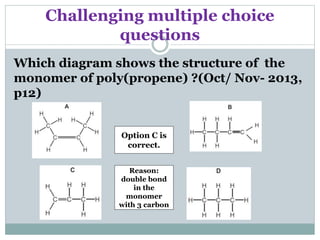
Which diagram shows the structure of the
monomer of poly(propene) ?(Oct/ Nov- 2013,
p12)
Option C is
correct.
Reason:
double bond
in the
monomer
with 3 carbon
Doubt clarification
The solubility of the carboxylic acids in water
decreases as the size of the carboxylic acid molecules
increases.
Which carboxylic acid is the least soluble in water?
A butanoic acid
B ethanoic acid
C methanoic acid
D propanoic acid
Option A
Reason: butanoic acid
Has more carbon atoms
than other three acids
Doubt clarification
Poly(ethene) is the addition polymer formed from
the monomer ethene.
Which statement is correct?
A Poly(ethene) can be disposed of by burning – this
produces carbon dioxide and water.
B Poly(ethene) decolourises bromine water.
C Poly(ethene) has the empirical formula C2H4.
D Poly(ethene) is acted upon by bacteria so that it
decomposes quickly when in a landfill site.
Option A
Reason: Combustion of
any hydro carbon releases
carbon dioxide and water
Challenging multiple choice
questions
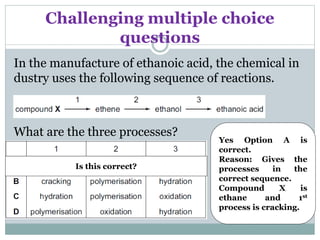
In the manufacture of ethanoic acid, the chemical in
dustry uses the following sequence of reactions.
What are the three processes?
Yes Option A is
correct.
Reason: Gives the
processes in the
correct sequence.
Compound X is
ethane and 1st
process is cracking.
Is this correct?
Challenging multiple choice
questions
Option C is correct.
Burning of any hydrocarbon gives out carbon
dioxide and water vapour
Is this correct?
Challenging multiple choice
questions
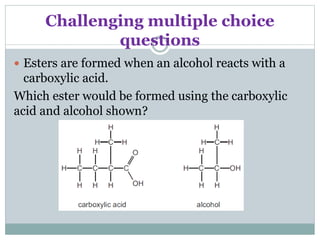
 Esters are formed when an alcohol reacts with a
carboxylic acid.
Which ester would be formed using the carboxylic
acid and alcohol shown?
Challenging multiple choice
questions
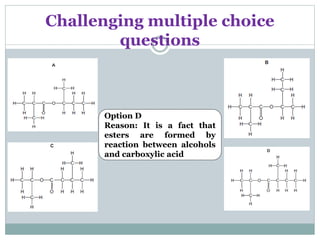
Option D
Reason: It is a fact that
esters are formed by
reaction between alcohols
and carboxylic acid
Challenging structured questions
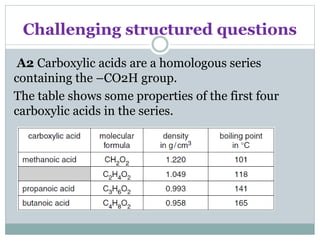
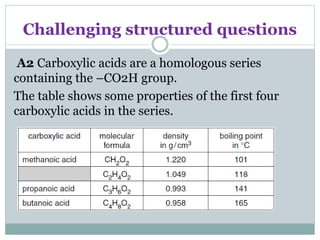
A2 Carboxylic acids are a homologous series
containing the –CO2H group.
The table shows some properties of the first four
carboxylic acids in the series.
Challenging structured questions
(a) (i) Describe how the density of these carboxylic
acids varies with the number of
carbon atoms in the molecule.
....................................................................................[1]
(ii) Name the carboxylic acid with the molecular
formula C2H4O2.
................................................................................... [1]
(iii) Draw the structure of propanoic acid, showing
all atoms and bonds. [1]
Challenging structured questions
(b) The next carboxylic acid in this homologous series is pentanoic
acid.
Pentanoic acid has five carbon atoms.
(i) Deduce the molecular formula for pentanoic acid.
................................................................................... [1]
(ii) Suggest a value for the boiling point of pentanoic acid.
.............................................°C [1]
(c) Butanoic acid, C3H7CO2H, reacts with sodium to form a salt
and a gas.
(i) Name the gas.
........................................................................................................... [1]
(ii) Give the formula of the salt.
............................................................................................................[1]
Challenging structured questions
(d) Esters are formed when carboxylic acids react with
alcohols.
The reaction is catalysed by hydrogen ions.
(i) Describe and explain the effect of a catalyst on
reaction rate.
..............................................................................................
..............................................................................................
......................................................................................... [2]
(ii) State one commercial use of esters.
......................................................................................... [1]
Challenging structured questions
(iii) The structure of an ester is shown below.
Name this ester.
................................................................................... [1]
Challenging structured questions
A2 Carboxylic acids are a homologous series
containing the –CO2H group.
The table shows some properties of the first four
carboxylic acids in the series.
Challenging structured questions
(a) (i) Describe how the density of these carboxylic acids
varies with the number of
carbon atoms in the molecule.
decreases as number of carbon atoms increases / increases as
number of carbon atoms decreases [1]
(ii) Name the carboxylic acid with the molecular formula
C2H4O2. [1]
Ethanoic acid
(iii) Draw the structure of propanoic acid, showing all atoms
and bonds. [1]
Challenging structured questions
(b) The next carboxylic acid in this homologous series is
pentanoic acid. Pentanoic acid has five carbon atoms.
(i) Deduce the molecular formula for pentanoic acid.
[1]
(ii) Suggest a value for the boiling point of pentanoic acid.
180 - 190°C [1]
(c) Butanoic acid, C3H7CO2H, reacts with sodium to form a
salt and a gas.
(i) Name the gas.
Hydrogen [1]
(ii) Give the formula of the salt.
C3H7CO2Na/ C4H7O2Na [1]
Challenging structured questions
(d) Esters are formed when carboxylic acids react
with alcohols.
The reaction is catalysed by hydrogen ions.
(i) Describe and explain the effect of a catalyst on
reaction rate.
speeds up reaction (rate) / reaction faster/ lowers
activation energy/ [2]
(ii) State one commercial use of esters.
solvent / fragrance / perfume / food additive /
flavourings / polyesters / terylene [1]
Challenging structured questions
(iii) The structure of an ester is shown below.
Name this ester.
propyl methanoate [1]

Organic chemistry

  • 1.
     ALKANES  ALKENES ALCOHOLS  CARBOXYLIC ACIDS  MACROMOLECULES ORGANIC CHEMISTRY  PREPARED BY AHMED SHAZEEL
  • 2.
    ALKANES  What ishomologous series? A group of compounds in increasing carbon numbers where 1 member differs from the other by a –CH2 unit  Members of a homologous series have:  The same general formula.  Similar chemical properties.  Different melting and boiling points. (Boiling and melting points increases with the chain length)  The general formula of alkane is CnH2n+2
  • 3.
    PHYSICAL PROPPERTIES OFALKANES No: of C atom Chemical name Chemical formula Relative molecular mass Structural formula Boiling point/ 0C Physical state 1 Methane C1H4 16 -162 Gas 2 Ethane C2H6 30 -89 Gas 3 Propane C3H8 44 -42 Gas 4 Butane C4H10 58 -0.5 Gas 5 Pentane C5H12 72 36 Liquid 6 Hexane C6H14 86 69 Liquid 7 Heptane C7H16 100 98 Liquid 8 Octane C8H18 114 126 Liquid
  • 4.
    COMBUSTION & SUBSTITUTION Alkanes are usually unreactive as they are saturated, having C-C and C-H bonds but they can undergo combustion and substitution reaction with chlorine in the presence of light.  Combustion reaction CH4(g) + 2O2(g) CO2 (g)+ 2H2O (g) C3H8(g) + 5O2(g) 3CO2 (g)+ 4H2O (g)  Substitution with chlorine CH4 + Cl2 CH3 Cl + HCl C2H6 + Cl2 C2H5 Cl + HCl
  • 5.
    CRACKING  Breaking upof complex alkane molecules into smaller molecules using heat as a catalyst.  When alkanes are broken down it always produces an alkene with the alkane. C14H30 C10H22 + C4H8 Reasons for cracking  There is a high demand for smaller alkanes to be used for Moto vehicles.  To produces alkenes.  To produce hydrogen for the manufacture of ammonia in the Haber process.  Ethane produced in cracking is used to manufacture alcohol.
  • 6.
    ISOMERISM  Isomers ofalkanes (C4H10)
  • 7.
    ISOMERISM  Isomers areorganic compounds with the same molecular formula but different structural formula.  Isomers of alkanes (C5H12)
  • 8.
    ISOMERISM  Importance ofisomerism  Essential in petroleum industry as car engines do not run smoothly on straight chains of alkanes.(e.g. Octane)  But can burn better in the isomer trimethylpentane.
  • 9.
    ALKENES  Group ofhydrocarbons with C=C bonds.  They form homologous series.  Their general formula is CnH2n.
  • 10.
    PHYSICAL PROPPERTIES OFALKENES No: of C atom Chemical name Chemical formula Relative molecular mass Structural formula Boiling point/ 0C Physical state 2 Ethene C2H4 28 -104 Gas 3 Propene C3H6 42 -48 Gas 4 Butene C4H8 56 -6 Gas
  • 11.
    ISOMERISM Isomers of alkanes(C4H8) But-1-ene But-2-ene
  • 12.
    ISOMERISM Isomers of alkanes(C5H10) Pent-1-ene pent-2-ene
  • 13.
    ISOMERISM Isomers of alkanes(C5H10) 2 Methylbut-1-ene
  • 14.
    PREPERATION OF ALKENES Cracking High temperature and pressure needed to break up the large molecules.  Catalyst used; Alumina (Al2O3) and Silica (SiO2)  Alkenes have C=C bonds, so they can undergo addition reaction.  Addition reaction is a reaction in which molecules join together to form a single new molecular product.
  • 15.
    ADDITION REACTIONS OFALKANES Addition of hydrogen  Alkenes react with hydrogen to form alkanes. This reaction is called hydrogenation.  Nickel catalyst and high temperature must be used.  Hydrogenation is used to change vegetable oil into margarine.
  • 16.
    ADDITION REACTIONS OFALKANES Addition of water.  Alkenes react with steam to produce alcohols.  A molecule of H – OH adds on to the C=C over a phosphoric acid catalyst at a high temperature of 300 degree Celsius and pressure of 60atm.  C2H4+ H2O C2H5O
  • 17.
    ADDITION REACTIONS OFALKANES Addition of water. Example 2  C3H6+ H2O C3H7O
  • 18.
    ADDITION OF AQUEOUSBROMINE Test for unsaturated hydrocarbons Reddish brown solution of aqueous bromine is decolorized. C2H4+ Br2 C2H7O
  • 19.
    ADDITION OF AQUEOUSBROMINE Test for unsaturated hydrocarbons
  • 20.
    POLYMERIZATION Through an additionreaction, alkanes molecules can be used as monomers to form addition polymers. Thousands of monomers can join together to form a long polymer molecule. Ethane is polymerized to form poly(ethene). Uses of poly(ethene) # make plastic films # make plastic bags # make plastic drinking bottles
  • 21.
    ALCOHOLS  Physical propertiesof alcohols  Series of compounds with (-OH) group join to a carbon atom in the hydrocarbon chain.  The general formula of alcohol is CnH2n+1 where OH is the functional group.
  • 22.
    PHYSICAL PROPPERTIES OFALCOHOLS No: of C atom Chemical name Chemical formula Relative molecular mass Structural formula Boiling point/ 0C Physical state 1 Methanol CH3OH 32 64 liquid 2 Ethanol C2H5OH 46 78 liquid 3 Propanol C3H7OH 60 97 liquid 4 Butanol C4H9OH 74 117 liquid
  • 23.
    ISOMERISM Isomers of propanol(C3H7OH) Propan – 1- ol Propan – 2- ol
  • 24.
    PREPERATION OF ALCOHOL Ethanol is manufactured by  Fermentation  Catalytic addition of steam to ethene. Fermentation  Fermentation is a process where enzymes in yeast undergo anaerobic respiration to produce ethanol and carbon dioxide. C6H12O6 yeast 2C2H5OH(l) + 2CO2 37 o C
  • 25.
    PREPERATION OF ALCOHOL About a week later the fermented mixture is filtered and the alcohol is extracted by fractional distillation.  The fermentation should be carried out in anaerobic condition where there are no oxygen available.  This is to prevent from oxidation of alcohols to (carboxylic/ethanoic) acid.
  • 26.
    PREPERATION OF ALCOHOL Additionof steam to ethane  This is done in the presence of phosphoric acid catalyst at 300 o C and 60atm. C2H4(g) + H2O(g) 2C2H5OH(l)
  • 27.
    REACTION OF ALCOHOLS There are three importance of alcohols  Combustion, Oxidation and esterification Combustion  Alcohols can undergo combustion reactions with oxygen like alkanes and alkenes.  Complete combustion produces carbon dioxide and water  Incomplete combustion produces carbon monoxide and carbon soot. C2H5OH(l) +3O2(g) CO2(g)+ H2O(g)
  • 28.
    REACTION OF ALCOHOLS Oxidation Alcohols can undergo oxidation to form carboxylic acids.  In this reaction alcohol will lose two hydrogen atoms and gain 1 oxygen atom. C2H5OH(l) + 2[O] (g) CH3COOH(l) + H2O(l)
  • 29.
    REACTION OF ALCOHOLS Inthis oxidation process we can use either:  Amphoteric oxygen  Acidified potassium dichromate (VI), which change from orange to green.  Purple acidified potassium manganate (VII), which is decolorized. Uses of Alcohols  As constituents of alcoholic beverages.  As solvents for medicines perfumes and detergents.  As a fuel.
  • 30.
    CARBOXYLIC ACID  Thegeneral formula of carboxylic acid is CnH2n+1 COOH (where n starts from 0 for the first compound in the homologous series)  The functional group is the carboxyl group –COOH.
  • 31.
    PHYSICAL PROPPERTIES OFCARBOXYLIC ACIDS No: of C atom Chemical name Chemical formula Structural formula Physical state 1 Methanoic acid HCOOH liquid 2 Ethanoic acid CH3COOH liquid 3 Propanoic acid C2H5COOH liquid 4 Butanoic acid C3H7COOH liquid
  • 32.
    FORMATION OF CARBOXYLICACIDS  Formation of ethanoic acid by oxidation of ethanol. 1. Using atmospheric oxygen. C2H5OH(l) +O2(g) CH3COOH(l) + H2O(l) 2. Using acidified potassium dichromate. C2H5OH(l) +2[O] (g) CH3COOH(l) + H2O(l)  The orange potassium dichromate (VI) solution changes to green.
  • 33.
    REACTIONS OF ETHANOICACID  There are two important acid reactions in this homologous series. They are: 1. Acid reactions 2. Esterification Acid reactions  When dissolved in water, carboxylic acids can dissociate to form hydrogen ions, H+ ions.  Only the hydrogen atoms in the –COOH group can dissociate to form hydrogen ions. –COOH –COOH- + H+
  • 34.
    REACTIONS OF ETHANOICACID  Carboxylic acids are weak acids and they are partially ionized in water. RCOOH RCOO- + H+ CH3OOH CH3OO- + H+  Ethanoic acid is a monobasic acid as it has only 1 carboxyl group in the acid molecule, hence dissociates to form only 1 H+ ion per acid molecule.  Carboxylic acids can also react with reactive metals, carbonates and bases, as in inorganic acids.
  • 35.
    REACTIONS OF ETHANOICACID  Examples:  Reaction with metals 2CH3OOH(aq) + Mg(s) Mg(CH3OO) 2(aq) +H2O (g)  Reaction with bases. 2CH3OOH(aq) + CuO(s) Cu(CH3OO) 2(aq) +H2O (l)  Reaction with Carbonates. 2CH3OOH(aq) + CaCO3 (s) Ca(CH3OO) 2(aq) +H2O (l) +CO2
  • 36.
    ESTERIFICATION  Alcohols andcarboxylic acids react in the presence of concentrated sulphuric acid to form esters.  Example  Ethanoic acid + ethanol ethyl ethanoate + water 2CH3OOH(aq) + C2H5 OH (l) CH3COOC2H5 +H2O (l)
  • 37.
    MACROMOLECULES  Macromolecules aregiant molecules formed from thousands of small monomers (sub units).  The process of joining together small identical units into a large macromolecule (polymer) is called polymerization. Types of polymers  Synthetic polymers  Natural macromolecules.
  • 38.
    MACROMOLECULES Synthetic polymers  Syntheticpolymers are man made that are formed by: 1. Addition polymerization. 2. Condensation polymerization  Polymers that are formed by addition polymerization are called addition polymers and those formed by condensation are called condensation polymers.
  • 39.
    MACROMOLECULES Addition polymers Addition polymersare made from unsaturated monomers through an addition reaction. You will see some examples of addition polymers in the next slide shows.
  • 40.
    ADDITION POLYMERS Monomer PolymerRepeated Unit Uses To make plastic bags, plastic plates To make water pipes, water proof sheets, electrical insulators. To make plastic ropes
  • 41.
    MACROMOLECULES Condensation polymers  Condensationpolymers are made from monomers containing alcohol, acid or amino functional groups.  Through elimination of small molecules like water, the monomers are joined together to form macromolecule by a condensation reaction.  Nylon and Terylene are examples of condensation polymers.
  • 42.
    MACROMOLECULES 1. Nylon monomers:Carboxylic amines and acids Linkages: Amide linkages Water molecule eliminated
  • 43.
    MACROMOLECULES 1. Terylene monomers:carboxylic acids and alcohols Linkages: Ester linkages Water molecule eliminated
  • 44.
    MACROMOLECULES Uses of nylonand terylene  Both are made into synthetic fibres  Nylon – used to make ropes, fishing lines and cloths for making raincoats and parachutes.  Terylene fibres are used to make cloths Disadvantages of plastics  Non – biodegradable cannot be decomposed by bacteria so pollute the environment.  Carbon based polymer which releases toxic fumes in burning.
  • 45.
    Doubt clarification Do youhave any question? Yes No But I do have some questions to ask you. Please get ready to answer.
  • 46.
    Challenging multiple choice questions Whichdiagram shows the structure of the monomer of poly(propene) ?(Oct/ Nov- 2013, p12) Option C is correct. Reason: double bond in the monomer with 3 carbon
  • 47.
    Doubt clarification The solubilityof the carboxylic acids in water decreases as the size of the carboxylic acid molecules increases. Which carboxylic acid is the least soluble in water? A butanoic acid B ethanoic acid C methanoic acid D propanoic acid Option A Reason: butanoic acid Has more carbon atoms than other three acids
  • 48.
    Doubt clarification Poly(ethene) isthe addition polymer formed from the monomer ethene. Which statement is correct? A Poly(ethene) can be disposed of by burning – this produces carbon dioxide and water. B Poly(ethene) decolourises bromine water. C Poly(ethene) has the empirical formula C2H4. D Poly(ethene) is acted upon by bacteria so that it decomposes quickly when in a landfill site. Option A Reason: Combustion of any hydro carbon releases carbon dioxide and water
  • 49.
    Challenging multiple choice questions Inthe manufacture of ethanoic acid, the chemical in dustry uses the following sequence of reactions. What are the three processes? Yes Option A is correct. Reason: Gives the processes in the correct sequence. Compound X is ethane and 1st process is cracking. Is this correct?
  • 50.
    Challenging multiple choice questions OptionC is correct. Burning of any hydrocarbon gives out carbon dioxide and water vapour Is this correct?
  • 51.
    Challenging multiple choice questions Esters are formed when an alcohol reacts with a carboxylic acid. Which ester would be formed using the carboxylic acid and alcohol shown?
  • 52.
    Challenging multiple choice questions OptionD Reason: It is a fact that esters are formed by reaction between alcohols and carboxylic acid
  • 53.
    Challenging structured questions A2Carboxylic acids are a homologous series containing the –CO2H group. The table shows some properties of the first four carboxylic acids in the series.
  • 54.
    Challenging structured questions (a)(i) Describe how the density of these carboxylic acids varies with the number of carbon atoms in the molecule. ....................................................................................[1] (ii) Name the carboxylic acid with the molecular formula C2H4O2. ................................................................................... [1] (iii) Draw the structure of propanoic acid, showing all atoms and bonds. [1]
  • 55.
    Challenging structured questions (b)The next carboxylic acid in this homologous series is pentanoic acid. Pentanoic acid has five carbon atoms. (i) Deduce the molecular formula for pentanoic acid. ................................................................................... [1] (ii) Suggest a value for the boiling point of pentanoic acid. .............................................°C [1] (c) Butanoic acid, C3H7CO2H, reacts with sodium to form a salt and a gas. (i) Name the gas. ........................................................................................................... [1] (ii) Give the formula of the salt. ............................................................................................................[1]
  • 56.
    Challenging structured questions (d)Esters are formed when carboxylic acids react with alcohols. The reaction is catalysed by hydrogen ions. (i) Describe and explain the effect of a catalyst on reaction rate. .............................................................................................. .............................................................................................. ......................................................................................... [2] (ii) State one commercial use of esters. ......................................................................................... [1]
  • 57.
    Challenging structured questions (iii)The structure of an ester is shown below. Name this ester. ................................................................................... [1]
  • 58.
    Challenging structured questions A2Carboxylic acids are a homologous series containing the –CO2H group. The table shows some properties of the first four carboxylic acids in the series.
  • 59.
    Challenging structured questions (a)(i) Describe how the density of these carboxylic acids varies with the number of carbon atoms in the molecule. decreases as number of carbon atoms increases / increases as number of carbon atoms decreases [1] (ii) Name the carboxylic acid with the molecular formula C2H4O2. [1] Ethanoic acid (iii) Draw the structure of propanoic acid, showing all atoms and bonds. [1]
  • 60.
    Challenging structured questions (b)The next carboxylic acid in this homologous series is pentanoic acid. Pentanoic acid has five carbon atoms. (i) Deduce the molecular formula for pentanoic acid. [1] (ii) Suggest a value for the boiling point of pentanoic acid. 180 - 190°C [1] (c) Butanoic acid, C3H7CO2H, reacts with sodium to form a salt and a gas. (i) Name the gas. Hydrogen [1] (ii) Give the formula of the salt. C3H7CO2Na/ C4H7O2Na [1]
  • 61.
    Challenging structured questions (d)Esters are formed when carboxylic acids react with alcohols. The reaction is catalysed by hydrogen ions. (i) Describe and explain the effect of a catalyst on reaction rate. speeds up reaction (rate) / reaction faster/ lowers activation energy/ [2] (ii) State one commercial use of esters. solvent / fragrance / perfume / food additive / flavourings / polyesters / terylene [1]
  • 62.
    Challenging structured questions (iii)The structure of an ester is shown below. Name this ester. propyl methanoate [1]