IGCSE CHEMISTRY
SECTION 4 LESSON 4
Content
The iGCSE
Chemistry
course
Section 1 Principles of Chemistry
Section 2 Chemistry of the Elements
Section 3 Organic Chemistry
Section 4 Physical Chemistry
Section 5 Chemistry in Society
Content
Section 4
Physical
Chemistry
a) Acids, alkalis and salts
b) Energetics
c) Rates of reaction
d) Equilibria
Lesson 4
d) Equilibria
d) Equilibria
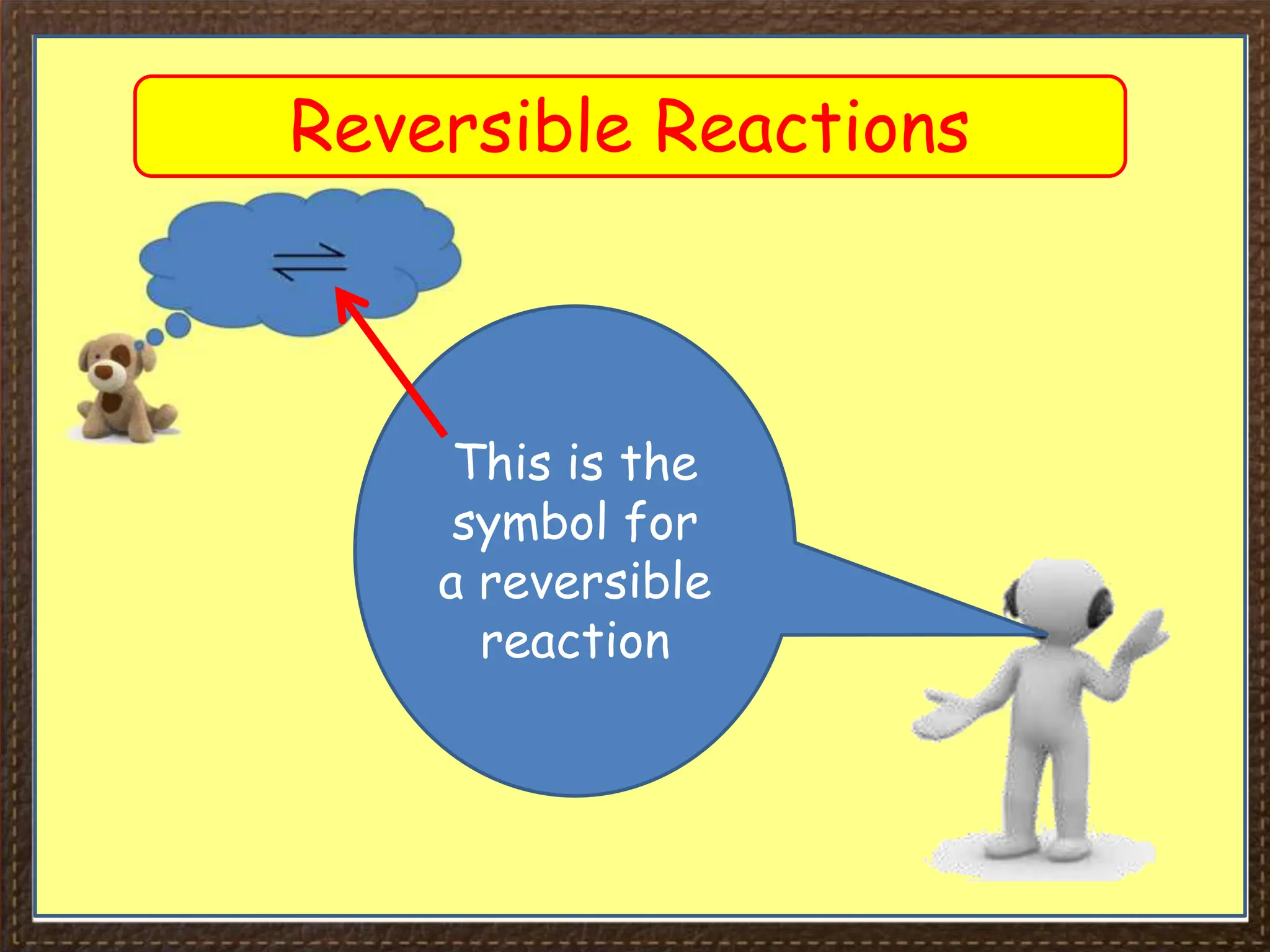
4.22 understand that some reactions are reversible
and are indicated by the symbol ⇌ in equations
4.23 describe reversible reactions such as the
dehydration of hydrated copper(II) sulphate and the
effect of heat on ammonium chloride
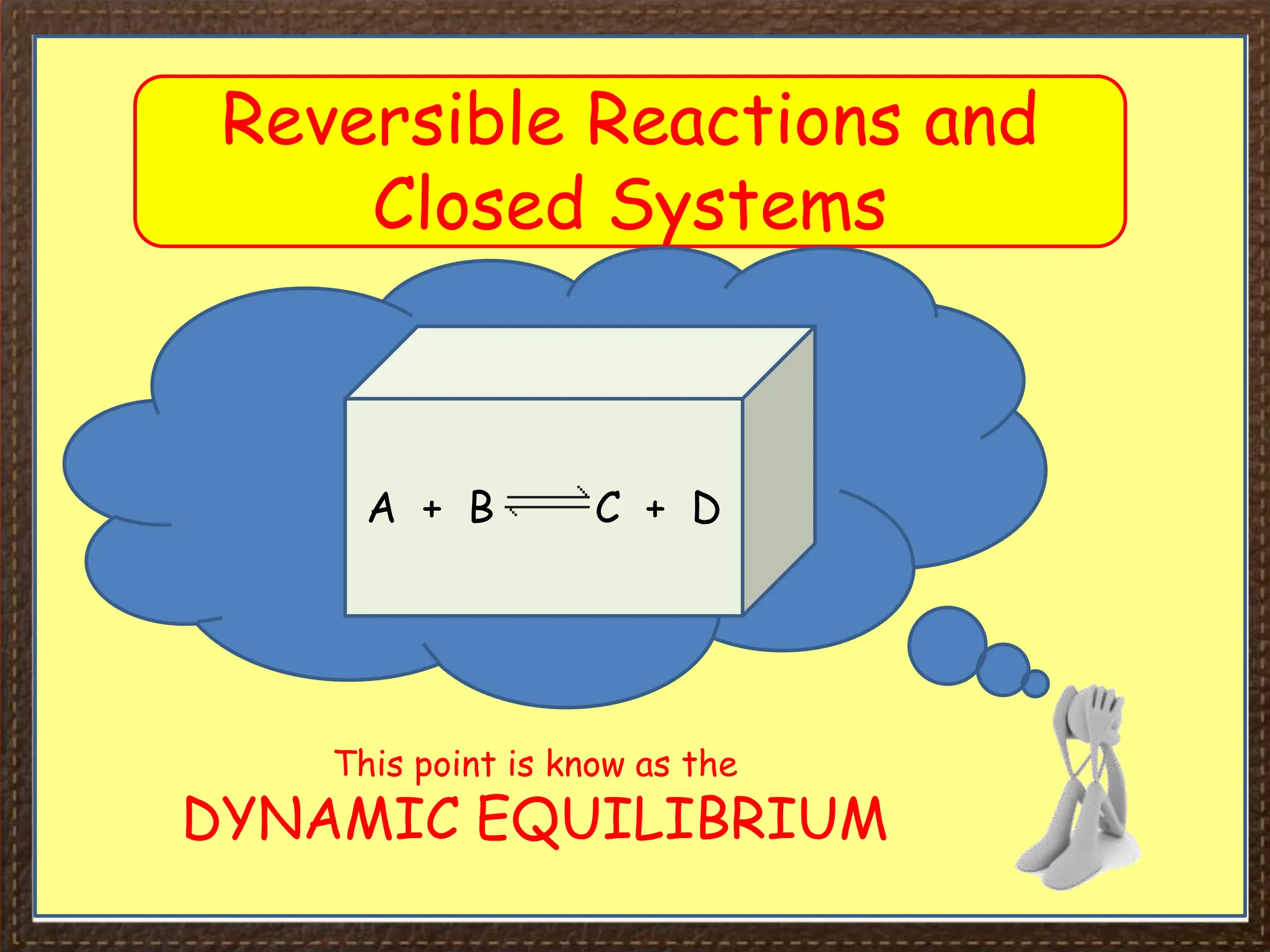
4.24 understand the concept of dynamic
equilibrium
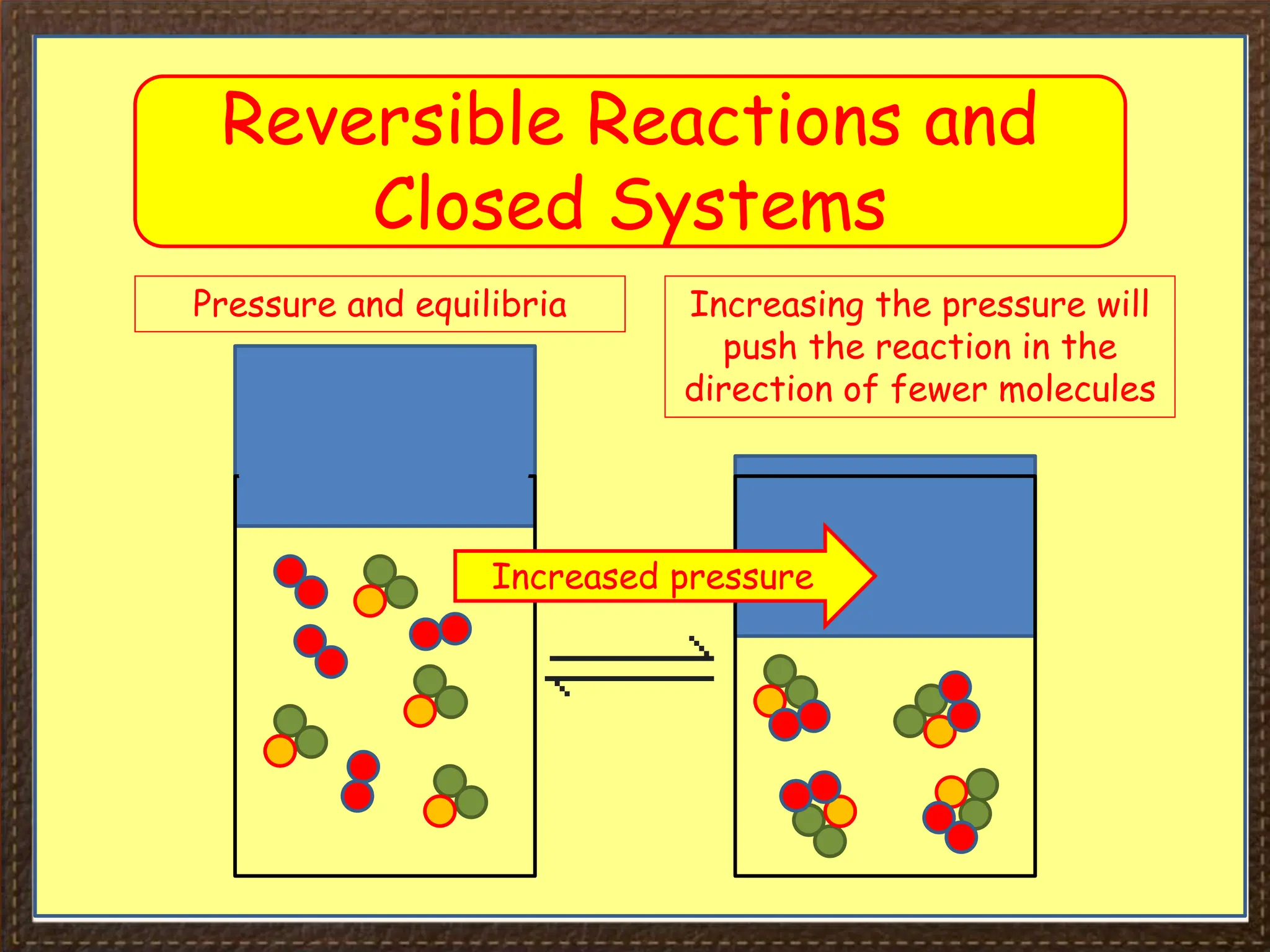
4.25 predict the effects of changing the pressure
and temperature on the equilibrium position in
reversible reactions.
Reversible Reactions
OK, let’s introduce
you to a new
symbol and
concept.
Reversible Reactions
X
Reversible Reactions
This is the
symbol for
a reversible
reaction
Reversible Reactions
A reversible
reaction is one
which can go in both
directions.
Reversible Reactions
This means that in a
chemical reaction the
products of the reaction can
be turned back into the
original reactants.
Reversible Reactions
For example:
A + B C + D
Reversible Reactions
For example:
A + B C + D
A and B react to produce C and D, but
also C and D can react to produce A
and B.
Reversible Reactions
Let’s look at an
example
Reversible Reactions
Heating blue
copper sulphate
Heat
Water
vapour
Reversible Reactions
Heating blue
copper sulphate
Heat
Water
vapour
White
anhydrous
copper
sulphate
Reversible Reactions
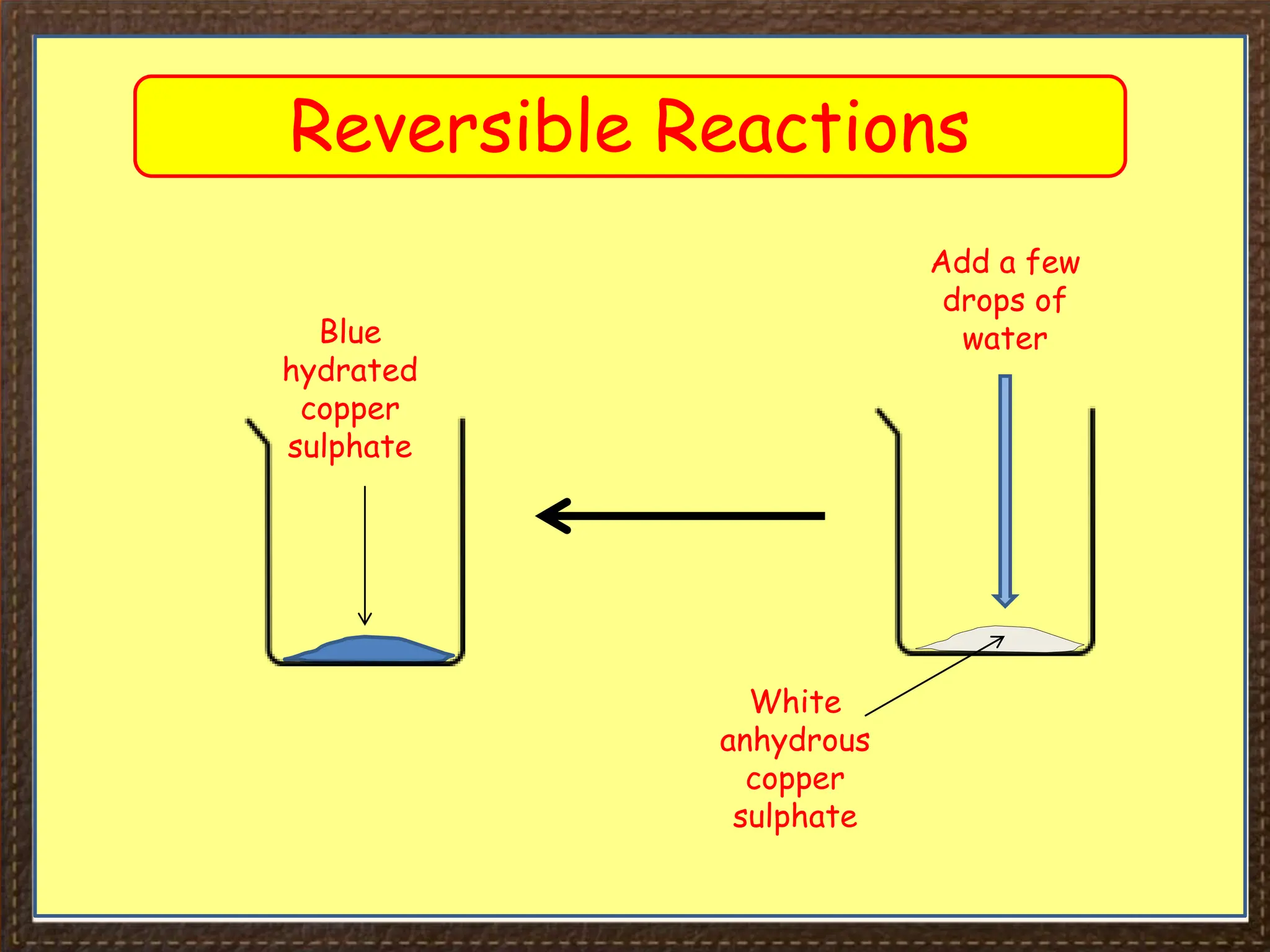
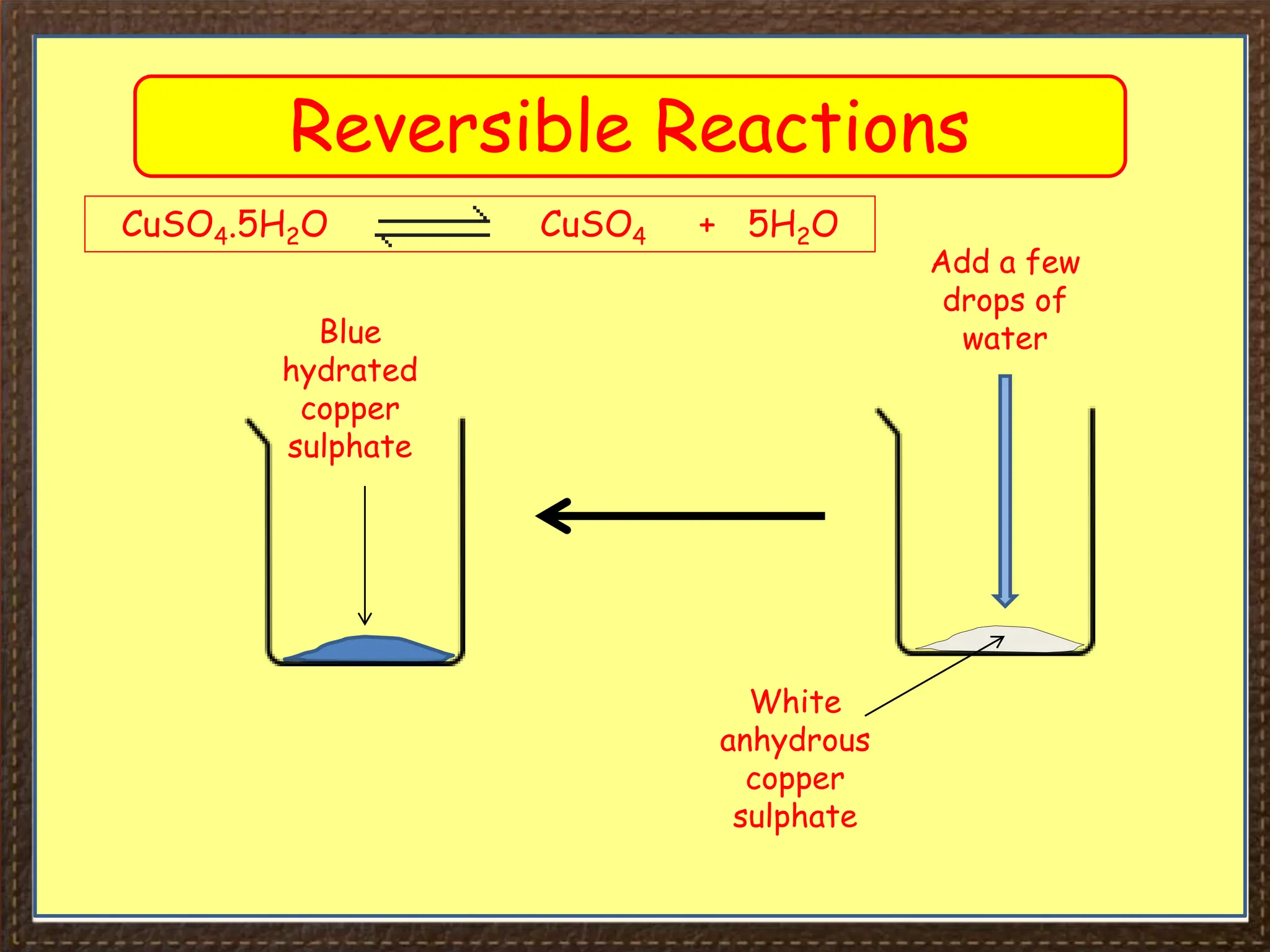
Blue
hydrated
copper
sulphate
White
anhydrous
copper
sulphate
Add a few
drops of
water
Reversible Reactions
Blue
hydrated
copper
sulphate
White
anhydrous
copper
sulphate
Add a few
drops of
water
CuSO4.5H2O CuSO4 + 5H2O
Reversible Reactions
Let’s look at
another example –
favourite one in
the exams!
Reversible Reactions
Let’s look at
another example –
favourite one in
the exams!
The Thermal
Decomposition
of ammonium
chloride,
NH4Cl
Reversible Reactions
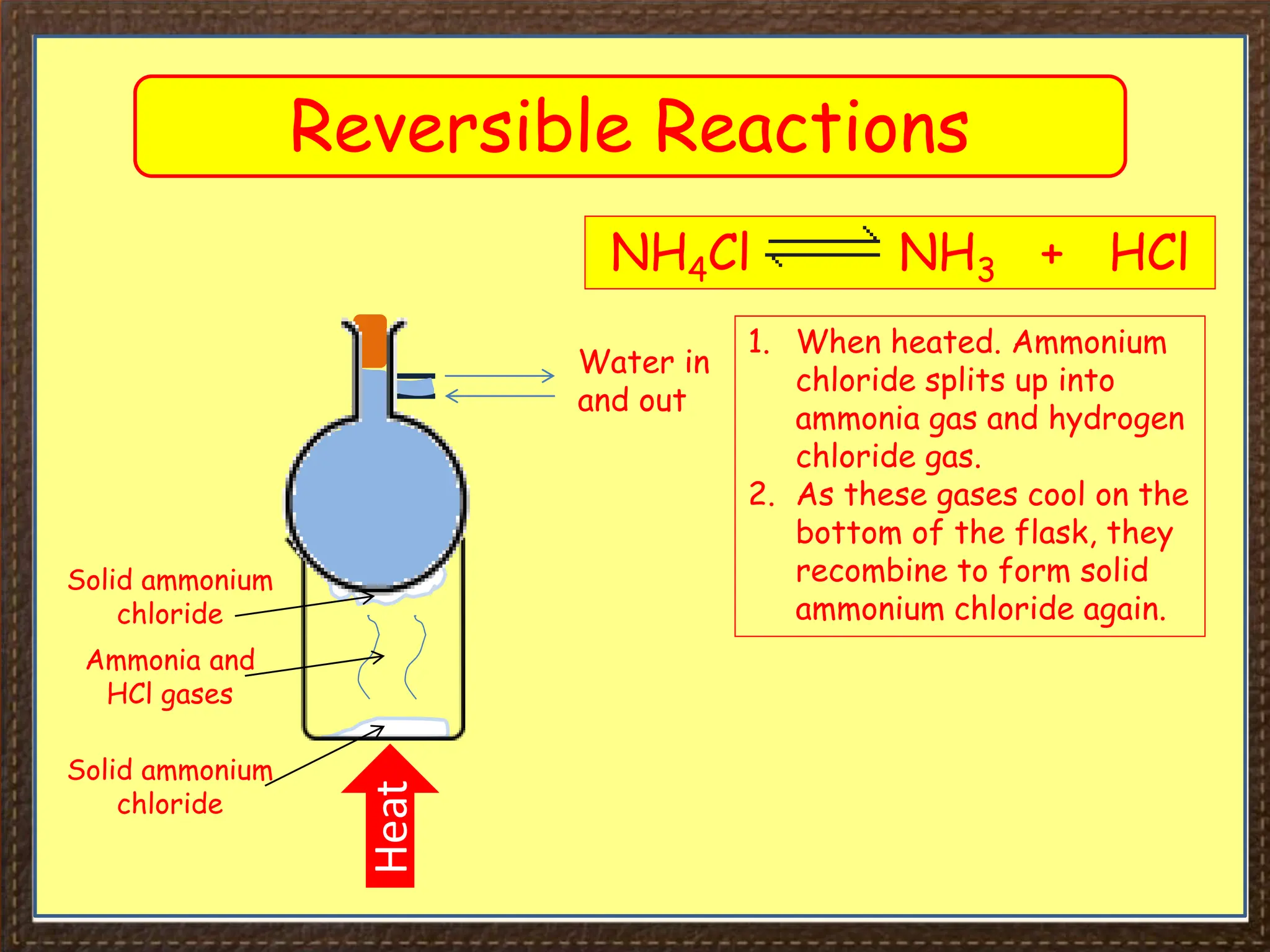
NH4Cl NH3 + HCl
Heat
Water in
and out
Solid ammonium
chloride
Solid ammonium
chloride
Ammonia and
HCl gases
Reversible Reactions
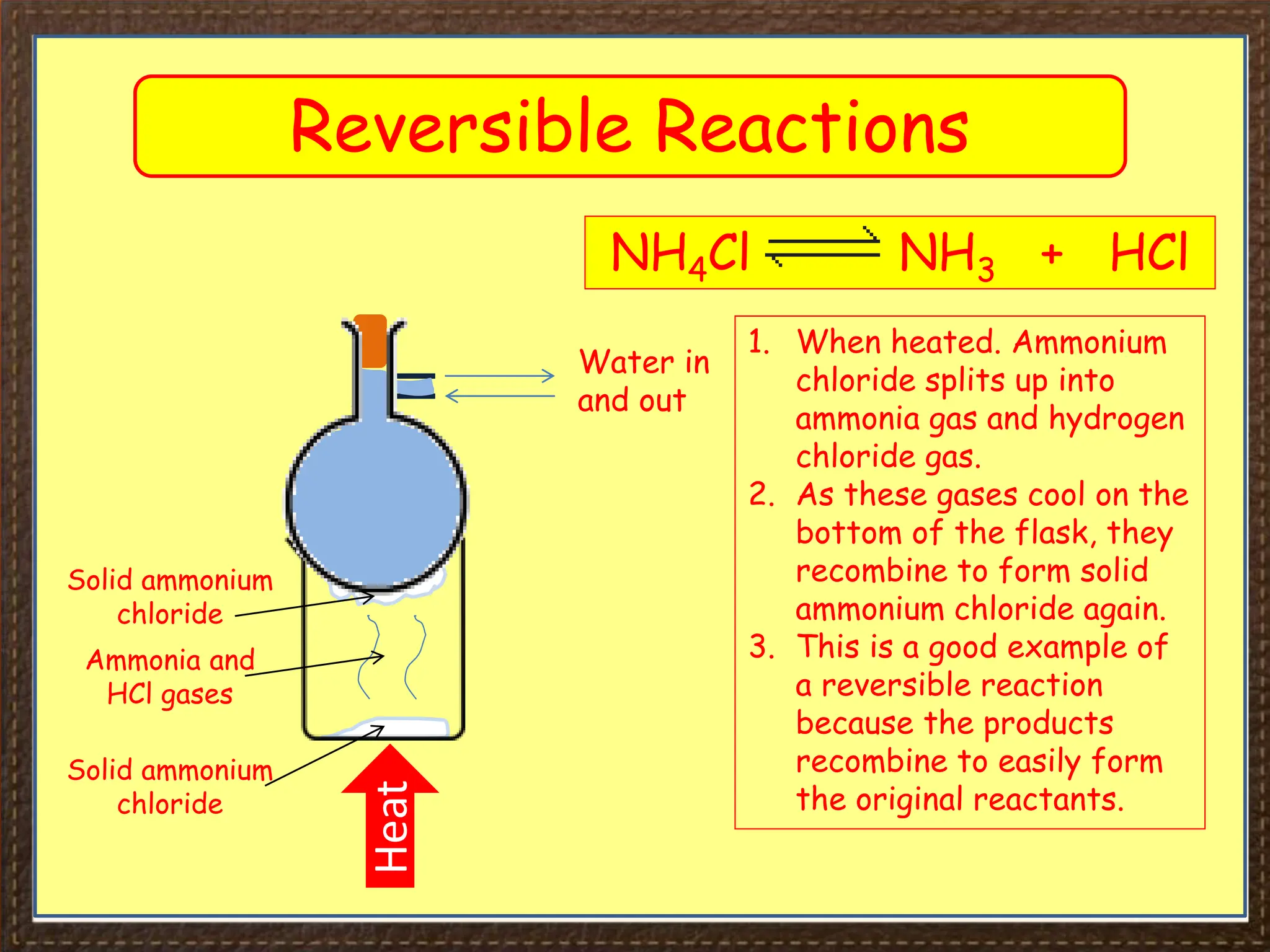
NH4Cl NH3 + HCl
Heat
Water in
and out
Solid ammonium
chloride
Solid ammonium
chloride
Ammonia and
HCl gases
1. When heated. Ammonium
chloride splits up into
ammonia gas and hydrogen
chloride gas.
Reversible Reactions
NH4Cl NH3 + HCl
Heat
Water in
and out
Solid ammonium
chloride
Solid ammonium
chloride
Ammonia and
HCl gases
1. When heated. Ammonium
chloride splits up into
ammonia gas and hydrogen
chloride gas.
2. As these gases cool on the
bottom of the flask, they
recombine to form solid
ammonium chloride again.
Reversible Reactions
NH4Cl NH3 + HCl
Heat
Water in
and out
Solid ammonium
chloride
Solid ammonium
chloride
Ammonia and
HCl gases
1. When heated. Ammonium
chloride splits up into
ammonia gas and hydrogen
chloride gas.
2. As these gases cool on the
bottom of the flask, they
recombine to form solid
ammonium chloride again.
3. This is a good example of
a reversible reaction
because the products
recombine to easily form
the original reactants.
Reversible Reactions and
Closed Systems
Reversible Reactions and
Closed Systems
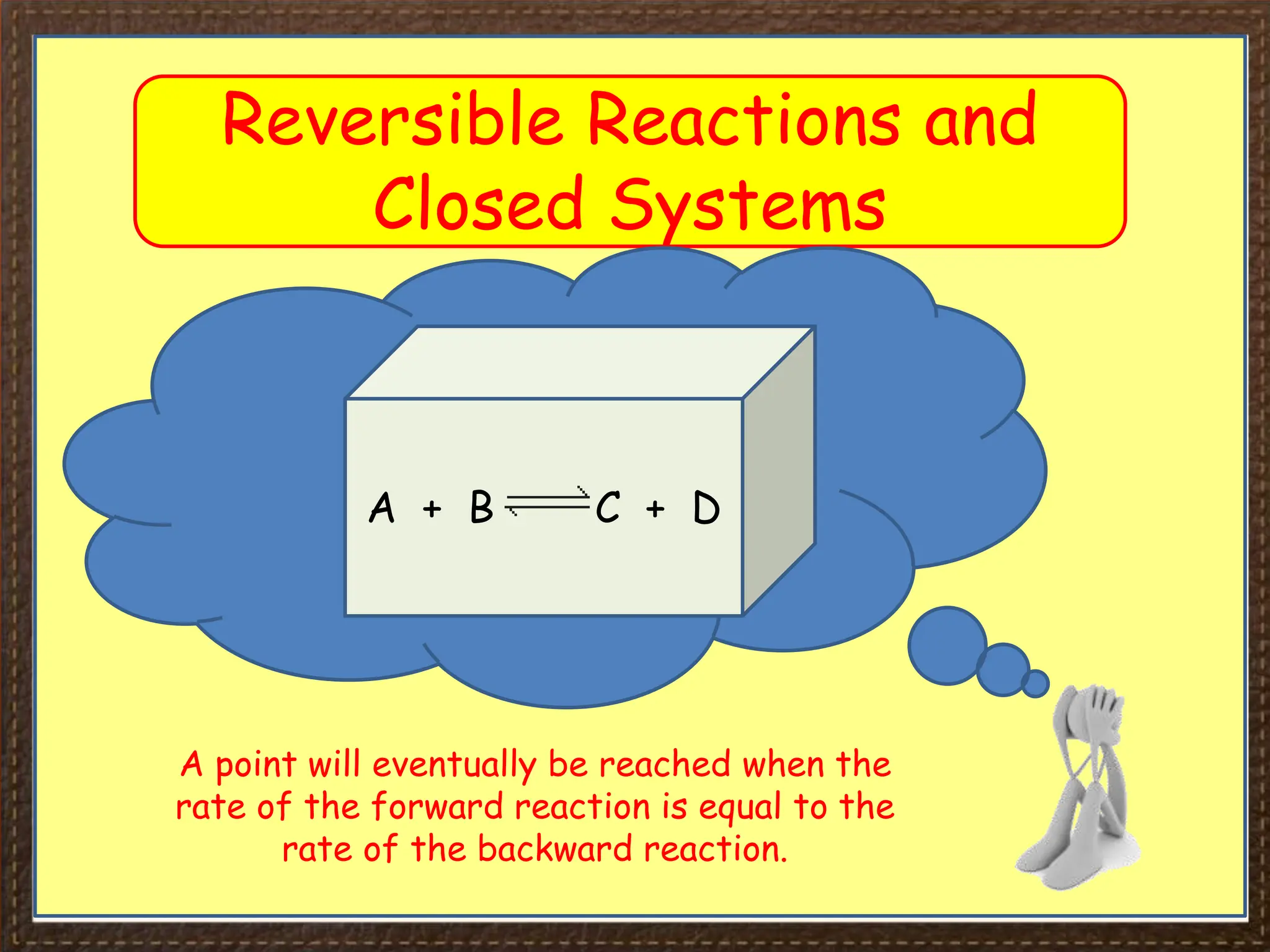
Try to imagine a closed
system where no more
reactants are added, and
no products are removed.
Reversible Reactions and
Closed Systems
Reversible Reactions and
Closed Systems
A + B C + D
A and B will be combining to form C and D,
while at the same time C and D will be
combining to form A + B.
Reversible Reactions and
Closed Systems
A + B C + D
A point will eventually be reached when the
rate of the forward reaction is equal to the
rate of the backward reaction.
Reversible Reactions and
Closed Systems
A + B C + D
This point is know as the
DYNAMIC EQUILIBRIUM
Reversible Reactions and
Closed Systems
Temperature and equilibria
A + B C + D
If the forward reaction (i.e. going from left to right) is
ENDOTHERMIC and heat energy is taken in ……..
Reversible Reactions and
Closed Systems
Temperature and equilibria
A + B C + D
If the forward reaction (i.e. going from left to right) is
ENDOTHERMIC and heat energy is taken in ……..
Then if the
temperature is
increased.
Reversible Reactions and
Closed Systems
Temperature and equilibria
A + B C + D
If the forward reaction (i.e. going from left to right) is
ENDOTHERMIC and heat energy is taken in ……..
Then if the
temperature is
increased.
The yield of
products is
increased, and
more heat is
taken in.
Reversible Reactions and
Closed Systems
Temperature and equilibria
A + B C + D
If the forward reaction (i.e. going from left to right) is
ENDOTHERMIC and heat energy is taken in ……..
Then if the
temperature is
decreased
Reversible Reactions and
Closed Systems
Temperature and equilibria
A + B C + D
If the forward reaction (i.e. going from left to right) is
ENDOTHERMIC and heat energy is taken in ……..
Then if the
temperature is
decreased.
The yield of
products is
decreased, and
less heat is
taken in.
Reversible Reactions and
Closed Systems
Temperature and equilibria
A + B C + D
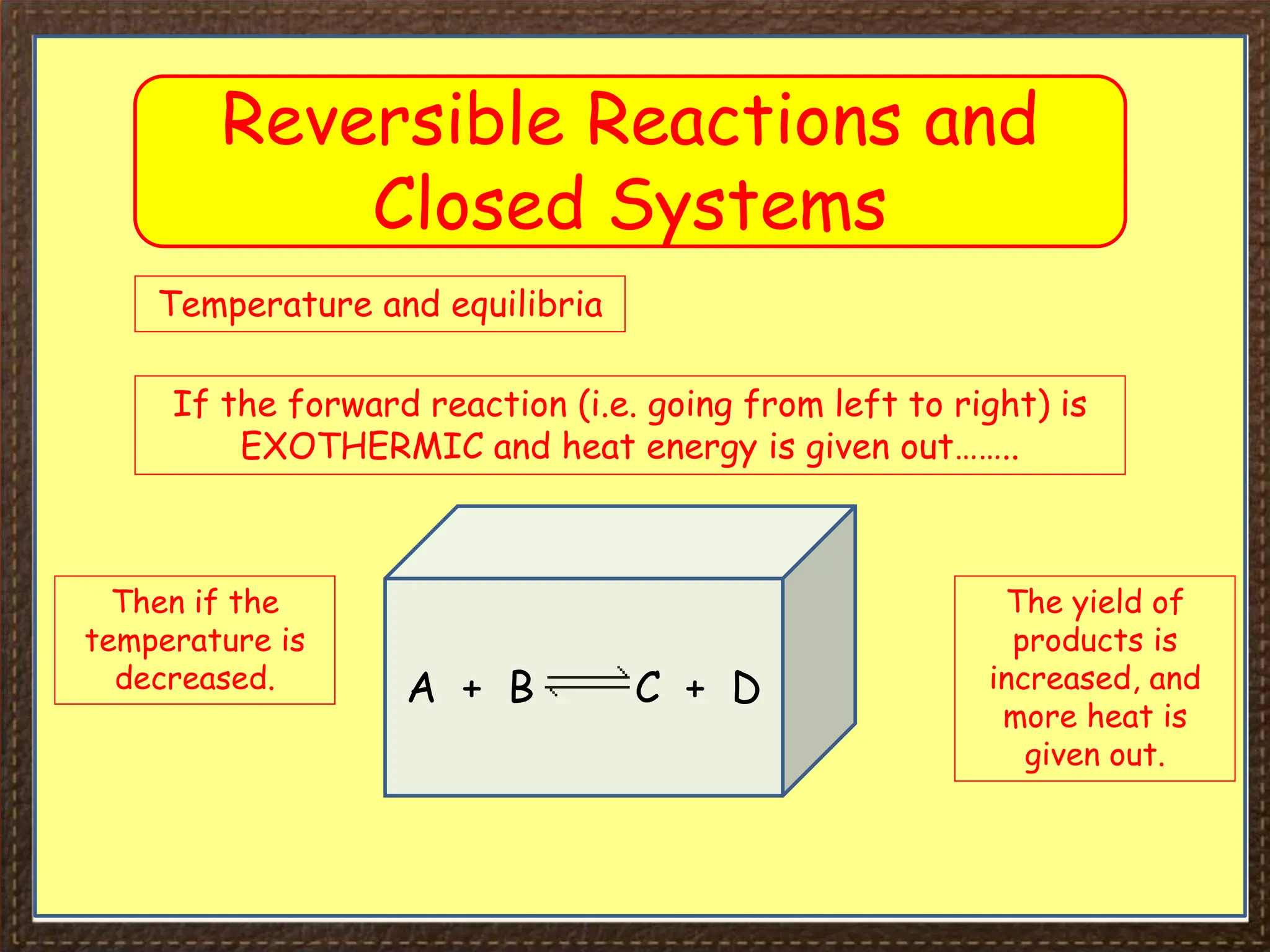
If the forward reaction (i.e. going from left to right) is
EXOTHERMIC and heat energy is given out……..
Reversible Reactions and
Closed Systems
Temperature and equilibria
A + B C + D
If the forward reaction (i.e. going from left to right) is
EXOTHERMIC and heat energy is given out……..
Then if the
temperature is
increased.
Reversible Reactions and
Closed Systems
Temperature and equilibria
A + B C + D
If the forward reaction (i.e. going from left to right) is
EXOTHERMIC and heat energy is given out……..
Then if the
temperature is
increased.
The yield of
products is
decreased, and
less heat is given
out.
Reversible Reactions and
Closed Systems
Temperature and equilibria
A + B C + D
If the forward reaction (i.e. going from left to right) is
EXOTHERMIC and heat energy is given out……..
Then if the
temperature is
decreased.
Reversible Reactions and
Closed Systems
Temperature and equilibria
A + B C + D
If the forward reaction (i.e. going from left to right) is
EXOTHERMIC and heat energy is given out……..
Then if the
temperature is
decreased.
The yield of
products is
increased, and
more heat is
given out.
Reversible Reactions and
Closed Systems
What about gases and
equilibria?
Reversible Reactions and
Closed Systems
Pressure and equilibria
Reversible Reactions and
Closed Systems
Pressure and equilibria
Reversible Reactions and
Closed Systems
Pressure and equilibria
Reversible Reactions and
Closed Systems
Pressure and equilibria Increasing the pressure will
push the reaction in the
direction of fewer molecules
Reversible Reactions and
Closed Systems
Pressure and equilibria Increasing the pressure will
push the reaction in the
direction of fewer molecules
Increased pressure
Reversible Reactions and
Closed Systems
Pressure and equilibria Increasing the pressure will
push the reaction in the
direction of fewer molecules
Decreased pressure
End of Section 4 Lesson 4
In this lesson we have covered:
Reversible reactions
Reversible reactions in closed systems
iGCSE Chemistry Section 4 Chemical Equilibrium.ppt

iGCSE Chemistry Section 4 Chemical Equilibrium.ppt