PsychologyPsychology comes from a Greek word Psyche which means mind, consciousness, or awareness. It refers to the soul which is the core, essence of a person. It also derive character which is attributed to man.Science of behavior and mental processes.
Psychology as a ScienceIt has scientific processesIt accepted theories as product of research:         > Statement of the problem         > Hypotheses         > Research Design         > Collection of Data and Analysis          > Replication         > Conclusion Its contribution: PAP, APA (authorities in Tests/Research)
Psychology in the context of BehaviorSocial RelationshipEmotional ResponsesMental Functioning           > Overt actions – observable like, walking, kissing           > Social relationship – interacting with people           > Emotional Responses – feelings such as anger, lust, happiness and depression           > Physiological Reactions – heart rate, excitement, biochemical reactions
The Beginnings of Psychology: Philosophy and PhysiologyIts earliest history can be traced back to the time of the early Greeks with Socrates, Plato and Aristotle.During the 17th-century, the French philosopher Rene Descartes introduced the idea of dualism, which asserted that the mind and body were two separate entities that interact to form the human experience. Its concern with Nature vs. nurture.
Wilhelm Wundt – founded Psychology as acad. discipline in 1879. established the 1st psych lab at the Uni. of Leipzig Germany. Concern with senses  like vision, attention, emotion, memory.G. Stanley Hall – studied with Wundt and est. the 1st psych lab in the US in 1883 at John Hopkins University.J. MckeenCattell – student of Wundt. Called as the 1st professor in Psychology in 1888. He was known for designing a personality test, the 16 PF.Sir Francis Galton – individual differences in 1869 in Germany.Titchener – Wundt trained psychologist introduced Structuralism in latter part of 19th century. Focused on mental structure and consciousness. Introspection as major method.
William James – psychologist from Harvard, opposed structuralism and advocated functionalism, how conscious function.Sigmund Freud – 20th century physician from Vienese introduced the psychoanalytic theory where human behavior is governed by the unconscious.John Watson – founded behaviorism in 1920.Ivan Pavlov – founded the behaviorism which focused on classical conditioning.Max Wertheimer – founded the Gestalt psychology in Germany. Gestalt means Form or Configuration.
Perspective in PsychologyThe Biological PerspectiveThe study of physiology played a major role in the development of psychology as a separate science. Today, this perspective is known as biological psychology. Sometimes referred to as biopsychology or physiological psychology, this perspective emphasizes the physical and biological bases of behavior.
The Behavioral PerspectiveBehavioral psychology is a perspective that focuses on learned behaviors. Behavioral principles are often applied in mental health settings, where therapists and counselors use these techniques to explain and treat a variety of illnesses.
The Cognitive PerspectiveDuring the 1960s, a new perspective known as cognitive psychology began to take hold. It focuses on mental processes. This area of psychology is concern with memory, thinking, problem solving, language and decision-making.Influenced by psychologists such as Jean Piaget and Albert Bandura, this perspective has grown tremendously in recent decades.
The Cross-Cultural PerspectiveCross-cultural psychology is a fairly new perspective that has grown significantly in recent years. These psychologists and researchers look at human behavior across different cultures.
The Evolutionary PerspectiveEvolutionary psychology is focused on the study of how evolution explains physiological processes. Psychologists and researchers take the basic principles of evolution, including natural selection, and apply them to psychological phenomena. This perspective suggests that these mental processes exist because they serve an evolutionary purpose – they aid in survival and reproduction.
The Humanistic PerspectiveDuring the 1950s, a school of thought known as humanistic psychology emerged. Influenced greatly by the work of prominent humanists such as Carl Rogers and Abraham Maslow, this perspective emphasizes the role of motivation on thought and behavior. Concepts such as self-actualization are an essential part of this perspective.
The Psychodynamic PerspectiveThe psychodynamic perspective originated with the work of Sigmund Freud. This perspective emphasizes the role of the unconscious mind, early childhood experiences, and interpersonal relationships to explain human behavior and to treat people suffering from mental illnesses.
Different Fields in PsychologyAbnormal PsychologyPsychology of AddictionPsychology of AdvertisingPsychology of AltruismPsychology of AmbitionAnimal PsychologyArt PsychologyPsychology of AtheismPsychology of AttractionPsychology of Beauty
Psychology of BehaviorPsychology of BeliefBiological PsychologyNeuropsychologyChild PsychologyCognitive PsychologyColor PsychologyComparative PsychologyCounseling PsychologyClinical Psychology
Psychology of Communication Criminal PsychologyDevelopmental PsychologyPsychology of DreamsEducational PsychologyForensic PsychologyHealth PsychologyHuman Factors PsychologyIndustrial PsychologyPersonality Psychology
Quantitative PsychologySchool PsychologySocial PsychologySports Psychology
ORGANIZATION OF THE NERVOUS SYSTEM
Objectivesdiscuss the development of the nervous systemenumerate the parts of the neuron and their functions in the neural impulse  transferidentify the different divisions of the nervous system, their functions and relevance to human behaviordiscuss the possible disorders with any part of the nervous system
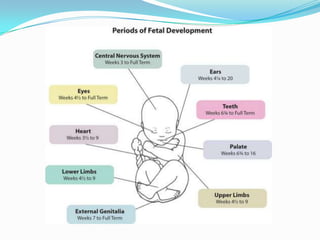
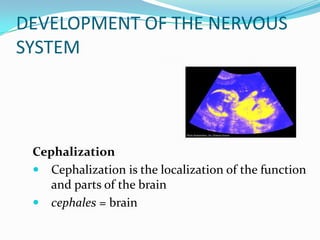
DEVELOPMENT OF THE NERVOUS SYSTEMCephalizationCephalization is the localization of the function and parts of the brain cephales = brain
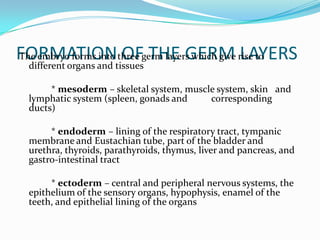
FORMATION OF THE GERM LAYERSThe embryo forms into three germ layers which give rise to different organs and tissues		* mesoderm – skeletal system, muscle system, skin 	and lymphatic system (spleen, gonads and 	corresponding ducts) 		* endoderm – lining of the respiratory tract, tympanic membrane and Eustachian tube, part of the bladder and urethra, thyroids, parathyroids, thymus, liver and pancreas, and gastro-intestinal tract		* ectoderm – central and peripheral nervous systems, the epithelium of the sensory organs, hypophysis, enamel of the teeth, and epithelial lining of the organs
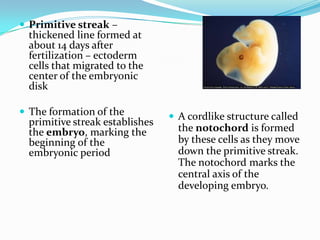
Primitive streak – thickened line formed at about 14 days after fertilization – ectoderm cells that migrated to the center of the embryonic diskThe formation of the primitive streak establishes the embryo, marking the beginning of the embryonic periodA cordlike structure called the notochord is formed by these cells as they move down the primitive streak. The notochord marks the central axis of the developing embryo.
NEURAL TUBE AND NEURAL CREST FORMATION	At about 18 days after fertilization, the ectoderm overlying the notochord thickens to form the neural plate. The lateral edges of the plate begin to rise like two ocean waves coming together. These edges are called neural crests, and a neural groove lies between them. The neural crests begin to meet in the midline and fuse into neural tube which is completely closed by 26 days. The cells of the neural tube are called neuroectoderm. The neuroectoderm becomes the brain, the spinal cord, and parts of the peripheral nervous system. If the neural tube fails to close, major defects of the central nervous system can result.
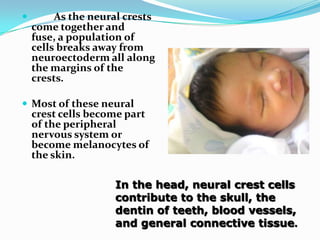
	As the neural crests come together and fuse, a population of cells breaks away from neuroectoderm all along the margins of the crests.  Most of these neural crest cells become part of the peripheral nervous system or become melanocytes of the skin. In the head, neural crest cells contribute to the skull, the dentin of teeth, blood vessels, and general connective tissue.
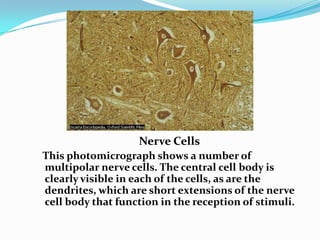
Nerve Cells   This photomicrograph shows a number of multipolar nerve cells. The central cell body is clearly visible in each of the cells, as are the dendrites, which are short extensions of the nerve cell body that function in the reception of stimuli.
Cells of the Nervous System Neurons are specialized to respond rapidly to signals and send signals of their own.Glial cells hold neurons together, guide their growth, secrete and absorb chemicals to maintain a stable chemical environment, and send a limited number of signals between neurons.
Common Features of CellsAn outer membrane selectively allows only some substances to pass in and out.The cell body contains the nucleusSpecialized FeaturesAn axon is a cell fiber that carries signals away from the cell body. Most neurons have just one axonA dendrite is a cell fiber that receives signals from other neurons and carries information toward the neuron's cell body. Most neurons have many dendrites
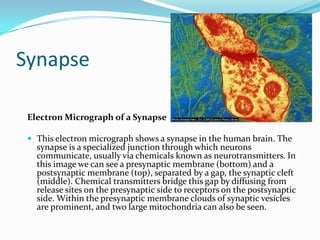
SynapseElectron Micrograph of a Synapse This electron micrograph shows a synapse in the human brain. The synapse is a specialized junction through which neurons communicate, usually via chemicals known as neurotransmitters. In this image we can see a presynaptic membrane (bottom) and a postsynaptic membrane (top), separated by a gap, the synaptic cleft (middle). Chemical transmitters bridge this gap by diffusing from release sites on the presynaptic side to receptors on the postsynaptic side. Within the presynaptic membrane clouds of synaptic vesicles are prominent, and two large mitochondria can also be seen.
NeurotransmittersChemicals made by neurons or nerve cellsChemical signals to activate or inhibit a function of neighboring cellsChemicals involved in synaptic transmission, released by the synaptic vesicles when stimulated by the  impulse
Common NeurotransmittersACETYLCHOLINEMost widely used Involves concentration of the musclesFound in the CNS and the peripheralSEROTONINResponsible for moods Sleeping and relaxation/drowsinessBlocking pain sensationFound in the hindbrain
DOPAMINE Responsible for voluntary movementsDegeneration lead to Parkinson’s diseaseDopamine theory Excessive dopamine in the brain may cause schizophreniaGAMMA-AMINO BUTYRIC ACIDMost abundant in CNSInhibitory to dopamine Excess GABA results to uncontrollable movement of arms and legsProgressive loss of mental activityNOTES: Drugs may influence neurotransmitter behavior block neurotransmitters or prevent re-uptake ex. Belladona – decreases intestinal cramps of disorders like irritable bowel syndrome (blocks acetylcholine) ex. Prozac – blocks re-uptake of serotonin (remains in the synapse – relief of depression and control of OC behavior)
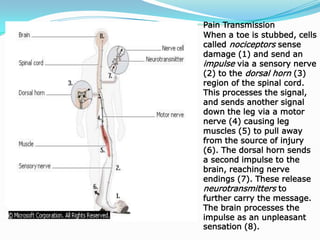
                                                               Pain TransmissionWhen a toe is stubbed, cells called nociceptors sense damage (1) and send an impulse via a sensory nerve (2) to the dorsal horn (3) region of the spinal cord. This processes the signal, and sends another signal down the leg via a motor nerve (4) causing leg muscles (5) to pull away from the source of injury (6). The dorsal horn sends a second impulse to the brain, reaching nerve endings (7). These release neurotransmitters to further carry the message. The brain processes the impulse as an unpleasant sensation (8).
Nervous Systemis the seat of all mental activity (consciousness, memory and thinking)maintain homeostasisdetect, interpret and respond to change in the internal and external conditionsone of the major regulating and coordinating systems of the body (the other is the endocrine system)
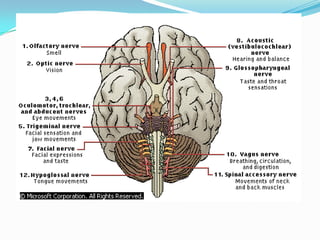
Peripheral nervous systemThe peripheral nervous system (PNS) the neurons outside the CNS, send information from the eyes, ears, and other sense organs to the CNS.THE SOMATIC NERVOUS SYSTEMThe somatic nervous system takes in pieces of sensory information and sends them to the central nervous system for processing.
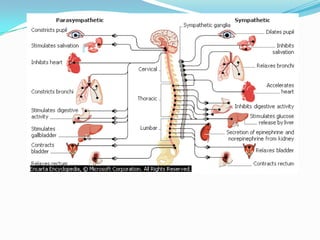
B. THE AUTONOMIC NERVOUS SYSTEMThe autonomic nervous system (ANS) carries messages back and forth between the CNS and the heart, lungs and other organs and glands. The ANS has two subdivisions.The sympathetic nervous system readies your body for action in the face of stress. This system spends energy.The parasympathetic nervous system calms you down once the crisis has passed. It preserves energy.Both systems may act on the same body areas, with their relative "balance" regulating the state of the targeted organs.
DIVISION OF THE CNSSPINAL CORDReflexes are simple, involuntary behaviors controlled by spinal cord neurons, without requiring instructions from the brain. A reflex pathway includes a sensory neuron, a minimal number of connecting neurons, and a motor neuron.The spinal cord is an example of a feedback system -- a regulatory system that sends information about the consequences of an action back to the source of the action for further adjustment.
BRAIN OR ENCEPHALON(SUB-DIVISIONS)Forebrain or Procencephalon  Midbrain or MecencephalonHindbrain or Rhombencephalon
Hindbrain or RhombencephalonFound above the spinal cordThe medulla performs vital coordination of the basic life functions (e.g., blood pressure, heart rate, breathing).The reticular formation is a web of neurons that helps alert and arouse other brain areas.The cerebellum maintains balance, coordinates fine motor movements, stores a memory code for well-rehearsed behaviors and participates in cognitive tasks, such as reading.
Midbrain or MecencephalonA small structure called the midbrain lies above the hindbrain. Part of the midbrain and its connections to the forebrain allow one to move smoothly. Together, the midbrain and parts of the hindbrain other than the cerebellum are called the brainstem.
Forebrain or ProcencephalonThe forebrain controls the most complex aspects of behavior and mental life. The outer part of the forebrain is called the cerebral cortex. Areas deep in the forebrain affect emotion, motivational "drives," and sensory processing.
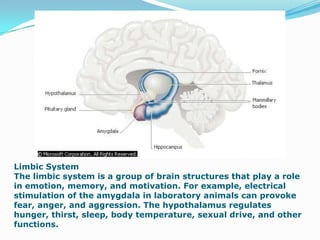
Areas of the Forebrainthalamus processes inputs from sense organs and then relays sensory information to appropriate "higher" forebrain areas 	- primary sensory relay into the rest of the brainhypothalamus has some of the brain's most important control systems
It regulates many physiological feedback systems, coordinating hunger, thirst, temperature regulation and sexual behavior
It directly influences both the autonomic and endocrine systems. It contains the suprachiasmatic nucleus -- an endogenous "clock" that sets biological rhythms for the body.The amygdala and the hippocampus help to regulate memory and emotion. The amygdala links different kinds of sensory information in memory, such as the shape and feel of objects.The amygdala, hippocampus, and some portions of the cerebral cortex are part of a group of brain structures called the limbic system, which is activated when emotions are being generated.The hippocampus also helps you form new memories.
                                             Limbic SystemThe limbic system is a group of brain structures that play a role in emotion, memory, and motivation. For example, electrical stimulation of the amygdala in laboratory animals can provoke fear, anger, and aggression. The hypothalamus regulates hunger, thirst, sleep, body temperature, sexual drive, and other functions.
Cerebrumlargest part of the brainconcerned with the processing of information of the braincoordination of voluntary responsesthinking and other cognitive functions
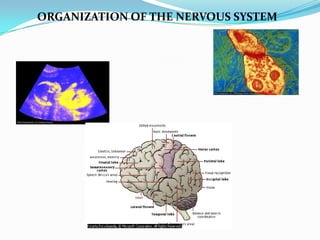
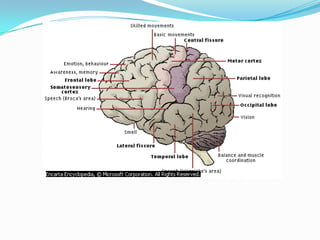
Cerebral CortexThe cerebrum's outer surface, is a thin sheet of neurons. In humans, the sheet folds in on itself, giving the brain its characteristic wrinkled appearance.The left and right cerebral hemispheres are physically separate halves of the cerebrum. The corpus callosum connects the two halves.The folds of cortex produce gyri (ridges), and sulci or fissures (valleys or wrinkles), on the brain's outer surface. Several deep sulci make convenient markers for dividing the cortex of each hemisphere into four anatomical regions, or lobes: frontal, parietal, occipital and temporal.
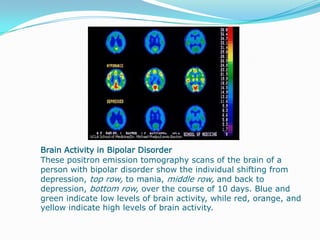
                                                                     Brain Activity in Bipolar DisorderThese positron emission tomography scans of the brain of a person with bipolar disorder show the individual shifting from depression, top row, to mania, middle row, and back to depression, bottom row, over the course of 10 days. Blue and green indicate low levels of brain activity, while red, orange, and yellow indicate high levels of brain activity.
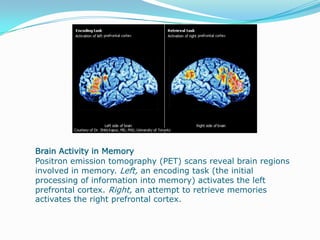
                                                                                    Brain Activity in MemoryPositron emission tomography (PET) scans reveal brain regions involved in memory. Left, an encoding task (the initial processing of information into memory) activates the left prefrontal cortex. Right, an attempt to retrieve memories activates the right prefrontal cortex.
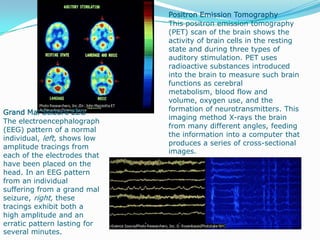
                                                       Positron Emission TomographyThis positron emission tomography (PET) scan of the brain shows the activity of brain cells in the resting state and during three types of auditory stimulation. PET uses radioactive substances introduced into the brain to measure such brain functions as cerebral metabolism, blood flow and volume, oxygen use, and the formation of neurotransmitters. This imaging method X-rays the brain from many different angles, feeding the information into a computer that produces a series of cross-sectional images.                                                                                       Grand Mal Seizure EEGThe electroencephalograph (EEG) pattern of a normal individual, left, shows low amplitude tracings from each of the electrodes that have been placed on the head. In an EEG pattern from an individual suffering from a grand mal seizure, right, these tracings exhibit both a high amplitude and an erratic pattern lasting for several minutes.
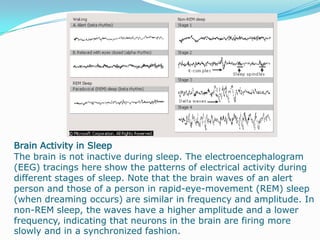
                                                                                      Brain Activity in SleepThe brain is not inactive during sleep. The electroencephalogram (EEG) tracings here show the patterns of electrical activity during different stages of sleep. Note that the brain waves of an alert person and those of a person in rapid-eye-movement (REM) sleep (when dreaming occurs) are similar in frequency and amplitude. In non-REM sleep, the waves have a higher amplitude and a lower frequency, indicating that neurons in the brain are firing more slowly and in a synchronized fashion.

Psychology Ppt

  • 1.
    PsychologyPsychology comes froma Greek word Psyche which means mind, consciousness, or awareness. It refers to the soul which is the core, essence of a person. It also derive character which is attributed to man.Science of behavior and mental processes.
  • 2.
    Psychology as aScienceIt has scientific processesIt accepted theories as product of research: > Statement of the problem > Hypotheses > Research Design > Collection of Data and Analysis > Replication > Conclusion Its contribution: PAP, APA (authorities in Tests/Research)
  • 3.
    Psychology in thecontext of BehaviorSocial RelationshipEmotional ResponsesMental Functioning > Overt actions – observable like, walking, kissing > Social relationship – interacting with people > Emotional Responses – feelings such as anger, lust, happiness and depression > Physiological Reactions – heart rate, excitement, biochemical reactions
  • 4.
    The Beginnings ofPsychology: Philosophy and PhysiologyIts earliest history can be traced back to the time of the early Greeks with Socrates, Plato and Aristotle.During the 17th-century, the French philosopher Rene Descartes introduced the idea of dualism, which asserted that the mind and body were two separate entities that interact to form the human experience. Its concern with Nature vs. nurture.
  • 5.
    Wilhelm Wundt –founded Psychology as acad. discipline in 1879. established the 1st psych lab at the Uni. of Leipzig Germany. Concern with senses like vision, attention, emotion, memory.G. Stanley Hall – studied with Wundt and est. the 1st psych lab in the US in 1883 at John Hopkins University.J. MckeenCattell – student of Wundt. Called as the 1st professor in Psychology in 1888. He was known for designing a personality test, the 16 PF.Sir Francis Galton – individual differences in 1869 in Germany.Titchener – Wundt trained psychologist introduced Structuralism in latter part of 19th century. Focused on mental structure and consciousness. Introspection as major method.
  • 6.
    William James –psychologist from Harvard, opposed structuralism and advocated functionalism, how conscious function.Sigmund Freud – 20th century physician from Vienese introduced the psychoanalytic theory where human behavior is governed by the unconscious.John Watson – founded behaviorism in 1920.Ivan Pavlov – founded the behaviorism which focused on classical conditioning.Max Wertheimer – founded the Gestalt psychology in Germany. Gestalt means Form or Configuration.
  • 7.
    Perspective in PsychologyTheBiological PerspectiveThe study of physiology played a major role in the development of psychology as a separate science. Today, this perspective is known as biological psychology. Sometimes referred to as biopsychology or physiological psychology, this perspective emphasizes the physical and biological bases of behavior.
  • 8.
    The Behavioral PerspectiveBehavioralpsychology is a perspective that focuses on learned behaviors. Behavioral principles are often applied in mental health settings, where therapists and counselors use these techniques to explain and treat a variety of illnesses.
  • 9.
    The Cognitive PerspectiveDuringthe 1960s, a new perspective known as cognitive psychology began to take hold. It focuses on mental processes. This area of psychology is concern with memory, thinking, problem solving, language and decision-making.Influenced by psychologists such as Jean Piaget and Albert Bandura, this perspective has grown tremendously in recent decades.
  • 10.
    The Cross-Cultural PerspectiveCross-culturalpsychology is a fairly new perspective that has grown significantly in recent years. These psychologists and researchers look at human behavior across different cultures.
  • 11.
    The Evolutionary PerspectiveEvolutionarypsychology is focused on the study of how evolution explains physiological processes. Psychologists and researchers take the basic principles of evolution, including natural selection, and apply them to psychological phenomena. This perspective suggests that these mental processes exist because they serve an evolutionary purpose – they aid in survival and reproduction.
  • 12.
    The Humanistic PerspectiveDuringthe 1950s, a school of thought known as humanistic psychology emerged. Influenced greatly by the work of prominent humanists such as Carl Rogers and Abraham Maslow, this perspective emphasizes the role of motivation on thought and behavior. Concepts such as self-actualization are an essential part of this perspective.
  • 13.
    The Psychodynamic PerspectiveThepsychodynamic perspective originated with the work of Sigmund Freud. This perspective emphasizes the role of the unconscious mind, early childhood experiences, and interpersonal relationships to explain human behavior and to treat people suffering from mental illnesses.
  • 14.
    Different Fields inPsychologyAbnormal PsychologyPsychology of AddictionPsychology of AdvertisingPsychology of AltruismPsychology of AmbitionAnimal PsychologyArt PsychologyPsychology of AtheismPsychology of AttractionPsychology of Beauty
  • 15.
    Psychology of BehaviorPsychologyof BeliefBiological PsychologyNeuropsychologyChild PsychologyCognitive PsychologyColor PsychologyComparative PsychologyCounseling PsychologyClinical Psychology
  • 16.
    Psychology of CommunicationCriminal PsychologyDevelopmental PsychologyPsychology of DreamsEducational PsychologyForensic PsychologyHealth PsychologyHuman Factors PsychologyIndustrial PsychologyPersonality Psychology
  • 17.
  • 19.
    ORGANIZATION OF THENERVOUS SYSTEM
  • 20.
    Objectivesdiscuss the developmentof the nervous systemenumerate the parts of the neuron and their functions in the neural impulse transferidentify the different divisions of the nervous system, their functions and relevance to human behaviordiscuss the possible disorders with any part of the nervous system
  • 21.
    DEVELOPMENT OF THENERVOUS SYSTEMCephalizationCephalization is the localization of the function and parts of the brain cephales = brain
  • 22.
    FORMATION OF THEGERM LAYERSThe embryo forms into three germ layers which give rise to different organs and tissues * mesoderm – skeletal system, muscle system, skin and lymphatic system (spleen, gonads and corresponding ducts) * endoderm – lining of the respiratory tract, tympanic membrane and Eustachian tube, part of the bladder and urethra, thyroids, parathyroids, thymus, liver and pancreas, and gastro-intestinal tract * ectoderm – central and peripheral nervous systems, the epithelium of the sensory organs, hypophysis, enamel of the teeth, and epithelial lining of the organs
  • 23.
    Primitive streak –thickened line formed at about 14 days after fertilization – ectoderm cells that migrated to the center of the embryonic diskThe formation of the primitive streak establishes the embryo, marking the beginning of the embryonic periodA cordlike structure called the notochord is formed by these cells as they move down the primitive streak. The notochord marks the central axis of the developing embryo.
  • 24.
    NEURAL TUBE ANDNEURAL CREST FORMATION At about 18 days after fertilization, the ectoderm overlying the notochord thickens to form the neural plate. The lateral edges of the plate begin to rise like two ocean waves coming together. These edges are called neural crests, and a neural groove lies between them. The neural crests begin to meet in the midline and fuse into neural tube which is completely closed by 26 days. The cells of the neural tube are called neuroectoderm. The neuroectoderm becomes the brain, the spinal cord, and parts of the peripheral nervous system. If the neural tube fails to close, major defects of the central nervous system can result.
  • 25.
    As the neuralcrests come together and fuse, a population of cells breaks away from neuroectoderm all along the margins of the crests. Most of these neural crest cells become part of the peripheral nervous system or become melanocytes of the skin. In the head, neural crest cells contribute to the skull, the dentin of teeth, blood vessels, and general connective tissue.
  • 26.
    Nerve Cells This photomicrograph shows a number of multipolar nerve cells. The central cell body is clearly visible in each of the cells, as are the dendrites, which are short extensions of the nerve cell body that function in the reception of stimuli.
  • 27.
    Cells of theNervous System Neurons are specialized to respond rapidly to signals and send signals of their own.Glial cells hold neurons together, guide their growth, secrete and absorb chemicals to maintain a stable chemical environment, and send a limited number of signals between neurons.
  • 28.
    Common Features ofCellsAn outer membrane selectively allows only some substances to pass in and out.The cell body contains the nucleusSpecialized FeaturesAn axon is a cell fiber that carries signals away from the cell body. Most neurons have just one axonA dendrite is a cell fiber that receives signals from other neurons and carries information toward the neuron's cell body. Most neurons have many dendrites
  • 29.
    SynapseElectron Micrograph ofa Synapse This electron micrograph shows a synapse in the human brain. The synapse is a specialized junction through which neurons communicate, usually via chemicals known as neurotransmitters. In this image we can see a presynaptic membrane (bottom) and a postsynaptic membrane (top), separated by a gap, the synaptic cleft (middle). Chemical transmitters bridge this gap by diffusing from release sites on the presynaptic side to receptors on the postsynaptic side. Within the presynaptic membrane clouds of synaptic vesicles are prominent, and two large mitochondria can also be seen.
  • 30.
    NeurotransmittersChemicals made byneurons or nerve cellsChemical signals to activate or inhibit a function of neighboring cellsChemicals involved in synaptic transmission, released by the synaptic vesicles when stimulated by the impulse
  • 31.
    Common NeurotransmittersACETYLCHOLINEMost widelyused Involves concentration of the musclesFound in the CNS and the peripheralSEROTONINResponsible for moods Sleeping and relaxation/drowsinessBlocking pain sensationFound in the hindbrain
  • 32.
    DOPAMINE Responsible forvoluntary movementsDegeneration lead to Parkinson’s diseaseDopamine theory Excessive dopamine in the brain may cause schizophreniaGAMMA-AMINO BUTYRIC ACIDMost abundant in CNSInhibitory to dopamine Excess GABA results to uncontrollable movement of arms and legsProgressive loss of mental activityNOTES: Drugs may influence neurotransmitter behavior block neurotransmitters or prevent re-uptake ex. Belladona – decreases intestinal cramps of disorders like irritable bowel syndrome (blocks acetylcholine) ex. Prozac – blocks re-uptake of serotonin (remains in the synapse – relief of depression and control of OC behavior)
  • 33.
                                                                   Pain TransmissionWhena toe is stubbed, cells called nociceptors sense damage (1) and send an impulse via a sensory nerve (2) to the dorsal horn (3) region of the spinal cord. This processes the signal, and sends another signal down the leg via a motor nerve (4) causing leg muscles (5) to pull away from the source of injury (6). The dorsal horn sends a second impulse to the brain, reaching nerve endings (7). These release neurotransmitters to further carry the message. The brain processes the impulse as an unpleasant sensation (8).
  • 34.
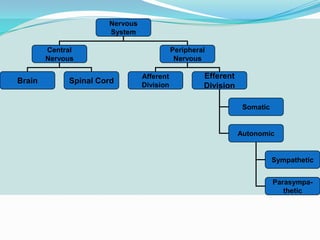
    Nervous Systemis theseat of all mental activity (consciousness, memory and thinking)maintain homeostasisdetect, interpret and respond to change in the internal and external conditionsone of the major regulating and coordinating systems of the body (the other is the endocrine system)
  • 36.
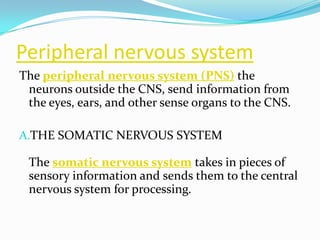
    Peripheral nervous systemTheperipheral nervous system (PNS) the neurons outside the CNS, send information from the eyes, ears, and other sense organs to the CNS.THE SOMATIC NERVOUS SYSTEMThe somatic nervous system takes in pieces of sensory information and sends them to the central nervous system for processing.
  • 38.
    B. THE AUTONOMICNERVOUS SYSTEMThe autonomic nervous system (ANS) carries messages back and forth between the CNS and the heart, lungs and other organs and glands. The ANS has two subdivisions.The sympathetic nervous system readies your body for action in the face of stress. This system spends energy.The parasympathetic nervous system calms you down once the crisis has passed. It preserves energy.Both systems may act on the same body areas, with their relative "balance" regulating the state of the targeted organs.
  • 40.
    DIVISION OF THECNSSPINAL CORDReflexes are simple, involuntary behaviors controlled by spinal cord neurons, without requiring instructions from the brain. A reflex pathway includes a sensory neuron, a minimal number of connecting neurons, and a motor neuron.The spinal cord is an example of a feedback system -- a regulatory system that sends information about the consequences of an action back to the source of the action for further adjustment.
  • 41.
    BRAIN OR ENCEPHALON(SUB-DIVISIONS)Forebrainor Procencephalon Midbrain or MecencephalonHindbrain or Rhombencephalon
  • 42.
    Hindbrain or RhombencephalonFoundabove the spinal cordThe medulla performs vital coordination of the basic life functions (e.g., blood pressure, heart rate, breathing).The reticular formation is a web of neurons that helps alert and arouse other brain areas.The cerebellum maintains balance, coordinates fine motor movements, stores a memory code for well-rehearsed behaviors and participates in cognitive tasks, such as reading.
  • 43.
    Midbrain or MecencephalonAsmall structure called the midbrain lies above the hindbrain. Part of the midbrain and its connections to the forebrain allow one to move smoothly. Together, the midbrain and parts of the hindbrain other than the cerebellum are called the brainstem.
  • 44.
    Forebrain or ProcencephalonTheforebrain controls the most complex aspects of behavior and mental life. The outer part of the forebrain is called the cerebral cortex. Areas deep in the forebrain affect emotion, motivational "drives," and sensory processing.
  • 45.
    Areas of theForebrainthalamus processes inputs from sense organs and then relays sensory information to appropriate "higher" forebrain areas - primary sensory relay into the rest of the brainhypothalamus has some of the brain's most important control systems
  • 46.
    It regulates manyphysiological feedback systems, coordinating hunger, thirst, temperature regulation and sexual behavior
  • 47.
    It directly influencesboth the autonomic and endocrine systems. It contains the suprachiasmatic nucleus -- an endogenous "clock" that sets biological rhythms for the body.The amygdala and the hippocampus help to regulate memory and emotion. The amygdala links different kinds of sensory information in memory, such as the shape and feel of objects.The amygdala, hippocampus, and some portions of the cerebral cortex are part of a group of brain structures called the limbic system, which is activated when emotions are being generated.The hippocampus also helps you form new memories.
  • 48.
                                                 Limbic SystemThelimbic system is a group of brain structures that play a role in emotion, memory, and motivation. For example, electrical stimulation of the amygdala in laboratory animals can provoke fear, anger, and aggression. The hypothalamus regulates hunger, thirst, sleep, body temperature, sexual drive, and other functions.
  • 49.
    Cerebrumlargest part ofthe brainconcerned with the processing of information of the braincoordination of voluntary responsesthinking and other cognitive functions
  • 50.
    Cerebral CortexThe cerebrum'souter surface, is a thin sheet of neurons. In humans, the sheet folds in on itself, giving the brain its characteristic wrinkled appearance.The left and right cerebral hemispheres are physically separate halves of the cerebrum. The corpus callosum connects the two halves.The folds of cortex produce gyri (ridges), and sulci or fissures (valleys or wrinkles), on the brain's outer surface. Several deep sulci make convenient markers for dividing the cortex of each hemisphere into four anatomical regions, or lobes: frontal, parietal, occipital and temporal.
  • 52.
                                                                         Brain Activityin Bipolar DisorderThese positron emission tomography scans of the brain of a person with bipolar disorder show the individual shifting from depression, top row, to mania, middle row, and back to depression, bottom row, over the course of 10 days. Blue and green indicate low levels of brain activity, while red, orange, and yellow indicate high levels of brain activity.
  • 53.
                                                                                        Brain Activityin MemoryPositron emission tomography (PET) scans reveal brain regions involved in memory. Left, an encoding task (the initial processing of information into memory) activates the left prefrontal cortex. Right, an attempt to retrieve memories activates the right prefrontal cortex.
  • 54.
                                                        Positron Emission TomographyThis positron emission tomography (PET) scan of the brain shows the activity of brain cells in the resting state and during three types of auditory stimulation. PET uses radioactive substances introduced into the brain to measure such brain functions as cerebral metabolism, blood flow and volume, oxygen use, and the formation of neurotransmitters. This imaging method X-rays the brain from many different angles, feeding the information into a computer that produces a series of cross-sectional images.                                                                                       Grand Mal Seizure EEGThe electroencephalograph (EEG) pattern of a normal individual, left, shows low amplitude tracings from each of the electrodes that have been placed on the head. In an EEG pattern from an individual suffering from a grand mal seizure, right, these tracings exhibit both a high amplitude and an erratic pattern lasting for several minutes.
  • 55.
                                                                                       Brain Activity in SleepThe brain is not inactive during sleep. The electroencephalogram (EEG) tracings here show the patterns of electrical activity during different stages of sleep. Note that the brain waves of an alert person and those of a person in rapid-eye-movement (REM) sleep (when dreaming occurs) are similar in frequency and amplitude. In non-REM sleep, the waves have a higher amplitude and a lower frequency, indicating that neurons in the brain are firing more slowly and in a synchronized fashion.
  • 56.
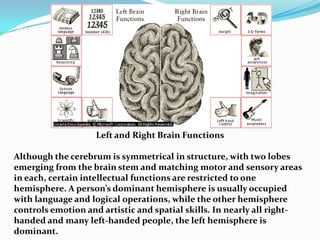
    Left and RightBrain Functions Although the cerebrum is symmetrical in structure, with two lobes emerging from the brain stem and matching motor and sensory areas in each, certain intellectual functions are restricted to one hemisphere. A person’s dominant hemisphere is usually occupied with language and logical operations, while the other hemisphere controls emotion and artistic and spatial skills. In nearly all right-handed and many left-handed people, the left hemisphere is dominant.