AP Psychology
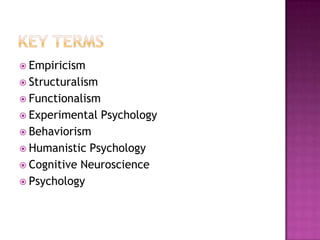
 Empiricism
 Structuralism
 Functionalism
 Experimental    Psychology
 Behaviorism
 Humanistic Psychology
 Cognitive Neuroscience
 Psychology
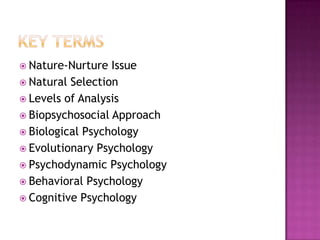
 Nature-Nurture  Issue
 Natural Selection
 Levels of Analysis
 Biopsychosocial Approach
 Biological Psychology
 Evolutionary Psychology
 Psychodynamic Psychology
 Behavioral Psychology
 Cognitive Psychology
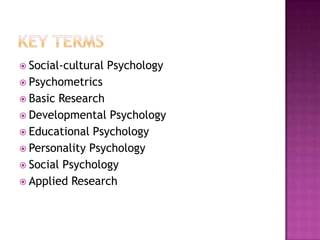
 Social-cultural   Psychology
 Psychometrics
 Basic Research
 Developmental Psychology
 Educational Psychology
 Personality Psychology
 Social Psychology
 Applied Research
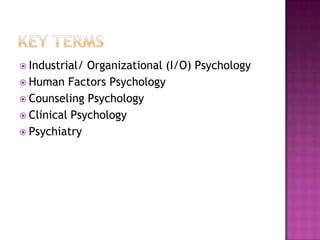
 Industrial/ Organizational (I/O) Psychology
 Human Factors Psychology
 Counseling Psychology
 Clinical Psychology
 Psychiatry
 Psychology   is a science
    Uses scientific methodology to study behavior
     and mental processes
    A wide ranging discipline that can encompass any
     aspect of human and nonhuman behavior
    Developed from the more established fields of
     philosophy and biology
 Socrates  (469-399 BC)
 Plato (428-348 BC)
 Aristotle (384-322 BC)
 Rene Descartes (1595-1650)
    Promoted Dualism- mind and body are seperate
 FrancisBacon (1561-1626)
 John Locke (1632-1704)
    Tabula Rasa (this aided in forming Empiricism)
 William   Wundt
    The birth of modern psychology occurred in
     December 1879 in Leipzig, Germany
    Wundt, Max Friedrich, and G. Stanley Hall
     collected data for Friedrich’s dissertation on “the
     duration of apperception” (the time lag between
     the subject's recognition that he has heard the
     ball hit the platform and his pressing of the
     telegraph key)
 Edward    Bradford Titchener
 WilliamJames
 Mary Whiton Calkins
    First female to earn a Ph.D. in Psychology at
     Harvard, but was denied her degree
 Margaret   Floy Washburn
    First female to receive a psychology Ph.D.
 Dorothea Dix
 Charles Darwin
    Natural selection shapes behaviors as well as
     bodies
 John  B. Watson
 B. F. Skinner
 Sigmund Freud
 Carl Rogers
 Abraham Maslow
 Charles DarwinIvan Pavlov
 Jean Piaget
 Structuralism
 Functionalism
 Behaviorism
 Uses introspection to explore the structural
  elements of the human mind
 Has its basis in Wundt’s European
  perspective. Titchener established this
  school based on his work as Wudt’s student in
  Germany
 Sought to identify what the mind and
  consciousness were
 Focused  on how our mental and behavioral
  process function- how they enable us to
  adapt, survive, and flourish
 Based on William James’ ideas about
  psychology having practical applications to
  life
    Assumed thinking was adaptive
 Soughtto identify how the mind and
 consciousness worked
 Founded     by John B. Watson
     He believed environment is the main component
      of psychology (like Locke)
 The   view that psychology
     Should be an objective science
     Studies behavior without reference to mental
      processes
 B.F. Skinner rejected introspection and
 studied how consequences shape behavior
 Sigmund    Freud
    Id, Ego, Superego
 Focused
        on meaning of early childhood
 memories
 The  Third Force
 In the 1950s and 1960s, psychologist followed
  either the behaviorist or the psychoanalytic
  perspective. Humanistic psychology offered
  a third way of thinking about behavior
    Believes people are essentially good, unlike
     psychoanalytic psychologist
    Believes human were unique and distinct from
     animals, unlike behaviorist
 Emphasized  the importance of current
 environmental influences on our growth
 potential, and the importance of having our
 needs for love and acceptance satisfied
 Germany
 Studied how people organized perceptual
  experiences in understandable ways.
 Developed rules for how we organize what
  we sense and perceive
 “The whole is greater than the sum of its
  parts”
 Supported ideas developed by earlier
 psychologist, such as the importance of how
 our mid processes and retains information
 Do our human traits develop through
  experience or are we born with them?
 Evolution does not imply genetic
  determinism
 Behavior can be changed
 Organisms do not have a conscious or
  unconscious goal of maximizing gene
  reproduction.
    Rather they most adaptive traits will survive due
     to natural selection
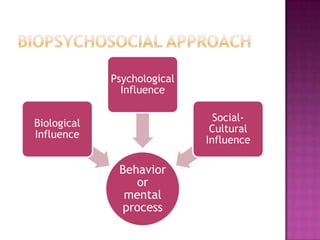
 Integrated  viewpoint incorporates various
  levels of analysis and offers a more complete
  picture of any given behavior or mental
  process
 Everything is related to everything else
Psychological
               Influence

                               Social-
Biological
                              Cultural
Influence
                             Influence

              Behavior
                 or
               mental
              process
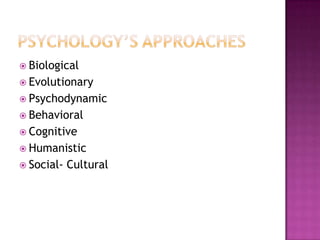
 Biological
 Evolutionary
 Psychodynamic
 Behavioral
 Cognitive
 Humanistic
 Social-   Cultural
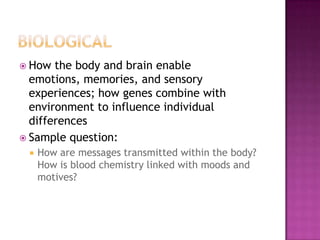
 How  the body and brain enable
  emotions, memories, and sensory
  experiences; how genes combine with
  environment to influence individual
  differences
 Sample question:
    How are messages transmitted within the body?
     How is blood chemistry linked with moods and
     motives?
 How  the natural selection of traits promoted
  the survival of genes
 Sample questions
    How does evolution influence behavior
     tendencies?
 How  behavior springs from unconscious
  drives and conflicts
 Sample question
    How can someone’s personality traits and
     disorders be explained in terms of sexual and
     aggressive drives or as the disguised effects of
     unfulfilled wishes and childhood traumas?
 How we learn observable responses
 Sample question
    How do we learn to fear particular objects or
     situations? What is the best way to alter our
     behavior, say, to lose weight or stop smoking?
 How  we encode, process, store, and retrieve
  information
 Sample question
    How do we use information in remembering?
     Reasoning? Solving problems?
 How we meet our needs for love and
  acceptance and achieve self-fulfillment
 Sample question
    How can we work toward fulfilling our potential?
     How can we overcome barriers to our personal
     growth?
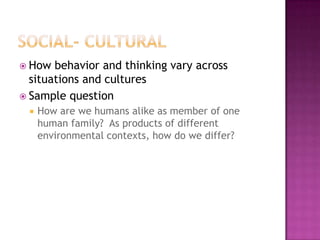
 How  behavior and thinking vary across
  situations and cultures
 Sample question
    How are we humans alike as member of one
     human family? As products of different
     environmental contexts, how do we differ?
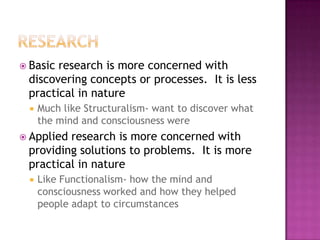
 Basicresearch is more concerned with
 discovering concepts or processes. It is less
 practical in nature
    Much like Structuralism- want to discover what
     the mind and consciousness were
 Appliedresearch is more concerned with
 providing solutions to problems. It is more
 practical in nature
    Like Functionalism- how the mind and
     consciousness worked and how they helped
     people adapt to circumstances
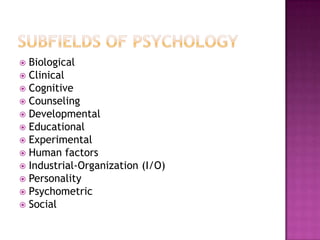
 Biological
 Clinical
 Cognitive
 Counseling
 Developmental
 Educational
 Experimental
 Human factors
 Industrial-Organization (I/O)
 Personality
 Psychometric
 Social
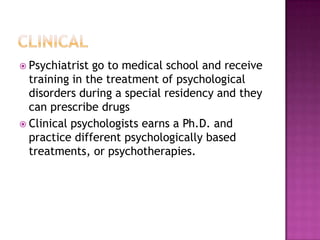
 Psychiatrist go to medical school and receive
  training in the treatment of psychological
  disorders during a special residency and they
  can prescribe drugs
 Clinical psychologists earns a Ph.D. and
  practice different psychologically based
  treatments, or psychotherapies.

History & Approaches

  • 1.
  • 2.
     Empiricism  Structuralism Functionalism  Experimental Psychology  Behaviorism  Humanistic Psychology  Cognitive Neuroscience  Psychology
  • 3.
     Nature-Nurture Issue  Natural Selection  Levels of Analysis  Biopsychosocial Approach  Biological Psychology  Evolutionary Psychology  Psychodynamic Psychology  Behavioral Psychology  Cognitive Psychology
  • 4.
     Social-cultural Psychology  Psychometrics  Basic Research  Developmental Psychology  Educational Psychology  Personality Psychology  Social Psychology  Applied Research
  • 5.
     Industrial/ Organizational(I/O) Psychology  Human Factors Psychology  Counseling Psychology  Clinical Psychology  Psychiatry
  • 6.
     Psychology is a science  Uses scientific methodology to study behavior and mental processes  A wide ranging discipline that can encompass any aspect of human and nonhuman behavior  Developed from the more established fields of philosophy and biology
  • 7.
     Socrates (469-399 BC)  Plato (428-348 BC)  Aristotle (384-322 BC)  Rene Descartes (1595-1650)  Promoted Dualism- mind and body are seperate  FrancisBacon (1561-1626)  John Locke (1632-1704)  Tabula Rasa (this aided in forming Empiricism)
  • 8.
     William Wundt  The birth of modern psychology occurred in December 1879 in Leipzig, Germany  Wundt, Max Friedrich, and G. Stanley Hall collected data for Friedrich’s dissertation on “the duration of apperception” (the time lag between the subject's recognition that he has heard the ball hit the platform and his pressing of the telegraph key)  Edward Bradford Titchener
  • 9.
     WilliamJames  MaryWhiton Calkins  First female to earn a Ph.D. in Psychology at Harvard, but was denied her degree  Margaret Floy Washburn  First female to receive a psychology Ph.D.  Dorothea Dix  Charles Darwin  Natural selection shapes behaviors as well as bodies
  • 10.
     John B. Watson  B. F. Skinner  Sigmund Freud  Carl Rogers  Abraham Maslow  Charles DarwinIvan Pavlov  Jean Piaget
  • 11.
  • 12.
     Uses introspectionto explore the structural elements of the human mind  Has its basis in Wundt’s European perspective. Titchener established this school based on his work as Wudt’s student in Germany  Sought to identify what the mind and consciousness were
  • 13.
     Focused on how our mental and behavioral process function- how they enable us to adapt, survive, and flourish  Based on William James’ ideas about psychology having practical applications to life  Assumed thinking was adaptive  Soughtto identify how the mind and consciousness worked
  • 14.
     Founded by John B. Watson  He believed environment is the main component of psychology (like Locke)  The view that psychology  Should be an objective science  Studies behavior without reference to mental processes  B.F. Skinner rejected introspection and studied how consequences shape behavior
  • 15.
     Sigmund Freud  Id, Ego, Superego  Focused on meaning of early childhood memories
  • 16.
     The Third Force  In the 1950s and 1960s, psychologist followed either the behaviorist or the psychoanalytic perspective. Humanistic psychology offered a third way of thinking about behavior  Believes people are essentially good, unlike psychoanalytic psychologist  Believes human were unique and distinct from animals, unlike behaviorist
  • 17.
     Emphasized the importance of current environmental influences on our growth potential, and the importance of having our needs for love and acceptance satisfied
  • 18.
     Germany  Studiedhow people organized perceptual experiences in understandable ways.  Developed rules for how we organize what we sense and perceive  “The whole is greater than the sum of its parts”
  • 19.
     Supported ideasdeveloped by earlier psychologist, such as the importance of how our mid processes and retains information
  • 20.
     Do ourhuman traits develop through experience or are we born with them?  Evolution does not imply genetic determinism  Behavior can be changed  Organisms do not have a conscious or unconscious goal of maximizing gene reproduction.  Rather they most adaptive traits will survive due to natural selection
  • 21.
     Integrated viewpoint incorporates various levels of analysis and offers a more complete picture of any given behavior or mental process  Everything is related to everything else
  • 22.
    Psychological Influence Social- Biological Cultural Influence Influence Behavior or mental process
  • 23.
     Biological  Evolutionary Psychodynamic  Behavioral  Cognitive  Humanistic  Social- Cultural
  • 24.
     How the body and brain enable emotions, memories, and sensory experiences; how genes combine with environment to influence individual differences  Sample question:  How are messages transmitted within the body? How is blood chemistry linked with moods and motives?
  • 25.
     How the natural selection of traits promoted the survival of genes  Sample questions  How does evolution influence behavior tendencies?
  • 26.
     How behavior springs from unconscious drives and conflicts  Sample question  How can someone’s personality traits and disorders be explained in terms of sexual and aggressive drives or as the disguised effects of unfulfilled wishes and childhood traumas?
  • 27.
     How welearn observable responses  Sample question  How do we learn to fear particular objects or situations? What is the best way to alter our behavior, say, to lose weight or stop smoking?
  • 28.
     How we encode, process, store, and retrieve information  Sample question  How do we use information in remembering? Reasoning? Solving problems?
  • 29.
     How wemeet our needs for love and acceptance and achieve self-fulfillment  Sample question  How can we work toward fulfilling our potential? How can we overcome barriers to our personal growth?
  • 30.
     How behavior and thinking vary across situations and cultures  Sample question  How are we humans alike as member of one human family? As products of different environmental contexts, how do we differ?
  • 31.
     Basicresearch ismore concerned with discovering concepts or processes. It is less practical in nature  Much like Structuralism- want to discover what the mind and consciousness were  Appliedresearch is more concerned with providing solutions to problems. It is more practical in nature  Like Functionalism- how the mind and consciousness worked and how they helped people adapt to circumstances
  • 32.
     Biological  Clinical Cognitive  Counseling  Developmental  Educational  Experimental  Human factors  Industrial-Organization (I/O)  Personality  Psychometric  Social
  • 33.
     Psychiatrist goto medical school and receive training in the treatment of psychological disorders during a special residency and they can prescribe drugs  Clinical psychologists earns a Ph.D. and practice different psychologically based treatments, or psychotherapies.