Psychology
Jammu University
2 Year B.Ed.
Paper 202
Sem: II
Unit: I
This work is licensed under a Creative Commons Attribution-ShareAlike 4.0 International
License.
Definitions
Eric Pettifor defines psychology as "an art which
presents itself as science".
H. D. Hamm defines psychology as the "scientific
study of the behavior of humans and animals"
Tom Bolling defines psychology as a science of
description and application used for the
"interpretation, prediction, development, and
improvement of human behavior" and that
psychology was originally a branch of philosophy.
The science that deals with mental processes and
behavior.
The scientific study of all forms of human and
animal behaviour, sometimes concerned with the
methods through which behaviour can be
modified.
the science of the mind or of mental states and
processes.
the science of human and animal behavior.
the sum of the mental states and processes
characteristic of a person or class of persons.
mental tricks or strategy
Psychology
 is the study of mind and behavior
 It is an academic discipline and an applied science
which seeks to understand individuals and groups by
establishing general principles and researching
specific cases.
 In this field, a professional practitioner or researcher is
called a psychologist and can be classified as a social,
behavioral, or cognitive scientist.
 Psychologists attempt to understand the role of mental
functions in individual and social behavior, while also
exploring the physiological and biological processes
that underlie cognitive functions and behaviors.
Psychologists explore concepts such as
perception, cognition, attention, emotion,
intelligence, phenomenology, motivation,
brain functioning, personality, behavior, and
interpersonal relationships, including
psychological resilience, family resilience,
and other areas. Psychologists of diverse
orientations also consider the unconscious
mind.
Psychologists employ empirical methods to infer
causal and correlational relationships between
psychosocial variables.
In addition, or in opposition, to employing
empirical and deductive methods, some—
especially clinical and counseling
psychologists—at times rely upon symbolic
interpretation and other inductive techniques.
Psychology has been described as a "hub
science", with psychological findings linking to
research and perspectives from the social
sciences, natural sciences, medicine, humanities,
and philosophy.
 While psychological knowledge is often applied to the
assessment and treatment of mental health problems, it is
also directed towards understanding and solving problems
in several spheres of human activity.
 The majority of psychologists are involved in some kind of
therapeutic role, practicing in clinical, counseling, or
school settings.
 Many do scientific research on a wide range of topics
related to mental processes and behavior, and typically
work in university psychology departments or teach in
other academic settings.
 Some are employed in industrial and organizational
settings, or in other areas such as human development and
aging, sports, health, and the media, as well as in forensic
investigation and other aspects of law.
The word psychology derives from Greek roots
meaning study of the psyche, or soul, "breath,
spirit, soul" and -logia, "study of" or "research").
The Latin word psychologia was first used by
the Croatian humanist and Latinist Marko
Marulić in his book, Psichiologia de ratione
animae humanae in the late 15th century or early
16th century.
 The earliest known reference to the word
psychology in English was by Steven Blankaart
in 1694 in The Physical Dictionary which refers
to "Anatomy, which treats the Body, and
Psychology, which treats of the Soul."
In 1890, William James defined psychology
as "the science of mental life, both of its
phenomena and their conditions".
John Watson, in 1913 defined the discipline
of psychology as the acquisition of
information useful to the control of behavior.
Historical Background of Psychology
 Traditionally: Gods and spirits were attributed the
power to direct or cause such events, activities and
behavior of men.
 Greek Influence: Democritus Believed that the human
mind and body is composed of atoms which could
circulate freely and which enabled it to penetrate the
whole body. According to him, atoms from our
environment enter through our sense organ enabling
us to perceive the world around us.
 Plato: The mind or soul has a distinct power and is
God-given. The soul is composed of three parts: Head
– exerts reason Heart – noble impulses Diaphragm –
own passions and desires
 Aristotle: believed that at birth, the mind is a
tabularasa, a blank sheet and that the experiences one
encounters during one’s lifetime are impressed on the
mind. Distinguished three functions of the soul:1.
Vegetative – concerned with basic maintenance of
life.2. Appetitive – concerned with motives and
desires.3. Rational – governing function.4. Introduces
common sense,
 Galen: Believes that differences in behavior is
attributed to the vital fluids / juices of the body: Blood
: Sanguine – cheerful; Phlegm: Phlegmatic – sluggish
/ flat affect; Black Bile: Melancholic – sad; Yellow
Bile: Choleric – bad temper
 Medieval Period
 St. Agustine: introduced and used the method of
Introspection (the description of one’s own conscious
process).
 Pre – Modern Period: Rene Descartes Formulated a
theory of mind-body interaction.
 John Locke: Introduced the Idea as the unit into which all
experiences may be analyzed.
 Scientific Psychology: Wilhelm Wundt A German
psychologist, founded his Psychological Laboratory at
Leizpeg, Germany which earned for the title of “Father of
Scientific Psychology” He first undertook through the
experimental approach, a systematic, scientific body of
knowledge about man’s interaction with his environment.
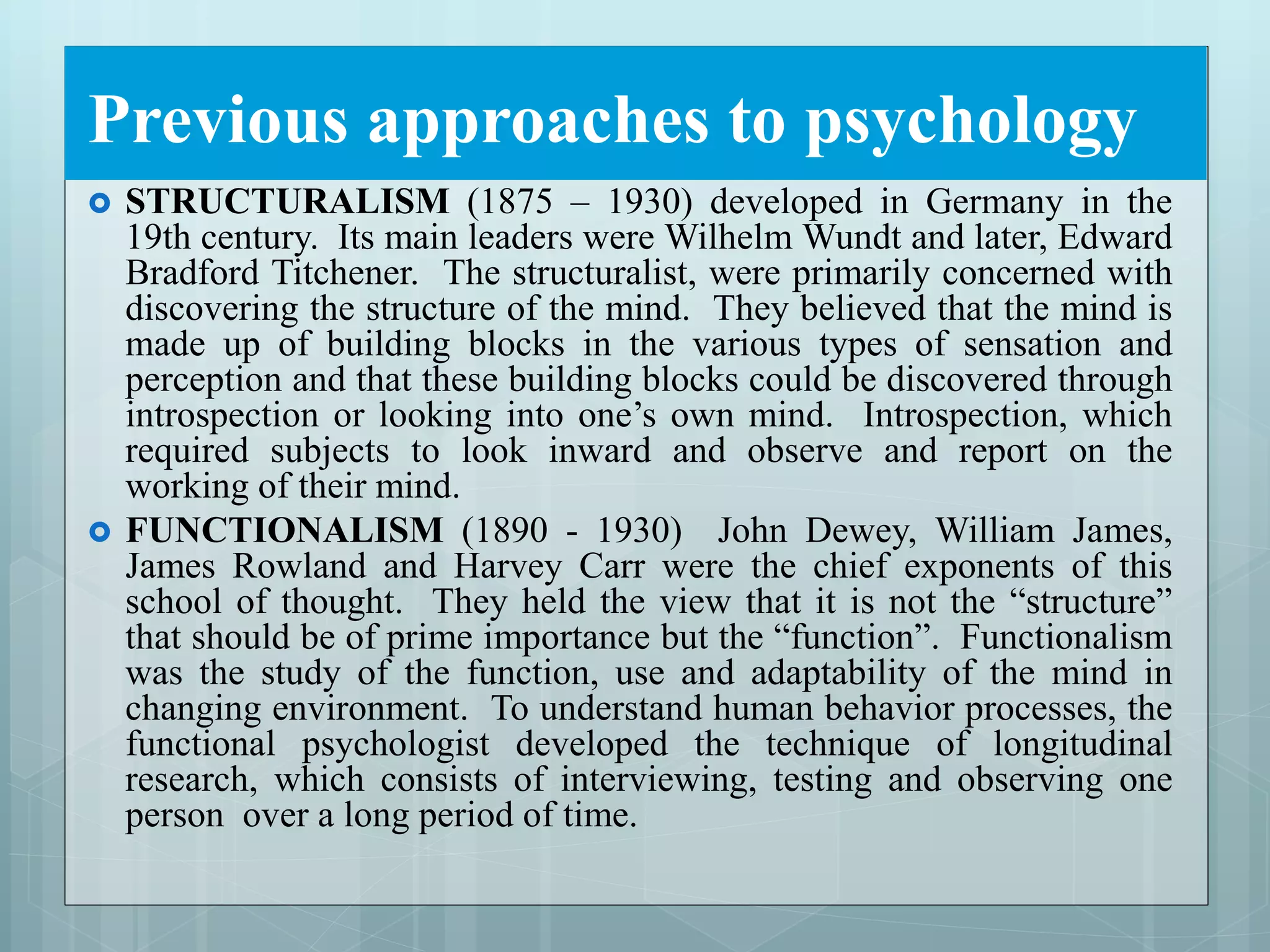
Previous approaches to psychology
 STRUCTURALISM (1875 – 1930) developed in Germany in the
19th century. Its main leaders were Wilhelm Wundt and later, Edward
Bradford Titchener. The structuralist, were primarily concerned with
discovering the structure of the mind. They believed that the mind is
made up of building blocks in the various types of sensation and
perception and that these building blocks could be discovered through
introspection or looking into one’s own mind. Introspection, which
required subjects to look inward and observe and report on the
working of their mind.
 FUNCTIONALISM (1890 - 1930) John Dewey, William James,
James Rowland and Harvey Carr were the chief exponents of this
school of thought. They held the view that it is not the “structure”
that should be of prime importance but the “function”. Functionalism
was the study of the function, use and adaptability of the mind in
changing environment. To understand human behavior processes, the
functional psychologist developed the technique of longitudinal
research, which consists of interviewing, testing and observing one
person over a long period of time.
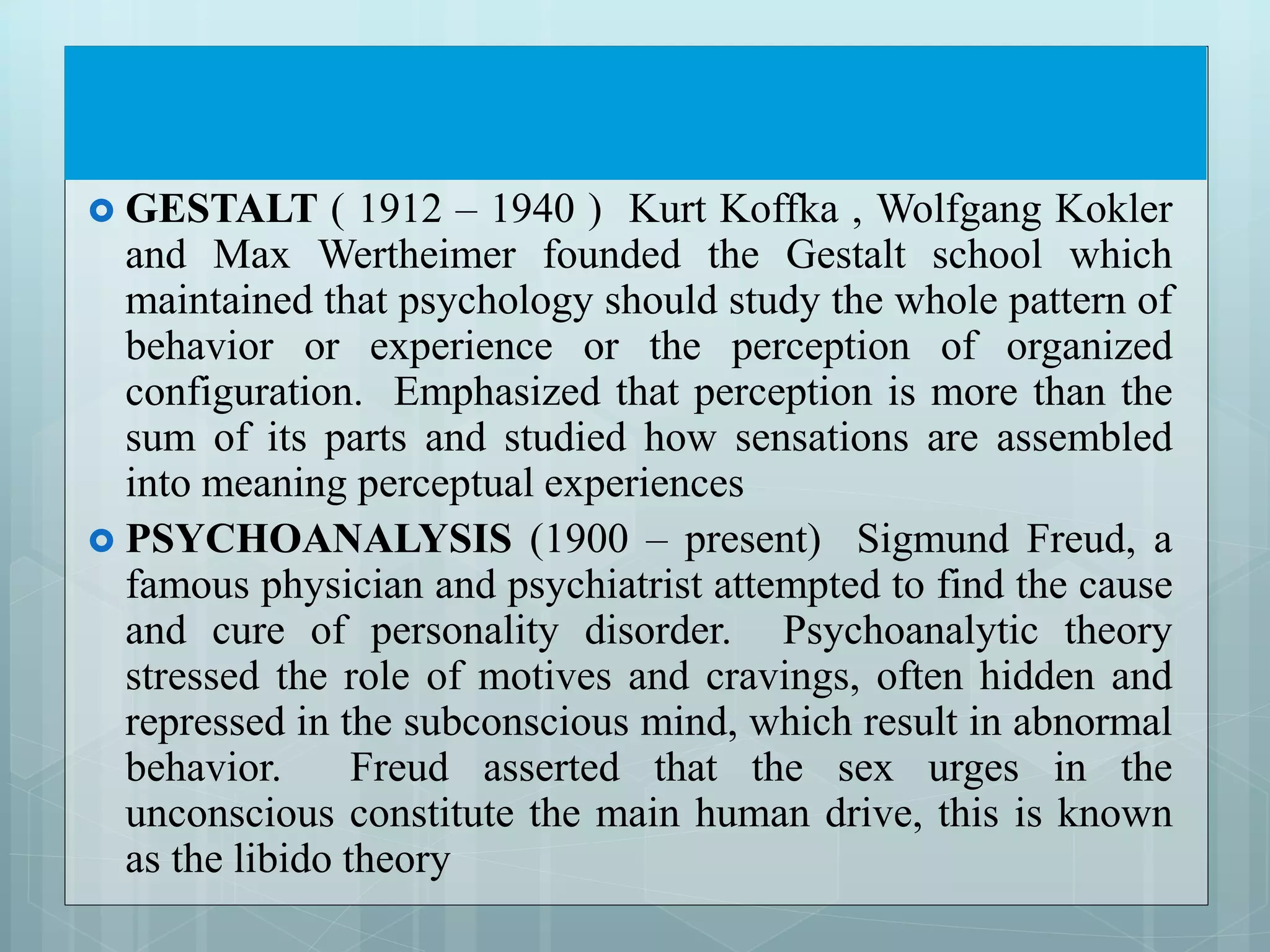
 GESTALT ( 1912 – 1940 ) Kurt Koffka , Wolfgang Kokler
and Max Wertheimer founded the Gestalt school which
maintained that psychology should study the whole pattern of
behavior or experience or the perception of organized
configuration. Emphasized that perception is more than the
sum of its parts and studied how sensations are assembled
into meaning perceptual experiences
 PSYCHOANALYSIS (1900 – present) Sigmund Freud, a
famous physician and psychiatrist attempted to find the cause
and cure of personality disorder. Psychoanalytic theory
stressed the role of motives and cravings, often hidden and
repressed in the subconscious mind, which result in abnormal
behavior. Freud asserted that the sex urges in the
unconscious constitute the main human drive, this is known
as the libido theory
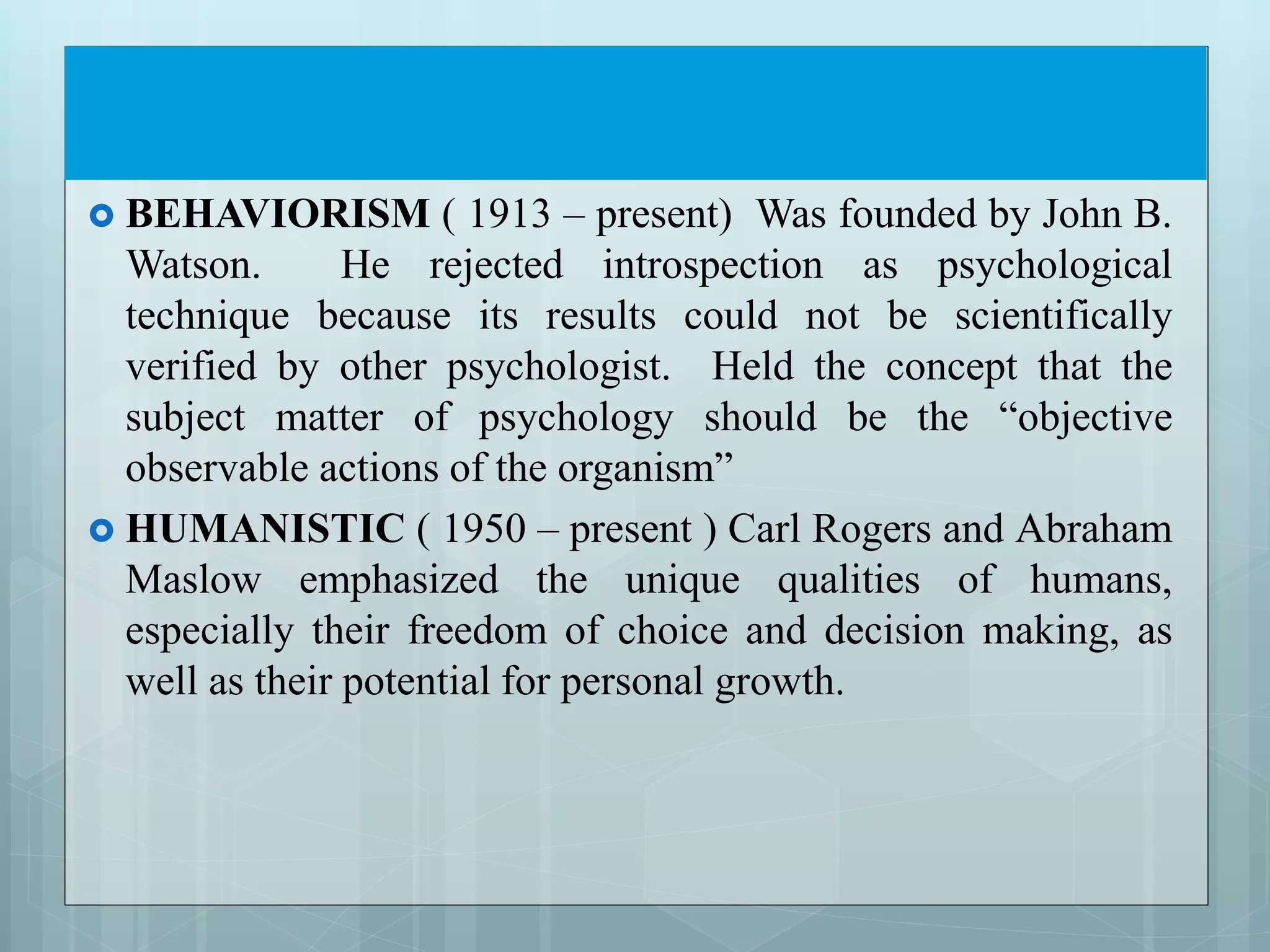
 BEHAVIORISM ( 1913 – present) Was founded by John B.
Watson. He rejected introspection as psychological
technique because its results could not be scientifically
verified by other psychologist. Held the concept that the
subject matter of psychology should be the “objective
observable actions of the organism”
 HUMANISTIC ( 1950 – present ) Carl Rogers and Abraham
Maslow emphasized the unique qualities of humans,
especially their freedom of choice and decision making, as
well as their potential for personal growth.
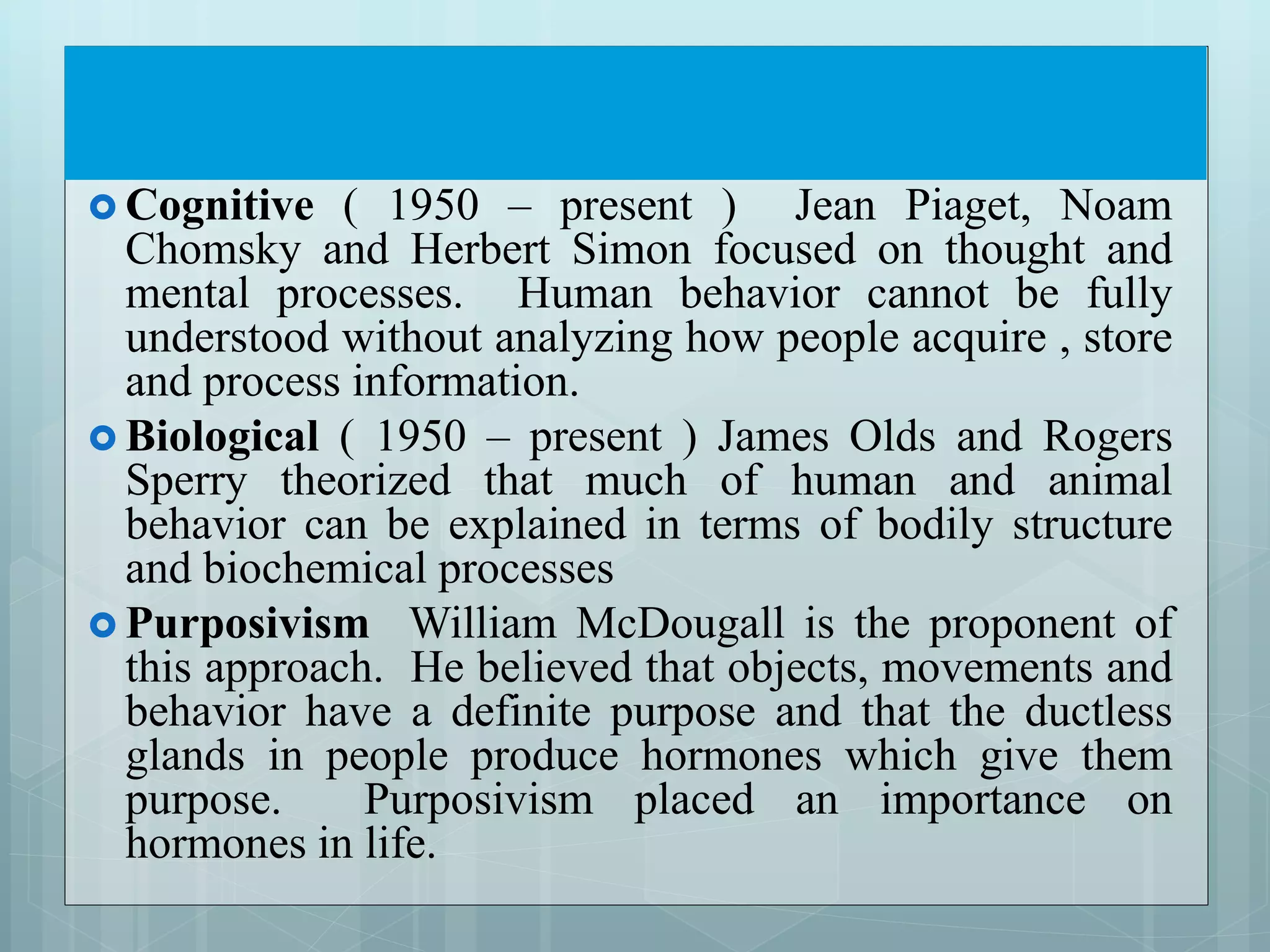
 Cognitive ( 1950 – present ) Jean Piaget, Noam
Chomsky and Herbert Simon focused on thought and
mental processes. Human behavior cannot be fully
understood without analyzing how people acquire , store
and process information.
 Biological ( 1950 – present ) James Olds and Rogers
Sperry theorized that much of human and animal
behavior can be explained in terms of bodily structure
and biochemical processes
 Purposivism William McDougall is the proponent of
this approach. He believed that objects, movements and
behavior have a definite purpose and that the ductless
glands in people produce hormones which give them
purpose. Purposivism placed an importance on
hormones in life.
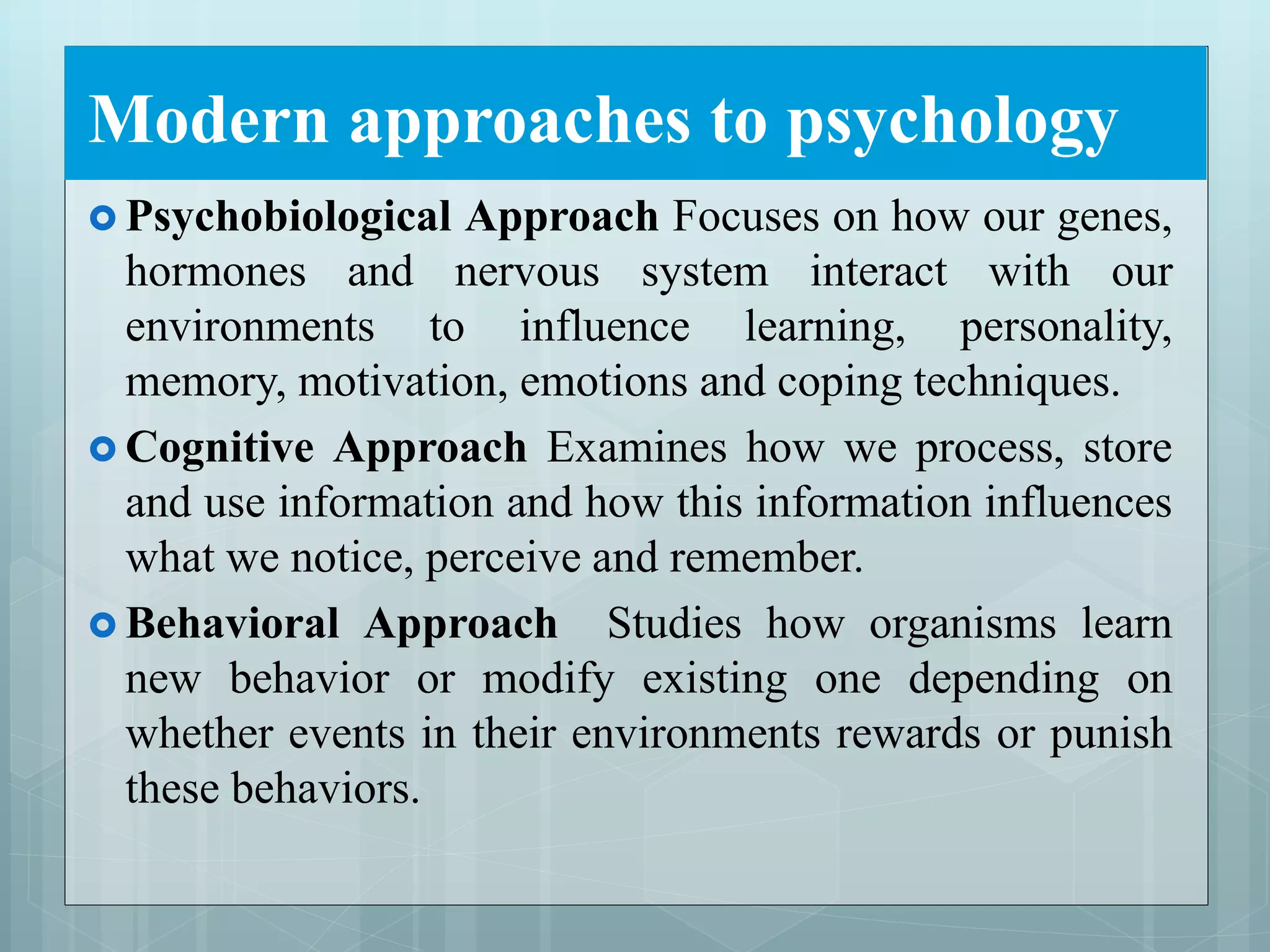
Modern approaches to psychology
 Psychobiological Approach Focuses on how our genes,
hormones and nervous system interact with our
environments to influence learning, personality,
memory, motivation, emotions and coping techniques.
 Cognitive Approach Examines how we process, store
and use information and how this information influences
what we notice, perceive and remember.
 Behavioral Approach Studies how organisms learn
new behavior or modify existing one depending on
whether events in their environments rewards or punish
these behaviors.
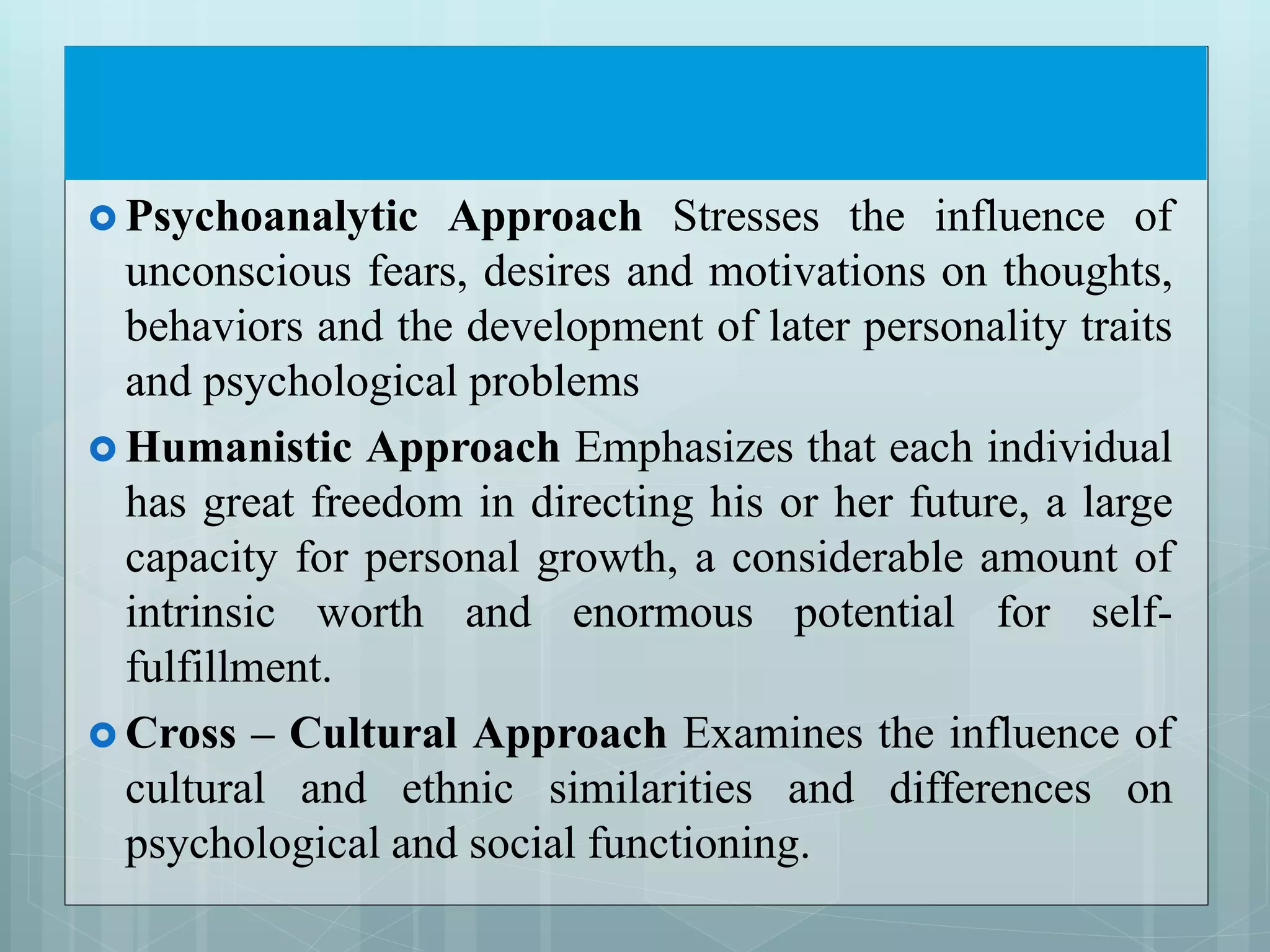
 Psychoanalytic Approach Stresses the influence of
unconscious fears, desires and motivations on thoughts,
behaviors and the development of later personality traits
and psychological problems
 Humanistic Approach Emphasizes that each individual
has great freedom in directing his or her future, a large
capacity for personal growth, a considerable amount of
intrinsic worth and enormous potential for self-
fulfillment.
 Cross – Cultural Approach Examines the influence of
cultural and ethnic similarities and differences on
psychological and social functioning.
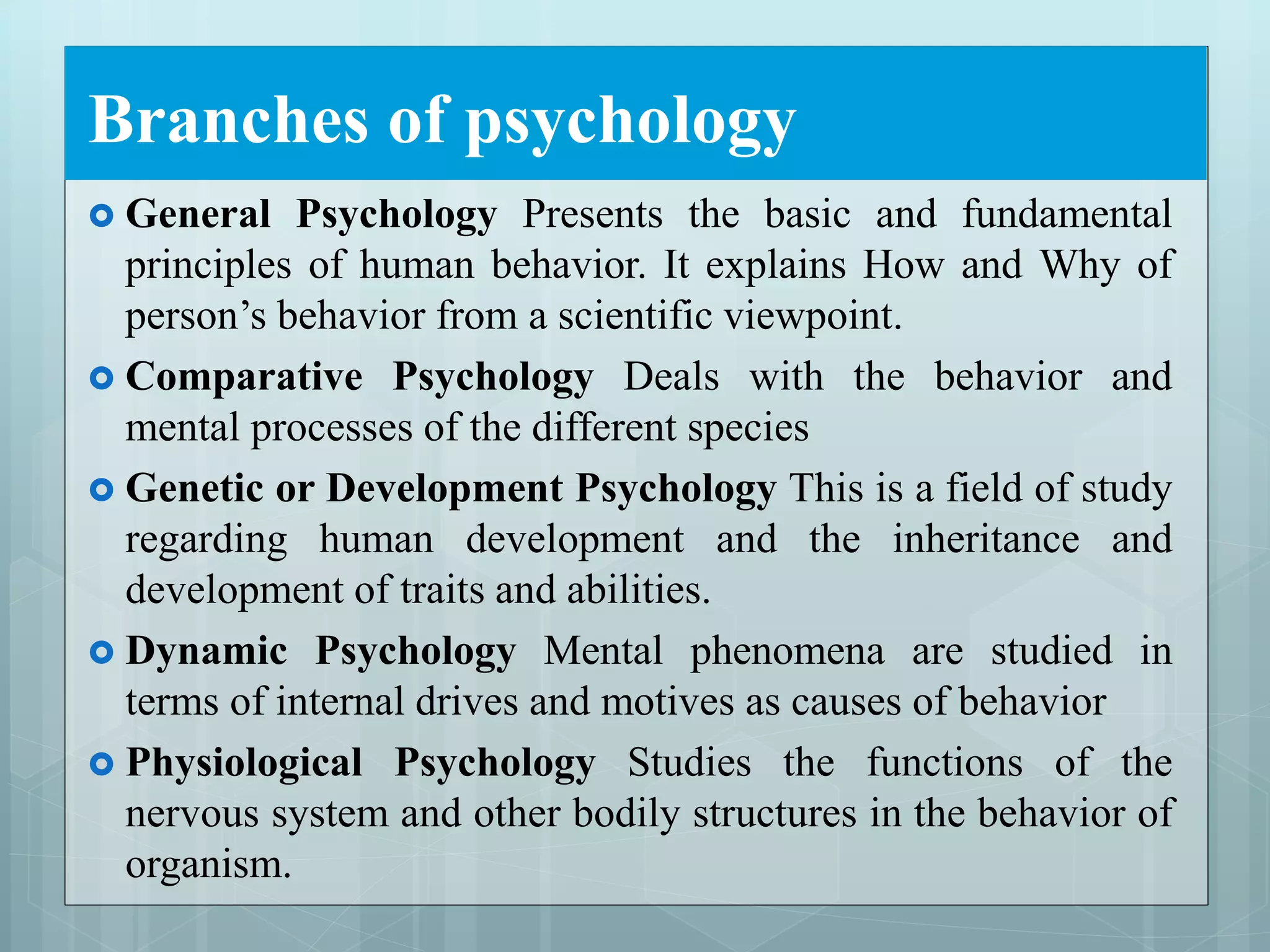
Branches of psychology
 General Psychology Presents the basic and fundamental
principles of human behavior. It explains How and Why of
person’s behavior from a scientific viewpoint.
 Comparative Psychology Deals with the behavior and
mental processes of the different species
 Genetic or Development Psychology This is a field of study
regarding human development and the inheritance and
development of traits and abilities.
 Dynamic Psychology Mental phenomena are studied in
terms of internal drives and motives as causes of behavior
 Physiological Psychology Studies the functions of the
nervous system and other bodily structures in the behavior of
organism.
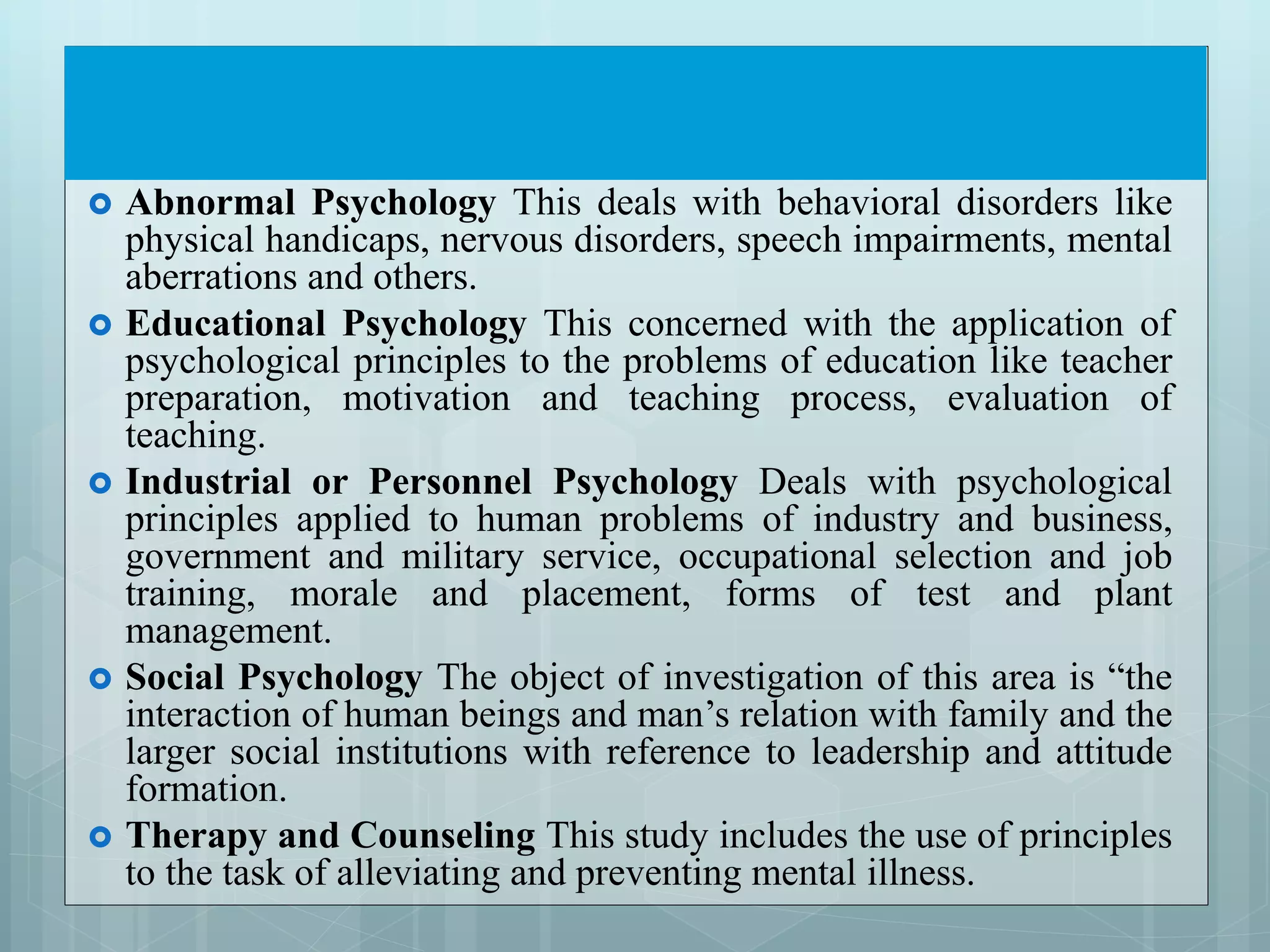
 Abnormal Psychology This deals with behavioral disorders like
physical handicaps, nervous disorders, speech impairments, mental
aberrations and others.
 Educational Psychology This concerned with the application of
psychological principles to the problems of education like teacher
preparation, motivation and teaching process, evaluation of
teaching.
 Industrial or Personnel Psychology Deals with psychological
principles applied to human problems of industry and business,
government and military service, occupational selection and job
training, morale and placement, forms of test and plant
management.
 Social Psychology The object of investigation of this area is “the
interaction of human beings and man’s relation with family and the
larger social institutions with reference to leadership and attitude
formation.
 Therapy and Counseling This study includes the use of principles
to the task of alleviating and preventing mental illness.
 Human Engineering This field adapts machines and
processes to the capabilities and limitations of human beings
– the reverse of fitting men to work conditions.
 Clinical Psychology This study uses concepts and methods
in the diagnosis and treatment of maladjustment and mental
disorders in clinical setting – like behavior abnormalities
ranging from reading or spelling to major mental disorders.
 Psychometric Psychology Concerned with the application of
mathematical procedures to the problems of psychology like
testing, the use of norms, central tendencies and the like.
 Legal Psychology Deals with the application of
psychological knowledge in the field of law relating to the
study of human behavior.
Major schools of thought
Biological
Behavioral
Cognitive
Social
Psychoanalysis
Existential-humanistic theories
Applications
Mental testing
Mental health care
Education
Work
Military and intelligence
Health, well-being, and social change
. Research areas
Cognitive development
Social and emotional development
Physical development
Memory development

Psychology: Introduction

  • 1.
    Psychology Jammu University 2 YearB.Ed. Paper 202 Sem: II Unit: I This work is licensed under a Creative Commons Attribution-ShareAlike 4.0 International License.
  • 2.
    Definitions Eric Pettifor definespsychology as "an art which presents itself as science". H. D. Hamm defines psychology as the "scientific study of the behavior of humans and animals" Tom Bolling defines psychology as a science of description and application used for the "interpretation, prediction, development, and improvement of human behavior" and that psychology was originally a branch of philosophy.
  • 3.
    The science thatdeals with mental processes and behavior. The scientific study of all forms of human and animal behaviour, sometimes concerned with the methods through which behaviour can be modified. the science of the mind or of mental states and processes. the science of human and animal behavior. the sum of the mental states and processes characteristic of a person or class of persons. mental tricks or strategy
  • 4.
    Psychology  is thestudy of mind and behavior  It is an academic discipline and an applied science which seeks to understand individuals and groups by establishing general principles and researching specific cases.  In this field, a professional practitioner or researcher is called a psychologist and can be classified as a social, behavioral, or cognitive scientist.  Psychologists attempt to understand the role of mental functions in individual and social behavior, while also exploring the physiological and biological processes that underlie cognitive functions and behaviors.
  • 5.
    Psychologists explore conceptssuch as perception, cognition, attention, emotion, intelligence, phenomenology, motivation, brain functioning, personality, behavior, and interpersonal relationships, including psychological resilience, family resilience, and other areas. Psychologists of diverse orientations also consider the unconscious mind.
  • 6.
    Psychologists employ empiricalmethods to infer causal and correlational relationships between psychosocial variables. In addition, or in opposition, to employing empirical and deductive methods, some— especially clinical and counseling psychologists—at times rely upon symbolic interpretation and other inductive techniques. Psychology has been described as a "hub science", with psychological findings linking to research and perspectives from the social sciences, natural sciences, medicine, humanities, and philosophy.
  • 7.
     While psychologicalknowledge is often applied to the assessment and treatment of mental health problems, it is also directed towards understanding and solving problems in several spheres of human activity.  The majority of psychologists are involved in some kind of therapeutic role, practicing in clinical, counseling, or school settings.  Many do scientific research on a wide range of topics related to mental processes and behavior, and typically work in university psychology departments or teach in other academic settings.  Some are employed in industrial and organizational settings, or in other areas such as human development and aging, sports, health, and the media, as well as in forensic investigation and other aspects of law.
  • 8.
    The word psychologyderives from Greek roots meaning study of the psyche, or soul, "breath, spirit, soul" and -logia, "study of" or "research"). The Latin word psychologia was first used by the Croatian humanist and Latinist Marko Marulić in his book, Psichiologia de ratione animae humanae in the late 15th century or early 16th century.  The earliest known reference to the word psychology in English was by Steven Blankaart in 1694 in The Physical Dictionary which refers to "Anatomy, which treats the Body, and Psychology, which treats of the Soul."
  • 9.
    In 1890, WilliamJames defined psychology as "the science of mental life, both of its phenomena and their conditions". John Watson, in 1913 defined the discipline of psychology as the acquisition of information useful to the control of behavior.
  • 10.
    Historical Background ofPsychology  Traditionally: Gods and spirits were attributed the power to direct or cause such events, activities and behavior of men.  Greek Influence: Democritus Believed that the human mind and body is composed of atoms which could circulate freely and which enabled it to penetrate the whole body. According to him, atoms from our environment enter through our sense organ enabling us to perceive the world around us.  Plato: The mind or soul has a distinct power and is God-given. The soul is composed of three parts: Head – exerts reason Heart – noble impulses Diaphragm – own passions and desires
  • 11.
     Aristotle: believedthat at birth, the mind is a tabularasa, a blank sheet and that the experiences one encounters during one’s lifetime are impressed on the mind. Distinguished three functions of the soul:1. Vegetative – concerned with basic maintenance of life.2. Appetitive – concerned with motives and desires.3. Rational – governing function.4. Introduces common sense,  Galen: Believes that differences in behavior is attributed to the vital fluids / juices of the body: Blood : Sanguine – cheerful; Phlegm: Phlegmatic – sluggish / flat affect; Black Bile: Melancholic – sad; Yellow Bile: Choleric – bad temper
  • 12.
     Medieval Period St. Agustine: introduced and used the method of Introspection (the description of one’s own conscious process).  Pre – Modern Period: Rene Descartes Formulated a theory of mind-body interaction.  John Locke: Introduced the Idea as the unit into which all experiences may be analyzed.  Scientific Psychology: Wilhelm Wundt A German psychologist, founded his Psychological Laboratory at Leizpeg, Germany which earned for the title of “Father of Scientific Psychology” He first undertook through the experimental approach, a systematic, scientific body of knowledge about man’s interaction with his environment.
  • 13.
    Previous approaches topsychology  STRUCTURALISM (1875 – 1930) developed in Germany in the 19th century. Its main leaders were Wilhelm Wundt and later, Edward Bradford Titchener. The structuralist, were primarily concerned with discovering the structure of the mind. They believed that the mind is made up of building blocks in the various types of sensation and perception and that these building blocks could be discovered through introspection or looking into one’s own mind. Introspection, which required subjects to look inward and observe and report on the working of their mind.  FUNCTIONALISM (1890 - 1930) John Dewey, William James, James Rowland and Harvey Carr were the chief exponents of this school of thought. They held the view that it is not the “structure” that should be of prime importance but the “function”. Functionalism was the study of the function, use and adaptability of the mind in changing environment. To understand human behavior processes, the functional psychologist developed the technique of longitudinal research, which consists of interviewing, testing and observing one person over a long period of time.
  • 14.
     GESTALT (1912 – 1940 ) Kurt Koffka , Wolfgang Kokler and Max Wertheimer founded the Gestalt school which maintained that psychology should study the whole pattern of behavior or experience or the perception of organized configuration. Emphasized that perception is more than the sum of its parts and studied how sensations are assembled into meaning perceptual experiences  PSYCHOANALYSIS (1900 – present) Sigmund Freud, a famous physician and psychiatrist attempted to find the cause and cure of personality disorder. Psychoanalytic theory stressed the role of motives and cravings, often hidden and repressed in the subconscious mind, which result in abnormal behavior. Freud asserted that the sex urges in the unconscious constitute the main human drive, this is known as the libido theory
  • 15.
     BEHAVIORISM (1913 – present) Was founded by John B. Watson. He rejected introspection as psychological technique because its results could not be scientifically verified by other psychologist. Held the concept that the subject matter of psychology should be the “objective observable actions of the organism”  HUMANISTIC ( 1950 – present ) Carl Rogers and Abraham Maslow emphasized the unique qualities of humans, especially their freedom of choice and decision making, as well as their potential for personal growth.
  • 16.
     Cognitive (1950 – present ) Jean Piaget, Noam Chomsky and Herbert Simon focused on thought and mental processes. Human behavior cannot be fully understood without analyzing how people acquire , store and process information.  Biological ( 1950 – present ) James Olds and Rogers Sperry theorized that much of human and animal behavior can be explained in terms of bodily structure and biochemical processes  Purposivism William McDougall is the proponent of this approach. He believed that objects, movements and behavior have a definite purpose and that the ductless glands in people produce hormones which give them purpose. Purposivism placed an importance on hormones in life.
  • 17.
    Modern approaches topsychology  Psychobiological Approach Focuses on how our genes, hormones and nervous system interact with our environments to influence learning, personality, memory, motivation, emotions and coping techniques.  Cognitive Approach Examines how we process, store and use information and how this information influences what we notice, perceive and remember.  Behavioral Approach Studies how organisms learn new behavior or modify existing one depending on whether events in their environments rewards or punish these behaviors.
  • 18.
     Psychoanalytic ApproachStresses the influence of unconscious fears, desires and motivations on thoughts, behaviors and the development of later personality traits and psychological problems  Humanistic Approach Emphasizes that each individual has great freedom in directing his or her future, a large capacity for personal growth, a considerable amount of intrinsic worth and enormous potential for self- fulfillment.  Cross – Cultural Approach Examines the influence of cultural and ethnic similarities and differences on psychological and social functioning.
  • 19.
    Branches of psychology General Psychology Presents the basic and fundamental principles of human behavior. It explains How and Why of person’s behavior from a scientific viewpoint.  Comparative Psychology Deals with the behavior and mental processes of the different species  Genetic or Development Psychology This is a field of study regarding human development and the inheritance and development of traits and abilities.  Dynamic Psychology Mental phenomena are studied in terms of internal drives and motives as causes of behavior  Physiological Psychology Studies the functions of the nervous system and other bodily structures in the behavior of organism.
  • 20.
     Abnormal PsychologyThis deals with behavioral disorders like physical handicaps, nervous disorders, speech impairments, mental aberrations and others.  Educational Psychology This concerned with the application of psychological principles to the problems of education like teacher preparation, motivation and teaching process, evaluation of teaching.  Industrial or Personnel Psychology Deals with psychological principles applied to human problems of industry and business, government and military service, occupational selection and job training, morale and placement, forms of test and plant management.  Social Psychology The object of investigation of this area is “the interaction of human beings and man’s relation with family and the larger social institutions with reference to leadership and attitude formation.  Therapy and Counseling This study includes the use of principles to the task of alleviating and preventing mental illness.
  • 21.
     Human EngineeringThis field adapts machines and processes to the capabilities and limitations of human beings – the reverse of fitting men to work conditions.  Clinical Psychology This study uses concepts and methods in the diagnosis and treatment of maladjustment and mental disorders in clinical setting – like behavior abnormalities ranging from reading or spelling to major mental disorders.  Psychometric Psychology Concerned with the application of mathematical procedures to the problems of psychology like testing, the use of norms, central tendencies and the like.  Legal Psychology Deals with the application of psychological knowledge in the field of law relating to the study of human behavior.
  • 22.
    Major schools ofthought Biological Behavioral Cognitive Social Psychoanalysis Existential-humanistic theories
  • 23.
    Applications Mental testing Mental healthcare Education Work Military and intelligence Health, well-being, and social change
  • 24.
    . Research areas Cognitivedevelopment Social and emotional development Physical development Memory development