FUNCTIONALISM
WILLIAM
JAMES
THEORY
BY FATEMA PATEL
FUNCTIONALISM
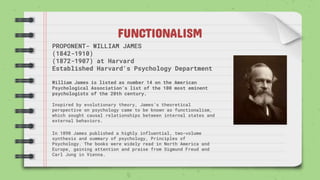
PROPONENT- WILLIAM JAMES
(1842-1910)
(1872-1907) at Harvard
Established Harvard's Psychology Department
William James is listed as number 14 on the American
Psychological Association’s list of the 100 most eminent
psychologists of the 20th century.
Inspired by evolutionary theory, James’s theoretical
perspective on psychology came to be known as functionalism,
which sought causal relationships between internal states and
external behaviors.
In 1890 James published a highly influential, two-volume
synthesis and summary of psychology, Principles of
Psychology. The books were widely read in North America and
Europe, gaining attention and praise from Sigmund Freud and
Carl Jung in Vienna.
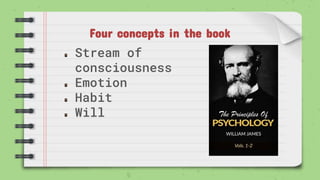
Four concepts in the book
Stream of
consciousness
Emotion
Habit
Will
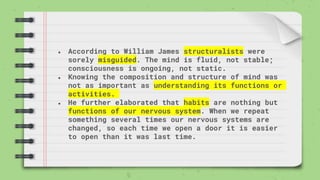
Influenced by
Charles Darwin
and his theory of
natural selection
in the 19th
century.
● According to William James structuralists were
sorely misguided. The mind is fluid, not stable;
consciousness is ongoing, not static.
● Knowing the composition and structure of mind was
not as important as understanding its functions or
activities.
● He further elaborated that habits are nothing but
functions of our nervous system. When we repeat
something several times our nervous systems are
changed, so each time we open a door it is easier
to open than it was last time.
First, how the mind
operates i.e., how the
elements of mind work
together.
And second, how mental
processes promote
adaptation.
Purpose of
the study
To study functioning of
mind. Function in this
sense can mean two things.
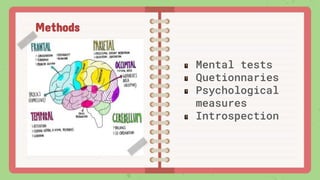
Mental tests
Quetionnaries
Psychological
measures
Introspection
Methods
Influence of
functionalism
on psychology
Functionalism was
criticized perhaps
most famously by
Wundt. "It is
literature. It is
beautiful, but it is
not psychology," he
said of functionalist
William James’ book
The Principles of
Psychology.
Functionalism also influenced
the educational system,
especially with regards to John
Dewey’s belief that children
should learn at the level for
which they are developmentally
prepared.
Functionalism prompted
the development of
behaviorism and applied
psychology.
Criticism
SUMMARY
Advocated by William James.
This theory is less concentrated on identifying
the composition of the human mind, and more
concentrated on various adaptations of the human
mind to different environments.
Focused on how things worked together
Used objective techniques to explore memories and
emotions.
However, the main drawbacks identified in this
theory include its extreme focus on objective
matters where the subjective tendencies of human
behavior have been completely ignored.

William James' Functionalism

  • 1.
  • 2.
    FUNCTIONALISM PROPONENT- WILLIAM JAMES (1842-1910) (1872-1907)at Harvard Established Harvard's Psychology Department William James is listed as number 14 on the American Psychological Association’s list of the 100 most eminent psychologists of the 20th century. Inspired by evolutionary theory, James’s theoretical perspective on psychology came to be known as functionalism, which sought causal relationships between internal states and external behaviors. In 1890 James published a highly influential, two-volume synthesis and summary of psychology, Principles of Psychology. The books were widely read in North America and Europe, gaining attention and praise from Sigmund Freud and Carl Jung in Vienna.
  • 3.
    Four concepts inthe book Stream of consciousness Emotion Habit Will
  • 4.
    Influenced by Charles Darwin andhis theory of natural selection in the 19th century.
  • 5.
    ● According toWilliam James structuralists were sorely misguided. The mind is fluid, not stable; consciousness is ongoing, not static. ● Knowing the composition and structure of mind was not as important as understanding its functions or activities. ● He further elaborated that habits are nothing but functions of our nervous system. When we repeat something several times our nervous systems are changed, so each time we open a door it is easier to open than it was last time.
  • 6.
    First, how themind operates i.e., how the elements of mind work together. And second, how mental processes promote adaptation. Purpose of the study To study functioning of mind. Function in this sense can mean two things.
  • 7.
  • 8.
    Influence of functionalism on psychology Functionalismwas criticized perhaps most famously by Wundt. "It is literature. It is beautiful, but it is not psychology," he said of functionalist William James’ book The Principles of Psychology. Functionalism also influenced the educational system, especially with regards to John Dewey’s belief that children should learn at the level for which they are developmentally prepared. Functionalism prompted the development of behaviorism and applied psychology. Criticism
  • 9.
    SUMMARY Advocated by WilliamJames. This theory is less concentrated on identifying the composition of the human mind, and more concentrated on various adaptations of the human mind to different environments. Focused on how things worked together Used objective techniques to explore memories and emotions. However, the main drawbacks identified in this theory include its extreme focus on objective matters where the subjective tendencies of human behavior have been completely ignored.