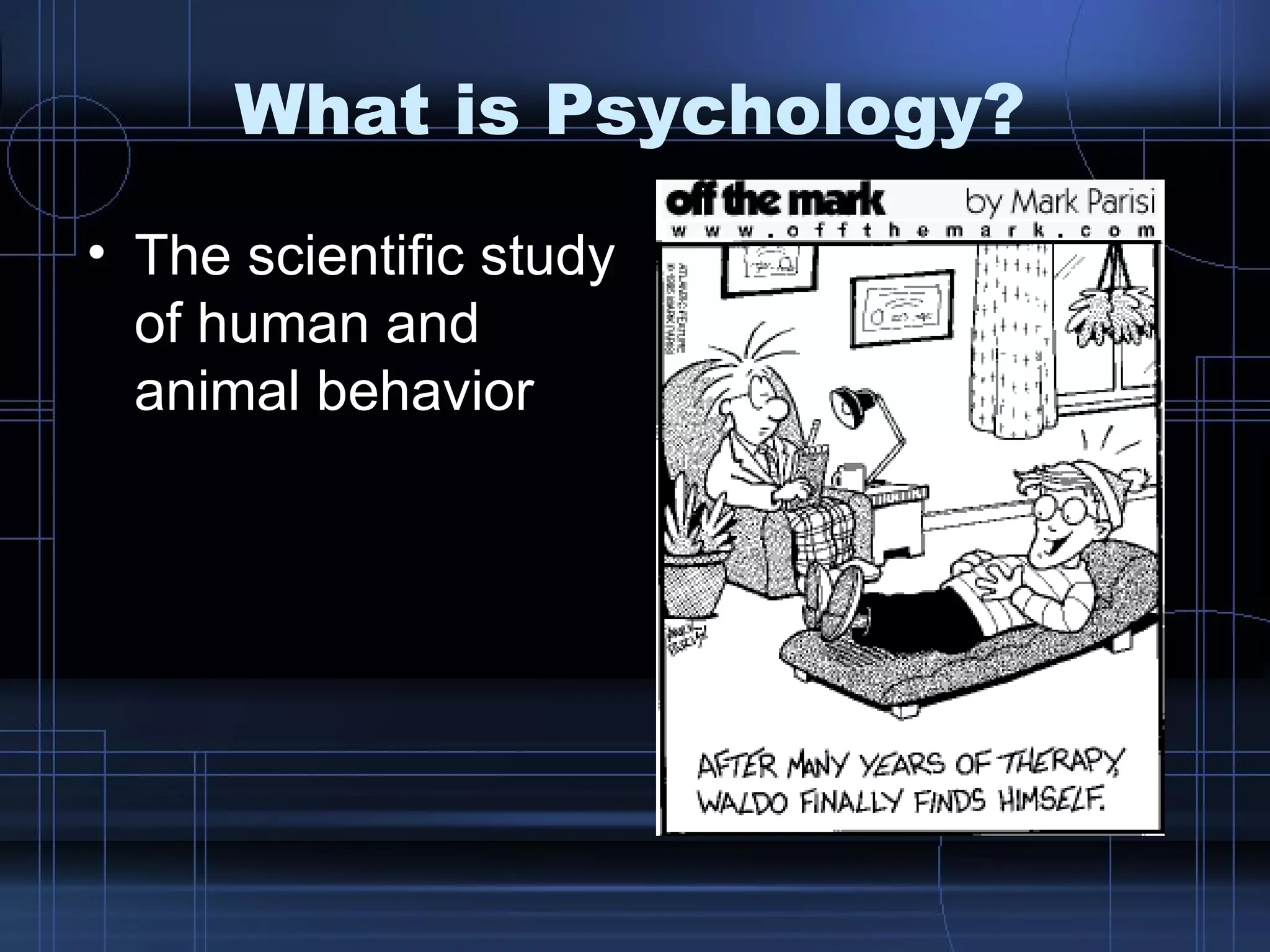
What is Psychology? The scientific study of human and animal behavior
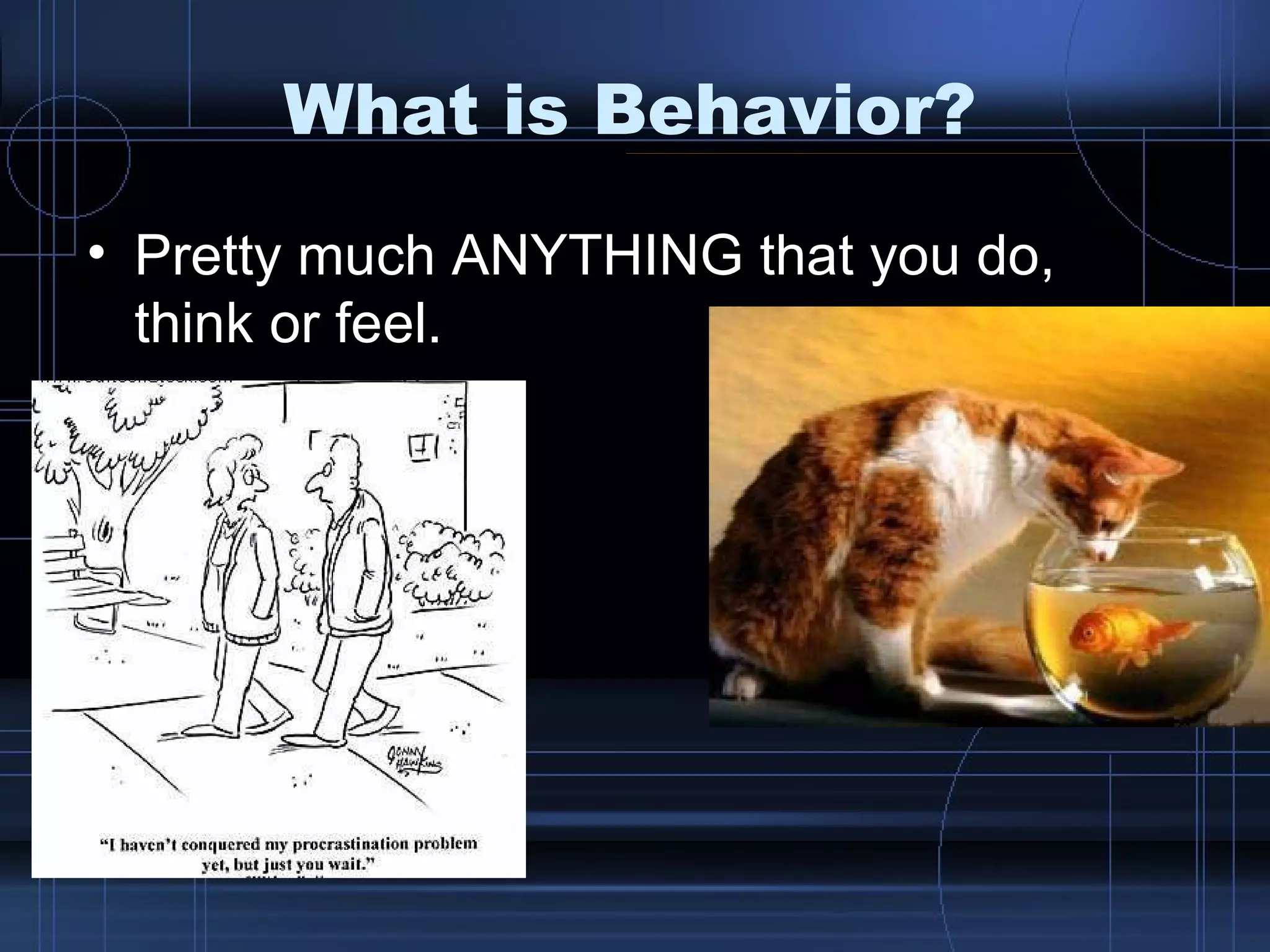
What is Behavior? Pretty much ANYTHING that you do, think or feel.
Types of Psychology Research:  Studies why things happen. Deals with theories and lab experiments “Lab tests show people’s anxiety level increases when surrounded by the color red.” Applied:  Figures out how to USE information found by researchers “NASA scientists study which colors to paint the inside of the International Space Station”
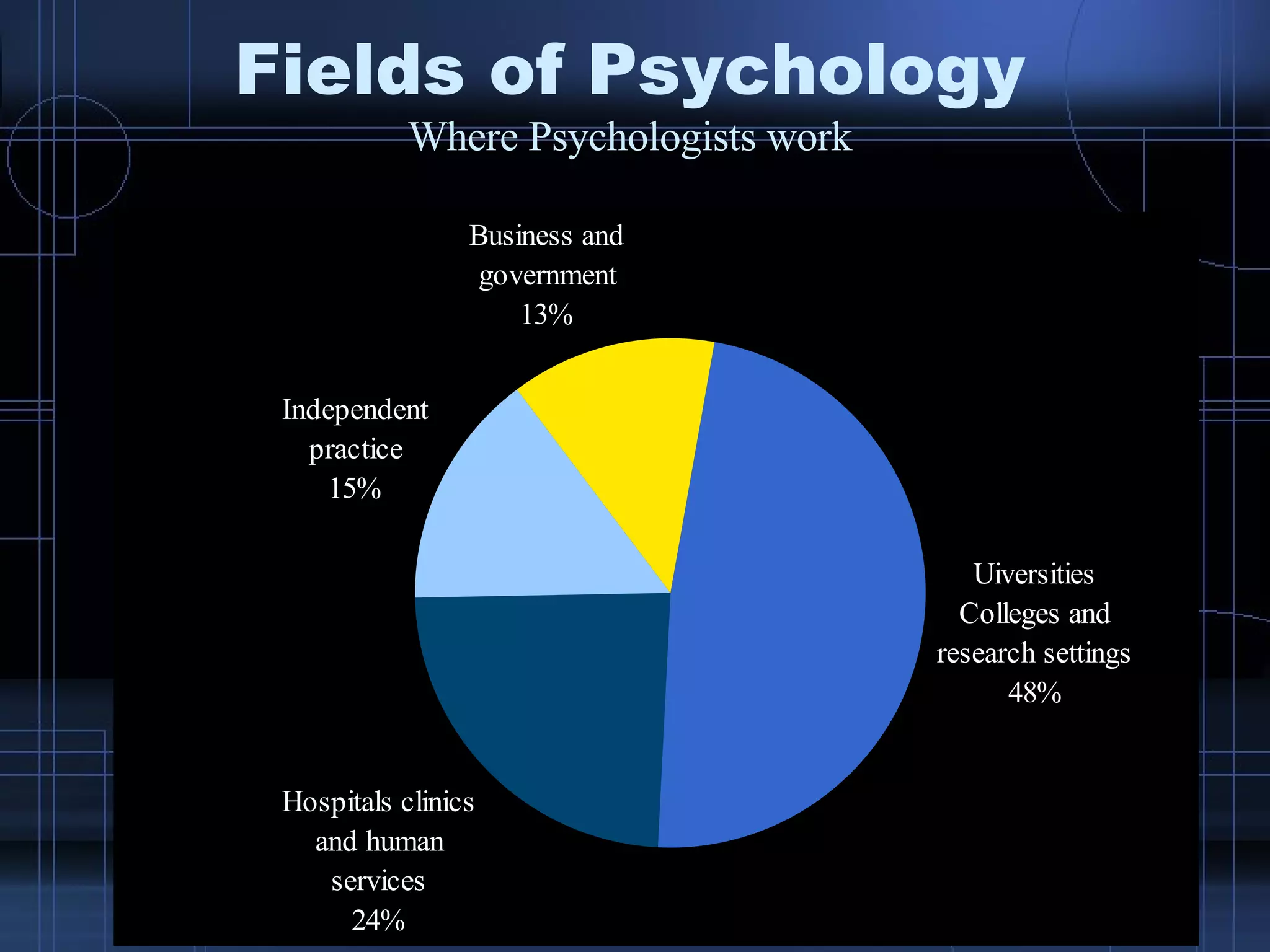
Fields of Psychology Where Psychologists work
Example fields (p21-22) Clinical Psychology – therapists etc Educational Psychology – therapists for kids, help ID and aid learning styles and issues Child Psych – how the brain grows and learns to learn.  Also – how to parent Environmental Psych – coping with disasters, crowding, workplace environment
Example Fields continued Industrial Psych – marketing, public relations, efficiency Engineering Psych – human / machine interaction, design casinos Experimental Psych – usually research people. Lab experiments. Colleges Teaching – this class for instance
History of Psychology The founders
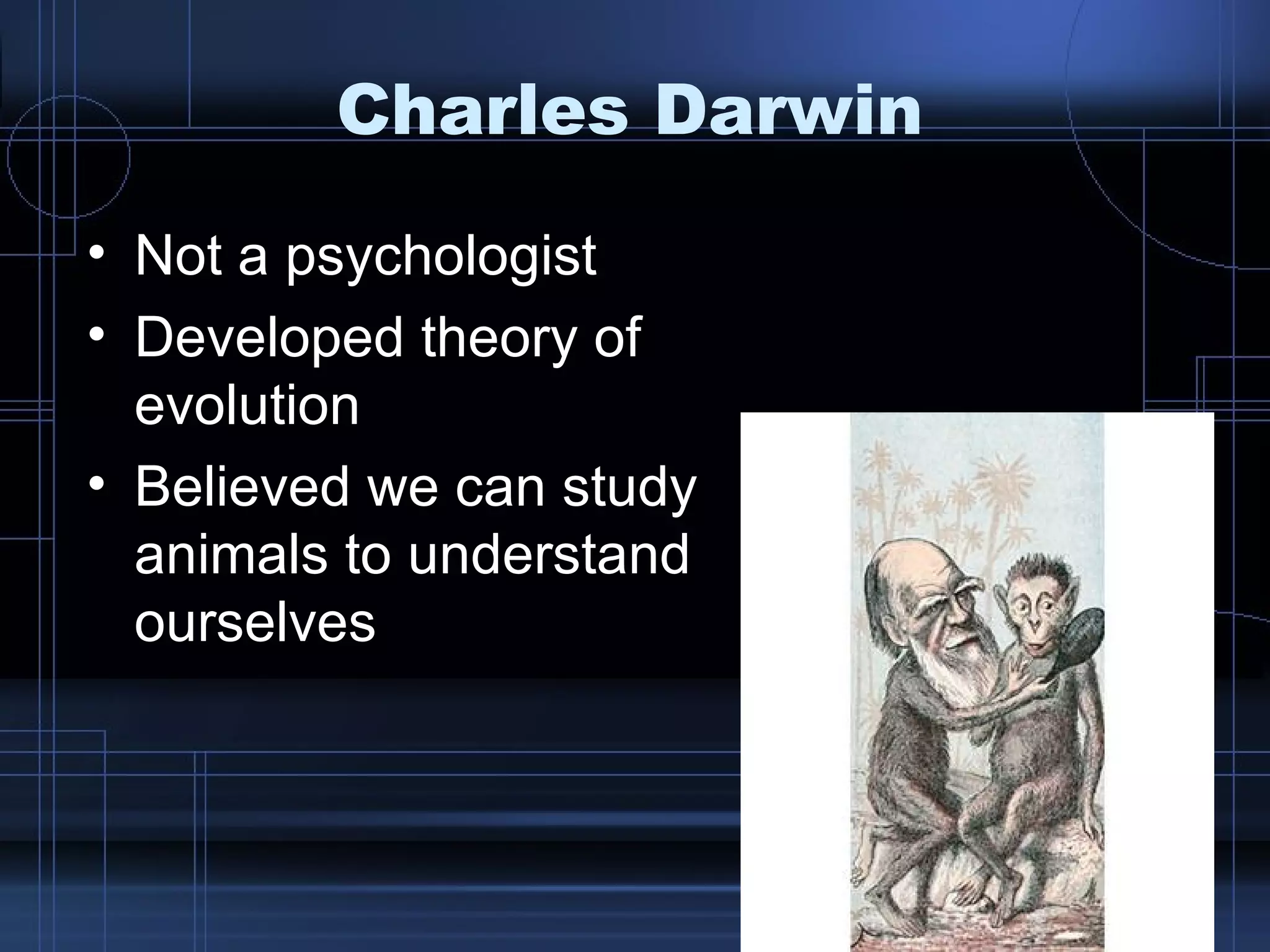
Charles Darwin Not a psychologist Developed theory of evolution Believed we can study animals to understand ourselves
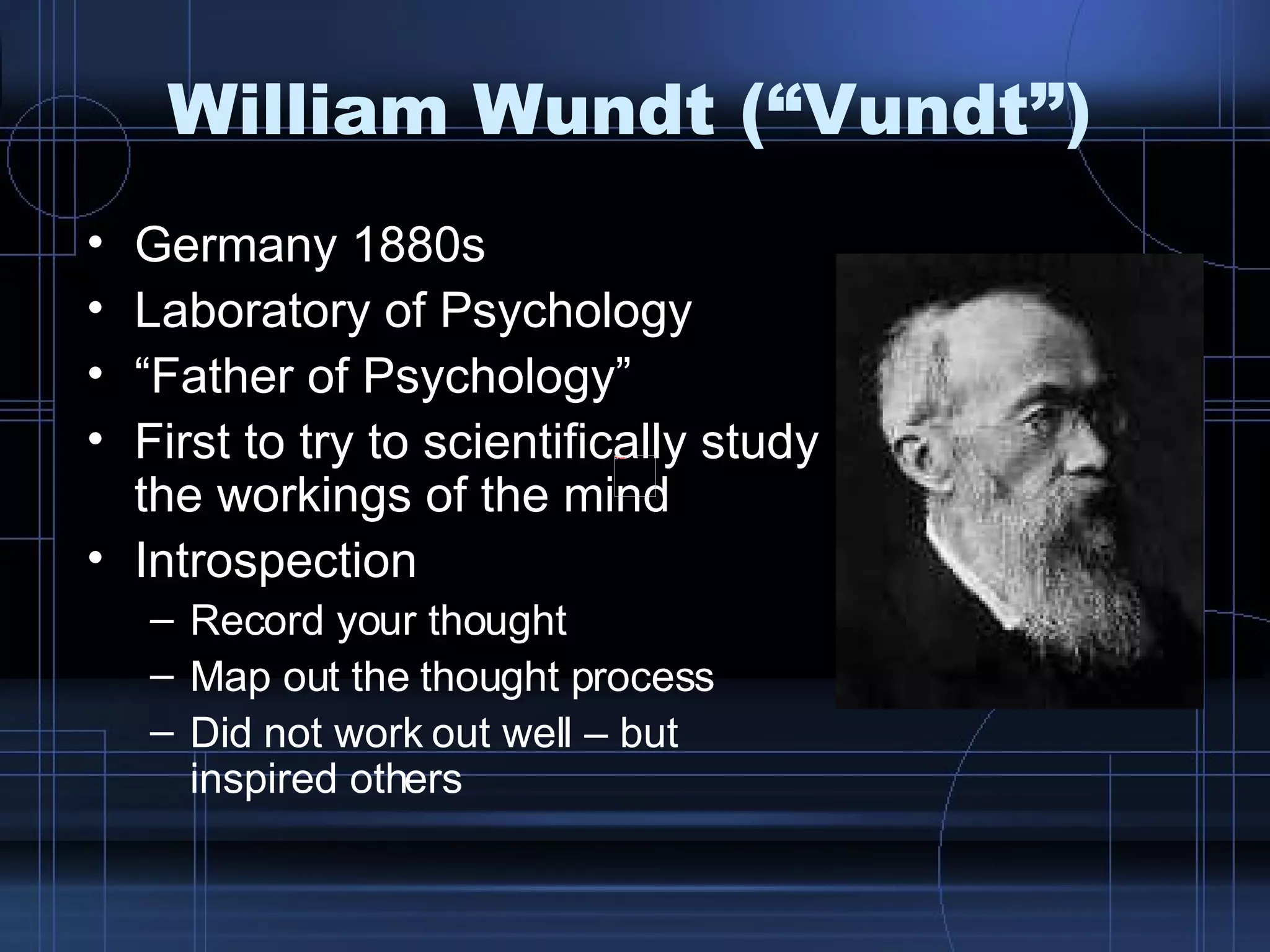
William Wundt (“Vundt”) Germany 1880s Laboratory of Psychology “ Father of Psychology” First to try to scientifically study the workings of the mind Introspection Record your thought Map out the thought process Did not work out well – but inspired others
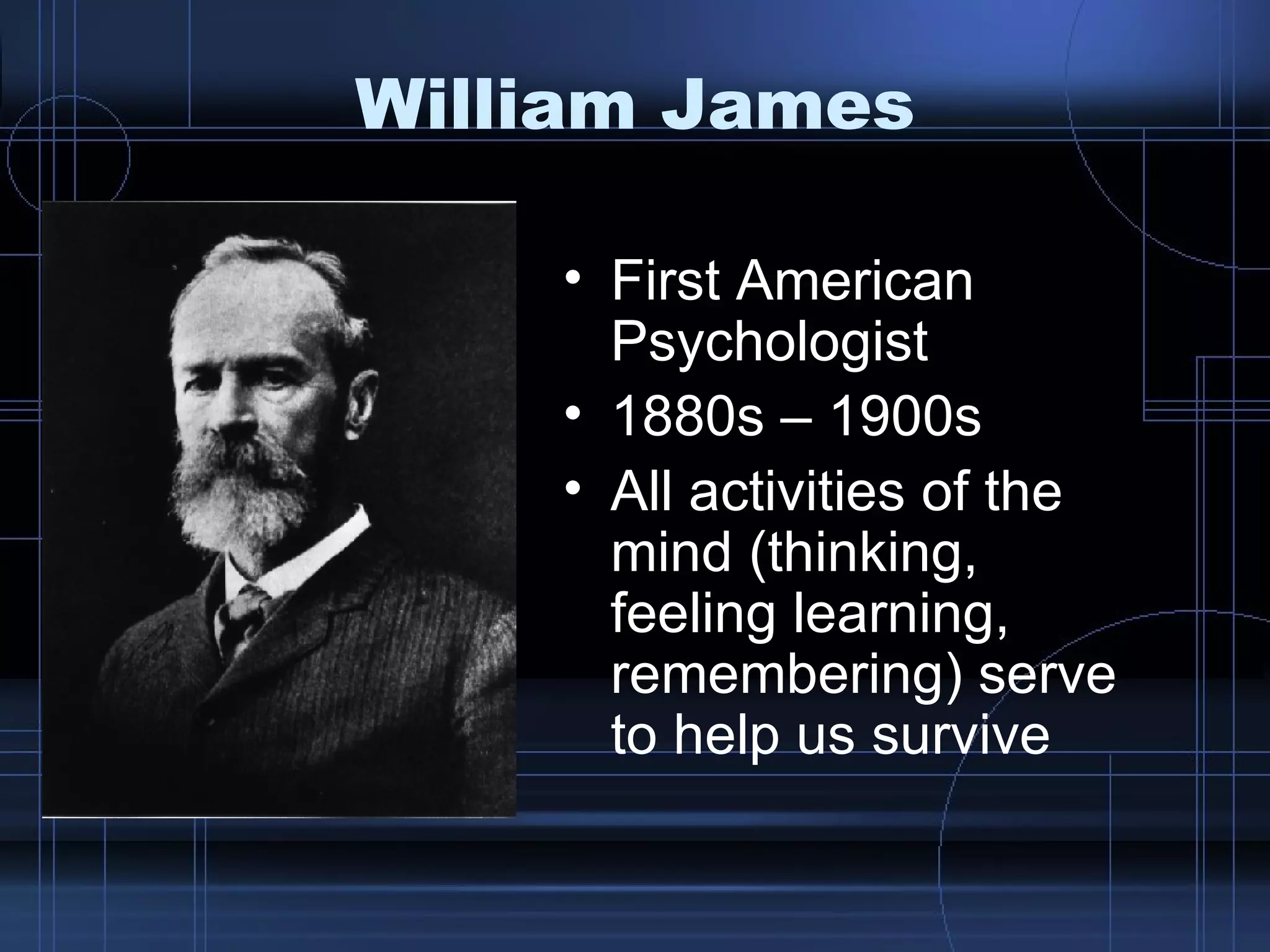
William James First American Psychologist 1880s – 1900s All activities of the mind (thinking, feeling learning, remembering) serve to help us survive
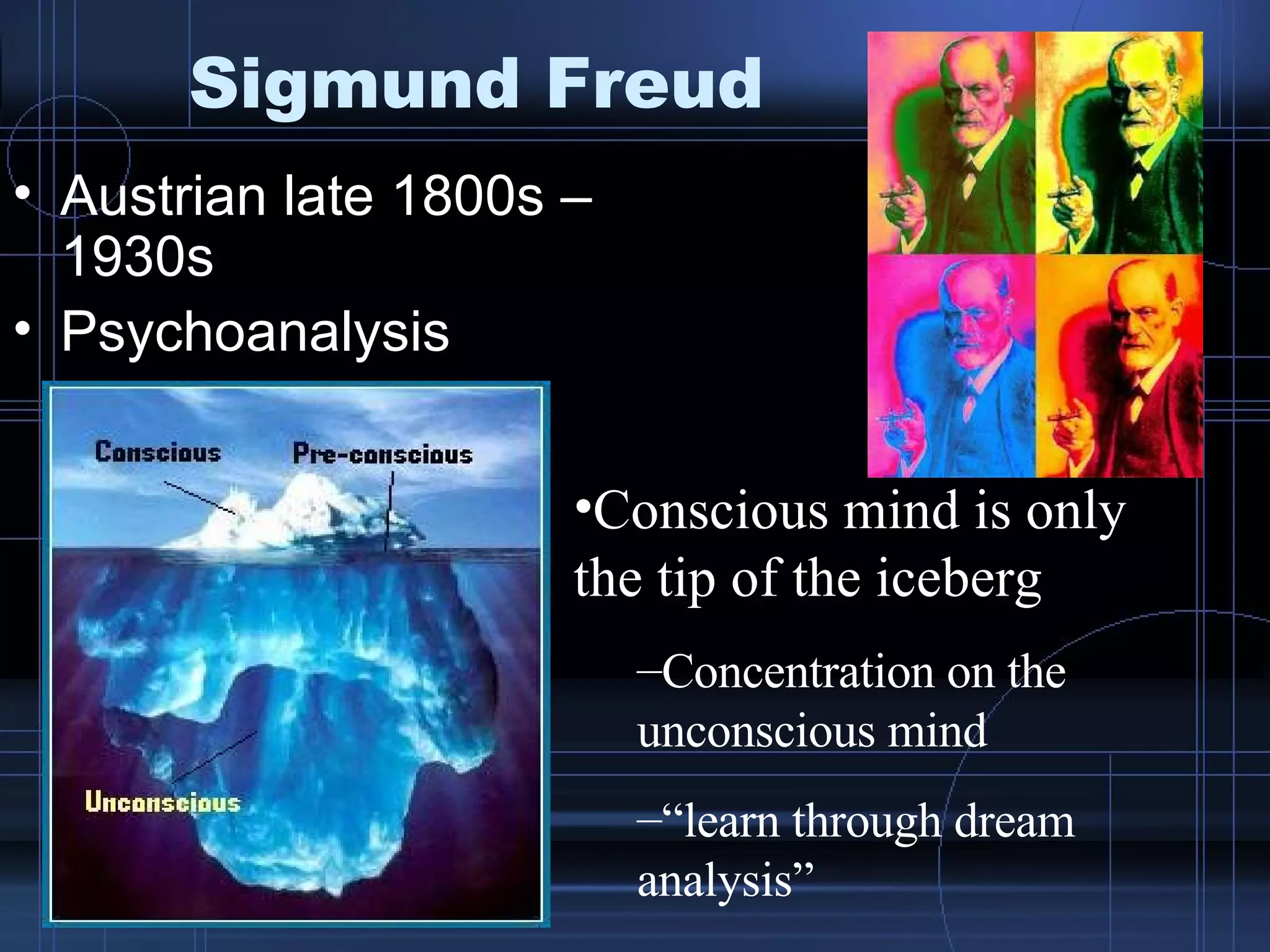
Sigmund Freud Austrian late 1800s – 1930s Psychoanalysis Conscious mind is only the tip of the iceberg Concentration on the unconscious mind “ learn through dream analysis”
Francis Galton  (1880s, England) Is Behavior / Intelligence hereditary or learned? “ nature vs nurture idea Based his ideas on biographies of “intellectual” families Has some serious flaws Developed the first “personality tests” and “intelligence tests”
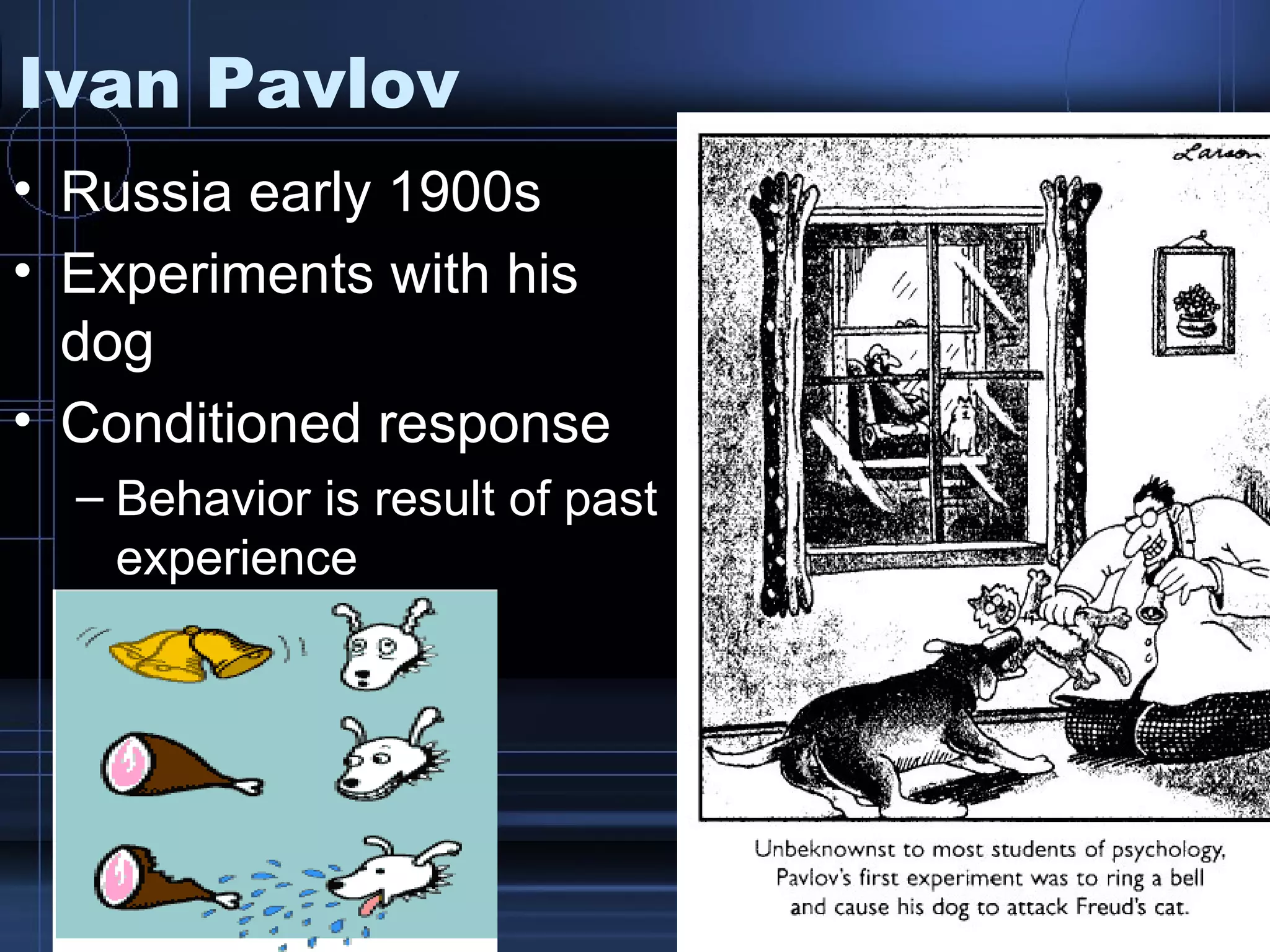
Ivan Pavlov Russia early 1900s Experiments with his dog Conditioned response Behavior is result of past experience                        
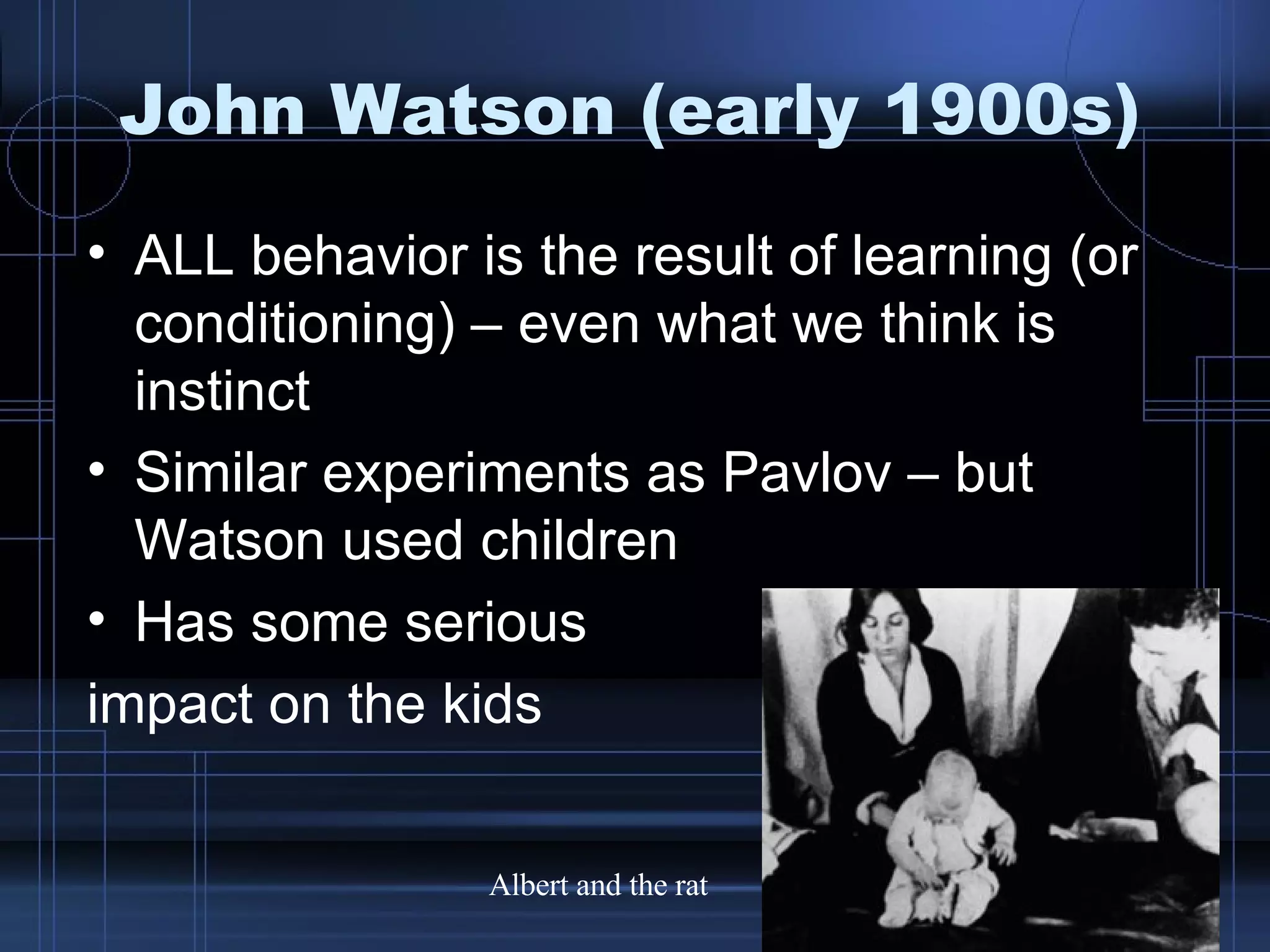
John Watson (early 1900s) ALL behavior is the result of learning (or conditioning) – even what we think is instinct Similar experiments as Pavlov – but Watson used children Has some serious  impact on the kids Albert and the rat
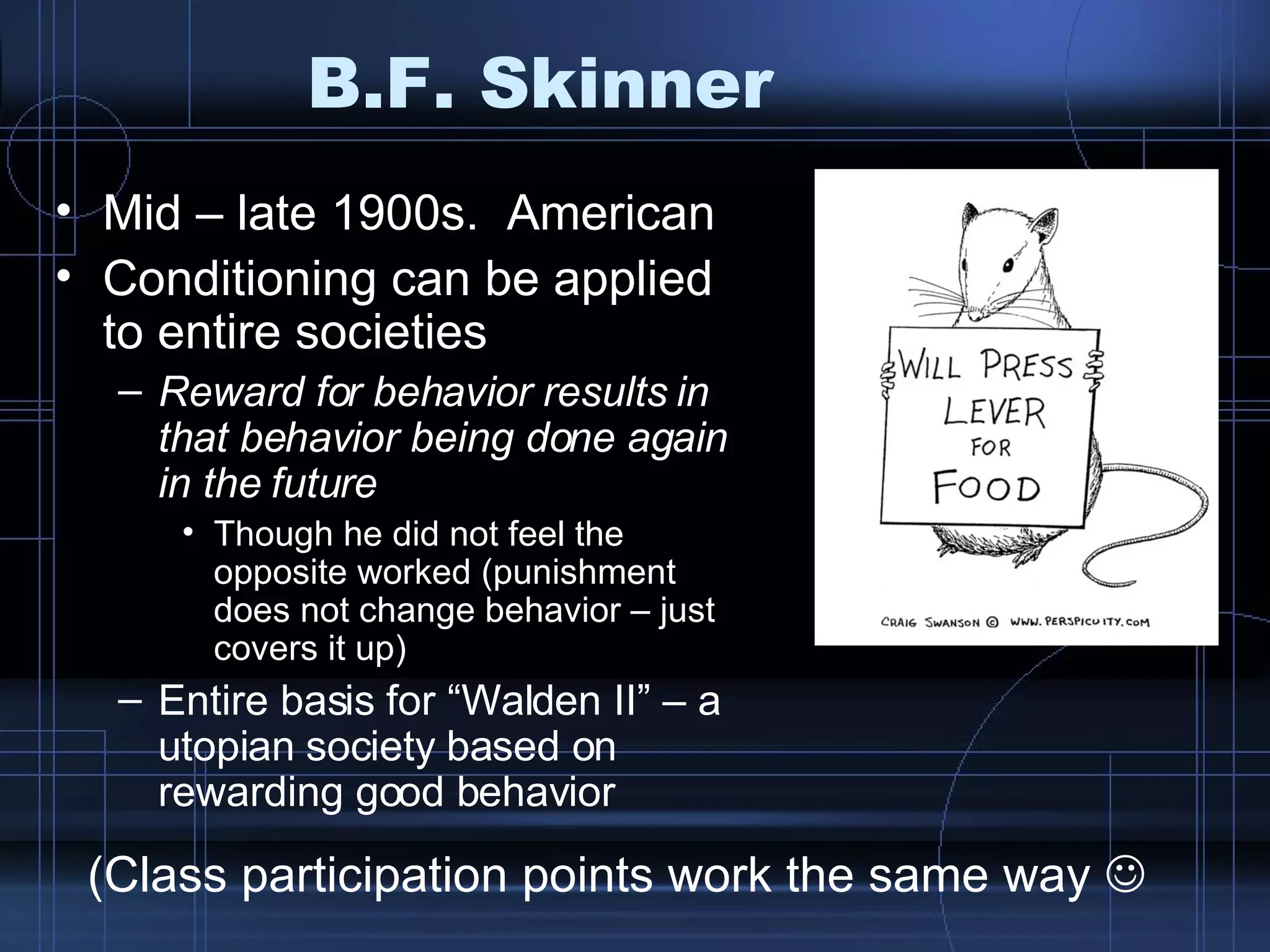
B.F. Skinner Mid – late 1900s.  American Conditioning can be applied to entire societies Reward for behavior results in that behavior being done again in the future Though he did not feel the opposite worked (punishment does not change behavior – just covers it up) Entire basis for “Walden II” – a utopian society based on rewarding good behavior (Class participation points work the same way  
Approaches to Psychology Neurobiological Behavioral Psychoanalytic Cognitive Sociocultural
Neurobiological Concentrates on the Chemical / Physical reasons for behavior What chemical reactions occur in our brains and bodies as a result of stimulations and what reactions do they cause? In some ways, our behavior is hard wired into us
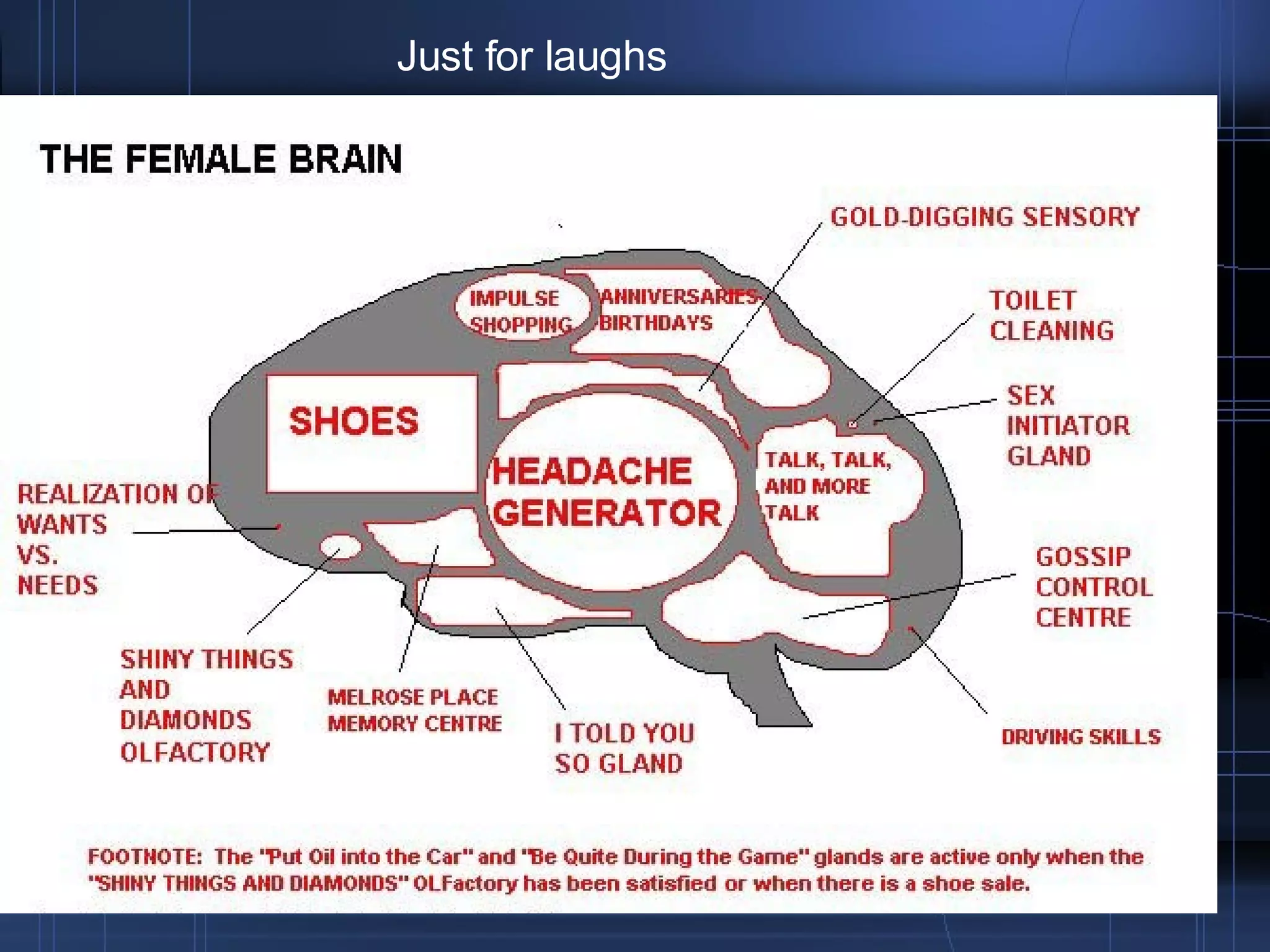
Just for laughs
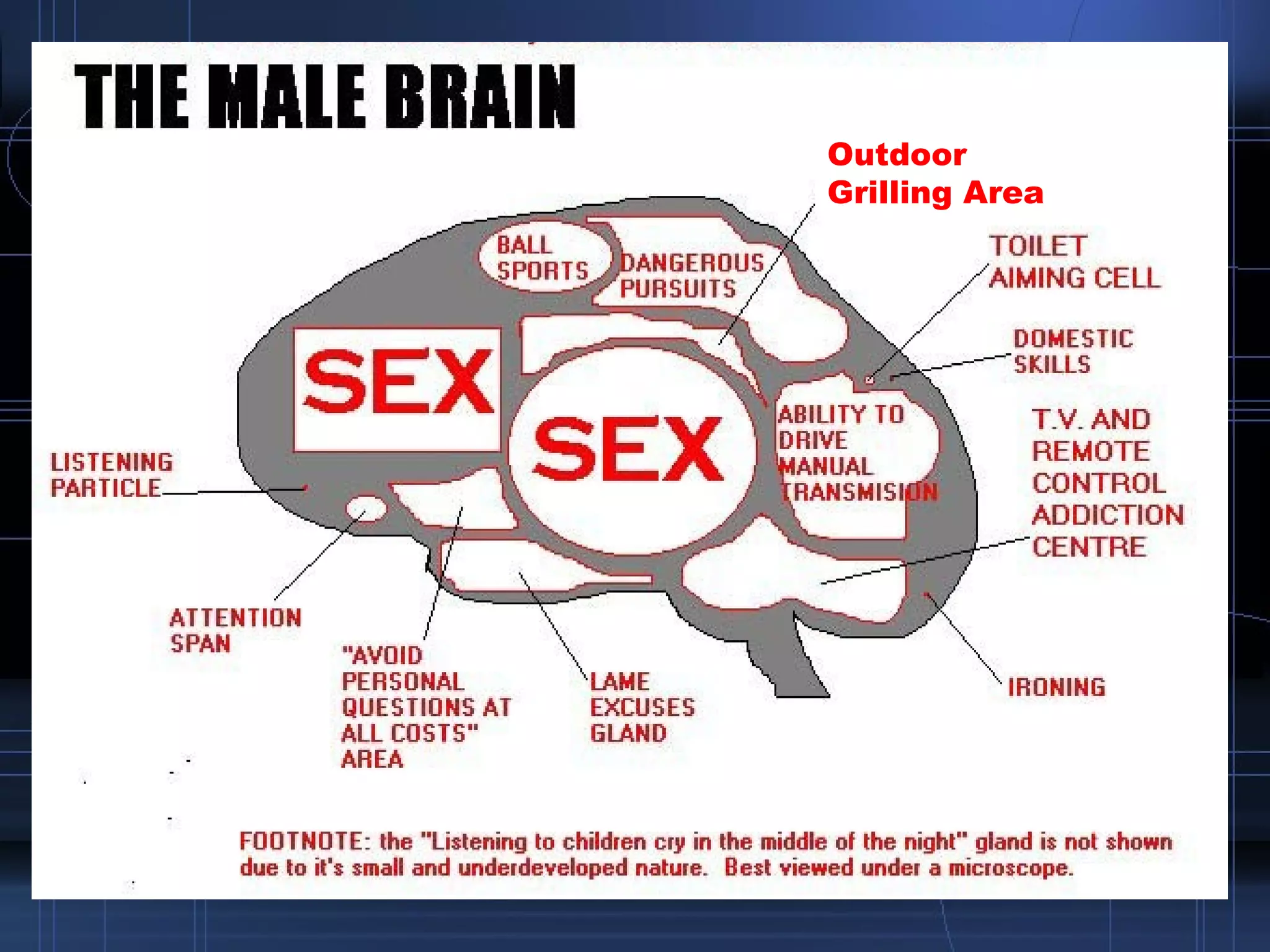
Outdoor Grilling   Area
Behavioral We adapt our behavior based on rewards We learn through experience Behavior can be changed B.F. Skinner was a behavioralist
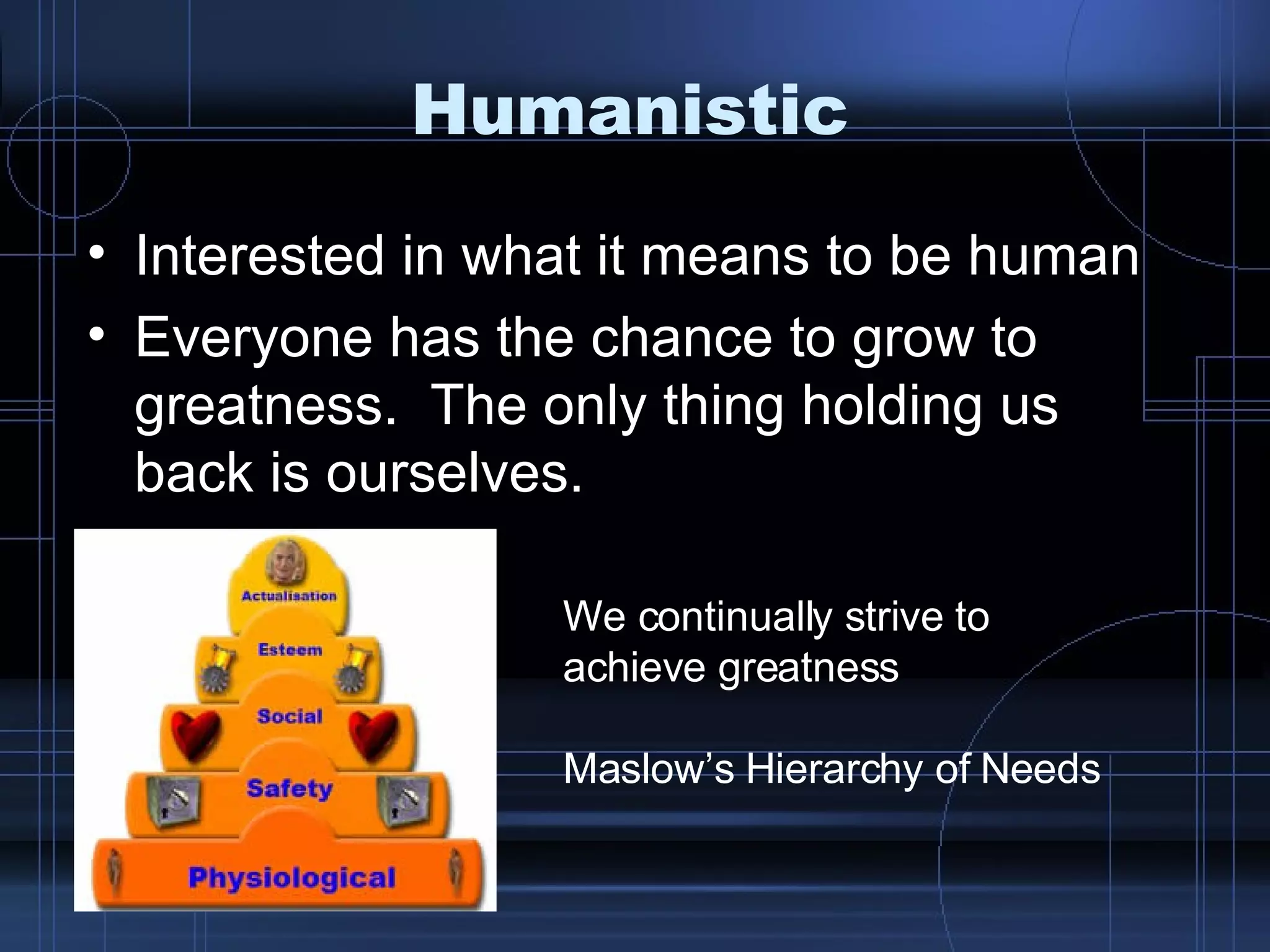
Humanistic Interested in what it means to be human   Everyone has the chance to grow to greatness.  The only thing holding us back is ourselves. We continually strive to achieve greatness Maslow’s Hierarchy of Needs
Psychoanalytical Approach We all have suppressed desires We unconsciously do things to  alleviate these desires Analyze what we do subconsciously in order to understand our REAL selves. Freud: father of psychoanalysis
Cognitive Approach Studies how we process information through perception, attention, language, memory, and thinking How they influence our thoughts, feelings, behaviors  and ability to operate in our world.  Past experiences make the difference between one person's perception and another's  Can you give an example to illustrate this?
Sociocultural Approach Impact society has on behavior economics, race, ethnic group, climate, religion, language, traditions, cultures, gender, location, politics, etc

Intro To Psychology Chap 1

  • 1.
    What is Psychology?The scientific study of human and animal behavior
  • 2.
    What is Behavior?Pretty much ANYTHING that you do, think or feel.
  • 3.
    Types of PsychologyResearch: Studies why things happen. Deals with theories and lab experiments “Lab tests show people’s anxiety level increases when surrounded by the color red.” Applied: Figures out how to USE information found by researchers “NASA scientists study which colors to paint the inside of the International Space Station”
  • 4.
    Fields of PsychologyWhere Psychologists work
  • 5.
    Example fields (p21-22)Clinical Psychology – therapists etc Educational Psychology – therapists for kids, help ID and aid learning styles and issues Child Psych – how the brain grows and learns to learn. Also – how to parent Environmental Psych – coping with disasters, crowding, workplace environment
  • 6.
    Example Fields continuedIndustrial Psych – marketing, public relations, efficiency Engineering Psych – human / machine interaction, design casinos Experimental Psych – usually research people. Lab experiments. Colleges Teaching – this class for instance
  • 7.
  • 8.
    Charles Darwin Nota psychologist Developed theory of evolution Believed we can study animals to understand ourselves
  • 9.
    William Wundt (“Vundt”)Germany 1880s Laboratory of Psychology “ Father of Psychology” First to try to scientifically study the workings of the mind Introspection Record your thought Map out the thought process Did not work out well – but inspired others
  • 10.
    William James FirstAmerican Psychologist 1880s – 1900s All activities of the mind (thinking, feeling learning, remembering) serve to help us survive
  • 11.
    Sigmund Freud Austrianlate 1800s – 1930s Psychoanalysis Conscious mind is only the tip of the iceberg Concentration on the unconscious mind “ learn through dream analysis”
  • 12.
    Francis Galton (1880s, England) Is Behavior / Intelligence hereditary or learned? “ nature vs nurture idea Based his ideas on biographies of “intellectual” families Has some serious flaws Developed the first “personality tests” and “intelligence tests”
  • 13.
    Ivan Pavlov Russiaearly 1900s Experiments with his dog Conditioned response Behavior is result of past experience                        
  • 14.
    John Watson (early1900s) ALL behavior is the result of learning (or conditioning) – even what we think is instinct Similar experiments as Pavlov – but Watson used children Has some serious impact on the kids Albert and the rat
  • 15.
    B.F. Skinner Mid– late 1900s. American Conditioning can be applied to entire societies Reward for behavior results in that behavior being done again in the future Though he did not feel the opposite worked (punishment does not change behavior – just covers it up) Entire basis for “Walden II” – a utopian society based on rewarding good behavior (Class participation points work the same way 
  • 16.
    Approaches to PsychologyNeurobiological Behavioral Psychoanalytic Cognitive Sociocultural
  • 17.
    Neurobiological Concentrates onthe Chemical / Physical reasons for behavior What chemical reactions occur in our brains and bodies as a result of stimulations and what reactions do they cause? In some ways, our behavior is hard wired into us
  • 18.
  • 19.
  • 20.
    Behavioral We adaptour behavior based on rewards We learn through experience Behavior can be changed B.F. Skinner was a behavioralist
  • 21.
    Humanistic Interested inwhat it means to be human Everyone has the chance to grow to greatness. The only thing holding us back is ourselves. We continually strive to achieve greatness Maslow’s Hierarchy of Needs
  • 22.
    Psychoanalytical Approach Weall have suppressed desires We unconsciously do things to alleviate these desires Analyze what we do subconsciously in order to understand our REAL selves. Freud: father of psychoanalysis
  • 23.
    Cognitive Approach Studieshow we process information through perception, attention, language, memory, and thinking How they influence our thoughts, feelings, behaviors and ability to operate in our world. Past experiences make the difference between one person's perception and another's Can you give an example to illustrate this?
  • 24.
    Sociocultural Approach Impactsociety has on behavior economics, race, ethnic group, climate, religion, language, traditions, cultures, gender, location, politics, etc