THE EVOLUTION OF 
PSYCHOLOGY 
UNIVERSITY OF ALASKA 
K.D. BORCOMAN
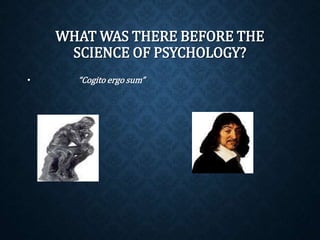
WHAT WAS THERE BEFORE THE 
SCIENCE OF PSYCHOLOGY? 
• “Cogito ergo sum”
EMPIRICAL METHOD 
• Empiricism: the premise that knowledge should be gained through 
observation 
• 1. This makes science precise 
• 2. Relatively intolerant of error
THE BATTLE OF THE “SCHOOLS” IN THE U.S.: 
STRUCTURALISM VS. FUNCTIONALISM 
• Structuralism– Edward Titchener 
• Analyze consciousness into basic elements 
• Introspection – careful, systematic observations of one’s own 
conscious experience 
• Functionalism– William James (VERY influenced by Darwin). 
• Investigate function of consciousness 
• Led to investigation of mental testing, developmental patterns, and sex 
differences
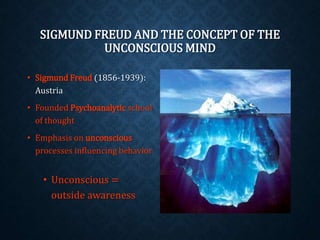
SIGMUND FREUD AND THE CONCEPT OF THE 
UNCONSCIOUS MIND 
• Sigmund Freud (1856-1939): 
Austria 
• Founded Psychoanalytic school 
of thought 
• Emphasis on unconscious 
processes influencing behavior 
• Unconscious = 
outside awareness
FREUD’S IDEAS: 
CONTROVERSY AND INFLUENCE 
• Behavior is entirely influenced by the unconscious 
• Unconscious conflict related to sexuality plays a central role in 
behavior 
• Controversial notions caused debate/resistance 
• Significant influence on the field of psychology
BEHAVIORISM: REDEFINING PSYCHOLOGY 
• John B. Watson (1878-1958): United States 
• Founder of Behaviorism – Can you observe the unconscious? Then how 
can it be studied? 
• Psychology = scientific study of behavior 
• Behavior = overt or observable responses or activities 
• Radical reorientation of psychology as a science of observable 
behavior 
• Study of consciousness abandoned
JOHN WATSON AND THE NATURE-NURTURE 
DEBATE • Nurture, not nature 
• “give me a dozen healthy infants, well-formed, and my own special 
world to bring them up in and I’ll guarantee to take any one at random 
and train him to become any type of specialist I might select – doctor, 
lawyer, artist, merchant-chief, and yes, even beggar-man and thief…” 
• Behaviorist school of thought emphasized the environment 
(nurture), rather than innate biological predispositions (nature) 
• Focus on stimulus-response relationships 
• S-R psychology
ARE PEOPLE FREE? 
B.F. SKINNER 
ANOTHER NAME ASSOCIATED WITH BEHAVIORISM 
• B.F. Skinner (1904-1990): United States 
• Environmental factors determine behavior 
• Responses that lead to positive outcomes are repeated 
• Responses that lead to negative outcomes are not repeated 
• Beyond Freedom and Dignity 
• More controversy regarding free will
THE 1950’S: OPPOSITION TO PSYCHOANALYTIC 
THEORY AND BEHAVIORISM 
• Charges that both were de-humanizing 
• Diverse opposition groups got together to form a loose alliance 
• A new school of thought emerged - Humanism 
• Led by Abraham Maslow(1908-1970) and Carl Rogers (1902-1987) 
• Emphasis on the unique qualities of humans: freedom and personal 
growth
PUTTING THE PSYCHE BACK IN PSYCHOLOGY: 
THE RETURN OF COGNITION 
• Cognition = mental processes involved in acquiring knowledge 
• 1950’s and 60’s – Piaget, Chomsky, and Simon 
• Application of scientific methods to studying internal mental events 
• Cognitive psychology: the new dominant perspective?
BIOLOGICAL PSYCHOLOGY: 
THE BIOLOGICAL BASIS OF BEHAVIOR 
• Biological perspective - behavior 
explained in terms of physiological 
processes 
• James Olds (1956) 
• Electrical stimulation of the brain 
evokes emotional responses in 
animals 
• Roger Sperry (1981) 
• Left and right brain specialization
CULTURAL PSYCHOLOGY: 
RECOGNIZING HUMAN VARIATION 
• Ethnocentrism– viewing one’s own group as superior and as the 
standard for judging 
• Historically: middle and upper class white males studying middle 
and upper class white males 
• 1980’s – increased interest in how cultural factors influence 
behavior 
• Growing global interdependence 
• Increased cultural diversity
EVOLUTIONARY PSYCHOLOGY: 
HUMAN ADAPTATIONS 
• Central premise: natural selection occurs for behavioral, as well as 
physical, characteristics 
• Buss, Daly & Wilson, Cosmides & Tooby – 80’s and 90’s 
• Studied natural selection of mating preferences, jealousy, aggression, 
sexual behavior, language, decision making, personality, and development 
• Thought provoking perspective gaining in influence, but not without 
criticism
POSITIVE PSYCHOLOGY 
• Martin Seligman’s epiphany 
• Humanist concerns revisited 
• Uses theory and research to better understand the positive, 
creative, and fulfilling aspects of human existence 
• Positive subjective experiences 
• Positive individual traits 
• Positive institutions and communities
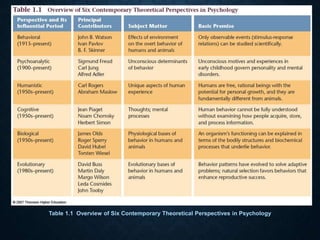
Table 1.1 Overview of Six Contemporary Theoretical Perspectives in Psychology
PSYCHOLOGY TODAY: 
A THRIVING SCIENCE AND PROFESSION 
• Psychology is the science that studies behavior and the 
physiological and cognitive processes that underlie it, and it is the 
profession that applies the accumulated knowledge of this science 
to practical problems. 
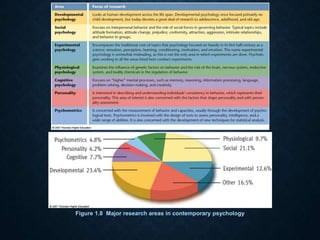
• Research: Seven major areas 
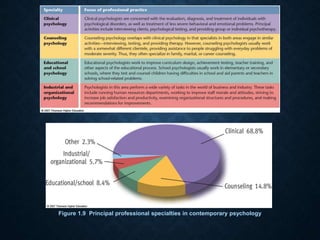
• Applied Psychology: Four major areas
Figure 1.7 Employment of psychologists by setting
Figure 1.8 Major research areas in contemporary psychology
Figure 1.9 Principal professional specialties in contemporary psychology
STUDYING PSYCHOLOGY: 
SEVEN ORGANIZING THEMES 
• Psychology as a field of study: 
• 1. 
• Empirical: dependent on evidence that is observable by 
the senses 
2. 
• Theoretically diverse 
3. 
• Evolves in sociohistorical context 
4. 
• Behavior: 
• Determined by multiple causes 
• Shaped by cultural heritage 
• Influenced jointly by heredity and environment
UNIFYING THEMES CONTINUED 
• 5. Behavior is shaped by cultural heritage 
• 6. Heredity and Environment Jointly influence behavior Is the 
Nature vs. Nurture argument dead? 
• 7. People’s experience of the world is highly subjective.

Evolution of psychology

  • 1.
    THE EVOLUTION OF PSYCHOLOGY UNIVERSITY OF ALASKA K.D. BORCOMAN
  • 2.
    WHAT WAS THEREBEFORE THE SCIENCE OF PSYCHOLOGY? • “Cogito ergo sum”
  • 3.
    EMPIRICAL METHOD •Empiricism: the premise that knowledge should be gained through observation • 1. This makes science precise • 2. Relatively intolerant of error
  • 4.
    THE BATTLE OFTHE “SCHOOLS” IN THE U.S.: STRUCTURALISM VS. FUNCTIONALISM • Structuralism– Edward Titchener • Analyze consciousness into basic elements • Introspection – careful, systematic observations of one’s own conscious experience • Functionalism– William James (VERY influenced by Darwin). • Investigate function of consciousness • Led to investigation of mental testing, developmental patterns, and sex differences
  • 5.
    SIGMUND FREUD ANDTHE CONCEPT OF THE UNCONSCIOUS MIND • Sigmund Freud (1856-1939): Austria • Founded Psychoanalytic school of thought • Emphasis on unconscious processes influencing behavior • Unconscious = outside awareness
  • 6.
    FREUD’S IDEAS: CONTROVERSYAND INFLUENCE • Behavior is entirely influenced by the unconscious • Unconscious conflict related to sexuality plays a central role in behavior • Controversial notions caused debate/resistance • Significant influence on the field of psychology
  • 7.
    BEHAVIORISM: REDEFINING PSYCHOLOGY • John B. Watson (1878-1958): United States • Founder of Behaviorism – Can you observe the unconscious? Then how can it be studied? • Psychology = scientific study of behavior • Behavior = overt or observable responses or activities • Radical reorientation of psychology as a science of observable behavior • Study of consciousness abandoned
  • 8.
    JOHN WATSON ANDTHE NATURE-NURTURE DEBATE • Nurture, not nature • “give me a dozen healthy infants, well-formed, and my own special world to bring them up in and I’ll guarantee to take any one at random and train him to become any type of specialist I might select – doctor, lawyer, artist, merchant-chief, and yes, even beggar-man and thief…” • Behaviorist school of thought emphasized the environment (nurture), rather than innate biological predispositions (nature) • Focus on stimulus-response relationships • S-R psychology
  • 9.
    ARE PEOPLE FREE? B.F. SKINNER ANOTHER NAME ASSOCIATED WITH BEHAVIORISM • B.F. Skinner (1904-1990): United States • Environmental factors determine behavior • Responses that lead to positive outcomes are repeated • Responses that lead to negative outcomes are not repeated • Beyond Freedom and Dignity • More controversy regarding free will
  • 10.
    THE 1950’S: OPPOSITIONTO PSYCHOANALYTIC THEORY AND BEHAVIORISM • Charges that both were de-humanizing • Diverse opposition groups got together to form a loose alliance • A new school of thought emerged - Humanism • Led by Abraham Maslow(1908-1970) and Carl Rogers (1902-1987) • Emphasis on the unique qualities of humans: freedom and personal growth
  • 11.
    PUTTING THE PSYCHEBACK IN PSYCHOLOGY: THE RETURN OF COGNITION • Cognition = mental processes involved in acquiring knowledge • 1950’s and 60’s – Piaget, Chomsky, and Simon • Application of scientific methods to studying internal mental events • Cognitive psychology: the new dominant perspective?
  • 12.
    BIOLOGICAL PSYCHOLOGY: THEBIOLOGICAL BASIS OF BEHAVIOR • Biological perspective - behavior explained in terms of physiological processes • James Olds (1956) • Electrical stimulation of the brain evokes emotional responses in animals • Roger Sperry (1981) • Left and right brain specialization
  • 13.
    CULTURAL PSYCHOLOGY: RECOGNIZINGHUMAN VARIATION • Ethnocentrism– viewing one’s own group as superior and as the standard for judging • Historically: middle and upper class white males studying middle and upper class white males • 1980’s – increased interest in how cultural factors influence behavior • Growing global interdependence • Increased cultural diversity
  • 14.
    EVOLUTIONARY PSYCHOLOGY: HUMANADAPTATIONS • Central premise: natural selection occurs for behavioral, as well as physical, characteristics • Buss, Daly & Wilson, Cosmides & Tooby – 80’s and 90’s • Studied natural selection of mating preferences, jealousy, aggression, sexual behavior, language, decision making, personality, and development • Thought provoking perspective gaining in influence, but not without criticism
  • 15.
    POSITIVE PSYCHOLOGY •Martin Seligman’s epiphany • Humanist concerns revisited • Uses theory and research to better understand the positive, creative, and fulfilling aspects of human existence • Positive subjective experiences • Positive individual traits • Positive institutions and communities
  • 16.
    Table 1.1 Overviewof Six Contemporary Theoretical Perspectives in Psychology
  • 17.
    PSYCHOLOGY TODAY: ATHRIVING SCIENCE AND PROFESSION • Psychology is the science that studies behavior and the physiological and cognitive processes that underlie it, and it is the profession that applies the accumulated knowledge of this science to practical problems. • Research: Seven major areas • Applied Psychology: Four major areas
  • 18.
    Figure 1.7 Employmentof psychologists by setting
  • 19.
    Figure 1.8 Majorresearch areas in contemporary psychology
  • 20.
    Figure 1.9 Principalprofessional specialties in contemporary psychology
  • 21.
    STUDYING PSYCHOLOGY: SEVENORGANIZING THEMES • Psychology as a field of study: • 1. • Empirical: dependent on evidence that is observable by the senses 2. • Theoretically diverse 3. • Evolves in sociohistorical context 4. • Behavior: • Determined by multiple causes • Shaped by cultural heritage • Influenced jointly by heredity and environment
  • 22.
    UNIFYING THEMES CONTINUED • 5. Behavior is shaped by cultural heritage • 6. Heredity and Environment Jointly influence behavior Is the Nature vs. Nurture argument dead? • 7. People’s experience of the world is highly subjective.