Probability
       Vocabulary
  Random Phenomenon
      Sample space
        Outcome
           Trial
          Event
        Probability
    Probability model
      Complement
      Independent
    Mutually exclusive
  Conditional probability
      Combination
       permutation
Key Points
 P(A)= (the number of times the desired outcome
    occurs) ÷ (the total number of trials)
   Events are independent if the outcome of one
    event does not influence the outcome of any
    other event
   Events are mutually exclusive if they cannot
    occur together
   Addition Rule: P(A or B)= P(A) + P(B) – P(A and
    B)
   Multiplication Rule: If A and B are independent
    events, P(A and B)= P(A)P(B)
Probability

 _________ is the branch of math that studies
 patterns of chance

 The idea of probability is based on observation.
 Probability describes what happens over
 many, many trials.

 The probability, P(A), of any outcome of a random
 phenomenon is the proportion of times the
 outcome would occur in a long series of
 repetitions.
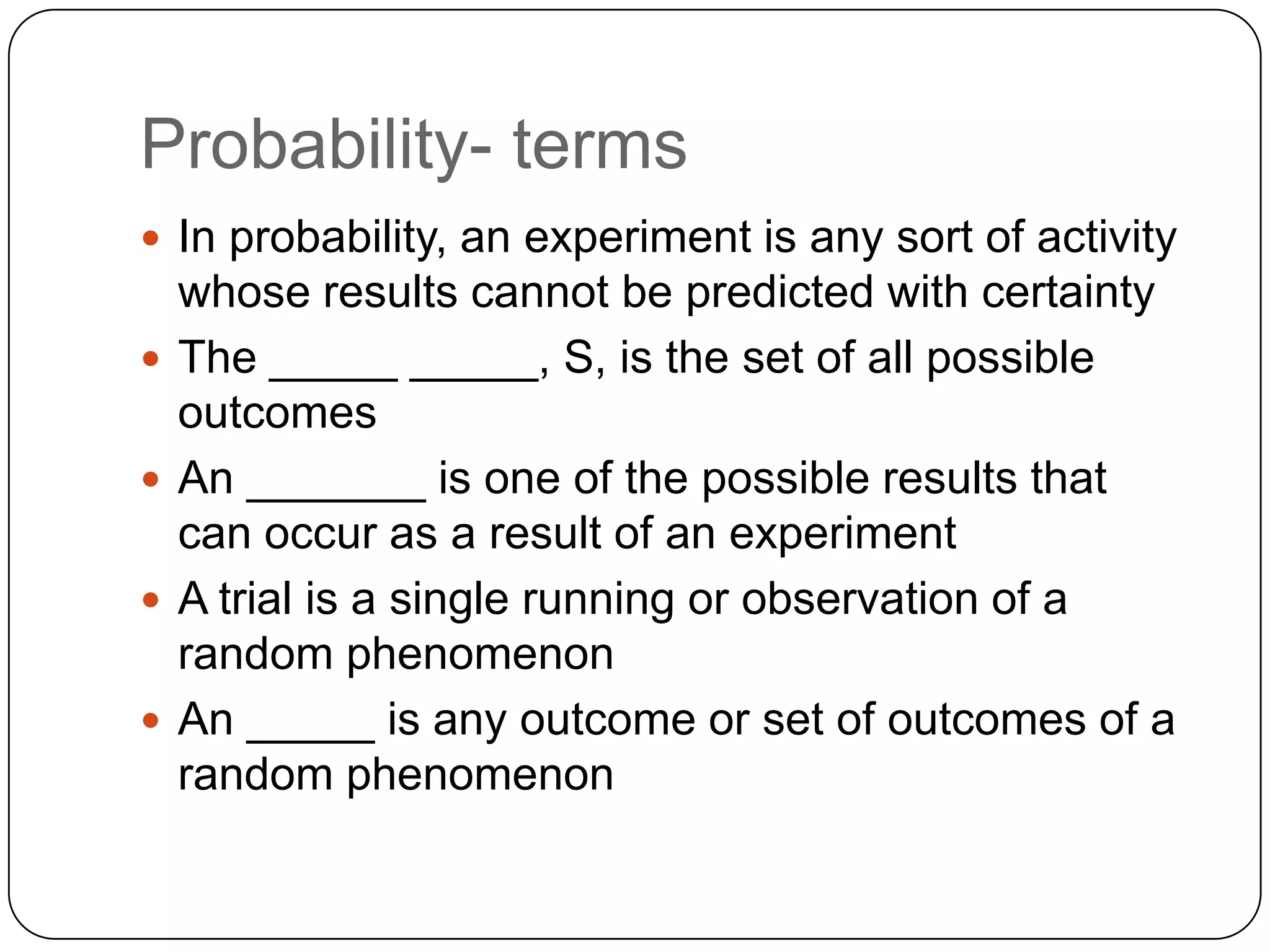
Probability- terms
 In probability, an experiment is any sort of activity
    whose results cannot be predicted with certainty
   The _____ _____, S, is the set of all possible
    outcomes
   An _______ is one of the possible results that
    can occur as a result of an experiment
   A trial is a single running or observation of a
    random phenomenon
   An _____ is any outcome or set of outcomes of a
    random phenomenon
Probability
 P(A)= (the number of times the desired outcome
  occurs) ÷ (the total number of trials)
Example
 Ryan rolls the die 20 times and gets a 5 on 7 of
  the rolls. Then, the probability of rolling a 5 is:
 P(A)= (the number of times you roll a 5) ÷ (the
  number of times you roll the die)=
                          7/20
Experimental v Theoretical
Probability
 When a random phenomenon has k possible
  outcomes that are all equally likely, then each
  outcome has the probability 1/k. This is called
  theoretical probability
 The actual outcome of an experimental activity is
  called experimental probability
Probability- General Rules
 1. Probability is a number between 0 and 1.
 2. The sum of the probabilities of all possible
  outcomes in a sample space is 1.
 3. The probability that an event does not occur is
  1 minus the probability that it does occur. (also
  called the complement of A)


 If an event has the probability of .3 of
  happening, then it has a probability of .7 of not
  happening( 1-0.3= 0.7)
Independence and Mutually
Exclusive

 Events or trials are said to be _________ if the
  outcome of an event or trial doesn’t influence the
  outcome of another event or trial
 Two events are ______ _______ if they cannot
  occur together
 Sam can either pass the test or fail- cant do both
  at same time
Rules of Probability- Addition
Rules of Probability-
Multiplication
Conditional Probability


Conditional probability describes the situation where
the probability of a second event is dependent upon
            a first event having occurred
Possible outcomes and counting
techniques
 If you can do one task in A ways and a second
 task in B ways, then both tasks can be done in A
 x B ways.

 Flip a coin and toss a die (2)(6)= 12 possible
 outcomes
Possible outcomes and counting
techniques
Possible outcomes and counting
techniques
Review Questions
Review Questions
Review Questions
Review Questions
Review Questions
Review Questions

Probability

  • 1.
    Probability Vocabulary Random Phenomenon Sample space Outcome Trial Event Probability Probability model Complement Independent Mutually exclusive Conditional probability Combination permutation
  • 2.
    Key Points  P(A)=(the number of times the desired outcome occurs) ÷ (the total number of trials)  Events are independent if the outcome of one event does not influence the outcome of any other event  Events are mutually exclusive if they cannot occur together  Addition Rule: P(A or B)= P(A) + P(B) – P(A and B)  Multiplication Rule: If A and B are independent events, P(A and B)= P(A)P(B)
  • 3.
    Probability  _________ isthe branch of math that studies patterns of chance  The idea of probability is based on observation. Probability describes what happens over many, many trials.  The probability, P(A), of any outcome of a random phenomenon is the proportion of times the outcome would occur in a long series of repetitions.
  • 4.
    Probability- terms  Inprobability, an experiment is any sort of activity whose results cannot be predicted with certainty  The _____ _____, S, is the set of all possible outcomes  An _______ is one of the possible results that can occur as a result of an experiment  A trial is a single running or observation of a random phenomenon  An _____ is any outcome or set of outcomes of a random phenomenon
  • 5.
    Probability  P(A)= (thenumber of times the desired outcome occurs) ÷ (the total number of trials) Example  Ryan rolls the die 20 times and gets a 5 on 7 of the rolls. Then, the probability of rolling a 5 is:  P(A)= (the number of times you roll a 5) ÷ (the number of times you roll the die)= 7/20
  • 6.
    Experimental v Theoretical Probability When a random phenomenon has k possible outcomes that are all equally likely, then each outcome has the probability 1/k. This is called theoretical probability  The actual outcome of an experimental activity is called experimental probability
  • 7.
    Probability- General Rules 1. Probability is a number between 0 and 1.  2. The sum of the probabilities of all possible outcomes in a sample space is 1.  3. The probability that an event does not occur is 1 minus the probability that it does occur. (also called the complement of A)  If an event has the probability of .3 of happening, then it has a probability of .7 of not happening( 1-0.3= 0.7)
  • 8.
    Independence and Mutually Exclusive Events or trials are said to be _________ if the outcome of an event or trial doesn’t influence the outcome of another event or trial  Two events are ______ _______ if they cannot occur together  Sam can either pass the test or fail- cant do both at same time
  • 9.
  • 10.
  • 11.
    Conditional Probability Conditional probabilitydescribes the situation where the probability of a second event is dependent upon a first event having occurred
  • 12.
    Possible outcomes andcounting techniques  If you can do one task in A ways and a second task in B ways, then both tasks can be done in A x B ways.  Flip a coin and toss a die (2)(6)= 12 possible outcomes
  • 13.
    Possible outcomes andcounting techniques
  • 14.
    Possible outcomes andcounting techniques
  • 15.
  • 16.
  • 17.
  • 18.
  • 19.
  • 20.