Chapter 4
Discrete Random Variables and
Probability Distributions
Statistics for
Business and Economics
7th Edition
Copyright © 2010 Pearson Education, Inc. Publishing as Prentice Hall Ch. 4-1
Chapter Goals
After completing this chapter, you should be
able to:
 Interpret the mean and standard deviation for a
discrete random variable
 Use the binomial probability distribution to find
probabilities
 Describe when to apply the binomial distribution
 Use the hypergeometric and Poisson discrete
probability distributions to find probabilities
 Explain covariance and correlation for jointly
distributed discrete random variables
Copyright © 2010 Pearson Education, Inc. Publishing as Prentice Hall Ch. 4-2
Introduction to
Probability Distributions
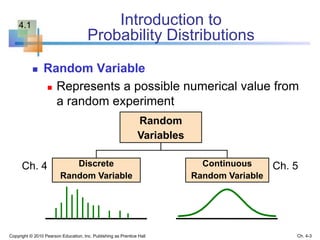
 Random Variable
 Represents a possible numerical value from
a random experiment
Random
Variables
Discrete
Random Variable
Continuous
Random Variable
Ch. 4 Ch. 5
Copyright © 2010 Pearson Education, Inc. Publishing as Prentice Hall Ch. 4-3
4.1
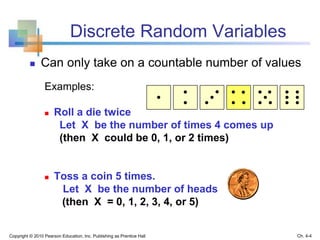
Discrete Random Variables
 Can only take on a countable number of values
Examples:
 Roll a die twice
Let X be the number of times 4 comes up
(then X could be 0, 1, or 2 times)
 Toss a coin 5 times.
Let X be the number of heads
(then X = 0, 1, 2, 3, 4, or 5)
Copyright © 2010 Pearson Education, Inc. Publishing as Prentice Hall Ch. 4-4
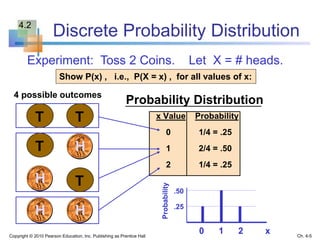
Discrete Probability Distribution
x Value Probability
0 1/4 = .25
1 2/4 = .50
2 1/4 = .25
Experiment: Toss 2 Coins. Let X = # heads.
T
T
4 possible outcomes
T
T
H
H
H H
Probability Distribution
0 1 2 x
.50
.25
Probability
Show P(x) , i.e., P(X = x) , for all values of x:
Copyright © 2010 Pearson Education, Inc. Publishing as Prentice Hall Ch. 4-5
4.2
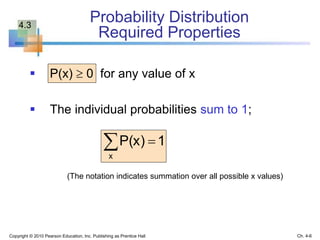
Probability Distribution
Required Properties
 
x
1P(x)
 P(x)  0 for any value of x
 The individual probabilities sum to 1;
(The notation indicates summation over all possible x values)
Copyright © 2010 Pearson Education, Inc. Publishing as Prentice Hall Ch. 4-6
4.3
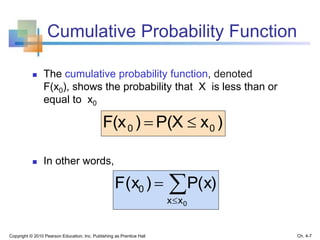
Cumulative Probability Function
 The cumulative probability function, denoted
F(x0), shows the probability that X is less than or
equal to x0
 In other words,
)xP(X)F(x 00 


0xx
0 P(x))F(x
Copyright © 2010 Pearson Education, Inc. Publishing as Prentice Hall Ch. 4-7
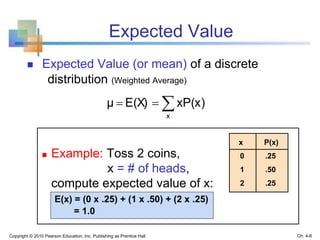
Expected Value
 Expected Value (or mean) of a discrete
distribution (Weighted Average)
 Example: Toss 2 coins,
x = # of heads,
compute expected value of x:
E(x) = (0 x .25) + (1 x .50) + (2 x .25)
= 1.0
x P(x)
0 .25
1 .50
2 .25

x
P(x)xE(X)μ
Copyright © 2010 Pearson Education, Inc. Publishing as Prentice Hall Ch. 4-8
Variance and Standard
Deviation
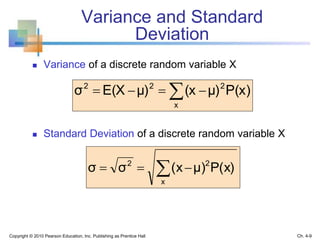
 Variance of a discrete random variable X
 Standard Deviation of a discrete random variable X
 
x
222
P(x)μ)(xμ)E(Xσ
 
x
22
P(x)μ)(xσσ
Copyright © 2010 Pearson Education, Inc. Publishing as Prentice Hall Ch. 4-9
Standard Deviation Example
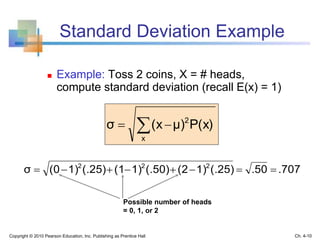
 Example: Toss 2 coins, X = # heads,
compute standard deviation (recall E(x) = 1)
 
x
2
P(x)μ)(xσ
.707.50(.25)1)(2(.50)1)(1(.25)1)(0σ 222

Possible number of heads
= 0, 1, or 2
Copyright © 2010 Pearson Education, Inc. Publishing as Prentice Hall Ch. 4-10
Functions of Random Variables
 If P(x) is the probability function of a discrete
random variable X , and g(X) is some function of
X , then the expected value of function g is

x
g(x)P(x)E[g(X)]
Copyright © 2010 Pearson Education, Inc. Publishing as Prentice Hall Ch. 4-11
Linear Functions
of Random Variables
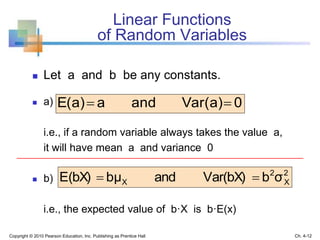
 Let a and b be any constants.
 a)
i.e., if a random variable always takes the value a,
it will have mean a and variance 0
 b)
i.e., the expected value of b·X is b·E(x)
0Var(a)andaE(a) 
2
X
2
X σbVar(bX)andbμE(bX) 
Copyright © 2010 Pearson Education, Inc. Publishing as Prentice Hall Ch. 4-12
Linear Functions
of Random Variables
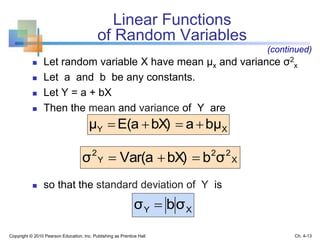
 Let random variable X have mean µx and variance σ2
x
 Let a and b be any constants.
 Let Y = a + bX
 Then the mean and variance of Y are
 so that the standard deviation of Y is
XY bμabX)E(aμ 
X
22
Y
2
σbbX)Var(aσ 
XY σbσ 
(continued)
Copyright © 2010 Pearson Education, Inc. Publishing as Prentice Hall Ch. 4-13
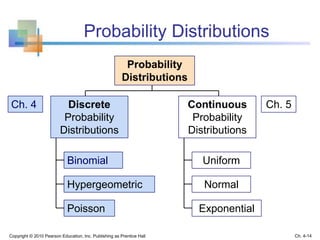
Probability Distributions
Continuous
Probability
Distributions
Binomial
Hypergeometric
Poisson
Probability
Distributions
Discrete
Probability
Distributions
Uniform
Normal
Exponential
Ch. 4 Ch. 5
Copyright © 2010 Pearson Education, Inc. Publishing as Prentice Hall Ch. 4-14
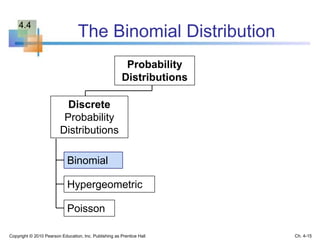
The Binomial Distribution
Binomial
Hypergeometric
Poisson
Probability
Distributions
Discrete
Probability
Distributions
Copyright © 2010 Pearson Education, Inc. Publishing as Prentice Hall Ch. 4-15
4.4
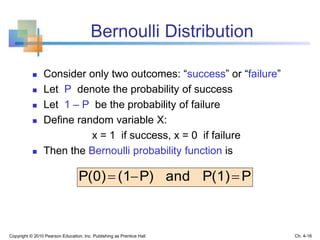
Bernoulli Distribution
 Consider only two outcomes: “success” or “failure”
 Let P denote the probability of success
 Let 1 – P be the probability of failure
 Define random variable X:
x = 1 if success, x = 0 if failure
 Then the Bernoulli probability function is
PP(1)andP)(1P(0) 
Copyright © 2010 Pearson Education, Inc. Publishing as Prentice Hall Ch. 4-16
Bernoulli Distribution
Mean and Variance
 The mean is µ = P
 The variance is σ2 = P(1 – P)
P(1)PP)(0)(1P(x)xE(X)μ
X
 
P)P(1PP)(1P)(1P)(0
P(x)μ)(x]μ)E[(Xσ
22
X
222

 
Copyright © 2010 Pearson Education, Inc. Publishing as Prentice Hall Ch. 4-17
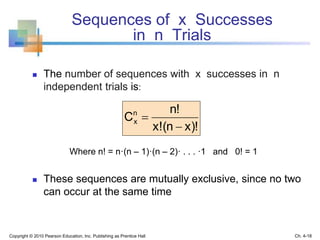
Sequences of x Successes
in n Trials
 The number of sequences with x successes in n
independent trials is:
Where n! = n·(n – 1)·(n – 2)· . . . ·1 and 0! = 1
 These sequences are mutually exclusive, since no two
can occur at the same time
x)!(nx!
n!
Cn
x


Copyright © 2010 Pearson Education, Inc. Publishing as Prentice Hall Ch. 4-18
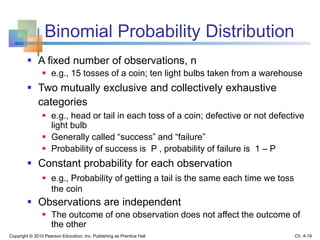
Binomial Probability Distribution
 A fixed number of observations, n
 e.g., 15 tosses of a coin; ten light bulbs taken from a warehouse
 Two mutually exclusive and collectively exhaustive
categories
 e.g., head or tail in each toss of a coin; defective or not defective
light bulb
 Generally called “success” and “failure”
 Probability of success is P , probability of failure is 1 – P
 Constant probability for each observation
 e.g., Probability of getting a tail is the same each time we toss
the coin
 Observations are independent
 The outcome of one observation does not affect the outcome of
the other
Copyright © 2010 Pearson Education, Inc. Publishing as Prentice Hall Ch. 4-19
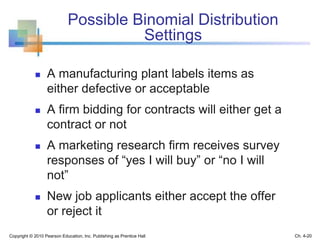
Possible Binomial Distribution
Settings
 A manufacturing plant labels items as
either defective or acceptable
 A firm bidding for contracts will either get a
contract or not
 A marketing research firm receives survey
responses of “yes I will buy” or “no I will
not”
 New job applicants either accept the offer
or reject it
Copyright © 2010 Pearson Education, Inc. Publishing as Prentice Hall Ch. 4-20
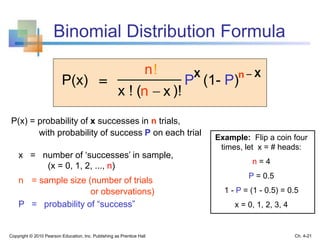
Binomial Distribution Formula
P(x) = probability of x successes in n trials,
with probability of success P on each trial
x = number of ‘successes’ in sample,
(x = 0, 1, 2, ..., n)
n = sample size (number of trials
or observations)
P = probability of “success”
P(x)
n
x ! n x
P (1- P)
X n X!
( )!



Example: Flip a coin four
times, let x = # heads:
n = 4
P = 0.5
1 - P = (1 - 0.5) = 0.5
x = 0, 1, 2, 3, 4
Copyright © 2010 Pearson Education, Inc. Publishing as Prentice Hall Ch. 4-21
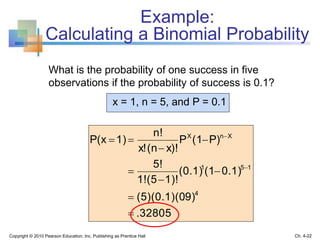
Example:
Calculating a Binomial Probability
What is the probability of one success in five
observations if the probability of success is 0.1?
x = 1, n = 5, and P = 0.1
.32805
.9)(5)(0.1)(0
0.1)(1(0.1)
1)!(51!
5!
P)(1P
x)!(nx!
n!
1)P(x
4
151
XnX










Copyright © 2010 Pearson Education, Inc. Publishing as Prentice Hall Ch. 4-22
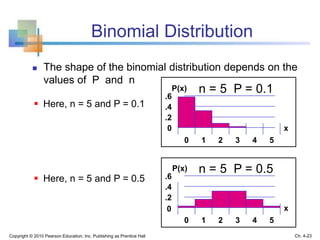
Binomial Distribution
 The shape of the binomial distribution depends on the
values of P and n
n = 5 P = 0.1
n = 5 P = 0.5
Mean
0
.2
.4
.6
0 1 2 3 4 5
x
P(x)
.2
.4
.6
0 1 2 3 4 5
x
P(x)
0
 Here, n = 5 and P = 0.1
 Here, n = 5 and P = 0.5
Copyright © 2010 Pearson Education, Inc. Publishing as Prentice Hall Ch. 4-23
Binomial Distribution
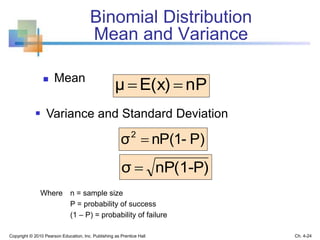
Mean and Variance
 Mean
 Variance and Standard Deviation
nPE(x)μ 
P)nP(1-σ2

P)nP(1-σ 
Where n = sample size
P = probability of success
(1 – P) = probability of failure
Copyright © 2010 Pearson Education, Inc. Publishing as Prentice Hall Ch. 4-24
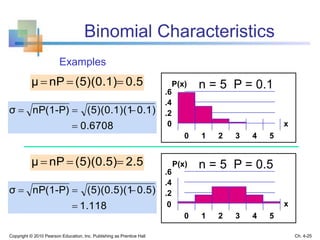
Binomial Characteristics
n = 5 P = 0.1
n = 5 P = 0.5
Mean
0
.2
.4
.6
0 1 2 3 4 5
x
P(x)
.2
.4
.6
0 1 2 3 4 5
x
P(x)
0
0.5(5)(0.1)nPμ 
0.6708
0.1)(5)(0.1)(1P)nP(1-σ


2.5(5)(0.5)nPμ 
1.118
0.5)(5)(0.5)(1P)nP(1-σ


Examples
Copyright © 2010 Pearson Education, Inc. Publishing as Prentice Hall Ch. 4-25
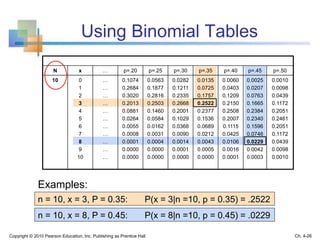
Using Binomial Tables
N x … p=.20 p=.25 p=.30 p=.35 p=.40 p=.45 p=.50
10 0
1
2
3
4
5
6
7
8
9
10
…
…
…
…
…
…
…
…
…
…
…
0.1074
0.2684
0.3020
0.2013
0.0881
0.0264
0.0055
0.0008
0.0001
0.0000
0.0000
0.0563
0.1877
0.2816
0.2503
0.1460
0.0584
0.0162
0.0031
0.0004
0.0000
0.0000
0.0282
0.1211
0.2335
0.2668
0.2001
0.1029
0.0368
0.0090
0.0014
0.0001
0.0000
0.0135
0.0725
0.1757
0.2522
0.2377
0.1536
0.0689
0.0212
0.0043
0.0005
0.0000
0.0060
0.0403
0.1209
0.2150
0.2508
0.2007
0.1115
0.0425
0.0106
0.0016
0.0001
0.0025
0.0207
0.0763
0.1665
0.2384
0.2340
0.1596
0.0746
0.0229
0.0042
0.0003
0.0010
0.0098
0.0439
0.1172
0.2051
0.2461
0.2051
0.1172
0.0439
0.0098
0.0010
Examples:
n = 10, x = 3, P = 0.35: P(x = 3|n =10, p = 0.35) = .2522
n = 10, x = 8, P = 0.45: P(x = 8|n =10, p = 0.45) = .0229
Copyright © 2010 Pearson Education, Inc. Publishing as Prentice Hall Ch. 4-26
The Hypergeometric Distribution
Binomial
Poisson
Probability
Distributions
Discrete
Probability
Distributions
Hypergeometric
Copyright © 2010 Pearson Education, Inc. Publishing as Prentice Hall Ch. 4-27
4.5
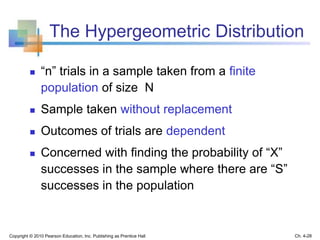
The Hypergeometric Distribution
 “n” trials in a sample taken from a finite
population of size N
 Sample taken without replacement
 Outcomes of trials are dependent
 Concerned with finding the probability of “X”
successes in the sample where there are “S”
successes in the population
Copyright © 2010 Pearson Education, Inc. Publishing as Prentice Hall Ch. 4-28
Hypergeometric Distribution
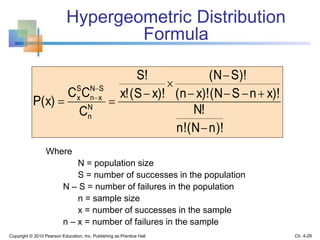
Formula
Where
N = population size
S = number of successes in the population
N – S = number of failures in the population
n = sample size
x = number of successes in the sample
n – x = number of failures in the sample
n)!(Nn!
N!
x)!nS(Nx)!(n
S)!(N
x)!(Sx!
S!
C
CC
P(x) N
n
SN
xn
S
x








Copyright © 2010 Pearson Education, Inc. Publishing as Prentice Hall Ch. 4-29
Using the
Hypergeometric Distribution
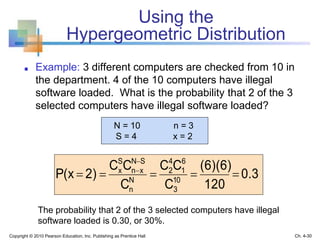
■ Example: 3 different computers are checked from 10 in
the department. 4 of the 10 computers have illegal
software loaded. What is the probability that 2 of the 3
selected computers have illegal software loaded?
N = 10 n = 3
S = 4 x = 2
The probability that 2 of the 3 selected computers have illegal
software loaded is 0.30, or 30%.
0.3
120
(6)(6)
C
CC
C
CC
2)P(x 10
3
6
1
4
2
N
n
SN
xn
S
x



Copyright © 2010 Pearson Education, Inc. Publishing as Prentice Hall Ch. 4-30
The Poisson Distribution
Binomial
Hypergeometric
Poisson
Probability
Distributions
Discrete
Probability
Distributions
Copyright © 2010 Pearson Education, Inc. Publishing as Prentice Hall Ch. 4-31
4.6
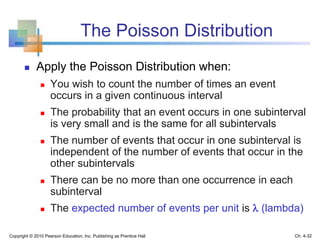
The Poisson Distribution
 Apply the Poisson Distribution when:
 You wish to count the number of times an event
occurs in a given continuous interval
 The probability that an event occurs in one subinterval
is very small and is the same for all subintervals
 The number of events that occur in one subinterval is
independent of the number of events that occur in the
other subintervals
 There can be no more than one occurrence in each
subinterval
 The expected number of events per unit is  (lambda)
Copyright © 2010 Pearson Education, Inc. Publishing as Prentice Hall Ch. 4-32
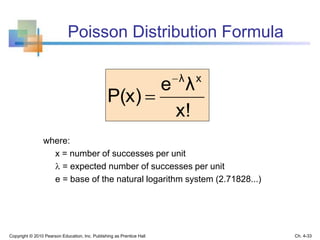
Poisson Distribution Formula
where:
x = number of successes per unit
 = expected number of successes per unit
e = base of the natural logarithm system (2.71828...)
x!
λe
P(x)
xλ

Copyright © 2010 Pearson Education, Inc. Publishing as Prentice Hall Ch. 4-33
Poisson Distribution
Characteristics
 Mean
 Variance and Standard Deviation
λE(X)μ 
λ]μ)E[(Xσ 22

λσ 
where  = expected number of successes per unit
Copyright © 2010 Pearson Education, Inc. Publishing as Prentice Hall Ch. 4-34
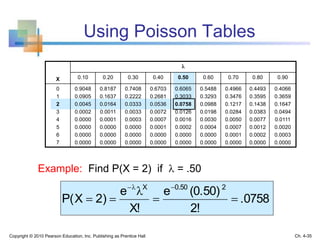
Using Poisson Tables
X

0.10 0.20 0.30 0.40 0.50 0.60 0.70 0.80 0.90
0
1
2
3
4
5
6
7
0.9048
0.0905
0.0045
0.0002
0.0000
0.0000
0.0000
0.0000
0.8187
0.1637
0.0164
0.0011
0.0001
0.0000
0.0000
0.0000
0.7408
0.2222
0.0333
0.0033
0.0003
0.0000
0.0000
0.0000
0.6703
0.2681
0.0536
0.0072
0.0007
0.0001
0.0000
0.0000
0.6065
0.3033
0.0758
0.0126
0.0016
0.0002
0.0000
0.0000
0.5488
0.3293
0.0988
0.0198
0.0030
0.0004
0.0000
0.0000
0.4966
0.3476
0.1217
0.0284
0.0050
0.0007
0.0001
0.0000
0.4493
0.3595
0.1438
0.0383
0.0077
0.0012
0.0002
0.0000
0.4066
0.3659
0.1647
0.0494
0.0111
0.0020
0.0003
0.0000
Example: Find P(X = 2) if  = .50
.0758
2!
(0.50)e
!X
e
)2X(P
20.50X




Copyright © 2010 Pearson Education, Inc. Publishing as Prentice Hall Ch. 4-35
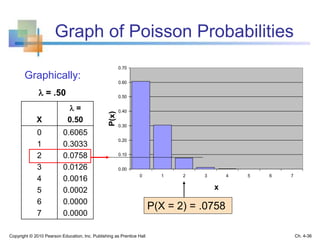
Graph of Poisson Probabilities
0.00
0.10
0.20
0.30
0.40
0.50
0.60
0.70
0 1 2 3 4 5 6 7
x
P(x)
X
 =
0.50
0
1
2
3
4
5
6
7
0.6065
0.3033
0.0758
0.0126
0.0016
0.0002
0.0000
0.0000
P(X = 2) = .0758
Graphically:
 = .50
Copyright © 2010 Pearson Education, Inc. Publishing as Prentice Hall Ch. 4-36
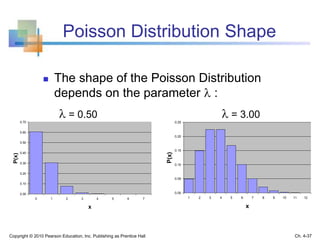
Poisson Distribution Shape
 The shape of the Poisson Distribution
depends on the parameter  :
0.00
0.05
0.10
0.15
0.20
0.25
1 2 3 4 5 6 7 8 9 10 11 12
x
P(x)
0.00
0.10
0.20
0.30
0.40
0.50
0.60
0.70
0 1 2 3 4 5 6 7
x
P(x)
 = 0.50  = 3.00
Copyright © 2010 Pearson Education, Inc. Publishing as Prentice Hall Ch. 4-37
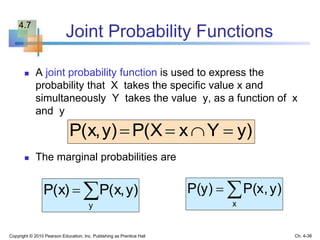
Joint Probability Functions
 A joint probability function is used to express the
probability that X takes the specific value x and
simultaneously Y takes the value y, as a function of x
and y
 The marginal probabilities are
y)YxP(Xy)P(x, 

y
y)P(x,P(x) 
x
y)P(x,P(y)
Copyright © 2010 Pearson Education, Inc. Publishing as Prentice Hall Ch. 4-38
4.7
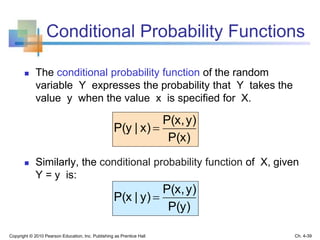
Conditional Probability Functions
 The conditional probability function of the random
variable Y expresses the probability that Y takes the
value y when the value x is specified for X.
 Similarly, the conditional probability function of X, given
Y = y is:
P(x)
y)P(x,
x)|P(y 
P(y)
y)P(x,
y)|P(x 
Copyright © 2010 Pearson Education, Inc. Publishing as Prentice Hall Ch. 4-39
Independence
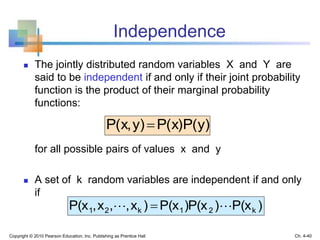
 The jointly distributed random variables X and Y are
said to be independent if and only if their joint probability
function is the product of their marginal probability
functions:
for all possible pairs of values x and y
 A set of k random variables are independent if and only
if
P(x)P(y)y)P(x, 
)P(x))P(xP(x)x,,x,P(x k21k21  
Copyright © 2010 Pearson Education, Inc. Publishing as Prentice Hall Ch. 4-40
Conditional Mean and Variance
Ch. 4-41Copyright © 2010 Pearson Education, Inc. Publishing as Prentice Hall
 The conditional mean is
 The conditional variance is
x)|P(yx)|(yX]|E[Yμ
Y
X|Y 
 
Y
2
X|Y
2
X|Y
2
X|Y x)|x]P(y|)μ[(yX]|)μE[(Yσ
Covariance
 Let X and Y be discrete random variables with means
μX and μY
 The expected value of (X - μX)(Y - μY) is called the
covariance between X and Y
 For discrete random variables
 An equivalent expression is
 
x y
yxYX y))P(x,μ)(yμ(x)]μ)(YμE[(XY)Cov(X,
 
x y
yxyx μμy)xyP(x,μμE(XY)Y)Cov(X,
Copyright © 2010 Pearson Education, Inc. Publishing as Prentice Hall Ch. 4-42
Covariance and Independence
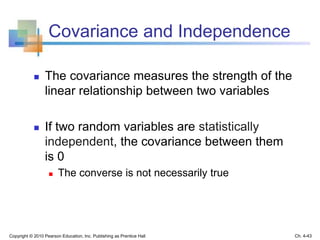
 The covariance measures the strength of the
linear relationship between two variables
 If two random variables are statistically
independent, the covariance between them
is 0
 The converse is not necessarily true
Copyright © 2010 Pearson Education, Inc. Publishing as Prentice Hall Ch. 4-43
Correlation
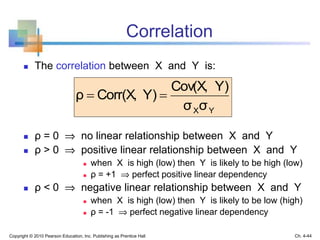
 The correlation between X and Y is:
 ρ = 0 no linear relationship between X and Y
 ρ > 0 positive linear relationship between X and Y
 when X is high (low) then Y is likely to be high (low)
 ρ = +1 perfect positive linear dependency
 ρ < 0 negative linear relationship between X and Y
 when X is high (low) then Y is likely to be low (high)
 ρ = -1 perfect negative linear dependency
YXσσ
Y)Cov(X,
Y)Corr(X,ρ 
Copyright © 2010 Pearson Education, Inc. Publishing as Prentice Hall Ch. 4-44
Portfolio Analysis
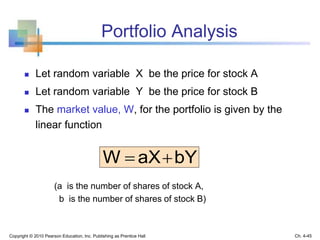
 Let random variable X be the price for stock A
 Let random variable Y be the price for stock B
 The market value, W, for the portfolio is given by the
linear function
(a is the number of shares of stock A,
b is the number of shares of stock B)
bYaXW 
Copyright © 2010 Pearson Education, Inc. Publishing as Prentice Hall Ch. 4-45
Portfolio Analysis
 The mean value for W is
 The variance for W is
or using the correlation formula
(continued)
YX
W
bμaμ
bY]E[aXE[W]μ


Y)2abCov(X,σbσaσ 2
Y
22
X
22
W 
YX
2
Y
22
X
22
W σY)σ2abCorr(X,σbσaσ 
Copyright © 2010 Pearson Education, Inc. Publishing as Prentice Hall Ch. 4-46
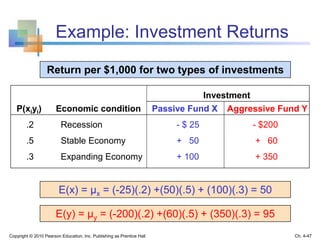
Example: Investment Returns
Return per $1,000 for two types of investments
P(xiyi) Economic condition Passive Fund X Aggressive Fund Y
.2 Recession - $ 25 - $200
.5 Stable Economy + 50 + 60
.3 Expanding Economy + 100 + 350
Investment
E(x) = μx = (-25)(.2) +(50)(.5) + (100)(.3) = 50
E(y) = μy = (-200)(.2) +(60)(.5) + (350)(.3) = 95
Copyright © 2010 Pearson Education, Inc. Publishing as Prentice Hall Ch. 4-47
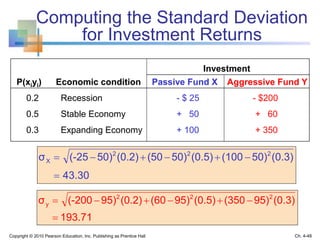
Computing the Standard Deviation
for Investment Returns
P(xiyi) Economic condition Passive Fund X Aggressive Fund Y
0.2 Recession - $ 25 - $200
0.5 Stable Economy + 50 + 60
0.3 Expanding Economy + 100 + 350
Investment
43.30
(0.3)50)(100(0.5)50)(50(0.2)50)(-25σ 222
X


193.71
(0.3)95)(350(0.5)95)(60(0.2)95)(-200σ 222
y


Copyright © 2010 Pearson Education, Inc. Publishing as Prentice Hall Ch. 4-48
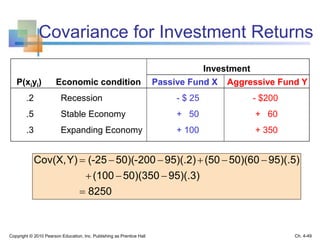
Covariance for Investment Returns
P(xiyi) Economic condition Passive Fund X Aggressive Fund Y
.2 Recession - $ 25 - $200
.5 Stable Economy + 50 + 60
.3 Expanding Economy + 100 + 350
Investment
8250
95)(.3)50)(350(100
95)(.5)50)(60(5095)(.2)200-50)((-25Y)Cov(X,



Copyright © 2010 Pearson Education, Inc. Publishing as Prentice Hall Ch. 4-49
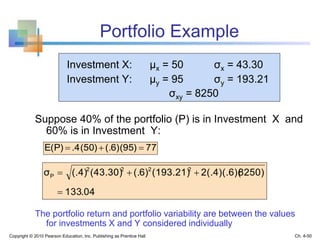
Portfolio Example
Investment X: μx = 50 σx = 43.30
Investment Y: μy = 95 σy = 193.21
σxy = 8250
Suppose 40% of the portfolio (P) is in Investment X and
60% is in Investment Y:
The portfolio return and portfolio variability are between the values
for investments X and Y considered individually
77)95()6(.)50(4.E(P) 
04.133
8250)2(.4)(.6)((193.21))6(.(43.30)(.4)σ 2222
P


Copyright © 2010 Pearson Education, Inc. Publishing as Prentice Hall Ch. 4-50
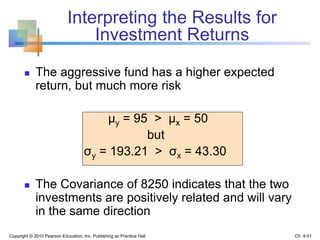
Interpreting the Results for
Investment Returns
 The aggressive fund has a higher expected
return, but much more risk
μy = 95 > μx = 50
but
σy = 193.21 > σx = 43.30
 The Covariance of 8250 indicates that the two
investments are positively related and will vary
in the same direction
Copyright © 2010 Pearson Education, Inc. Publishing as Prentice Hall Ch. 4-51
Chapter Summary
 Defined discrete random variables and
probability distributions
 Discussed the Binomial distribution
 Discussed the Hypergeometric distribution
 Reviewed the Poisson distribution
 Defined covariance and the correlation between
two random variables
 Examined application to portfolio investment
Copyright © 2010 Pearson Education, Inc. Publishing as Prentice Hall Ch. 4-52

Chap04 discrete random variables and probability distribution

  • 1.
    Chapter 4 Discrete RandomVariables and Probability Distributions Statistics for Business and Economics 7th Edition Copyright © 2010 Pearson Education, Inc. Publishing as Prentice Hall Ch. 4-1
  • 2.
    Chapter Goals After completingthis chapter, you should be able to:  Interpret the mean and standard deviation for a discrete random variable  Use the binomial probability distribution to find probabilities  Describe when to apply the binomial distribution  Use the hypergeometric and Poisson discrete probability distributions to find probabilities  Explain covariance and correlation for jointly distributed discrete random variables Copyright © 2010 Pearson Education, Inc. Publishing as Prentice Hall Ch. 4-2
  • 3.
    Introduction to Probability Distributions Random Variable  Represents a possible numerical value from a random experiment Random Variables Discrete Random Variable Continuous Random Variable Ch. 4 Ch. 5 Copyright © 2010 Pearson Education, Inc. Publishing as Prentice Hall Ch. 4-3 4.1
  • 4.
    Discrete Random Variables Can only take on a countable number of values Examples:  Roll a die twice Let X be the number of times 4 comes up (then X could be 0, 1, or 2 times)  Toss a coin 5 times. Let X be the number of heads (then X = 0, 1, 2, 3, 4, or 5) Copyright © 2010 Pearson Education, Inc. Publishing as Prentice Hall Ch. 4-4
  • 5.
    Discrete Probability Distribution xValue Probability 0 1/4 = .25 1 2/4 = .50 2 1/4 = .25 Experiment: Toss 2 Coins. Let X = # heads. T T 4 possible outcomes T T H H H H Probability Distribution 0 1 2 x .50 .25 Probability Show P(x) , i.e., P(X = x) , for all values of x: Copyright © 2010 Pearson Education, Inc. Publishing as Prentice Hall Ch. 4-5 4.2
  • 6.
    Probability Distribution Required Properties  x 1P(x)  P(x)  0 for any value of x  The individual probabilities sum to 1; (The notation indicates summation over all possible x values) Copyright © 2010 Pearson Education, Inc. Publishing as Prentice Hall Ch. 4-6 4.3
  • 7.
    Cumulative Probability Function The cumulative probability function, denoted F(x0), shows the probability that X is less than or equal to x0  In other words, )xP(X)F(x 00    0xx 0 P(x))F(x Copyright © 2010 Pearson Education, Inc. Publishing as Prentice Hall Ch. 4-7
  • 8.
    Expected Value  ExpectedValue (or mean) of a discrete distribution (Weighted Average)  Example: Toss 2 coins, x = # of heads, compute expected value of x: E(x) = (0 x .25) + (1 x .50) + (2 x .25) = 1.0 x P(x) 0 .25 1 .50 2 .25  x P(x)xE(X)μ Copyright © 2010 Pearson Education, Inc. Publishing as Prentice Hall Ch. 4-8
  • 9.
    Variance and Standard Deviation Variance of a discrete random variable X  Standard Deviation of a discrete random variable X   x 222 P(x)μ)(xμ)E(Xσ   x 22 P(x)μ)(xσσ Copyright © 2010 Pearson Education, Inc. Publishing as Prentice Hall Ch. 4-9
  • 10.
    Standard Deviation Example Example: Toss 2 coins, X = # heads, compute standard deviation (recall E(x) = 1)   x 2 P(x)μ)(xσ .707.50(.25)1)(2(.50)1)(1(.25)1)(0σ 222  Possible number of heads = 0, 1, or 2 Copyright © 2010 Pearson Education, Inc. Publishing as Prentice Hall Ch. 4-10
  • 11.
    Functions of RandomVariables  If P(x) is the probability function of a discrete random variable X , and g(X) is some function of X , then the expected value of function g is  x g(x)P(x)E[g(X)] Copyright © 2010 Pearson Education, Inc. Publishing as Prentice Hall Ch. 4-11
  • 12.
    Linear Functions of RandomVariables  Let a and b be any constants.  a) i.e., if a random variable always takes the value a, it will have mean a and variance 0  b) i.e., the expected value of b·X is b·E(x) 0Var(a)andaE(a)  2 X 2 X σbVar(bX)andbμE(bX)  Copyright © 2010 Pearson Education, Inc. Publishing as Prentice Hall Ch. 4-12
  • 13.
    Linear Functions of RandomVariables  Let random variable X have mean µx and variance σ2 x  Let a and b be any constants.  Let Y = a + bX  Then the mean and variance of Y are  so that the standard deviation of Y is XY bμabX)E(aμ  X 22 Y 2 σbbX)Var(aσ  XY σbσ  (continued) Copyright © 2010 Pearson Education, Inc. Publishing as Prentice Hall Ch. 4-13
  • 14.
  • 15.
  • 16.
    Bernoulli Distribution  Consideronly two outcomes: “success” or “failure”  Let P denote the probability of success  Let 1 – P be the probability of failure  Define random variable X: x = 1 if success, x = 0 if failure  Then the Bernoulli probability function is PP(1)andP)(1P(0)  Copyright © 2010 Pearson Education, Inc. Publishing as Prentice Hall Ch. 4-16
  • 17.
    Bernoulli Distribution Mean andVariance  The mean is µ = P  The variance is σ2 = P(1 – P) P(1)PP)(0)(1P(x)xE(X)μ X   P)P(1PP)(1P)(1P)(0 P(x)μ)(x]μ)E[(Xσ 22 X 222    Copyright © 2010 Pearson Education, Inc. Publishing as Prentice Hall Ch. 4-17
  • 18.
    Sequences of xSuccesses in n Trials  The number of sequences with x successes in n independent trials is: Where n! = n·(n – 1)·(n – 2)· . . . ·1 and 0! = 1  These sequences are mutually exclusive, since no two can occur at the same time x)!(nx! n! Cn x   Copyright © 2010 Pearson Education, Inc. Publishing as Prentice Hall Ch. 4-18
  • 19.
    Binomial Probability Distribution A fixed number of observations, n  e.g., 15 tosses of a coin; ten light bulbs taken from a warehouse  Two mutually exclusive and collectively exhaustive categories  e.g., head or tail in each toss of a coin; defective or not defective light bulb  Generally called “success” and “failure”  Probability of success is P , probability of failure is 1 – P  Constant probability for each observation  e.g., Probability of getting a tail is the same each time we toss the coin  Observations are independent  The outcome of one observation does not affect the outcome of the other Copyright © 2010 Pearson Education, Inc. Publishing as Prentice Hall Ch. 4-19
  • 20.
    Possible Binomial Distribution Settings A manufacturing plant labels items as either defective or acceptable  A firm bidding for contracts will either get a contract or not  A marketing research firm receives survey responses of “yes I will buy” or “no I will not”  New job applicants either accept the offer or reject it Copyright © 2010 Pearson Education, Inc. Publishing as Prentice Hall Ch. 4-20
  • 21.
    Binomial Distribution Formula P(x)= probability of x successes in n trials, with probability of success P on each trial x = number of ‘successes’ in sample, (x = 0, 1, 2, ..., n) n = sample size (number of trials or observations) P = probability of “success” P(x) n x ! n x P (1- P) X n X! ( )!    Example: Flip a coin four times, let x = # heads: n = 4 P = 0.5 1 - P = (1 - 0.5) = 0.5 x = 0, 1, 2, 3, 4 Copyright © 2010 Pearson Education, Inc. Publishing as Prentice Hall Ch. 4-21
  • 22.
    Example: Calculating a BinomialProbability What is the probability of one success in five observations if the probability of success is 0.1? x = 1, n = 5, and P = 0.1 .32805 .9)(5)(0.1)(0 0.1)(1(0.1) 1)!(51! 5! P)(1P x)!(nx! n! 1)P(x 4 151 XnX           Copyright © 2010 Pearson Education, Inc. Publishing as Prentice Hall Ch. 4-22
  • 23.
    Binomial Distribution  Theshape of the binomial distribution depends on the values of P and n n = 5 P = 0.1 n = 5 P = 0.5 Mean 0 .2 .4 .6 0 1 2 3 4 5 x P(x) .2 .4 .6 0 1 2 3 4 5 x P(x) 0  Here, n = 5 and P = 0.1  Here, n = 5 and P = 0.5 Copyright © 2010 Pearson Education, Inc. Publishing as Prentice Hall Ch. 4-23
  • 24.
    Binomial Distribution Mean andVariance  Mean  Variance and Standard Deviation nPE(x)μ  P)nP(1-σ2  P)nP(1-σ  Where n = sample size P = probability of success (1 – P) = probability of failure Copyright © 2010 Pearson Education, Inc. Publishing as Prentice Hall Ch. 4-24
  • 25.
    Binomial Characteristics n =5 P = 0.1 n = 5 P = 0.5 Mean 0 .2 .4 .6 0 1 2 3 4 5 x P(x) .2 .4 .6 0 1 2 3 4 5 x P(x) 0 0.5(5)(0.1)nPμ  0.6708 0.1)(5)(0.1)(1P)nP(1-σ   2.5(5)(0.5)nPμ  1.118 0.5)(5)(0.5)(1P)nP(1-σ   Examples Copyright © 2010 Pearson Education, Inc. Publishing as Prentice Hall Ch. 4-25
  • 26.
    Using Binomial Tables Nx … p=.20 p=.25 p=.30 p=.35 p=.40 p=.45 p=.50 10 0 1 2 3 4 5 6 7 8 9 10 … … … … … … … … … … … 0.1074 0.2684 0.3020 0.2013 0.0881 0.0264 0.0055 0.0008 0.0001 0.0000 0.0000 0.0563 0.1877 0.2816 0.2503 0.1460 0.0584 0.0162 0.0031 0.0004 0.0000 0.0000 0.0282 0.1211 0.2335 0.2668 0.2001 0.1029 0.0368 0.0090 0.0014 0.0001 0.0000 0.0135 0.0725 0.1757 0.2522 0.2377 0.1536 0.0689 0.0212 0.0043 0.0005 0.0000 0.0060 0.0403 0.1209 0.2150 0.2508 0.2007 0.1115 0.0425 0.0106 0.0016 0.0001 0.0025 0.0207 0.0763 0.1665 0.2384 0.2340 0.1596 0.0746 0.0229 0.0042 0.0003 0.0010 0.0098 0.0439 0.1172 0.2051 0.2461 0.2051 0.1172 0.0439 0.0098 0.0010 Examples: n = 10, x = 3, P = 0.35: P(x = 3|n =10, p = 0.35) = .2522 n = 10, x = 8, P = 0.45: P(x = 8|n =10, p = 0.45) = .0229 Copyright © 2010 Pearson Education, Inc. Publishing as Prentice Hall Ch. 4-26
  • 27.
  • 28.
    The Hypergeometric Distribution “n” trials in a sample taken from a finite population of size N  Sample taken without replacement  Outcomes of trials are dependent  Concerned with finding the probability of “X” successes in the sample where there are “S” successes in the population Copyright © 2010 Pearson Education, Inc. Publishing as Prentice Hall Ch. 4-28
  • 29.
    Hypergeometric Distribution Formula Where N =population size S = number of successes in the population N – S = number of failures in the population n = sample size x = number of successes in the sample n – x = number of failures in the sample n)!(Nn! N! x)!nS(Nx)!(n S)!(N x)!(Sx! S! C CC P(x) N n SN xn S x         Copyright © 2010 Pearson Education, Inc. Publishing as Prentice Hall Ch. 4-29
  • 30.
    Using the Hypergeometric Distribution ■Example: 3 different computers are checked from 10 in the department. 4 of the 10 computers have illegal software loaded. What is the probability that 2 of the 3 selected computers have illegal software loaded? N = 10 n = 3 S = 4 x = 2 The probability that 2 of the 3 selected computers have illegal software loaded is 0.30, or 30%. 0.3 120 (6)(6) C CC C CC 2)P(x 10 3 6 1 4 2 N n SN xn S x    Copyright © 2010 Pearson Education, Inc. Publishing as Prentice Hall Ch. 4-30
  • 31.
  • 32.
    The Poisson Distribution Apply the Poisson Distribution when:  You wish to count the number of times an event occurs in a given continuous interval  The probability that an event occurs in one subinterval is very small and is the same for all subintervals  The number of events that occur in one subinterval is independent of the number of events that occur in the other subintervals  There can be no more than one occurrence in each subinterval  The expected number of events per unit is  (lambda) Copyright © 2010 Pearson Education, Inc. Publishing as Prentice Hall Ch. 4-32
  • 33.
    Poisson Distribution Formula where: x= number of successes per unit  = expected number of successes per unit e = base of the natural logarithm system (2.71828...) x! λe P(x) xλ  Copyright © 2010 Pearson Education, Inc. Publishing as Prentice Hall Ch. 4-33
  • 34.
    Poisson Distribution Characteristics  Mean Variance and Standard Deviation λE(X)μ  λ]μ)E[(Xσ 22  λσ  where  = expected number of successes per unit Copyright © 2010 Pearson Education, Inc. Publishing as Prentice Hall Ch. 4-34
  • 35.
    Using Poisson Tables X  0.100.20 0.30 0.40 0.50 0.60 0.70 0.80 0.90 0 1 2 3 4 5 6 7 0.9048 0.0905 0.0045 0.0002 0.0000 0.0000 0.0000 0.0000 0.8187 0.1637 0.0164 0.0011 0.0001 0.0000 0.0000 0.0000 0.7408 0.2222 0.0333 0.0033 0.0003 0.0000 0.0000 0.0000 0.6703 0.2681 0.0536 0.0072 0.0007 0.0001 0.0000 0.0000 0.6065 0.3033 0.0758 0.0126 0.0016 0.0002 0.0000 0.0000 0.5488 0.3293 0.0988 0.0198 0.0030 0.0004 0.0000 0.0000 0.4966 0.3476 0.1217 0.0284 0.0050 0.0007 0.0001 0.0000 0.4493 0.3595 0.1438 0.0383 0.0077 0.0012 0.0002 0.0000 0.4066 0.3659 0.1647 0.0494 0.0111 0.0020 0.0003 0.0000 Example: Find P(X = 2) if  = .50 .0758 2! (0.50)e !X e )2X(P 20.50X     Copyright © 2010 Pearson Education, Inc. Publishing as Prentice Hall Ch. 4-35
  • 36.
    Graph of PoissonProbabilities 0.00 0.10 0.20 0.30 0.40 0.50 0.60 0.70 0 1 2 3 4 5 6 7 x P(x) X  = 0.50 0 1 2 3 4 5 6 7 0.6065 0.3033 0.0758 0.0126 0.0016 0.0002 0.0000 0.0000 P(X = 2) = .0758 Graphically:  = .50 Copyright © 2010 Pearson Education, Inc. Publishing as Prentice Hall Ch. 4-36
  • 37.
    Poisson Distribution Shape The shape of the Poisson Distribution depends on the parameter  : 0.00 0.05 0.10 0.15 0.20 0.25 1 2 3 4 5 6 7 8 9 10 11 12 x P(x) 0.00 0.10 0.20 0.30 0.40 0.50 0.60 0.70 0 1 2 3 4 5 6 7 x P(x)  = 0.50  = 3.00 Copyright © 2010 Pearson Education, Inc. Publishing as Prentice Hall Ch. 4-37
  • 38.
    Joint Probability Functions A joint probability function is used to express the probability that X takes the specific value x and simultaneously Y takes the value y, as a function of x and y  The marginal probabilities are y)YxP(Xy)P(x,   y y)P(x,P(x)  x y)P(x,P(y) Copyright © 2010 Pearson Education, Inc. Publishing as Prentice Hall Ch. 4-38 4.7
  • 39.
    Conditional Probability Functions The conditional probability function of the random variable Y expresses the probability that Y takes the value y when the value x is specified for X.  Similarly, the conditional probability function of X, given Y = y is: P(x) y)P(x, x)|P(y  P(y) y)P(x, y)|P(x  Copyright © 2010 Pearson Education, Inc. Publishing as Prentice Hall Ch. 4-39
  • 40.
    Independence  The jointlydistributed random variables X and Y are said to be independent if and only if their joint probability function is the product of their marginal probability functions: for all possible pairs of values x and y  A set of k random variables are independent if and only if P(x)P(y)y)P(x,  )P(x))P(xP(x)x,,x,P(x k21k21   Copyright © 2010 Pearson Education, Inc. Publishing as Prentice Hall Ch. 4-40
  • 41.
    Conditional Mean andVariance Ch. 4-41Copyright © 2010 Pearson Education, Inc. Publishing as Prentice Hall  The conditional mean is  The conditional variance is x)|P(yx)|(yX]|E[Yμ Y X|Y    Y 2 X|Y 2 X|Y 2 X|Y x)|x]P(y|)μ[(yX]|)μE[(Yσ
  • 42.
    Covariance  Let Xand Y be discrete random variables with means μX and μY  The expected value of (X - μX)(Y - μY) is called the covariance between X and Y  For discrete random variables  An equivalent expression is   x y yxYX y))P(x,μ)(yμ(x)]μ)(YμE[(XY)Cov(X,   x y yxyx μμy)xyP(x,μμE(XY)Y)Cov(X, Copyright © 2010 Pearson Education, Inc. Publishing as Prentice Hall Ch. 4-42
  • 43.
    Covariance and Independence The covariance measures the strength of the linear relationship between two variables  If two random variables are statistically independent, the covariance between them is 0  The converse is not necessarily true Copyright © 2010 Pearson Education, Inc. Publishing as Prentice Hall Ch. 4-43
  • 44.
    Correlation  The correlationbetween X and Y is:  ρ = 0 no linear relationship between X and Y  ρ > 0 positive linear relationship between X and Y  when X is high (low) then Y is likely to be high (low)  ρ = +1 perfect positive linear dependency  ρ < 0 negative linear relationship between X and Y  when X is high (low) then Y is likely to be low (high)  ρ = -1 perfect negative linear dependency YXσσ Y)Cov(X, Y)Corr(X,ρ  Copyright © 2010 Pearson Education, Inc. Publishing as Prentice Hall Ch. 4-44
  • 45.
    Portfolio Analysis  Letrandom variable X be the price for stock A  Let random variable Y be the price for stock B  The market value, W, for the portfolio is given by the linear function (a is the number of shares of stock A, b is the number of shares of stock B) bYaXW  Copyright © 2010 Pearson Education, Inc. Publishing as Prentice Hall Ch. 4-45
  • 46.
    Portfolio Analysis  Themean value for W is  The variance for W is or using the correlation formula (continued) YX W bμaμ bY]E[aXE[W]μ   Y)2abCov(X,σbσaσ 2 Y 22 X 22 W  YX 2 Y 22 X 22 W σY)σ2abCorr(X,σbσaσ  Copyright © 2010 Pearson Education, Inc. Publishing as Prentice Hall Ch. 4-46
  • 47.
    Example: Investment Returns Returnper $1,000 for two types of investments P(xiyi) Economic condition Passive Fund X Aggressive Fund Y .2 Recession - $ 25 - $200 .5 Stable Economy + 50 + 60 .3 Expanding Economy + 100 + 350 Investment E(x) = μx = (-25)(.2) +(50)(.5) + (100)(.3) = 50 E(y) = μy = (-200)(.2) +(60)(.5) + (350)(.3) = 95 Copyright © 2010 Pearson Education, Inc. Publishing as Prentice Hall Ch. 4-47
  • 48.
    Computing the StandardDeviation for Investment Returns P(xiyi) Economic condition Passive Fund X Aggressive Fund Y 0.2 Recession - $ 25 - $200 0.5 Stable Economy + 50 + 60 0.3 Expanding Economy + 100 + 350 Investment 43.30 (0.3)50)(100(0.5)50)(50(0.2)50)(-25σ 222 X   193.71 (0.3)95)(350(0.5)95)(60(0.2)95)(-200σ 222 y   Copyright © 2010 Pearson Education, Inc. Publishing as Prentice Hall Ch. 4-48
  • 49.
    Covariance for InvestmentReturns P(xiyi) Economic condition Passive Fund X Aggressive Fund Y .2 Recession - $ 25 - $200 .5 Stable Economy + 50 + 60 .3 Expanding Economy + 100 + 350 Investment 8250 95)(.3)50)(350(100 95)(.5)50)(60(5095)(.2)200-50)((-25Y)Cov(X,    Copyright © 2010 Pearson Education, Inc. Publishing as Prentice Hall Ch. 4-49
  • 50.
    Portfolio Example Investment X:μx = 50 σx = 43.30 Investment Y: μy = 95 σy = 193.21 σxy = 8250 Suppose 40% of the portfolio (P) is in Investment X and 60% is in Investment Y: The portfolio return and portfolio variability are between the values for investments X and Y considered individually 77)95()6(.)50(4.E(P)  04.133 8250)2(.4)(.6)((193.21))6(.(43.30)(.4)σ 2222 P   Copyright © 2010 Pearson Education, Inc. Publishing as Prentice Hall Ch. 4-50
  • 51.
    Interpreting the Resultsfor Investment Returns  The aggressive fund has a higher expected return, but much more risk μy = 95 > μx = 50 but σy = 193.21 > σx = 43.30  The Covariance of 8250 indicates that the two investments are positively related and will vary in the same direction Copyright © 2010 Pearson Education, Inc. Publishing as Prentice Hall Ch. 4-51
  • 52.
    Chapter Summary  Defineddiscrete random variables and probability distributions  Discussed the Binomial distribution  Discussed the Hypergeometric distribution  Reviewed the Poisson distribution  Defined covariance and the correlation between two random variables  Examined application to portfolio investment Copyright © 2010 Pearson Education, Inc. Publishing as Prentice Hall Ch. 4-52