Chapter 3
Probability
Statistics for
Business and Economics
7th Edition
Copyright © 2010 Pearson Education, Inc. Publishing as Prentice Hall Ch. 3-1
Chapter Goals
After completing this chapter, you should be
able to:
 Explain basic probability concepts and definitions
 Use a Venn diagram or tree diagram to illustrate
simple probabilities
 Apply common rules of probability
 Compute conditional probabilities
 Determine whether events are statistically
independent
 Use Bayes’ Theorem for conditional probabilities
Copyright © 2010 Pearson Education, Inc. Publishing as Prentice Hall Ch. 3-2
Important Terms
 Random Experiment – a process leading to an
uncertain outcome
 Basic Outcome – a possible outcome of a
random experiment
 Sample Space – the collection of all possible
outcomes of a random experiment
 Event – any subset of basic outcomes from the
sample space
Copyright © 2010 Pearson Education, Inc. Publishing as Prentice Hall Ch. 3-3
3.1
Important Terms
 Intersection of Events – If A and B are two
events in a sample space S, then the
intersection, A ∩ B, is the set of all outcomes in
S that belong to both A and B
(continued)
A BAB
S
Copyright © 2010 Pearson Education, Inc. Publishing as Prentice Hall Ch. 3-4
Important Terms
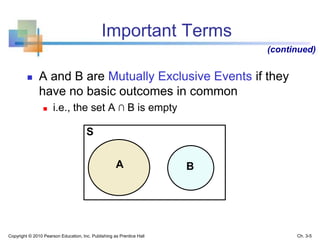
 A and B are Mutually Exclusive Events if they
have no basic outcomes in common
 i.e., the set A ∩ B is empty
(continued)
A B
S
Copyright © 2010 Pearson Education, Inc. Publishing as Prentice Hall Ch. 3-5
Important Terms
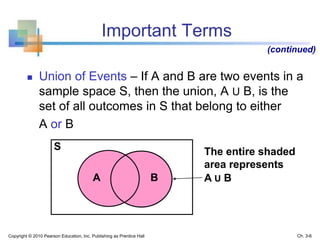
 Union of Events – If A and B are two events in a
sample space S, then the union, A U B, is the
set of all outcomes in S that belong to either
A or B
(continued)
A B
The entire shaded
area represents
A U B
S
Copyright © 2010 Pearson Education, Inc. Publishing as Prentice Hall Ch. 3-6
Important Terms
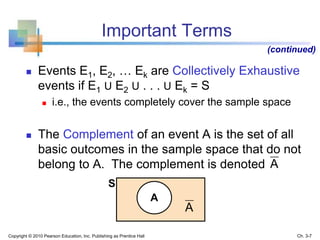
 Events E1, E2, … Ek are Collectively Exhaustive
events if E1 U E2 U . . . U Ek = S
 i.e., the events completely cover the sample space
 The Complement of an event A is the set of all
basic outcomes in the sample space that do not
belong to A. The complement is denoted
(continued)
A
A
S
A
Copyright © 2010 Pearson Education, Inc. Publishing as Prentice Hall Ch. 3-7
Examples
Let the Sample Space be the collection of
all possible outcomes of rolling one die:
S = [1, 2, 3, 4, 5, 6]
Let A be the event “Number rolled is even”
Let B be the event “Number rolled is at least 4”
Then
A = [2, 4, 6] and B = [4, 5, 6]
Copyright © 2010 Pearson Education, Inc. Publishing as Prentice Hall Ch. 3-8
Examples
(continued)
S = [1, 2, 3, 4, 5, 6] A = [2, 4, 6] B = [4, 5, 6]
5]3,[1,A 
6][4,BA 
6]5,4,[2,BA 
S6]5,4,3,2,[1,AA 
Complements:
Intersections:
Unions:
[5]BA 
3]2,[1,B 
Copyright © 2010 Pearson Education, Inc. Publishing as Prentice Hall Ch. 3-9
Examples
 Mutually exclusive:
 A and B are not mutually exclusive
 The outcomes 4 and 6 are common to both
 Collectively exhaustive:
 A and B are not collectively exhaustive
 A U B does not contain 1 or 3
(continued)
S = [1, 2, 3, 4, 5, 6] A = [2, 4, 6] B = [4, 5, 6]
Copyright © 2010 Pearson Education, Inc. Publishing as Prentice Hall Ch. 3-10
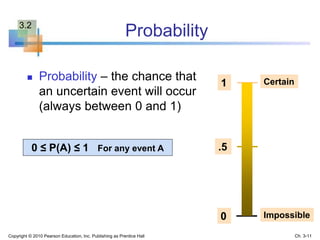
Probability
 Probability – the chance that
an uncertain event will occur
(always between 0 and 1)
0 ≤ P(A) ≤ 1 For any event A
Certain
Impossible
.5
1
0
Copyright © 2010 Pearson Education, Inc. Publishing as Prentice Hall Ch. 3-11
3.2
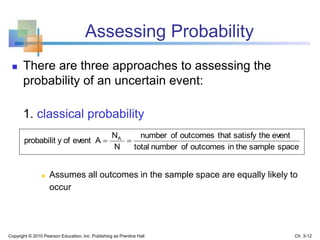
Assessing Probability
 There are three approaches to assessing the
probability of an uncertain event:
1. classical probability
 Assumes all outcomes in the sample space are equally likely to
occur
spacesampletheinoutcomesofnumbertotal
eventthesatisfythatoutcomesofnumber
N
N
Aeventofyprobabilit A

Copyright © 2010 Pearson Education, Inc. Publishing as Prentice Hall Ch. 3-12
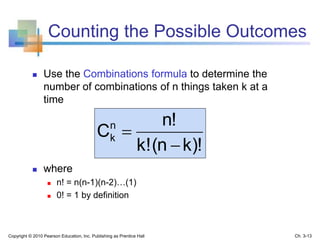
Counting the Possible Outcomes
 Use the Combinations formula to determine the
number of combinations of n things taken k at a
time
 where
 n! = n(n-1)(n-2)…(1)
 0! = 1 by definition
k)!(nk!
n!
Cn
k


Copyright © 2010 Pearson Education, Inc. Publishing as Prentice Hall Ch. 3-13
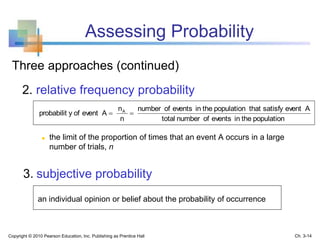
Assessing Probability
Three approaches (continued)
2. relative frequency probability
 the limit of the proportion of times that an event A occurs in a large
number of trials, n
3. subjective probability
an individual opinion or belief about the probability of occurrence
populationtheineventsofnumbertotal
Aeventsatisfythatpopulationtheineventsofnumber
n
n
Aeventofyprobabilit A

Copyright © 2010 Pearson Education, Inc. Publishing as Prentice Hall Ch. 3-14
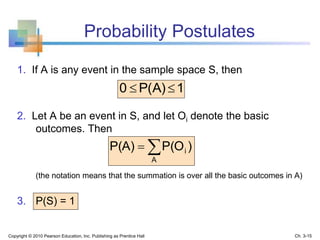
Probability Postulates
1. If A is any event in the sample space S, then
2. Let A be an event in S, and let Oi denote the basic
outcomes. Then
(the notation means that the summation is over all the basic outcomes in A)
3. P(S) = 1
1P(A)0 
)P(OP(A)
A
i
Copyright © 2010 Pearson Education, Inc. Publishing as Prentice Hall Ch. 3-15
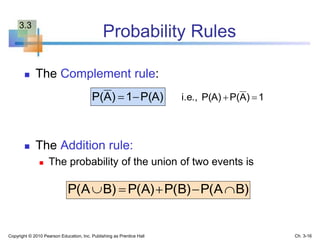
Probability Rules
 The Complement rule:
 The Addition rule:
 The probability of the union of two events is
1)AP(P(A)i.e., P(A)1)AP( 
B)P(AP(B)P(A)B)P(A 
Copyright © 2010 Pearson Education, Inc. Publishing as Prentice Hall Ch. 3-16
3.3
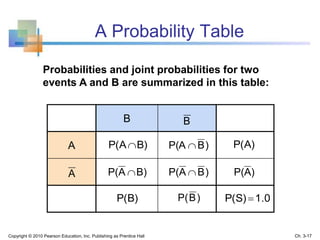
A Probability Table
B
A
A
B
)BP(A 
)BAP( B)AP( 
P(A)B)P(A
)AP(
)BP(P(B) 1.0P(S) 
Probabilities and joint probabilities for two
events A and B are summarized in this table:
Copyright © 2010 Pearson Education, Inc. Publishing as Prentice Hall Ch. 3-17
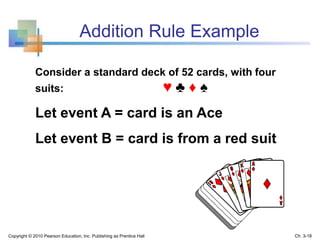
Addition Rule Example
Consider a standard deck of 52 cards, with four
suits: ♥ ♣ ♦ ♠
Let event A = card is an Ace
Let event B = card is from a red suit
Copyright © 2010 Pearson Education, Inc. Publishing as Prentice Hall Ch. 3-18
Addition Rule Example
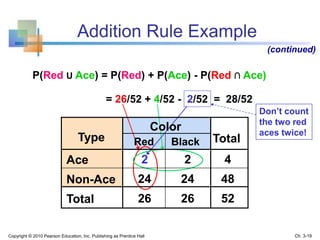
P(Red U Ace) = P(Red) + P(Ace) - P(Red ∩ Ace)
= 26/52 + 4/52 - 2/52 = 28/52
Don’t count
the two red
aces twice!
Black
Color
Type Red Total
Ace 2 2 4
Non-Ace 24 24 48
Total 26 26 52
(continued)
Copyright © 2010 Pearson Education, Inc. Publishing as Prentice Hall Ch. 3-19
Conditional Probability
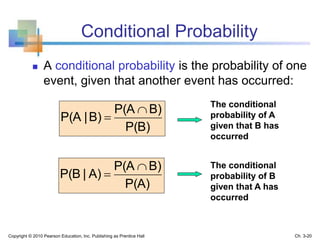
 A conditional probability is the probability of one
event, given that another event has occurred:
P(B)
B)P(A
B)|P(A


P(A)
B)P(A
A)|P(B


The conditional
probability of A
given that B has
occurred
The conditional
probability of B
given that A has
occurred
Copyright © 2010 Pearson Education, Inc. Publishing as Prentice Hall Ch. 3-20
Conditional Probability Example
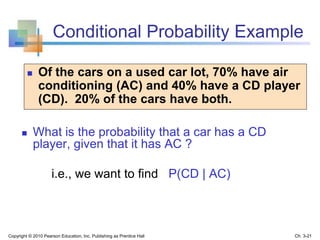
 What is the probability that a car has a CD
player, given that it has AC ?
i.e., we want to find P(CD | AC)
 Of the cars on a used car lot, 70% have air
conditioning (AC) and 40% have a CD player
(CD). 20% of the cars have both.
Copyright © 2010 Pearson Education, Inc. Publishing as Prentice Hall Ch. 3-21
Conditional Probability Example
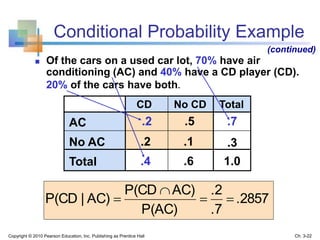
No CDCD Total
AC .2 .5 .7
No AC .2 .1 .3
Total .4 .6 1.0
 Of the cars on a used car lot, 70% have air
conditioning (AC) and 40% have a CD player (CD).
20% of the cars have both.
.2857
.7
.2
P(AC)
AC)P(CD
AC)|P(CD 


(continued)
Copyright © 2010 Pearson Education, Inc. Publishing as Prentice Hall Ch. 3-22
Conditional Probability Example
No CDCD Total
AC .2 .5 .7
No AC .2 .1 .3
Total .4 .6 1.0
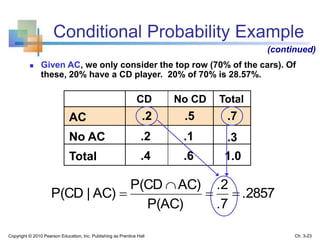
 Given AC, we only consider the top row (70% of the cars). Of
these, 20% have a CD player. 20% of 70% is 28.57%.
.2857
.7
.2
P(AC)
AC)P(CD
AC)|P(CD 


(continued)
Copyright © 2010 Pearson Education, Inc. Publishing as Prentice Hall Ch. 3-23
Multiplication Rule
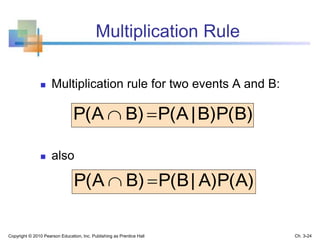
 Multiplication rule for two events A and B:
 also
P(B)B)|P(AB)P(A 
P(A)A)|P(BB)P(A 
Copyright © 2010 Pearson Education, Inc. Publishing as Prentice Hall Ch. 3-24
Multiplication Rule Example
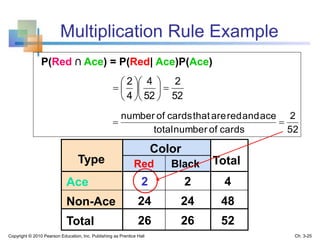
P(Red ∩ Ace) = P(Red| Ace)P(Ace)
Black
Color
Type Red Total
Ace 2 2 4
Non-Ace 24 24 48
Total 26 26 52
52
2
52
4
4
2













52
2
cardsofnumbertotal
aceandredarethatcardsofnumber

Copyright © 2010 Pearson Education, Inc. Publishing as Prentice Hall Ch. 3-25
Statistical Independence
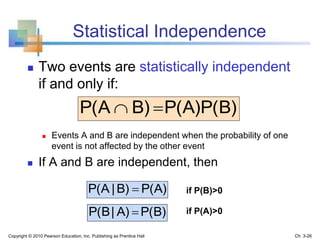
 Two events are statistically independent
if and only if:
 Events A and B are independent when the probability of one
event is not affected by the other event
 If A and B are independent, then
P(A)B)|P(A 
P(B)P(A)B)P(A 
P(B)A)|P(B 
if P(B)>0
if P(A)>0
Copyright © 2010 Pearson Education, Inc. Publishing as Prentice Hall Ch. 3-26
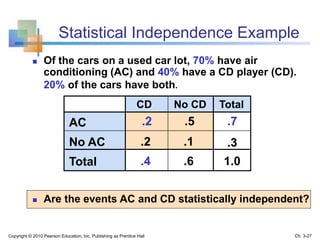
Statistical Independence Example
No CDCD Total
AC .2 .5 .7
No AC .2 .1 .3
Total .4 .6 1.0
 Of the cars on a used car lot, 70% have air
conditioning (AC) and 40% have a CD player (CD).
20% of the cars have both.
 Are the events AC and CD statistically independent?
Copyright © 2010 Pearson Education, Inc. Publishing as Prentice Hall Ch. 3-27
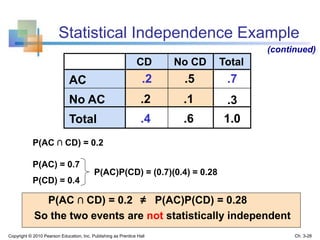
Statistical Independence Example
No CDCD Total
AC .2 .5 .7
No AC .2 .1 .3
Total .4 .6 1.0
(continued)
P(AC ∩ CD) = 0.2
P(AC) = 0.7
P(CD) = 0.4
P(AC)P(CD) = (0.7)(0.4) = 0.28
P(AC ∩ CD) = 0.2 ≠ P(AC)P(CD) = 0.28
So the two events are not statistically independent
Copyright © 2010 Pearson Education, Inc. Publishing as Prentice Hall Ch. 3-28
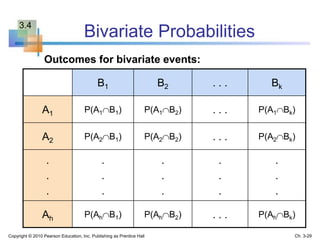
Bivariate Probabilities
B1 B2 . . . Bk
A1 P(A1B1) P(A1B2) . . . P(A1Bk)
A2 P(A2B1) P(A2B2) . . . P(A2Bk)
.
.
.
.
.
.
.
.
.
.
.
.
.
.
.
Ah P(AhB1) P(AhB2) . . . P(AhBk)
Outcomes for bivariate events:
Copyright © 2010 Pearson Education, Inc. Publishing as Prentice Hall Ch. 3-29
3.4
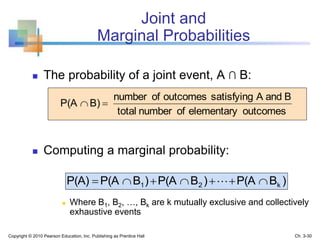
Joint and
Marginal Probabilities
 The probability of a joint event, A ∩ B:
 Computing a marginal probability:
 Where B1, B2, …, Bk are k mutually exclusive and collectively
exhaustive events
outcomeselementaryofnumbertotal
BandAsatisfyingoutcomesofnumber
B)P(A 
)BP(A)BP(A)BP(AP(A) k21  
Copyright © 2010 Pearson Education, Inc. Publishing as Prentice Hall Ch. 3-30
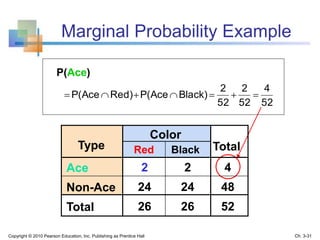
Marginal Probability Example
P(Ace)
Black
Color
Type Red Total
Ace 2 2 4
Non-Ace 24 24 48
Total 26 26 52
52
4
52
2
52
2
Black)P(AceRed)P(Ace 
Copyright © 2010 Pearson Education, Inc. Publishing as Prentice Hall Ch. 3-31
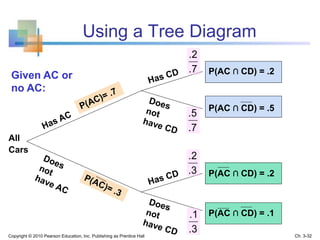
Using a Tree Diagram
P(AC ∩ CD) = .2
P(AC ∩ CD) = .5
P(AC ∩ CD) = .1
P(AC ∩ CD) = .2
7.
5.
3.
2.
3.
1.
All
Cars
7.
2.
Given AC or
no AC:
Copyright © 2010 Pearson Education, Inc. Publishing as Prentice Hall Ch. 3-32
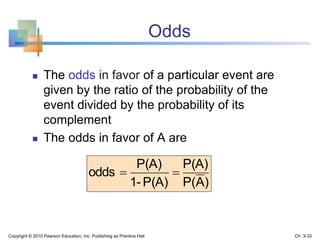
Odds
 The odds in favor of a particular event are
given by the ratio of the probability of the
event divided by the probability of its
complement
 The odds in favor of A are
)AP(
P(A)
P(A)1-
P(A)
odds 
Copyright © 2010 Pearson Education, Inc. Publishing as Prentice Hall Ch. 3-33
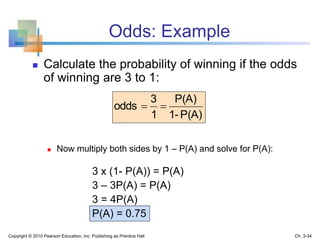
Odds: Example
 Calculate the probability of winning if the odds
of winning are 3 to 1:
 Now multiply both sides by 1 – P(A) and solve for P(A):
3 x (1- P(A)) = P(A)
3 – 3P(A) = P(A)
3 = 4P(A)
P(A) = 0.75
P(A)1-
P(A)
1
3
odds 
Copyright © 2010 Pearson Education, Inc. Publishing as Prentice Hall Ch. 3-34
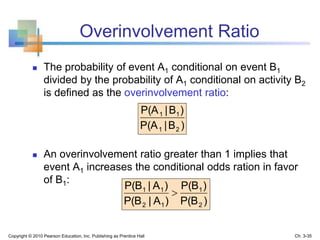
Overinvolvement Ratio
 The probability of event A1 conditional on event B1
divided by the probability of A1 conditional on activity B2
is defined as the overinvolvement ratio:
 An overinvolvement ratio greater than 1 implies that
event A1 increases the conditional odds ration in favor
of B1:
)B|P(A
)B|P(A
21
11
)P(B
)P(B
)A|P(B
)A|P(B
2
1
12
11

Copyright © 2010 Pearson Education, Inc. Publishing as Prentice Hall Ch. 3-35
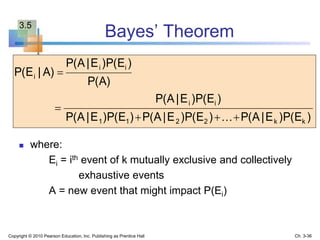
Bayes’ Theorem
 where:
Ei = ith event of k mutually exclusive and collectively
exhaustive events
A = new event that might impact P(Ei)
))P(EE|P(A))P(EE|P(A))P(EE|P(A
))P(EE|P(A
P(A)
))P(EE|P(A
A)|P(E
kk2211
ii
ii
i




Copyright © 2010 Pearson Education, Inc. Publishing as Prentice Hall Ch. 3-36
3.5
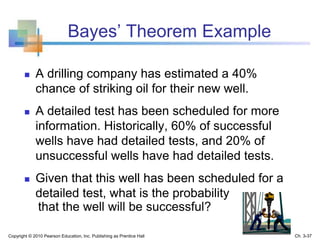
Bayes’ Theorem Example
 A drilling company has estimated a 40%
chance of striking oil for their new well.
 A detailed test has been scheduled for more
information. Historically, 60% of successful
wells have had detailed tests, and 20% of
unsuccessful wells have had detailed tests.
 Given that this well has been scheduled for a
detailed test, what is the probability
that the well will be successful?
Copyright © 2010 Pearson Education, Inc. Publishing as Prentice Hall Ch. 3-37
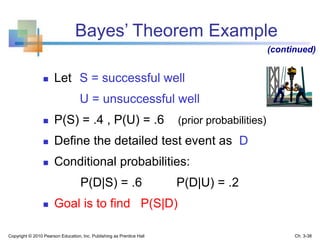
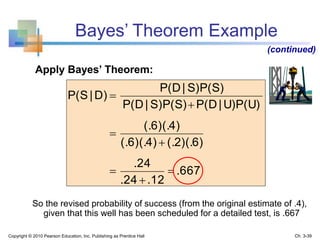
 Let S = successful well
U = unsuccessful well
 P(S) = .4 , P(U) = .6 (prior probabilities)
 Define the detailed test event as D
 Conditional probabilities:
P(D|S) = .6 P(D|U) = .2
 Goal is to find P(S|D)
Bayes’ Theorem Example
(continued)
Copyright © 2010 Pearson Education, Inc. Publishing as Prentice Hall Ch. 3-38
So the revised probability of success (from the original estimate of .4),
given that this well has been scheduled for a detailed test, is .667
667.
12.24.
24.
)6)(.2(.)4)(.6(.
)4)(.6(.
U)P(U)|P(DS)P(S)|P(D
S)P(S)|P(D
D)|P(S







Bayes’ Theorem Example
(continued)
Apply Bayes’ Theorem:
Copyright © 2010 Pearson Education, Inc. Publishing as Prentice Hall Ch. 3-39
Chapter Summary
 Defined basic probability concepts
 Sample spaces and events, intersection and union
of events, mutually exclusive and collectively
exhaustive events, complements
 Examined basic probability rules
 Complement rule, addition rule, multiplication rule
 Defined conditional, joint, and marginal probabilities
 Reviewed odds and the overinvolvement ratio
 Defined statistical independence
 Discussed Bayes’ theorem
Copyright © 2010 Pearson Education, Inc. Publishing as Prentice Hall Ch. 3-40

Chap03 probability

  • 1.
    Chapter 3 Probability Statistics for Businessand Economics 7th Edition Copyright © 2010 Pearson Education, Inc. Publishing as Prentice Hall Ch. 3-1
  • 2.
    Chapter Goals After completingthis chapter, you should be able to:  Explain basic probability concepts and definitions  Use a Venn diagram or tree diagram to illustrate simple probabilities  Apply common rules of probability  Compute conditional probabilities  Determine whether events are statistically independent  Use Bayes’ Theorem for conditional probabilities Copyright © 2010 Pearson Education, Inc. Publishing as Prentice Hall Ch. 3-2
  • 3.
    Important Terms  RandomExperiment – a process leading to an uncertain outcome  Basic Outcome – a possible outcome of a random experiment  Sample Space – the collection of all possible outcomes of a random experiment  Event – any subset of basic outcomes from the sample space Copyright © 2010 Pearson Education, Inc. Publishing as Prentice Hall Ch. 3-3 3.1
  • 4.
    Important Terms  Intersectionof Events – If A and B are two events in a sample space S, then the intersection, A ∩ B, is the set of all outcomes in S that belong to both A and B (continued) A BAB S Copyright © 2010 Pearson Education, Inc. Publishing as Prentice Hall Ch. 3-4
  • 5.
    Important Terms  Aand B are Mutually Exclusive Events if they have no basic outcomes in common  i.e., the set A ∩ B is empty (continued) A B S Copyright © 2010 Pearson Education, Inc. Publishing as Prentice Hall Ch. 3-5
  • 6.
    Important Terms  Unionof Events – If A and B are two events in a sample space S, then the union, A U B, is the set of all outcomes in S that belong to either A or B (continued) A B The entire shaded area represents A U B S Copyright © 2010 Pearson Education, Inc. Publishing as Prentice Hall Ch. 3-6
  • 7.
    Important Terms  EventsE1, E2, … Ek are Collectively Exhaustive events if E1 U E2 U . . . U Ek = S  i.e., the events completely cover the sample space  The Complement of an event A is the set of all basic outcomes in the sample space that do not belong to A. The complement is denoted (continued) A A S A Copyright © 2010 Pearson Education, Inc. Publishing as Prentice Hall Ch. 3-7
  • 8.
    Examples Let the SampleSpace be the collection of all possible outcomes of rolling one die: S = [1, 2, 3, 4, 5, 6] Let A be the event “Number rolled is even” Let B be the event “Number rolled is at least 4” Then A = [2, 4, 6] and B = [4, 5, 6] Copyright © 2010 Pearson Education, Inc. Publishing as Prentice Hall Ch. 3-8
  • 9.
    Examples (continued) S = [1,2, 3, 4, 5, 6] A = [2, 4, 6] B = [4, 5, 6] 5]3,[1,A  6][4,BA  6]5,4,[2,BA  S6]5,4,3,2,[1,AA  Complements: Intersections: Unions: [5]BA  3]2,[1,B  Copyright © 2010 Pearson Education, Inc. Publishing as Prentice Hall Ch. 3-9
  • 10.
    Examples  Mutually exclusive: A and B are not mutually exclusive  The outcomes 4 and 6 are common to both  Collectively exhaustive:  A and B are not collectively exhaustive  A U B does not contain 1 or 3 (continued) S = [1, 2, 3, 4, 5, 6] A = [2, 4, 6] B = [4, 5, 6] Copyright © 2010 Pearson Education, Inc. Publishing as Prentice Hall Ch. 3-10
  • 11.
    Probability  Probability –the chance that an uncertain event will occur (always between 0 and 1) 0 ≤ P(A) ≤ 1 For any event A Certain Impossible .5 1 0 Copyright © 2010 Pearson Education, Inc. Publishing as Prentice Hall Ch. 3-11 3.2
  • 12.
    Assessing Probability  Thereare three approaches to assessing the probability of an uncertain event: 1. classical probability  Assumes all outcomes in the sample space are equally likely to occur spacesampletheinoutcomesofnumbertotal eventthesatisfythatoutcomesofnumber N N Aeventofyprobabilit A  Copyright © 2010 Pearson Education, Inc. Publishing as Prentice Hall Ch. 3-12
  • 13.
    Counting the PossibleOutcomes  Use the Combinations formula to determine the number of combinations of n things taken k at a time  where  n! = n(n-1)(n-2)…(1)  0! = 1 by definition k)!(nk! n! Cn k   Copyright © 2010 Pearson Education, Inc. Publishing as Prentice Hall Ch. 3-13
  • 14.
    Assessing Probability Three approaches(continued) 2. relative frequency probability  the limit of the proportion of times that an event A occurs in a large number of trials, n 3. subjective probability an individual opinion or belief about the probability of occurrence populationtheineventsofnumbertotal Aeventsatisfythatpopulationtheineventsofnumber n n Aeventofyprobabilit A  Copyright © 2010 Pearson Education, Inc. Publishing as Prentice Hall Ch. 3-14
  • 15.
    Probability Postulates 1. IfA is any event in the sample space S, then 2. Let A be an event in S, and let Oi denote the basic outcomes. Then (the notation means that the summation is over all the basic outcomes in A) 3. P(S) = 1 1P(A)0  )P(OP(A) A i Copyright © 2010 Pearson Education, Inc. Publishing as Prentice Hall Ch. 3-15
  • 16.
    Probability Rules  TheComplement rule:  The Addition rule:  The probability of the union of two events is 1)AP(P(A)i.e., P(A)1)AP(  B)P(AP(B)P(A)B)P(A  Copyright © 2010 Pearson Education, Inc. Publishing as Prentice Hall Ch. 3-16 3.3
  • 17.
    A Probability Table B A A B )BP(A )BAP( B)AP(  P(A)B)P(A )AP( )BP(P(B) 1.0P(S)  Probabilities and joint probabilities for two events A and B are summarized in this table: Copyright © 2010 Pearson Education, Inc. Publishing as Prentice Hall Ch. 3-17
  • 18.
    Addition Rule Example Considera standard deck of 52 cards, with four suits: ♥ ♣ ♦ ♠ Let event A = card is an Ace Let event B = card is from a red suit Copyright © 2010 Pearson Education, Inc. Publishing as Prentice Hall Ch. 3-18
  • 19.
    Addition Rule Example P(RedU Ace) = P(Red) + P(Ace) - P(Red ∩ Ace) = 26/52 + 4/52 - 2/52 = 28/52 Don’t count the two red aces twice! Black Color Type Red Total Ace 2 2 4 Non-Ace 24 24 48 Total 26 26 52 (continued) Copyright © 2010 Pearson Education, Inc. Publishing as Prentice Hall Ch. 3-19
  • 20.
    Conditional Probability  Aconditional probability is the probability of one event, given that another event has occurred: P(B) B)P(A B)|P(A   P(A) B)P(A A)|P(B   The conditional probability of A given that B has occurred The conditional probability of B given that A has occurred Copyright © 2010 Pearson Education, Inc. Publishing as Prentice Hall Ch. 3-20
  • 21.
    Conditional Probability Example What is the probability that a car has a CD player, given that it has AC ? i.e., we want to find P(CD | AC)  Of the cars on a used car lot, 70% have air conditioning (AC) and 40% have a CD player (CD). 20% of the cars have both. Copyright © 2010 Pearson Education, Inc. Publishing as Prentice Hall Ch. 3-21
  • 22.
    Conditional Probability Example NoCDCD Total AC .2 .5 .7 No AC .2 .1 .3 Total .4 .6 1.0  Of the cars on a used car lot, 70% have air conditioning (AC) and 40% have a CD player (CD). 20% of the cars have both. .2857 .7 .2 P(AC) AC)P(CD AC)|P(CD    (continued) Copyright © 2010 Pearson Education, Inc. Publishing as Prentice Hall Ch. 3-22
  • 23.
    Conditional Probability Example NoCDCD Total AC .2 .5 .7 No AC .2 .1 .3 Total .4 .6 1.0  Given AC, we only consider the top row (70% of the cars). Of these, 20% have a CD player. 20% of 70% is 28.57%. .2857 .7 .2 P(AC) AC)P(CD AC)|P(CD    (continued) Copyright © 2010 Pearson Education, Inc. Publishing as Prentice Hall Ch. 3-23
  • 24.
    Multiplication Rule  Multiplicationrule for two events A and B:  also P(B)B)|P(AB)P(A  P(A)A)|P(BB)P(A  Copyright © 2010 Pearson Education, Inc. Publishing as Prentice Hall Ch. 3-24
  • 25.
    Multiplication Rule Example P(Red∩ Ace) = P(Red| Ace)P(Ace) Black Color Type Red Total Ace 2 2 4 Non-Ace 24 24 48 Total 26 26 52 52 2 52 4 4 2              52 2 cardsofnumbertotal aceandredarethatcardsofnumber  Copyright © 2010 Pearson Education, Inc. Publishing as Prentice Hall Ch. 3-25
  • 26.
    Statistical Independence  Twoevents are statistically independent if and only if:  Events A and B are independent when the probability of one event is not affected by the other event  If A and B are independent, then P(A)B)|P(A  P(B)P(A)B)P(A  P(B)A)|P(B  if P(B)>0 if P(A)>0 Copyright © 2010 Pearson Education, Inc. Publishing as Prentice Hall Ch. 3-26
  • 27.
    Statistical Independence Example NoCDCD Total AC .2 .5 .7 No AC .2 .1 .3 Total .4 .6 1.0  Of the cars on a used car lot, 70% have air conditioning (AC) and 40% have a CD player (CD). 20% of the cars have both.  Are the events AC and CD statistically independent? Copyright © 2010 Pearson Education, Inc. Publishing as Prentice Hall Ch. 3-27
  • 28.
    Statistical Independence Example NoCDCD Total AC .2 .5 .7 No AC .2 .1 .3 Total .4 .6 1.0 (continued) P(AC ∩ CD) = 0.2 P(AC) = 0.7 P(CD) = 0.4 P(AC)P(CD) = (0.7)(0.4) = 0.28 P(AC ∩ CD) = 0.2 ≠ P(AC)P(CD) = 0.28 So the two events are not statistically independent Copyright © 2010 Pearson Education, Inc. Publishing as Prentice Hall Ch. 3-28
  • 29.
    Bivariate Probabilities B1 B2. . . Bk A1 P(A1B1) P(A1B2) . . . P(A1Bk) A2 P(A2B1) P(A2B2) . . . P(A2Bk) . . . . . . . . . . . . . . . Ah P(AhB1) P(AhB2) . . . P(AhBk) Outcomes for bivariate events: Copyright © 2010 Pearson Education, Inc. Publishing as Prentice Hall Ch. 3-29 3.4
  • 30.
    Joint and Marginal Probabilities The probability of a joint event, A ∩ B:  Computing a marginal probability:  Where B1, B2, …, Bk are k mutually exclusive and collectively exhaustive events outcomeselementaryofnumbertotal BandAsatisfyingoutcomesofnumber B)P(A  )BP(A)BP(A)BP(AP(A) k21   Copyright © 2010 Pearson Education, Inc. Publishing as Prentice Hall Ch. 3-30
  • 31.
    Marginal Probability Example P(Ace) Black Color TypeRed Total Ace 2 2 4 Non-Ace 24 24 48 Total 26 26 52 52 4 52 2 52 2 Black)P(AceRed)P(Ace  Copyright © 2010 Pearson Education, Inc. Publishing as Prentice Hall Ch. 3-31
  • 32.
    Using a TreeDiagram P(AC ∩ CD) = .2 P(AC ∩ CD) = .5 P(AC ∩ CD) = .1 P(AC ∩ CD) = .2 7. 5. 3. 2. 3. 1. All Cars 7. 2. Given AC or no AC: Copyright © 2010 Pearson Education, Inc. Publishing as Prentice Hall Ch. 3-32
  • 33.
    Odds  The oddsin favor of a particular event are given by the ratio of the probability of the event divided by the probability of its complement  The odds in favor of A are )AP( P(A) P(A)1- P(A) odds  Copyright © 2010 Pearson Education, Inc. Publishing as Prentice Hall Ch. 3-33
  • 34.
    Odds: Example  Calculatethe probability of winning if the odds of winning are 3 to 1:  Now multiply both sides by 1 – P(A) and solve for P(A): 3 x (1- P(A)) = P(A) 3 – 3P(A) = P(A) 3 = 4P(A) P(A) = 0.75 P(A)1- P(A) 1 3 odds  Copyright © 2010 Pearson Education, Inc. Publishing as Prentice Hall Ch. 3-34
  • 35.
    Overinvolvement Ratio  Theprobability of event A1 conditional on event B1 divided by the probability of A1 conditional on activity B2 is defined as the overinvolvement ratio:  An overinvolvement ratio greater than 1 implies that event A1 increases the conditional odds ration in favor of B1: )B|P(A )B|P(A 21 11 )P(B )P(B )A|P(B )A|P(B 2 1 12 11  Copyright © 2010 Pearson Education, Inc. Publishing as Prentice Hall Ch. 3-35
  • 36.
    Bayes’ Theorem  where: Ei= ith event of k mutually exclusive and collectively exhaustive events A = new event that might impact P(Ei) ))P(EE|P(A))P(EE|P(A))P(EE|P(A ))P(EE|P(A P(A) ))P(EE|P(A A)|P(E kk2211 ii ii i     Copyright © 2010 Pearson Education, Inc. Publishing as Prentice Hall Ch. 3-36 3.5
  • 37.
    Bayes’ Theorem Example A drilling company has estimated a 40% chance of striking oil for their new well.  A detailed test has been scheduled for more information. Historically, 60% of successful wells have had detailed tests, and 20% of unsuccessful wells have had detailed tests.  Given that this well has been scheduled for a detailed test, what is the probability that the well will be successful? Copyright © 2010 Pearson Education, Inc. Publishing as Prentice Hall Ch. 3-37
  • 38.
     Let S= successful well U = unsuccessful well  P(S) = .4 , P(U) = .6 (prior probabilities)  Define the detailed test event as D  Conditional probabilities: P(D|S) = .6 P(D|U) = .2  Goal is to find P(S|D) Bayes’ Theorem Example (continued) Copyright © 2010 Pearson Education, Inc. Publishing as Prentice Hall Ch. 3-38
  • 39.
    So the revisedprobability of success (from the original estimate of .4), given that this well has been scheduled for a detailed test, is .667 667. 12.24. 24. )6)(.2(.)4)(.6(. )4)(.6(. U)P(U)|P(DS)P(S)|P(D S)P(S)|P(D D)|P(S        Bayes’ Theorem Example (continued) Apply Bayes’ Theorem: Copyright © 2010 Pearson Education, Inc. Publishing as Prentice Hall Ch. 3-39
  • 40.
    Chapter Summary  Definedbasic probability concepts  Sample spaces and events, intersection and union of events, mutually exclusive and collectively exhaustive events, complements  Examined basic probability rules  Complement rule, addition rule, multiplication rule  Defined conditional, joint, and marginal probabilities  Reviewed odds and the overinvolvement ratio  Defined statistical independence  Discussed Bayes’ theorem Copyright © 2010 Pearson Education, Inc. Publishing as Prentice Hall Ch. 3-40