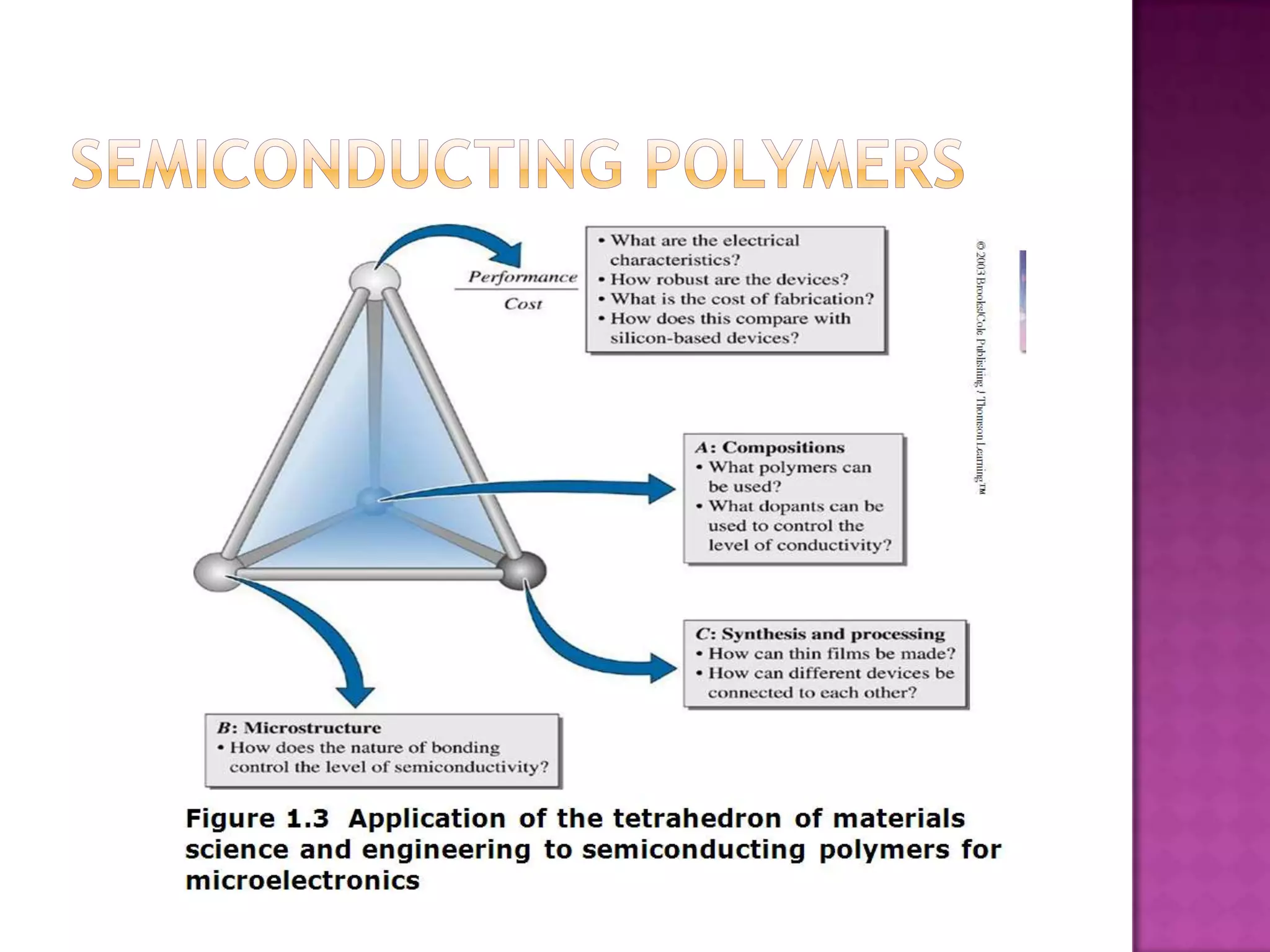
 Materialscience and engineering is an
 interdisciplinary field concerned with
 inventing new materials and improving
 previously known materials by developing
 deeper understanding of microstructure-
 composition-synthesis processing
 relationships.
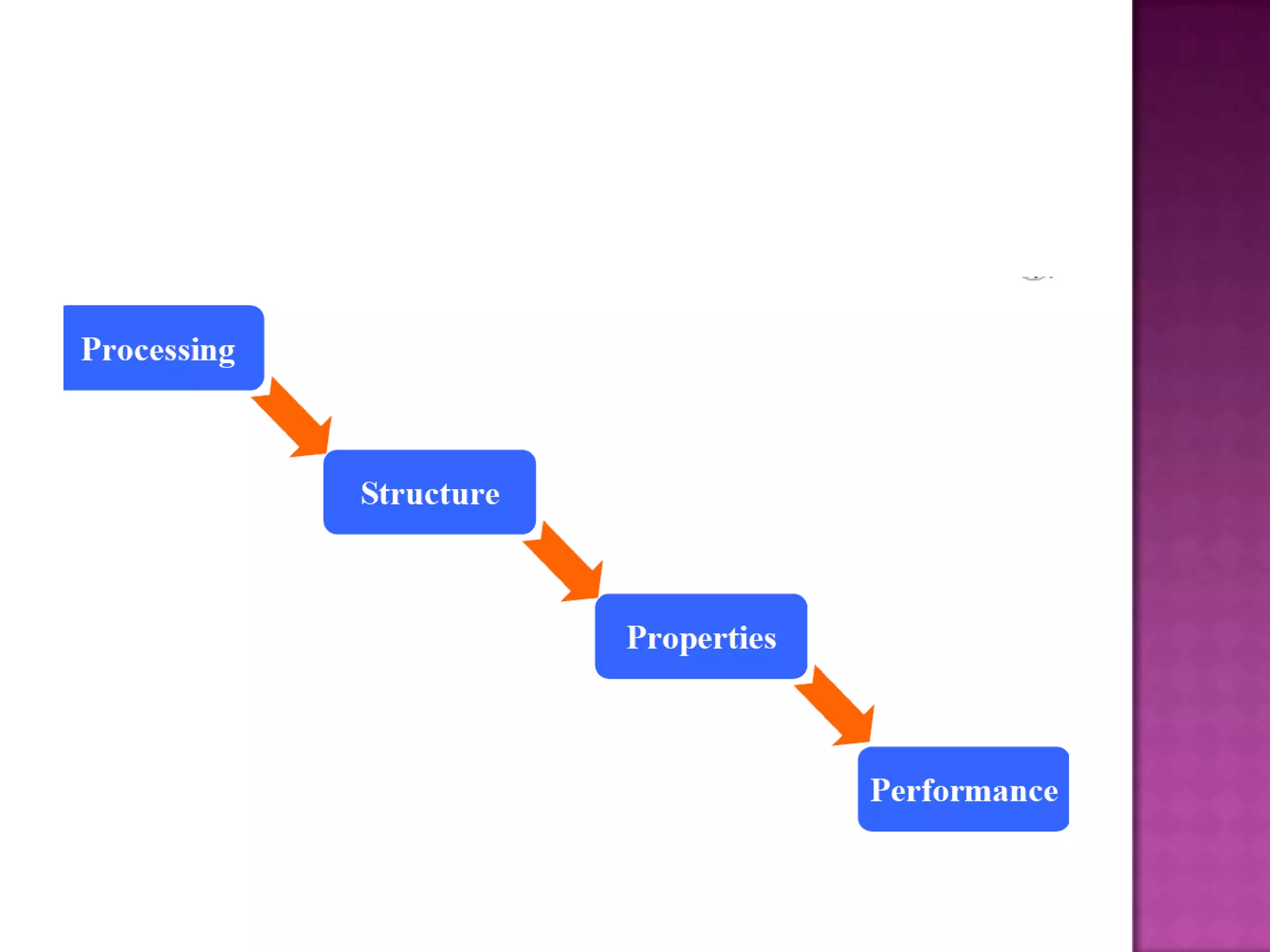
 Structure   means description of arrangement
  of atoms.
 Synthesis refers to how material are being
  made from naturally occurring or man made
  chemicals
 Processesing refers to how material are
  shaped into useful component to cause
  changes in properties of different material.
 In MATERIAL SCIENCE the emphasis is on
  underlying relation ships between synthesis
  and processesing, structure and properties of
  materials.
 In MATERIALS ENGINEERING the focus is on
  how to translate or transform materials into
  useful devices or structures.
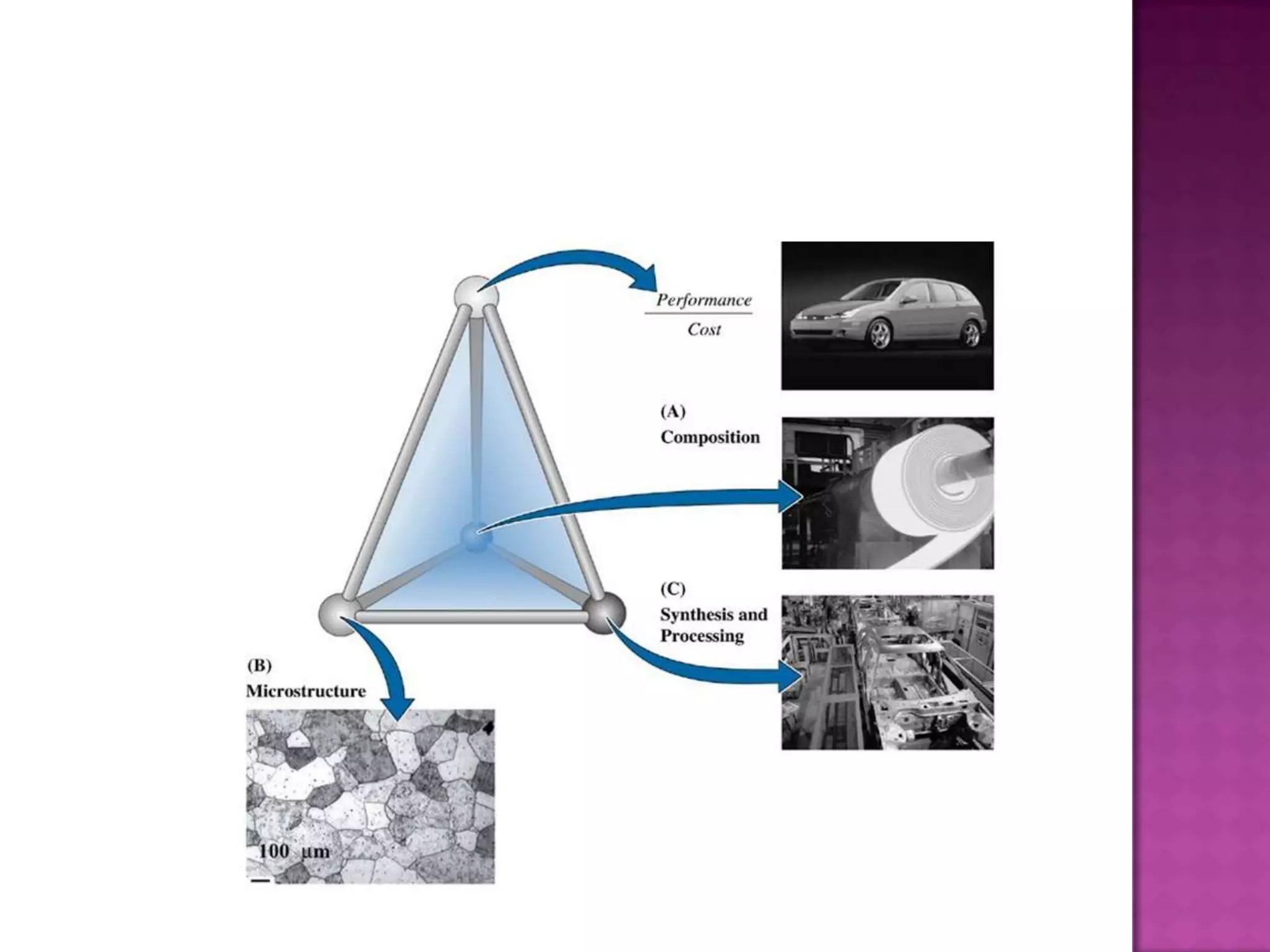
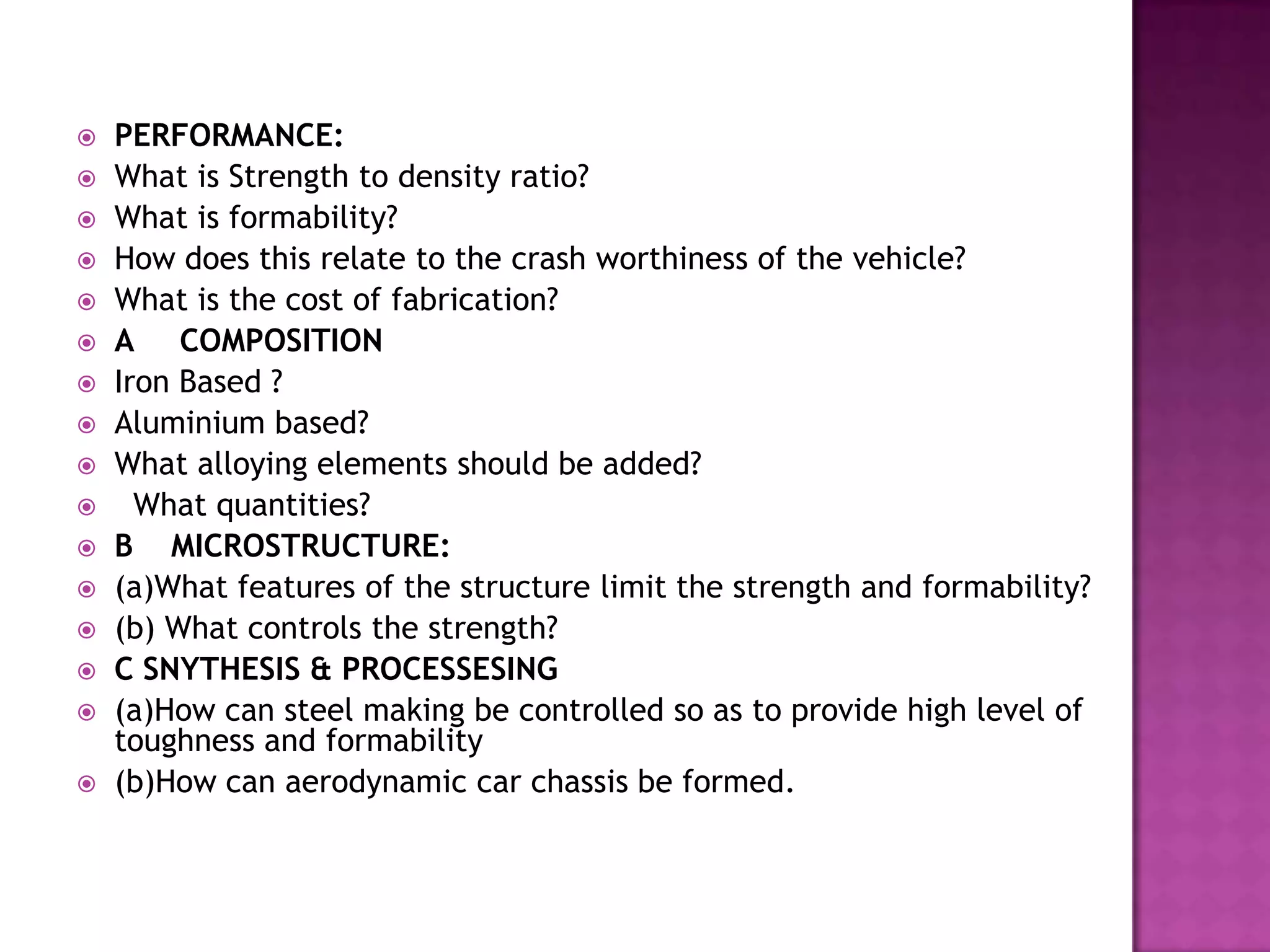
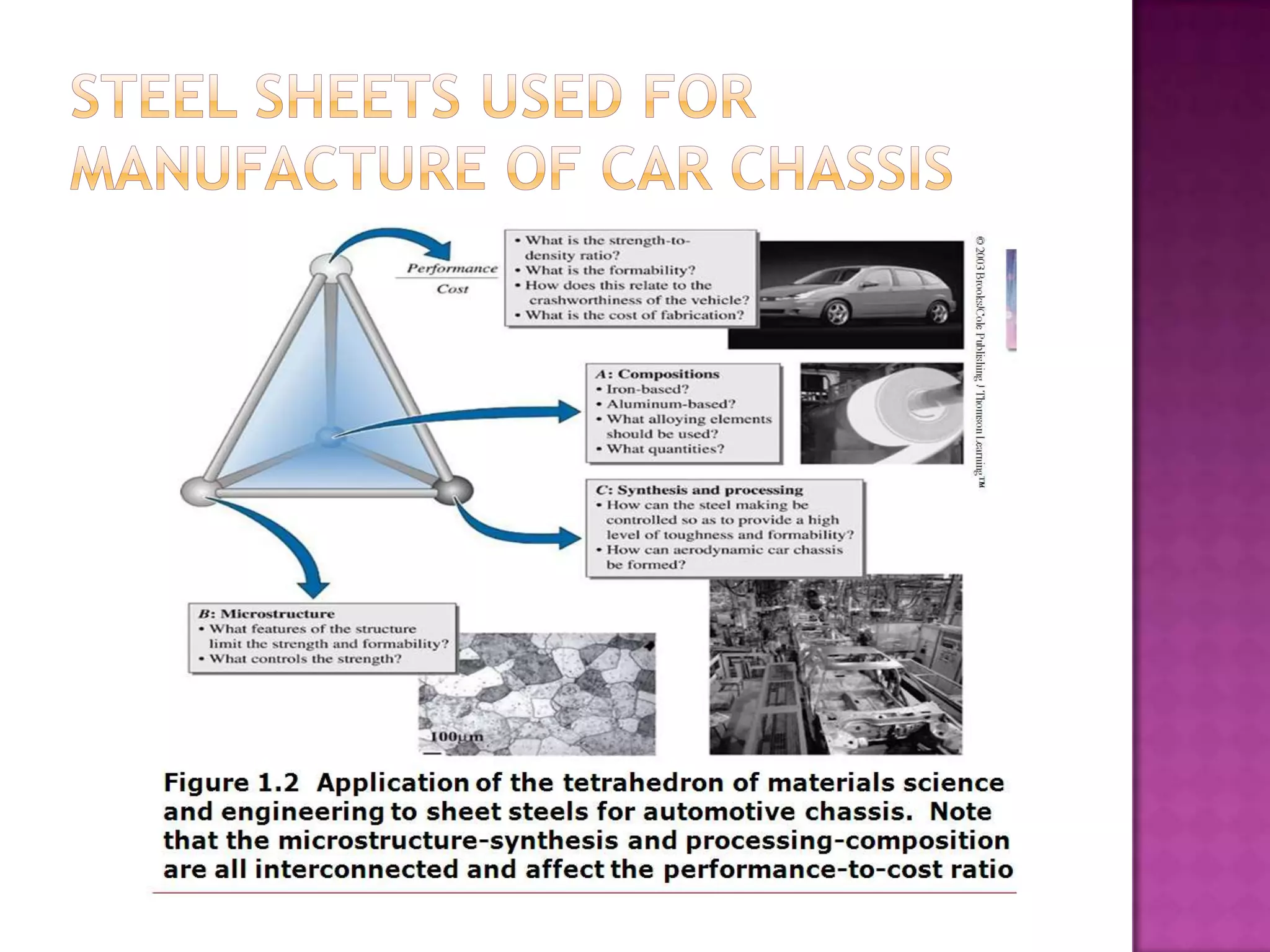
   PERFORMANCE:
   What is Strength to density ratio?
   What is formability?
   How does this relate to the crash worthiness of the vehicle?
   What is the cost of fabrication?
   A COMPOSITION
   Iron Based ?
   Aluminium based?
   What alloying elements should be added?
     What quantities?
   B MICROSTRUCTURE:
   (a)What features of the structure limit the strength and formability?
   (b) What controls the strength?
   C SNYTHESIS & PROCESSESING
   (a)How can steel making be controlled so as to provide high level of
    toughness and formability
   (b)How can aerodynamic car chassis be formed.
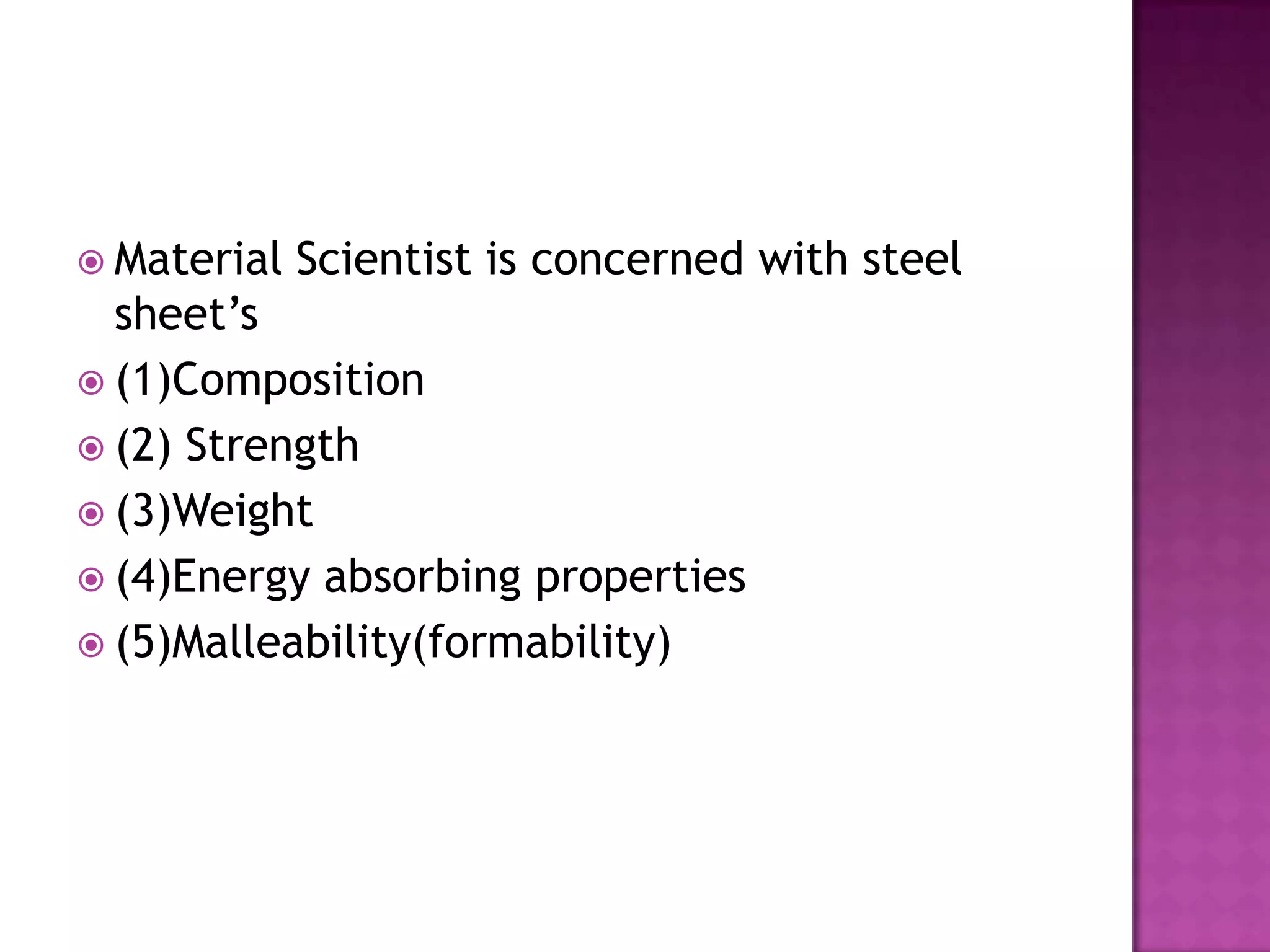
 Material   Scientist is concerned with steel
  sheet’s
 (1)Composition
 (2) Strength
 (3)Weight
 (4)Energy absorbing properties
 (5)Malleability(formability)
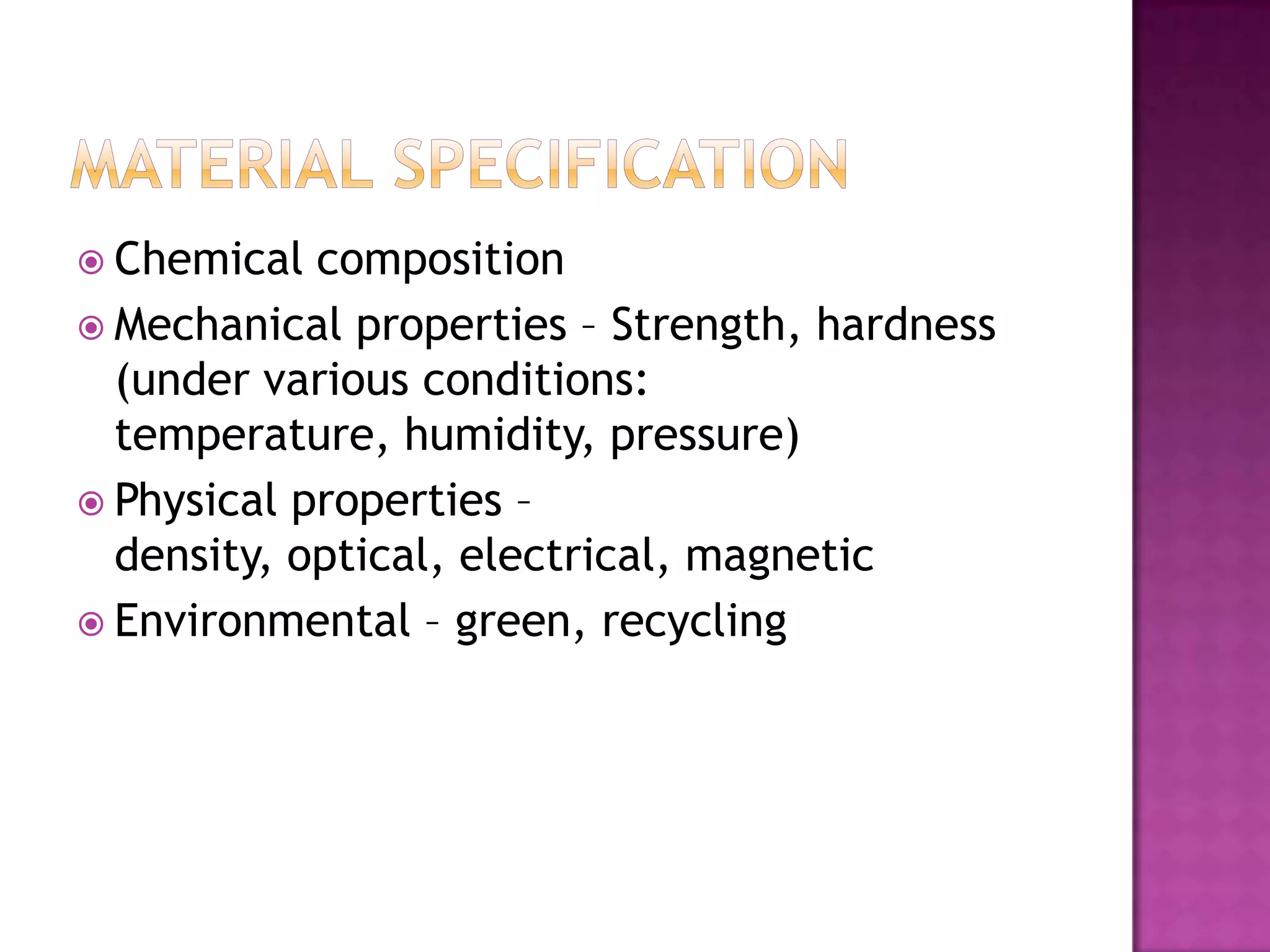
 Chemical  composition
 Mechanical properties – Strength, hardness
  (under various conditions:
  temperature, humidity, pressure)
 Physical properties –
  density, optical, electrical, magnetic
 Environmental – green, recycling
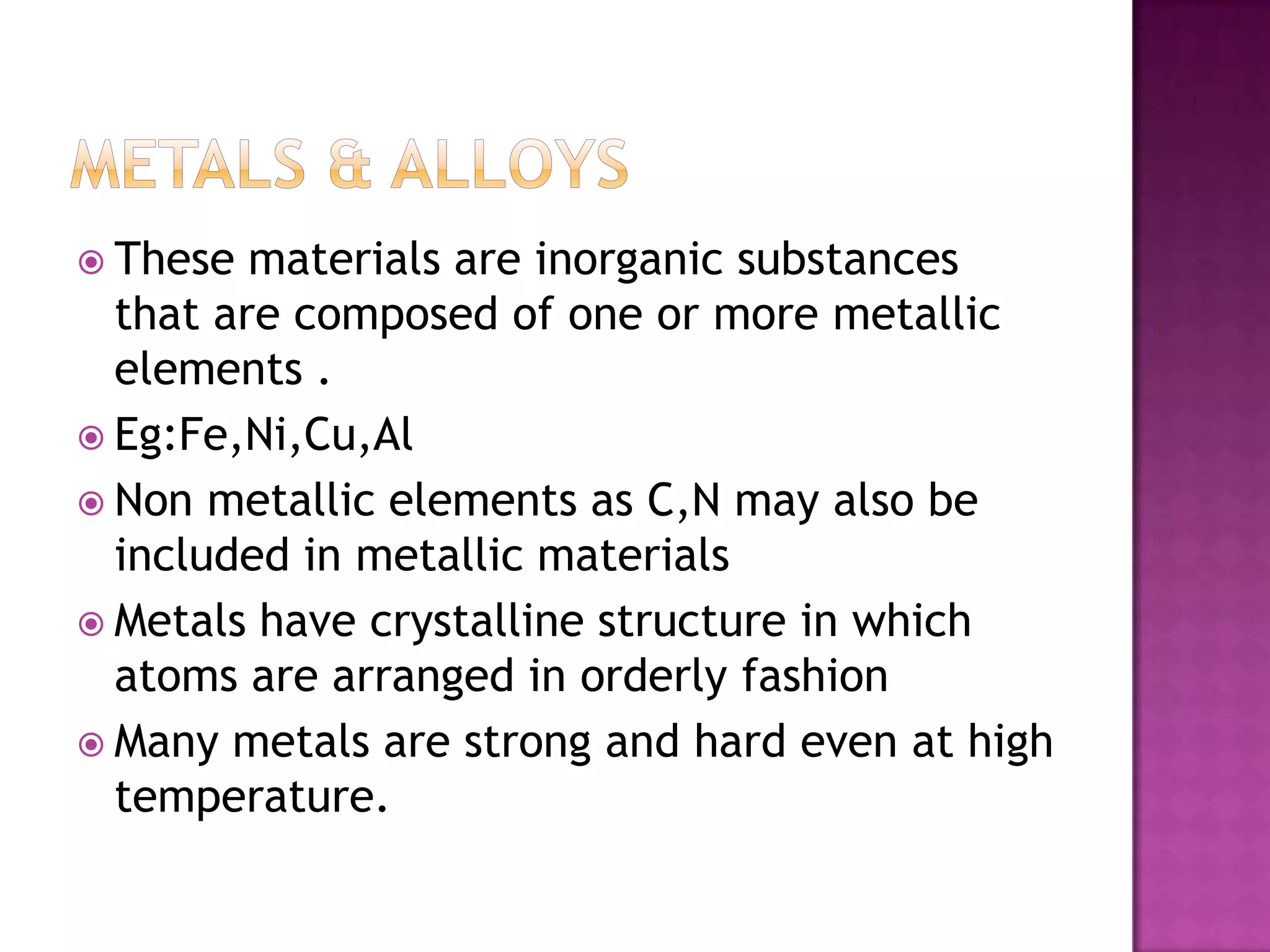
 These  materials are inorganic substances
  that are composed of one or more metallic
  elements .
 Eg:Fe,Ni,Cu,Al
 Non metallic elements as C,N may also be
  included in metallic materials
 Metals have crystalline structure in which
  atoms are arranged in orderly fashion
 Many metals are strong and hard even at high
  temperature.
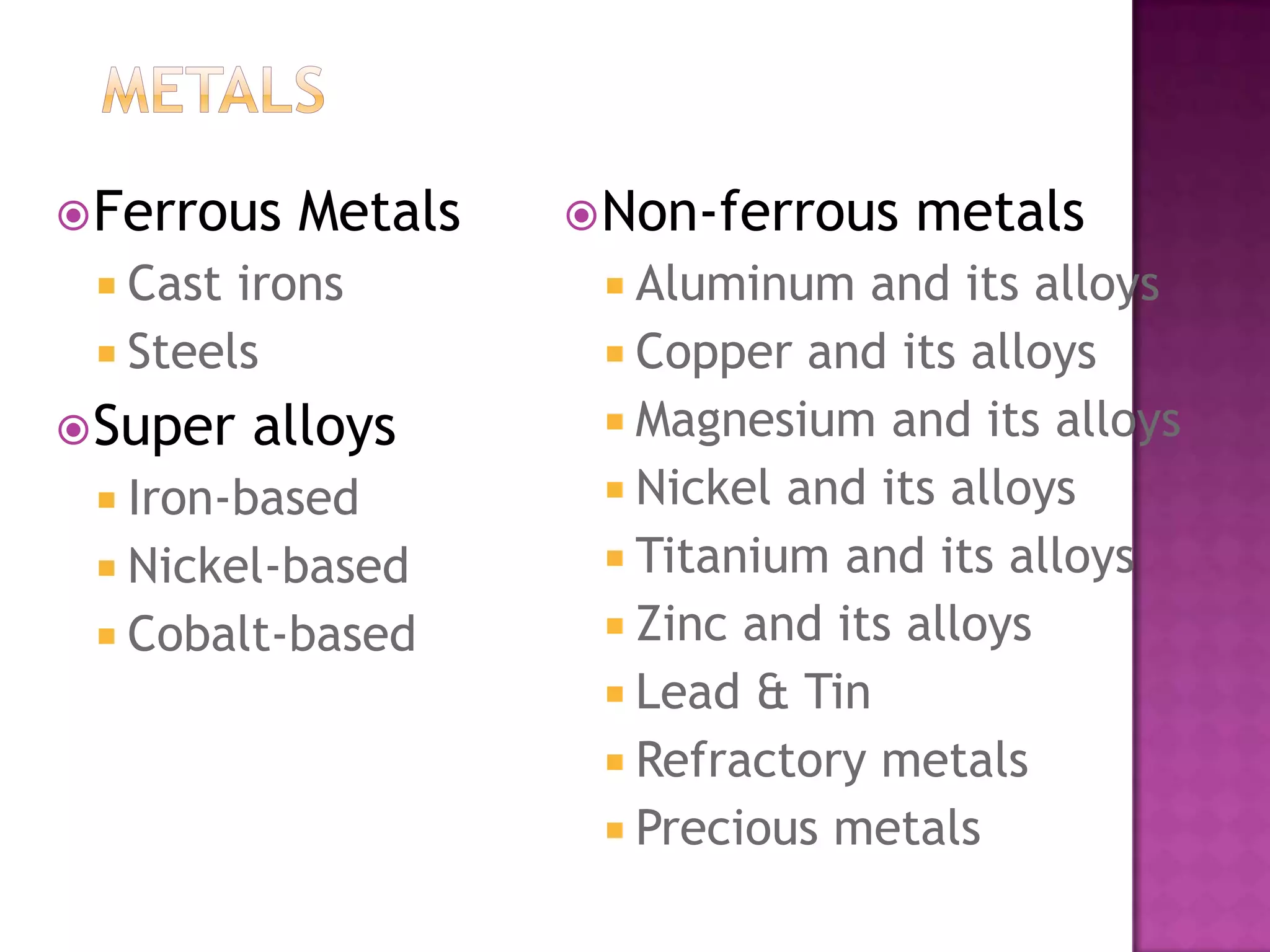
 Ferrous   Metals    Non-ferrous   metals
  Cast irons          Aluminum   and its alloys
  Steels              Copper and its alloys
 Super   alloys       Magnesium and its alloys
  Iron-based          Nickel and its alloys
  Nickel-based        Titanium and its alloys
  Cobalt-based        Zinc and its alloys
                       Lead & Tin
                       Refractory metals
                       Precious metals
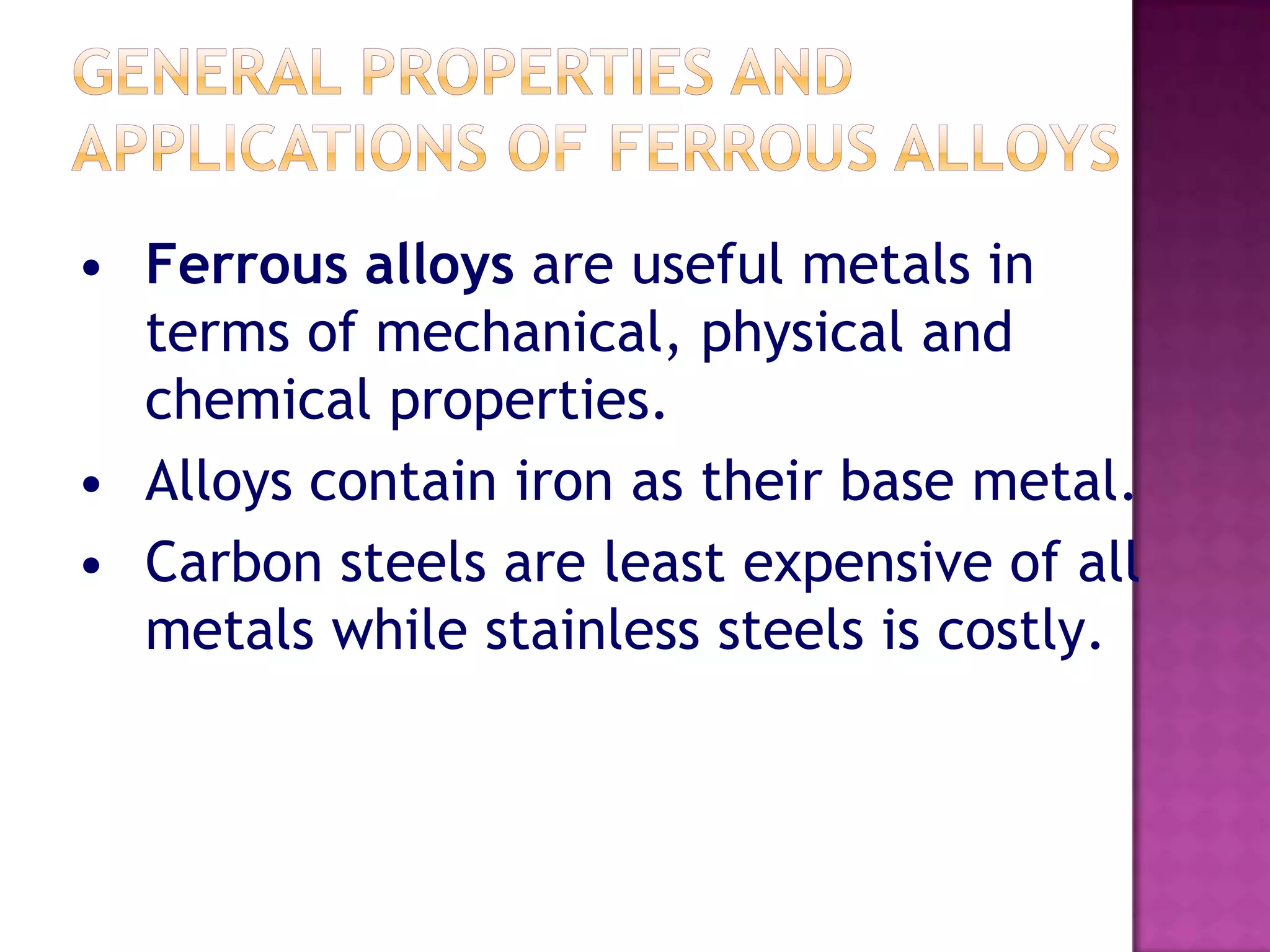
• Ferrous alloys are useful metals in
  terms of mechanical, physical and
  chemical properties.
• Alloys contain iron as their base metal.
• Carbon steels are least expensive of all
  metals while stainless steels is costly.
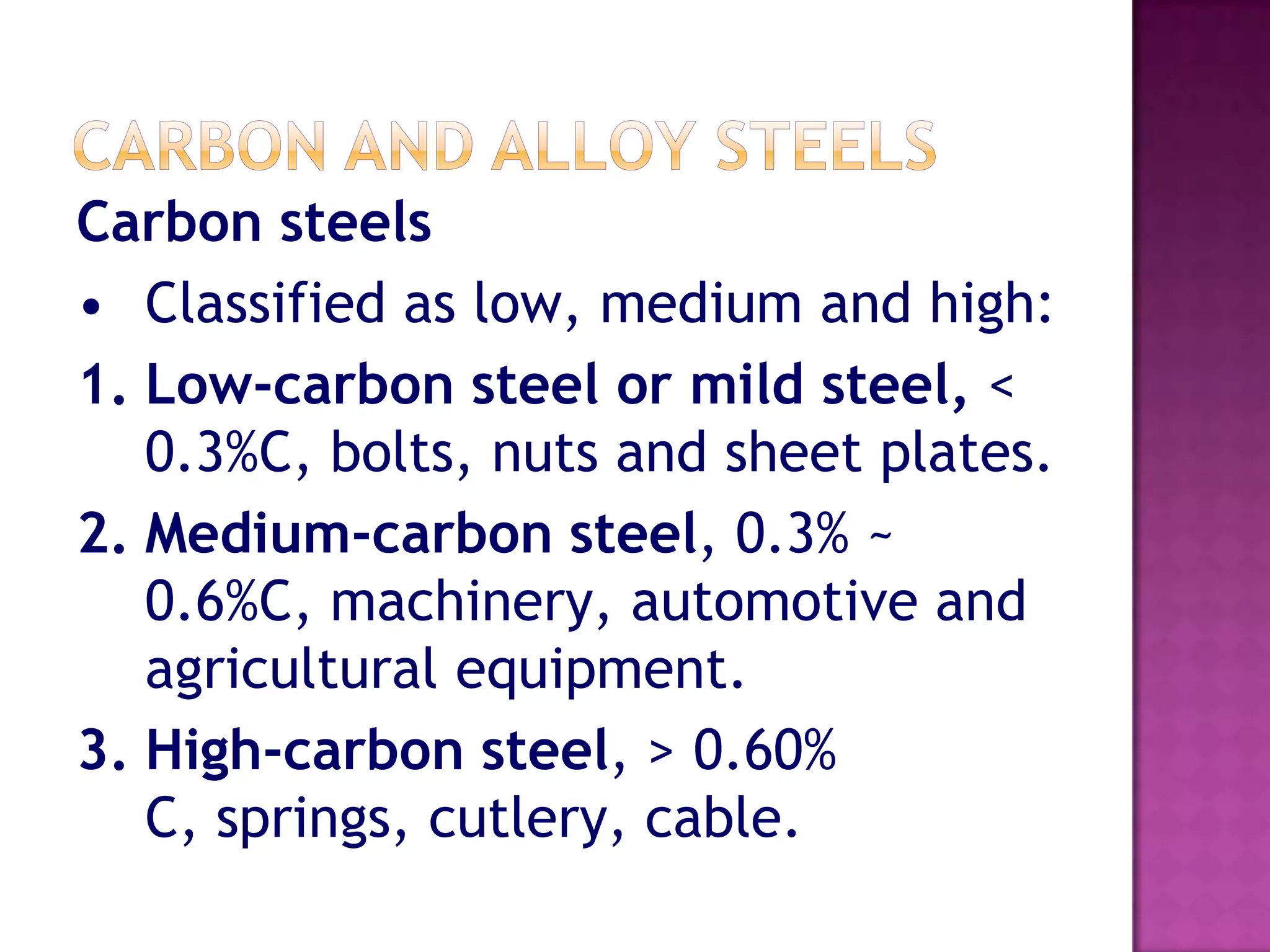
Carbon steels
• Classified as low, medium and high:
1. Low-carbon steel or mild steel, <
   0.3%C, bolts, nuts and sheet plates.
2. Medium-carbon steel, 0.3% ~
   0.6%C, machinery, automotive and
   agricultural equipment.
3. High-carbon steel, > 0.60%
   C, springs, cutlery, cable.
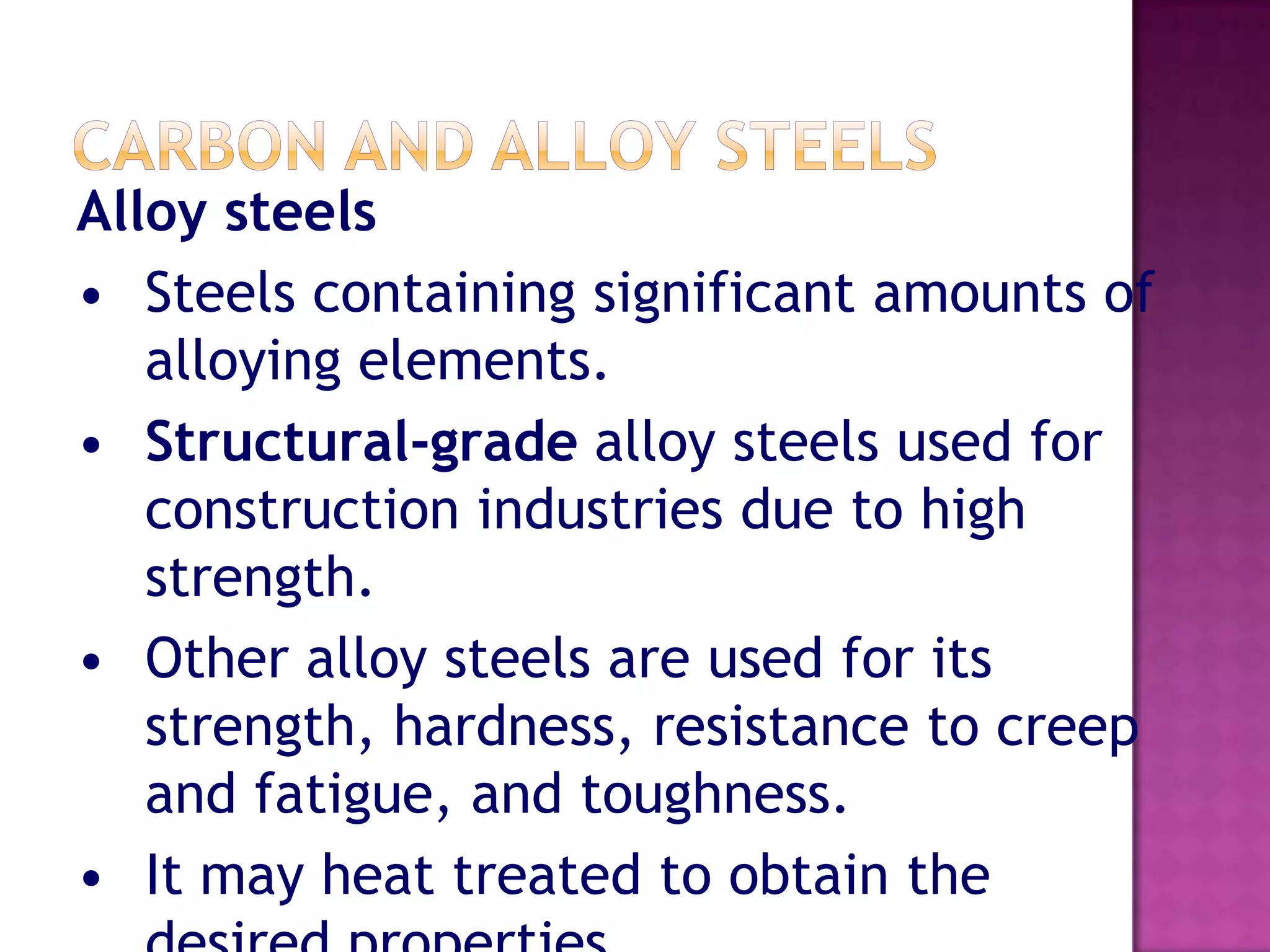
Alloy steels
• Steels containing significant amounts of
   alloying elements.
• Structural-grade alloy steels used for
   construction industries due to high
   strength.
• Other alloy steels are used for its
   strength, hardness, resistance to creep
   and fatigue, and toughness.
• It may heat treated to obtain the
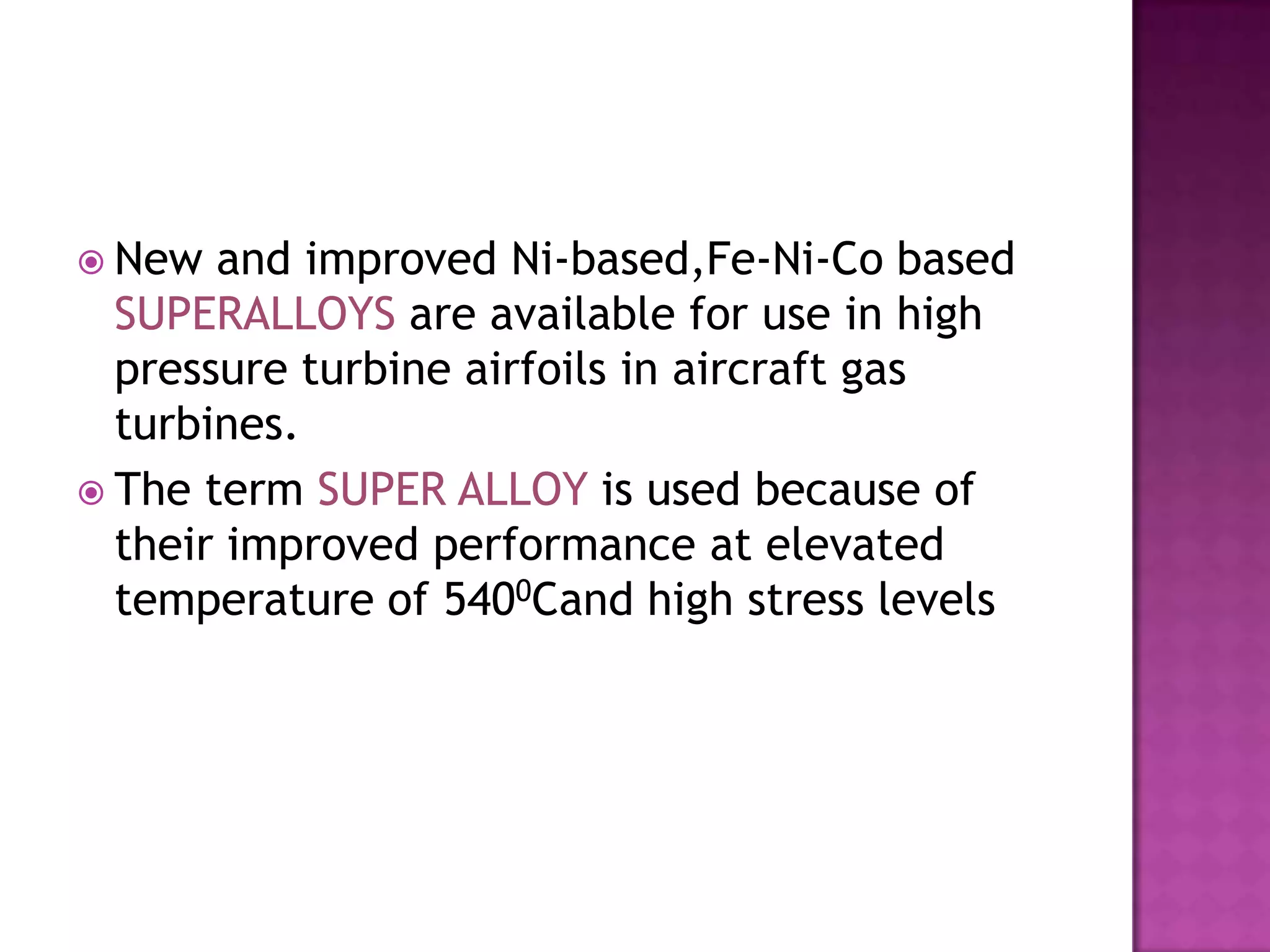
 New  and improved Ni-based,Fe-Ni-Co based
  SUPERALLOYS are available for use in high
  pressure turbine airfoils in aircraft gas
  turbines.
 The term SUPER ALLOY is used because of
  their improved performance at elevated
  temperature of 5400Cand high stress levels
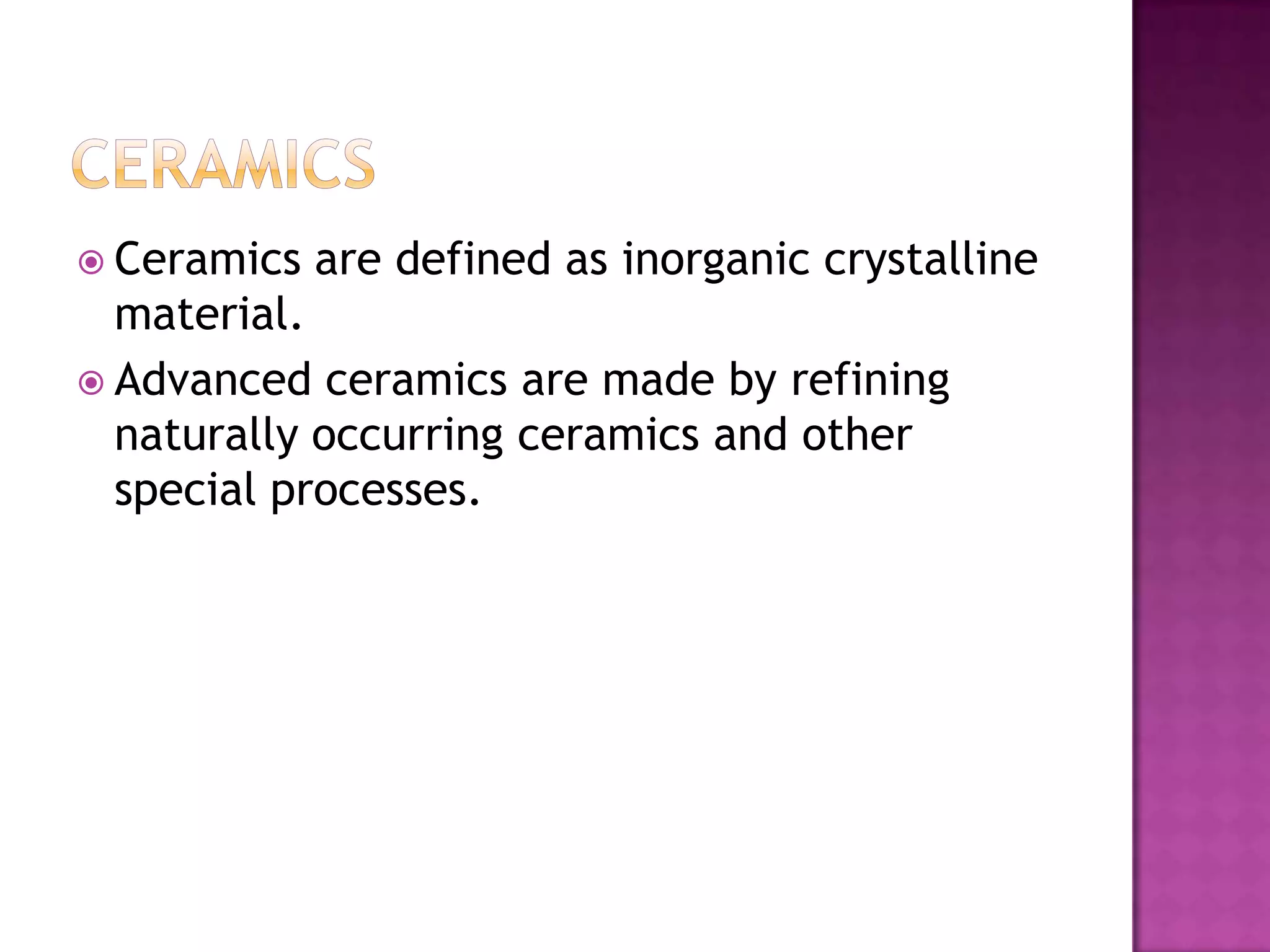
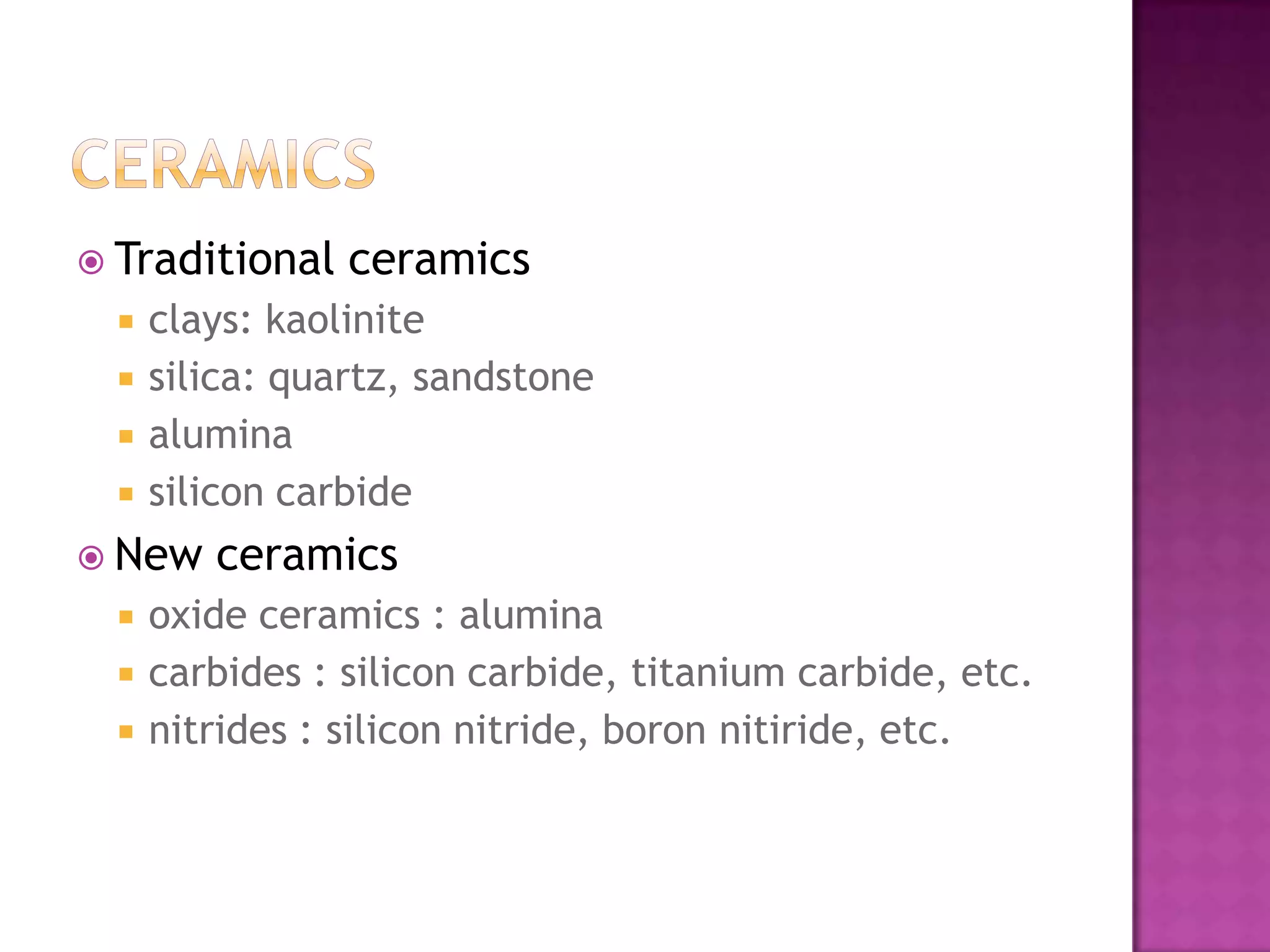
 Ceramics   are defined as inorganic crystalline
  material.
 Advanced ceramics are made by refining
  naturally occurring ceramics and other
  special processes.
 Traditional    ceramics
     clays: kaolinite
     silica: quartz, sandstone
     alumina
     silicon carbide
 New    ceramics
     oxide ceramics : alumina
     carbides : silicon carbide, titanium carbide, etc.
     nitrides : silicon nitride, boron nitiride, etc.
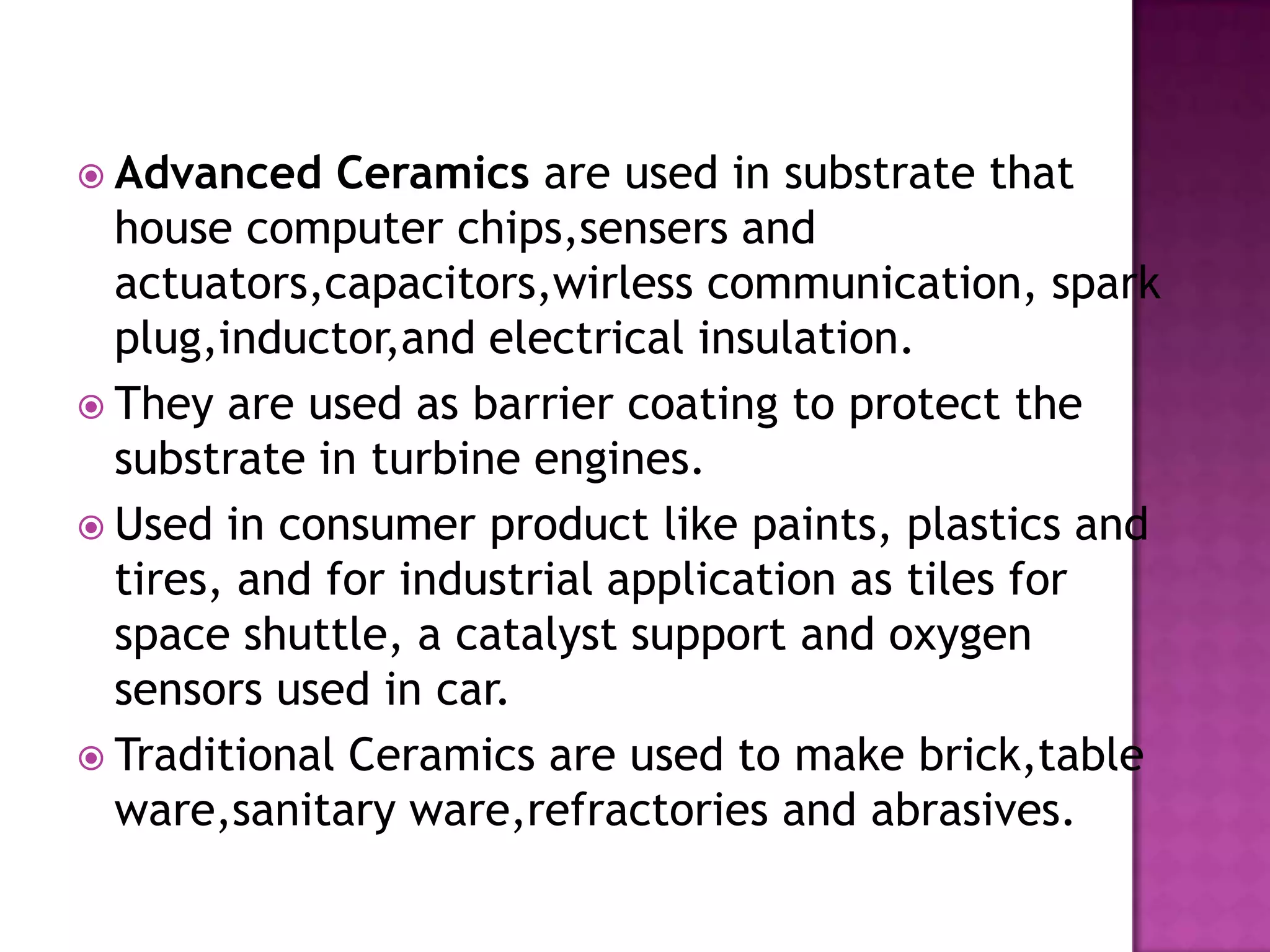
 Advanced    Ceramics are used in substrate that
  house computer chips,sensers and
  actuators,capacitors,wirless communication, spark
  plug,inductor,and electrical insulation.
 They are used as barrier coating to protect the
  substrate in turbine engines.
 Used in consumer product like paints, plastics and
  tires, and for industrial application as tiles for
  space shuttle, a catalyst support and oxygen
  sensors used in car.
 Traditional Ceramics are used to make brick,table
  ware,sanitary ware,refractories and abrasives.
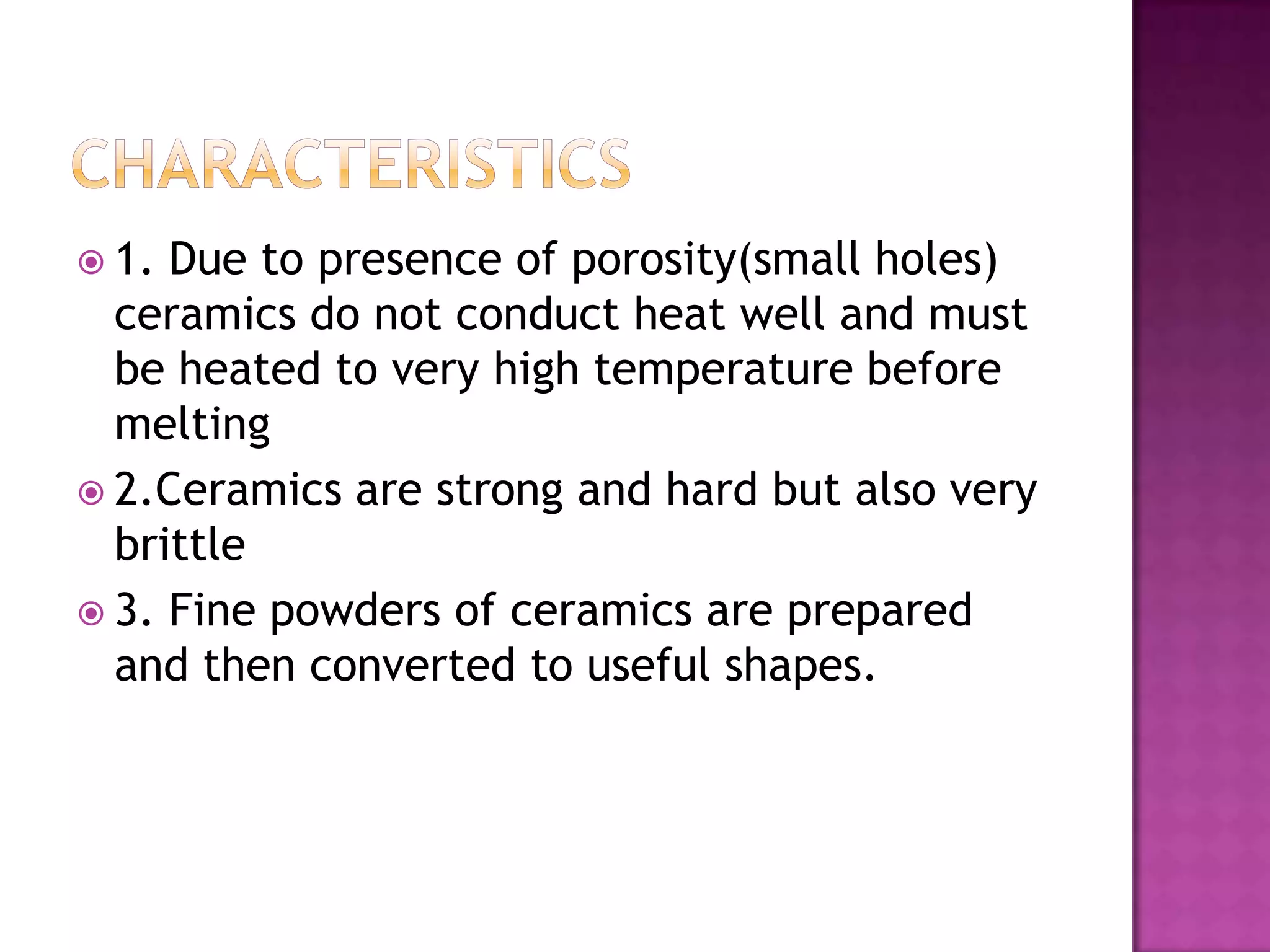
 1. Due to presence of porosity(small holes)
  ceramics do not conduct heat well and must
  be heated to very high temperature before
  melting
 2.Ceramics are strong and hard but also very
  brittle
 3. Fine powders of ceramics are prepared
  and then converted to useful shapes.
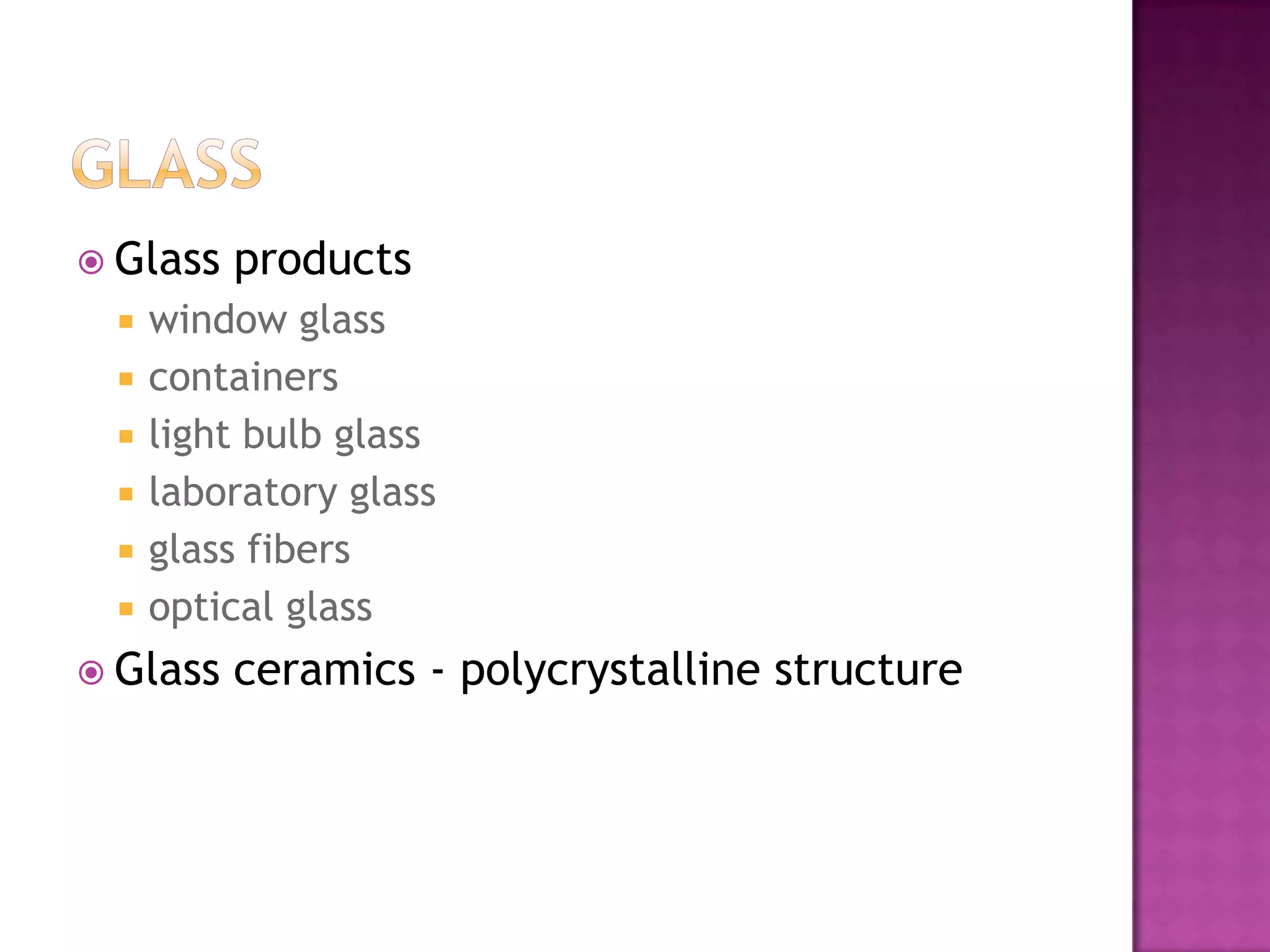
 Glass   products
    window glass
    containers
    light bulb glass
    laboratory glass
    glass fibers
    optical glass
 Glass   ceramics - polycrystalline structure
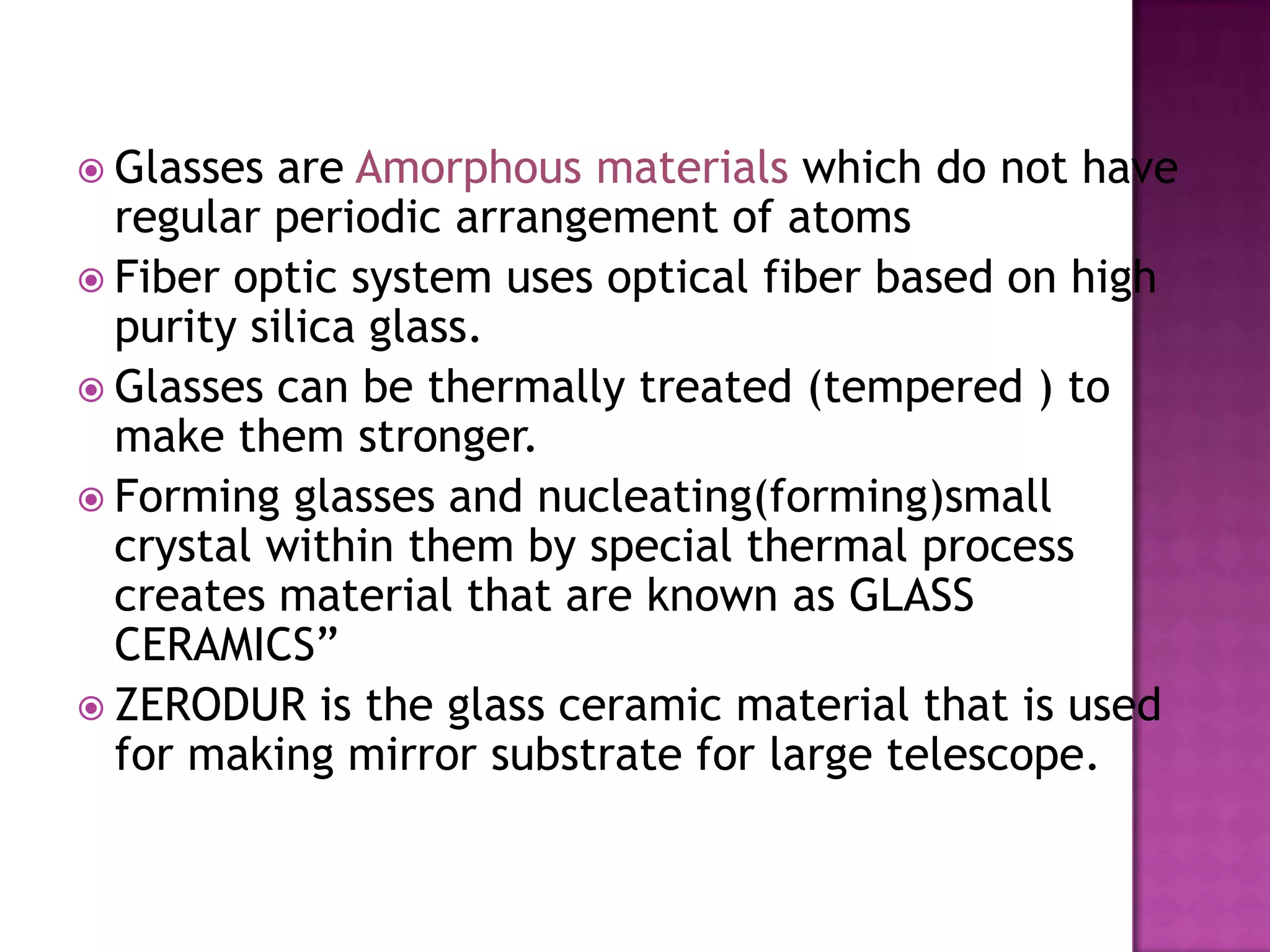
 Glasses  are Amorphous materials which do not have
  regular periodic arrangement of atoms
 Fiber optic system uses optical fiber based on high
  purity silica glass.
 Glasses can be thermally treated (tempered ) to
  make them stronger.
 Forming glasses and nucleating(forming)small
  crystal within them by special thermal process
  creates material that are known as GLASS
  CERAMICS”
 ZERODUR is the glass ceramic material that is used
  for making mirror substrate for large telescope.
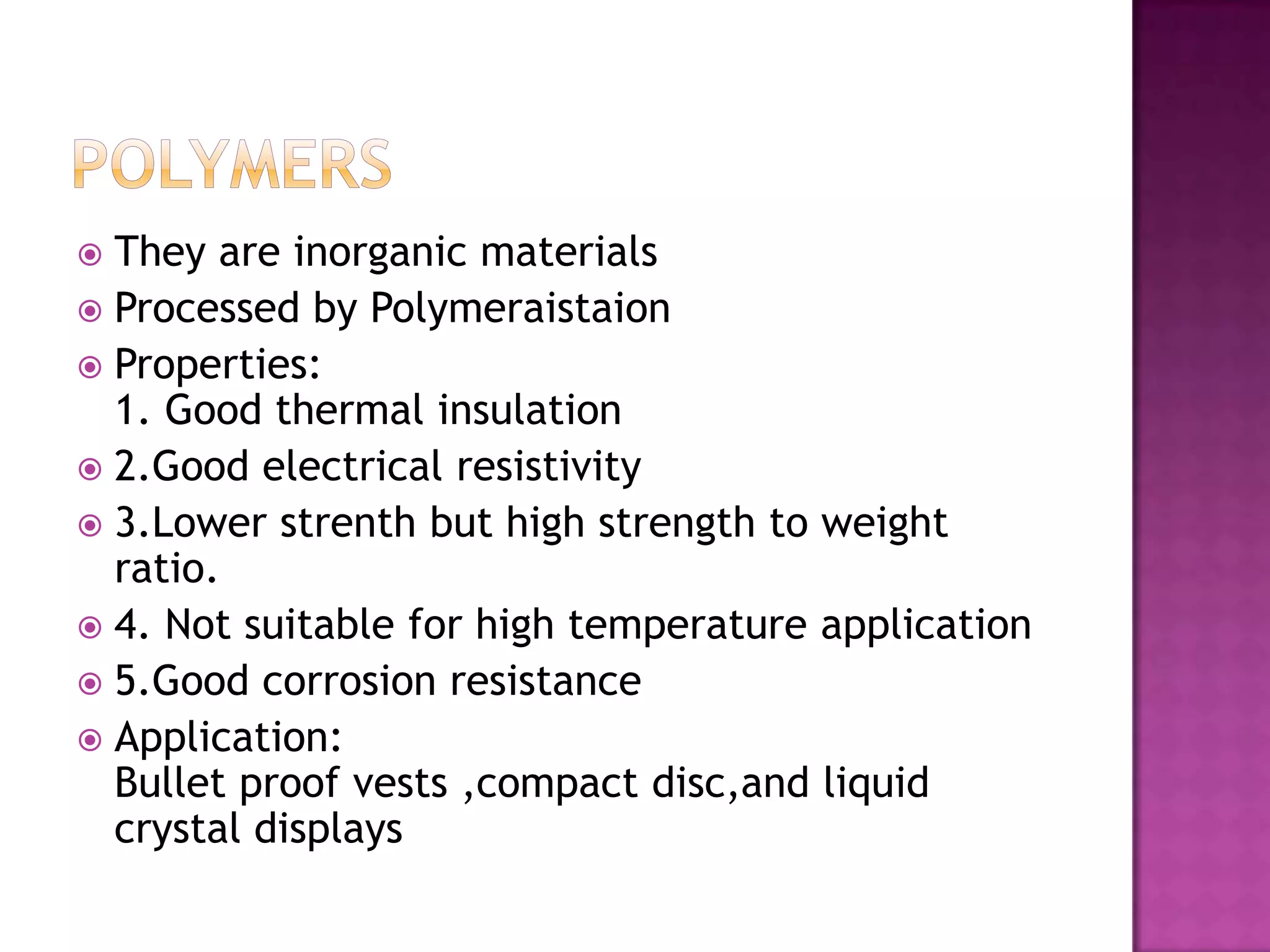
 They are inorganic materials
 Processed by Polymeraistaion
 Properties:
  1. Good thermal insulation
 2.Good electrical resistivity
 3.Lower strenth but high strength to weight
  ratio.
 4. Not suitable for high temperature application
 5.Good corrosion resistance
 Application:
  Bullet proof vests ,compact disc,and liquid
  crystal displays
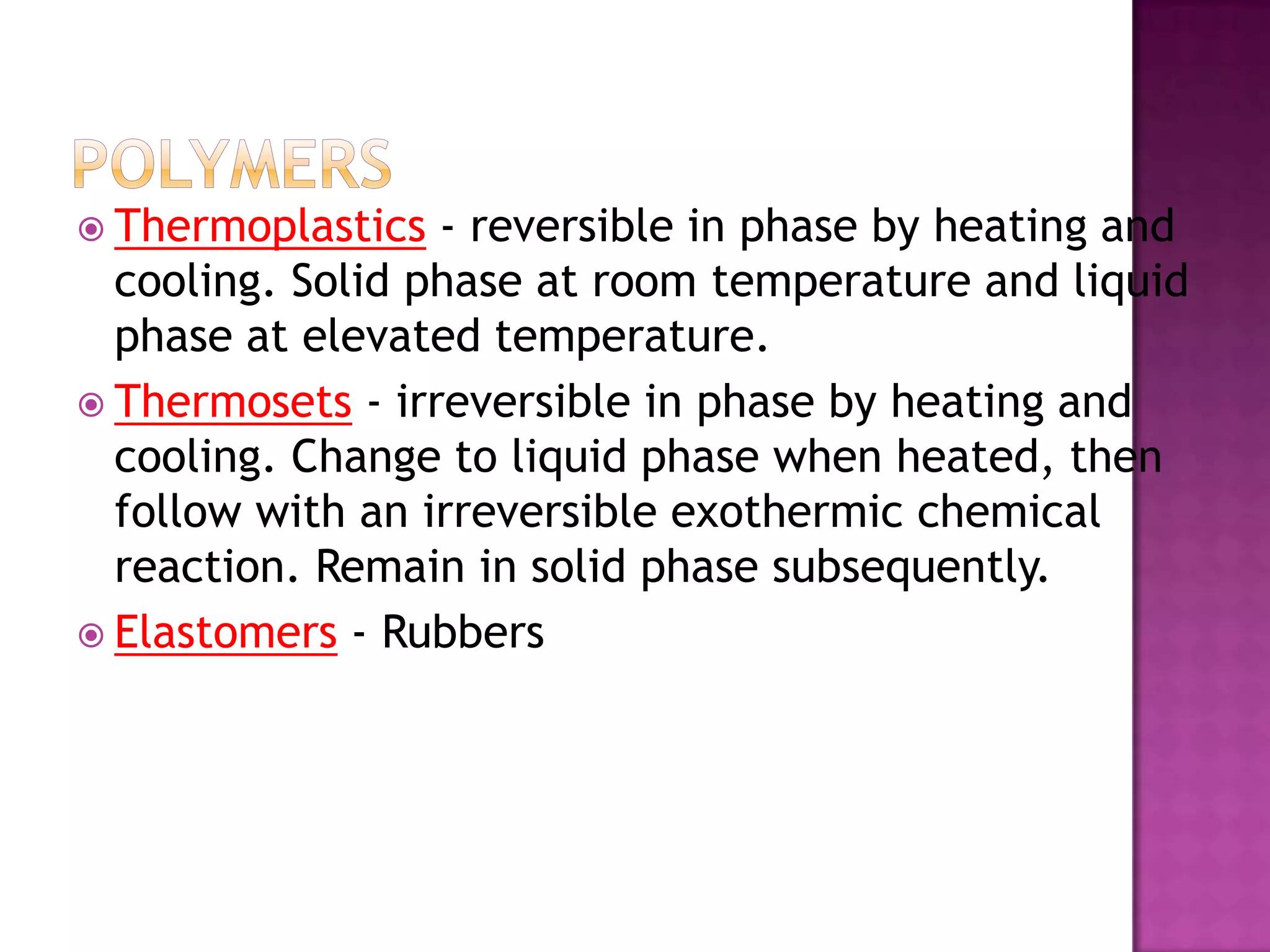
 Thermoplastics  - reversible in phase by heating and
  cooling. Solid phase at room temperature and liquid
  phase at elevated temperature.
 Thermosets - irreversible in phase by heating and
  cooling. Change to liquid phase when heated, then
  follow with an irreversible exothermic chemical
  reaction. Remain in solid phase subsequently.
 Elastomers - Rubbers
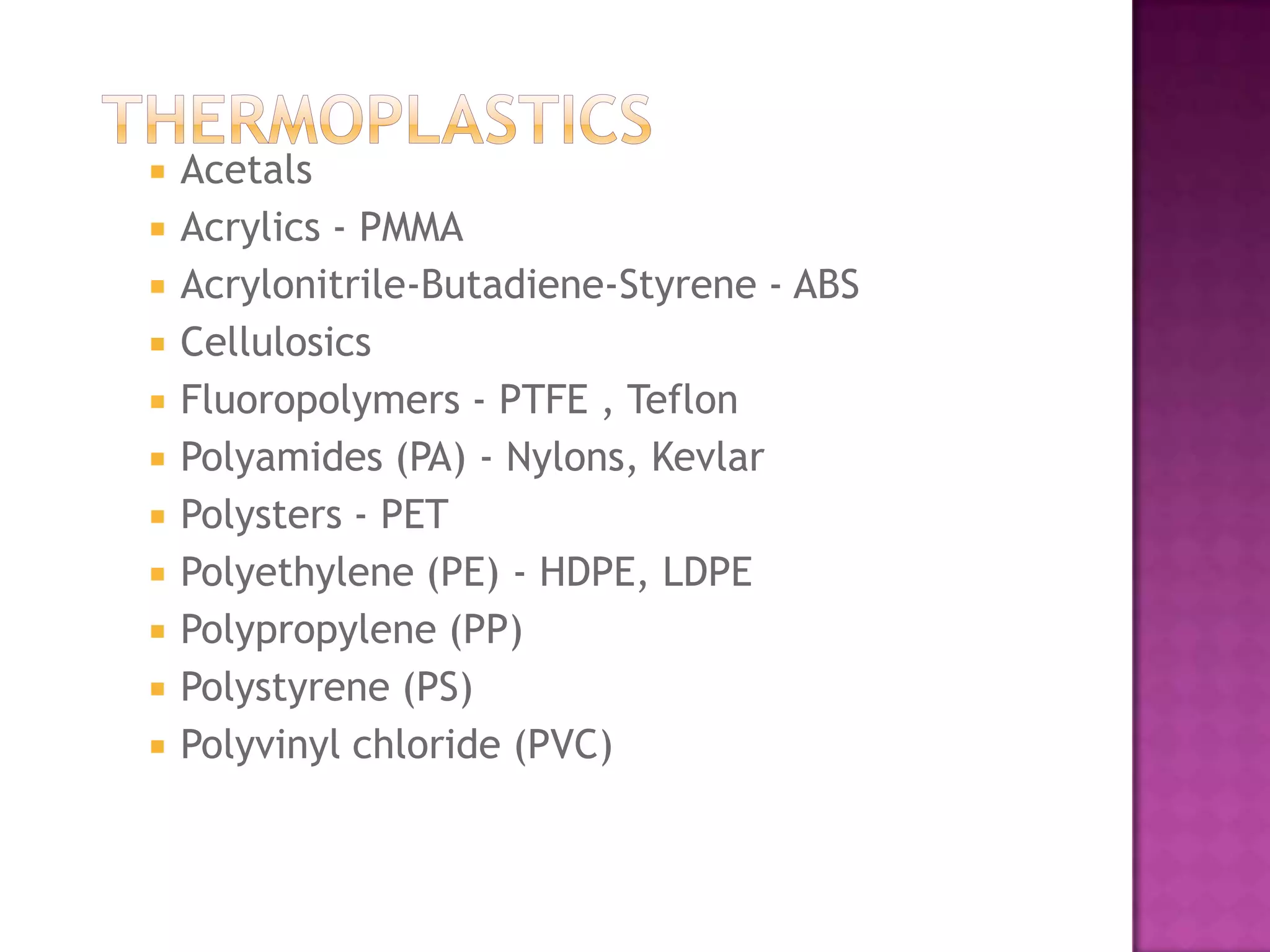
   Acetals
   Acrylics - PMMA
   Acrylonitrile-Butadiene-Styrene - ABS
   Cellulosics
   Fluoropolymers - PTFE , Teflon
   Polyamides (PA) - Nylons, Kevlar
   Polysters - PET
   Polyethylene (PE) - HDPE, LDPE
   Polypropylene (PP)
   Polystyrene (PS)
   Polyvinyl chloride (PVC)
 Amino  resins
 Epoxies
 Phenolics
 Polyesters
 Polyurethanes
 Silicones
 Natural rubber
 Synthetic rubbers
    butadiene rubber
    butyl rubber
    chloroprene rubber
    ethylene-propylene rubber
    isoprene rubber
    nitrile rubber
    polyurethanes
    silicones
    styrene-butadiene rubber
    thermoplastic elastomers
 Si,Ge and gallium arsenide based semiconductors
  such as those used in computers and electronics
  are part of Electronic materials.
 The electrical conductivity of semiconductors is
  material is between metal conductor and
  ceramic insulator.
 In some semiconductor the level of conductivity
  can be controlled to enable electronic devices
  such as transistor, diodes etc that are used to
  build integrated circuits.
 Thin films of semiconducting materials are also
  made by specialization processes.
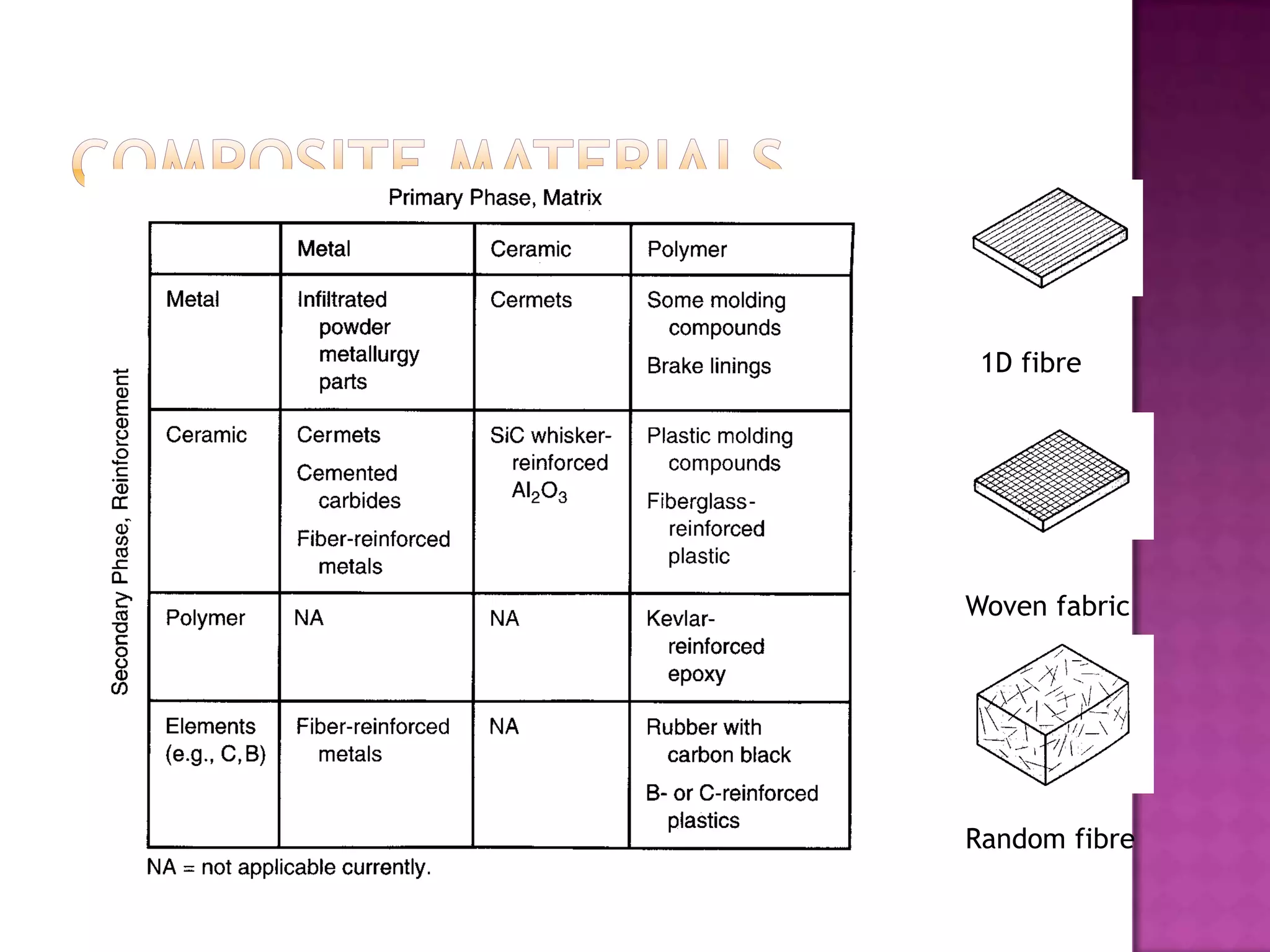
 Main  idea in developing COMPOSITE is to
  blend the properties of different material
 These are formed from two or more
  materials, producing properties not found in
  single material.
 Concrete, plywood and fiberglass are
  example of composite material
 Fiberglass is obtained by dispersing glass
  fibers in polymer matrix. Fiber make it
  stiffer without increasing density.
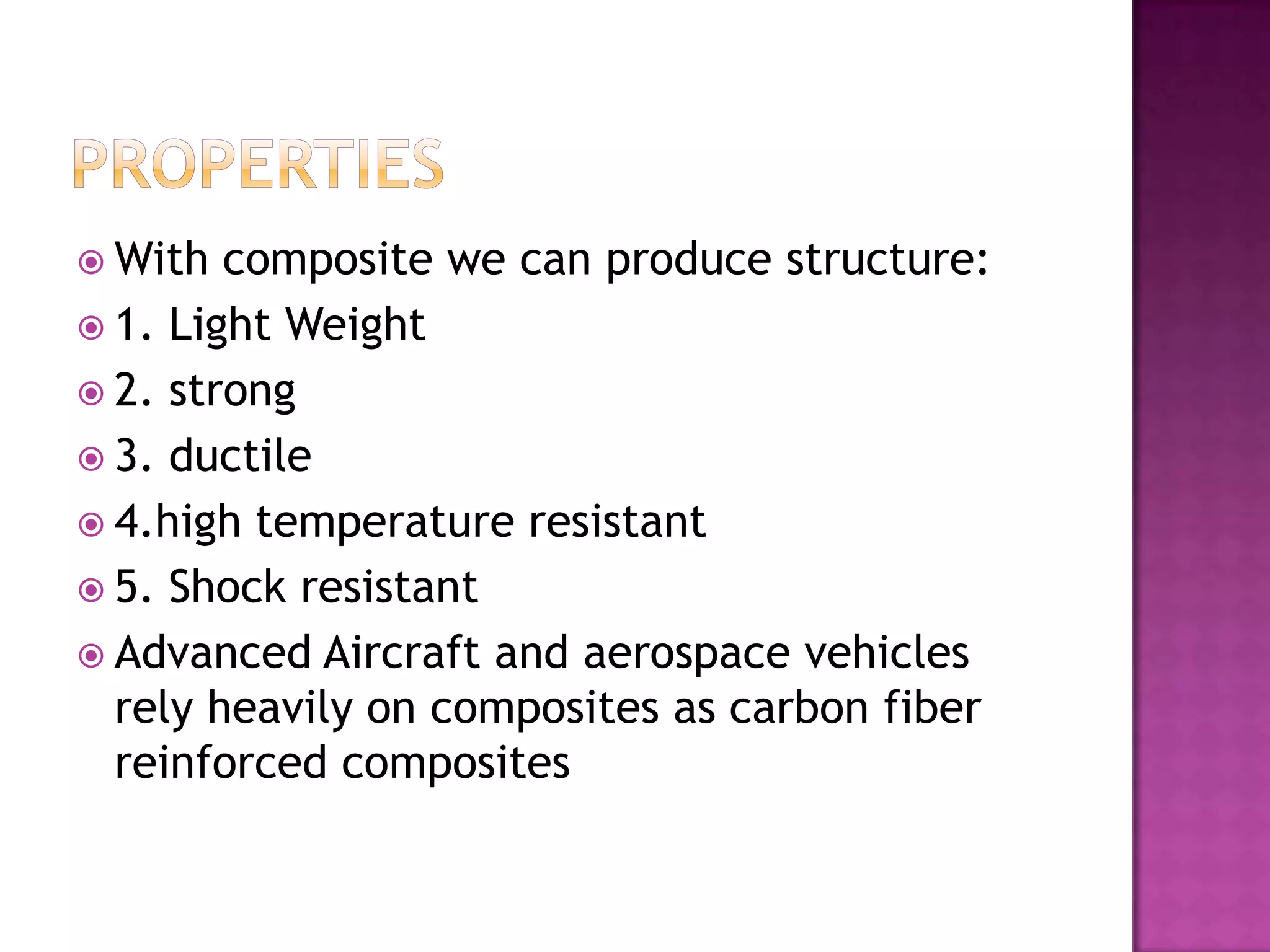
 With  composite we can produce structure:
 1. Light Weight
 2. strong
 3. ductile
 4.high temperature resistant
 5. Shock resistant
 Advanced Aircraft and aerospace vehicles
  rely heavily on composites as carbon fiber
  reinforced composites
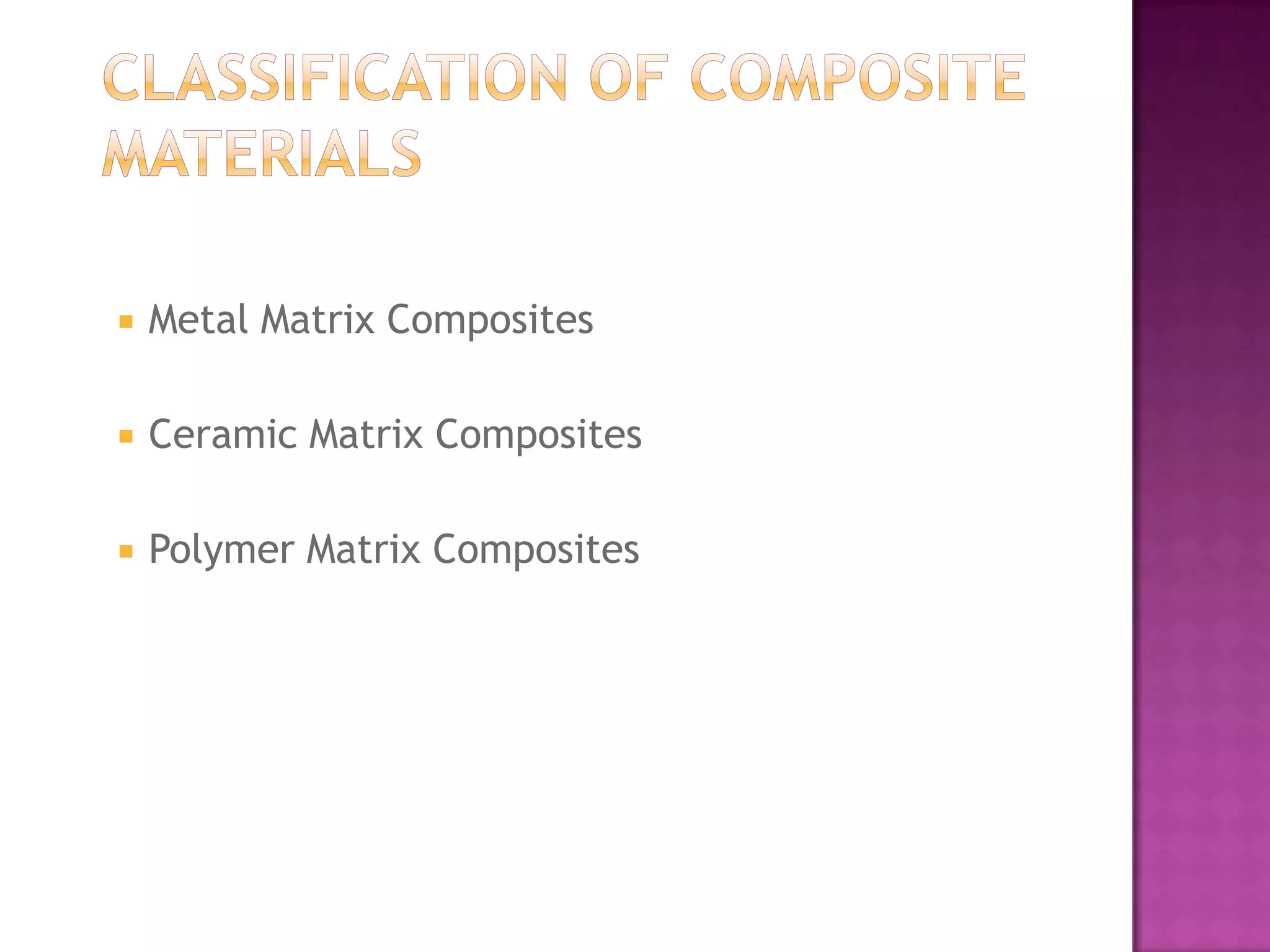
   Metal Matrix Composites

   Ceramic Matrix Composites

   Polymer Matrix Composites
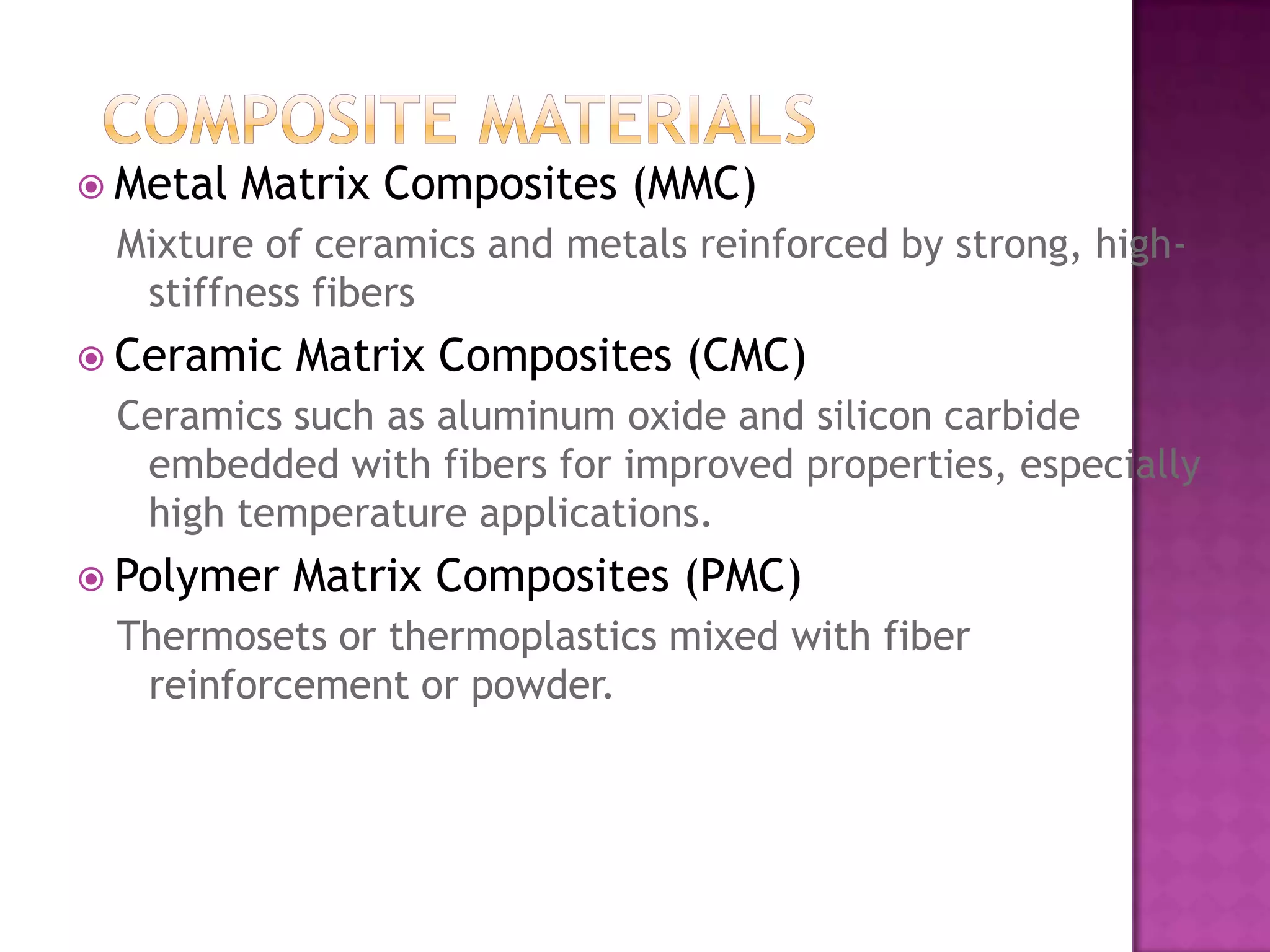
 Metal   Matrix Composites (MMC)
 Mixture of ceramics and metals reinforced by strong, high-
  stiffness fibers
 Ceramic   Matrix Composites (CMC)
 Ceramics such as aluminum oxide and silicon carbide
  embedded with fibers for improved properties, especially
  high temperature applications.
 Polymer   Matrix Composites (PMC)
 Thermosets or thermoplastics mixed with fiber
  reinforcement or powder.
1D fibre


Woven fabric


Random fibre
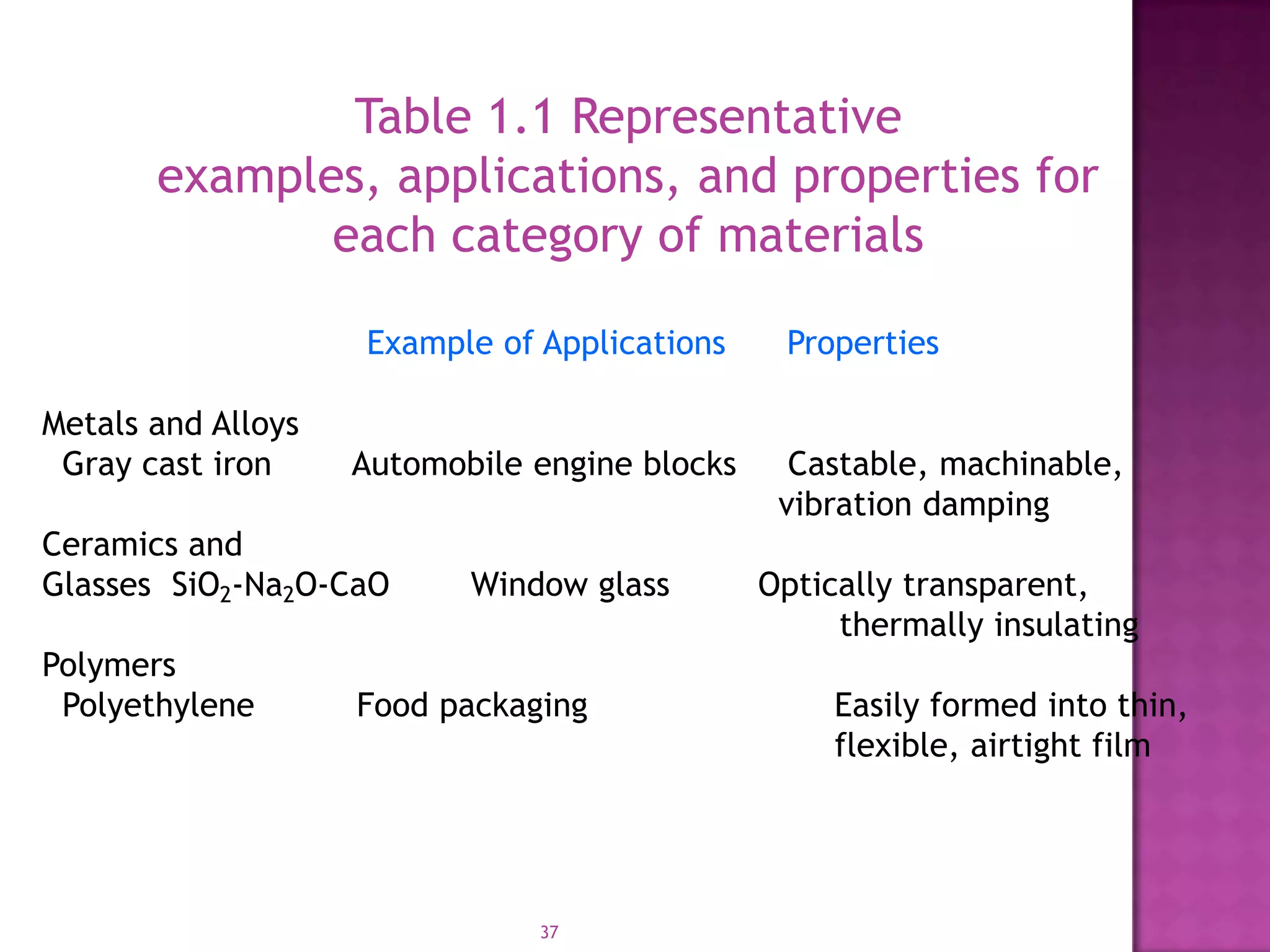
Table 1.1 Representative
       examples, applications, and properties for
              each category of materials

                    Example of Applications     Properties

Metals and Alloys
 Gray cast iron     Automobile engine blocks     Castable, machinable,
                                                vibration damping
Ceramics and
Glasses SiO2-Na2O-CaO      Window glass        Optically transparent,
                                                    thermally insulating
Polymers
 Polyethylene       Food packaging                  Easily formed into thin,
                                                    flexible, airtight film


                               37
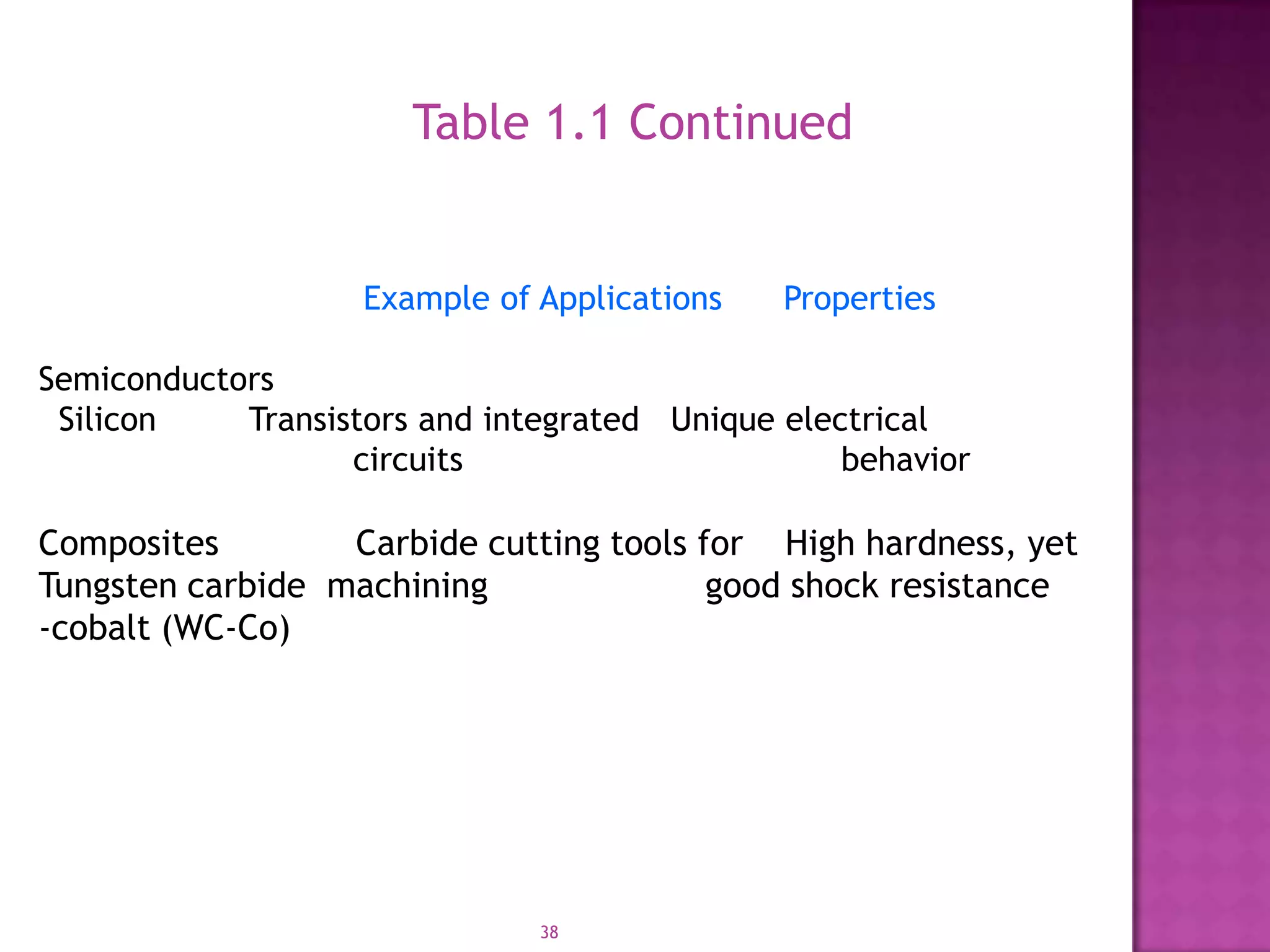
Table 1.1 Continued


                    Example of Applications   Properties

Semiconductors
 Silicon    Transistors and integrated Unique electrical
                   circuits                       behavior

Composites        Carbide cutting tools for High hardness, yet
Tungsten carbide machining               good shock resistance
-cobalt (WC-Co)


                               38
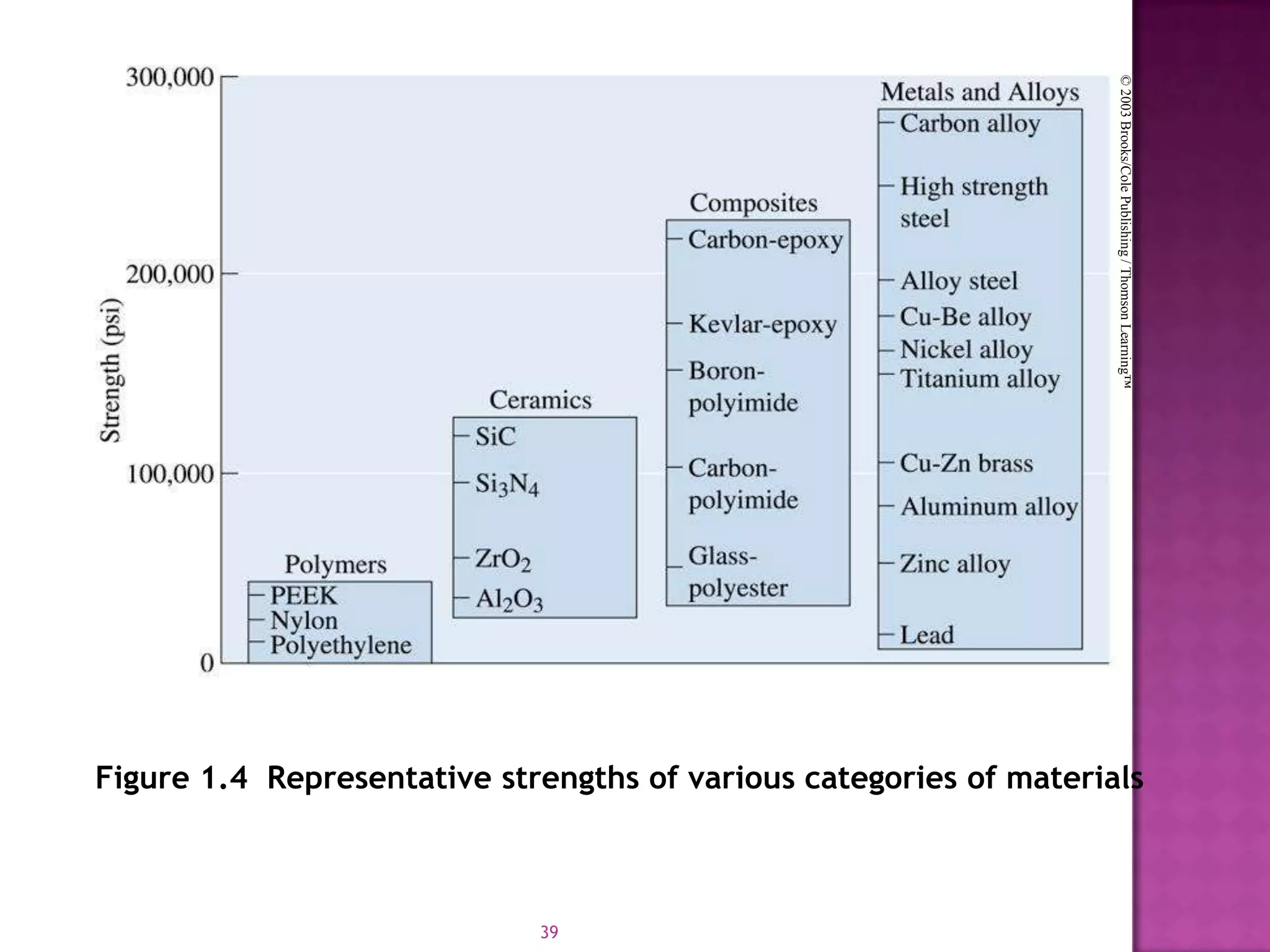
© 2003 Brooks/Cole Publishing / Thomson Learning™
Figure 1.4 Representative strengths of various categories of materials


                             39
Chap 1 final
Chap 1 final

Chap 1 final

  • 2.
     Materialscience andengineering is an interdisciplinary field concerned with inventing new materials and improving previously known materials by developing deeper understanding of microstructure- composition-synthesis processing relationships.
  • 3.
     Structure means description of arrangement of atoms.  Synthesis refers to how material are being made from naturally occurring or man made chemicals  Processesing refers to how material are shaped into useful component to cause changes in properties of different material.
  • 4.
     In MATERIALSCIENCE the emphasis is on underlying relation ships between synthesis and processesing, structure and properties of materials.  In MATERIALS ENGINEERING the focus is on how to translate or transform materials into useful devices or structures.
  • 7.
    PERFORMANCE:  What is Strength to density ratio?  What is formability?  How does this relate to the crash worthiness of the vehicle?  What is the cost of fabrication?  A COMPOSITION  Iron Based ?  Aluminium based?  What alloying elements should be added?  What quantities?  B MICROSTRUCTURE:  (a)What features of the structure limit the strength and formability?  (b) What controls the strength?  C SNYTHESIS & PROCESSESING  (a)How can steel making be controlled so as to provide high level of toughness and formability  (b)How can aerodynamic car chassis be formed.
  • 11.
     Material Scientist is concerned with steel sheet’s  (1)Composition  (2) Strength  (3)Weight  (4)Energy absorbing properties  (5)Malleability(formability)
  • 13.
     Chemical composition  Mechanical properties – Strength, hardness (under various conditions: temperature, humidity, pressure)  Physical properties – density, optical, electrical, magnetic  Environmental – green, recycling
  • 14.
     These materials are inorganic substances that are composed of one or more metallic elements .  Eg:Fe,Ni,Cu,Al  Non metallic elements as C,N may also be included in metallic materials  Metals have crystalline structure in which atoms are arranged in orderly fashion  Many metals are strong and hard even at high temperature.
  • 15.
     Ferrous Metals  Non-ferrous metals  Cast irons  Aluminum and its alloys  Steels  Copper and its alloys  Super alloys  Magnesium and its alloys  Iron-based  Nickel and its alloys  Nickel-based  Titanium and its alloys  Cobalt-based  Zinc and its alloys  Lead & Tin  Refractory metals  Precious metals
  • 16.
    • Ferrous alloysare useful metals in terms of mechanical, physical and chemical properties. • Alloys contain iron as their base metal. • Carbon steels are least expensive of all metals while stainless steels is costly.
  • 17.
    Carbon steels • Classifiedas low, medium and high: 1. Low-carbon steel or mild steel, < 0.3%C, bolts, nuts and sheet plates. 2. Medium-carbon steel, 0.3% ~ 0.6%C, machinery, automotive and agricultural equipment. 3. High-carbon steel, > 0.60% C, springs, cutlery, cable.
  • 18.
    Alloy steels • Steelscontaining significant amounts of alloying elements. • Structural-grade alloy steels used for construction industries due to high strength. • Other alloy steels are used for its strength, hardness, resistance to creep and fatigue, and toughness. • It may heat treated to obtain the
  • 19.
     New and improved Ni-based,Fe-Ni-Co based SUPERALLOYS are available for use in high pressure turbine airfoils in aircraft gas turbines.  The term SUPER ALLOY is used because of their improved performance at elevated temperature of 5400Cand high stress levels
  • 20.
     Ceramics are defined as inorganic crystalline material.  Advanced ceramics are made by refining naturally occurring ceramics and other special processes.
  • 21.
     Traditional ceramics  clays: kaolinite  silica: quartz, sandstone  alumina  silicon carbide  New ceramics  oxide ceramics : alumina  carbides : silicon carbide, titanium carbide, etc.  nitrides : silicon nitride, boron nitiride, etc.
  • 22.
     Advanced Ceramics are used in substrate that house computer chips,sensers and actuators,capacitors,wirless communication, spark plug,inductor,and electrical insulation.  They are used as barrier coating to protect the substrate in turbine engines.  Used in consumer product like paints, plastics and tires, and for industrial application as tiles for space shuttle, a catalyst support and oxygen sensors used in car.  Traditional Ceramics are used to make brick,table ware,sanitary ware,refractories and abrasives.
  • 23.
     1. Dueto presence of porosity(small holes) ceramics do not conduct heat well and must be heated to very high temperature before melting  2.Ceramics are strong and hard but also very brittle  3. Fine powders of ceramics are prepared and then converted to useful shapes.
  • 24.
     Glass products  window glass  containers  light bulb glass  laboratory glass  glass fibers  optical glass  Glass ceramics - polycrystalline structure
  • 25.
     Glasses are Amorphous materials which do not have regular periodic arrangement of atoms  Fiber optic system uses optical fiber based on high purity silica glass.  Glasses can be thermally treated (tempered ) to make them stronger.  Forming glasses and nucleating(forming)small crystal within them by special thermal process creates material that are known as GLASS CERAMICS”  ZERODUR is the glass ceramic material that is used for making mirror substrate for large telescope.
  • 26.
     They areinorganic materials  Processed by Polymeraistaion  Properties: 1. Good thermal insulation  2.Good electrical resistivity  3.Lower strenth but high strength to weight ratio.  4. Not suitable for high temperature application  5.Good corrosion resistance  Application: Bullet proof vests ,compact disc,and liquid crystal displays
  • 27.
     Thermoplastics - reversible in phase by heating and cooling. Solid phase at room temperature and liquid phase at elevated temperature.  Thermosets - irreversible in phase by heating and cooling. Change to liquid phase when heated, then follow with an irreversible exothermic chemical reaction. Remain in solid phase subsequently.  Elastomers - Rubbers
  • 28.
    Acetals  Acrylics - PMMA  Acrylonitrile-Butadiene-Styrene - ABS  Cellulosics  Fluoropolymers - PTFE , Teflon  Polyamides (PA) - Nylons, Kevlar  Polysters - PET  Polyethylene (PE) - HDPE, LDPE  Polypropylene (PP)  Polystyrene (PS)  Polyvinyl chloride (PVC)
  • 29.
     Amino resins  Epoxies  Phenolics  Polyesters  Polyurethanes  Silicones
  • 30.
     Natural rubber Synthetic rubbers  butadiene rubber  butyl rubber  chloroprene rubber  ethylene-propylene rubber  isoprene rubber  nitrile rubber  polyurethanes  silicones  styrene-butadiene rubber  thermoplastic elastomers
  • 31.
     Si,Ge andgallium arsenide based semiconductors such as those used in computers and electronics are part of Electronic materials.  The electrical conductivity of semiconductors is material is between metal conductor and ceramic insulator.  In some semiconductor the level of conductivity can be controlled to enable electronic devices such as transistor, diodes etc that are used to build integrated circuits.  Thin films of semiconducting materials are also made by specialization processes.
  • 32.
     Main idea in developing COMPOSITE is to blend the properties of different material  These are formed from two or more materials, producing properties not found in single material.  Concrete, plywood and fiberglass are example of composite material  Fiberglass is obtained by dispersing glass fibers in polymer matrix. Fiber make it stiffer without increasing density.
  • 33.
     With composite we can produce structure:  1. Light Weight  2. strong  3. ductile  4.high temperature resistant  5. Shock resistant  Advanced Aircraft and aerospace vehicles rely heavily on composites as carbon fiber reinforced composites
  • 34.
    Metal Matrix Composites  Ceramic Matrix Composites  Polymer Matrix Composites
  • 35.
     Metal Matrix Composites (MMC) Mixture of ceramics and metals reinforced by strong, high- stiffness fibers  Ceramic Matrix Composites (CMC) Ceramics such as aluminum oxide and silicon carbide embedded with fibers for improved properties, especially high temperature applications.  Polymer Matrix Composites (PMC) Thermosets or thermoplastics mixed with fiber reinforcement or powder.
  • 36.
  • 37.
    Table 1.1 Representative examples, applications, and properties for each category of materials Example of Applications Properties Metals and Alloys Gray cast iron Automobile engine blocks Castable, machinable, vibration damping Ceramics and Glasses SiO2-Na2O-CaO Window glass Optically transparent, thermally insulating Polymers Polyethylene Food packaging Easily formed into thin, flexible, airtight film 37
  • 38.
    Table 1.1 Continued Example of Applications Properties Semiconductors Silicon Transistors and integrated Unique electrical circuits behavior Composites Carbide cutting tools for High hardness, yet Tungsten carbide machining good shock resistance -cobalt (WC-Co) 38
  • 39.
    © 2003 Brooks/ColePublishing / Thomson Learning™ Figure 1.4 Representative strengths of various categories of materials 39