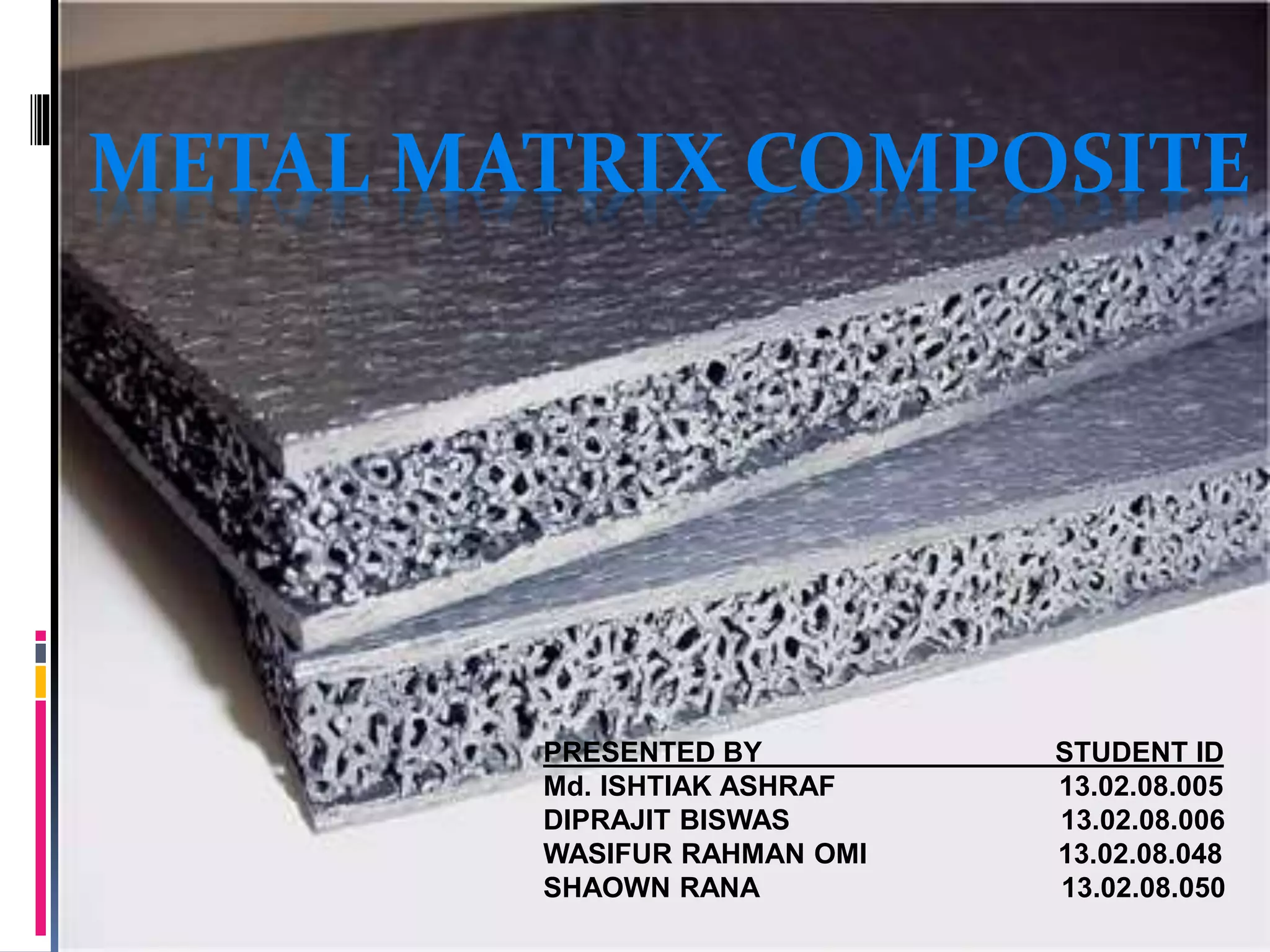
METAL MATRIX COMPOSITE
PRESENTED BY STUDENT ID
Md. ISHTIAK ASHRAF 13.02.08.005
DIPRAJIT BISWAS 13.02.08.006
WASIFUR RAHMAN OMI 13.02.08.048
SHAOWN RANA 13.02.08.050
CONTENTS
 INTRODUCTION
 CLASSIFICATION OF MMC
 COMPOSITION
 REIGNFORCEMENT
 PROCESSING OF MMC
 MANUFACTURING AND FORMING
 APPLICATION OF METAL MATIX COMPOSITES
 DEMAND
 CHARACTERISTICS
 ADVANTAGES
 DISADVANTAGES
 FUTURE APPLICATION OF MMC
INTRODUCTION
A metal matrix composite (MMC) is composite
material with at least two constituent parts, one being
a metal necessarily, the other material may be a
different metal or another material, such as
a ceramic or organic compound.
History
 Initial work in late 1960s was stimulated by the high-
performance needs of the aerospace industry
 Steel-wire reinforced copper, were among the first
continuous-fiber reinforced metal composites
 Boron filament was the first high-strength, high-
modulus reinforcement in MMC
WHY WE USE MMC?
 High strength
 High stiffness
 Toughness
 Density
 Good wear resistance
 Damping capacity
 Specific modulus
CLASSIFICATION OF MMC
Composites with metal phase
Dispersion
hardened & particle
composites
Layer
composites
(Laminates)
Fiber
composites
Infiltration
composites
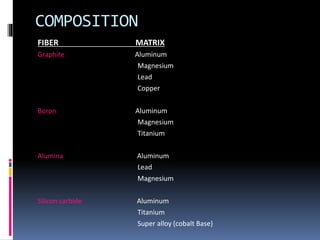
COMPOSITION
FIBER MATRIX
Graphite Aluminum
Magnesium
Lead
Copper
Boron Aluminum
Magnesium
Titanium
Alumina Aluminum
Lead
Magnesium
Silicon carbide Aluminum
Titanium
Super alloy (cobalt Base)
REIGNFORCEMENT
 Embedded into matrix
 Change physical properties, wear resistance, friction
co efficient, thermal conductivity
 Continuous or, discontinuous
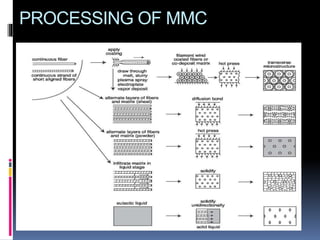
PROCESSING OF MMC
Manufacturing and Forming
Methods
 Solid state methods
 Semi-solid state methods
 Liquid state methods
 Vapor Deposition
 In-situ fabrication technique
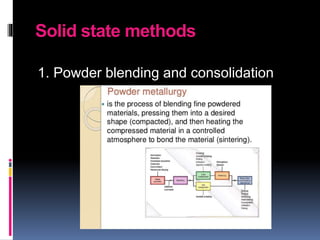
Solid state methods
1. Powder blending and consolidation
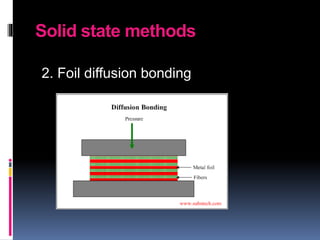
Solid state methods
2. Foil diffusion bonding
Semi-solid state methods
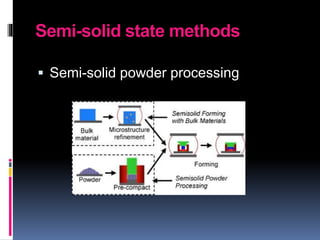
 Semi-solid powder processing
Liquid state methods
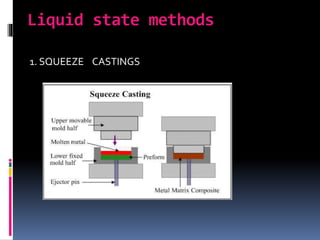
1. SQUEEZE CASTINGS
Liquid state methods
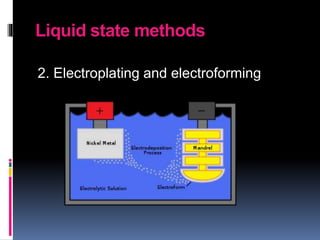
2. Electroplating and electroforming
Liquid state methods
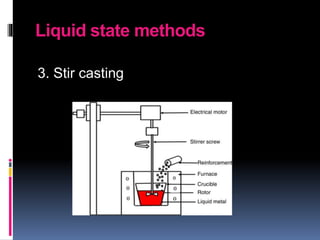
3. Stir casting
Liquid state methods
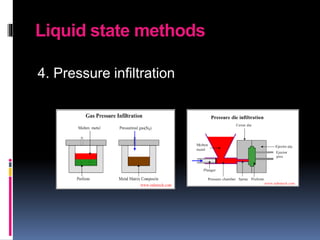
4. Pressure infiltration
Liquid state methods
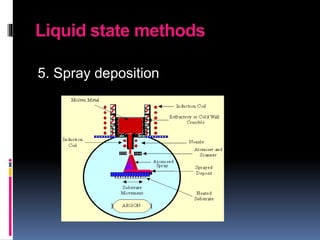
5. Spray deposition
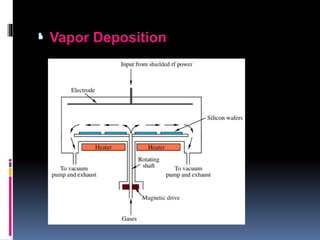
. Vapor Deposition
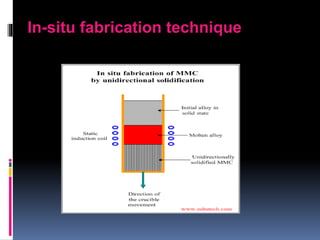
In-situ fabrication technique
APPLICATIONS OF MMC
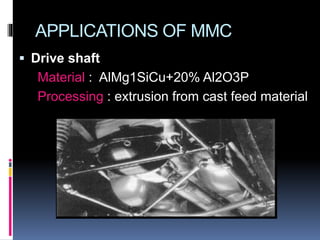
 Drive shaft
Material : AlMg1SiCu+20% Al2O3P
Processing : extrusion from cast feed material
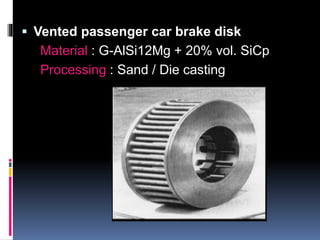
 Vented passenger car brake disk
Material : G-AlSi12Mg + 20% vol. SiCp
Processing : Sand / Die casting
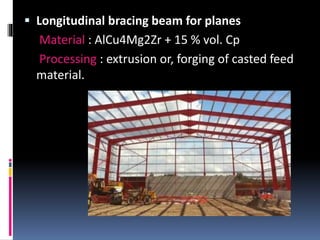
 Longitudinal bracing beam for planes
Material : AlCu4Mg2Zr + 15 % vol. Cp
Processing : extrusion or, forging of casted feed
material.
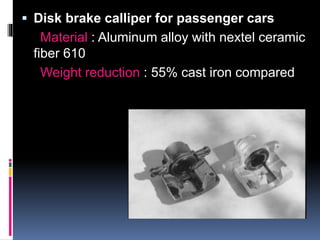
 Disk brake calliper for passenger cars
Material : Aluminum alloy with nextel ceramic
fiber 610
Weight reduction : 55% cast iron compared
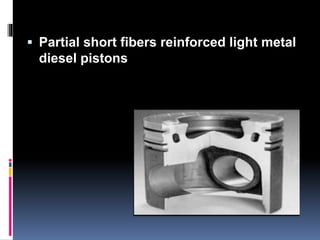
 Partial short fibers reinforced light metal
diesel pistons
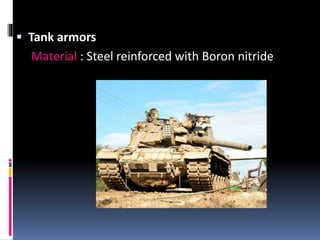
 Tank armors
Material : Steel reinforced with Boron nitride
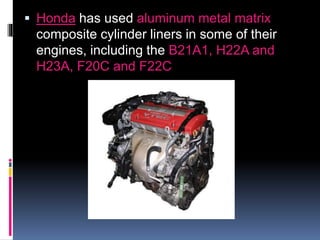
 Honda has used aluminum metal matrix
composite cylinder liners in some of their
engines, including the B21A1, H22A and
H23A, F20C and F22C
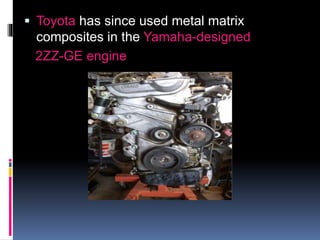
 Toyota has since used metal matrix
composites in the Yamaha-designed
2ZZ-GE engine
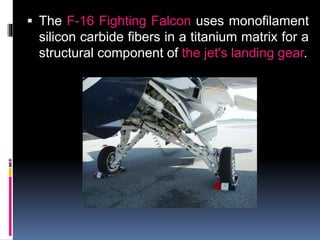
 The F-16 Fighting Falcon uses monofilament
silicon carbide fibers in a titanium matrix for a
structural component of the jet's landing gear.
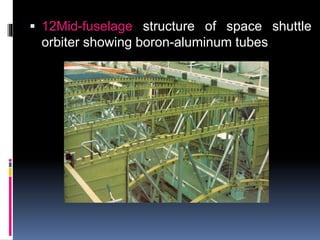
 12Mid-fuselage structure of space shuttle
orbiter showing boron-aluminum tubes
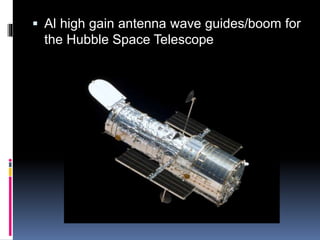
 Al high gain antenna wave guides/boom for
the Hubble Space Telescope
Demand
 Low density,
 Mechanical compatibility,
 Chemical compatibility,
 Thermal stability,
 High Young’s modulus,
 High compression and tensile strength,
 Good process ability,
 Economic efficiency.
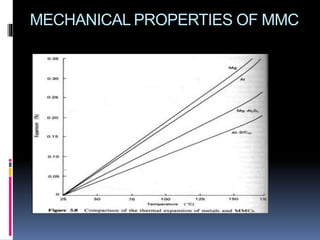
MECHANICAL PROPERTIES OF MMC
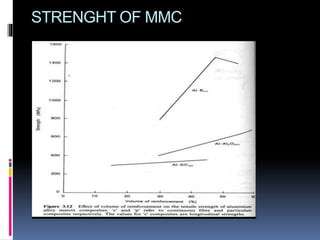
STRENGHT OF MMC
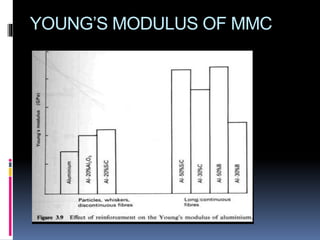
YOUNG’S MODULUS OF MMC
Advantages
 Low coefficient for thermal expansion
 Fire resistance, wear resistance.
 Higher transverse stiffness , strength &
modulus
 No moisture absorption
 Higher electrical and thermal conductivities
 Better radiation resistance
 Some reinforcing fibers are inexpensive
 Casting is low cost and net shaped process
Disadvantages
 Some fabrication processes are complex and
expensive
 Higher cost of some reinforcing fibers
 Relatively immature technology
 Machining difficult
 Complex fabrication methods
 Reinforcing material may reduce ductility and
fracture toughness
 Fiber-matrix interactions at high temperature
degrade fibers
FUTURE PLANS & APPLICATION
 Aerospace & Army defense
 DRTi offers excellent values of absolute
strength and stiffness as well as specific
strength and stiffness.
 Discontinuously reinforced metals
 Decreasing cost
 More mature production system
THE END
???

Metal Matrix Composite (MMC)

  • 1.
    METAL MATRIX COMPOSITE PRESENTEDBY STUDENT ID Md. ISHTIAK ASHRAF 13.02.08.005 DIPRAJIT BISWAS 13.02.08.006 WASIFUR RAHMAN OMI 13.02.08.048 SHAOWN RANA 13.02.08.050
  • 2.
    CONTENTS  INTRODUCTION  CLASSIFICATIONOF MMC  COMPOSITION  REIGNFORCEMENT  PROCESSING OF MMC  MANUFACTURING AND FORMING  APPLICATION OF METAL MATIX COMPOSITES  DEMAND  CHARACTERISTICS  ADVANTAGES  DISADVANTAGES  FUTURE APPLICATION OF MMC
  • 3.
    INTRODUCTION A metal matrixcomposite (MMC) is composite material with at least two constituent parts, one being a metal necessarily, the other material may be a different metal or another material, such as a ceramic or organic compound.
  • 4.
    History  Initial workin late 1960s was stimulated by the high- performance needs of the aerospace industry  Steel-wire reinforced copper, were among the first continuous-fiber reinforced metal composites  Boron filament was the first high-strength, high- modulus reinforcement in MMC
  • 5.
    WHY WE USEMMC?  High strength  High stiffness  Toughness  Density  Good wear resistance  Damping capacity  Specific modulus
  • 6.
    CLASSIFICATION OF MMC Compositeswith metal phase Dispersion hardened & particle composites Layer composites (Laminates) Fiber composites Infiltration composites
  • 7.
    COMPOSITION FIBER MATRIX Graphite Aluminum Magnesium Lead Copper BoronAluminum Magnesium Titanium Alumina Aluminum Lead Magnesium Silicon carbide Aluminum Titanium Super alloy (cobalt Base)
  • 8.
    REIGNFORCEMENT  Embedded intomatrix  Change physical properties, wear resistance, friction co efficient, thermal conductivity  Continuous or, discontinuous
  • 9.
  • 10.
    Manufacturing and Forming Methods Solid state methods  Semi-solid state methods  Liquid state methods  Vapor Deposition  In-situ fabrication technique
  • 11.
    Solid state methods 1.Powder blending and consolidation
  • 12.
    Solid state methods 2.Foil diffusion bonding
  • 13.
    Semi-solid state methods Semi-solid powder processing
  • 14.
    Liquid state methods 1.SQUEEZE CASTINGS
  • 15.
    Liquid state methods 2.Electroplating and electroforming
  • 16.
  • 17.
    Liquid state methods 4.Pressure infiltration
  • 18.
    Liquid state methods 5.Spray deposition
  • 19.
  • 20.
  • 21.
    APPLICATIONS OF MMC Drive shaft Material : AlMg1SiCu+20% Al2O3P Processing : extrusion from cast feed material
  • 22.
     Vented passengercar brake disk Material : G-AlSi12Mg + 20% vol. SiCp Processing : Sand / Die casting
  • 23.
     Longitudinal bracingbeam for planes Material : AlCu4Mg2Zr + 15 % vol. Cp Processing : extrusion or, forging of casted feed material.
  • 24.
     Disk brakecalliper for passenger cars Material : Aluminum alloy with nextel ceramic fiber 610 Weight reduction : 55% cast iron compared
  • 25.
     Partial shortfibers reinforced light metal diesel pistons
  • 26.
     Tank armors Material: Steel reinforced with Boron nitride
  • 27.
     Honda hasused aluminum metal matrix composite cylinder liners in some of their engines, including the B21A1, H22A and H23A, F20C and F22C
  • 28.
     Toyota hassince used metal matrix composites in the Yamaha-designed 2ZZ-GE engine
  • 29.
     The F-16Fighting Falcon uses monofilament silicon carbide fibers in a titanium matrix for a structural component of the jet's landing gear.
  • 30.
     12Mid-fuselage structureof space shuttle orbiter showing boron-aluminum tubes
  • 31.
     Al highgain antenna wave guides/boom for the Hubble Space Telescope
  • 32.
    Demand  Low density, Mechanical compatibility,  Chemical compatibility,  Thermal stability,  High Young’s modulus,  High compression and tensile strength,  Good process ability,  Economic efficiency.
  • 33.
  • 34.
  • 35.
  • 36.
    Advantages  Low coefficientfor thermal expansion  Fire resistance, wear resistance.  Higher transverse stiffness , strength & modulus  No moisture absorption  Higher electrical and thermal conductivities  Better radiation resistance  Some reinforcing fibers are inexpensive  Casting is low cost and net shaped process
  • 37.
    Disadvantages  Some fabricationprocesses are complex and expensive  Higher cost of some reinforcing fibers  Relatively immature technology  Machining difficult  Complex fabrication methods  Reinforcing material may reduce ductility and fracture toughness  Fiber-matrix interactions at high temperature degrade fibers
  • 38.
    FUTURE PLANS &APPLICATION  Aerospace & Army defense  DRTi offers excellent values of absolute strength and stiffness as well as specific strength and stiffness.  Discontinuously reinforced metals  Decreasing cost  More mature production system
  • 39.