PVG’s COLLEGE OF ENGINEERING &
                  TECHNOLOGY
                                PUNE – 411 009


                                CERTIFICATE

                      This is to certify that the SEMINAR titled


       “Ceramic Composites: Case Study of Ballistic Impact”


               has been completed in the academic year 2012-13 by

                         Deshpande Jaydeep Sanjeev

                           Roll No. 22 (T.E. Mechanical)

                 In partial fulfillment of the Bachelor Degree in

                      MECHANICAL ENGINEERING

                      As prescribed by the University Of Pune.


Prof. P.G. Kulkarni                         Dr. Mrs. S. S. Sane

     (Guide)                                Head of the Dept.


                                                                    1
Contents


1. Introduction……………………………………………… 3
   1.1 Constituents
2. History……………………………………………………. 5
3. Ceramic Processing……………………………………… 7
4. Applications……………………………………………… 10
   4.1 Aerospace
   4.2 Space Shuttle Tiles
   4.3 Military
5. Case Study……………………………………………….. 15
   5.1 Steel Plate
   5.2 Monolithic Ceramic Tile
   5.3 Composite Tile
6. Conclusion……………………………………………….. 20


                                         2
1. Introduction

       Composite materials, often shortened to composites or called composition
materials, are engineered or naturally occurring materials made from two or more
constituent materials with significantly different physical or chemical properties
which remain separate and distinct within the finished structure.

       A common example of a composite would be disc brake pads, which consist
of hard ceramic particles embedded in soft metal matrix. Another example is found in
shower stalls and bathtubs which are made of 3iberglass. Imitation granite and
cultured marble sinks and countertops are also widely used. The most advanced
examples perform routinely on spacecraft in demanding environments.


1.1 Constituents

1.1.1 Matrices

Common matrices include mud (wattle and daub), cement (concrete), polymers (fiber
reinforced plastics), metals and ceramics. Road surfaces are often made from asphalt
concrete which uses bitumen as a matrix. Unusual matrices such as ice are sometime
proposed as in pykecrete.

   1.0.1   Resins

Typically, most common polymer-based composite materials, including fiberglass,
carbon fiber, and Kevlar, include at least two parts, the substrate and the resin.

   1.0.2   Reinforcements: Fibres

Fiber-reinforced composite materials can be divided into two main categories
normally referred to as short fiber-reinforced materials and continuous fiber-
reinforced materials. Continuous reinforced materials will often constitute a layered
or laminated structure. The woven and continuous fibre styles are typically available
in a variety of forms, being pre-impregnated with the given matrix (resin), dry, uni-
directional tapes of various widths, plain weave, harness satins, braided, and stitched.


                                                                                           3
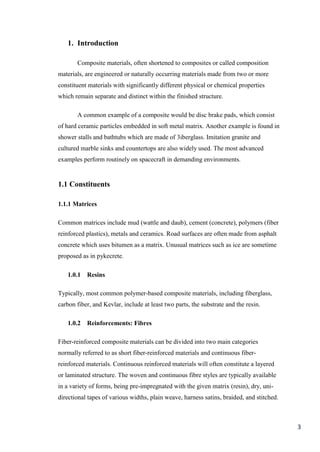
The short and long fibers are typically employed in compression moulding and sheet
moulding operations. These come in the form of flakes, chips, and random mate
(which can also be made from a continuous fibre laid in random fashion until the
desired thickness of the ply / laminate is achieved).


                          Fig1: Examples of reinforcements

   (a) Continuous fibre
   (b) Discontinues fibre
   (c) Whisker


                                                                                     4
2. History


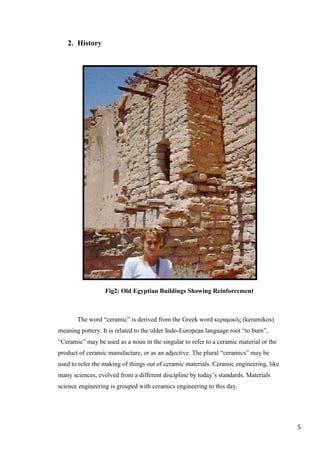
                  Fig2: Old Egyptian Buildings Showing Reinforcement


       The word “ceramic” is derived from the Greek word κεραμικός (keramikos)
meaning pottery. It is related to the older Indo-European language root “to burn”,
“Ceramic” may be used as a noun in the singular to refer to a ceramic material or the
product of ceramic manufacture, or as an adjective. The plural “ceramics” may be
used to refer the making of things out of ceramic materials. Ceramic engineering, like
many sciences, evolved from a different discipline by today’s standards. Materials
science engineering is grouped with ceramics engineering to this day.


                                                                                         5
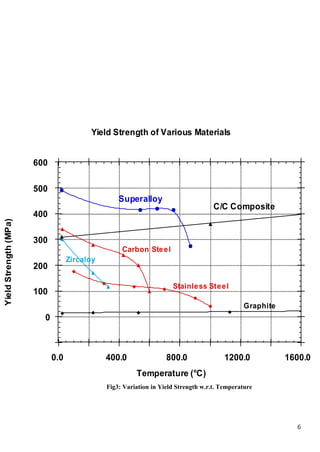
Yield Strength of Various Materials


                       600

                       500
                                                  Superalloy
                                                                                    C/C Composite
                       400
Yield Strength (MPa)


                       300
                                                   Carbon Ste e l
                                   Zircaloy
                       200

                                                                     Stainle ss Ste e l
                       100
                                                                                              Graphite
                         0


                             0.0              400.0                800.0                1200.0           1600.0
                                                        Temperature (°C)
                                              Fig3: Variation in Yield Strength w.r.t. Temperature


                                                                                                           6
3. Ceramic Processing


    Substantial interest has arisen in recent years in fabricating ceramic composites.
While there is considerable interest in composites with one or more non-ceramic
constituents, the greatest attention is on composites in which all constituents are
ceramic. These typically comprise two ceramic constituents: a continuous matrix, and
a dispersed phase of ceramic particles, whiskers, or short (chopped) or continuous
ceramic fibers. The challenge, as in wet chemical processing, is to obtain a uniform or
homogeneous distribution of the dispersed particle or fiber phase.


    Consider first the processing of particulate composites. The particulate phase of
greatest interest is tetragonal zirconia because of the toughening that can be achieved
from the phase transformation from the metastable tetragonal to the monoclinic
crystalline phase, aka transformation toughening. There is also substantial interest in
dispersion of hard, non-oxide phases such as SiC, TiB, TiC, boron, carbon and
especially oxide matrices like alumina and mullite. There is also interest too
incorporating other ceramic particulates, especially those of highly anisotropic
thermal expansion. Examples include Al2O3, TiO2, graphite, and boron nitride.


    In processing particulate composites, the issue is not only homogeneity of the size
and spatial distribution of the dispersed and matrix phases, but also control of the
matrix grain size. However, there is some built-in self-control due to inhibition of
matrix grain growth by the dispersed phase. Particulate composites, though generally
offer increased resistance to damage, failure, or both, are still quite sensitive to
inhomogeneities of composition as well as other processing defects such as pores.
Thus they need good processing to be effective.


    Particulate composites have been made on a commercial basis by simply mixing
powders of the two constituents. Although this approach is inherently limited in the


                                                                                          7
homogeneity that can be achieved, it is the most readily adaptable for existing ceramic
production technology. However, other approaches are of interest.


   From the technological standpoint, a particularly desirable approach to fabricating
particulate composites is to coat the matrix or its precursor onto fine particles of the
dispersed phase with good control of the starting dispersed particle size and the
resultant matrix coating thickness. One should in principle be able to achieve the
ultimate in homogeneity of distribution and thereby optimize composite performance.
This can also have other ramifications, such as allowing more useful composite
performance to be achieved in a body having porosity, which might be desired for
other factors, such as limiting thermal conductivity.


   There are also some opportunities to utilize melt processing for fabrication of
ceramic, particulate, whisker and short-fiber, and continuous-fiber composites.
Clearly, both particulate and whisker composites are conceivable by solid-state
precipitation after solidification of the melt. This can also be obtained in some cases
by sintering, as for precipitation-toughened, partially stabilized zirconia. Similarly, it
is known that one can directionally solidify ceramic eutectic mixtures and hence
obtain uniaxially aligned fiber composites. Such composite processing has typically
been limited to very simple shapes and thus suffers from serious economic problems
due to high machining costs.


   Clearly, there are possibilities of using melt casting for many of these approaches.
Potentially even more desirable is using melt-derived particles. In this method,
quenching is done in a solid solution or in a fine eutectic structure, in which the
particles are then processed by more typical ceramic powder processing methods into
a useful body. There have also been preliminary attempts to use melt spraying as a
means of forming composites by introducing the dispersed particulate, whisker, or
fiber phase in conjunction with the melt spraying process.


                                                                                             8
Other methods besides melt infiltration to manufacture ceramic composites with
long fiber reinforcement are chemical vapor infiltration and the infiltration of fiber
preforms with organic precursor, which after pyrolysis yield an amorphous ceramic
matrix, initially with a low density. With repeated cycles of infiltration and pyrolysis
one of those types of ceramic matrix composites is produced. Chemical vapor
infiltration is used to manufacture carbon/carbon and silicon carbide reinforced with
carbon or silicon carbide fibers.


   Besides many process improvements, the first of two major needs for fiber
composites is lower fiber costs. The second major need is fiber compositions or
coatings, or composite processing, to reduce degradation that results from high-
temperature composite exposure under oxidizing conditions.


                                                                                           9
4. Applications

   The products of technical ceramics include tiles used in the Space Shuttle
program, gas burner nozzles, ballistic protection, nuclear fuel uranium oxide pellets,
bio-medical implants, jet engine turbine blades, and missile nose cones.

   Its products are often made from materials other than clay, chosen for their
particular physical properties. These may be classified as follows:

Oxides: silica, alumina, zirconia

Non-oxides: carbides, borides, nitrides, silicides

Composites: particulate or whisker reinforced matrices, combinations of oxides and
non-oxides (e.g. polymers).

       Ceramics can be used in many technological industries. One application is the
ceramic tiles on NASA’s Space Shuttle, used to protect it and the future supersonic
space planes from the searing heat of reentry into the Earth’s atmosphere. They are
also used widely in electronics and optics. In addition to the applications listed here,
ceramics are also used as a coating in various engineering cases. An example would
be a ceramic bearing coating over a titanium frame used for an airplane. Recently the
field has come to include the studies of single crystals or glass fibers, in addition to
traditional polycrystalline materials, and the applications of these have been
overlapping and changing rapidly.


   4.0 Aerospace

Engines:shielding a hot running airplane engine from damaging other components.

Airframes: Used as a high-stress, high-temp and lightweight bearing and structural
component.

Missile nose-cones:shielding the missile internals from heat.


                                                                                           10
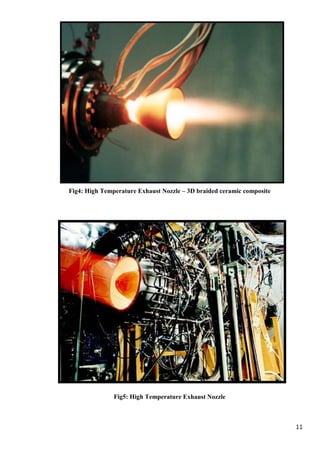
Fig4: High Temperature Exhaust Nozzle – 3D braided ceramic composite


               Fig5: High Temperature Exhaust Nozzle


                                                                       11
4.1 Space Shuttle tiles

          Space-debris ballistic shields – ceramic fiber woven shields offer better
protection to hypervelocity (~7 km/s) particles than aluminum shields of equal
weight.

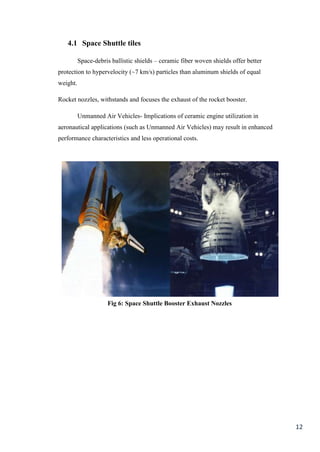
Rocket nozzles, withstands and focuses the exhaust of the rocket booster.

          Unmanned Air Vehicles- Implications of ceramic engine utilization in
aeronautical applications (such as Unmanned Air Vehicles) may result in enhanced
performance characteristics and less operational costs.


                     Fig 6: Space Shuttle Booster Exhaust Nozzles


                                                                                      12
4.2    Military

         There is an increasing need in the military sector for high-strength, robust
materials which have the capability to transmit light around the visible (0.4–0.7
micrometers) and mid-infrared (1–5 micrometers) regions of the spectrum. These
materials are needed for applications requiring transparent armor. Transparent armor
is a material or system of materials designed to be optically transparent, yet protect
from fragmentation or ballistic impacts. The primary requirement for a transparent
armor system is to not only defeat the designated threat but also provide a multi-hit
capability with minimized distortion of surrounding areas. Transparent armor
windows must also be compatible with night vision equipment. New materials that are
thinner, lightweight, and offer better ballistic performance are being sought. Such
solid-state components have found widespread use for various applications in the
electro-optical field including: optical fibers for guided lightwave transmission,
optical switches, laser amplifiers and lenses, hosts for solid-state lasers and optical
window materials for gas lasers, and infrared (IR) heat seeking devices for missile
guidance systems and IR night vision.

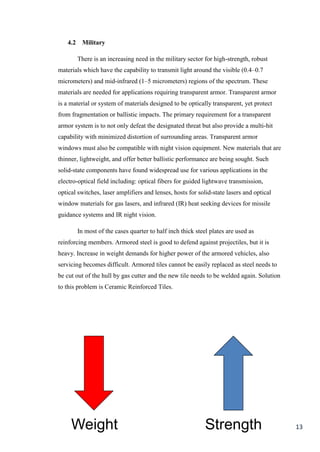
         In most of the cases quarter to half inch thick steel plates are used as
reinforcing members. Armored steel is good to defend against projectiles, but it is
heavy. Increase in weight demands for higher power of the armored vehicles, also
servicing becomes difficult. Armored tiles cannot be easily replaced as steel needs to
be cut out of the hull by gas cutter and the new tile needs to be welded again. Solution
to this problem is Ceramic Reinforced Tiles.


     Weight                                                  Strength                      13
Ceramic reduced weight and yet maintains or improves the strength of the tiles.

       Tiles are easily replaceable
       Better multishot capability
       Light in weight
       Withstand higher temperatures


                                                                                  14
5. Case Study: Ballistic Impact on Steel, Monolithic, Composite
                                Ceramic Tiles


5.1 Steel:-


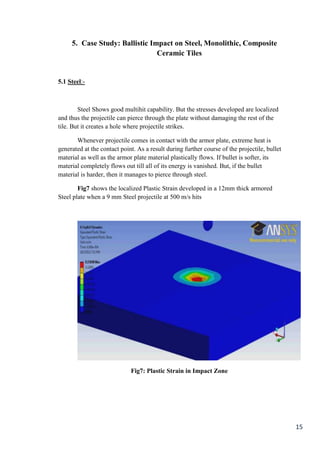
        Steel Shows good multihit capability. But the stresses developed are localized
and thus the projectile can pierce through the plate without damaging the rest of the
tile. But it creates a hole where projectile strikes.

       Whenever projectile comes in contact with the armor plate, extreme heat is
generated at the contact point. As a result during further course of the projectile, bullet
material as well as the armor plate material plastically flows. If bullet is softer, its
material completely flows out till all of its energy is vanished. But, if the bullet
material is harder, then it manages to pierce through steel.

        Fig7 shows the localized Plastic Strain developed in a 12mm thick armored
Steel plate when a 9 mm Steel projectile at 500 m/s hits


                             Fig7: Plastic Strain in Impact Zone


                                                                                              15
Weight is an important factor which limits the use of steel. If one were to use
steel for personal body armor, then it will not be any lighter than 8kg. Thus it
becomes necessary to search a material of similar or better properties.


5.2Monolithic Ceramic:-


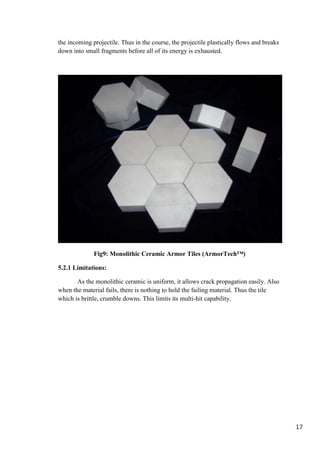
         Monolithic ceramics provide good impact resistance by its failure mechanism.
Ceramics are brittle in nature. Thus on impact ceramic fails at the point of impact.
The stress wave thus generated travels through the material as a compressive wave.
Ceramics typically are extra-ordinary in compressive strength. Thus all of the material
holds up the stress wave. But, when the stress wave reflects back from the boundaries,
it reflects back as a tensile wave. As the ceramic is very poor in tensile strength,
material fails.

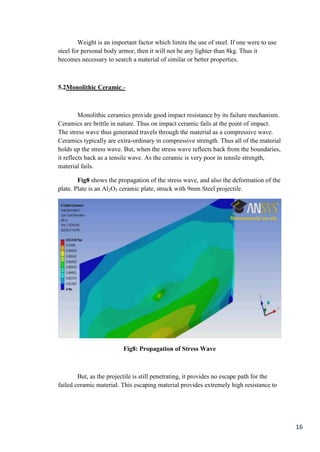
        Fig8 shows the propagation of the stress wave, and also the deformation of the
plate. Plate is an Al2O3 ceramic plate, struck with 9mm Steel projectile.


                          Fig8: Propagation of Stress Wave


        But, as the projectile is still penetrating, it provides no escape path for the
failed ceramic material. This escaping material provides extremely high resistance to


                                                                                          16
the incoming projectile. Thus in the course, the projectile plastically flows and breaks
down into small fragments before all of its energy is exhausted.


              Fig9: Monolithic Ceramic Armor Tiles (ArmorTech™)

5.2.1 Limitations:

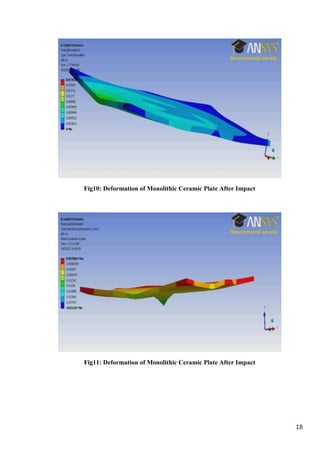
       As the monolithic ceramic is uniform, it allows crack propagation easily. Also
when the material fails, there is nothing to hold the failing material. Thus the tile
which is brittle, crumble downs. This limits its multi-hit capability.


                                                                                           17
Fig10: Deformation of Monolithic Ceramic Plate After Impact


Fig11: Deformation of Monolithic Ceramic Plate After Impact


                                                              18
5.3Ceramic Composites:-


       As previously mentioned, monolithic ceramic is good, but not good enough to
be used directly. Thus adding reinforcement greatly improves overall characteristics.

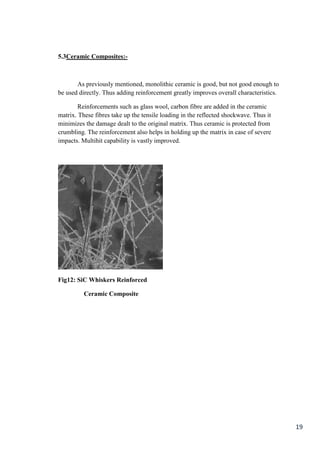
        Reinforcements such as glass wool, carbon fibre are added in the ceramic
matrix. These fibres take up the tensile loading in the reflected shockwave. Thus it
minimizes the damage dealt to the original matrix. Thus ceramic is protected from
crumbling. The reinforcement also helps in holding up the matrix in case of severe
impacts. Multihit capability is vastly improved.


Fig12: SiC Whiskers Reinforced

          Ceramic Composite


                                                                                        19
6 Conclusion:


      Thus wherever weight constraints hinder the use of thick steel plates,
      Ceramic composites provide the best solution.

      In defense applications ceramic composite tiles are popularly used in
      ballistic impact protection tiles and vests.

Ceramic composites are also popularly used in high temperature applications
such as rocket nozzles and reactors


                                                                               20
References:

www.google.com
www.en.wikipedia.org/ceramic
www.en.wikipedia.org/composites
University of Wisconsin, Open Courseware
University of Michigan at Ann Arbor, Open Courseware
“Introduction to Advanced 3D Reinforced Composites”: Fredrik
Stig, KTH, Stockholm
“Properties of 3D-woven Composites”: Fredrik Stig, KTH,
Stockholm
Advanced Ceramic Composites: US Department of Defense


                                                               21

Seminar Report on ceramic composites

  • 1.
    PVG’s COLLEGE OFENGINEERING & TECHNOLOGY PUNE – 411 009 CERTIFICATE This is to certify that the SEMINAR titled “Ceramic Composites: Case Study of Ballistic Impact” has been completed in the academic year 2012-13 by Deshpande Jaydeep Sanjeev Roll No. 22 (T.E. Mechanical) In partial fulfillment of the Bachelor Degree in MECHANICAL ENGINEERING As prescribed by the University Of Pune. Prof. P.G. Kulkarni Dr. Mrs. S. S. Sane (Guide) Head of the Dept. 1
  • 2.
    Contents 1. Introduction……………………………………………… 3 1.1 Constituents 2. History……………………………………………………. 5 3. Ceramic Processing……………………………………… 7 4. Applications……………………………………………… 10 4.1 Aerospace 4.2 Space Shuttle Tiles 4.3 Military 5. Case Study……………………………………………….. 15 5.1 Steel Plate 5.2 Monolithic Ceramic Tile 5.3 Composite Tile 6. Conclusion……………………………………………….. 20 2
  • 3.
    1. Introduction Composite materials, often shortened to composites or called composition materials, are engineered or naturally occurring materials made from two or more constituent materials with significantly different physical or chemical properties which remain separate and distinct within the finished structure. A common example of a composite would be disc brake pads, which consist of hard ceramic particles embedded in soft metal matrix. Another example is found in shower stalls and bathtubs which are made of 3iberglass. Imitation granite and cultured marble sinks and countertops are also widely used. The most advanced examples perform routinely on spacecraft in demanding environments. 1.1 Constituents 1.1.1 Matrices Common matrices include mud (wattle and daub), cement (concrete), polymers (fiber reinforced plastics), metals and ceramics. Road surfaces are often made from asphalt concrete which uses bitumen as a matrix. Unusual matrices such as ice are sometime proposed as in pykecrete. 1.0.1 Resins Typically, most common polymer-based composite materials, including fiberglass, carbon fiber, and Kevlar, include at least two parts, the substrate and the resin. 1.0.2 Reinforcements: Fibres Fiber-reinforced composite materials can be divided into two main categories normally referred to as short fiber-reinforced materials and continuous fiber- reinforced materials. Continuous reinforced materials will often constitute a layered or laminated structure. The woven and continuous fibre styles are typically available in a variety of forms, being pre-impregnated with the given matrix (resin), dry, uni- directional tapes of various widths, plain weave, harness satins, braided, and stitched. 3
  • 4.
    The short andlong fibers are typically employed in compression moulding and sheet moulding operations. These come in the form of flakes, chips, and random mate (which can also be made from a continuous fibre laid in random fashion until the desired thickness of the ply / laminate is achieved). Fig1: Examples of reinforcements (a) Continuous fibre (b) Discontinues fibre (c) Whisker 4
  • 5.
    2. History Fig2: Old Egyptian Buildings Showing Reinforcement The word “ceramic” is derived from the Greek word κεραμικός (keramikos) meaning pottery. It is related to the older Indo-European language root “to burn”, “Ceramic” may be used as a noun in the singular to refer to a ceramic material or the product of ceramic manufacture, or as an adjective. The plural “ceramics” may be used to refer the making of things out of ceramic materials. Ceramic engineering, like many sciences, evolved from a different discipline by today’s standards. Materials science engineering is grouped with ceramics engineering to this day. 5
  • 6.
    Yield Strength ofVarious Materials 600 500 Superalloy C/C Composite 400 Yield Strength (MPa) 300 Carbon Ste e l Zircaloy 200 Stainle ss Ste e l 100 Graphite 0 0.0 400.0 800.0 1200.0 1600.0 Temperature (°C) Fig3: Variation in Yield Strength w.r.t. Temperature 6
  • 7.
    3. Ceramic Processing Substantial interest has arisen in recent years in fabricating ceramic composites. While there is considerable interest in composites with one or more non-ceramic constituents, the greatest attention is on composites in which all constituents are ceramic. These typically comprise two ceramic constituents: a continuous matrix, and a dispersed phase of ceramic particles, whiskers, or short (chopped) or continuous ceramic fibers. The challenge, as in wet chemical processing, is to obtain a uniform or homogeneous distribution of the dispersed particle or fiber phase. Consider first the processing of particulate composites. The particulate phase of greatest interest is tetragonal zirconia because of the toughening that can be achieved from the phase transformation from the metastable tetragonal to the monoclinic crystalline phase, aka transformation toughening. There is also substantial interest in dispersion of hard, non-oxide phases such as SiC, TiB, TiC, boron, carbon and especially oxide matrices like alumina and mullite. There is also interest too incorporating other ceramic particulates, especially those of highly anisotropic thermal expansion. Examples include Al2O3, TiO2, graphite, and boron nitride. In processing particulate composites, the issue is not only homogeneity of the size and spatial distribution of the dispersed and matrix phases, but also control of the matrix grain size. However, there is some built-in self-control due to inhibition of matrix grain growth by the dispersed phase. Particulate composites, though generally offer increased resistance to damage, failure, or both, are still quite sensitive to inhomogeneities of composition as well as other processing defects such as pores. Thus they need good processing to be effective. Particulate composites have been made on a commercial basis by simply mixing powders of the two constituents. Although this approach is inherently limited in the 7
  • 8.
    homogeneity that canbe achieved, it is the most readily adaptable for existing ceramic production technology. However, other approaches are of interest. From the technological standpoint, a particularly desirable approach to fabricating particulate composites is to coat the matrix or its precursor onto fine particles of the dispersed phase with good control of the starting dispersed particle size and the resultant matrix coating thickness. One should in principle be able to achieve the ultimate in homogeneity of distribution and thereby optimize composite performance. This can also have other ramifications, such as allowing more useful composite performance to be achieved in a body having porosity, which might be desired for other factors, such as limiting thermal conductivity. There are also some opportunities to utilize melt processing for fabrication of ceramic, particulate, whisker and short-fiber, and continuous-fiber composites. Clearly, both particulate and whisker composites are conceivable by solid-state precipitation after solidification of the melt. This can also be obtained in some cases by sintering, as for precipitation-toughened, partially stabilized zirconia. Similarly, it is known that one can directionally solidify ceramic eutectic mixtures and hence obtain uniaxially aligned fiber composites. Such composite processing has typically been limited to very simple shapes and thus suffers from serious economic problems due to high machining costs. Clearly, there are possibilities of using melt casting for many of these approaches. Potentially even more desirable is using melt-derived particles. In this method, quenching is done in a solid solution or in a fine eutectic structure, in which the particles are then processed by more typical ceramic powder processing methods into a useful body. There have also been preliminary attempts to use melt spraying as a means of forming composites by introducing the dispersed particulate, whisker, or fiber phase in conjunction with the melt spraying process. 8
  • 9.
    Other methods besidesmelt infiltration to manufacture ceramic composites with long fiber reinforcement are chemical vapor infiltration and the infiltration of fiber preforms with organic precursor, which after pyrolysis yield an amorphous ceramic matrix, initially with a low density. With repeated cycles of infiltration and pyrolysis one of those types of ceramic matrix composites is produced. Chemical vapor infiltration is used to manufacture carbon/carbon and silicon carbide reinforced with carbon or silicon carbide fibers. Besides many process improvements, the first of two major needs for fiber composites is lower fiber costs. The second major need is fiber compositions or coatings, or composite processing, to reduce degradation that results from high- temperature composite exposure under oxidizing conditions. 9
  • 10.
    4. Applications The products of technical ceramics include tiles used in the Space Shuttle program, gas burner nozzles, ballistic protection, nuclear fuel uranium oxide pellets, bio-medical implants, jet engine turbine blades, and missile nose cones. Its products are often made from materials other than clay, chosen for their particular physical properties. These may be classified as follows: Oxides: silica, alumina, zirconia Non-oxides: carbides, borides, nitrides, silicides Composites: particulate or whisker reinforced matrices, combinations of oxides and non-oxides (e.g. polymers). Ceramics can be used in many technological industries. One application is the ceramic tiles on NASA’s Space Shuttle, used to protect it and the future supersonic space planes from the searing heat of reentry into the Earth’s atmosphere. They are also used widely in electronics and optics. In addition to the applications listed here, ceramics are also used as a coating in various engineering cases. An example would be a ceramic bearing coating over a titanium frame used for an airplane. Recently the field has come to include the studies of single crystals or glass fibers, in addition to traditional polycrystalline materials, and the applications of these have been overlapping and changing rapidly. 4.0 Aerospace Engines:shielding a hot running airplane engine from damaging other components. Airframes: Used as a high-stress, high-temp and lightweight bearing and structural component. Missile nose-cones:shielding the missile internals from heat. 10
  • 11.
    Fig4: High TemperatureExhaust Nozzle – 3D braided ceramic composite Fig5: High Temperature Exhaust Nozzle 11
  • 12.
    4.1 Space Shuttletiles Space-debris ballistic shields – ceramic fiber woven shields offer better protection to hypervelocity (~7 km/s) particles than aluminum shields of equal weight. Rocket nozzles, withstands and focuses the exhaust of the rocket booster. Unmanned Air Vehicles- Implications of ceramic engine utilization in aeronautical applications (such as Unmanned Air Vehicles) may result in enhanced performance characteristics and less operational costs. Fig 6: Space Shuttle Booster Exhaust Nozzles 12
  • 13.
    4.2 Military There is an increasing need in the military sector for high-strength, robust materials which have the capability to transmit light around the visible (0.4–0.7 micrometers) and mid-infrared (1–5 micrometers) regions of the spectrum. These materials are needed for applications requiring transparent armor. Transparent armor is a material or system of materials designed to be optically transparent, yet protect from fragmentation or ballistic impacts. The primary requirement for a transparent armor system is to not only defeat the designated threat but also provide a multi-hit capability with minimized distortion of surrounding areas. Transparent armor windows must also be compatible with night vision equipment. New materials that are thinner, lightweight, and offer better ballistic performance are being sought. Such solid-state components have found widespread use for various applications in the electro-optical field including: optical fibers for guided lightwave transmission, optical switches, laser amplifiers and lenses, hosts for solid-state lasers and optical window materials for gas lasers, and infrared (IR) heat seeking devices for missile guidance systems and IR night vision. In most of the cases quarter to half inch thick steel plates are used as reinforcing members. Armored steel is good to defend against projectiles, but it is heavy. Increase in weight demands for higher power of the armored vehicles, also servicing becomes difficult. Armored tiles cannot be easily replaced as steel needs to be cut out of the hull by gas cutter and the new tile needs to be welded again. Solution to this problem is Ceramic Reinforced Tiles. Weight Strength 13
  • 14.
    Ceramic reduced weightand yet maintains or improves the strength of the tiles. Tiles are easily replaceable Better multishot capability Light in weight Withstand higher temperatures 14
  • 15.
    5. Case Study:Ballistic Impact on Steel, Monolithic, Composite Ceramic Tiles 5.1 Steel:- Steel Shows good multihit capability. But the stresses developed are localized and thus the projectile can pierce through the plate without damaging the rest of the tile. But it creates a hole where projectile strikes. Whenever projectile comes in contact with the armor plate, extreme heat is generated at the contact point. As a result during further course of the projectile, bullet material as well as the armor plate material plastically flows. If bullet is softer, its material completely flows out till all of its energy is vanished. But, if the bullet material is harder, then it manages to pierce through steel. Fig7 shows the localized Plastic Strain developed in a 12mm thick armored Steel plate when a 9 mm Steel projectile at 500 m/s hits Fig7: Plastic Strain in Impact Zone 15
  • 16.
    Weight is animportant factor which limits the use of steel. If one were to use steel for personal body armor, then it will not be any lighter than 8kg. Thus it becomes necessary to search a material of similar or better properties. 5.2Monolithic Ceramic:- Monolithic ceramics provide good impact resistance by its failure mechanism. Ceramics are brittle in nature. Thus on impact ceramic fails at the point of impact. The stress wave thus generated travels through the material as a compressive wave. Ceramics typically are extra-ordinary in compressive strength. Thus all of the material holds up the stress wave. But, when the stress wave reflects back from the boundaries, it reflects back as a tensile wave. As the ceramic is very poor in tensile strength, material fails. Fig8 shows the propagation of the stress wave, and also the deformation of the plate. Plate is an Al2O3 ceramic plate, struck with 9mm Steel projectile. Fig8: Propagation of Stress Wave But, as the projectile is still penetrating, it provides no escape path for the failed ceramic material. This escaping material provides extremely high resistance to 16
  • 17.
    the incoming projectile.Thus in the course, the projectile plastically flows and breaks down into small fragments before all of its energy is exhausted. Fig9: Monolithic Ceramic Armor Tiles (ArmorTech™) 5.2.1 Limitations: As the monolithic ceramic is uniform, it allows crack propagation easily. Also when the material fails, there is nothing to hold the failing material. Thus the tile which is brittle, crumble downs. This limits its multi-hit capability. 17
  • 18.
    Fig10: Deformation ofMonolithic Ceramic Plate After Impact Fig11: Deformation of Monolithic Ceramic Plate After Impact 18
  • 19.
    5.3Ceramic Composites:- As previously mentioned, monolithic ceramic is good, but not good enough to be used directly. Thus adding reinforcement greatly improves overall characteristics. Reinforcements such as glass wool, carbon fibre are added in the ceramic matrix. These fibres take up the tensile loading in the reflected shockwave. Thus it minimizes the damage dealt to the original matrix. Thus ceramic is protected from crumbling. The reinforcement also helps in holding up the matrix in case of severe impacts. Multihit capability is vastly improved. Fig12: SiC Whiskers Reinforced Ceramic Composite 19
  • 20.
    6 Conclusion: Thus wherever weight constraints hinder the use of thick steel plates, Ceramic composites provide the best solution. In defense applications ceramic composite tiles are popularly used in ballistic impact protection tiles and vests. Ceramic composites are also popularly used in high temperature applications such as rocket nozzles and reactors 20
  • 21.
    References: www.google.com www.en.wikipedia.org/ceramic www.en.wikipedia.org/composites University of Wisconsin,Open Courseware University of Michigan at Ann Arbor, Open Courseware “Introduction to Advanced 3D Reinforced Composites”: Fredrik Stig, KTH, Stockholm “Properties of 3D-woven Composites”: Fredrik Stig, KTH, Stockholm Advanced Ceramic Composites: US Department of Defense 21