by
SHAIK JABBAR (1604-13-736-323 )
MOHAMMED FAHED (1604-13-736-318 )
SYED MUQSEEDUDDIN (1604-13-736-315 )
MOHAMMED SHAREEF (1604-13-736-317 )
Under the guidance
Of
Mr . M. A. Hakeemuddin Ahmed
Associate Professor (Mechanical Eng.. Dept.)
Objectives
 To fabricate Aluminium Metal Matrix Composite (Al SiC MMC).
 To characterize its mechanical properties such as tensile strength and
hardness.
 To obtain optimum machining parameters in order to get good
surface finish.
Introduction
Composites
 “A materials system composed of two or more physically distinct
phases whose combination produces aggregate properties that are
different from those of its constituents”.
Composite = Matrix + Reinforcement + Additives
Examples
 Cemented carbides (WC with Co binder)
 Plastic molding compounds containing fillers
 Rubber mixed with carbon black
 Wood (a natural composite as distinguished from a synthesized
composite)
Importance of composites
 Composites can be very strong and stiff, yet very light in weight, so
ratios of strength-to-weight and stiffness-to-weight are several times
greater than steel or aluminum.
 Fatigue properties are generally better than for common engineering
metals.
 Toughness is greater than other materials
 Composites can be designed to be corrosion resistive.
 It is possible to achieve combinations of properties not attainable
with metals, ceramics, or polymers alone.
Matrix
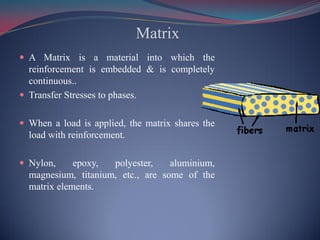
 A Matrix is a material into which the
reinforcement is embedded & is completely
continuous..
 Transfer Stresses to phases.
 When a load is applied, the matrix shares the
load with reinforcement.
 Nylon, epoxy, polyester, aluminium,
magnesium, titanium, etc., are some of the
matrix elements.
Reinforcement
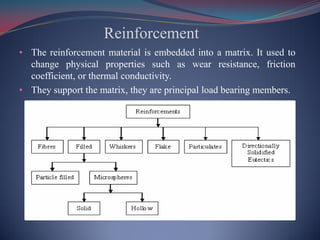
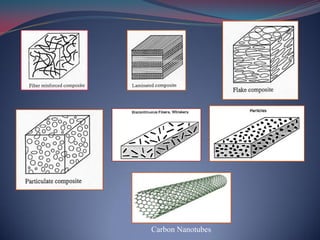
• The reinforcement material is embedded into a matrix. It used to
change physical properties such as wear resistance, friction
coefficient, or thermal conductivity.
• They support the matrix, they are principal load bearing members.
Carbon Nanotubes
Classification
 Natural Composites – composite materials that occur in nature or
have been produced by civilizations for many years
 Examples: wood, concrete, asphalt
 Synthetic composites - modern material systems normally
associated with the manufacturing industries, in which the
components are first produced separately and then combined in a
controlled way to achieve the desired structure, properties, and part
geometry.
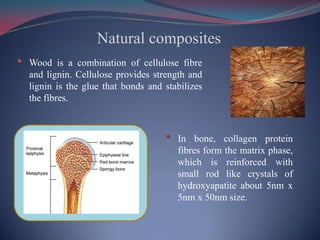
Natural composites
• Wood is a combination of cellulose fibre
and lignin. Cellulose provides strength and
lignin is the glue that bonds and stabilizes
the fibres.
• In bone, collagen protein
fibres form the matrix phase,
which is reinforced with
small rod like crystals of
hydroxyapatite about 5nm x
5nm x 50nm size.
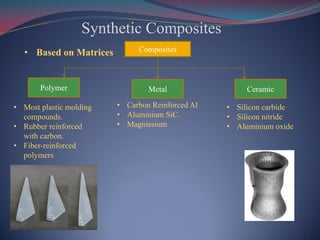
Synthetic Composites
• Based on Matrices Composites
Polymer Metal Ceramic
• Most plastic molding
compounds.
• Rubber reinforced
with carbon.
• Fiber-reinforced
polymers
• Carbon Reinforced Al
• Aluminium SiC.
• Magniesium
• Silicon carbide
• Silicon nitride
• Aluminium oxide
Metal Matrix Composite
Definition
 A metal matrix composite (MMC) is composite material with at least
two constituent parts, one being a metal necessarily, the other material
may be a different metal or another material, such as a ceramic or
organic compound.
 Examples: Aluminium SiC, Magnesium Graphite, Copper reinforced
with Boron.
Aluminium
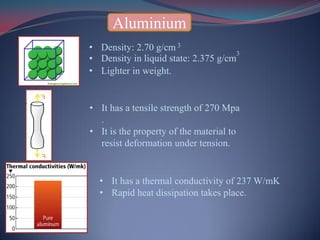
• Density: 2.70 g/cm 3
• Density in liquid state: 2.375 g/cm
3
• Lighter in weight.
• It has a tensile strength of 270 Mpa
.
• It is the property of the material to
resist deformation under tension.
• It has a thermal conductivity of 237 W/mK
• Rapid heat dissipation takes place.
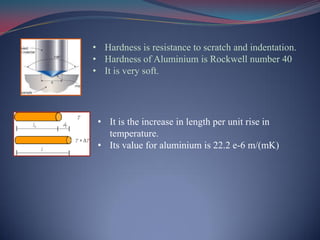
• Hardness is resistance to scratch and indentation.
• Hardness of Aluminium is Rockwell number 40
• It is very soft.
• It is the increase in length per unit rise in
temperature.
• Its value for aluminium is 22.2 e-6 m/(mK)
Silicon Carbide
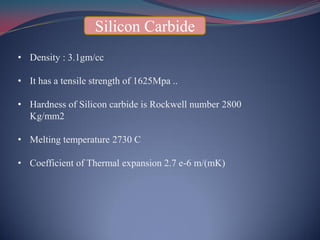
• Density : 3.1gm/cc
• It has a tensile strength of 1625Mpa ..
• Hardness of Silicon carbide is Rockwell number 2800
Kg/mm2
• Melting temperature 2730 C
• Coefficient of Thermal expansion 2.7 e-6 m/(mK)
Aluminium Silicon Carbide
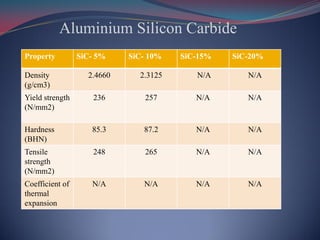
Property SiC- 5% SiC- 10% SiC-15% SiC-20%
Density
(g/cm3)
2.4660 2.3125 N/A N/A
Yield strength
(N/mm2)
236 257 N/A N/A
Hardness
(BHN)
85.3 87.2 N/A N/A
Tensile
strength
(N/mm2)
248 265 N/A N/A
Coefficient of
thermal
expansion
N/A N/A N/A N/A
Advantages Of Al MMC
 Higher specific strength and modulus over metals.
 Lower coefficients of thermal expansion.
 Maintenance of high strength properties at high temperatures.
 No moisture absorption.
 High thermal conductivity.
 Higher operating temperatures.
 Fatigue resistance.
Limitations
 Material cost is higher than the conventional metals.
 Higher manufacturing cost.
 Non visible impact damage.
 Repairs are different than those of conventional metals.
 Complex fabrication methods.
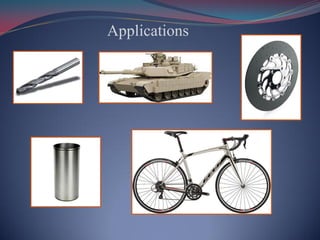
Applications
Fabrication of Aluminium MMC
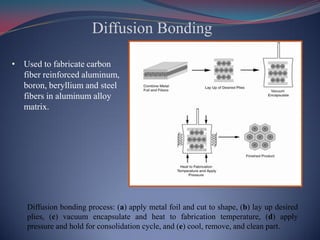
Diffusion Bonding
Diffusion bonding process: (a) apply metal foil and cut to shape, (b) lay up desired
plies, (c) vacuum encapsulate and heat to fabrication temperature, (d) apply
pressure and hold for consolidation cycle, and (e) cool, remove, and clean part.
• Used to fabricate carbon
fiber reinforced aluminum,
boron, beryllium and steel
fibers in aluminum alloy
matrix.
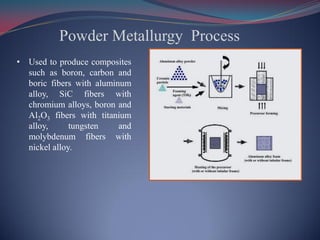
Powder Metallurgy Process
• Used to produce composites
such as boron, carbon and
boric fibers with aluminum
alloy, SiC fibers with
chromium alloys, boron and
Al2O3 fibers with titanium
alloy, tungsten and
molybdenum fibers with
nickel alloy.
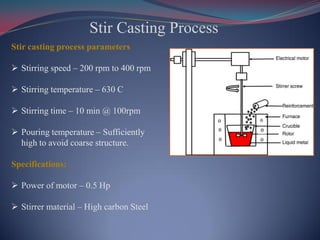
Stir Casting Process
Stir casting process parameters
 Stirring speed – 200 rpm to 400 rpm
 Stirring temperature – 630 C
 Stirring time – 10 min @ 100rpm
 Pouring temperature – Sufficiently
high to avoid coarse structure.
Specifications:
 Power of motor – 0.5 Hp
 Stirrer material – High carbon Steel
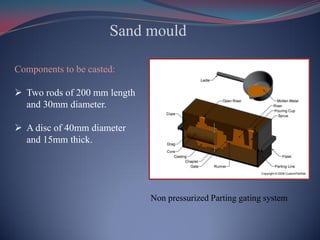
Sand mould
Components to be casted:
 Two rods of 200 mm length
and 30mm diameter.
 A disc of 40mm diameter
and 15mm thick.
Non pressurized Parting gating system
Characterization
Tensile Test
 A test in which fabricated Al MMC is subjected to a controlled
tension until failure.
 Properties that are directly measured via tensile test are
 Tensile strength
 Maximum elongation under tension.
 Reduction in cross section area.
 Young’s Modulus of elasticity
 Yield strength
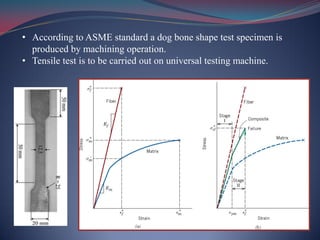
• According to ASME standard a dog bone shape test specimen is
produced by machining operation.
• Tensile test is to be carried out on universal testing machine.
Hardness Test
 Hardness is the property of a material that enables it to resist
indentation, scratching, bending, abrasion and cutting.
Hardness Test Methods:
• Rockwell Hardness Test
• Rockwell Superficial Hardness Test
• Brinell Hardness Test
• Vickers Hardness Test
• Micro hardness Test
• Moh's Hardness Test
• Scleroscope and other hardness test
methods
Rockwell hardness test
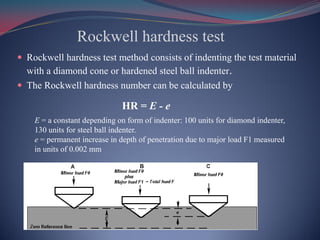
 Rockwell hardness test method consists of indenting the test material
with a diamond cone or hardened steel ball indenter.
 The Rockwell hardness number can be calculated by
HR = E - e
E = a constant depending on form of indenter: 100 units for diamond indenter,
130 units for steel ball indenter.
e = permanent increase in depth of penetration due to major load F1 measured
in units of 0.002 mm
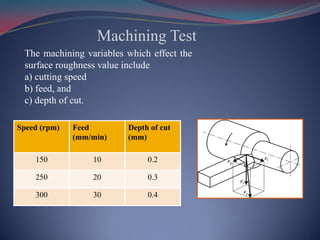
Machining Test
Speed (rpm) Feed
(mm/min)
Depth of cut
(mm)
150 10 0.2
250 20 0.3
300 30 0.4
The machining variables which effect the
surface roughness value include
a) cutting speed
b) feed, and
c) depth of cut.
Literature Review
 Pradeep R et.al observed the study of mechanical properties of Al- Red
Mud and Silicon Carbide Metal Matrix Composite (MMC) of Aluminum
alloy of grade 7075 with addition of varying SiC weight percentage such as
6%, 4%, 2%. The experimental result reveals that the combination of a
matrix material improves mechanical properties like tensile strength,
compressive strength, hardness and yield strength.
 H. Izadi et.al investigated through FSP and has observed improvement in
the micro hardness of Al–SiC composites produced by traditional powder
metallurgy and sintering methods. The material flow in the stir zone during
FSP was successful in uniformly distributing the SiC particles. However,
when samples with 16% SiC (by volume) were processed, there were
residual pores and lack of consolidation. An increase in hardness of all
samples was observed after friction stir processing which was attributed to
the improvement in particle distribution and elimination of porosity.
Thank You

Aluminum si c mmc

  • 1.
    by SHAIK JABBAR (1604-13-736-323) MOHAMMED FAHED (1604-13-736-318 ) SYED MUQSEEDUDDIN (1604-13-736-315 ) MOHAMMED SHAREEF (1604-13-736-317 ) Under the guidance Of Mr . M. A. Hakeemuddin Ahmed Associate Professor (Mechanical Eng.. Dept.)
  • 2.
    Objectives  To fabricateAluminium Metal Matrix Composite (Al SiC MMC).  To characterize its mechanical properties such as tensile strength and hardness.  To obtain optimum machining parameters in order to get good surface finish.
  • 3.
  • 4.
    Composites  “A materialssystem composed of two or more physically distinct phases whose combination produces aggregate properties that are different from those of its constituents”. Composite = Matrix + Reinforcement + Additives Examples  Cemented carbides (WC with Co binder)  Plastic molding compounds containing fillers  Rubber mixed with carbon black  Wood (a natural composite as distinguished from a synthesized composite)
  • 5.
    Importance of composites Composites can be very strong and stiff, yet very light in weight, so ratios of strength-to-weight and stiffness-to-weight are several times greater than steel or aluminum.  Fatigue properties are generally better than for common engineering metals.  Toughness is greater than other materials  Composites can be designed to be corrosion resistive.  It is possible to achieve combinations of properties not attainable with metals, ceramics, or polymers alone.
  • 6.
    Matrix  A Matrixis a material into which the reinforcement is embedded & is completely continuous..  Transfer Stresses to phases.  When a load is applied, the matrix shares the load with reinforcement.  Nylon, epoxy, polyester, aluminium, magnesium, titanium, etc., are some of the matrix elements.
  • 7.
    Reinforcement • The reinforcementmaterial is embedded into a matrix. It used to change physical properties such as wear resistance, friction coefficient, or thermal conductivity. • They support the matrix, they are principal load bearing members.
  • 8.
  • 9.
    Classification  Natural Composites– composite materials that occur in nature or have been produced by civilizations for many years  Examples: wood, concrete, asphalt  Synthetic composites - modern material systems normally associated with the manufacturing industries, in which the components are first produced separately and then combined in a controlled way to achieve the desired structure, properties, and part geometry.
  • 10.
    Natural composites • Woodis a combination of cellulose fibre and lignin. Cellulose provides strength and lignin is the glue that bonds and stabilizes the fibres. • In bone, collagen protein fibres form the matrix phase, which is reinforced with small rod like crystals of hydroxyapatite about 5nm x 5nm x 50nm size.
  • 11.
    Synthetic Composites • Basedon Matrices Composites Polymer Metal Ceramic • Most plastic molding compounds. • Rubber reinforced with carbon. • Fiber-reinforced polymers • Carbon Reinforced Al • Aluminium SiC. • Magniesium • Silicon carbide • Silicon nitride • Aluminium oxide
  • 12.
  • 13.
    Definition  A metalmatrix composite (MMC) is composite material with at least two constituent parts, one being a metal necessarily, the other material may be a different metal or another material, such as a ceramic or organic compound.  Examples: Aluminium SiC, Magnesium Graphite, Copper reinforced with Boron.
  • 14.
    Aluminium • Density: 2.70g/cm 3 • Density in liquid state: 2.375 g/cm 3 • Lighter in weight. • It has a tensile strength of 270 Mpa . • It is the property of the material to resist deformation under tension. • It has a thermal conductivity of 237 W/mK • Rapid heat dissipation takes place.
  • 15.
    • Hardness isresistance to scratch and indentation. • Hardness of Aluminium is Rockwell number 40 • It is very soft. • It is the increase in length per unit rise in temperature. • Its value for aluminium is 22.2 e-6 m/(mK)
  • 16.
    Silicon Carbide • Density: 3.1gm/cc • It has a tensile strength of 1625Mpa .. • Hardness of Silicon carbide is Rockwell number 2800 Kg/mm2 • Melting temperature 2730 C • Coefficient of Thermal expansion 2.7 e-6 m/(mK)
  • 17.
    Aluminium Silicon Carbide PropertySiC- 5% SiC- 10% SiC-15% SiC-20% Density (g/cm3) 2.4660 2.3125 N/A N/A Yield strength (N/mm2) 236 257 N/A N/A Hardness (BHN) 85.3 87.2 N/A N/A Tensile strength (N/mm2) 248 265 N/A N/A Coefficient of thermal expansion N/A N/A N/A N/A
  • 18.
    Advantages Of AlMMC  Higher specific strength and modulus over metals.  Lower coefficients of thermal expansion.  Maintenance of high strength properties at high temperatures.  No moisture absorption.  High thermal conductivity.  Higher operating temperatures.  Fatigue resistance.
  • 19.
    Limitations  Material costis higher than the conventional metals.  Higher manufacturing cost.  Non visible impact damage.  Repairs are different than those of conventional metals.  Complex fabrication methods.
  • 20.
  • 21.
  • 22.
    Diffusion Bonding Diffusion bondingprocess: (a) apply metal foil and cut to shape, (b) lay up desired plies, (c) vacuum encapsulate and heat to fabrication temperature, (d) apply pressure and hold for consolidation cycle, and (e) cool, remove, and clean part. • Used to fabricate carbon fiber reinforced aluminum, boron, beryllium and steel fibers in aluminum alloy matrix.
  • 23.
    Powder Metallurgy Process •Used to produce composites such as boron, carbon and boric fibers with aluminum alloy, SiC fibers with chromium alloys, boron and Al2O3 fibers with titanium alloy, tungsten and molybdenum fibers with nickel alloy.
  • 24.
    Stir Casting Process Stircasting process parameters  Stirring speed – 200 rpm to 400 rpm  Stirring temperature – 630 C  Stirring time – 10 min @ 100rpm  Pouring temperature – Sufficiently high to avoid coarse structure. Specifications:  Power of motor – 0.5 Hp  Stirrer material – High carbon Steel
  • 25.
    Sand mould Components tobe casted:  Two rods of 200 mm length and 30mm diameter.  A disc of 40mm diameter and 15mm thick. Non pressurized Parting gating system
  • 26.
  • 27.
    Tensile Test  Atest in which fabricated Al MMC is subjected to a controlled tension until failure.  Properties that are directly measured via tensile test are  Tensile strength  Maximum elongation under tension.  Reduction in cross section area.  Young’s Modulus of elasticity  Yield strength
  • 28.
    • According toASME standard a dog bone shape test specimen is produced by machining operation. • Tensile test is to be carried out on universal testing machine.
  • 29.
    Hardness Test  Hardnessis the property of a material that enables it to resist indentation, scratching, bending, abrasion and cutting. Hardness Test Methods: • Rockwell Hardness Test • Rockwell Superficial Hardness Test • Brinell Hardness Test • Vickers Hardness Test • Micro hardness Test • Moh's Hardness Test • Scleroscope and other hardness test methods
  • 30.
    Rockwell hardness test Rockwell hardness test method consists of indenting the test material with a diamond cone or hardened steel ball indenter.  The Rockwell hardness number can be calculated by HR = E - e E = a constant depending on form of indenter: 100 units for diamond indenter, 130 units for steel ball indenter. e = permanent increase in depth of penetration due to major load F1 measured in units of 0.002 mm
  • 31.
    Machining Test Speed (rpm)Feed (mm/min) Depth of cut (mm) 150 10 0.2 250 20 0.3 300 30 0.4 The machining variables which effect the surface roughness value include a) cutting speed b) feed, and c) depth of cut.
  • 32.
    Literature Review  PradeepR et.al observed the study of mechanical properties of Al- Red Mud and Silicon Carbide Metal Matrix Composite (MMC) of Aluminum alloy of grade 7075 with addition of varying SiC weight percentage such as 6%, 4%, 2%. The experimental result reveals that the combination of a matrix material improves mechanical properties like tensile strength, compressive strength, hardness and yield strength.  H. Izadi et.al investigated through FSP and has observed improvement in the micro hardness of Al–SiC composites produced by traditional powder metallurgy and sintering methods. The material flow in the stir zone during FSP was successful in uniformly distributing the SiC particles. However, when samples with 16% SiC (by volume) were processed, there were residual pores and lack of consolidation. An increase in hardness of all samples was observed after friction stir processing which was attributed to the improvement in particle distribution and elimination of porosity.
  • 33.