Lap lace Equation


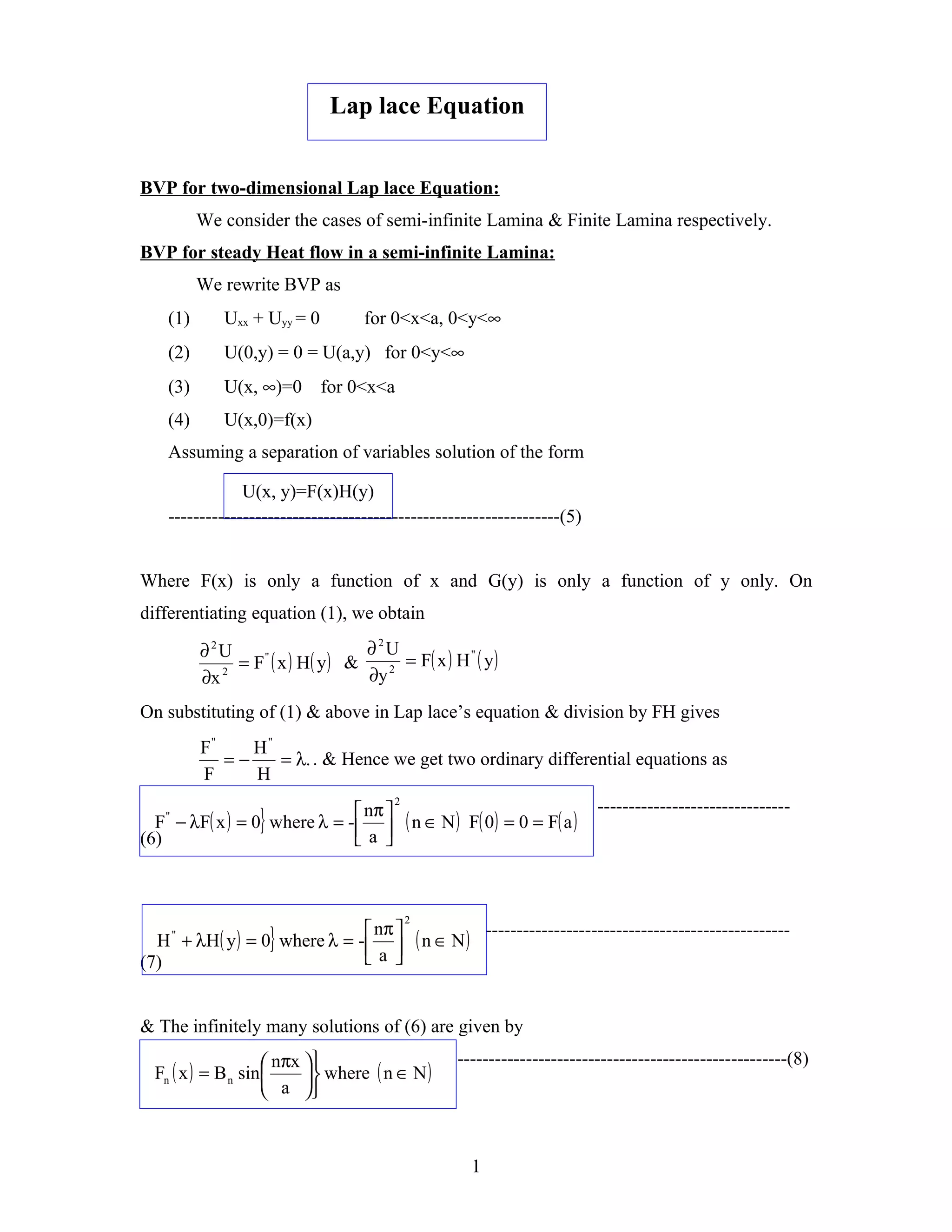
BVP for two-dimensional Lap lace Equation:
           We consider the cases of semi-infinite Lamina & Finite Lamina respectively.
BVP for steady Heat flow in a semi-infinite Lamina:
           We rewrite BVP as
    (1)       Uxx + Uyy = 0         for 0<x<a, 0<y<∞
    (2)       U(0,y) = 0 = U(a,y) for 0<y<∞
    (3)       U(x, ∞)=0       for 0<x<a
    (4)       U(x,0)=f(x)
    Assuming a separation of variables solution of the form

                U(x, y)=F(x)H(y)
    ---------------------------------------------------------------(5)


Where F(x) is only a function of x and G(y) is only a function of y only. On
differentiating equation (1), we obtain

           ∂2U                     ∂2U
                = F ( x ) H( y ) &
                   "
                                        = F( x ) H " ( y )
           ∂x 2
                                   ∂y 2


On substituting of (1) & above in Lap lace’s equation & division by FH gives
           F"    H"
              =−    = λ. . & Hence we get two ordinary differential equations as
           F     H
                                         2
                               nπ                                               -------------------------------
  F − λF( x ) = 0} where λ = - 
   "
                                             ( n ∈ N ) F( 0) = 0 = F( a )
(6)                           a 


                                             2
                               nπ 
  H + λH( y ) = 0} where λ = - 
                                                                -------------------------------------------------
       "
                                                 ( n ∈ N)
(7)                           a 


& The infinitely many solutions of (6) are given by
                      nπx                           -----------------------------------------------------(8)
  Fn ( x ) = B n sin       where ( n ∈ N )
                      a 


                                                            1
       nπy 
                                                                                 
                                                                              nπy 
                                                                            −
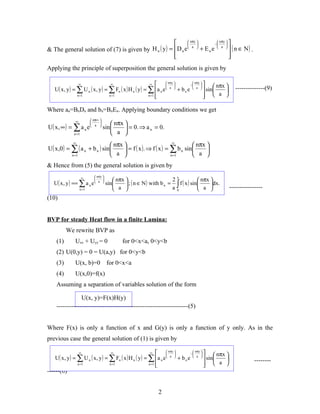
& The general solution of (7) is given by H n ( y ) = D n e  a 
                                                                     + E n e  a   ( n ∈ N) .
                                                      
                                                                                    
                                                                                     
Applying the principle of superposition the general solution is given by

                                                         ∞       nπy 
                                                                                     
                                                                                nπy 
                 ∞                ∞                                         −
                                                                                            nπx 
   U( x , y ) = ∑ U n ( x, y ) = ∑ Fn ( x ) H n ( y ) = ∑ a n e  a  + b n e  a   sin            --------------(9)
                n =1             n =1                   n =1 
                                                                                        a 
                                                                                       

Where an=BnDn and bn=BnEn. Applying boundary conditions we get
                          nπ∞ 
              ∞               
                                        nπx 
U( x, ∞ ) = ∑ a n e       a 
                                   sin       = 0. ⇒ a n = 0.
             n =1                       a 
             ∞
                                 nπx                          ∞
                                                                          nπx 
U( x ,0 ) = ∑ ( a n + b n ) sin       = f ( x ). ⇒ f ( x ) = ∑ b n sin      
            n =1                 a                           n =1       a 
& Hence from (5) the general solution is given by
                            nπy                                        a
                    ∞           
                                          nπx                        2               nπx 
   U( x , y ) == ∑ a n e    a 
                                     sin       ; ( n ∈ N ) with b n = ∫ f ( x ) sin      dx.
                  n =1                    a                          a0              a           ----------------
(10)


BVP for steady Heat flow in a finite Lamina:
          We rewrite BVP as
    (1)       Uxx + Uyy = 0                  for 0<x<a, 0<y<b
    (2) U(0,y) = 0 = U(a,y) for 0<y<b
    (3)       U(x, b)=0              for 0<x<a
    (4)       U(x,0)=f(x)
    Assuming a separation of variables solution of the form

                U(x, y)=F(x)H(y)
    ---------------------------------------------------------------(5)


Where F(x) is only a function of x and G(y) is only a function of y only. As in the
previous case the general solution of (1) is given by

                  ∞                    ∞                    ∞  nπy 
                                                                            −     
                                                                                nπy 
                                                                                            nπx 
   U( x , y ) = ∑ U n ( x, y ) = ∑ Fn ( x ) H n ( y ) = ∑ a n e  a 
                                                                       + b n e  a   sin                     --------
                n =1             n =1                   n =1 
                                                                                        a 
                                                                                       
------(6)


                                                                2
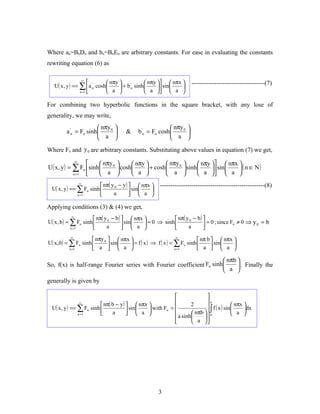
Where an=BnDn and bn=BnEn are arbitrary constants. For ease in evaluating the constants
rewriting equation (6) as

                  ∞
                             nπy              nπy   nπx         -----------------------------------(7)
   U( x , y ) == ∑ a 'n cosh      + b n sinh 
                                         '
                                                       sin  
                 n =1        a                a   a 

For combining two hyperbolic functions in the square bracket, with any lose of
generality, we may write,
                         nπy 0                             nπy 0 
         a 'n = Fn sinh             &      b 'n = Fn cosh        
                         a                                 a 

Where Fn and y 0 are arbitrary constants. Substituting above values in equation (7) we get,
            ∞
                        nπy 0       nπy         nπy 0        nπy          
                                                                                 nπx 
U( x , y ) = ∑ Fn sinh         cosh      + cosh        sinh       sin       ( n ∈ N)
            n =1           a            a              a             a          a 
                ∞
                          nπ( y 0 − y )   nπx       --------------------------------------------------(8)
 U( x , y ) == ∑ Fn sinh                 sin  a 
               n =1            a                

Applying conditions (3) & (4) we get,
              ∞
                        nπ( y 0 − b )   nπx                nπ( y 0 − b ) 
U ( x, b ) = ∑ Fn sinh                 sin  a  = 0 ⇒ sinh                 = 0 ; since Fn ≠ 0 ⇒ y 0 = b
             n =1            a                                  a        
            ∞
                      nπy 0   nπx                         ∞
                                                                        nπ b   nπx 
U ( x,0) = ∑ Fn sinh         sin   = f ( x ) ⇒ f ( x ) = ∑ Fn sinh        sin  
           n =1       a   a                              n =1       a   a 

                                                                        nπb 
So, f(x) is half-range Fourier series with Fourier coefficient Fn sinh       . Finally the
                                                                        a 
generally is given by

                                                                             
                                                                             a
                   ∞
                          nπ( b − y )   nπx                      2         ∫ f ( x ) sin  nπx dx
 U( x , y ) == ∑ Fn sinh                                    
                                        sin  a  with Fn =                                      
               n =1           a                                    nπb   0              a 
                                                              a sinh  a  
                                                                          


                                                       3
Examples
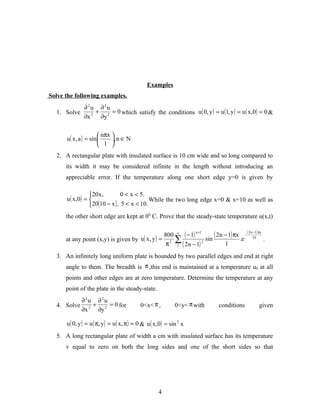
Solve the following examples.
               ∂2u ∂2u
  1. Solve         +     = 0 which satisfy the conditions u ( 0, y ) = u ( l, y ) = u ( x ,0) = 0 &
               ∂x 2 ∂y 2

                         nπx 
      u ( x , a ) = sin      , n ∈ N
                         l 
  2. A rectangular plate with insulated surface is 10 cm wide and so long compared to
      its width it may be considered infinite in the length without introducing an
      appreciable error. If the temperature along one short edge y=0 is given by

                  20 x ,        0 < x < 5.
      u ( x ,0) =                           While the two long edge x=0 & x=10 as well as
                  20(10 − x ) , 5 < x < 10.
      the other short edge are kept at 00 C. Prove that the steady-state temperature u(x,t)

                                                  800 ∞ ( − 1)         ( 2n − 1) πx .e −
                                                                       n +1                ( 2 n −1) πy
      at any point (x,y) is given by u ( x , y ) = 2 ∑             sin                         10
                                                                                                          .
                                                   π 1 ( 2n − 1) 2           l
  3. An infinitely long uniform plate is bounded by two parallel edges and end at right
      angle to them. The breadth is π ,this end is maintained at a temperature u0 at all
      points and other edges are at zero temperature. Determine the temperature at any
      point of the plate in the steady-state.
             ∂2u ∂2u
  4. Solve       +     = 0 for               0<x< π ,          0<y< π with    conditions             given
             ∂x 2 ∂y 2

      u ( 0, y ) = u ( π, y ) = u ( x, π ) = 0 & u ( x ,0) = sin 2 x
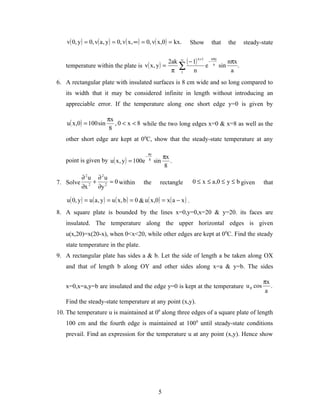
  5. A long rectangular plate of width a cm with insulated surface has its temperature
      v equal to zero on both the long sides and one of the short sides so that


                                                      4
v( 0, y ) = 0, v( a , y ) = 0, v( x , ∞ ) = 0, v( x,0 ) = kx.            Show             that        the     steady-state


                                                2ak ∞ ( − 1)
                                                                               n +1           nπy
                                                                                          −               nπx
   temperature within the plate is v( x , y ) =    ∑ n                                e        a
                                                                                                    sin       .
                                                 π 1                                                       a
6. A rectangular plate with insulated surfaces is 8 cm wide and so long compared to
   its width that it may be considered infinite in length without introducing an
   appreciable error. If the temperature along one short edge y=0 is given by

                          πx
    u ( x ,0) = 100 sin      , 0 < x < 8 while the two long edges x=0 & x=8 as well as the
                           8
   other short edge are kept at 00C, show that the steady-state temperature at any

                                                    πy
                                                −              πx
   point is given by u ( x , y ) = 100e             8
                                                         sin      .
                                                                8
        ∂2u ∂2u
7. Solve 2 + 2 = 0 within                      the         rectangle         0 ≤ x ≤ a ,0 ≤ y ≤ b given                   that
        ∂x  ∂y

    u ( 0, y ) = u ( a , y ) = u ( x , b ) = 0 & u ( x ,0) = x ( a − x ) .
8. A square plate is bounded by the lines x=0,y=0,x=20 & y=20. its faces are
   insulated. The temperature along the upper horizontal edges is given
   u(x,20)=x(20-x), when 0<x<20, while other edges are kept at 0 0C. Find the steady
   state temperature in the plate.
9. A rectangular plate has sides a & b. Let the side of length a be taken along OX
   and that of length b along OY and other sides along x=a & y=b. The sides

                                                                                                                          πx
   x=0,x=a,y=b are insulated and the edge y=0 is kept at the temperature u 0 cos                                             .
                                                                                                                           a
   Find the steady-state temperature at any point (x,y).
10. The temperature u is maintained at 00 along three edges of a square plate of length
   100 cm and the fourth edge is maintained at 100 0 until steady-state conditions
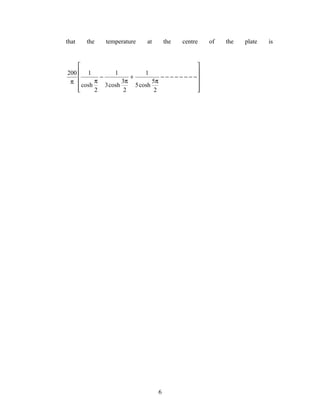
   prevail. Find an expression for the temperature u at any point (x,y). Hence show


                                                          5
that   the     temperature      at       the   centre   of   the   plate   is


                                                   
200  1            1           1                    
            −           +           − − − − − − − −
 π        π          3π          5π                
      cosh     3 cosh      5 cosh
    
          2           2           2                
                                                    


                                     6

Lap lace

  • 1.
    Lap lace Equation BVPfor two-dimensional Lap lace Equation: We consider the cases of semi-infinite Lamina & Finite Lamina respectively. BVP for steady Heat flow in a semi-infinite Lamina: We rewrite BVP as (1) Uxx + Uyy = 0 for 0<x<a, 0<y<∞ (2) U(0,y) = 0 = U(a,y) for 0<y<∞ (3) U(x, ∞)=0 for 0<x<a (4) U(x,0)=f(x) Assuming a separation of variables solution of the form U(x, y)=F(x)H(y) ---------------------------------------------------------------(5) Where F(x) is only a function of x and G(y) is only a function of y only. On differentiating equation (1), we obtain ∂2U ∂2U = F ( x ) H( y ) & " = F( x ) H " ( y ) ∂x 2 ∂y 2 On substituting of (1) & above in Lap lace’s equation & division by FH gives F" H" =− = λ. . & Hence we get two ordinary differential equations as F H 2  nπ  ------------------------------- F − λF( x ) = 0} where λ = -  " ( n ∈ N ) F( 0) = 0 = F( a ) (6) a  2  nπ  H + λH( y ) = 0} where λ = -  ------------------------------------------------- " ( n ∈ N) (7) a  & The infinitely many solutions of (6) are given by  nπx  -----------------------------------------------------(8) Fn ( x ) = B n sin   where ( n ∈ N )  a  1
  • 2.
     nπy      nπy  − & The general solution of (7) is given by H n ( y ) = D n e  a  + E n e  a   ( n ∈ N) .     Applying the principle of superposition the general solution is given by ∞   nπy    nπy  ∞ ∞   −  nπx  U( x , y ) = ∑ U n ( x, y ) = ∑ Fn ( x ) H n ( y ) = ∑ a n e  a  + b n e  a   sin   --------------(9) n =1 n =1 n =1     a   Where an=BnDn and bn=BnEn. Applying boundary conditions we get  nπ∞  ∞    nπx  U( x, ∞ ) = ∑ a n e  a  sin   = 0. ⇒ a n = 0. n =1  a  ∞  nπx  ∞  nπx  U( x ,0 ) = ∑ ( a n + b n ) sin   = f ( x ). ⇒ f ( x ) = ∑ b n sin   n =1  a  n =1  a  & Hence from (5) the general solution is given by  nπy  a ∞    nπx  2  nπx  U( x , y ) == ∑ a n e  a  sin   ; ( n ∈ N ) with b n = ∫ f ( x ) sin  dx. n =1  a  a0  a  ---------------- (10) BVP for steady Heat flow in a finite Lamina: We rewrite BVP as (1) Uxx + Uyy = 0 for 0<x<a, 0<y<b (2) U(0,y) = 0 = U(a,y) for 0<y<b (3) U(x, b)=0 for 0<x<a (4) U(x,0)=f(x) Assuming a separation of variables solution of the form U(x, y)=F(x)H(y) ---------------------------------------------------------------(5) Where F(x) is only a function of x and G(y) is only a function of y only. As in the previous case the general solution of (1) is given by ∞ ∞ ∞  nπy    −   nπy   nπx  U( x , y ) = ∑ U n ( x, y ) = ∑ Fn ( x ) H n ( y ) = ∑ a n e  a  + b n e  a   sin   -------- n =1 n =1 n =1     a   ------(6) 2
  • 3.
    Where an=BnDn andbn=BnEn are arbitrary constants. For ease in evaluating the constants rewriting equation (6) as ∞   nπy   nπy   nπx  -----------------------------------(7) U( x , y ) == ∑ a 'n cosh  + b n sinh  '  sin   n =1   a   a   a  For combining two hyperbolic functions in the square bracket, with any lose of generality, we may write,  nπy 0   nπy 0  a 'n = Fn sinh   & b 'n = Fn cosh    a   a  Where Fn and y 0 are arbitrary constants. Substituting above values in equation (7) we get, ∞  nπy 0   nπy   nπy 0   nπy    nπx  U( x , y ) = ∑ Fn sinh   cosh  + cosh  sinh   sin   ( n ∈ N) n =1   a   a   a   a   a  ∞  nπ( y 0 − y )   nπx  --------------------------------------------------(8) U( x , y ) == ∑ Fn sinh   sin  a  n =1  a    Applying conditions (3) & (4) we get, ∞  nπ( y 0 − b )   nπx   nπ( y 0 − b )  U ( x, b ) = ∑ Fn sinh   sin  a  = 0 ⇒ sinh   = 0 ; since Fn ≠ 0 ⇒ y 0 = b n =1  a     a  ∞  nπy 0   nπx  ∞  nπ b   nπx  U ( x,0) = ∑ Fn sinh   sin   = f ( x ) ⇒ f ( x ) = ∑ Fn sinh   sin   n =1  a   a  n =1  a   a   nπb  So, f(x) is half-range Fourier series with Fourier coefficient Fn sinh   . Finally the  a  generally is given by    a ∞  nπ( b − y )   nπx  2  ∫ f ( x ) sin  nπx dx U( x , y ) == ∑ Fn sinh    sin  a  with Fn =    n =1  a     nπb   0  a   a sinh  a      3
  • 4.
    Examples Solve the followingexamples. ∂2u ∂2u 1. Solve + = 0 which satisfy the conditions u ( 0, y ) = u ( l, y ) = u ( x ,0) = 0 & ∂x 2 ∂y 2  nπx  u ( x , a ) = sin  , n ∈ N  l  2. A rectangular plate with insulated surface is 10 cm wide and so long compared to its width it may be considered infinite in the length without introducing an appreciable error. If the temperature along one short edge y=0 is given by 20 x , 0 < x < 5. u ( x ,0) =  While the two long edge x=0 & x=10 as well as 20(10 − x ) , 5 < x < 10. the other short edge are kept at 00 C. Prove that the steady-state temperature u(x,t) 800 ∞ ( − 1) ( 2n − 1) πx .e − n +1 ( 2 n −1) πy at any point (x,y) is given by u ( x , y ) = 2 ∑ sin 10 . π 1 ( 2n − 1) 2 l 3. An infinitely long uniform plate is bounded by two parallel edges and end at right angle to them. The breadth is π ,this end is maintained at a temperature u0 at all points and other edges are at zero temperature. Determine the temperature at any point of the plate in the steady-state. ∂2u ∂2u 4. Solve + = 0 for 0<x< π , 0<y< π with conditions given ∂x 2 ∂y 2 u ( 0, y ) = u ( π, y ) = u ( x, π ) = 0 & u ( x ,0) = sin 2 x 5. A long rectangular plate of width a cm with insulated surface has its temperature v equal to zero on both the long sides and one of the short sides so that 4
  • 5.
    v( 0, y) = 0, v( a , y ) = 0, v( x , ∞ ) = 0, v( x,0 ) = kx. Show that the steady-state 2ak ∞ ( − 1) n +1 nπy − nπx temperature within the plate is v( x , y ) = ∑ n e a sin . π 1 a 6. A rectangular plate with insulated surfaces is 8 cm wide and so long compared to its width that it may be considered infinite in length without introducing an appreciable error. If the temperature along one short edge y=0 is given by πx u ( x ,0) = 100 sin , 0 < x < 8 while the two long edges x=0 & x=8 as well as the 8 other short edge are kept at 00C, show that the steady-state temperature at any πy − πx point is given by u ( x , y ) = 100e 8 sin . 8 ∂2u ∂2u 7. Solve 2 + 2 = 0 within the rectangle 0 ≤ x ≤ a ,0 ≤ y ≤ b given that ∂x ∂y u ( 0, y ) = u ( a , y ) = u ( x , b ) = 0 & u ( x ,0) = x ( a − x ) . 8. A square plate is bounded by the lines x=0,y=0,x=20 & y=20. its faces are insulated. The temperature along the upper horizontal edges is given u(x,20)=x(20-x), when 0<x<20, while other edges are kept at 0 0C. Find the steady state temperature in the plate. 9. A rectangular plate has sides a & b. Let the side of length a be taken along OX and that of length b along OY and other sides along x=a & y=b. The sides πx x=0,x=a,y=b are insulated and the edge y=0 is kept at the temperature u 0 cos . a Find the steady-state temperature at any point (x,y). 10. The temperature u is maintained at 00 along three edges of a square plate of length 100 cm and the fourth edge is maintained at 100 0 until steady-state conditions prevail. Find an expression for the temperature u at any point (x,y). Hence show 5
  • 6.
    that the temperature at the centre of the plate is   200  1 1 1   − + − − − − − − − − π  π 3π 5π  cosh 3 cosh 5 cosh   2 2 2   6