MATERIAL TECHNOLOGY 
NEWLY DEVELOPED ENGINEERING MATERIAL
INTRODUCTION 
Materials Technology is an interdisciplinary field involving the properties of 
matter and its applications to various areas of technology and engineering. This 
scientific field investigates the relationship between the structure of materials 
at atomic or molecular scales and their macroscopic properties. It incorporates 
elements of applied physics and chemistry. With significant media attention 
focused on nanoscience and nanotechnology in recent years, materials science 
has been propelled to the forefront at many universities. It is also an important 
part of forensic engineering and failure analysis. Materials science also deals 
with fundamental properties and characteristics of materials.
 LIST OF NEWLY DEVELOPED ENGG. MATERIALS 
1. Lead Zirconate Titanate (PZT) 
2. Zirconium Dioxide (ZrO2) 
3. Amorphus Silicon 
4. Magneto Rheological Fluid 
5. YAG (Yteum aluminium garnets) laser 
6. Stellites 
7. Vatillium 
8. Titanium alloy 
9. Silicon Bricks
1. Lead Zirconate Titanate (PZT) 
 Lead Zirconate Titanate (PZT) is a ceramic material made of lead (Pb), 
oxygen (O) and titanium (Ti) or zirconium (Zr). 
 Chemical formula: Pb[ZrxTi1-x]O3; x = 0,52 
 The atoms are arranged in a cubical structure.
 ATOMIC STRUCTURE OF PZT 
 At temperatures below the Curie temperature (depending on the material 
between 150°C and 200°C) the titanium atom moves from its central 
position and the electrically neutral lattice becomes a dipole. 
 This dipole lattice presents now piezoelectric characteristics and is 
considered as one of the most economical piezoelectric material. 
 By doping the PZT material, its piezoelectric characteristics can be modified: 
especially the hardness or softness of the material.
 MAKING OF PZT 
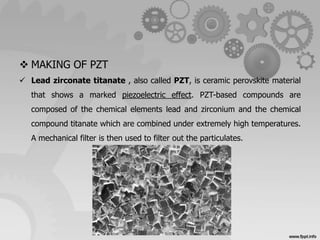
 Lead zirconate titanate , also called PZT, is ceramic perovskite material 
that shows a marked piezoelectric effect. PZT-based compounds are 
composed of the chemical elements lead and zirconium and the chemical 
compound titanate which are combined under extremely high temperatures. 
A mechanical filter is then used to filter out the particulates.
 APPLICATION OF PZT 
 Being piezoelectric, it develops a voltage (or potential difference) across 
two of its faces when compressed (useful for sensor applications), or 
physically changes shape when an external electric field is applied (useful 
for actuator applications). 
 Being pyroelectric, this material develops a voltage difference across two of 
its faces when it experiences a temperature change. As a result, it can be 
used as a sensor for detecting heat. 
 In 1975 Sandia National Laboratories was working on anti-flash goggles to 
protect aircrew from burns and blindness in case of a nuclear explosion. 
The PZT lenses could turn opaque in less than 150 microseconds.
 LIMITATION OF PZT 
 High mechanical stress can depolarize a PZT ceramic. 
 As the operating temperature increases, piezoelectric perfonamce of 
material decreases . 
 the curie point is the maximum exposure temperature for PZT. And it has 
it’s own curie point. When this ceramic element is heated above the curie 
point, all piezoelectric properties are lost.
2. ZIRCONIUM DIOXIDE 
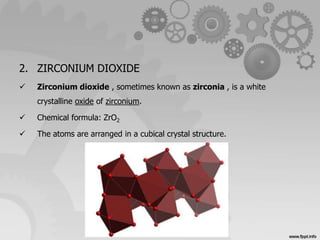
 Zirconium dioxide , sometimes known as zirconia , is a white 
crystalline oxide of zirconium. 
 Chemical formula: ZrO2 
 The atoms are arranged in a cubical crystal structure.
 Zirconium dioxide in powder form
 ATOMIC STRUCTURE 
 Pure ZrO2 has a monoclinic crystal structure at room temperature and 
transitions to tetragonal and cubic at increasing temperatures. 
 The volume expansion caused by the cubic to tetragonal to monoclinic 
transformation induces very large stresses, and will cause pure ZrO2 to 
crack upon cooling from high temperatures.
Tetragonal 
Monoclinic 
Several different oxides are added to zirconia to stabilize the tetragonal 
and/or cubic phases: magnesium oxide (MgO), yttrium oxide, (Y2O3), calcium 
oxide (CaO), and cerium(III) oxide (Ce2O3)
 MAKING OF ZrO2 
 Monoclinic zirconium dioxide formed by a process comprising : Melting 
zirconium silicate into a induction melting furnace with a sintering crust 
crucible at a temperature in a range of 2500° to 3000° C. 
 Quenching the melt by drawing the melt off in a stream and cooling the 
stream by subjecting the stream, while in a free fall, to a spray of fluid so 
as to form thermally split zirconium silicate. 
 Leaching out amorphous silica from the thermally split zirconium silicate 
with alkali lye at 100° to 200° and a molar ratio of SiO2 to alkali hydroxide 
of 1 to at least 2 so as to obtain zirconium dioxide.
 APPLICATION OF ZrO2 
 The cubic phase of zirconia has a very low thermal conductivity, which has 
led to its use as a thermal barrier coating or TBC in jet and diesel 
engines to allow operation at higher temperatures. 
 It is used as a refractory material, in insulation, abrasives and ceramic 
glazes. 
 Zirconia is also an important high dielectric material that is being 
investigated for potential applications as an insulator in transistor in 
future nanoelectronic devices.
• Products made from Zirconium Oxide (ZrO2) 
 Bearing Technology in Automotive Engineering 
 Cutters 
 Dental Ceramics 
 Drawing Tools 
 Forming Applications 
 Sealing Technology (Seal Rings, Bearings) 
 Technical Cutters 
 Tubes and Pipes
 LIMITATION 
 Use of zincronia is more expensive then metal . 
 It’s not easily available, number of process are required to get pure 
zincronia. 
 Less resistant to stress or extra force, there is a risk of chipping or fracture.
3. AMORPHOUS SILICON 
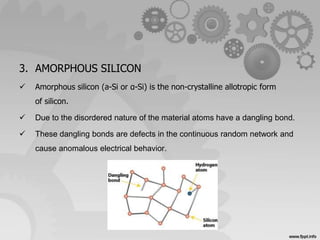
 Amorphous silicon (a-Si or α-Si) is the non-crystalline allotropic form 
of silicon. 
 Due to the disordered nature of the material atoms have a dangling bond. 
 These dangling bonds are defects in the continuous random network and 
cause anomalous electrical behavior.
 ATOMIC STRUCTURE OF AMORPHOUS SILICON 
 Silicon is a fourfold coordinated atom that is normally tetrahedrally bonded 
to four neighboring silicon atoms. 
 In crystalline silicon this tetrahedral structure is continued over a large 
range, forming a well-ordered crystal lattice. 
 If desired, the material can be passivated by hydrogen, which bonds to the 
dangling bonds and can reduce the dangling bond density by several orders 
of magnitude. 
 Hydrogenated amorphous silicon (a-Si:H) has a sufficiently low amount of 
defects to be used within devices.
 MAKING OF AMORPHOUS SILICON 
 In the manufacture of amorphous silicon, thin monocrystalline silicon wafers 
are made by cutting a crystal of monocrystalline silicon. For further 
processing these wafers are fixed on a polishing block. The exposed surface 
of each wafer is then polished in order to remove the surface irregularities 
which are caused by the cutting of the crystal of monocrystalline silicon. 
Generally, the silicon wafers are processed in successive steps with grinding 
or polishing agents of different particle size. These process steps comprise 
the lapping and/or the so-called Blanchard grinding by which rough 
irregularities are removed from the surface, and finally one or several 
mechanical or chemical precision polishing processes which produce an 
extremely smooth and defect-free surface which subsequently is subjected 
to the known processing methods for making semiconductor devices.
 APPLICATION OF AMORPHOUS SILICON 
 Amorphous silicon has become the material of choice for the active 
layer in thin-film transistors (TFTs), which are most widely used in large-area 
electronics applications, mainly for liquid-crystal displays (LCDs). 
 Amorphous silicon has been used as a photovoltaic solar cell material.
 LIMITATION 
 In this material the converge takes place below the temperature of 250K, 
so the valance place has been occurred between the molecular of the 
material. 
 This limitation is known as hole mobility of the material.
4. MAGNETO RHEOLOGICAL FLUID 
 A magneto rheological fluid (MR fluid) is a type of smart fluid in a carrier 
fluid, usually a type of oil. When subjected to a magnetic field, the fluid 
greatly increases its apparent viscosity, to the point of becoming 
a viscoelastic solid. Importantly, the yield stress of the fluid when in its 
active ("on") state can be controlled very accurately by varying the 
magnetic field intensity. The upshot of which is that the fluid's ability to 
transmit force can be controlled with an electromagnet, which gives rise to 
its many possible control-based applications.
 WORKING OF MR FLUID 
The magnetic particles, which are typically micrometer or nanometer scale 
spheres or ellipsoids, are suspended within the carrier oil are distributed 
randomly and in suspension under normal circumstances, as below.
 When a magnetic field is applied, however, the microscopic particles 
(usually in the 0.1–10 μm range) align themselves along the lines 
of magnetic flux. When the fluid is contained between two poles (typically 
of separation 0.5–2 mm in the majority of devices), the resulting chains of 
particles restrict the movement of the fluid, perpendicular to the direction of 
flux, effectively increasing its viscosity. Importantly, mechanical properties 
of the fluid in its “on” state are anisotropic. Thus in designing a magneto 
rheological (or MR) device, it is crucial to ensure that the lines of flux are 
perpendicular to the direction of the motion to be restricted.
 Shear strength 
 Low shear strength has been the primary reason for limited range of 
applications. In the absence of external pressure the maximum shear 
strength is about 100 kPa. If the fluid is compressed in the magnetic field 
direction and the compressive stress is 2 MPa, the shear strength is raised 
to 1100 kPa. If the standard magnetic particles are replaced with elongated 
magnetic particles, the shear strength is also improved.
 APPLICATIONS OF MAGNETO RHEOLOGICAL FLUID 
 Mechanical Engineering 
Magnetorheological dampers of various applications have been and 
continue to be developed. These dampers are mainly used in heavy 
industry with applications such as heavy motor damping, operator seat/cab 
damping in construction vehicles, and more. 
 Military and Defense 
The U.S. Army Research Office is currently funding research into using MR 
fluid to enhance body armor. In 2003, researchers stated they were five to 
ten years away from making the fluid bullet resistant. In addition, Humvees, 
certain helicopters, and various other all-terrain vehicles employ dynamic 
MR shock absorbers and/or dampers.
 Optics 
Magnetorheological Finishing, a magneto rheological fluid-based optical 
polishing method, has proven to be highly precise. It was used in the 
construction of the Hubble Space Telescope's corrective lens. 
 Automotive and Aerospace 
If the shock absorbers of a vehicle's suspension are filled with MR fluid 
instead of plain oil, and the whole device surrounded with an electromagnet, 
the viscosity of the fluid (and hence the amount of damping provided by the 
shock absorber) can be varied depending on driver preference or the weight 
being carried by the vehicle - or it may be dynamically varied in order to 
provide stability control.
 Human Prosthesis 
Magnetorheological dampers are utilized in semi-active human prosthetic 
legs. Much like those used in military and commercial helicopters, a damper 
in the prosthetic leg decreases the shock delivered to the patients leg when 
jumping, for example. This results in an increased mobility and agility for the 
patient.
 LIMITATION 
 High density, due to presence of iron, makes them heavy. However, 
operating volumes are small, so while this is a problem, it is not 
insurmountable. 
 High-quality fluids are expensive. 
 Fluids are subject to thickening after prolonged use and need replacing. 
 Settling of ferro-particles can be a problem for some application.
Material technology Newly develpoed engineering materials

Material technology Newly develpoed engineering materials

  • 1.
    MATERIAL TECHNOLOGY NEWLYDEVELOPED ENGINEERING MATERIAL
  • 2.
    INTRODUCTION Materials Technologyis an interdisciplinary field involving the properties of matter and its applications to various areas of technology and engineering. This scientific field investigates the relationship between the structure of materials at atomic or molecular scales and their macroscopic properties. It incorporates elements of applied physics and chemistry. With significant media attention focused on nanoscience and nanotechnology in recent years, materials science has been propelled to the forefront at many universities. It is also an important part of forensic engineering and failure analysis. Materials science also deals with fundamental properties and characteristics of materials.
  • 3.
     LIST OFNEWLY DEVELOPED ENGG. MATERIALS 1. Lead Zirconate Titanate (PZT) 2. Zirconium Dioxide (ZrO2) 3. Amorphus Silicon 4. Magneto Rheological Fluid 5. YAG (Yteum aluminium garnets) laser 6. Stellites 7. Vatillium 8. Titanium alloy 9. Silicon Bricks
  • 4.
    1. Lead ZirconateTitanate (PZT)  Lead Zirconate Titanate (PZT) is a ceramic material made of lead (Pb), oxygen (O) and titanium (Ti) or zirconium (Zr).  Chemical formula: Pb[ZrxTi1-x]O3; x = 0,52  The atoms are arranged in a cubical structure.
  • 5.
     ATOMIC STRUCTUREOF PZT  At temperatures below the Curie temperature (depending on the material between 150°C and 200°C) the titanium atom moves from its central position and the electrically neutral lattice becomes a dipole.  This dipole lattice presents now piezoelectric characteristics and is considered as one of the most economical piezoelectric material.  By doping the PZT material, its piezoelectric characteristics can be modified: especially the hardness or softness of the material.
  • 6.
     MAKING OFPZT  Lead zirconate titanate , also called PZT, is ceramic perovskite material that shows a marked piezoelectric effect. PZT-based compounds are composed of the chemical elements lead and zirconium and the chemical compound titanate which are combined under extremely high temperatures. A mechanical filter is then used to filter out the particulates.
  • 7.
     APPLICATION OFPZT  Being piezoelectric, it develops a voltage (or potential difference) across two of its faces when compressed (useful for sensor applications), or physically changes shape when an external electric field is applied (useful for actuator applications).  Being pyroelectric, this material develops a voltage difference across two of its faces when it experiences a temperature change. As a result, it can be used as a sensor for detecting heat.  In 1975 Sandia National Laboratories was working on anti-flash goggles to protect aircrew from burns and blindness in case of a nuclear explosion. The PZT lenses could turn opaque in less than 150 microseconds.
  • 8.
     LIMITATION OFPZT  High mechanical stress can depolarize a PZT ceramic.  As the operating temperature increases, piezoelectric perfonamce of material decreases .  the curie point is the maximum exposure temperature for PZT. And it has it’s own curie point. When this ceramic element is heated above the curie point, all piezoelectric properties are lost.
  • 9.
    2. ZIRCONIUM DIOXIDE  Zirconium dioxide , sometimes known as zirconia , is a white crystalline oxide of zirconium.  Chemical formula: ZrO2  The atoms are arranged in a cubical crystal structure.
  • 10.
     Zirconium dioxidein powder form
  • 11.
     ATOMIC STRUCTURE  Pure ZrO2 has a monoclinic crystal structure at room temperature and transitions to tetragonal and cubic at increasing temperatures.  The volume expansion caused by the cubic to tetragonal to monoclinic transformation induces very large stresses, and will cause pure ZrO2 to crack upon cooling from high temperatures.
  • 12.
    Tetragonal Monoclinic Severaldifferent oxides are added to zirconia to stabilize the tetragonal and/or cubic phases: magnesium oxide (MgO), yttrium oxide, (Y2O3), calcium oxide (CaO), and cerium(III) oxide (Ce2O3)
  • 13.
     MAKING OFZrO2  Monoclinic zirconium dioxide formed by a process comprising : Melting zirconium silicate into a induction melting furnace with a sintering crust crucible at a temperature in a range of 2500° to 3000° C.  Quenching the melt by drawing the melt off in a stream and cooling the stream by subjecting the stream, while in a free fall, to a spray of fluid so as to form thermally split zirconium silicate.  Leaching out amorphous silica from the thermally split zirconium silicate with alkali lye at 100° to 200° and a molar ratio of SiO2 to alkali hydroxide of 1 to at least 2 so as to obtain zirconium dioxide.
  • 14.
     APPLICATION OFZrO2  The cubic phase of zirconia has a very low thermal conductivity, which has led to its use as a thermal barrier coating or TBC in jet and diesel engines to allow operation at higher temperatures.  It is used as a refractory material, in insulation, abrasives and ceramic glazes.  Zirconia is also an important high dielectric material that is being investigated for potential applications as an insulator in transistor in future nanoelectronic devices.
  • 15.
    • Products madefrom Zirconium Oxide (ZrO2)  Bearing Technology in Automotive Engineering  Cutters  Dental Ceramics  Drawing Tools  Forming Applications  Sealing Technology (Seal Rings, Bearings)  Technical Cutters  Tubes and Pipes
  • 16.
     LIMITATION Use of zincronia is more expensive then metal .  It’s not easily available, number of process are required to get pure zincronia.  Less resistant to stress or extra force, there is a risk of chipping or fracture.
  • 17.
    3. AMORPHOUS SILICON  Amorphous silicon (a-Si or α-Si) is the non-crystalline allotropic form of silicon.  Due to the disordered nature of the material atoms have a dangling bond.  These dangling bonds are defects in the continuous random network and cause anomalous electrical behavior.
  • 18.
     ATOMIC STRUCTUREOF AMORPHOUS SILICON  Silicon is a fourfold coordinated atom that is normally tetrahedrally bonded to four neighboring silicon atoms.  In crystalline silicon this tetrahedral structure is continued over a large range, forming a well-ordered crystal lattice.  If desired, the material can be passivated by hydrogen, which bonds to the dangling bonds and can reduce the dangling bond density by several orders of magnitude.  Hydrogenated amorphous silicon (a-Si:H) has a sufficiently low amount of defects to be used within devices.
  • 19.
     MAKING OFAMORPHOUS SILICON  In the manufacture of amorphous silicon, thin monocrystalline silicon wafers are made by cutting a crystal of monocrystalline silicon. For further processing these wafers are fixed on a polishing block. The exposed surface of each wafer is then polished in order to remove the surface irregularities which are caused by the cutting of the crystal of monocrystalline silicon. Generally, the silicon wafers are processed in successive steps with grinding or polishing agents of different particle size. These process steps comprise the lapping and/or the so-called Blanchard grinding by which rough irregularities are removed from the surface, and finally one or several mechanical or chemical precision polishing processes which produce an extremely smooth and defect-free surface which subsequently is subjected to the known processing methods for making semiconductor devices.
  • 20.
     APPLICATION OFAMORPHOUS SILICON  Amorphous silicon has become the material of choice for the active layer in thin-film transistors (TFTs), which are most widely used in large-area electronics applications, mainly for liquid-crystal displays (LCDs).  Amorphous silicon has been used as a photovoltaic solar cell material.
  • 21.
     LIMITATION In this material the converge takes place below the temperature of 250K, so the valance place has been occurred between the molecular of the material.  This limitation is known as hole mobility of the material.
  • 22.
    4. MAGNETO RHEOLOGICALFLUID  A magneto rheological fluid (MR fluid) is a type of smart fluid in a carrier fluid, usually a type of oil. When subjected to a magnetic field, the fluid greatly increases its apparent viscosity, to the point of becoming a viscoelastic solid. Importantly, the yield stress of the fluid when in its active ("on") state can be controlled very accurately by varying the magnetic field intensity. The upshot of which is that the fluid's ability to transmit force can be controlled with an electromagnet, which gives rise to its many possible control-based applications.
  • 23.
     WORKING OFMR FLUID The magnetic particles, which are typically micrometer or nanometer scale spheres or ellipsoids, are suspended within the carrier oil are distributed randomly and in suspension under normal circumstances, as below.
  • 24.
     When amagnetic field is applied, however, the microscopic particles (usually in the 0.1–10 μm range) align themselves along the lines of magnetic flux. When the fluid is contained between two poles (typically of separation 0.5–2 mm in the majority of devices), the resulting chains of particles restrict the movement of the fluid, perpendicular to the direction of flux, effectively increasing its viscosity. Importantly, mechanical properties of the fluid in its “on” state are anisotropic. Thus in designing a magneto rheological (or MR) device, it is crucial to ensure that the lines of flux are perpendicular to the direction of the motion to be restricted.
  • 25.
     Shear strength  Low shear strength has been the primary reason for limited range of applications. In the absence of external pressure the maximum shear strength is about 100 kPa. If the fluid is compressed in the magnetic field direction and the compressive stress is 2 MPa, the shear strength is raised to 1100 kPa. If the standard magnetic particles are replaced with elongated magnetic particles, the shear strength is also improved.
  • 26.
     APPLICATIONS OFMAGNETO RHEOLOGICAL FLUID  Mechanical Engineering Magnetorheological dampers of various applications have been and continue to be developed. These dampers are mainly used in heavy industry with applications such as heavy motor damping, operator seat/cab damping in construction vehicles, and more.  Military and Defense The U.S. Army Research Office is currently funding research into using MR fluid to enhance body armor. In 2003, researchers stated they were five to ten years away from making the fluid bullet resistant. In addition, Humvees, certain helicopters, and various other all-terrain vehicles employ dynamic MR shock absorbers and/or dampers.
  • 27.
     Optics MagnetorheologicalFinishing, a magneto rheological fluid-based optical polishing method, has proven to be highly precise. It was used in the construction of the Hubble Space Telescope's corrective lens.  Automotive and Aerospace If the shock absorbers of a vehicle's suspension are filled with MR fluid instead of plain oil, and the whole device surrounded with an electromagnet, the viscosity of the fluid (and hence the amount of damping provided by the shock absorber) can be varied depending on driver preference or the weight being carried by the vehicle - or it may be dynamically varied in order to provide stability control.
  • 28.
     Human Prosthesis Magnetorheological dampers are utilized in semi-active human prosthetic legs. Much like those used in military and commercial helicopters, a damper in the prosthetic leg decreases the shock delivered to the patients leg when jumping, for example. This results in an increased mobility and agility for the patient.
  • 29.
     LIMITATION High density, due to presence of iron, makes them heavy. However, operating volumes are small, so while this is a problem, it is not insurmountable.  High-quality fluids are expensive.  Fluids are subject to thickening after prolonged use and need replacing.  Settling of ferro-particles can be a problem for some application.