Amal kumar
CBPST Kochi
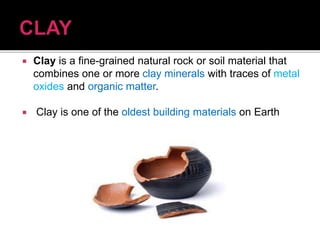
 Clay is a fine-grained natural rock or soil material that
combines one or more clay minerals with traces of metal
oxides and organic matter.
 Clay is one of the oldest building materials on Earth
 Clay is a mineral, belonging to phyllosilicate category.
 Chemically it consists of aluminium silicate as a principal
component along with variety of other metals like
magnesium, calcium, potassium and varying level of
watermolecules.
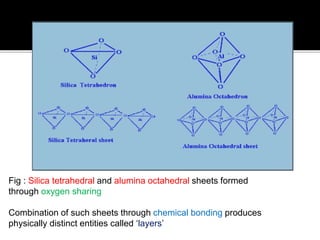
 Atomic configuration of clays consists of alternating
‘sheets’ of tetrahedral SiO4 and octahedral AlO6 units
formed by oxygen sharing
Fig : Silica tetrahedral and alumina octahedral sheets formed
through oxygen sharing
Combination of such sheets through chemical bonding produces
physically distinct entities called ‘layers’
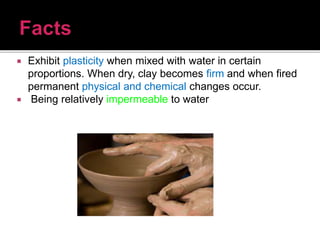
 Exhibit plasticity when mixed with water in certain
proportions. When dry, clay becomes firm and when fired
permanent physical and chemical changes occur.
 Being relatively impermeable to water
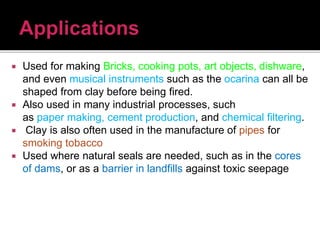
 Used for making Bricks, cooking pots, art objects, dishware,
and even musical instruments such as the ocarina can all be
shaped from clay before being fired.
 Also used in many industrial processes, such
as paper making, cement production, and chemical filtering.
 Clay is also often used in the manufacture of pipes for
smoking tobacco
 Used where natural seals are needed, such as in the cores
of dams, or as a barrier in landfills against toxic seepage
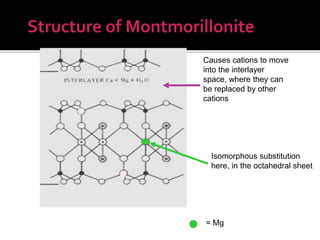
 Layer charge originates from the substitution
of Mg2+ for Al3+ in the octahedral sheet
 Unstable (weathers to something else) under
low pH and high moisture
 Most swelling of all clays
 “Nutrient rich”
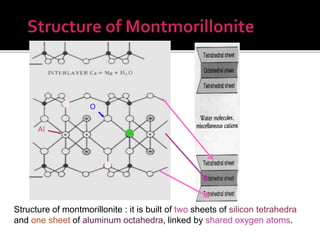
Structure of montmorillonite : it is built of two sheets of silicon tetrahedra
and one sheet of aluminum octahedra, linked by shared oxygen atoms.
Al
O
Isomorphous substitution
here, in the octahedral sheet
Causes cations to move
into the interlayer
space, where they can
be replaced by other
cations
= Mg
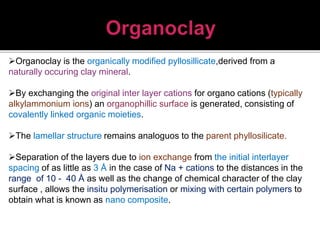
Organoclay is the organically modified pyllosillicate,derived from a
naturally occuring clay mineral.
By exchanging the original inter layer cations for organo cations (typically
alkylammonium ions) an organophillic surface is generated, consisting of
covalently linked organic moieties.
The lamellar structure remains analoguos to the parent phyllosilicate.
Separation of the layers due to ion exchange from the initial interlayer
spacing of as little as 3 Å in the case of Na + cations to the distances in the
range of 10 - 40 Å as well as the change of chemical character of the clay
surface , allows the insitu polymerisation or mixing with certain polymers to
obtain what is known as nano composite.
 When ordered alluminasilicate sheets are lying parellel to each other
,separated with polymerchains of certain type the system is classified
as intercalated nano composite.
 If separation of the layers is so significant ,that they are no longer lying
opposite to one another , but randomly ordered , then one get the
exfoliated nano composite.
 Hydrophobic modification
 Intercalation
 Exfoliation
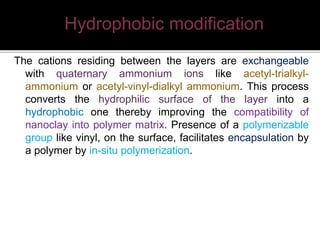
The cations residing between the layers are exchangeable
with quaternary ammonium ions like acetyl-trialkyl-
ammonium or acetyl-vinyl-dialkyl ammonium. This process
converts the hydrophilic surface of the layer into a
hydrophobic one thereby improving the compatibility of
nanoclay into polymer matrix. Presence of a polymerizable
group like vinyl, on the surface, facilitates encapsulation by
a polymer by in-situ polymerization.
Hydrophobic modification
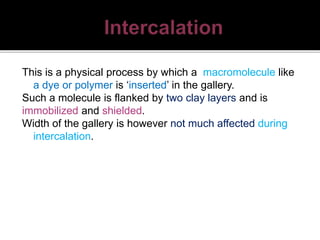
This is a physical process by which a macromolecule like
a dye or polymer is ‘inserted’ in the gallery.
Such a molecule is flanked by two clay layers and is
immobilized and shielded.
Width of the gallery is however not much affected during
intercalation.
This is a delaminating process where in the gallery is
expanded from its normal size of 1 nm to about 20 nm or
higher. Thus there is a clear disruption of the layers
which get spacially separated apart bringing about
nanoscale dispersion in the polymer matrix. Thus
exfoliated clays represent true nanomaterials.
 A series of poly(oxyalkylene)-polyamine salts (POA-salts) including
hydrophobic poly-(oxypropylene)-(POP-) and hydrophilic poly(oxyethylene)-
(POE-) amines of molecular weights ranging from 230 to 5,000 g/mol had
been used to modify the natural clays.
 As a result, high d spacing up to 92 Å was reported in the case of POP-
amine salt of 4,000 g/mol Mw for the intercalation of Na+- MMT.
 The lamellar interlayer expansion is generally proportional to molecular
lengths of the intercalating agents.
 In the gallery of layered structures, the POP organics aggregated into a new
hydrophobic phase which ultimately expanded the basal spacing.
 The interlayer expansion was reported to occur in a critical concentration
manner similar to the so-called Critical Micelle Concentration (CMC) as a
surfactant behaves in water.
 A new approach was reported for interacting with the clays through counter-
ion exchange, chelating and hydrogen bonding association mechanism by
using POA-derived amindoacids.
 In the chelating mechanism involving the POA-amidoacid with Na+-MMT, a
seven-member ring cyclic intermediate was proposed.
 A similar mechanism with an acid-chelating intermediate was reported for
intercalation of alkylcarboxylic acids, CH3(CH2)nCOOH, into the gallery of
clay containing divalent metal counter ions.
 For comparison, the use of C12−18 carboxylic acids such as lauric acid (n =
10) and stearic acid (n = 16) intercalated into Na+-MMT resulted in only low
organic embedment of 10−15 wt % organics and low XRD basal spacing of
15 Å. For the divalent M2+-MMT analog (XRD = 10.1 Å), the same acid
species could expand the silicates with a larger d spacing of 30 or 43 Å. The
difference between the M2+-MMT and Na+-MMT intercalation was
attributed to the formation of thermally stable intermediates for the divalent
M2+, but not for Na+ form of MMT.
 However, the LDHs are different from MMTs, not only in opposite charges of
ionic characteristics but also in charge density. The strong interlayer
electrostatic interaction among individual Mg-Al oxide platelets leads to a
tight stacking of the lamellae and difficulty for organic incorporation.
 Alkyl carboxylates and sulfonates are common species as the intercalating
agents, but which could widen the interlayer spacing only up to 30 Å .
 In addition to the limitation on interlayer widening, the rate of ionic exchange
reaction is considerably slow as compared to the MMT intercalation. In
comparing with the alkyl carboxylic acids, the amidoacids are suitable for
interacting with the anionic LDH clay.
 For example, POA-derived amidoacids of high molecular weight could
render LDH wide basal spacing of 92 Å .
 Besides the wide expansion of layered silicates through intercalation,
random silicate platelets could be obtained by using amphiphilic
copolymers, such as Mannich condensates, hydrophobic backboned
polyamidoacids and other polyamines .
 The subsequent formation of amine-HCl salts was required for such
exfoliation agents. Their structures generally consisting of multiple amines
enabled to form stable emulsion in water with clays and exchange their
counter Na+ ions.
 As a result, the layered stack of multiple silicate sheets in the Na+-MMT
primary structure was exfoliated and randomized into individual clay
platelets.
 The process involved the exfoliation of the layered clay through ionic
exchange reaction and further NaOH treatment to phase separate and
recover the organic amines.
 The randomized silicates were shown to have a unique ionic character and
suspension in water.
 The physical properties of the platelets demonstrated an inherent 120
meq/100 g cation exchange capacity, averaged 720 m2/g surface areas,
20,000 ions, 0.9 nm2 area per ion and 4 × 10¹⁶ platelets per gram.
 Owing to its large surface area together with hydrophobic chains
emerging from the clay surface, organoclay can be used
 to remove oil from water
 also applied as a component in paint formulations
 as a viscosifier for oil-based drilling fluids
 can be used in polymer chemistry as a nucleating agent
Done by,
Amal kumar
 layered double hydroxide (LDH)
 montmorillonite (MMT) clay

Organic modification of Clay

  • 1.
  • 2.
     Clay isa fine-grained natural rock or soil material that combines one or more clay minerals with traces of metal oxides and organic matter.  Clay is one of the oldest building materials on Earth
  • 3.
     Clay isa mineral, belonging to phyllosilicate category.  Chemically it consists of aluminium silicate as a principal component along with variety of other metals like magnesium, calcium, potassium and varying level of watermolecules.  Atomic configuration of clays consists of alternating ‘sheets’ of tetrahedral SiO4 and octahedral AlO6 units formed by oxygen sharing
  • 4.
    Fig : Silicatetrahedral and alumina octahedral sheets formed through oxygen sharing Combination of such sheets through chemical bonding produces physically distinct entities called ‘layers’
  • 5.
     Exhibit plasticitywhen mixed with water in certain proportions. When dry, clay becomes firm and when fired permanent physical and chemical changes occur.  Being relatively impermeable to water
  • 6.
     Used formaking Bricks, cooking pots, art objects, dishware, and even musical instruments such as the ocarina can all be shaped from clay before being fired.  Also used in many industrial processes, such as paper making, cement production, and chemical filtering.  Clay is also often used in the manufacture of pipes for smoking tobacco  Used where natural seals are needed, such as in the cores of dams, or as a barrier in landfills against toxic seepage
  • 7.
     Layer chargeoriginates from the substitution of Mg2+ for Al3+ in the octahedral sheet  Unstable (weathers to something else) under low pH and high moisture  Most swelling of all clays  “Nutrient rich”
  • 8.
    Structure of montmorillonite: it is built of two sheets of silicon tetrahedra and one sheet of aluminum octahedra, linked by shared oxygen atoms. Al O
  • 9.
    Isomorphous substitution here, inthe octahedral sheet Causes cations to move into the interlayer space, where they can be replaced by other cations = Mg
  • 10.
    Organoclay is theorganically modified pyllosillicate,derived from a naturally occuring clay mineral. By exchanging the original inter layer cations for organo cations (typically alkylammonium ions) an organophillic surface is generated, consisting of covalently linked organic moieties. The lamellar structure remains analoguos to the parent phyllosilicate. Separation of the layers due to ion exchange from the initial interlayer spacing of as little as 3 Å in the case of Na + cations to the distances in the range of 10 - 40 Å as well as the change of chemical character of the clay surface , allows the insitu polymerisation or mixing with certain polymers to obtain what is known as nano composite.
  • 11.
     When orderedalluminasilicate sheets are lying parellel to each other ,separated with polymerchains of certain type the system is classified as intercalated nano composite.  If separation of the layers is so significant ,that they are no longer lying opposite to one another , but randomly ordered , then one get the exfoliated nano composite.
  • 12.
     Hydrophobic modification Intercalation  Exfoliation
  • 13.
    The cations residingbetween the layers are exchangeable with quaternary ammonium ions like acetyl-trialkyl- ammonium or acetyl-vinyl-dialkyl ammonium. This process converts the hydrophilic surface of the layer into a hydrophobic one thereby improving the compatibility of nanoclay into polymer matrix. Presence of a polymerizable group like vinyl, on the surface, facilitates encapsulation by a polymer by in-situ polymerization. Hydrophobic modification
  • 14.
    This is aphysical process by which a macromolecule like a dye or polymer is ‘inserted’ in the gallery. Such a molecule is flanked by two clay layers and is immobilized and shielded. Width of the gallery is however not much affected during intercalation.
  • 15.
    This is adelaminating process where in the gallery is expanded from its normal size of 1 nm to about 20 nm or higher. Thus there is a clear disruption of the layers which get spacially separated apart bringing about nanoscale dispersion in the polymer matrix. Thus exfoliated clays represent true nanomaterials.
  • 16.
     A seriesof poly(oxyalkylene)-polyamine salts (POA-salts) including hydrophobic poly-(oxypropylene)-(POP-) and hydrophilic poly(oxyethylene)- (POE-) amines of molecular weights ranging from 230 to 5,000 g/mol had been used to modify the natural clays.  As a result, high d spacing up to 92 Å was reported in the case of POP- amine salt of 4,000 g/mol Mw for the intercalation of Na+- MMT.  The lamellar interlayer expansion is generally proportional to molecular lengths of the intercalating agents.  In the gallery of layered structures, the POP organics aggregated into a new hydrophobic phase which ultimately expanded the basal spacing.  The interlayer expansion was reported to occur in a critical concentration manner similar to the so-called Critical Micelle Concentration (CMC) as a surfactant behaves in water.
  • 17.
     A newapproach was reported for interacting with the clays through counter- ion exchange, chelating and hydrogen bonding association mechanism by using POA-derived amindoacids.  In the chelating mechanism involving the POA-amidoacid with Na+-MMT, a seven-member ring cyclic intermediate was proposed.  A similar mechanism with an acid-chelating intermediate was reported for intercalation of alkylcarboxylic acids, CH3(CH2)nCOOH, into the gallery of clay containing divalent metal counter ions.  For comparison, the use of C12−18 carboxylic acids such as lauric acid (n = 10) and stearic acid (n = 16) intercalated into Na+-MMT resulted in only low organic embedment of 10−15 wt % organics and low XRD basal spacing of 15 Å. For the divalent M2+-MMT analog (XRD = 10.1 Å), the same acid species could expand the silicates with a larger d spacing of 30 or 43 Å. The difference between the M2+-MMT and Na+-MMT intercalation was attributed to the formation of thermally stable intermediates for the divalent M2+, but not for Na+ form of MMT.
  • 18.
     However, theLDHs are different from MMTs, not only in opposite charges of ionic characteristics but also in charge density. The strong interlayer electrostatic interaction among individual Mg-Al oxide platelets leads to a tight stacking of the lamellae and difficulty for organic incorporation.  Alkyl carboxylates and sulfonates are common species as the intercalating agents, but which could widen the interlayer spacing only up to 30 Å .  In addition to the limitation on interlayer widening, the rate of ionic exchange reaction is considerably slow as compared to the MMT intercalation. In comparing with the alkyl carboxylic acids, the amidoacids are suitable for interacting with the anionic LDH clay.  For example, POA-derived amidoacids of high molecular weight could render LDH wide basal spacing of 92 Å .
  • 19.
     Besides thewide expansion of layered silicates through intercalation, random silicate platelets could be obtained by using amphiphilic copolymers, such as Mannich condensates, hydrophobic backboned polyamidoacids and other polyamines .  The subsequent formation of amine-HCl salts was required for such exfoliation agents. Their structures generally consisting of multiple amines enabled to form stable emulsion in water with clays and exchange their counter Na+ ions.  As a result, the layered stack of multiple silicate sheets in the Na+-MMT primary structure was exfoliated and randomized into individual clay platelets.  The process involved the exfoliation of the layered clay through ionic exchange reaction and further NaOH treatment to phase separate and recover the organic amines.  The randomized silicates were shown to have a unique ionic character and suspension in water.  The physical properties of the platelets demonstrated an inherent 120 meq/100 g cation exchange capacity, averaged 720 m2/g surface areas, 20,000 ions, 0.9 nm2 area per ion and 4 × 10¹⁶ platelets per gram.
  • 20.
     Owing toits large surface area together with hydrophobic chains emerging from the clay surface, organoclay can be used  to remove oil from water  also applied as a component in paint formulations  as a viscosifier for oil-based drilling fluids  can be used in polymer chemistry as a nucleating agent
  • 21.
  • 22.
     layered doublehydroxide (LDH)  montmorillonite (MMT) clay