(SELF DRIVING CAR)
PRESENTED BY
BASAWARAJ D
GUIDED BY
Prof. RITESH R MULGE
Introduction
History
Vehicular hardware
Working
Comparison
Potential advantages
Potential obstacles
Official prediction
conclusion
Vehicular automation involves the use of
Mechatronics
Artificial Intelligence
to assist a vehicle's operator.
These features and the vehicles employing them may be
labeled as intelligent or smart
 An autonomous car is also called
as self driving car, driverless car or
robotic car, an autonomous vehicle
capable of fulfilling the human
transportation capabilities of a
traditional car.
 As an autonomous vehicle, it is
capable of sensing its environment
and navigating without human
input.
Driver less car is a project by Google that
involves
the developing technology for autonomous
car
The software powering car is called
“Google chauffeur”
This project is being led by Google engineer
and team
This team has 15 engineers
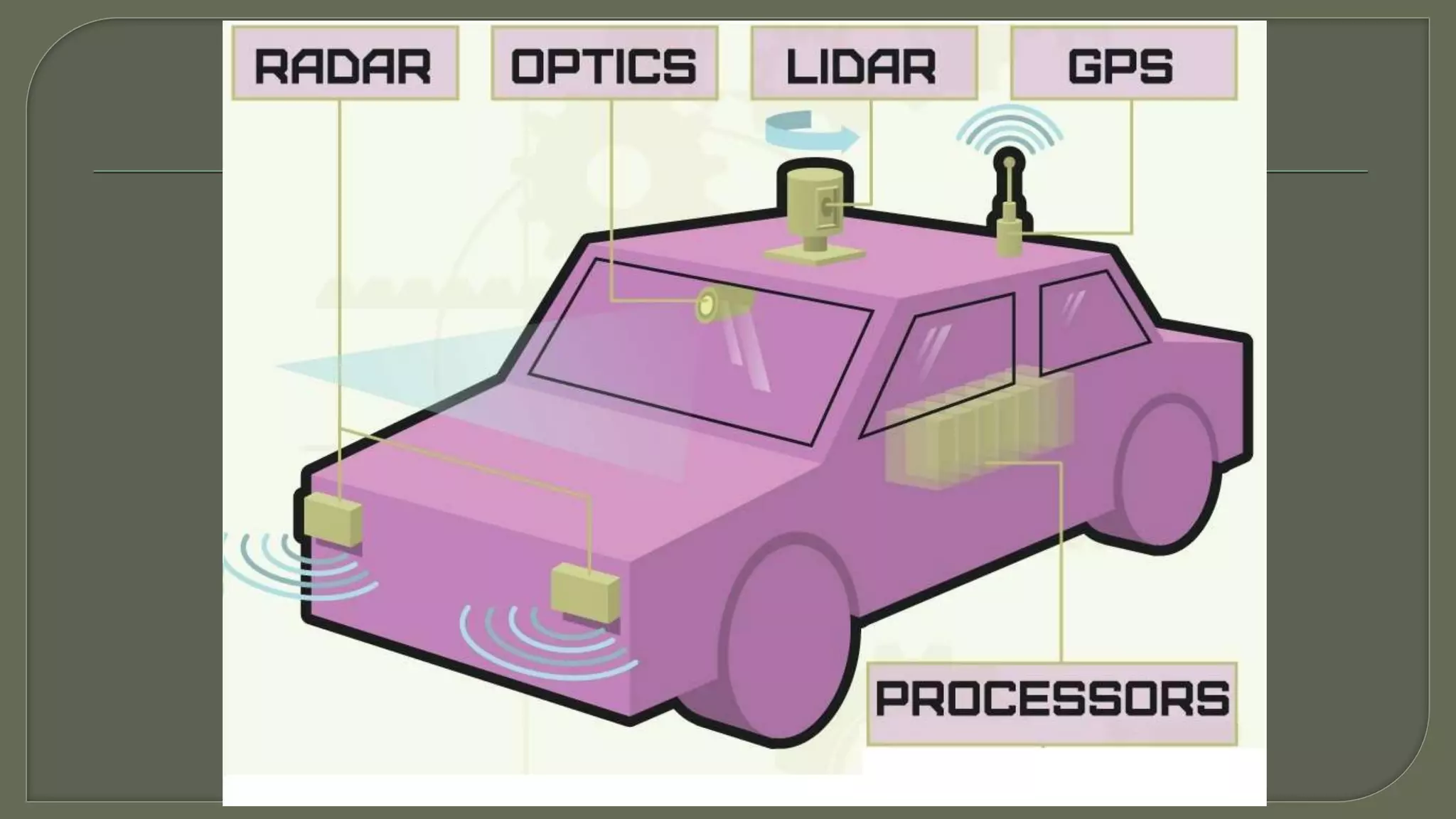
RADAR
Video camera
LIDAR
GPS
Processors
Wheel Speed Sensors
 Traditional RADAR sensors are used to detect
dangerous objects in the vehicle’s path that are
more than 100 meters away.
 Accident-Prevention systems trigger alerts when
they detect something in a blind car’s blind spot.
 The radar chirps between 10 and 11 GHz over a
5 millisecond period, transmitting the radar signal
from a centrally located antenna cone.
 Two receive cones, separated by approximately
14 inches, receive the reflected radar energy.
A video camera installed at the top
of the front glass near the rear-
view mirror.
These cameras are used to detect
the traffic lights , pedestrians,
animals etc.
It is also used to identify road
markings and traffic signals.
 The Light Detection And Ranging (LIDAR) which is mounted on the roof
of the vehicle is the most important device in the Autonomous vehicles.
 The LIDAR consists of an emitter, mirror and receiver.
 The emitter sends out a LASER beam that bounces off a mirror that is
rotating along with the cylindrical housing at 10 revolutions per minute.
 After bouncing off objects, the LASER beam returns to the mirror and is
bounced back towards the receiver, where it can be interpreted into
data.
 The vehicle can then generate a map of its surroundings and use the
map to avoid objects.
The global positioning system(GPS) is a
space based satellite navigation system that
provides location and the time information.
But the data alone with the GPS system is
less accurate so this data is combined with
the outputs from the IMU(inertial
measurement unit)
IMU is an electronic device which measures
and gives the information about vehicles
velocity
Some 7 dual-core 2.13 GHz processors and 2Gb of RAM
are needed to make sense of the data collected by the
car’s instruments.
 Wheel Speed Sensors
measure the road-wheel
speed and direction of
rotation.
 These sensors provide input
to a number of different
automotive systems including
the anti-lock brake system and
electronic stability control.
 The signal from the sensors are used by the Electronic
Control Unit for decision making using a software code.
 Based on the information from the sensors, the Electronic
Control Unit gives signal to the actuators, which in turn
control the vehicle.
 Also, real time information of the surroundings is output to
the user interface located inside the vehicle.
Google Maps and the hardware sensors
data are sent to the AI.
AI then determines:
how fast to accelerate
when to slow down/stop
when to steer the wheel
Goal of AI
The agent's goal is to take the passenger to
its desired destination safely and legally.
 Minimize accidents rates in cities
 The system will allow the commuters to do other things
while travelling such as reading or sleeping.
 Increased roadway capacity and reduced traffic congestion
 Relief of vehicle occupants from driving and navigation
chores.
 Higher speed limit for autonomous cars.
 Alleviation of parking scarcity.
 Reduction of space required for vehicle parking.
 Reduction in the need for traffic police and vehicle
insurance.
 Smoother ride.
 As of August 28,2014 the latest prototype cannot “Handle
heavy rain and snow covered roads”.
 Chris Urmson of Google said That the LIDAR technology
cannot spot a police officer signaling car to stop
 Vehicles are unable to differentiate between crumpled up paper
and a rock
Loss of driver-related jobs
Temporary construction zones which are not posted to any
maps or data bases.
According to Google, projects having these issues fixed by 2020.
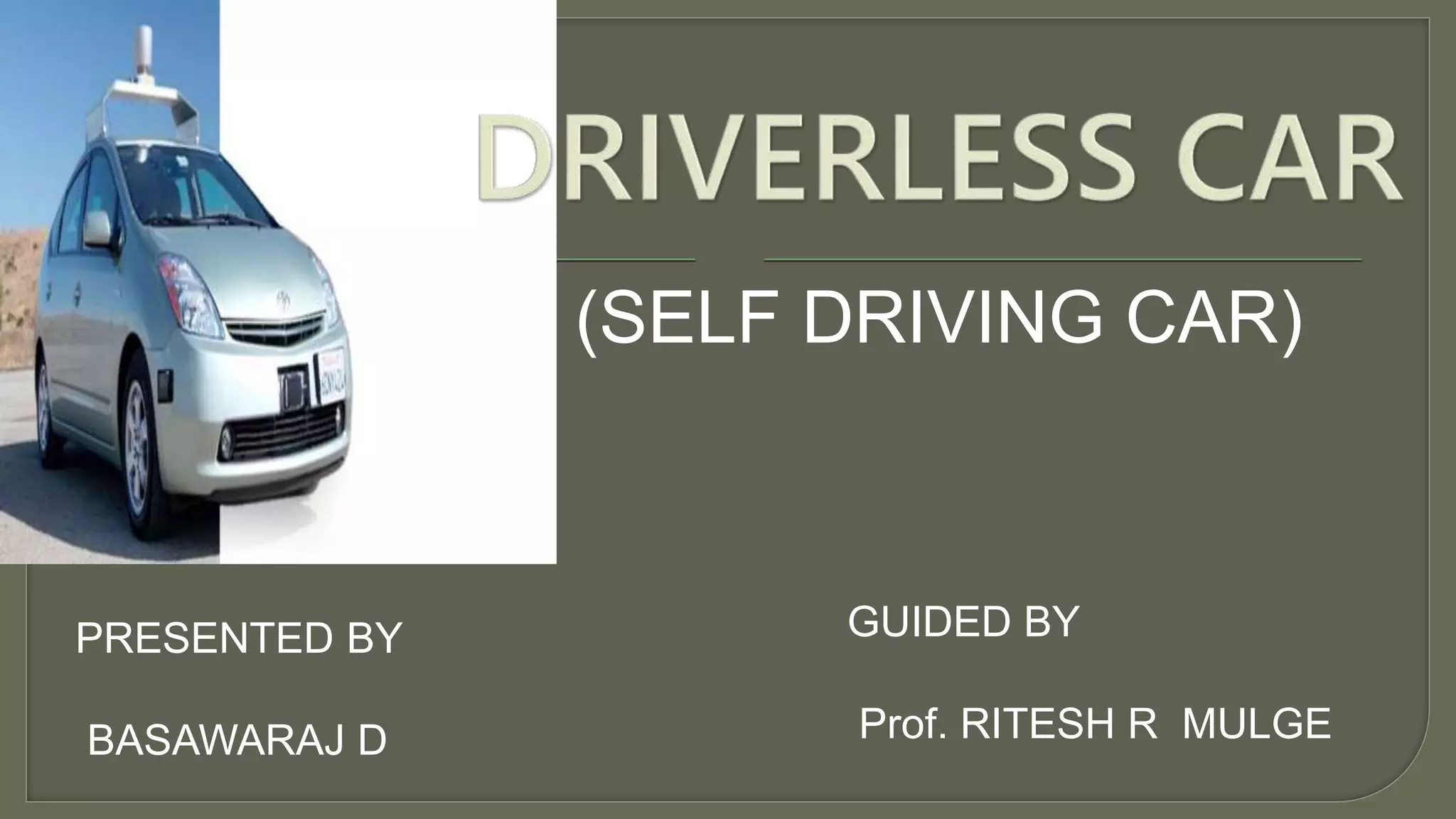
Toyota Prius modified to operate as a Google driverless
car
 By 2014, Israeli company Mobileye expects to release semi-
autonomous car technology.
 By 2015, Audi plans to market vehicles that can autonomously steer,
accelerate and brake at lower speeds, such as in traffic jams.
 By 2016, Mobileye expects to release fully autonomous car technology.
 By 2017, Google expects to release their autonomous car technology.
 By 2020, Volvo envisages having cars in which passengers would be
immune from injuries.
 By 2020, Mercedes-Benz, Audi, Nissan and BMW all expect to sell
autonomous cars.
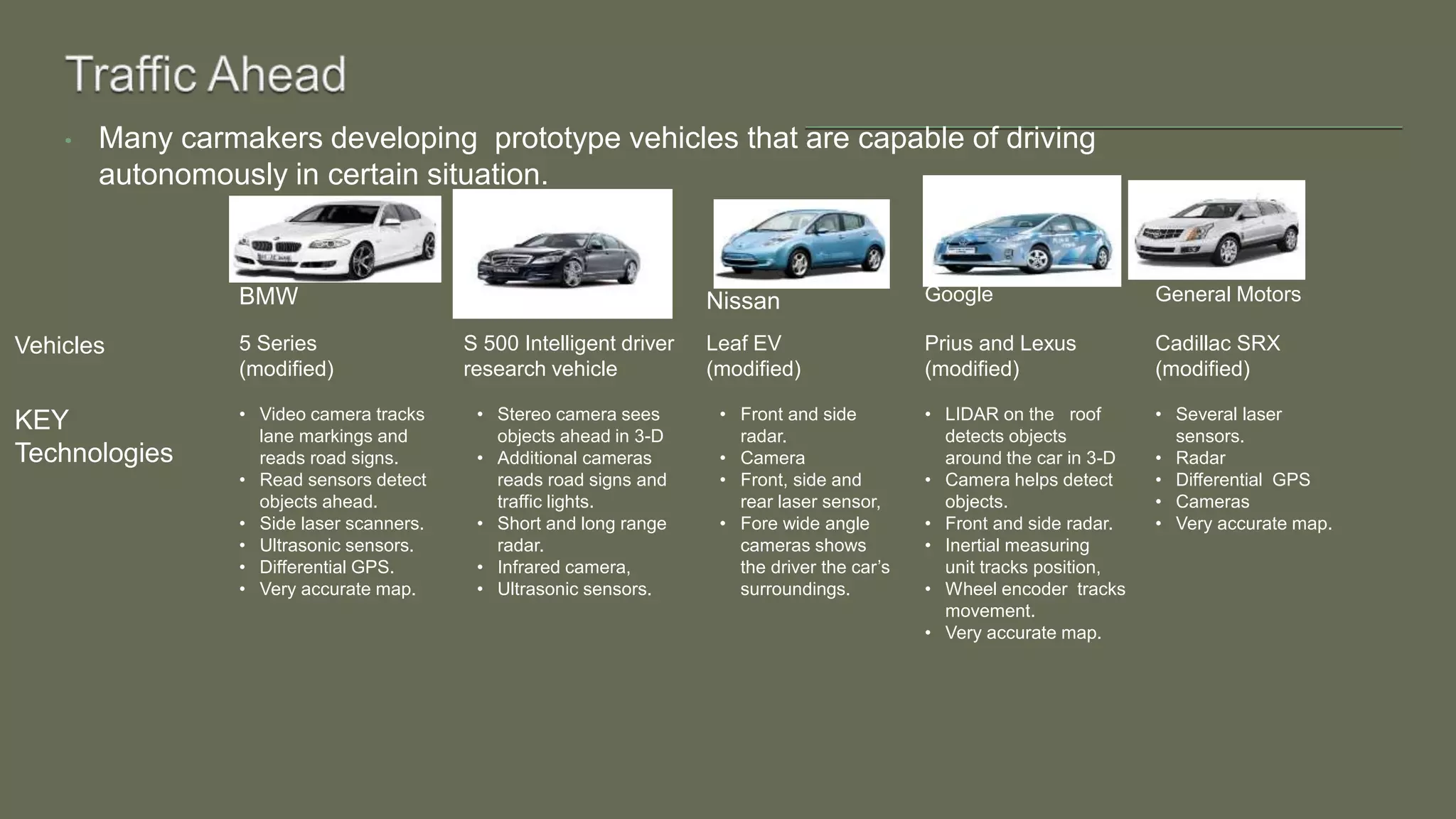
• Many carmakers developing prototype vehicles that are capable of driving
autonomously in certain situation.
BMW
z
Nissan Google General Motors
Vehicles 5 Series
(modified)
S 500 Intelligent driver
research vehicle
Leaf EV
(modified)
Prius and Lexus
(modified)
Cadillac SRX
(modified)
KEY
Technologies
• Video camera tracks
lane markings and
reads road signs.
• Read sensors detect
objects ahead.
• Side laser scanners.
• Ultrasonic sensors.
• Differential GPS.
• Very accurate map.
• Stereo camera sees
objects ahead in 3-D
• Additional cameras
reads road signs and
traffic lights.
• Short and long range
radar.
• Infrared camera,
• Ultrasonic sensors.
• Front and side
radar.
• Camera
• Front, side and
rear laser sensor,
• Fore wide angle
cameras shows
the driver the car’s
surroundings.
• LIDAR on the roof
detects objects
around the car in 3-D
• Camera helps detect
objects.
• Front and side radar.
• Inertial measuring
unit tracks position,
• Wheel encoder tracks
movement.
• Very accurate map.
• Several laser
sensors.
• Radar
• Differential GPS
• Cameras
• Very accurate map.
Although legal issues connected to driverless cars have
raised many questions, as driverless car is still in research,
hope we can see driverless car running on roads soon
which would overcome all these obstacles and issues in
the future, let’s wait and see
Could be ready for market as little a 4-5 years
http://en.wikipedia.org/wiki/Autonomous_car
http://www.techradar.com/us/news/car-tech/google-wants-some-form-of-self-driving-cars-on-
roads-by-2018-1130660
http://www.cvel.clemson.edu/auto/AuE835_Projects_2011/Vallabhaneni_project.html
www.matronic.de
http://auto.howstuffworks.com/under-the-hood/trends-innovations/driverless-car1.htm
Info graphics
http://drivesteady.com/how-autonomous-vehicles-work
Thank you

Autonomous car(driver less car) (self driving car)

  • 1.
    (SELF DRIVING CAR) PRESENTEDBY BASAWARAJ D GUIDED BY Prof. RITESH R MULGE
  • 2.
  • 3.
    Vehicular automation involvesthe use of Mechatronics Artificial Intelligence to assist a vehicle's operator. These features and the vehicles employing them may be labeled as intelligent or smart
  • 4.
     An autonomouscar is also called as self driving car, driverless car or robotic car, an autonomous vehicle capable of fulfilling the human transportation capabilities of a traditional car.  As an autonomous vehicle, it is capable of sensing its environment and navigating without human input.
  • 5.
    Driver less caris a project by Google that involves the developing technology for autonomous car The software powering car is called “Google chauffeur” This project is being led by Google engineer and team This team has 15 engineers
  • 6.
  • 8.
     Traditional RADARsensors are used to detect dangerous objects in the vehicle’s path that are more than 100 meters away.  Accident-Prevention systems trigger alerts when they detect something in a blind car’s blind spot.  The radar chirps between 10 and 11 GHz over a 5 millisecond period, transmitting the radar signal from a centrally located antenna cone.  Two receive cones, separated by approximately 14 inches, receive the reflected radar energy.
  • 9.
    A video camerainstalled at the top of the front glass near the rear- view mirror. These cameras are used to detect the traffic lights , pedestrians, animals etc. It is also used to identify road markings and traffic signals.
  • 10.
     The LightDetection And Ranging (LIDAR) which is mounted on the roof of the vehicle is the most important device in the Autonomous vehicles.  The LIDAR consists of an emitter, mirror and receiver.  The emitter sends out a LASER beam that bounces off a mirror that is rotating along with the cylindrical housing at 10 revolutions per minute.  After bouncing off objects, the LASER beam returns to the mirror and is bounced back towards the receiver, where it can be interpreted into data.  The vehicle can then generate a map of its surroundings and use the map to avoid objects.
  • 12.
    The global positioningsystem(GPS) is a space based satellite navigation system that provides location and the time information. But the data alone with the GPS system is less accurate so this data is combined with the outputs from the IMU(inertial measurement unit) IMU is an electronic device which measures and gives the information about vehicles velocity
  • 13.
    Some 7 dual-core2.13 GHz processors and 2Gb of RAM are needed to make sense of the data collected by the car’s instruments.
  • 14.
     Wheel SpeedSensors measure the road-wheel speed and direction of rotation.  These sensors provide input to a number of different automotive systems including the anti-lock brake system and electronic stability control.
  • 15.
     The signalfrom the sensors are used by the Electronic Control Unit for decision making using a software code.  Based on the information from the sensors, the Electronic Control Unit gives signal to the actuators, which in turn control the vehicle.  Also, real time information of the surroundings is output to the user interface located inside the vehicle.
  • 16.
    Google Maps andthe hardware sensors data are sent to the AI. AI then determines: how fast to accelerate when to slow down/stop when to steer the wheel Goal of AI The agent's goal is to take the passenger to its desired destination safely and legally.
  • 19.
     Minimize accidentsrates in cities  The system will allow the commuters to do other things while travelling such as reading or sleeping.  Increased roadway capacity and reduced traffic congestion  Relief of vehicle occupants from driving and navigation chores.  Higher speed limit for autonomous cars.  Alleviation of parking scarcity.  Reduction of space required for vehicle parking.  Reduction in the need for traffic police and vehicle insurance.  Smoother ride.
  • 20.
     As ofAugust 28,2014 the latest prototype cannot “Handle heavy rain and snow covered roads”.  Chris Urmson of Google said That the LIDAR technology cannot spot a police officer signaling car to stop  Vehicles are unable to differentiate between crumpled up paper and a rock Loss of driver-related jobs Temporary construction zones which are not posted to any maps or data bases. According to Google, projects having these issues fixed by 2020.
  • 21.
    Toyota Prius modifiedto operate as a Google driverless car
  • 22.
     By 2014,Israeli company Mobileye expects to release semi- autonomous car technology.  By 2015, Audi plans to market vehicles that can autonomously steer, accelerate and brake at lower speeds, such as in traffic jams.  By 2016, Mobileye expects to release fully autonomous car technology.  By 2017, Google expects to release their autonomous car technology.  By 2020, Volvo envisages having cars in which passengers would be immune from injuries.  By 2020, Mercedes-Benz, Audi, Nissan and BMW all expect to sell autonomous cars.
  • 23.
    • Many carmakersdeveloping prototype vehicles that are capable of driving autonomously in certain situation. BMW z Nissan Google General Motors Vehicles 5 Series (modified) S 500 Intelligent driver research vehicle Leaf EV (modified) Prius and Lexus (modified) Cadillac SRX (modified) KEY Technologies • Video camera tracks lane markings and reads road signs. • Read sensors detect objects ahead. • Side laser scanners. • Ultrasonic sensors. • Differential GPS. • Very accurate map. • Stereo camera sees objects ahead in 3-D • Additional cameras reads road signs and traffic lights. • Short and long range radar. • Infrared camera, • Ultrasonic sensors. • Front and side radar. • Camera • Front, side and rear laser sensor, • Fore wide angle cameras shows the driver the car’s surroundings. • LIDAR on the roof detects objects around the car in 3-D • Camera helps detect objects. • Front and side radar. • Inertial measuring unit tracks position, • Wheel encoder tracks movement. • Very accurate map. • Several laser sensors. • Radar • Differential GPS • Cameras • Very accurate map.
  • 24.
    Although legal issuesconnected to driverless cars have raised many questions, as driverless car is still in research, hope we can see driverless car running on roads soon which would overcome all these obstacles and issues in the future, let’s wait and see Could be ready for market as little a 4-5 years
  • 25.
  • 26.