



Channel Relationship
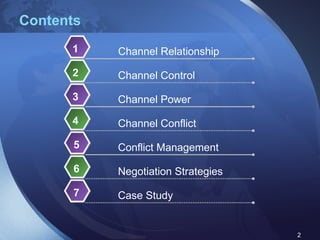
Contents Channel Relationship 1 Channel Control 2 Channel Power 3 Channel Conflict 4 5 Conflict Management 6 Negotiation Strategies 7 Case Study 1
Channel Relationship What is channel relationship? What is the importance of Channel Relationship?
Channel Relationship The relationships are defined in terms of interrelated concepts such as power, dependence, control, etc.. Strong and sustainable relationship is important. Channel leader sets channel wide objective. Defining a channel leader is important.
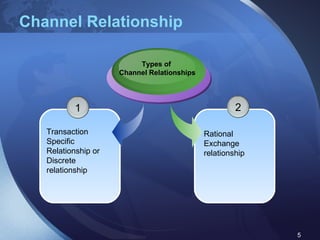
Channel Relationship Transaction Specific Relationship or Discrete relationship Types of  Channel Relationships Rational Exchange relationship 1 2
Channel Relationship Discrete relationship- parties do not have any commitment to each other. Absolute freedom on the price or other terms. There is no concept of channel leader.
Channel Relationship Rational exchange Relationship-parties are attached to each other to achieve a common goal. Willing to sacrifice their individual goals. Level of commitment is very high.
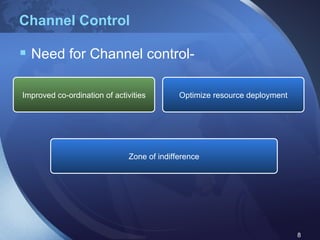
Channel Control Need for Channel control- Zone of indifference Optimize resource deployment Improved co-ordination of activities
Channel Control Future channel survival and success Optimize deployment of resources Controlling member must possess some authority
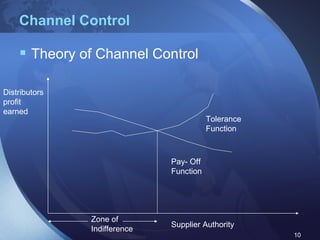
Channel Control Theory of Channel Control Pay- Off Function Tolerance Function Distributors profit earned Zone of Indifference Supplier Authority
Channel Power Emersons definition of power: The power of A over B is equal to and based upon the dependence of B upon A. The dependence of actor B upon Actor a is -: Directly proportional to B’s motivational investment in goals mediated by A, and  Inversely proportional to the availability of those goals to B outside of the A-B relation
Channel Power El-Ansary and Sterns definition of power: The power of a channel member is his ability to control his decision variables in the marketing strategy of another member in a given channel at a different level of distribution. For this control to qualify as power, it should be different from the influenced member’s original level of control over his marketing strategy.
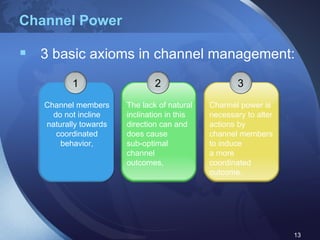
Channel Power 3 basic axioms in channel management: 1 Channel members do not incline naturally towards coordinated behavior, 3 Channel power is necessary to alter actions by channel members to induce  a more coordinated outcome. 2 The lack of natural inclination in this direction can and does cause  sub-optimal channel outcomes,
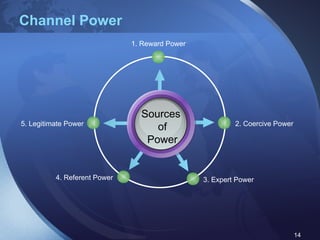
Channel Power Sources  of Power 1. Reward Power 2. Coercive Power 3. Expert Power 5. Legitimate Power 4. Referent Power
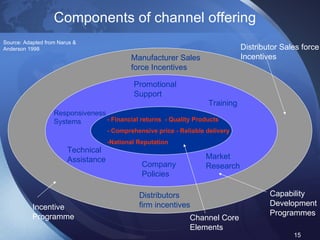
Source: Adapted from Narus & Anderson 1998 Promotional Support Training Market Research Company Policies Distributors firm incentives Responsiveness Systems Technical Assistance Incentive Programme Distributor Sales force Incentives - Financial returns  - Quality Products - Comprehensive price - Reliable delivery -National Reputation Channel Core Elements Capability Development Programmes Components of channel offering Manufacturer Sales force Incentives
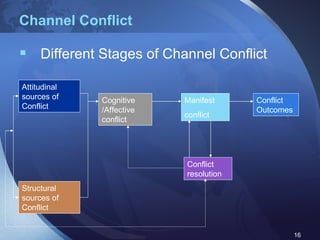
Channel Conflict Different Stages of Channel Conflict Attitudinal sources of Conflict Structural  sources of Conflict Cognitive /Affective conflict Manifest  conflict Conflict Outcomes Conflict resolution
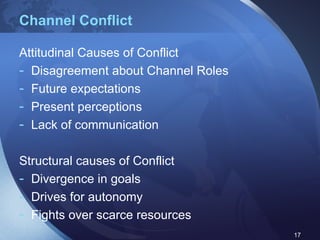
Channel Conflict Attitudinal Causes of Conflict Disagreement about Channel Roles Future expectations  Present perceptions Lack of communication  Structural causes of Conflict Divergence in goals Drives for autonomy Fights over scarce resources
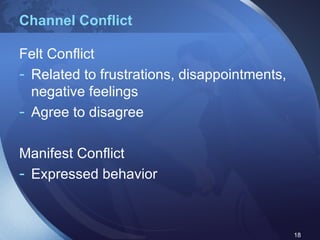
Channel Conflict Felt Conflict Related to frustrations, disappointments, negative feelings Agree to disagree Manifest Conflict Expressed behavior
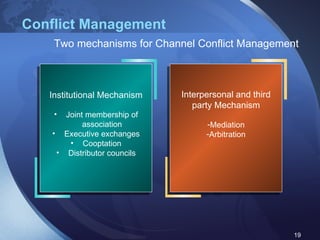
Conflict Management Institutional Mechanism Joint membership of association Executive exchanges Cooptation Distributor councils Interpersonal and third party Mechanism Mediation Arbitration Two mechanisms for Channel Conflict Management
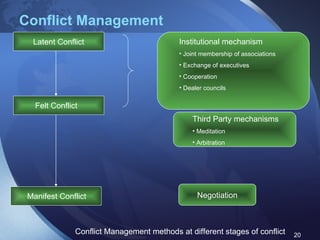
Conflict Management Latent Conflict Felt Conflict Manifest Conflict Institutional mechanism Joint membership of associations Exchange of executives Cooperation Dealer councils Third Party mechanisms Meditation Arbitration Negotiation Conflict Management methods at different stages of conflict
Negotiation Strategies Negotiation is a process where parties to the dispute set down mutual rules of engagement and work within these rules to achieve competitive advantage over the other party.
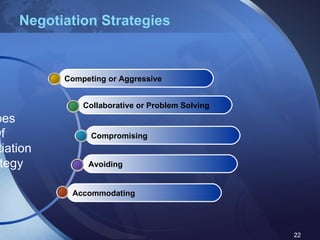
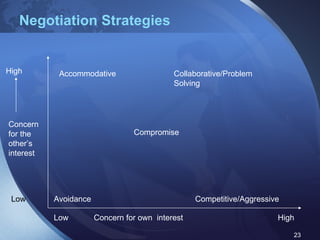
Negotiation Strategies Types  Of  Negotiation Strategy Accommodating Avoiding Compromising Collaborative or Problem Solving Competing or Aggressive
Negotiation Strategies Accommodative Collaborative/Problem Solving Compromise Avoidance Competitive/Aggressive High Concern for own  interest Low Low High Concern for the other’s interest
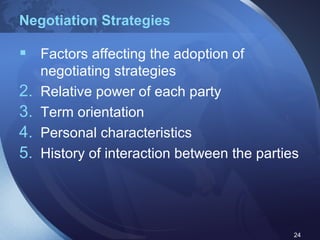
Negotiation Strategies Factors affecting the adoption of negotiating strategies Relative power of each party Term orientation Personal characteristics History of interaction between the parties
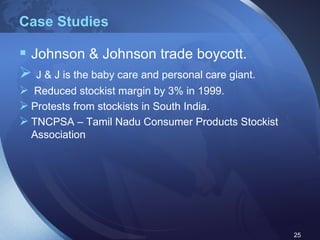
Case Studies Johnson & Johnson trade boycott. J & J is the baby care and personal care giant. Reduced stockist margin by 3% in 1999. Protests from stockists in South India. TNCPSA – Tamil Nadu Consumer Products Stockist Association
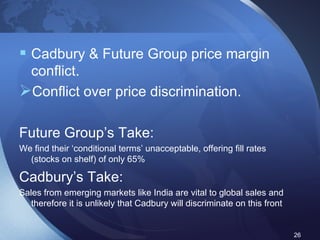
Cadbury & Future Group price margin conflict. Conflict over price discrimination. Future Group’s Take: We find their ‘conditional terms’ unacceptable, offering fill rates  (stocks on shelf) of only 65% Cadbury’s Take: Sales from emerging markets like India are vital to global sales and therefore it is unlikely that Cadbury will discriminate on this front
Thank us for educating you!

Channel Relationship

  • 1.
  • 2.
    Contents Channel Relationship1 Channel Control 2 Channel Power 3 Channel Conflict 4 5 Conflict Management 6 Negotiation Strategies 7 Case Study 1
  • 3.
    Channel Relationship Whatis channel relationship? What is the importance of Channel Relationship?
  • 4.
    Channel Relationship Therelationships are defined in terms of interrelated concepts such as power, dependence, control, etc.. Strong and sustainable relationship is important. Channel leader sets channel wide objective. Defining a channel leader is important.
  • 5.
    Channel Relationship TransactionSpecific Relationship or Discrete relationship Types of Channel Relationships Rational Exchange relationship 1 2
  • 6.
    Channel Relationship Discreterelationship- parties do not have any commitment to each other. Absolute freedom on the price or other terms. There is no concept of channel leader.
  • 7.
    Channel Relationship Rationalexchange Relationship-parties are attached to each other to achieve a common goal. Willing to sacrifice their individual goals. Level of commitment is very high.
  • 8.
    Channel Control Needfor Channel control- Zone of indifference Optimize resource deployment Improved co-ordination of activities
  • 9.
    Channel Control Futurechannel survival and success Optimize deployment of resources Controlling member must possess some authority
  • 10.
    Channel Control Theoryof Channel Control Pay- Off Function Tolerance Function Distributors profit earned Zone of Indifference Supplier Authority
  • 11.
    Channel Power Emersonsdefinition of power: The power of A over B is equal to and based upon the dependence of B upon A. The dependence of actor B upon Actor a is -: Directly proportional to B’s motivational investment in goals mediated by A, and Inversely proportional to the availability of those goals to B outside of the A-B relation
  • 12.
    Channel Power El-Ansaryand Sterns definition of power: The power of a channel member is his ability to control his decision variables in the marketing strategy of another member in a given channel at a different level of distribution. For this control to qualify as power, it should be different from the influenced member’s original level of control over his marketing strategy.
  • 13.
    Channel Power 3basic axioms in channel management: 1 Channel members do not incline naturally towards coordinated behavior, 3 Channel power is necessary to alter actions by channel members to induce a more coordinated outcome. 2 The lack of natural inclination in this direction can and does cause sub-optimal channel outcomes,
  • 14.
    Channel Power Sources of Power 1. Reward Power 2. Coercive Power 3. Expert Power 5. Legitimate Power 4. Referent Power
  • 15.
    Source: Adapted fromNarus & Anderson 1998 Promotional Support Training Market Research Company Policies Distributors firm incentives Responsiveness Systems Technical Assistance Incentive Programme Distributor Sales force Incentives - Financial returns - Quality Products - Comprehensive price - Reliable delivery -National Reputation Channel Core Elements Capability Development Programmes Components of channel offering Manufacturer Sales force Incentives
  • 16.
    Channel Conflict DifferentStages of Channel Conflict Attitudinal sources of Conflict Structural sources of Conflict Cognitive /Affective conflict Manifest conflict Conflict Outcomes Conflict resolution
  • 17.
    Channel Conflict AttitudinalCauses of Conflict Disagreement about Channel Roles Future expectations Present perceptions Lack of communication Structural causes of Conflict Divergence in goals Drives for autonomy Fights over scarce resources
  • 18.
    Channel Conflict FeltConflict Related to frustrations, disappointments, negative feelings Agree to disagree Manifest Conflict Expressed behavior
  • 19.
    Conflict Management InstitutionalMechanism Joint membership of association Executive exchanges Cooptation Distributor councils Interpersonal and third party Mechanism Mediation Arbitration Two mechanisms for Channel Conflict Management
  • 20.
    Conflict Management LatentConflict Felt Conflict Manifest Conflict Institutional mechanism Joint membership of associations Exchange of executives Cooperation Dealer councils Third Party mechanisms Meditation Arbitration Negotiation Conflict Management methods at different stages of conflict
  • 21.
    Negotiation Strategies Negotiationis a process where parties to the dispute set down mutual rules of engagement and work within these rules to achieve competitive advantage over the other party.
  • 22.
    Negotiation Strategies Types Of Negotiation Strategy Accommodating Avoiding Compromising Collaborative or Problem Solving Competing or Aggressive
  • 23.
    Negotiation Strategies AccommodativeCollaborative/Problem Solving Compromise Avoidance Competitive/Aggressive High Concern for own interest Low Low High Concern for the other’s interest
  • 24.
    Negotiation Strategies Factorsaffecting the adoption of negotiating strategies Relative power of each party Term orientation Personal characteristics History of interaction between the parties
  • 25.
    Case Studies Johnson& Johnson trade boycott. J & J is the baby care and personal care giant. Reduced stockist margin by 3% in 1999. Protests from stockists in South India. TNCPSA – Tamil Nadu Consumer Products Stockist Association
  • 26.
    Cadbury & FutureGroup price margin conflict. Conflict over price discrimination. Future Group’s Take: We find their ‘conditional terms’ unacceptable, offering fill rates (stocks on shelf) of only 65% Cadbury’s Take: Sales from emerging markets like India are vital to global sales and therefore it is unlikely that Cadbury will discriminate on this front
  • 27.
    Thank us foreducating you!