Contents Industry Overview 1 Company Overview 2 Competitors & competitor analysis 3 Strategic Groups 4 Resource Based View 6 Core Competencies 5 Activity Based View 7 Five Forces Model & Value Net 8 Value chain & SWOT Analysis 9 Adoption Of Strategies 10 Financial analysis & Recommendation 11
Industry Overview U.K The retail industry employed 2.9 million people, as at the end of September 20. The retail sector generates almost 8% of the Gross Domestic Product of the UK. Supermarkets dominate the UK food retail market, with 56.0% of sales. 11% of all VAT-registered businesses in the UK are retailers. 70% of UK retail is Organized and 30% is Unorganized.
Company overview www.Tesco.com is recognized as the world’s largest online grocer, with a customer base of little less than 1 million and more than 250,000 orders a week. Tesco is the  third-largest retailer in the world next to Wal-Mart, Carrefour  and is operating around 2,440 stores and employing over 4,00,000 people Tesco’s market share of UK retailing is 12.5%. Tesco’s is a United Kingdom based international supermarket chain. It is the largest British retailer both by global sales and by domestic market share. Established in 1924.
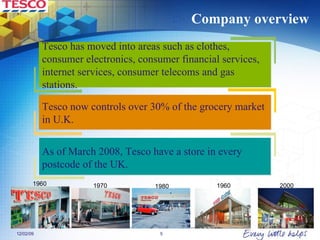
Company overview As of March 2008, Tesco have a store in every postcode of the UK. Tesco now controls over 30% of the grocery market in U.K. Tesco has moved into areas such as clothes, consumer electronics, consumer financial services, internet services, consumer telecoms and gas stations. 1960 1970 1980 1960 2000
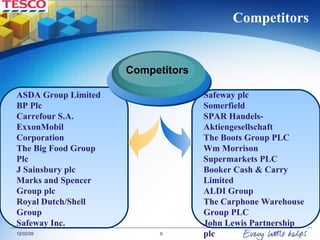
Competitors Safeway plc Somerfield SPAR Handels-Aktiengesellschaft The Boots Group PLC Wm Morrison Supermarkets PLC Booker Cash & Carry Limited ALDI Group The Carphone Warehouse Group PLC John Lewis Partnership plc ASDA Group Limited BP Plc Carrefour S.A. ExxonMobil Corporation The Big Food Group Plc J Sainsbury plc Marks and Spencer Group plc Royal Dutch/Shell Group Safeway Inc. Competitors
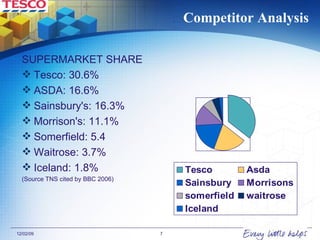
Competitor Analysis SUPERMARKET SHARE  Tesco: 30.6% ASDA: 16.6% Sainsbury's: 16.3% Morrison's: 11.1% Somerfield: 5.4 Waitrose: 3.7% Iceland: 1.8% (Source TNS cited by BBC 2006)
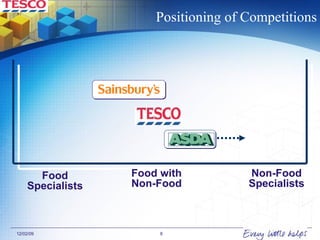
Positioning of Competitions Food Specialists Food with Non-Food Non-Food Specialists
Strategic Groups Sainsbury’s  was the UK's biggest grocer until 1995, but was recently relegated to third position behind Tesco and Asda. Despite the fact that company has been struggling lately it is starting to get back on track.  Despite predictions that Sainsbury's would regain second position and a narrowing of ASDA's lead in recent months, the latest figures released by Taylor Nelson Sofres show Asda's share as 16.6% compared to Sainsbury's at 16.22%.   ASDA owned by US corporation Wal-Mart since 1999, is the only supermarket with the potential to become a thorn in the side for Tesco. Wal-Mart is the biggest food chain in the world and has annual sales eight times bigger than Tesco’s. Asda's George range of clothing is the best selling brand in the UK and company is thinking about acquiring Matalan, the giant discount clothing and home furnishing store.
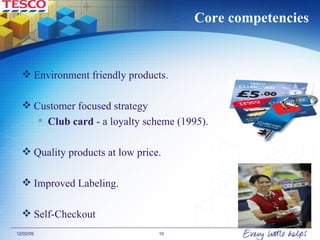
Core competencies Environment friendly products. Customer focused strategy Club card  - a loyalty scheme (1995). Quality products at low price. Improved Labeling. Self-Checkout
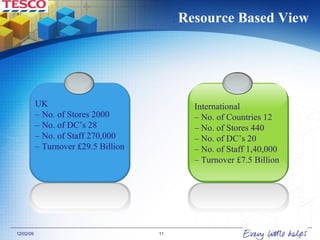
Resource Based View UK –  No. of Stores 2000 –  No. of DC’s 28 –  No. of Staff 270,000 –  Turnover £29.5 Billion International –  No. of Countries 12 –  No. of Stores 440 –  No. of DC’s 20 –  No. of Staff 1,40,000 –  Turnover £7.5 Billion
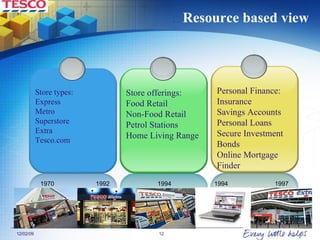
Resource based view 1994 1992 1970 1997 1994 Store types: Express Metro Superstore Extra Tesco.com Store offerings: Food Retail Non-Food Retail Petrol Stations Home Living Range Personal Finance: Insurance Savings Accounts Personal Loans Secure Investment Bonds Online Mortgage Finder
Resource Based View Overall Profit £2.0 Billion (1st time for a British Retailer) 04/05. Tesco sells approximately 40,000 food products in its superstores, as well as clothing and other non-food lines. The company’s own-label products are at three levels value, normal and finest. Own brand accounts for approximately 50% of sales. Tesco does business with nearly 2,000 own-brand  primary suppliers in 98 countries.
Private labels Ellen Wesley A trademark for the women who know what they want. Daniel Moore A successful man trademark James Be Yourself Mirage A trademark to fascinate you 4Future A new fashion line for boys from 3 up to 12. Miss M Sports fashion and stylish girl clothing.
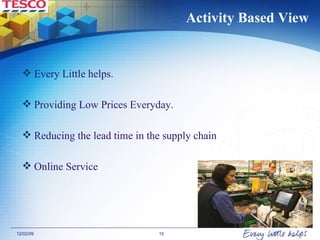
Activity Based View Every Little helps. Providing Low Prices Everyday. Reducing the lead time in the supply chain Online Service
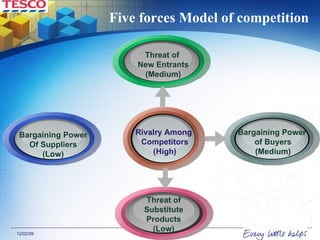
Five forces Model of competition Rivalry Among  Competitors (High) Bargaining Power  of Buyers (Medium) Threat of  New Entrants (Medium) Threat of Substitute Products (Low) Bargaining Power Of Suppliers (Low)
Five forces Model of competition Threats Of New Entrants Competitive Rivalry is considered a high threat and are people like Amazon and Asda including other supermarkets and non-food retailers who are involved in the same concept. IF consumers see little difference between the product and that of the competition then they will tend to choose on price.  Bargaining Power of Suppliers- There is little threat as often large supermarkets dictate the price they pay to the supplier. If the supplier does not agree to Tesco’s price then the supplier will be left with no retailer.
Five forces Model of competition Threats of New Entrants- Tesco, Asda, Sainsbury and other supermarket chains put up considerable barriers to entry. Anyone starting up a new supermarket chain has barriers imposed on them, implicitly or explicitly, by the existing supermarkets.  Bargaining Power of Buyer- Buyer power also acts to force prices down. If beans are too expensive in Tesco, buyers will exercise their power and move to Sainsbury. Tesco including other supermarkets have a disciplined approach to prices setting. This approach stops them from destroying each other in a profit war.
Five forces Model of competition Threat of Substitute Products- Tesco competition from other supermarkets which can provide substitute goods drives the prices of both companies down; therefore substitute is seen as a Low threat.
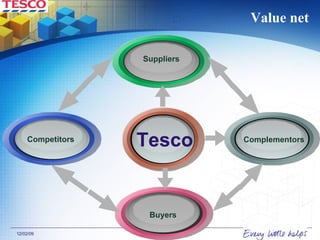
Value net Tesco Complementors Suppliers Buyers Competitors
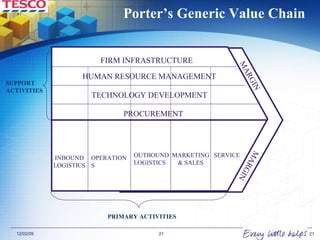
Porter’s Generic Value Chain  MARGIN MARGIN PRIMARY ACTIVITIES SUPPORT ACTIVITIES TECHNOLOGY DEVELOPMENT FIRM INFRASTRUCTURE HUMAN RESOURCE MANAGEMENT PROCUREMENT INBOUND LOGISTICS OPERATIONS OUTBOUND LOGISTICS MARKETING & SALES SERVICE
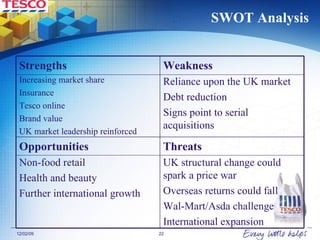
SWOT Analysis Threats UK structural change could spark a price war Overseas returns could fall Wal-Mart/Asda challenge International expansion Opportunities Non-food retail Health and beauty Further international growth Weakness Reliance upon the UK market Debt reduction Signs point to serial acquisitions Strengths Increasing market share Insurance Tesco online Brand value UK market leadership reinforced
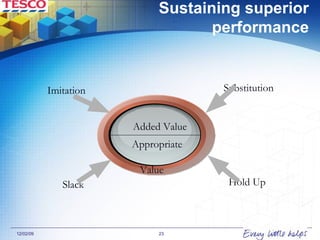
Sustaining superior performance Imitation Slack Substitution Hold Up Added Value Appropriate  Value
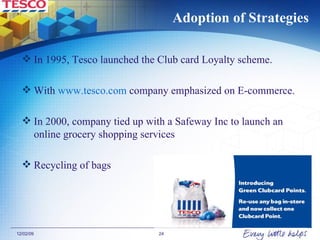
Adoption of Strategies In 1995, Tesco launched the Club card Loyalty scheme. With  www.tesco.com  company emphasized on E-commerce. In 2000, company tied up with a Safeway Inc to launch an online grocery shopping services Recycling of bags
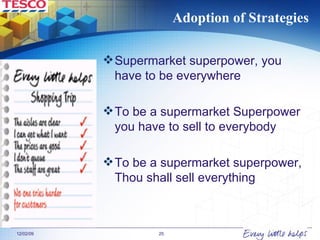
Adoption of Strategies Supermarket superpower, you have to be everywhere  To be a supermarket Superpower you have to sell to everybody  To be a supermarket superpower, Thou shall sell everything
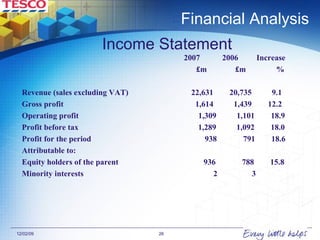
Financial Analysis   2007  2006  Increase  £m  £m  %  Revenue (sales excluding VAT)  22,631  20,735  9.1 Gross profit  1,614  1,439  12.2 Operating profit  1,309  1,101  18.9 Profit before tax  1,289  1,092  18.0 Profit for the period  938  791  18.6 Attributable to: Equity holders of the parent  936  788  15.8 Minority interests  2  3 Income Statement
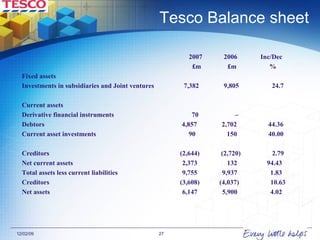
Tesco Balance sheet 2007  2006  Inc/Dec £m  £m  % Fixed assets Investments in subsidiaries and Joint ventures  7,382  9,805  24.7 Current assets Derivative financial instruments  70  – Debtors  4,857  2,702  44.36 Current asset investments  90  150  40.00 Creditors  (2,644)  (2,720)  2.79 Net current assets  2,373  132  94.43  Total assets less current liabilities  9,755  9,937  1.83 Creditors  (3,608)  (4,037)  10.63 Net assets  6,147  5,900  4.02
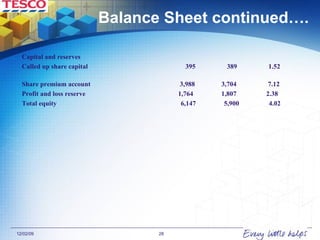
Balance Sheet continued…. Capital and reserves  Called up share capital  395  389  1.52  Share premium account  3,988  3,704  7.12 Profit and loss reserve  1,764  1,807  2.38 Total equity  6,147  5,900  4.02
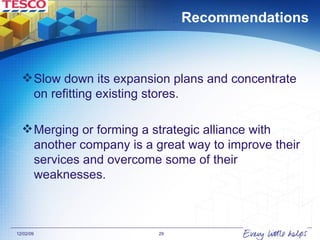
Recommendations Slow down its expansion plans and concentrate on refitting existing stores. Merging or forming a strategic alliance with another company is a great way to improve their services and overcome some of their weaknesses.
Bibliography www.wikipedia.com www.tescocorporate.com www.tesco.com
 

Tesco

  • 1.
  • 2.
    Contents Industry Overview1 Company Overview 2 Competitors & competitor analysis 3 Strategic Groups 4 Resource Based View 6 Core Competencies 5 Activity Based View 7 Five Forces Model & Value Net 8 Value chain & SWOT Analysis 9 Adoption Of Strategies 10 Financial analysis & Recommendation 11
  • 3.
    Industry Overview U.KThe retail industry employed 2.9 million people, as at the end of September 20. The retail sector generates almost 8% of the Gross Domestic Product of the UK. Supermarkets dominate the UK food retail market, with 56.0% of sales. 11% of all VAT-registered businesses in the UK are retailers. 70% of UK retail is Organized and 30% is Unorganized.
  • 4.
    Company overview www.Tesco.comis recognized as the world’s largest online grocer, with a customer base of little less than 1 million and more than 250,000 orders a week. Tesco is the third-largest retailer in the world next to Wal-Mart, Carrefour and is operating around 2,440 stores and employing over 4,00,000 people Tesco’s market share of UK retailing is 12.5%. Tesco’s is a United Kingdom based international supermarket chain. It is the largest British retailer both by global sales and by domestic market share. Established in 1924.
  • 5.
    Company overview Asof March 2008, Tesco have a store in every postcode of the UK. Tesco now controls over 30% of the grocery market in U.K. Tesco has moved into areas such as clothes, consumer electronics, consumer financial services, internet services, consumer telecoms and gas stations. 1960 1970 1980 1960 2000
  • 6.
    Competitors Safeway plcSomerfield SPAR Handels-Aktiengesellschaft The Boots Group PLC Wm Morrison Supermarkets PLC Booker Cash & Carry Limited ALDI Group The Carphone Warehouse Group PLC John Lewis Partnership plc ASDA Group Limited BP Plc Carrefour S.A. ExxonMobil Corporation The Big Food Group Plc J Sainsbury plc Marks and Spencer Group plc Royal Dutch/Shell Group Safeway Inc. Competitors
  • 7.
    Competitor Analysis SUPERMARKETSHARE Tesco: 30.6% ASDA: 16.6% Sainsbury's: 16.3% Morrison's: 11.1% Somerfield: 5.4 Waitrose: 3.7% Iceland: 1.8% (Source TNS cited by BBC 2006)
  • 8.
    Positioning of CompetitionsFood Specialists Food with Non-Food Non-Food Specialists
  • 9.
    Strategic Groups Sainsbury’s was the UK's biggest grocer until 1995, but was recently relegated to third position behind Tesco and Asda. Despite the fact that company has been struggling lately it is starting to get back on track. Despite predictions that Sainsbury's would regain second position and a narrowing of ASDA's lead in recent months, the latest figures released by Taylor Nelson Sofres show Asda's share as 16.6% compared to Sainsbury's at 16.22%. ASDA owned by US corporation Wal-Mart since 1999, is the only supermarket with the potential to become a thorn in the side for Tesco. Wal-Mart is the biggest food chain in the world and has annual sales eight times bigger than Tesco’s. Asda's George range of clothing is the best selling brand in the UK and company is thinking about acquiring Matalan, the giant discount clothing and home furnishing store.
  • 10.
    Core competencies Environmentfriendly products. Customer focused strategy Club card - a loyalty scheme (1995). Quality products at low price. Improved Labeling. Self-Checkout
  • 11.
    Resource Based ViewUK – No. of Stores 2000 – No. of DC’s 28 – No. of Staff 270,000 – Turnover £29.5 Billion International – No. of Countries 12 – No. of Stores 440 – No. of DC’s 20 – No. of Staff 1,40,000 – Turnover £7.5 Billion
  • 12.
    Resource based view1994 1992 1970 1997 1994 Store types: Express Metro Superstore Extra Tesco.com Store offerings: Food Retail Non-Food Retail Petrol Stations Home Living Range Personal Finance: Insurance Savings Accounts Personal Loans Secure Investment Bonds Online Mortgage Finder
  • 13.
    Resource Based ViewOverall Profit £2.0 Billion (1st time for a British Retailer) 04/05. Tesco sells approximately 40,000 food products in its superstores, as well as clothing and other non-food lines. The company’s own-label products are at three levels value, normal and finest. Own brand accounts for approximately 50% of sales. Tesco does business with nearly 2,000 own-brand primary suppliers in 98 countries.
  • 14.
    Private labels EllenWesley A trademark for the women who know what they want. Daniel Moore A successful man trademark James Be Yourself Mirage A trademark to fascinate you 4Future A new fashion line for boys from 3 up to 12. Miss M Sports fashion and stylish girl clothing.
  • 15.
    Activity Based ViewEvery Little helps. Providing Low Prices Everyday. Reducing the lead time in the supply chain Online Service
  • 16.
    Five forces Modelof competition Rivalry Among Competitors (High) Bargaining Power of Buyers (Medium) Threat of New Entrants (Medium) Threat of Substitute Products (Low) Bargaining Power Of Suppliers (Low)
  • 17.
    Five forces Modelof competition Threats Of New Entrants Competitive Rivalry is considered a high threat and are people like Amazon and Asda including other supermarkets and non-food retailers who are involved in the same concept. IF consumers see little difference between the product and that of the competition then they will tend to choose on price. Bargaining Power of Suppliers- There is little threat as often large supermarkets dictate the price they pay to the supplier. If the supplier does not agree to Tesco’s price then the supplier will be left with no retailer.
  • 18.
    Five forces Modelof competition Threats of New Entrants- Tesco, Asda, Sainsbury and other supermarket chains put up considerable barriers to entry. Anyone starting up a new supermarket chain has barriers imposed on them, implicitly or explicitly, by the existing supermarkets. Bargaining Power of Buyer- Buyer power also acts to force prices down. If beans are too expensive in Tesco, buyers will exercise their power and move to Sainsbury. Tesco including other supermarkets have a disciplined approach to prices setting. This approach stops them from destroying each other in a profit war.
  • 19.
    Five forces Modelof competition Threat of Substitute Products- Tesco competition from other supermarkets which can provide substitute goods drives the prices of both companies down; therefore substitute is seen as a Low threat.
  • 20.
    Value net TescoComplementors Suppliers Buyers Competitors
  • 21.
    Porter’s Generic ValueChain MARGIN MARGIN PRIMARY ACTIVITIES SUPPORT ACTIVITIES TECHNOLOGY DEVELOPMENT FIRM INFRASTRUCTURE HUMAN RESOURCE MANAGEMENT PROCUREMENT INBOUND LOGISTICS OPERATIONS OUTBOUND LOGISTICS MARKETING & SALES SERVICE
  • 22.
    SWOT Analysis ThreatsUK structural change could spark a price war Overseas returns could fall Wal-Mart/Asda challenge International expansion Opportunities Non-food retail Health and beauty Further international growth Weakness Reliance upon the UK market Debt reduction Signs point to serial acquisitions Strengths Increasing market share Insurance Tesco online Brand value UK market leadership reinforced
  • 23.
    Sustaining superior performanceImitation Slack Substitution Hold Up Added Value Appropriate Value
  • 24.
    Adoption of StrategiesIn 1995, Tesco launched the Club card Loyalty scheme. With www.tesco.com company emphasized on E-commerce. In 2000, company tied up with a Safeway Inc to launch an online grocery shopping services Recycling of bags
  • 25.
    Adoption of StrategiesSupermarket superpower, you have to be everywhere To be a supermarket Superpower you have to sell to everybody To be a supermarket superpower, Thou shall sell everything
  • 26.
    Financial Analysis 2007 2006 Increase £m £m % Revenue (sales excluding VAT) 22,631 20,735 9.1 Gross profit 1,614 1,439 12.2 Operating profit 1,309 1,101 18.9 Profit before tax 1,289 1,092 18.0 Profit for the period 938 791 18.6 Attributable to: Equity holders of the parent 936 788 15.8 Minority interests 2 3 Income Statement
  • 27.
    Tesco Balance sheet2007 2006 Inc/Dec £m £m % Fixed assets Investments in subsidiaries and Joint ventures 7,382 9,805 24.7 Current assets Derivative financial instruments 70 – Debtors 4,857 2,702 44.36 Current asset investments 90 150 40.00 Creditors (2,644) (2,720) 2.79 Net current assets 2,373 132 94.43 Total assets less current liabilities 9,755 9,937 1.83 Creditors (3,608) (4,037) 10.63 Net assets 6,147 5,900 4.02
  • 28.
    Balance Sheet continued….Capital and reserves Called up share capital 395 389 1.52 Share premium account 3,988 3,704 7.12 Profit and loss reserve 1,764 1,807 2.38 Total equity 6,147 5,900 4.02
  • 29.
    Recommendations Slow downits expansion plans and concentrate on refitting existing stores. Merging or forming a strategic alliance with another company is a great way to improve their services and overcome some of their weaknesses.
  • 30.
  • 31.