Physical distribution  and distribution  channels
Distribution ChannelsA set of interdependent organizations (intermediaries) involved in the process of making a product or service available for use or consumption.Channel decisionsaffect other marketing decisionsinvolve long-term commitments
Role of IntermediariesGreater efficiency in making goods available to target markets.Intermediaries provideContactsExperienceSpecializationScale of operationMatch supply and demand.
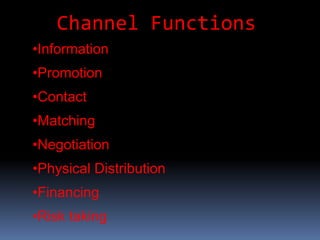
Channel FunctionsInformation
Promotion
Contact
Matching
Negotiation
Physical Distribution
Financing
Risk takingPhysical Distribution - Nature and ImportancePhysical distribution: Moving tangible products through distribution channels
Physical distribution (or logistics) consists of all activities involved in moving the right amount of the right products to the right place at the right time
In the past years, the surge of e-commerce has underscored the importance of physical distribution  	the challenge relates to fulfillment, which entails 	having the merchandise that is ordered by a 		customer in stock and then packing and shipping 	it in an efficient, timely mannerTHE ROLE OF MARKETING CHANNELSIN MARKETING STRATEGY• Marketing channels are key because they are the means of making goods and services available to ultimate users.• Four functions of marketing channels:• Channels facilitate the exchange process by reducing the number of marketplace contacts necessary to make a sale.• Distributors adjust for discrepancies in the market’s assortment  of goods and services via sorting, channeling products to meet the buyer’s and producer’s needs.• Channel members tend to standardize payment terms, delivery schedules, prices, purchase lots, and other conditions.•  Channels facilitate searches by both buyers and sellers and bring them together to complete the exchange process.
TYPES OF MARKETING CHANNELS• Most channel options involve at least one marketing intermediary, an organization that operates between producers and consumers or business users. • A retailer owned and operated by someone other than the manufacturer of the products it sells. • A wholesaler who takes title to the goods it handles and then distributes these goods to retailers, other distributors, or sometimes  end consumers. • Service firms market primarily through short channels because they sell intangible products and need to maintain personal relationships within their channels.
DIRECT SELLING• Direct channel—carries goods directly from a producer to the business purchaser or ultimate user. • Direct selling—a marketing strategy in which a producer establishes direct sales contact with its product’s final users. • Internet and direct mail are also potentially important tools for direct selling.CHANNELS USING MARKETING INTERMEDIARIES• For some products, using intermediaries may be more efficient, less expensive, and less time-consuming.
DUAL DISTRIBUTION• Movement of products through more than one channel to reach the firm’s target market.• Used to maximize the firm’s coverage in the marketplace or to increase the cost-effectiveness of the firm’s marketing effort.REVERSE CHANNELS• Channels designed to return goods to their producers.• Growing importance because of rising prices for raw materials, increasing availability of recycling facilities, and passage of additional antipollution and conservation laws.• Also used for recalls and repairs.
CHANNEL STRATEGY DECISIONSSELECTION OF A MARKETING CHANNEL• Multiple factors affect selection of a marketing channel.Market FactorsProduct FactorsOrganizational FactorsCompetitive Factors
DETERMINING DISTRIBUTION INTENSITY• Intensive distributionDistribution of a product through all available channels.• Selective distributionDistribution of a product through a limited number of channels.• Exclusive distributionDistribution of a product through a single wholesaler or retailer in a specific geographic region.• Restrictions are illegal if they reduce competition or create a monopoly.WHO SHOULD PERFORM CHANNEL FUNCTIONS?• Intermediary must provide better service at lower costs than manufacturers or retailers can provide for themselves. • Consolidation of channel functions can represent a strategic opportunity for a company.
CHANNEL MANAGEMENT AND LEADERSHIP• Marketers have relationships with intermediaries in distribution channels.• Channel captain Dominant and controlling member of a marketing channel.CHANNEL CONFLICT• Horizontal conflict—disagreements among channel members at the same level, such as two competing discount stores.• Vertical conflict occurs among members at different levels of the channel.• The gray market—goods produced for overseas markets that re-enter the U.S. market and compete against domestic versions.ACHIEVING CHANNEL COOPERATION• Best achieved when all members of channel see themselves as equal components; channel captain should provide this leadership.
VERTICAL MARKETING SYSTEMS• Vertical marketing system (VMS) Planned channel system designed to improve distribution efficiency and cost-effectiveness by integrating various functions throughout the distribution channel.CORPORATE AND ADMINISTERED SYSTEMS• Corporate marketing system—single owner runs organizations at each stage of the marketing channel.• Administered marketing system—dominant channel member exercises power to achieve channel coordination.CONTRACTUAL SYSTEMS	• Contractual marketing system—coordinates distribution through formal agreements among channel members.• Include wholesaler-sponsored voluntary chains, retail cooperatives, and franchises.
Tasks in Physical Distribution ManagementPhysical distribution refers to the actual physical flow of products
In contrast, physical distribution management is the development and operation of processes resulting in the effective and efficient physical flow of products
Effective physical distribution management requires careful attention to five interrelated activities:Order processingInventory controlInventory location and warehousingMaterials handlingTransportation
Tasks in Physical Distribution Management1. Order ProcessingThe starting point in a physical distribution system is order processing, which is a set of procedures for receiving, handling, and filling orders promptly and accurately
Electronic data interchange (EDI):
Between customer and supplier orders, invoices, and other business functions are transmitted by computer
Originally, EDI required a direct computer link between supplier and customer, now it is being conducted via the Internet
EDI can trim the cost of order processing significantly, which in turn may reduce purchase pricesTasks in Physical Distribution Management2. Inventory ControlThe goal of inventory control is to satisfy the order-fulfillment expectations of customerswhile minimizing both the investment and fluctuations in inventories
Just-in-Time:
JIT combines inventory control, purchasing, and production scheduling
Applying JIT, a firm buys in small quantities that arrive just in timefor production and then it produces in quantities just in time for saleTasks in Physical Distribution Management2. Inventory Control (continued)- Just-in-Time:…
Benefits of JIT are:
Dramatic cost savings
Shortened and more flexible and reliable production and delivery schedules
Quick responses to quality problems
Market-Response Systems:
The central promise is that those who intend to consume a product should activate a process to produce and deliver replacement items
In this way, a product is pulled through a channel on the basis of demandTasks in Physical Distribution Management3. Inventory Location and WarehousingManagement must make critical decisions about the size, location, and transportation of inventories
These areas are interrelated, often in complex ways

DISTRIBUTION CHANNELS

  • 1.
    Physical distribution and distribution channels
  • 2.
    Distribution ChannelsA setof interdependent organizations (intermediaries) involved in the process of making a product or service available for use or consumption.Channel decisionsaffect other marketing decisionsinvolve long-term commitments
  • 3.
    Role of IntermediariesGreaterefficiency in making goods available to target markets.Intermediaries provideContactsExperienceSpecializationScale of operationMatch supply and demand.
  • 4.
  • 5.
  • 6.
  • 7.
  • 8.
  • 9.
  • 10.
  • 11.
    Risk takingPhysical Distribution- Nature and ImportancePhysical distribution: Moving tangible products through distribution channels
  • 12.
    Physical distribution (orlogistics) consists of all activities involved in moving the right amount of the right products to the right place at the right time
  • 13.
    In the pastyears, the surge of e-commerce has underscored the importance of physical distribution  the challenge relates to fulfillment, which entails having the merchandise that is ordered by a customer in stock and then packing and shipping it in an efficient, timely mannerTHE ROLE OF MARKETING CHANNELSIN MARKETING STRATEGY• Marketing channels are key because they are the means of making goods and services available to ultimate users.• Four functions of marketing channels:• Channels facilitate the exchange process by reducing the number of marketplace contacts necessary to make a sale.• Distributors adjust for discrepancies in the market’s assortment of goods and services via sorting, channeling products to meet the buyer’s and producer’s needs.• Channel members tend to standardize payment terms, delivery schedules, prices, purchase lots, and other conditions.•  Channels facilitate searches by both buyers and sellers and bring them together to complete the exchange process.
  • 14.
    TYPES OF MARKETINGCHANNELS• Most channel options involve at least one marketing intermediary, an organization that operates between producers and consumers or business users. • A retailer owned and operated by someone other than the manufacturer of the products it sells. • A wholesaler who takes title to the goods it handles and then distributes these goods to retailers, other distributors, or sometimes end consumers. • Service firms market primarily through short channels because they sell intangible products and need to maintain personal relationships within their channels.
  • 15.
    DIRECT SELLING• Directchannel—carries goods directly from a producer to the business purchaser or ultimate user. • Direct selling—a marketing strategy in which a producer establishes direct sales contact with its product’s final users. • Internet and direct mail are also potentially important tools for direct selling.CHANNELS USING MARKETING INTERMEDIARIES• For some products, using intermediaries may be more efficient, less expensive, and less time-consuming.

  • 16.
    DUAL DISTRIBUTION• Movementof products through more than one channel to reach the firm’s target market.• Used to maximize the firm’s coverage in the marketplace or to increase the cost-effectiveness of the firm’s marketing effort.REVERSE CHANNELS• Channels designed to return goods to their producers.• Growing importance because of rising prices for raw materials, increasing availability of recycling facilities, and passage of additional antipollution and conservation laws.• Also used for recalls and repairs.
  • 17.
    CHANNEL STRATEGY DECISIONSSELECTIONOF A MARKETING CHANNEL• Multiple factors affect selection of a marketing channel.Market FactorsProduct FactorsOrganizational FactorsCompetitive Factors
  • 18.
    DETERMINING DISTRIBUTION INTENSITY•Intensive distributionDistribution of a product through all available channels.• Selective distributionDistribution of a product through a limited number of channels.• Exclusive distributionDistribution of a product through a single wholesaler or retailer in a specific geographic region.• Restrictions are illegal if they reduce competition or create a monopoly.WHO SHOULD PERFORM CHANNEL FUNCTIONS?• Intermediary must provide better service at lower costs than manufacturers or retailers can provide for themselves. • Consolidation of channel functions can represent a strategic opportunity for a company.
  • 19.
    CHANNEL MANAGEMENT ANDLEADERSHIP• Marketers have relationships with intermediaries in distribution channels.• Channel captain Dominant and controlling member of a marketing channel.CHANNEL CONFLICT• Horizontal conflict—disagreements among channel members at the same level, such as two competing discount stores.• Vertical conflict occurs among members at different levels of the channel.• The gray market—goods produced for overseas markets that re-enter the U.S. market and compete against domestic versions.ACHIEVING CHANNEL COOPERATION• Best achieved when all members of channel see themselves as equal components; channel captain should provide this leadership.
  • 20.
    VERTICAL MARKETING SYSTEMS•Vertical marketing system (VMS) Planned channel system designed to improve distribution efficiency and cost-effectiveness by integrating various functions throughout the distribution channel.CORPORATE AND ADMINISTERED SYSTEMS• Corporate marketing system—single owner runs organizations at each stage of the marketing channel.• Administered marketing system—dominant channel member exercises power to achieve channel coordination.CONTRACTUAL SYSTEMS • Contractual marketing system—coordinates distribution through formal agreements among channel members.• Include wholesaler-sponsored voluntary chains, retail cooperatives, and franchises.
  • 21.
    Tasks in PhysicalDistribution ManagementPhysical distribution refers to the actual physical flow of products
  • 22.
    In contrast, physicaldistribution management is the development and operation of processes resulting in the effective and efficient physical flow of products
  • 23.
    Effective physical distributionmanagement requires careful attention to five interrelated activities:Order processingInventory controlInventory location and warehousingMaterials handlingTransportation
  • 24.
    Tasks in PhysicalDistribution Management1. Order ProcessingThe starting point in a physical distribution system is order processing, which is a set of procedures for receiving, handling, and filling orders promptly and accurately
  • 25.
  • 26.
    Between customer andsupplier orders, invoices, and other business functions are transmitted by computer
  • 27.
    Originally, EDI requireda direct computer link between supplier and customer, now it is being conducted via the Internet
  • 28.
    EDI can trimthe cost of order processing significantly, which in turn may reduce purchase pricesTasks in Physical Distribution Management2. Inventory ControlThe goal of inventory control is to satisfy the order-fulfillment expectations of customerswhile minimizing both the investment and fluctuations in inventories
  • 29.
  • 30.
    JIT combines inventorycontrol, purchasing, and production scheduling
  • 31.
    Applying JIT, afirm buys in small quantities that arrive just in timefor production and then it produces in quantities just in time for saleTasks in Physical Distribution Management2. Inventory Control (continued)- Just-in-Time:…
  • 32.
  • 33.
  • 34.
    Shortened and moreflexible and reliable production and delivery schedules
  • 35.
    Quick responses toquality problems
  • 36.
  • 37.
    The central promiseis that those who intend to consume a product should activate a process to produce and deliver replacement items
  • 38.
    In this way,a product is pulled through a channel on the basis of demandTasks in Physical Distribution Management3. Inventory Location and WarehousingManagement must make critical decisions about the size, location, and transportation of inventories
  • 39.
    These areas areinterrelated, often in complex ways
  • 40.
    One key considerationin managing inventories is warehousing, which embraces a range of functions, such as assembling, dividing, and storing products and preparing them for reshippingTasks in Physical Distribution Management4. Materials HandlingSelecting the proper equipment to physically handle products, including the warehouse building itself, is the materials handling subsystem of physical distribution management
  • 41.
    Equipment that iswell matched to the task can minimize losses from breakage, spoilage, and theft
  • 42.
    Efficient equipment canreduce handling costs as well as time required for handlingTasks in Physical Distribution Management5. TransportationManagement must decide on both the mode of transportation and the particular carriers
  • 43.
    The leading modesof transportation are railroads, trucks, pipelines, water vessels, and airplanes
  • 44.
    Using two ormore modes of transportation to move freight is termed intermodal transportation; this approach is intended to seize the advantages of multiple forms of transportation Designing the Marketing Channel
  • 45.
    Channel Design:Decisions involvingthe development of new marketing channels either where none had previously existed or to the modification of existing channels
  • 46.
    Channel Design Distinguishing points of the definition include: A decision made by the marketerThe creation or modification of channelsThe active allocation of distribution tasks in an attempt to develop an efficient structureThe selection of channel membersA strategic tool for gaining a differential advantage
  • 47.
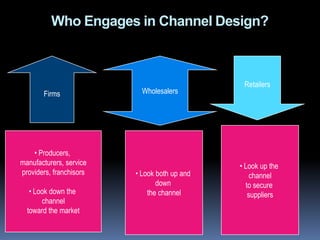
    Who Engages inChannel Design?FirmsWholesalersRetailers• Look up the channelto secure suppliers• Producers, manufacturers, serviceproviders, franchisors• Look down the channeltoward the market• Look both up and down the channel
  • 48.
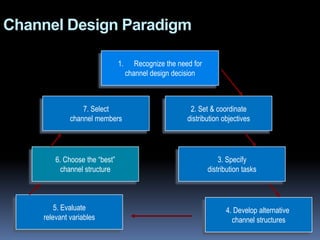
    Channel Design ParadigmRecognizethe need forchannel design decision7. Selectchannel members2. Set & coordinatedistribution objectives6. Choose the “best”channel structure3. Specifydistribution tasks5. Evaluaterelevant variables4. Develop alternative channel structures
  • 49.
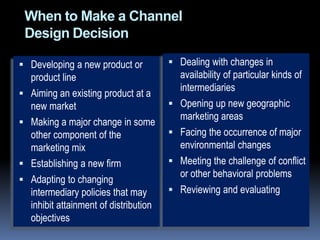
    When to Makea ChannelDesign DecisionDealing with changes in availability of particular kinds of intermediariesOpening up new geographic marketing areasFacing the occurrence of major environmental changesMeeting the challenge of conflict or other behavioral problemsReviewing and evaluatingDeveloping a new product or product lineAiming an existing product at a new marketMaking a major change in some other component of the marketing mixEstablishing a new firmAdapting to changing intermediary policies that may inhibit attainment of distribution objectives
  • 50.
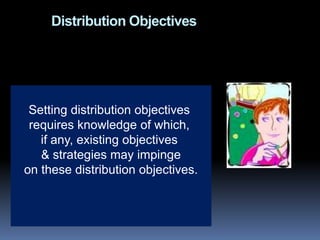
    Distribution ObjectivesSetting distributionobjectives requires knowledge of which, if any, existing objectives & strategies may impingeon these distribution objectives.
  • 51.
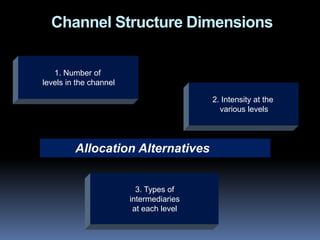
    Channel Structure Dimensions1.Number of levels in the channel2. Intensity at the various levelsAllocation Alternatives 3. Types ofintermediariesat each level
  • 52.
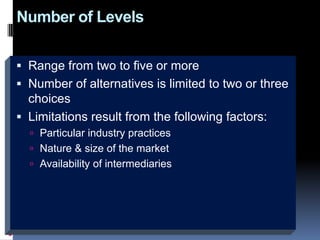
    Number of LevelsRangefrom two to five or moreNumber of alternatives is limited to two or three choicesLimitations result from the following factors:Particular industry practicesNature & size of the marketAvailability of intermediaries
  • 53.
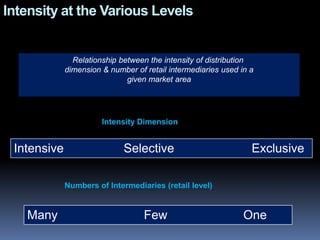
    Intensity at theVarious LevelsRelationship between the intensity of distribution dimension & number of retail intermediaries used in agiven market areaIntensity DimensionIntensive Selective ExclusiveNumbers of Intermediaries (retail level)Many Few One
  • 54.
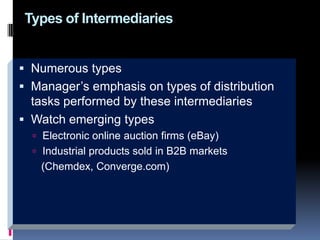
    Types of IntermediariesNumeroustypesManager’s emphasis on types of distribution tasks performed by these intermediariesWatch emerging typesElectronic online auction firms (eBay)Industrial products sold in B2B markets (Chemdex, Converge.com)
  • 55.
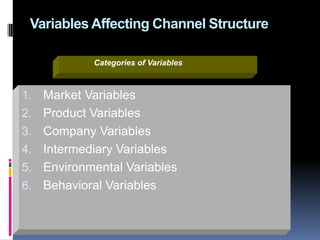
    Variables Affecting ChannelStructureCategories of VariablesMarket VariablesProduct VariablesCompany VariablesIntermediary VariablesEnvironmental VariablesBehavioral Variables
  • 56.
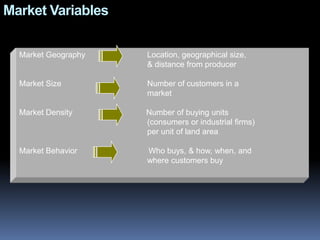
    Market VariablesMarket Geography Location,geographical size, & distance from producerMarket Size Number of customers in a marketMarket Density Number of buying units (consumers or industrial firms) per unit of land areaMarket Behavior Who buys, & how, when, and where customers buy
  • 57.
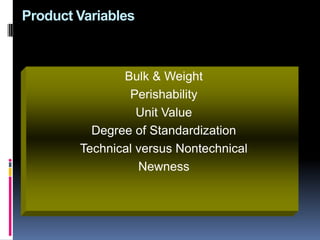
    Product VariablesBulk &WeightPerishabilityUnit ValueDegree of StandardizationTechnical versus NontechnicalNewness
  • 58.
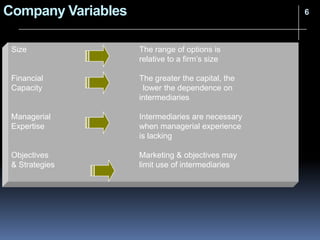
    Company Variables6Size The rangeof options is relative to a firm’s sizeFinancial The greater the capital, theCapacity lower the dependence on intermediariesManagerial Intermediaries are necessaryExpertise when managerial experience is lackingObjectives Marketing & objectives may& Strategies limit use of intermediaries
  • 59.
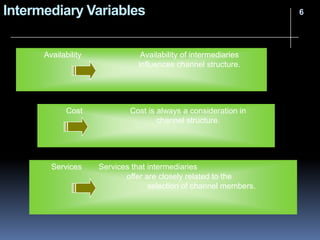
    Intermediary Variables6Availability Availability ofintermediaries influences channel structure.Cost Cost is always a consideration in channel structure.Services Services that intermediaries offer are closely related to the selection of channel members.
  • 60.
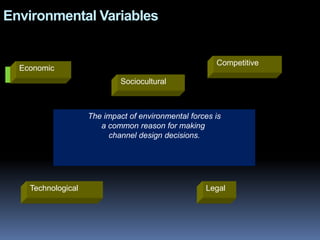
    Environmental VariablesCompetitiveEconomicSocioculturalThe impactof environmental forces isa common reason for making channel design decisions.TechnologicalLegal
  • 61.
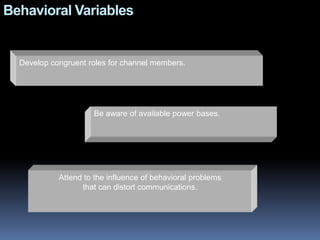
    Behavioral VariablesDevelop congruentroles for channel members.Be aware of available power bases.Attend to the influence of behavioral problemsthat can distort communications.
  • 62.