Chapter 2
• Physical Distribution


                          Chapter 2 Physical Distribution
Chapter Plan
• Concept & Definition
• Logistics
• Relation with other Marketing Mix
  Variables
• Importance of Physical Distribution
• Components of Physical Distribution


                           Chapter 2 Physical Distribution
Definition
• Physical distribution ‘involves planning,
  implementing and controlling the physical
  flows of materials and final goods from
  place of production to the place of end use
  to satisfy buyers ‘ needs.’’
  – Philip Kotler


                                 Chapter 2 Physical Distribution
Logistics
• Logistics management includes both
  physical distribution and physical supply


                            Chapter 2 Physical Distribution
Relation with Marketing Mix
A. Product-physical Distribution
  •    FMCG- Mass Distribution
  •    Perishable product- shortest distri.
B. Price-Physical Distribution
  •    Reciprocal Relationship
C. Promotion-Physical Distribution
  – Grab the market potential


                                 Chapter 2 Physical Distribution
Objectives of Physical
         Distribution Process
1. Total Cost Concept
2. Customer Service Concept
  a.   Time
  b.   Dependability
  c.   Communication
  d.   Convenience
  e.   Accuracy


                        Chapter 2 Physical Distribution
Objectives of Physical
         Distribution Process
3. Distribution Cost- service trade offs
  •   Achieve right balance between them
  •   Flexibility is important in balancing the cost
      and service


                                 Chapter 2 Physical Distribution
Component of Physical
           Distribution
1.   Order Processing
2.   Transportation
3.   Warehousing
4.   Material Handling
5.   Inventory Management and Control


                           Chapter 2 Physical Distribution
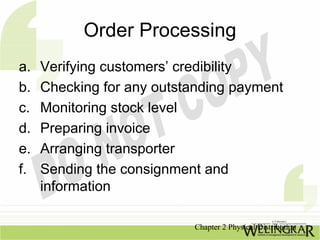
Order Processing
a.   Verifying customers’ credibility
b.   Checking for any outstanding payment
c.   Monitoring stock level
d.   Preparing invoice
e.   Arranging transporter
f.   Sending the consignment and
     information

                           Chapter 2 Physical Distribution
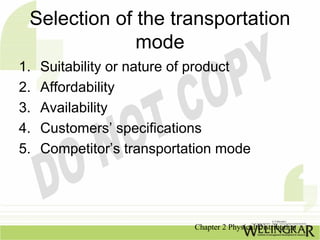
Selection of the transportation
              mode
1.   Suitability or nature of product
2.   Affordability
3.   Availability
4.   Customers’ specifications
5.   Competitor’s transportation mode


                            Chapter 2 Physical Distribution
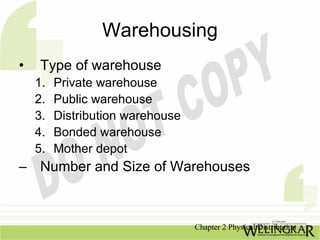
Warehousing
•    Type of warehouse
    1.   Private warehouse
    2.   Public warehouse
    3.   Distribution warehouse
    4.   Bonded warehouse
    5.   Mother depot
– Number and Size of Warehouses


                                  Chapter 2 Physical Distribution
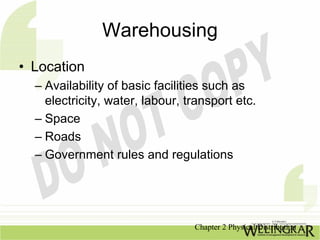
Warehousing
• Location
  – Availability of basic facilities such as
    electricity, water, labour, transport etc.
  – Space
  – Roads
  – Government rules and regulations


                                 Chapter 2 Physical Distribution
Warehousing
•   Layout
    1. Proper lighting, ventilation, and fire
       precaution
    2. Protection from temperature, moisture, etc
    3. Security arrangement
    4. Space arrangement


                                Chapter 2 Physical Distribution
Warehousing
• Storage Methods
  – Optimum use of space
  – Ease in storing and picking
  – Accurate identification of material
  – Possible to follow FIFO
  – Provision for fast moving items


                                Chapter 2 Physical Distribution
Material Handling
• Involves placing and positioning of
  material to facilitate movement and
  storage
• Common equipments are conveyors,
  bucket Elevators, hoists, lifts, cranes,
  forklifts, trolleys, dumpers, trailors, trucks


                               Chapter 2 Physical Distribution
Inventory Management &
              Control
• Major tool to cost reduction objective
• Just –in –time
  – Reliability of suppliers
  – Close communication between suppliers and
    customers
  – Attention to quality
  – Adequate storage facilities and transportation
    options

                               Chapter 2 Physical Distribution
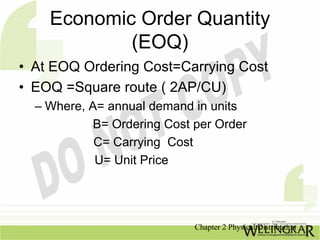
Economic Order Quantity
            (EOQ)
• At EOQ Ordering Cost=Carrying Cost
• EOQ =Square route ( 2AP/CU)
  – Where, A= annual demand in units
            B= Ordering Cost per Order
            C= Carrying Cost
            U= Unit Price


                             Chapter 2 Physical Distribution
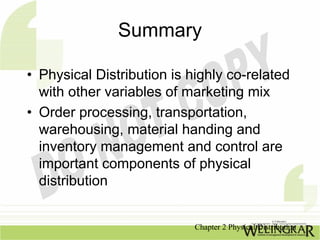
Summary

• Physical Distribution is highly co-related
  with other variables of marketing mix
• Order processing, transportation,
  warehousing, material handing and
  inventory management and control are
  important components of physical
  distribution


                            Chapter 2 Physical Distribution
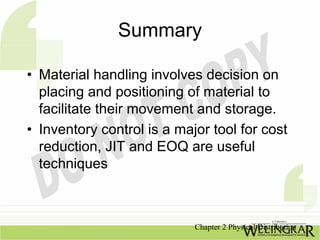
Summary

• Material handling involves decision on
  placing and positioning of material to
  facilitate their movement and storage.
• Inventory control is a major tool for cost
  reduction, JIT and EOQ are useful
  techniques


                            Chapter 2 Physical Distribution
“Like” us on Facebook: 
   p //                 /
http://www.facebook.com/welearnindia 

“Follow” us on Twitter:
http://twitter.com/WeLearnIndia
http://twitter com/WeLearnIndia

Watch informative videos on Youtube: 
http://www.youtube.com/WelingkarDLP

Physical Distribution

  • 1.
    Chapter 2 • PhysicalDistribution Chapter 2 Physical Distribution
  • 2.
    Chapter Plan • Concept& Definition • Logistics • Relation with other Marketing Mix Variables • Importance of Physical Distribution • Components of Physical Distribution Chapter 2 Physical Distribution
  • 3.
    Definition • Physical distribution‘involves planning, implementing and controlling the physical flows of materials and final goods from place of production to the place of end use to satisfy buyers ‘ needs.’’ – Philip Kotler Chapter 2 Physical Distribution
  • 4.
    Logistics • Logistics managementincludes both physical distribution and physical supply Chapter 2 Physical Distribution
  • 5.
    Relation with MarketingMix A. Product-physical Distribution • FMCG- Mass Distribution • Perishable product- shortest distri. B. Price-Physical Distribution • Reciprocal Relationship C. Promotion-Physical Distribution – Grab the market potential Chapter 2 Physical Distribution
  • 6.
    Objectives of Physical Distribution Process 1. Total Cost Concept 2. Customer Service Concept a. Time b. Dependability c. Communication d. Convenience e. Accuracy Chapter 2 Physical Distribution
  • 7.
    Objectives of Physical Distribution Process 3. Distribution Cost- service trade offs • Achieve right balance between them • Flexibility is important in balancing the cost and service Chapter 2 Physical Distribution
  • 8.
    Component of Physical Distribution 1. Order Processing 2. Transportation 3. Warehousing 4. Material Handling 5. Inventory Management and Control Chapter 2 Physical Distribution
  • 9.
    Order Processing a. Verifying customers’ credibility b. Checking for any outstanding payment c. Monitoring stock level d. Preparing invoice e. Arranging transporter f. Sending the consignment and information Chapter 2 Physical Distribution
  • 10.
    Selection of thetransportation mode 1. Suitability or nature of product 2. Affordability 3. Availability 4. Customers’ specifications 5. Competitor’s transportation mode Chapter 2 Physical Distribution
  • 11.
    Warehousing • Type of warehouse 1. Private warehouse 2. Public warehouse 3. Distribution warehouse 4. Bonded warehouse 5. Mother depot – Number and Size of Warehouses Chapter 2 Physical Distribution
  • 12.
    Warehousing • Location – Availability of basic facilities such as electricity, water, labour, transport etc. – Space – Roads – Government rules and regulations Chapter 2 Physical Distribution
  • 13.
    Warehousing • Layout 1. Proper lighting, ventilation, and fire precaution 2. Protection from temperature, moisture, etc 3. Security arrangement 4. Space arrangement Chapter 2 Physical Distribution
  • 14.
    Warehousing • Storage Methods – Optimum use of space – Ease in storing and picking – Accurate identification of material – Possible to follow FIFO – Provision for fast moving items Chapter 2 Physical Distribution
  • 15.
    Material Handling • Involvesplacing and positioning of material to facilitate movement and storage • Common equipments are conveyors, bucket Elevators, hoists, lifts, cranes, forklifts, trolleys, dumpers, trailors, trucks Chapter 2 Physical Distribution
  • 16.
    Inventory Management & Control • Major tool to cost reduction objective • Just –in –time – Reliability of suppliers – Close communication between suppliers and customers – Attention to quality – Adequate storage facilities and transportation options Chapter 2 Physical Distribution
  • 17.
    Economic Order Quantity (EOQ) • At EOQ Ordering Cost=Carrying Cost • EOQ =Square route ( 2AP/CU) – Where, A= annual demand in units B= Ordering Cost per Order C= Carrying Cost U= Unit Price Chapter 2 Physical Distribution
  • 18.
    Summary • Physical Distributionis highly co-related with other variables of marketing mix • Order processing, transportation, warehousing, material handing and inventory management and control are important components of physical distribution Chapter 2 Physical Distribution
  • 19.
    Summary • Material handlinginvolves decision on placing and positioning of material to facilitate their movement and storage. • Inventory control is a major tool for cost reduction, JIT and EOQ are useful techniques Chapter 2 Physical Distribution
  • 20.
    “Like” us on Facebook:  p // / http://www.facebook.com/welearnindia  “Follow” us on Twitter: http://twitter.com/WeLearnIndia http://twitter com/WeLearnIndia Watch informative videos on Youtube:  http://www.youtube.com/WelingkarDLP