Sheenam
Neha
Jagmohan
Sompal
Deepa
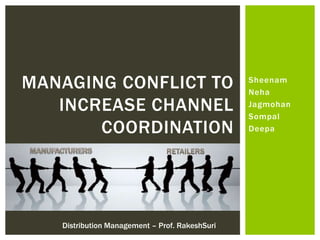
MANAGING CONFLICT TO
INCREASE CHANNEL
COORDINATION
Distribution Management – Prof. RakeshSuri
 A process that begins when one party perceives
that another party has negatively affected or is
about to negatively affect something that the
first party cares about.
 CHANNEL CONFLICT
 Arises when the behaviour of a channel
member is in opposition to its counterpart.
 It is opponent centered and direct ,
in which the goal or object sought is
controlled by the counterpart.
WHAT IS CONFLICT?
TYPES OF CONFLICTS
Latent conflict
• Is the norm on the marketing channel.
• Channel members collide as all parties pursue separate goals,
strive to retain their autonomy .
Perceived Conflict
•Occurs when the channel member senses that some sort of opposition
exists
•Is cognitive , emotionless and mental
Felt Conflict
•When emotions are involved it is Felt conflict – conflictual .
•Member feels a negative emotions
Manifest Conflict
•Usually appears as blocking each others initiative and withdrawing
support.
•One tries to sabotage the other or take revenge
 Steps in measuring the conflict
 Step 1 : Counting up the issues
 Step 2 : Importance
 Step 3 : Frequency of Disagreement
 Step 4 : Intensity of dispute
 Conflict = Importancei X Frequencyi X Intensityi
 Example
 Difference of opinion rarely occurs . – Low Frequency
 The issue is petty. – Low importance
 Two parties are not very far apart on the issue.- Low Intensity
MEASURING CONFLICT
C
O
N
F
L
I
C
T
 Functional conflict: supports the goals of the group and
improves its performance
 Dysfunctional conflict: Hinders group performance
CONSEQUENCES OF CONFLICT
 Conflict is usually thought to be dysfunctional, to hurt a
relationship
 Conflict in some cases makes a relationship better on certain
occasions; this is functional conflict.
 Functional conflict is common when channel members
recognize each other’s contribution and understand that each
party’s success depends on the other.
FUNCTIONAL VS DYSFUNCTIONAL
 The opposition leads them to:
 Communicate more frequently and effectively
 Establish outlets for expressing their grievances
 Critically review past actions
 Devise and implement a more equitable split of system resources
 Develop more balanced distribution of power in their relationship
 Develop standardized ways to deal with future conflict and keep it
within bounds
 Procter & Gamble Challenges French Whole Pricing Practices
FUNCTIONAL VS DYSFUNCTIONAL
MAJOR SOURCES OF CONFLICTS
MAJOR SOURCES OF CONFLICT
1. Channel member GOALS
2. Their perceptions of REALITY
1. Their clashes over DOMAINS
COMPETING GOALS
 Each channel members goals & objectives are different from
those of other members.
 Goal Divergence & Subsequent Conflict.
FINANCIAL GOALS
 Supplier:
“You don’t put enough effort behind my brand. Your prices are
too high.”
 Reseller:
“you don’t support me enough. With your wholesale prices, we
can’t make money.”
DESIRED TARGET ACCOUNTS
 Supplier:
“We need more coverage & more effort. Our reseller doesn’t do
enough for us.”
 Reseller:
“You don’t respect my marketing strategies. We need to make
money too.”
DESIRED PRODUCTS
 Supplier:
“You carry too many lines. You don’t give us enough attention.
You are disloyal.”
 Reseller:
“Our customers come first. If we satisfy our customers, you will
benefit.”
DIFFERING PERCEPTIONS OF REALITY
 Indicate different bases of action in response to the same
situation.
 Channel members are often confident that they know
“The FACT of the Situation”
PERCEPTIONS DIFFER
1. What the attributes of the products & service are
2. What applications it serves and for which segments
3. What the competition is
FOCUS ON
 Supplier:
Product and process.
Removed from customers.
 Reseller:
Functions and customers.
Removed from manufacturer.
PROBLEM
Cross Cultural Channel
Clashes
SOLUTION
1. Communication
2. Develop greater sensitivity to the business culture of other
channel member
CLASHES OVER DOMAINS
Each channel member has its own domain or sphere function.
Conflict occurs when one channel member perceives that other
is not taking proper care of its responsibilities in its appropriate
domain.
ISSUES:
 Doing the job wrong
 Not doing the job at all
 Trying to do the other channel member’s job
AGAIN SUPPLIER & RESELLER CLASH
 Who should do it
 How it should be done
 How it should be compensated
 INTRACHANNEL COMPETITION
 Retailer selling products of competitors along side the product of the
supplier
 Supplier using multiple channel for selling product
 MULTIPLE CHANNELS : NO LONGER UNUSUAL
 Supplier uses multiple channel for market penetration
 To provide convenience for the customer to choose Eg: e-commerce,
direct sales, Teleshopping
 Retailer losses motivation
CLASH OF MARKETS DOMAINS
IS IT REALLY A
PROBLEM ?
 Sell products under different brand names in different channels
 Sell the main product through one channel and the accessories
through another channel
 Different pricing.
 Different product.
 Different name.
 Domain conflict in marketing channel(financial services).
 Perceptual differences (coke)
WHAT SUPPLIER CAN DO?
 Gray marketing is the sale of authorized branded product
through unauthorized distribution channels – usually bargain
or discount outlets that provides less customer service than
authorized dealers do
 Gray marketing can be contrasted with black marketing, or
counterfeiting, which involves selling fake goods as branded
ones
 Counterfeiting remains illegal in almost all world markets; in
contrast, gray marketing is in many cases completely legal
GRAY MARKETS
 Who is supplying these unauthorized outlets?
 Authorized distributors and dealers, often in other markets
 Professional arbitragers, which include
 Import – Export houses
 Individual, professional traders, who but huge amounts at retail where
prices are low, then transport them to where the prices are high. Often,
these people live near borders of states/country
 The supplier itself, through foreign division
GRAY MARKETS
Conflict Begets More Conflict
 An excellent predictor of much channel members will dispute
in the future is how much conflict they have experienced in
the past.
 Conflict creates more conflicts.
 It proliferates is that once a relationship has experienced high
levels of tension and frustration, the players find it difficult to
set their acrimonious history aside and move on.
 Foundations of trust are thoroughly eroded by high levels of
conflict.
 Field experienced indicates that high and sustained conflict
once experienced is extremely difficult to overcome
FUELING CONFLICT
 Highly effective and reliable way to increase channel conflict
is to threaten a channel conflict member .e.g., punshisment or
negative sanctions will be applied.
 Strategy of repeated threats raises the temperature of a
relationship by increasing conflict and by reducing the
channel members satisfaction with every aspect of
relationship.
 Threats are perceived as coercion that eventually move the
threatened firm’s sense of conflict into zone of tension
,frustration and collision.
THREATS
CONFLICT
RESOLUTION
STRATEGIES
WHAT IS CONFLICT MANAGEMENT?
The use of resolution and stimulation
techniques to achieve the desired level of
conflict.
1/30/2015 30
CHANNEL CONFLICT
Conflict Resolution Strategies
Information Intensive Mechanisms
Third party mechanisms, Mediators and Arbitrators
Building relational norms
 INFORMATION INTENSIVE MECHANISM
 This mechanism is designed to head off conflict by way to
share information. It is risky and expensive each party side
risks divulging sensitive information and must devote
resources to communication.
 Trust and cooperation are helpful conditions because they
keep conflict manageable.
 These mechanism includes joint memberships in trade
association ,and exchange of personnel programs.
INSTITUTIONALIZED MECHANISMS
 THIRD PARTY MECHANISM
 Mediator: A neutral third party who facilitates a negotiated
solution by using reasoning, persuasion and suggestions for
alternatives
 Arbitrator: A third party who has the authority to dictate an
agreement
 Conciliator: A third party who provides an informal
communication link between the negotiator and the opponent
 Consultant: A third party skilled in conflict management who
attempts to facilitate creative problem solving through
communication and analysis
INSTITUTIONALIZED MECHANISMS
• Channel members expect each other to
adapt readily to changing circumstance with
a minimum of obstruction and negotiation.
Flexibility
• Channel members expect each other to
share any and all pertinent information –no
matter how sensitive .
Information
exchange
• Channel expect each other to work for
mutual benefit ,not merely one sided benefit.
Solidarity
BUILDING RELATIONAL NORMS
HANDLING CONFLICT
 Competing: Satisfying one’s own interest regardless of the
impact on the other party to the conflict
 Collaborating: A situation in which the parties to the conflict
each desire to satisfy fully the concerns of all parties
 Accommodating: The willingness of one party in a conflict to
place the opponent’s interests above his or her own
 Compromising: A situation in which each party to a conflict is
willing to give up something
 Avoiding: The desire to withdraw from or suppress a conflict
1/30/2015 35
THANK YOU

Marketing Channels

  • 1.
    Sheenam Neha Jagmohan Sompal Deepa MANAGING CONFLICT TO INCREASECHANNEL COORDINATION Distribution Management – Prof. RakeshSuri
  • 2.
     A processthat begins when one party perceives that another party has negatively affected or is about to negatively affect something that the first party cares about.  CHANNEL CONFLICT  Arises when the behaviour of a channel member is in opposition to its counterpart.  It is opponent centered and direct , in which the goal or object sought is controlled by the counterpart. WHAT IS CONFLICT?
  • 3.
    TYPES OF CONFLICTS Latentconflict • Is the norm on the marketing channel. • Channel members collide as all parties pursue separate goals, strive to retain their autonomy . Perceived Conflict •Occurs when the channel member senses that some sort of opposition exists •Is cognitive , emotionless and mental Felt Conflict •When emotions are involved it is Felt conflict – conflictual . •Member feels a negative emotions Manifest Conflict •Usually appears as blocking each others initiative and withdrawing support. •One tries to sabotage the other or take revenge
  • 4.
     Steps inmeasuring the conflict  Step 1 : Counting up the issues  Step 2 : Importance  Step 3 : Frequency of Disagreement  Step 4 : Intensity of dispute  Conflict = Importancei X Frequencyi X Intensityi  Example  Difference of opinion rarely occurs . – Low Frequency  The issue is petty. – Low importance  Two parties are not very far apart on the issue.- Low Intensity MEASURING CONFLICT C O N F L I C T
  • 5.
     Functional conflict:supports the goals of the group and improves its performance  Dysfunctional conflict: Hinders group performance CONSEQUENCES OF CONFLICT
  • 6.
     Conflict isusually thought to be dysfunctional, to hurt a relationship  Conflict in some cases makes a relationship better on certain occasions; this is functional conflict.  Functional conflict is common when channel members recognize each other’s contribution and understand that each party’s success depends on the other. FUNCTIONAL VS DYSFUNCTIONAL
  • 7.
     The oppositionleads them to:  Communicate more frequently and effectively  Establish outlets for expressing their grievances  Critically review past actions  Devise and implement a more equitable split of system resources  Develop more balanced distribution of power in their relationship  Develop standardized ways to deal with future conflict and keep it within bounds  Procter & Gamble Challenges French Whole Pricing Practices FUNCTIONAL VS DYSFUNCTIONAL
  • 8.
  • 9.
    MAJOR SOURCES OFCONFLICT 1. Channel member GOALS 2. Their perceptions of REALITY 1. Their clashes over DOMAINS
  • 10.
    COMPETING GOALS  Eachchannel members goals & objectives are different from those of other members.  Goal Divergence & Subsequent Conflict.
  • 11.
    FINANCIAL GOALS  Supplier: “Youdon’t put enough effort behind my brand. Your prices are too high.”  Reseller: “you don’t support me enough. With your wholesale prices, we can’t make money.”
  • 12.
    DESIRED TARGET ACCOUNTS Supplier: “We need more coverage & more effort. Our reseller doesn’t do enough for us.”  Reseller: “You don’t respect my marketing strategies. We need to make money too.”
  • 13.
    DESIRED PRODUCTS  Supplier: “Youcarry too many lines. You don’t give us enough attention. You are disloyal.”  Reseller: “Our customers come first. If we satisfy our customers, you will benefit.”
  • 14.
    DIFFERING PERCEPTIONS OFREALITY  Indicate different bases of action in response to the same situation.  Channel members are often confident that they know “The FACT of the Situation”
  • 15.
    PERCEPTIONS DIFFER 1. Whatthe attributes of the products & service are 2. What applications it serves and for which segments 3. What the competition is
  • 16.
    FOCUS ON  Supplier: Productand process. Removed from customers.  Reseller: Functions and customers. Removed from manufacturer.
  • 17.
  • 18.
    SOLUTION 1. Communication 2. Developgreater sensitivity to the business culture of other channel member
  • 19.
    CLASHES OVER DOMAINS Eachchannel member has its own domain or sphere function. Conflict occurs when one channel member perceives that other is not taking proper care of its responsibilities in its appropriate domain.
  • 20.
    ISSUES:  Doing thejob wrong  Not doing the job at all  Trying to do the other channel member’s job
  • 21.
    AGAIN SUPPLIER &RESELLER CLASH  Who should do it  How it should be done  How it should be compensated
  • 22.
     INTRACHANNEL COMPETITION Retailer selling products of competitors along side the product of the supplier  Supplier using multiple channel for selling product  MULTIPLE CHANNELS : NO LONGER UNUSUAL  Supplier uses multiple channel for market penetration  To provide convenience for the customer to choose Eg: e-commerce, direct sales, Teleshopping  Retailer losses motivation CLASH OF MARKETS DOMAINS
  • 23.
    IS IT REALLYA PROBLEM ?
  • 24.
     Sell productsunder different brand names in different channels  Sell the main product through one channel and the accessories through another channel  Different pricing.  Different product.  Different name.  Domain conflict in marketing channel(financial services).  Perceptual differences (coke) WHAT SUPPLIER CAN DO?
  • 25.
     Gray marketingis the sale of authorized branded product through unauthorized distribution channels – usually bargain or discount outlets that provides less customer service than authorized dealers do  Gray marketing can be contrasted with black marketing, or counterfeiting, which involves selling fake goods as branded ones  Counterfeiting remains illegal in almost all world markets; in contrast, gray marketing is in many cases completely legal GRAY MARKETS
  • 26.
     Who issupplying these unauthorized outlets?  Authorized distributors and dealers, often in other markets  Professional arbitragers, which include  Import – Export houses  Individual, professional traders, who but huge amounts at retail where prices are low, then transport them to where the prices are high. Often, these people live near borders of states/country  The supplier itself, through foreign division GRAY MARKETS
  • 27.
    Conflict Begets MoreConflict  An excellent predictor of much channel members will dispute in the future is how much conflict they have experienced in the past.  Conflict creates more conflicts.  It proliferates is that once a relationship has experienced high levels of tension and frustration, the players find it difficult to set their acrimonious history aside and move on.  Foundations of trust are thoroughly eroded by high levels of conflict.  Field experienced indicates that high and sustained conflict once experienced is extremely difficult to overcome FUELING CONFLICT
  • 28.
     Highly effectiveand reliable way to increase channel conflict is to threaten a channel conflict member .e.g., punshisment or negative sanctions will be applied.  Strategy of repeated threats raises the temperature of a relationship by increasing conflict and by reducing the channel members satisfaction with every aspect of relationship.  Threats are perceived as coercion that eventually move the threatened firm’s sense of conflict into zone of tension ,frustration and collision. THREATS
  • 29.
  • 30.
    WHAT IS CONFLICTMANAGEMENT? The use of resolution and stimulation techniques to achieve the desired level of conflict. 1/30/2015 30
  • 31.
    CHANNEL CONFLICT Conflict ResolutionStrategies Information Intensive Mechanisms Third party mechanisms, Mediators and Arbitrators Building relational norms
  • 32.
     INFORMATION INTENSIVEMECHANISM  This mechanism is designed to head off conflict by way to share information. It is risky and expensive each party side risks divulging sensitive information and must devote resources to communication.  Trust and cooperation are helpful conditions because they keep conflict manageable.  These mechanism includes joint memberships in trade association ,and exchange of personnel programs. INSTITUTIONALIZED MECHANISMS
  • 33.
     THIRD PARTYMECHANISM  Mediator: A neutral third party who facilitates a negotiated solution by using reasoning, persuasion and suggestions for alternatives  Arbitrator: A third party who has the authority to dictate an agreement  Conciliator: A third party who provides an informal communication link between the negotiator and the opponent  Consultant: A third party skilled in conflict management who attempts to facilitate creative problem solving through communication and analysis INSTITUTIONALIZED MECHANISMS
  • 34.
    • Channel membersexpect each other to adapt readily to changing circumstance with a minimum of obstruction and negotiation. Flexibility • Channel members expect each other to share any and all pertinent information –no matter how sensitive . Information exchange • Channel expect each other to work for mutual benefit ,not merely one sided benefit. Solidarity BUILDING RELATIONAL NORMS
  • 35.
    HANDLING CONFLICT  Competing:Satisfying one’s own interest regardless of the impact on the other party to the conflict  Collaborating: A situation in which the parties to the conflict each desire to satisfy fully the concerns of all parties  Accommodating: The willingness of one party in a conflict to place the opponent’s interests above his or her own  Compromising: A situation in which each party to a conflict is willing to give up something  Avoiding: The desire to withdraw from or suppress a conflict 1/30/2015 35
  • 36.