The Use of different Modes of 
Transport in Global Supply Chain 
Project by: 
• Nabeel Sarosh 
• Anand P. Waindeshkar 
Guidance by: 
• Prof. Dr. Bernd Herrler
Agenda 
1. Objectives 
2. Introduction 
3. Modes of transportation 
4. Roles of transportation in Global Supply Chain 
5. Factors (and Parties) Affecting Transportation Decisions 
6. Making Transportation Decisions in Practice 
7. Challenges 
8. Case Study 
9. Conclusion 
10. Bibliography
14-3 
Summary of Learning Objectives: 
• What are the different Modes of Transportation in Global Supply 
Chain? 
• What is the role of transportation in a supply chain? 
• What are the different network design options & risk involve with it? 
• What are roles of IT in transportation & how to make decisions for 
choosing right mode/s of transportation in global supply chain?
Introduction 
What is Global Supply Chain? 
• A system of organizations, people, activities, information, and 
resources involved in moving a product or service from supplier to 
customer 
• The primary objective of SCM is to fulfill customer demands through 
the most efficient use of resources, including distribution 
capacity, inventory, and labor.
Introduction 
What is Transportation? 
• Transport or transportation is a process which engages in 
movement of people, animals and goods from one location to 
another 
• Any device used to move an item from one location to another 
• Transport is important because it enables trade between people, 
which is essential for the development of civilizations
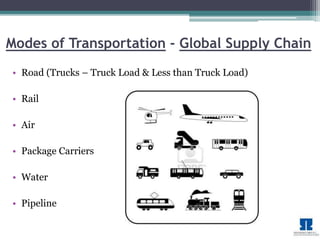
Modes of Transportation - Global Supply Chain 
• Road (Trucks – Truck Load & Less than Truck Load) 
• Rail 
• Air 
• Package Carriers 
• Water 
• Pipeline
14-7 
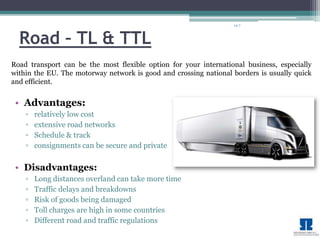
Road – TL & TTL 
Road transport can be the most flexible option for your international business, especially 
within the EU. The motorway network is good and crossing national borders is usually quick 
and efficient. 
• Advantages: 
▫ relatively low cost 
▫ extensive road networks 
▫ Schedule & track 
▫ consignments can be secure and private 
• Disadvantages: 
▫ Long distances overland can take more time 
▫ Traffic delays and breakdowns 
▫ Risk of goods being damaged 
▫ Toll charges are high in some countries 
▫ Different road and traffic regulations
14-8 
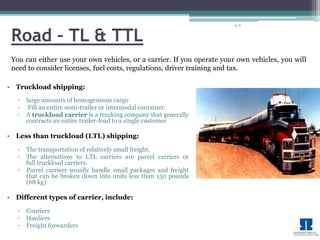
Road – TL & TTL 
You can either use your own vehicles, or a carrier. If you operate your own vehicles, you will 
need to consider licenses, fuel costs, regulations, driver training and tax. 
• Truckload shipping: 
▫ large amounts of homogeneous cargo 
▫ Fill an entire semi-trailer or intermodal container. 
▫ A truckload carrier is a trucking company that generally 
contracts an entire trailer-load to a single customer 
• Less than truckload (LTL) shipping: 
▫ The transportation of relatively small freight. 
▫ The alternatives to LTL carriers are parcel carriers or 
full truckload carriers. 
▫ Parcel carriers usually handle small packages and freight 
that can be broken down into units less than 150 pounds 
(68 kg) 
• Different types of carrier, include: 
▫ Couriers 
▫ Hauliers 
▫ Freight forwarders
14-9 Rails 
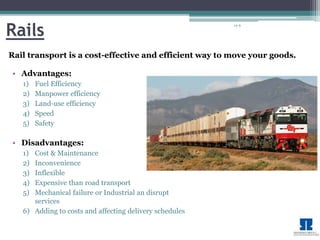
Rail transport is a cost-effective and efficient way tomove your goods. 
• Advantages: 
1) Fuel Efficiency 
2) Manpower efficiency 
3) Land-use efficiency 
4) Speed 
5) Safety 
• Disadvantages: 
1) Cost & Maintenance 
2) Inconvenience 
3) Inflexible 
4) Expensive than road transport 
5) Mechanical failure or Industrial an disrupt 
services 
6) Adding to costs and affecting delivery schedules
Rails 
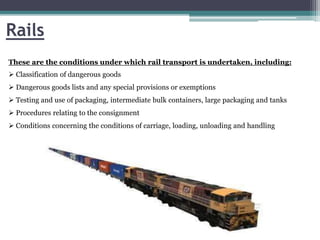
These are the conditions under which rail transport is undertaken, including: 
 Classification of dangerous goods 
 Dangerous goods lists and any special provisions or exemptions 
 Testing and use of packaging, intermediate bulk containers, large packaging and tanks 
 Procedures relating to the consignment 
 Conditions concerning the conditions of carriage, loading, unloading and handling
14-11 
Air 
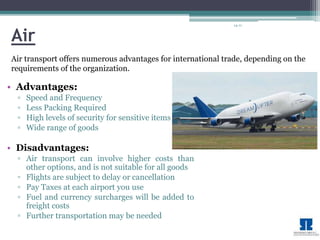
Air transport offers numerous advantages for international trade, depending on the 
requirements of the organization. 
• Advantages: 
▫ Speed and Frequency 
▫ Less Packing Required 
▫ High levels of security for sensitive items 
▫ Wide range of goods 
• Disadvantages: 
▫ Air transport can involve higher costs than 
other options, and is not suitable for all goods 
▫ Flights are subject to delay or cancellation 
▫ Pay Taxes at each airport you use 
▫ Fuel and currency surcharges will be added to 
freight costs 
▫ Further transportation may be needed
14-12 
Water 
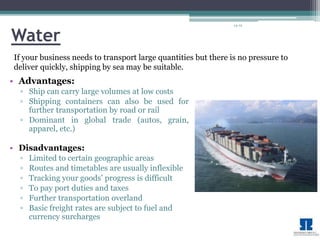
If your business needs to transport large quantities but there is no pressure to 
deliver quickly, shipping by sea may be suitable. 
• Advantages: 
▫ Ship can carry large volumes at low costs 
▫ Shipping containers can also be used for 
further transportation by road or rail 
▫ Dominant in global trade (autos, grain, 
apparel, etc.) 
• Disadvantages: 
▫ Limited to certain geographic areas 
▫ Routes and timetables are usually inflexible 
▫ Tracking your goods’ progress is difficult 
▫ To pay port duties and taxes 
▫ Further transportation overland 
▫ Basic freight rates are subject to fuel and 
currency surcharges
14-13 
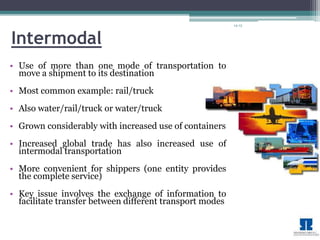
Intermodal 
• Use of more than one mode of transportation to 
move a shipment to its destination 
• Most common example: rail/truck 
• Also water/rail/truck or water/truck 
• Grown considerably with increased use of containers 
• Increased global trade has also increased use of 
intermodal transportation 
• More convenient for shippers (one entity provides 
the complete service) 
• Key issue involves the exchange of information to 
facilitate transfer between different transport modes
14-14 
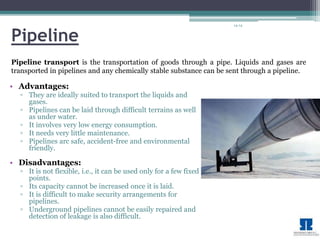
Pipeline 
Pipeline transport is the transportation of goods through a pipe. Liquids and gases are 
transported in pipelines and any chemically stable substance can be sent through a pipeline. 
• Advantages: 
▫ They are ideally suited to transport the liquids and 
gases. 
▫ Pipelines can be laid through difficult terrains as well 
as under water. 
▫ It involves very low energy consumption. 
▫ It needs very little maintenance. 
▫ Pipelines arc safe, accident-free and environmental 
friendly. 
• Disadvantages: 
▫ It is not flexible, i.e., it can be used only for a few fixed 
points. 
▫ Its capacity cannot be increased once it is laid. 
▫ It is difficult to make security arrangements for 
pipelines. 
▫ Underground pipelines cannot be easily repaired and 
detection of leakage is also difficult.
14-15 
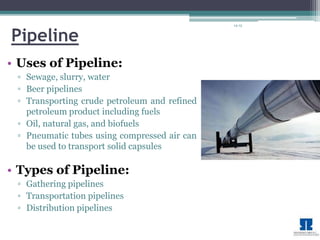
Pipeline 
• Uses of Pipeline: 
▫ Sewage, slurry, water 
▫ Beer pipelines 
▫ Transporting crude petroleum and refined 
petroleum product including fuels 
▫ Oil, natural gas, and biofuels 
▫ Pneumatic tubes using compressed air can 
be used to transport solid capsules 
• Types of Pipeline: 
▫ Gathering pipelines 
▫ Transportation pipelines 
▫ Distribution pipelines
14-16 
Package Carriers 
• Companies like FedEx, UPS, USPS, that 
carry small packages ranging from letters 
to shipments of about 150 pounds 
• Expensive 
• Rapid and reliable delivery 
• Small and time-sensitive shipments 
• Preferred mode for e-businesses (e.g., 
Amazon, Dell, McMaster-Carr) 
• Consolidation of shipments (especially 
important for package carriers that use air 
as a primary method of transport)
Roles of transportation - Global Supply Chain 
• International trade is becoming a bigger 
part of the world's economic activity. 
• Any supply chains success is closely 
linked to the appropriate use of 
transportation. 
• Supply chain also use responsive 
transportation to centralize inventories 
and operate with fewer facilities
Factors (and Parties) Affecting Transportation Decisions 
• What do you want to distribute? 
▫ Size and weight will affect the cost. 
• How quickly does the product need to reach 
its destination? 
▫ This will affect which type of delivery service you 
use and the cost - sending goods by air is quicker 
but significantly more expensive than by sea. 
• Where do the goods need to go? 
▫ For example, Europe has a large rail and inland 
waterway network, but you may encounter 
problems if the destination is especially remote. 
•
14-19 
Design Options for a Transportation Network 
• Direct shipping network 
• Direct shipping with milk runs 
• All shipments via central DC 
• Shipping via DC using milk runs 
• Tailored network
14-20 
Making Transportation Decisions in Practice 
• Align transportation strategy with 
competitive strategy 
• Consider both in-house and outsourced 
transportation 
• Design a transportation network that can 
handle e-commerce 
• Use technology to improve transportation 
performance 
• Design flexibility into the transportation 
network
Challenges 
• Demographic trends 
• Economic circumstances 
• Connectivity of existing networks 
• Environmental issues 
• Existing transport infrastructure capacity 
• Environmental issues 
• Travel patterns and trip rates 
• Air quality and noise pollution 
• Socio-economic profile
Case Study 
Please follow the link 
http://youtu.be/mhGaz_qGizA
• A manager must account for inventory costs when selecting a mode of 
transportation 
• A mode with higher transportation costs can be justified if it results in 
significantly lower inventories 
• Must be future ready & Innovative 
• Work on the Challenges & keep upgrading the transportation 
standards
Bibliography 
• Supply Chain Management – Strategy, Planning & Operation (5th Edition), 
Authors: Sunil Chopra & Peter Meindl 
• U.S. Department of Transportation Federal Highway Administration 
• Center for Freight & Infrastructure Research & Education 
• ^ Perez, Hernan David. Supply Chain Roadmap: aligning supply chain with 
business strategy 
• ^ Oliver, R. K.; Webber, M. D. (1992) [1982]. "Supply-chain management: 
logistics catches up with strategy“ 
• Blanchard, David (2010). Supply Chain Management Best Practices (2nd 
ed.). John Wiley & Sons 
• http://viktorwong-logistics.blogspot.de/2010/02/advantages-of-air-freight. 
html
THANK YOU!!

Supply Chain Management - Transportation - MBA Project

  • 1.
    The Use ofdifferent Modes of Transport in Global Supply Chain Project by: • Nabeel Sarosh • Anand P. Waindeshkar Guidance by: • Prof. Dr. Bernd Herrler
  • 2.
    Agenda 1. Objectives 2. Introduction 3. Modes of transportation 4. Roles of transportation in Global Supply Chain 5. Factors (and Parties) Affecting Transportation Decisions 6. Making Transportation Decisions in Practice 7. Challenges 8. Case Study 9. Conclusion 10. Bibliography
  • 3.
    14-3 Summary ofLearning Objectives: • What are the different Modes of Transportation in Global Supply Chain? • What is the role of transportation in a supply chain? • What are the different network design options & risk involve with it? • What are roles of IT in transportation & how to make decisions for choosing right mode/s of transportation in global supply chain?
  • 4.
    Introduction What isGlobal Supply Chain? • A system of organizations, people, activities, information, and resources involved in moving a product or service from supplier to customer • The primary objective of SCM is to fulfill customer demands through the most efficient use of resources, including distribution capacity, inventory, and labor.
  • 5.
    Introduction What isTransportation? • Transport or transportation is a process which engages in movement of people, animals and goods from one location to another • Any device used to move an item from one location to another • Transport is important because it enables trade between people, which is essential for the development of civilizations
  • 6.
    Modes of Transportation- Global Supply Chain • Road (Trucks – Truck Load & Less than Truck Load) • Rail • Air • Package Carriers • Water • Pipeline
  • 7.
    14-7 Road –TL & TTL Road transport can be the most flexible option for your international business, especially within the EU. The motorway network is good and crossing national borders is usually quick and efficient. • Advantages: ▫ relatively low cost ▫ extensive road networks ▫ Schedule & track ▫ consignments can be secure and private • Disadvantages: ▫ Long distances overland can take more time ▫ Traffic delays and breakdowns ▫ Risk of goods being damaged ▫ Toll charges are high in some countries ▫ Different road and traffic regulations
  • 8.
    14-8 Road –TL & TTL You can either use your own vehicles, or a carrier. If you operate your own vehicles, you will need to consider licenses, fuel costs, regulations, driver training and tax. • Truckload shipping: ▫ large amounts of homogeneous cargo ▫ Fill an entire semi-trailer or intermodal container. ▫ A truckload carrier is a trucking company that generally contracts an entire trailer-load to a single customer • Less than truckload (LTL) shipping: ▫ The transportation of relatively small freight. ▫ The alternatives to LTL carriers are parcel carriers or full truckload carriers. ▫ Parcel carriers usually handle small packages and freight that can be broken down into units less than 150 pounds (68 kg) • Different types of carrier, include: ▫ Couriers ▫ Hauliers ▫ Freight forwarders
  • 9.
    14-9 Rails Railtransport is a cost-effective and efficient way tomove your goods. • Advantages: 1) Fuel Efficiency 2) Manpower efficiency 3) Land-use efficiency 4) Speed 5) Safety • Disadvantages: 1) Cost & Maintenance 2) Inconvenience 3) Inflexible 4) Expensive than road transport 5) Mechanical failure or Industrial an disrupt services 6) Adding to costs and affecting delivery schedules
  • 10.
    Rails These arethe conditions under which rail transport is undertaken, including:  Classification of dangerous goods  Dangerous goods lists and any special provisions or exemptions  Testing and use of packaging, intermediate bulk containers, large packaging and tanks  Procedures relating to the consignment  Conditions concerning the conditions of carriage, loading, unloading and handling
  • 11.
    14-11 Air Airtransport offers numerous advantages for international trade, depending on the requirements of the organization. • Advantages: ▫ Speed and Frequency ▫ Less Packing Required ▫ High levels of security for sensitive items ▫ Wide range of goods • Disadvantages: ▫ Air transport can involve higher costs than other options, and is not suitable for all goods ▫ Flights are subject to delay or cancellation ▫ Pay Taxes at each airport you use ▫ Fuel and currency surcharges will be added to freight costs ▫ Further transportation may be needed
  • 12.
    14-12 Water Ifyour business needs to transport large quantities but there is no pressure to deliver quickly, shipping by sea may be suitable. • Advantages: ▫ Ship can carry large volumes at low costs ▫ Shipping containers can also be used for further transportation by road or rail ▫ Dominant in global trade (autos, grain, apparel, etc.) • Disadvantages: ▫ Limited to certain geographic areas ▫ Routes and timetables are usually inflexible ▫ Tracking your goods’ progress is difficult ▫ To pay port duties and taxes ▫ Further transportation overland ▫ Basic freight rates are subject to fuel and currency surcharges
  • 13.
    14-13 Intermodal •Use of more than one mode of transportation to move a shipment to its destination • Most common example: rail/truck • Also water/rail/truck or water/truck • Grown considerably with increased use of containers • Increased global trade has also increased use of intermodal transportation • More convenient for shippers (one entity provides the complete service) • Key issue involves the exchange of information to facilitate transfer between different transport modes
  • 14.
    14-14 Pipeline Pipelinetransport is the transportation of goods through a pipe. Liquids and gases are transported in pipelines and any chemically stable substance can be sent through a pipeline. • Advantages: ▫ They are ideally suited to transport the liquids and gases. ▫ Pipelines can be laid through difficult terrains as well as under water. ▫ It involves very low energy consumption. ▫ It needs very little maintenance. ▫ Pipelines arc safe, accident-free and environmental friendly. • Disadvantages: ▫ It is not flexible, i.e., it can be used only for a few fixed points. ▫ Its capacity cannot be increased once it is laid. ▫ It is difficult to make security arrangements for pipelines. ▫ Underground pipelines cannot be easily repaired and detection of leakage is also difficult.
  • 15.
    14-15 Pipeline •Uses of Pipeline: ▫ Sewage, slurry, water ▫ Beer pipelines ▫ Transporting crude petroleum and refined petroleum product including fuels ▫ Oil, natural gas, and biofuels ▫ Pneumatic tubes using compressed air can be used to transport solid capsules • Types of Pipeline: ▫ Gathering pipelines ▫ Transportation pipelines ▫ Distribution pipelines
  • 16.
    14-16 Package Carriers • Companies like FedEx, UPS, USPS, that carry small packages ranging from letters to shipments of about 150 pounds • Expensive • Rapid and reliable delivery • Small and time-sensitive shipments • Preferred mode for e-businesses (e.g., Amazon, Dell, McMaster-Carr) • Consolidation of shipments (especially important for package carriers that use air as a primary method of transport)
  • 17.
    Roles of transportation- Global Supply Chain • International trade is becoming a bigger part of the world's economic activity. • Any supply chains success is closely linked to the appropriate use of transportation. • Supply chain also use responsive transportation to centralize inventories and operate with fewer facilities
  • 18.
    Factors (and Parties)Affecting Transportation Decisions • What do you want to distribute? ▫ Size and weight will affect the cost. • How quickly does the product need to reach its destination? ▫ This will affect which type of delivery service you use and the cost - sending goods by air is quicker but significantly more expensive than by sea. • Where do the goods need to go? ▫ For example, Europe has a large rail and inland waterway network, but you may encounter problems if the destination is especially remote. •
  • 19.
    14-19 Design Optionsfor a Transportation Network • Direct shipping network • Direct shipping with milk runs • All shipments via central DC • Shipping via DC using milk runs • Tailored network
  • 20.
    14-20 Making TransportationDecisions in Practice • Align transportation strategy with competitive strategy • Consider both in-house and outsourced transportation • Design a transportation network that can handle e-commerce • Use technology to improve transportation performance • Design flexibility into the transportation network
  • 21.
    Challenges • Demographictrends • Economic circumstances • Connectivity of existing networks • Environmental issues • Existing transport infrastructure capacity • Environmental issues • Travel patterns and trip rates • Air quality and noise pollution • Socio-economic profile
  • 22.
    Case Study Pleasefollow the link http://youtu.be/mhGaz_qGizA
  • 23.
    • A managermust account for inventory costs when selecting a mode of transportation • A mode with higher transportation costs can be justified if it results in significantly lower inventories • Must be future ready & Innovative • Work on the Challenges & keep upgrading the transportation standards
  • 24.
    Bibliography • SupplyChain Management – Strategy, Planning & Operation (5th Edition), Authors: Sunil Chopra & Peter Meindl • U.S. Department of Transportation Federal Highway Administration • Center for Freight & Infrastructure Research & Education • ^ Perez, Hernan David. Supply Chain Roadmap: aligning supply chain with business strategy • ^ Oliver, R. K.; Webber, M. D. (1992) [1982]. "Supply-chain management: logistics catches up with strategy“ • Blanchard, David (2010). Supply Chain Management Best Practices (2nd ed.). John Wiley & Sons • http://viktorwong-logistics.blogspot.de/2010/02/advantages-of-air-freight. html
  • 25.