CHANNEL CONFLICT
Channel Conflict 
A channel conflict may be defined as “A situation 
in which one channel member perceives another 
channel member(s) to be engaged in behavior that 
prevents it from achieving its goals”. 
Conflict is opposition, disagreement or discard 
among the organizations.
Conflict is not always undesirable. 
It is needed to have positive effect as loopholes in the 
existing system can be plugged timely and performance 
can be maximized. 
 It can keep other channel members on their toes knowing 
that a decline in performance might lead to a change in 
the channel arrangements. 
“Channel conflict arises when the behavior of a channel 
member is in opposition, to its channel counterpart. It is 
opponent centered and direct, in which the goal or object 
sought is controlled by the counterpart.” 
Coughlan, Anderson,
Conflicts can also be classified 
as 
Vertical conflict 
Horizontal conflict 
Inter type conflict 
Multi Channel conflict
Vertical conflicts 
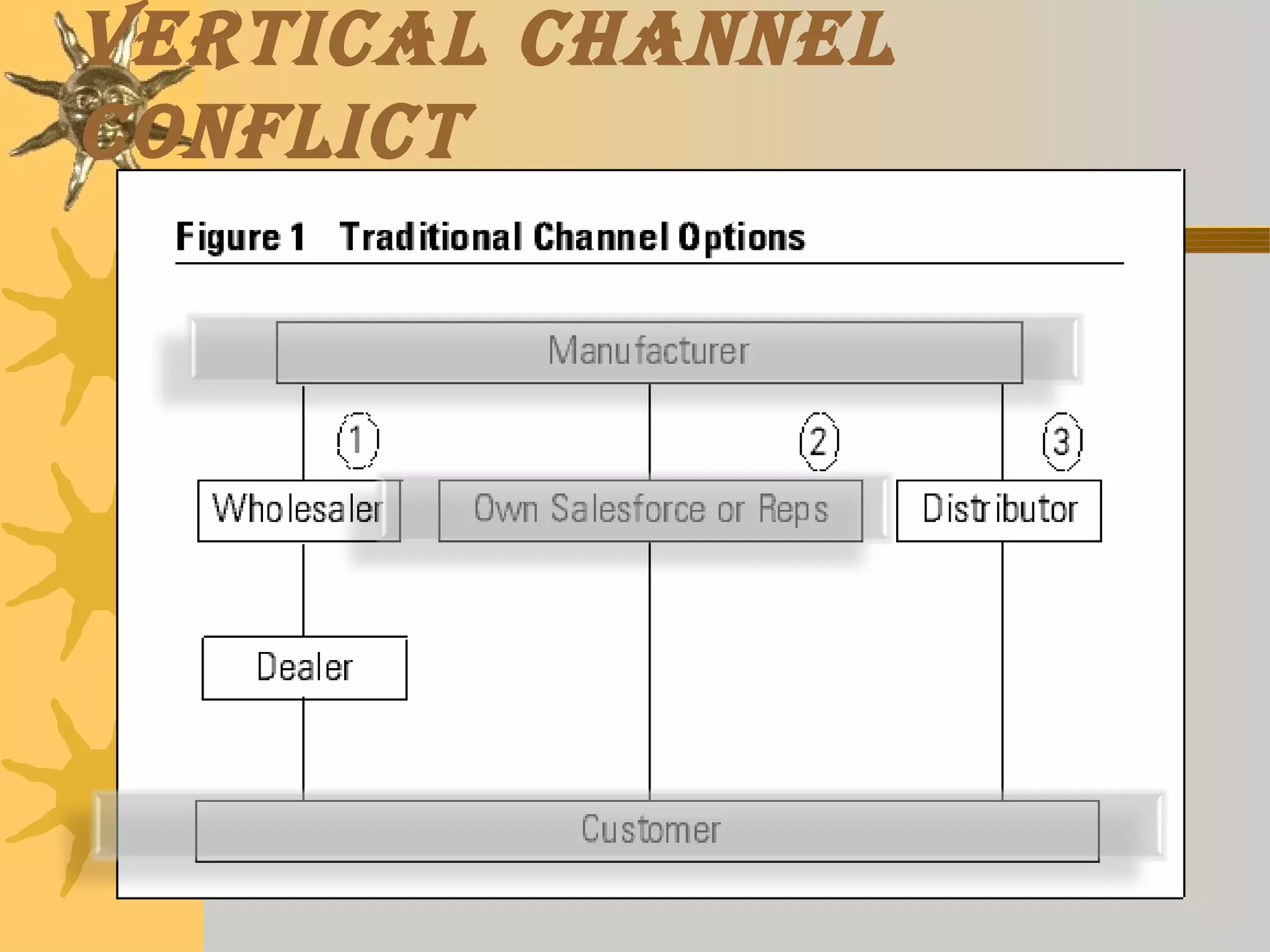
Vertical conflicts occur due to the differences in goals 
and objectives, misunderstandings, and mainly due to 
the poor communication 
Lack of role clarity and over dependence on the 
manufacturers. For e.g. Today the large retailers 
dominate the market and dictate the terms. Hence there 
are often conflicts between these giant retailers and the 
manufacturers.
Wholesalers expect manufacturers to maintain the 
product quality and production schedules and expect 
retailers to market the products effectively. In turn, 
retailers and manufacturers expect wholesalers to 
provide coordination functional services. If they fail to 
conform each others expectations, channel conflict 
results.
Some common reasons for vertical 
conflict are 
Dual distribution i.e. manufacturers may 
bypass intermediaries and sell directly to 
consumers and thus they compete with the 
intermediaries. 
Over saturation, i.e. manufacturers permit too 
many intermediaries in a designated area that can 
restrict, reduce sales opportunities for individual 
dealer and ultimately shrink their profits.
Partial treatment, i.e. manufacturers offer different 
services and margins to the different channels members even at 
same level or favor some members. 
New channels, i.e. manufacturers develop and use 
innovative channels that create threat to establish channel 
participants. 
No or inadequate sales support and training to 
intermediaries from the manufacturers. 
Irregular communication, non co-operation and 
rude behavior with the channel members.
Horizontal conflicts 
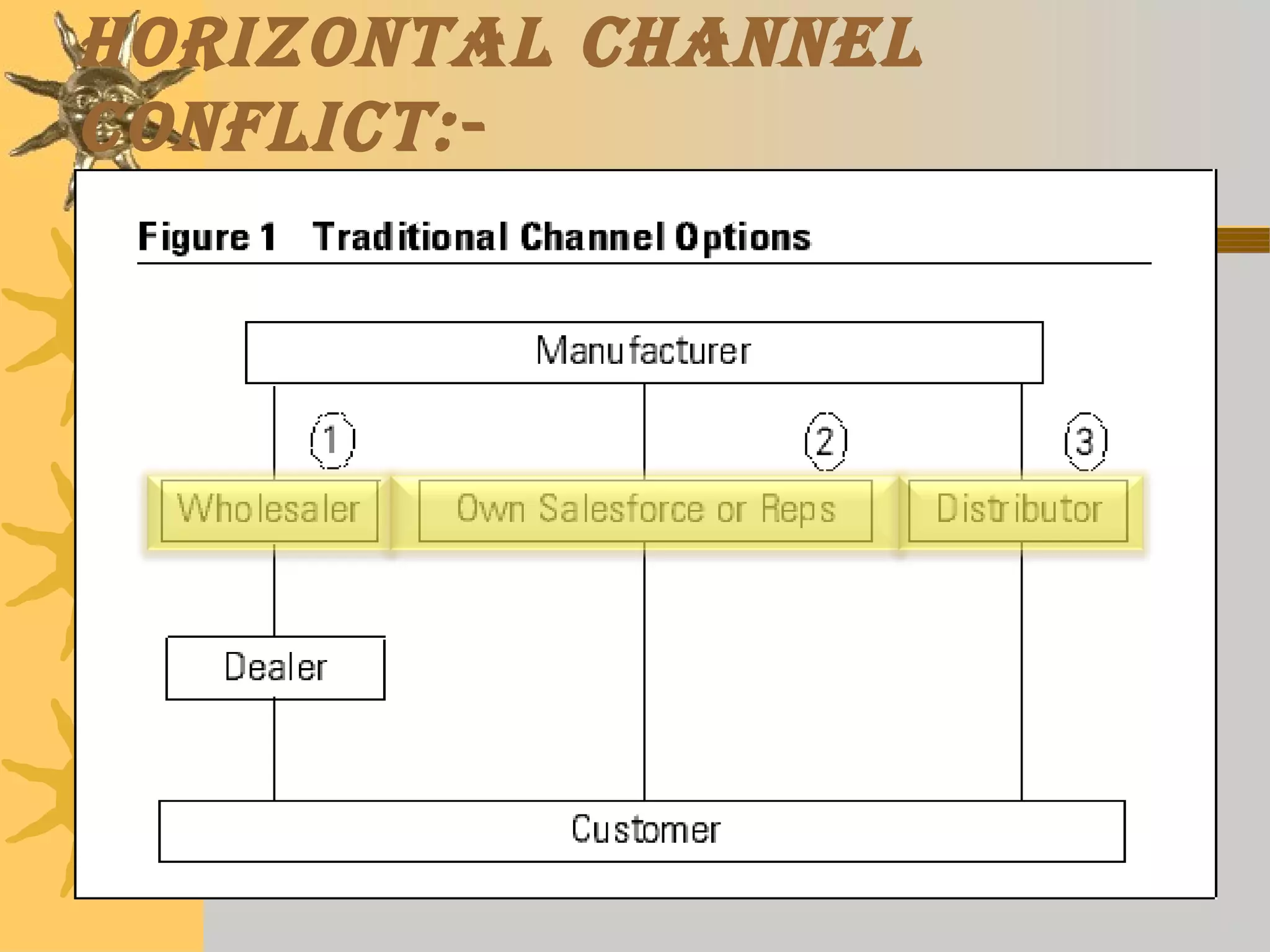
Horizontal conflicts are the conflicts between the 
channel members at the same level, i.e. two or 
more retailers, two or more franchisees etc. These 
conflicts can offer some positive benefits to the 
consumers. Competition or a price war between 
two dealers or retailers can be in favor of the 
consumers.
Reasons behind horizontal conflicts 
Price-off by one dealer / retailer can attract more customers of other 
retailers. 
Aggressive advertising and pricing by one dealer can affect 
business of other dealers. 
Extra service offered by one dealer / retailer can attract 
customers of others. 
Crossing the assigned territory and selling in other dealers / 
retailers / franchises area. 
Unethical practices or malpractices of one dealer or retailer can 
affect other and spoil the brand image.
Inter Type conflict 
Inter type conflict occurs when, the Intermediaries 
dealing in a particular product starts trading outside 
their normal product range. For example, now the 
supermarkets such as Foodworld also sell vegetables 
and fruits and thus compete with small retailers selling 
these products. Large retailers often offer a large variety 
and thus they compete with small but specialized 
retailers. This concept is called as “Scrambled 
Merchandising” where the retailers keep the 
merchandise lines that are outside their normal 
product range.
Multi-channel Conflict 
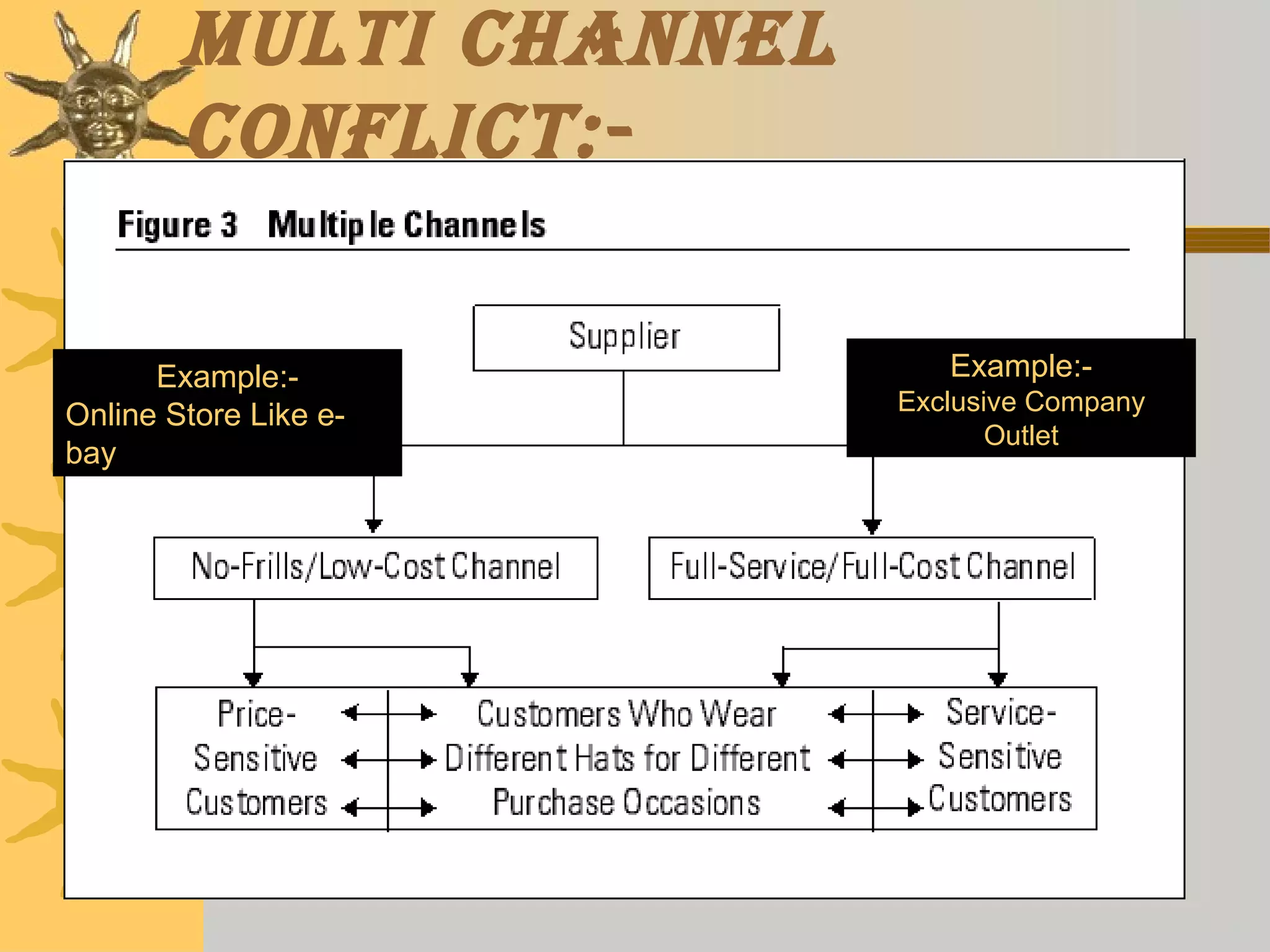
Multi-channel conflict occurs when the manufacturer uses a dual 
distribution strategy, i.e. the manufacturer uses two or more 
channel arrangements to reach to the same market. 
Manufacturers can sell directly through their exclusive 
showroom or outlets. This act can affect the business of other 
channels selling manufacturer’s brands. 
Manufacturers can bypass the wholesalers and sell directly to the 
large retailers. Conflict becomes more intense in this case as the 
large retailers can enjoy more customers and so the profit due to 
offering more variety and still economical prices, which is 
possible due to a volume purchase.
Vertical channel 
conflict
horizontal channel 
conflict:-
Multi channel 
conflict:- 
Example:- 
Online Store Like e-bay 
Example:- 
Exclusive Company 
Outlet
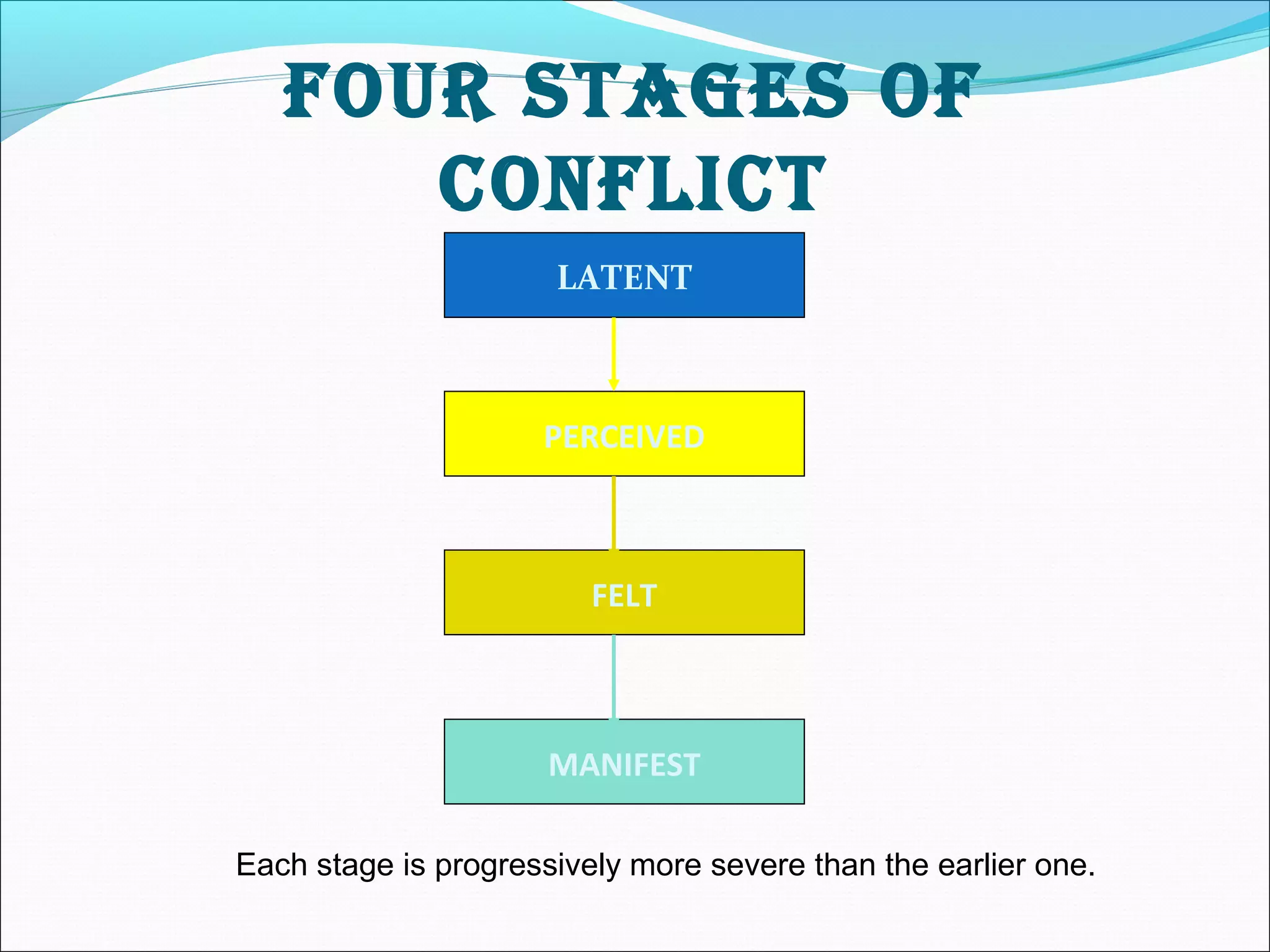
Four StageS oF 
conFlict 
LATENT 
PERCEIVED 
FELT 
MANIFEST 
Each stage is progressively more severe than the earlier one.
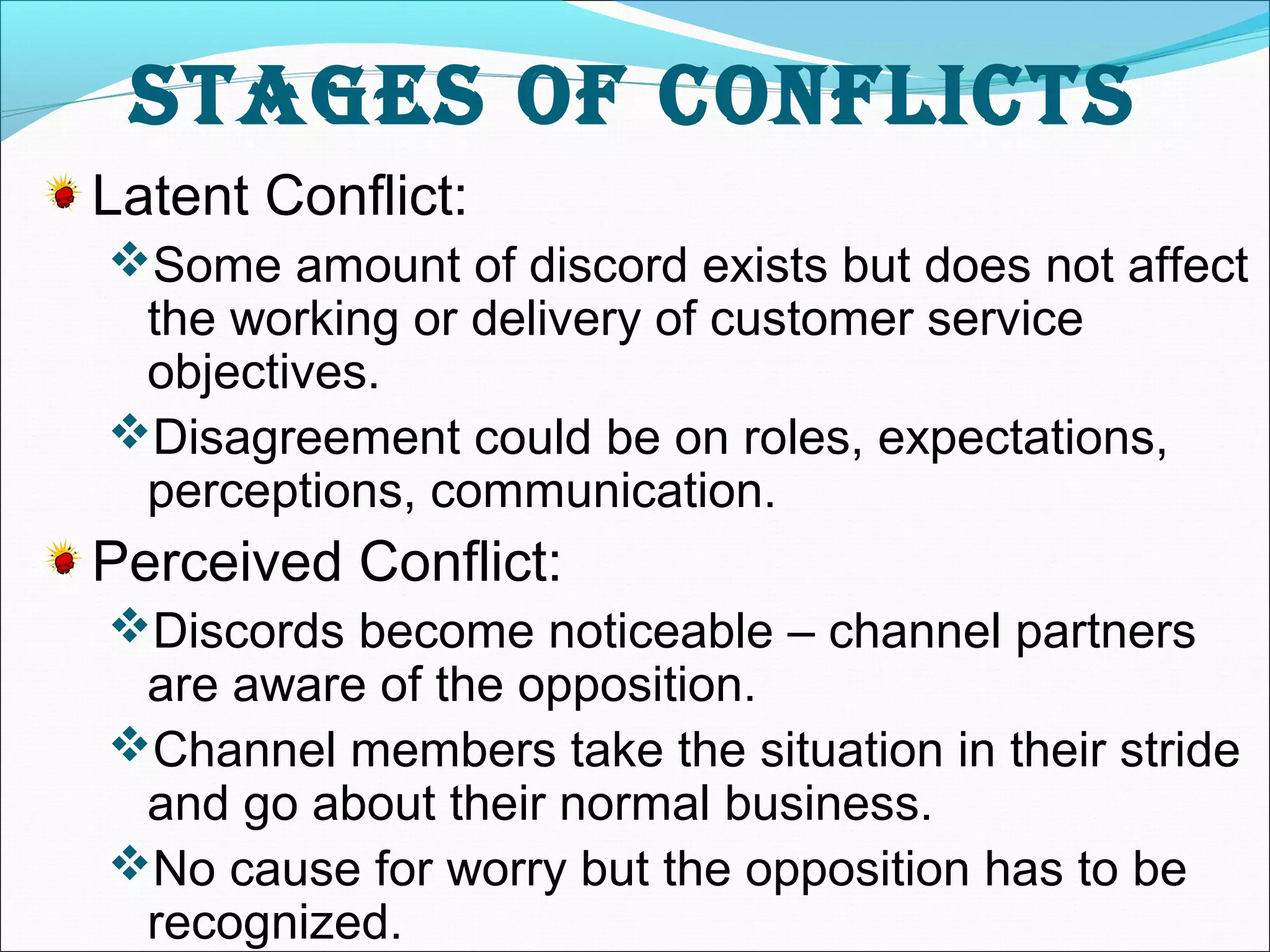
StageS oF conFlictS 
Latent Conflict: 
Some amount of discord exists but does not affect 
the working or delivery of customer service 
objectives. 
Disagreement could be on roles, expectations, 
perceptions, communication. 
Perceived Conflict: 
Discords become noticeable – channel partners 
are aware of the opposition. 
Channel members take the situation in their stride 
and go about their normal business. 
No cause for worry but the opposition has to be 
recognized.
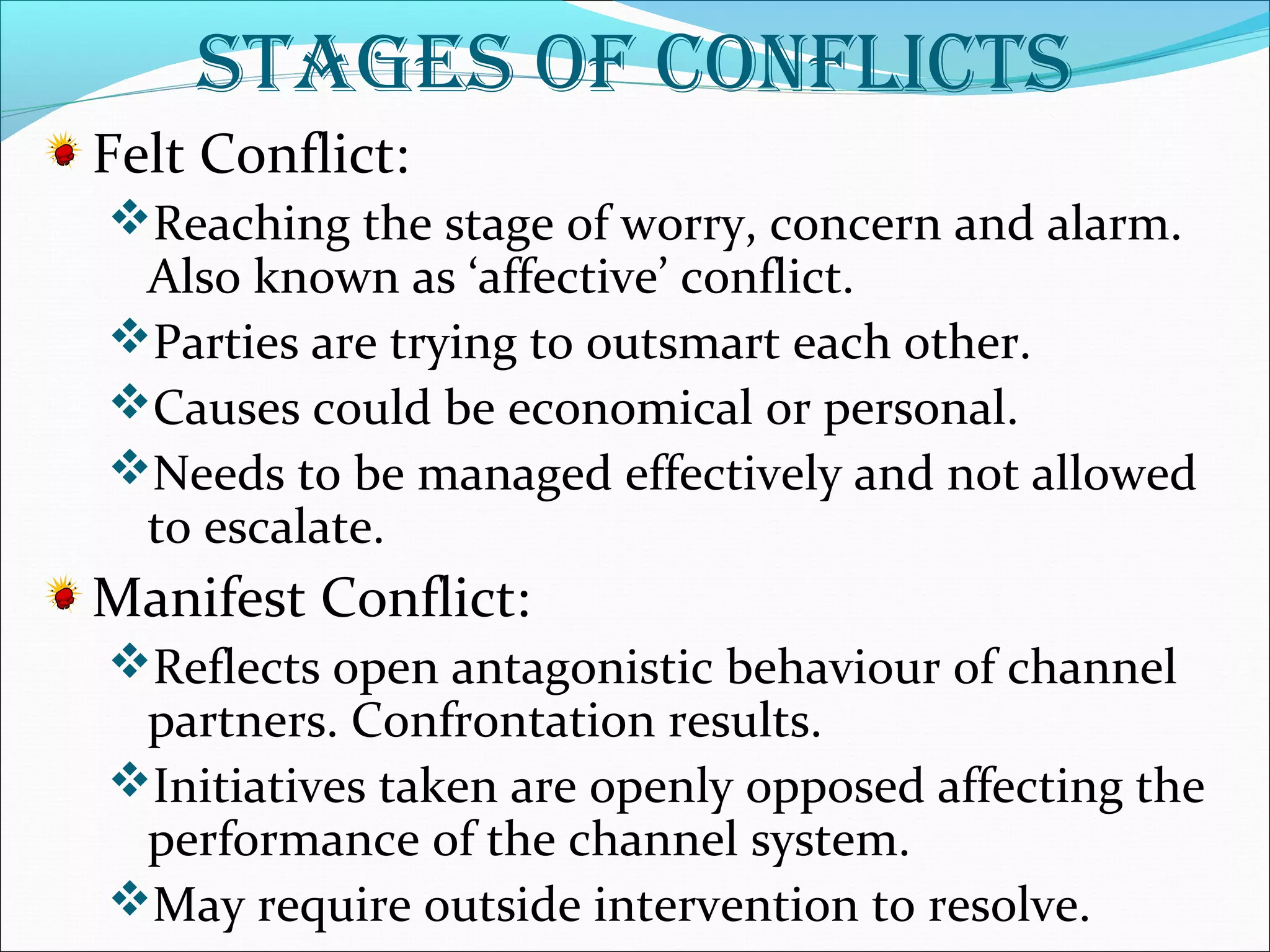
StageS oF conFlictS 
Felt Conflict: 
Reaching the stage of worry, concern and alarm. 
Also known as ‘affective’ conflict. 
Parties are trying to outsmart each other. 
Causes could be economical or personal. 
Needs to be managed effectively and not allowed 
to escalate. 
Manifest Conflict: 
Reflects open antagonistic behaviour of channel 
partners. Confrontation results. 
Initiatives taken are openly opposed affecting the 
performance of the channel system. 
May require outside intervention to resolve.
reSolving conFlictS 
A 4 Stage Process 
Understanding nature and intensity 
Tracing the source of the conflict 
Understand the impact of the conflict 
Strategy and plan of action for resolution
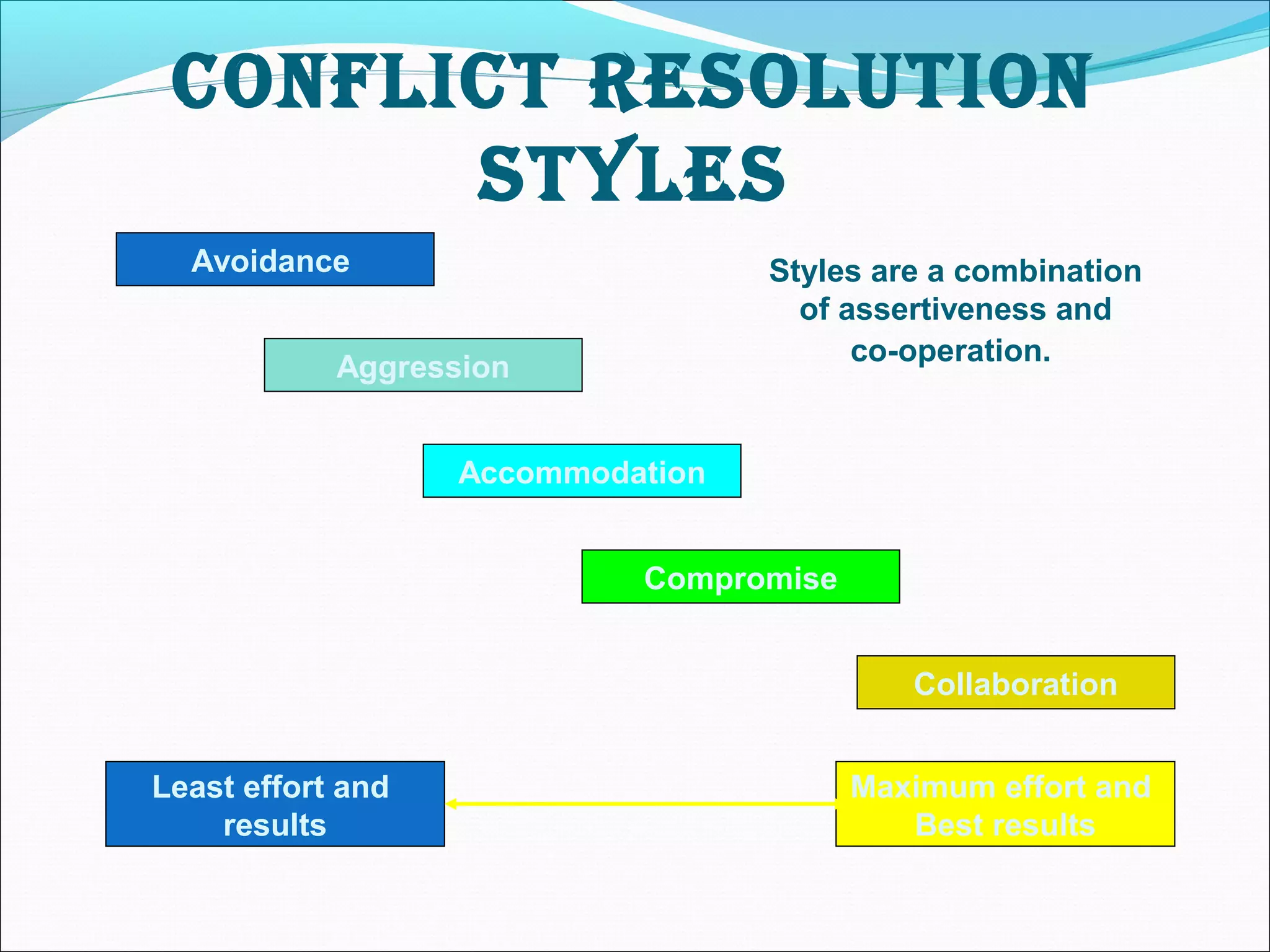
conFlict reSolution 
StyleS 
Avoidance 
Aggression 
Accommodation 
Styles are a combination 
of assertiveness and 
Compromise 
co-operation. 
Collaboration 
Least effort and 
results 
Maximum effort and 
Best results
avoidance 
Used by weak channel members. 
Problem is postponed or discussion 
avoided. 
Relationships are not of much importance. 
As there is no serious effort on getting 
anything done, conflict is avoided.
aggreSSion 
Also known as a competitive or selfish style. 
It means being concerned about one’s own goals 
without any thought for the others. 
The dominating channel partner (may be the 
principal) dictates terms to the others. Long term 
could be detrimental to the system.
accommodation 
A situation of complete surrender. 
One party helps the other achieve its goals without 
being worried about its own goals. 
Emphasis is on full co-operation and flexibility in 
approach. May generate matching feelings in the 
receiver. 
If not handled properly, can result in exploitation.
Compromise 
Obviously both sides have to give up 
something to meet mid way. 
Can only work with small and not so serious 
conflicts. 
Used often in the earlier two stages.
Collaboration 
Also known as a problem solving approach. 
Tries to maximize the benefit to both parties while 
solving the dispute. 
Most ideal style of conflict resolution – a win-win 
approach. 
Requires a lot of time and effort to succeed. 
Sensitive information may have to be shared.
power in 
marketing 
Channels 
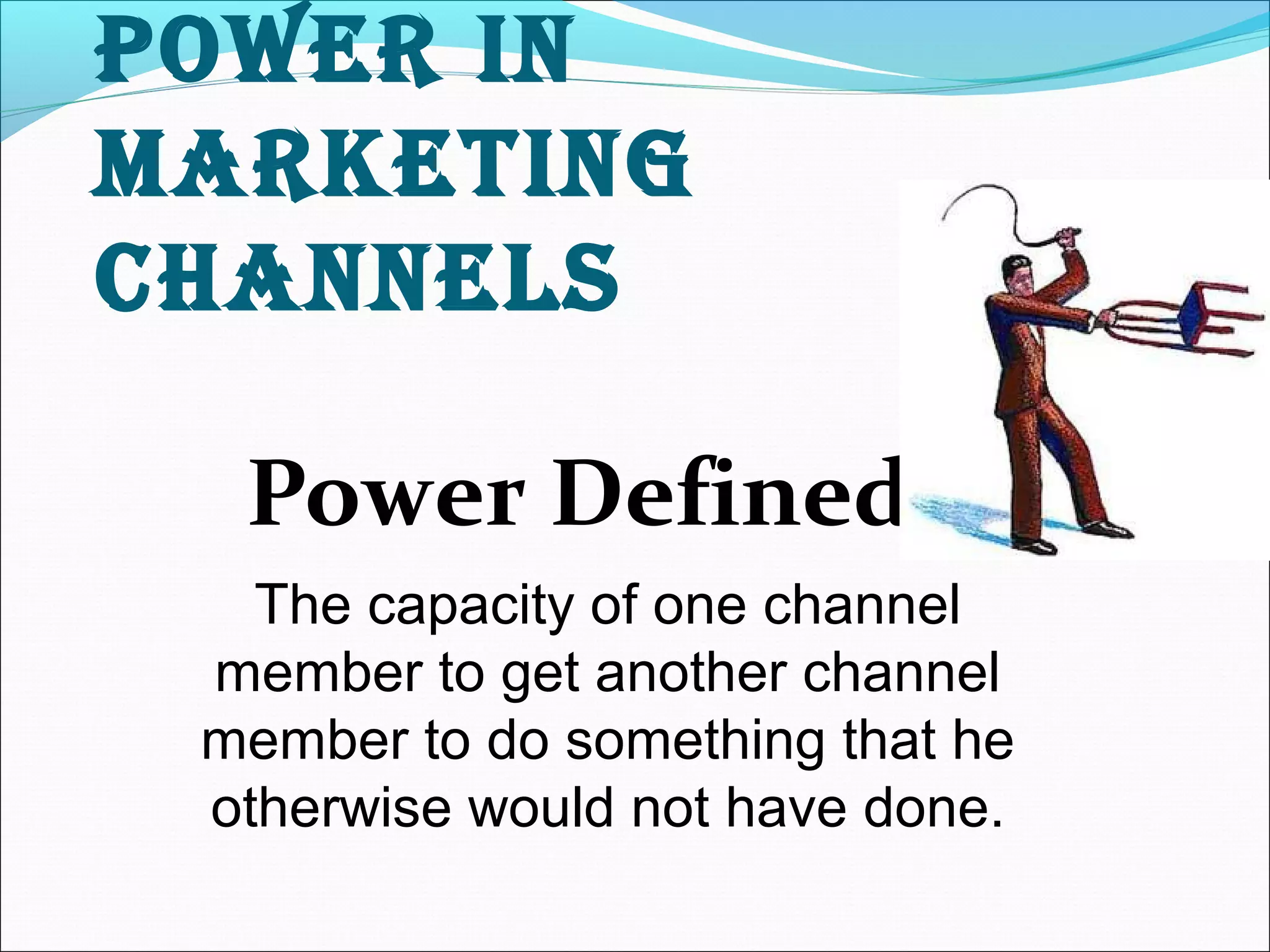
Power Defined: 
The capacity of one channel 
member to get another channel 
member to do something that he 
otherwise would not have done.
role in marketing 
Channels 
Role Defined: 
Set Prescriptions defining what 
the behavior of a position 
member should be.
CommuniCation in 
marketing Channels 
Communication Defined: 
Flow of information that enables 
channel members to send and 
receive messages
Managing conflict or conflict 
management strategies 
Arbitration and mediation 
Communication 
Channel captain 
Bargaining strategy 
Super ordinate goals 
Dealer councils

Channel conflicts

  • 1.
  • 2.
    Channel Conflict Achannel conflict may be defined as “A situation in which one channel member perceives another channel member(s) to be engaged in behavior that prevents it from achieving its goals”. Conflict is opposition, disagreement or discard among the organizations.
  • 3.
    Conflict is notalways undesirable. It is needed to have positive effect as loopholes in the existing system can be plugged timely and performance can be maximized.  It can keep other channel members on their toes knowing that a decline in performance might lead to a change in the channel arrangements. “Channel conflict arises when the behavior of a channel member is in opposition, to its channel counterpart. It is opponent centered and direct, in which the goal or object sought is controlled by the counterpart.” Coughlan, Anderson,
  • 4.
    Conflicts can alsobe classified as Vertical conflict Horizontal conflict Inter type conflict Multi Channel conflict
  • 5.
    Vertical conflicts Verticalconflicts occur due to the differences in goals and objectives, misunderstandings, and mainly due to the poor communication Lack of role clarity and over dependence on the manufacturers. For e.g. Today the large retailers dominate the market and dictate the terms. Hence there are often conflicts between these giant retailers and the manufacturers.
  • 6.
    Wholesalers expect manufacturersto maintain the product quality and production schedules and expect retailers to market the products effectively. In turn, retailers and manufacturers expect wholesalers to provide coordination functional services. If they fail to conform each others expectations, channel conflict results.
  • 7.
    Some common reasonsfor vertical conflict are Dual distribution i.e. manufacturers may bypass intermediaries and sell directly to consumers and thus they compete with the intermediaries. Over saturation, i.e. manufacturers permit too many intermediaries in a designated area that can restrict, reduce sales opportunities for individual dealer and ultimately shrink their profits.
  • 8.
    Partial treatment, i.e.manufacturers offer different services and margins to the different channels members even at same level or favor some members. New channels, i.e. manufacturers develop and use innovative channels that create threat to establish channel participants. No or inadequate sales support and training to intermediaries from the manufacturers. Irregular communication, non co-operation and rude behavior with the channel members.
  • 9.
    Horizontal conflicts Horizontalconflicts are the conflicts between the channel members at the same level, i.e. two or more retailers, two or more franchisees etc. These conflicts can offer some positive benefits to the consumers. Competition or a price war between two dealers or retailers can be in favor of the consumers.
  • 10.
    Reasons behind horizontalconflicts Price-off by one dealer / retailer can attract more customers of other retailers. Aggressive advertising and pricing by one dealer can affect business of other dealers. Extra service offered by one dealer / retailer can attract customers of others. Crossing the assigned territory and selling in other dealers / retailers / franchises area. Unethical practices or malpractices of one dealer or retailer can affect other and spoil the brand image.
  • 11.
    Inter Type conflict Inter type conflict occurs when, the Intermediaries dealing in a particular product starts trading outside their normal product range. For example, now the supermarkets such as Foodworld also sell vegetables and fruits and thus compete with small retailers selling these products. Large retailers often offer a large variety and thus they compete with small but specialized retailers. This concept is called as “Scrambled Merchandising” where the retailers keep the merchandise lines that are outside their normal product range.
  • 12.
    Multi-channel Conflict Multi-channelconflict occurs when the manufacturer uses a dual distribution strategy, i.e. the manufacturer uses two or more channel arrangements to reach to the same market. Manufacturers can sell directly through their exclusive showroom or outlets. This act can affect the business of other channels selling manufacturer’s brands. Manufacturers can bypass the wholesalers and sell directly to the large retailers. Conflict becomes more intense in this case as the large retailers can enjoy more customers and so the profit due to offering more variety and still economical prices, which is possible due to a volume purchase.
  • 14.
  • 15.
  • 16.
    Multi channel conflict:- Example:- Online Store Like e-bay Example:- Exclusive Company Outlet
  • 17.
    Four StageS oF conFlict LATENT PERCEIVED FELT MANIFEST Each stage is progressively more severe than the earlier one.
  • 18.
    StageS oF conFlictS Latent Conflict: Some amount of discord exists but does not affect the working or delivery of customer service objectives. Disagreement could be on roles, expectations, perceptions, communication. Perceived Conflict: Discords become noticeable – channel partners are aware of the opposition. Channel members take the situation in their stride and go about their normal business. No cause for worry but the opposition has to be recognized.
  • 19.
    StageS oF conFlictS Felt Conflict: Reaching the stage of worry, concern and alarm. Also known as ‘affective’ conflict. Parties are trying to outsmart each other. Causes could be economical or personal. Needs to be managed effectively and not allowed to escalate. Manifest Conflict: Reflects open antagonistic behaviour of channel partners. Confrontation results. Initiatives taken are openly opposed affecting the performance of the channel system. May require outside intervention to resolve.
  • 20.
    reSolving conFlictS A4 Stage Process Understanding nature and intensity Tracing the source of the conflict Understand the impact of the conflict Strategy and plan of action for resolution
  • 21.
    conFlict reSolution StyleS Avoidance Aggression Accommodation Styles are a combination of assertiveness and Compromise co-operation. Collaboration Least effort and results Maximum effort and Best results
  • 22.
    avoidance Used byweak channel members. Problem is postponed or discussion avoided. Relationships are not of much importance. As there is no serious effort on getting anything done, conflict is avoided.
  • 23.
    aggreSSion Also knownas a competitive or selfish style. It means being concerned about one’s own goals without any thought for the others. The dominating channel partner (may be the principal) dictates terms to the others. Long term could be detrimental to the system.
  • 24.
    accommodation A situationof complete surrender. One party helps the other achieve its goals without being worried about its own goals. Emphasis is on full co-operation and flexibility in approach. May generate matching feelings in the receiver. If not handled properly, can result in exploitation.
  • 25.
    Compromise Obviously bothsides have to give up something to meet mid way. Can only work with small and not so serious conflicts. Used often in the earlier two stages.
  • 26.
    Collaboration Also knownas a problem solving approach. Tries to maximize the benefit to both parties while solving the dispute. Most ideal style of conflict resolution – a win-win approach. Requires a lot of time and effort to succeed. Sensitive information may have to be shared.
  • 27.
    power in marketing Channels Power Defined: The capacity of one channel member to get another channel member to do something that he otherwise would not have done.
  • 28.
    role in marketing Channels Role Defined: Set Prescriptions defining what the behavior of a position member should be.
  • 29.
    CommuniCation in marketingChannels Communication Defined: Flow of information that enables channel members to send and receive messages
  • 30.
    Managing conflict orconflict management strategies Arbitration and mediation Communication Channel captain Bargaining strategy Super ordinate goals Dealer councils

Editor's Notes

  • #15 Conflicts between different levels within the same channel. Example : HUL came into a conflict with its distributors in Kerela on the issue of Commission
  • #16 when multiple channels are employed and distribution intensity increases, three profit threats may confront a retailer: sales cannibalization margin dilution customer diversion