
Outsourcing in General.
Contents 1 What is Outsourcing? 2 Spectrum of Outsourcing 3 Why Company Outsource? 4 Outsourcing Risks 5 Outsourcing Process 6 Drafting an outsourcing contract 7 Concerns of Outsourcing in SCM 8 Myths of Outsourcing in SCM
What is Outsourcing? Outsourcing  is subcontracting a process, such as product design or manufacturing, to a third-party company. Outsourcing  is defined as the contracting of one or more of a company’s business processes to an outside service provider to help increase shareholder value, by primarily reducing operating cost and focusing on core competencies.
The entire spectrum of sourcing Outsourcing,   To obtain components for products or services from sources outside the organization. In-sourcing,   Transfer tasks that were performed outside the organization into the organization Offshoring, Outsourcing overseas or in a separate country  Near-shoring, Outsourcing to cheaper overseas, still geographically closer locations , e.g. Canada and Mexico Rural-sourcing Outsourcing to cheaper rural areas in the United States Volunteers   Least expensive but sometimes most difficult to manage
Why do companies outsource? Reduces administrative burdens Focus on strategic areas Reduce costs Focus on core functions Acquire new skills Acquire better management Assist a fast growth situation Avoid labour problems Focus on strategy Avoid major investments
Why do company outsource? Handle overflow situation Improve flexibility Improve ratios Jump on to bandwagon Enhance credibility Maintain old functions Improve performance Begin a strategic initiative
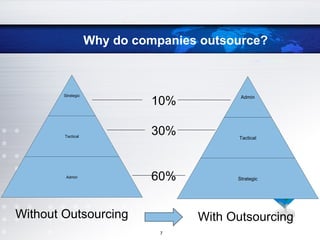
Why do companies outsource? 10% 30% 60% Without Outsourcing Strategic Tactical Admin Admin Tactical Strategic With Outsourcing
Outsourcing Risks Short term : pricing issues  operational issues at supplier’s end  Long term : non-performance by a supplier  nonalignment of company’s goals with supplier’s goals
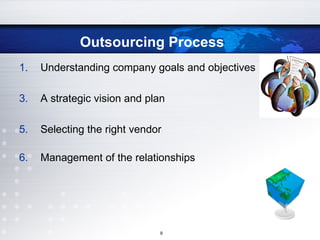
Outsourcing Process Understanding company goals and objectives A strategic vision and plan Selecting the right vendor Management of the relationships
Outsourcing Process 5. A properly structured contract 6. Open communication 7. Senior executive support 8. Use of outside expertise
Drafting an Outsourcing contract Why and what to be outsourced?? Clear business objectives Internal and external benchmarking Develop performance and cost targets
Drafting an Outsourcing contract Develop initiative-based targets Fulfillment of initiatives beneficiary for both parties Review performance regularly Expand or shrink the relationship
Concerns about Outsourcing in SCM Fear of losing control Lack of confidence Lack of outsourcing education Management philosophy and tradition
Myths of Supply Chain Outsourcing My Outsourced partners are all supply chain experts Partners have state-of-the-art IT infrastructure By outsourcing production and fulfillment, no need to worry about execution Outsourced partners will provide expert project management
Myths of Supply Chain Outsourcing Outsourcing automatically gives a time-to-market advantage Fulfillment is easier to outsource than manufacturing
Thank You !

Outsourcing

  • 1.
  • 2.
    Contents 1 Whatis Outsourcing? 2 Spectrum of Outsourcing 3 Why Company Outsource? 4 Outsourcing Risks 5 Outsourcing Process 6 Drafting an outsourcing contract 7 Concerns of Outsourcing in SCM 8 Myths of Outsourcing in SCM
  • 3.
    What is Outsourcing?Outsourcing is subcontracting a process, such as product design or manufacturing, to a third-party company. Outsourcing is defined as the contracting of one or more of a company’s business processes to an outside service provider to help increase shareholder value, by primarily reducing operating cost and focusing on core competencies.
  • 4.
    The entire spectrumof sourcing Outsourcing, To obtain components for products or services from sources outside the organization. In-sourcing, Transfer tasks that were performed outside the organization into the organization Offshoring, Outsourcing overseas or in a separate country Near-shoring, Outsourcing to cheaper overseas, still geographically closer locations , e.g. Canada and Mexico Rural-sourcing Outsourcing to cheaper rural areas in the United States Volunteers Least expensive but sometimes most difficult to manage
  • 5.
    Why do companiesoutsource? Reduces administrative burdens Focus on strategic areas Reduce costs Focus on core functions Acquire new skills Acquire better management Assist a fast growth situation Avoid labour problems Focus on strategy Avoid major investments
  • 6.
    Why do companyoutsource? Handle overflow situation Improve flexibility Improve ratios Jump on to bandwagon Enhance credibility Maintain old functions Improve performance Begin a strategic initiative
  • 7.
    Why do companiesoutsource? 10% 30% 60% Without Outsourcing Strategic Tactical Admin Admin Tactical Strategic With Outsourcing
  • 8.
    Outsourcing Risks Shortterm : pricing issues operational issues at supplier’s end Long term : non-performance by a supplier nonalignment of company’s goals with supplier’s goals
  • 9.
    Outsourcing Process Understandingcompany goals and objectives A strategic vision and plan Selecting the right vendor Management of the relationships
  • 10.
    Outsourcing Process 5.A properly structured contract 6. Open communication 7. Senior executive support 8. Use of outside expertise
  • 11.
    Drafting an Outsourcingcontract Why and what to be outsourced?? Clear business objectives Internal and external benchmarking Develop performance and cost targets
  • 12.
    Drafting an Outsourcingcontract Develop initiative-based targets Fulfillment of initiatives beneficiary for both parties Review performance regularly Expand or shrink the relationship
  • 13.
    Concerns about Outsourcingin SCM Fear of losing control Lack of confidence Lack of outsourcing education Management philosophy and tradition
  • 14.
    Myths of SupplyChain Outsourcing My Outsourced partners are all supply chain experts Partners have state-of-the-art IT infrastructure By outsourcing production and fulfillment, no need to worry about execution Outsourced partners will provide expert project management
  • 15.
    Myths of SupplyChain Outsourcing Outsourcing automatically gives a time-to-market advantage Fulfillment is easier to outsource than manufacturing
  • 16.