Amity Business School MBA Class of 2010, Semester II Distribution & Logistics Management Ms.Vandana Gupta
Channel Management – Key Decisions
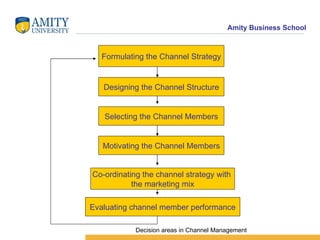
Formulating the Channel Strategy Designing   the Channel Structure Selecting the Channel Members Motivating the Channel Members Co-ordinating the channel strategy with  the marketing mix Evaluating channel member performance Decision areas in Channel Management
1. Formulating Channel Strategy The most crucial aspect is the choice of a level of service by which an enterprise might seek to secure competitive advantage. The importance of channel strategy is likely to depend upon the existence of one or more of following conditions:
Target markets demand a strong emphasis on distribution Competitive parity exists in other marketing mix variables, with the need for channel strategy to provide some differential advantage Competitive vulnerability exists because of distribution neglect Opportunities for synergy exist through channel strategy
2. Designing the channel Structure Can we effect distribution better than intermediaries at an equivalent cost? Can we effect distribution as well as intermediaries at a lower cost?
3. Selecting the channel Members Considerations need to be given to: Economic Criteria Control Criteria Adaptive Criteria End User Considerations Product Characteristics Manufacturer’s capability and Resources
4. Training the Channel Members Those who seek mentoring will rule the great expanse under heaven. -Shu Ching, Chinese Book Of History-
TRAINING It is a process of providing the intermediaries with specific skills for performing their task better and helping them to correct deficiencies in their sales performance. Training Program creates a Win-Win situation for both individual and the organization.
Phases Of Developing And Conducting Training Successfu l Program Consist of four phases : 1.Training Assessment 2. Program Design 3. Reinforcement 4. Evaluation
Phases of Developing and Conducting Training Establish program objectives Identify who should be trained Identify training needs and specific goals How much training is needed? Training  Assessment
Sales Training  Program  Objectives Higher  Morale Lower  Turnover Increased  Sales Productivity Improved  Communication Improved  Customer Relation  Improved Self  Management Objectives of Training Program
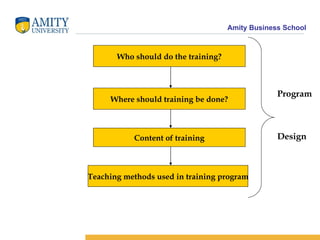
Where should training be done? Who should do the training? Content of training Program Design Teaching methods used in training program
What Should The Content Of The Training Be? Attitude toward Selling and toward Training Knowledge of the Company Product Knowledge and Application Knowledge of Competitive Products Knowledge of Customers Knowledge of Business Principles Selling Skills Relationship-Building Skills
What Teaching Methods Should Be Used? Teaching Methods For  Presenting Information In Sales  Training Discussion Cases Round table Panels Demonstrations Lectures Web- Based training Audiocassettes Role-Playing On-the-job  training Mentoring
Determine how training will be reinforced What outcomes will be evaluated? What measures will be used?  Reinforcement Evaluation
Training Evaluation Reactions Behavior Learning Results

Channel Management

  • 1.
    Amity Business SchoolMBA Class of 2010, Semester II Distribution & Logistics Management Ms.Vandana Gupta
  • 2.
  • 3.
    Formulating the ChannelStrategy Designing the Channel Structure Selecting the Channel Members Motivating the Channel Members Co-ordinating the channel strategy with the marketing mix Evaluating channel member performance Decision areas in Channel Management
  • 4.
    1. Formulating ChannelStrategy The most crucial aspect is the choice of a level of service by which an enterprise might seek to secure competitive advantage. The importance of channel strategy is likely to depend upon the existence of one or more of following conditions:
  • 5.
    Target markets demanda strong emphasis on distribution Competitive parity exists in other marketing mix variables, with the need for channel strategy to provide some differential advantage Competitive vulnerability exists because of distribution neglect Opportunities for synergy exist through channel strategy
  • 6.
    2. Designing thechannel Structure Can we effect distribution better than intermediaries at an equivalent cost? Can we effect distribution as well as intermediaries at a lower cost?
  • 7.
    3. Selecting thechannel Members Considerations need to be given to: Economic Criteria Control Criteria Adaptive Criteria End User Considerations Product Characteristics Manufacturer’s capability and Resources
  • 8.
    4. Training theChannel Members Those who seek mentoring will rule the great expanse under heaven. -Shu Ching, Chinese Book Of History-
  • 9.
    TRAINING It isa process of providing the intermediaries with specific skills for performing their task better and helping them to correct deficiencies in their sales performance. Training Program creates a Win-Win situation for both individual and the organization.
  • 10.
    Phases Of DevelopingAnd Conducting Training Successfu l Program Consist of four phases : 1.Training Assessment 2. Program Design 3. Reinforcement 4. Evaluation
  • 11.
    Phases of Developingand Conducting Training Establish program objectives Identify who should be trained Identify training needs and specific goals How much training is needed? Training Assessment
  • 12.
    Sales Training Program Objectives Higher Morale Lower Turnover Increased Sales Productivity Improved Communication Improved Customer Relation Improved Self Management Objectives of Training Program
  • 13.
    Where should trainingbe done? Who should do the training? Content of training Program Design Teaching methods used in training program
  • 14.
    What Should TheContent Of The Training Be? Attitude toward Selling and toward Training Knowledge of the Company Product Knowledge and Application Knowledge of Competitive Products Knowledge of Customers Knowledge of Business Principles Selling Skills Relationship-Building Skills
  • 15.
    What Teaching MethodsShould Be Used? Teaching Methods For Presenting Information In Sales Training Discussion Cases Round table Panels Demonstrations Lectures Web- Based training Audiocassettes Role-Playing On-the-job training Mentoring
  • 16.
    Determine how trainingwill be reinforced What outcomes will be evaluated? What measures will be used? Reinforcement Evaluation
  • 17.
    Training Evaluation ReactionsBehavior Learning Results

Editor's Notes

  • #2 Amity Business School