1
Change Management
BY: DR. HUMAYUN FAIZ RASOOL
MSc. MATERIALS SCIENCE
MBA
MS (MANAGEMENT)
MS (NUCLEAR ENGINEERING)
PHD (NUCLEAR PHYSICS)
Agenda for presentation
Defining change management
Individual change management
Organizational change management
Who is involved in managing change
Theories of Change Management
3 3
4 4
Change management is:
The process, tools and techniques to
manage the people side of change to
achieve the required organizational
results.
4 4
Rate of Change
“When the rate of change outside exceeds the
rate of change inside, the end is in sight”
Jack Welch
“The next few decades will bring about an
avalanche of change and that
most people and organisations
will not be prepared for the vastly
accelerated pace of change.”
A Toffler, Future Shock (New York: 1970)
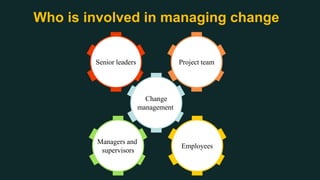
Who is involved in managing change
Project team
Change
management
Senior leaders
Managers and
supervisors
Employees
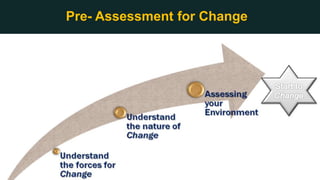
Pre- Assessment for Change
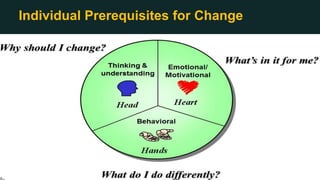
Individual Prerequisites for Change
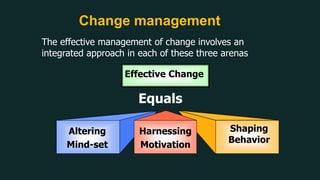
Change management
Effective Change
Equals
Altering
Mind-set
Harnessing
Motivation
Shaping
Behavior
The effective management of change involves an
integrated approach in each of these three arenas
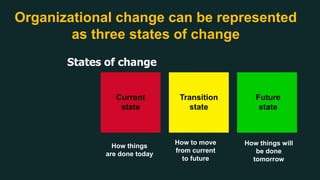
Organizational change can be represented
as three states of change
States of change
How things
are done today
How things will
be done
tomorrow
How to move
from current
to future
Current
state
Transition
state
Future
state
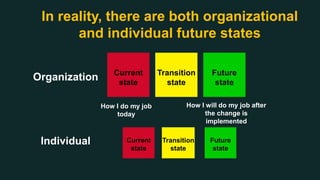
In reality, there are both organizational
and individual future states
Organization
Individual
How I do my job
today
How I will do my job after
the change is
implemented
Current
state
Transition
state
Future
state
Current
state
Transition
state
Future
state
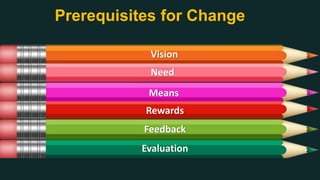
Vision
Need
Means
Rewards
Feedback
Evaluation
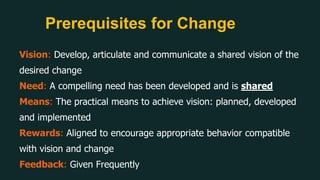
Prerequisites for Change
Vision: Develop, articulate and communicate a shared vision of the
desired change
Need: A compelling need has been developed and is shared
Means: The practical means to achieve vision: planned, developed
and implemented
Rewards: Aligned to encourage appropriate behavior compatible
with vision and change
Feedback: Given Frequently
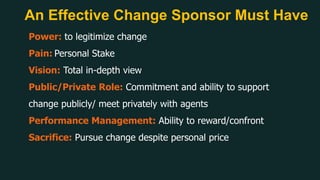
An Effective Change Sponsor Must Have
Power: to legitimize change
Pain: Personal Stake
Vision: Total in-depth view
Public/Private Role: Commitment and ability to support
change publicly/ meet privately with agents
Performance Management: Ability to reward/confront
Sacrifice: Pursue change despite personal price
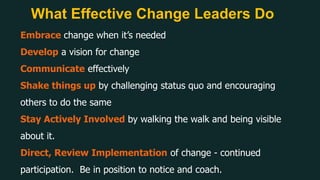
What Effective Change Leaders Do
Embrace change when it’s needed
Develop a vision for change
Communicate effectively
Shake things up by challenging status quo and encouraging
others to do the same
Stay Actively Involved by walking the walk and being visible
about it.
Direct, Review Implementation of change - continued
participation. Be in position to notice and coach.
Put PURPOSE
in the center
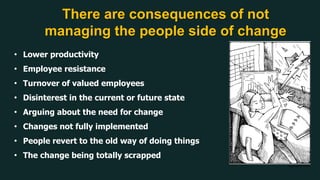
There are consequences of not
managing the people side of change
• Lower productivity
• Employee resistance
• Turnover of valued employees
• Disinterest in the current or future state
• Arguing about the need for change
• Changes not fully implemented
• People revert to the old way of doing things
• The change being totally scrapped
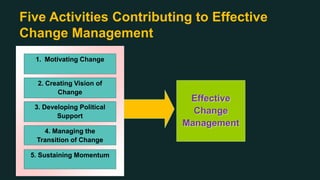
Five Activities Contributing to Effective
Change Management
1. Motivating Change
2. Creating Vision of
Change
3. Developing Political
Support
4. Managing the
Transition of Change
5. Sustaining Momentum
Effective
Change
Management
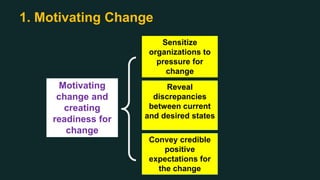
1. Motivating Change
Motivating
change and
creating
readiness for
change
Sensitize
organizations to
pressure for
change
Reveal
discrepancies
between current
and desired states
Convey credible
positive
expectations for
the change
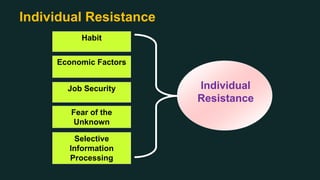
Individual Resistance
Individual
Resistance
Habit
Selective
Information
Processing
Economic Factors
Job Security
Fear of the
Unknown
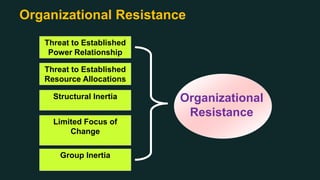
Organizational Resistance
Organizational
Resistance
Threat to Established
Power Relationship
Group Inertia
Threat to Established
Resource Allocations
Structural Inertia
Limited Focus of
Change
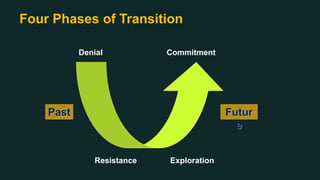
Four Phases of Transition
Denial
Resistance Exploration
Past Futur
e
Commitment
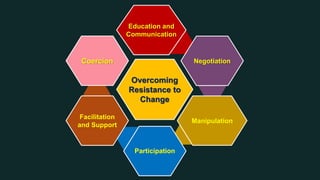
Overcoming
Resistance to
Change
Education and
Communication
Negotiation
Manipulation
Participation
Facilitation
and Support
Coercion
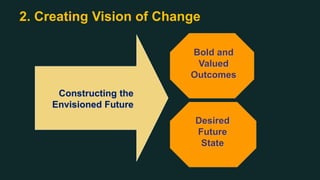
2. Creating Vision of Change
Constructing the
Envisioned Future
Bold and
Valued
Outcomes
Desired
Future
State
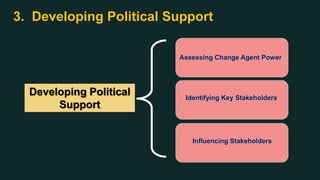
3. Developing Political Support
Assessing Change Agent Power
Identifying Key Stakeholders
Influencing Stakeholders
Developing Political
Support
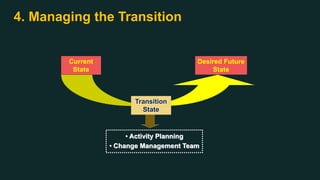
4. Managing the Transition
Current
State
Desired Future
State
Transition
State
• Activity Planning
• Change Management Team
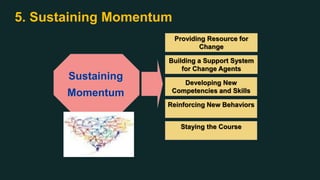
5. Sustaining Momentum
Sustaining
Momentum
Providing Resource for
Change
Building a Support System
for Change Agents
Developing New
Competencies and Skills
Reinforcing New Behaviors
Staying the Course
The Change Levers
1.0 leadership
…its about inspiring
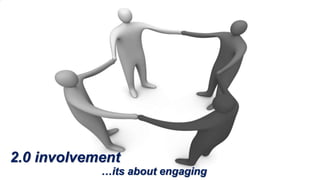
2.0 involvement
…its about engaging
3.0 Communication
…its about sharing information of change
4.0 learning
…its about building skills and competence
5.0 Measurement
…its about defining, quantifying and monitoring
6.0 Reinforcement
…its sustaining behavior over time
Models of Change Process
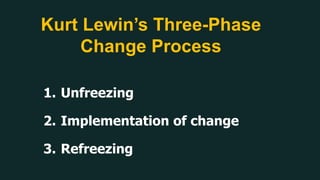
Kurt Lewin’s Three-Phase
Change Process
1. Unfreezing
2. Implementation of change
3. Refreezing
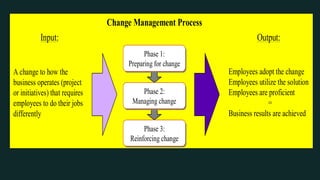
Phase 1:
Preparing for change
Phase 1:
Preparing for change
Phase 2:
Managing change
Phase 2:
Managing change
Phase 3:
Reinforcing change
Phase 3:
Reinforcing change
Change Management Process
Input: Output:
Employees adopt the change
Employees utilize the solution
Employees are proficient
=
Business results are achieved
A change to how the
business operates (project
or initiatives) that requires
employees to do their jobs
differently
Kotter’s eight-step Model for
successful change management
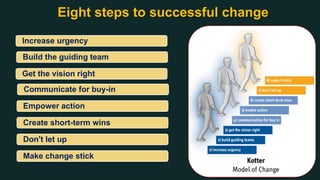
Eight steps to successful change
Increase urgency
Build the guiding team
Communicate for buy-in
Empower action
Create short-term wins
Don't let up
Make change stick
Get the vision right
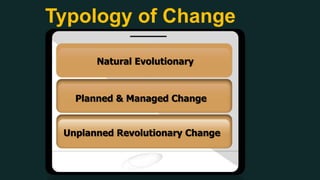
Typology of Change
Planned & Managed Change
Natural Evolutionary
Unplanned Revolutionary Change
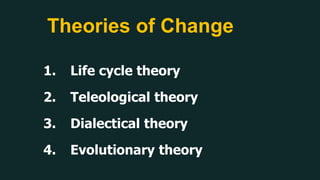
Theories of Change
1. Life cycle theory
2. Teleological theory
3. Dialectical theory
4. Evolutionary theory
Thank You and ….

Change managment lectures slides