


1www.studyMarketing.org
Creative Thinking
Skills for HR
Managers
2www.studyMarketing.org
You can download these
excellent slides at :
www.HR-Management-Slides.com
3www.studyMarketing.org
Contents
1. Creativity and Types of Innovation
2. Conceptual Blocks : Constancy, Compression and
Complacency
3. Three Components of Creativity
4. The Paradoxical Characteristics of Creative Groups
5. Tools for Defining Problems and Creating New Ideas
6. Creating a Creative Climate
4www.studyMarketing.org
Don’t Believe the Experts !
“Television won’t be able to hold onto any
market it captures after the first six
months. People will soon get tired of
staring into a box every night.”
Don’t Believe the Experts !
(Darryl F. Zanuck, Head of 20th Century Fox, 1946)
5www.studyMarketing.org
Don’t Believe the Experts !
“That’s an amazing invention, but
who would ever want to use one of
them?”
(US President Rutherford B. Hayes, after participating in a
trial telephone conversation between Washington and
Philadelphia in 1876).
6www.studyMarketing.org
Don’t Believe the Experts !
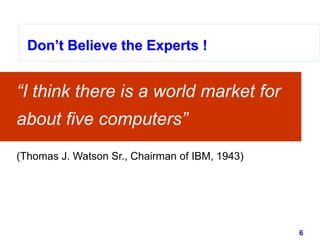
“I think there is a world market for
about five computers”
Don’t Believe the Experts !Don’t Believe the Experts !
(Thomas J. Watson Sr., Chairman of IBM, 1943)
7www.studyMarketing.org
Conceptual Blocks to Creativity
8www.studyMarketing.org
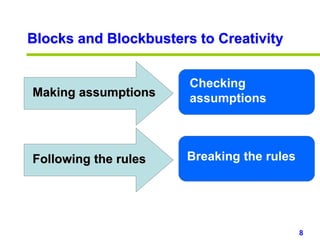
Blocks and Blockbusters to Creativity
Following the rules Breaking the rules
Making assumptions
Checking
assumptions
9www.studyMarketing.org
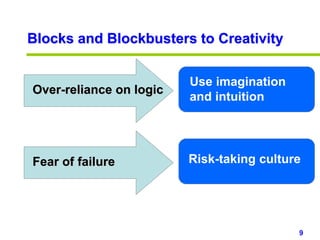
Blocks and Blockbusters to Creativity
Fear of failure Risk-taking culture
Over-reliance on logic
Use imagination
and intuition
10www.studyMarketing.org
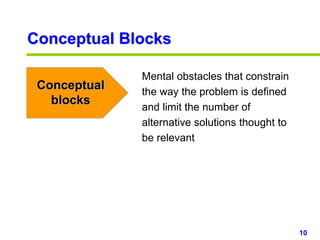
Conceptual Blocks
Conceptual
blocks
Mental obstacles that constrain
the way the problem is defined
and limit the number of
alternative solutions thought to
be relevant
11www.studyMarketing.org
Conceptual Blocks
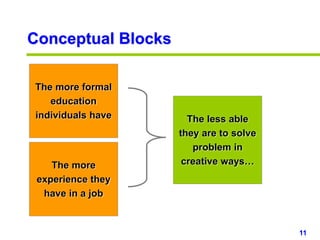
The more formal
education
individuals have
The more
experience they
have in a job
The less able
they are to solve
problem in
creative ways…
12www.studyMarketing.org
Conceptual Blocks
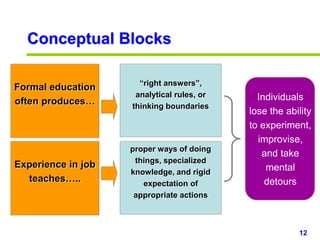
Formal education
often produces…
“right answers”,
analytical rules, or
thinking boundaries
Experience in job
teaches…..
proper ways of doing
things, specialized
knowledge, and rigid
expectation of
appropriate actions
Individuals
lose the ability
to experiment,
improvise,
and take
mental
detours
13www.studyMarketing.org
Types of Conceptual Blocks
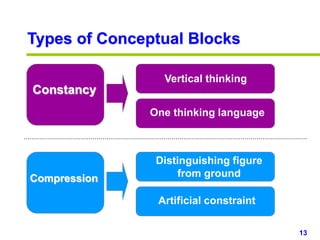
Constancy
Vertical thinking
One thinking language
Compression
Distinguishing figure
from ground
Artificial constraint
14www.studyMarketing.org
Types of Conceptual Blocks
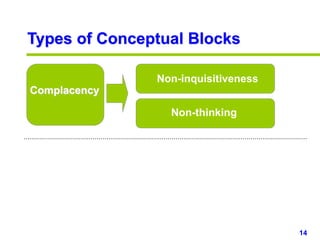
Complacency
Non-inquisitiveness
Non-thinking
15www.studyMarketing.org
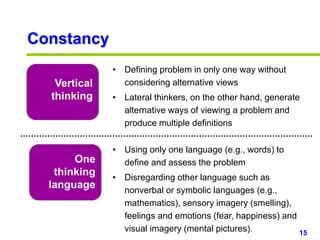
Constancy
Vertical
thinking
One
thinking
language
• Defining problem in only one way without
considering alternative views
• Lateral thinkers, on the other hand, generate
alternative ways of viewing a problem and
produce multiple definitions
• Using only one language (e.g., words) to
define and assess the problem
• Disregarding other language such as
nonverbal or symbolic languages (e.g.,
mathematics), sensory imagery (smelling),
feelings and emotions (fear, happiness) and
visual imagery (mental pictures).
16www.studyMarketing.org
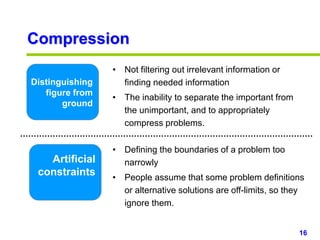
Compression
Distinguishing
figure from
ground
Artificial
constraints
• Not filtering out irrelevant information or
finding needed information
• The inability to separate the important from
the unimportant, and to appropriately
compress problems.
• Defining the boundaries of a problem too
narrowly
• People assume that some problem definitions
or alternative solutions are off-limits, so they
ignore them.
17www.studyMarketing.org
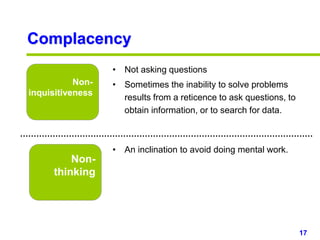
Complacency
Non-
inquisitiveness
Non-
thinking
• Not asking questions
• Sometimes the inability to solve problems
results from a reticence to ask questions, to
obtain information, or to search for data.
• An inclination to avoid doing mental work.
18www.studyMarketing.org
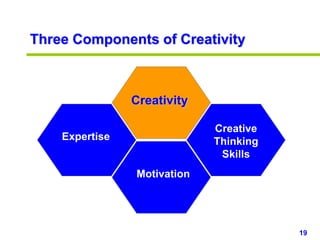
Three Components of Creativity
19www.studyMarketing.org
Three Components of Creativity
Expertise
Motivation
Creative
Thinking
Skills
Creativity
20www.studyMarketing.org
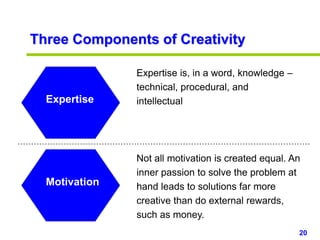
Three Components of Creativity
Expertise
Motivation
Expertise is, in a word, knowledge –
technical, procedural, and
intellectual
Not all motivation is created equal. An
inner passion to solve the problem at
hand leads to solutions far more
creative than do external rewards,
such as money.
21www.studyMarketing.org
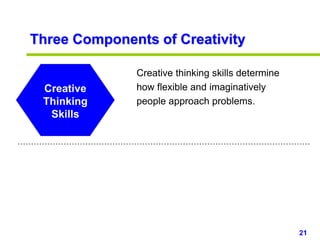
Three Components of Creativity
Creative
Thinking
Skills
Creative thinking skills determine
how flexible and imaginatively
people approach problems.
22www.studyMarketing.org
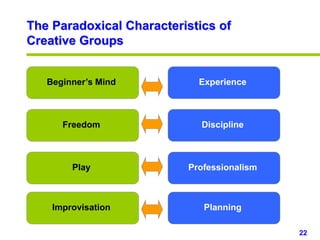
The Paradoxical Characteristics of
Creative Groups
Beginner’s Mind
Freedom
Play
Improvisation
Experience
Discipline
Professionalism
Planning
23www.studyMarketing.org
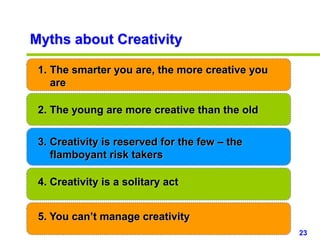
Myths about Creativity
1. The smarter you are, the more creative you
are
2. The young are more creative than the old
3. Creativity is reserved for the few – the
flamboyant risk takers
4. Creativity is a solitary act
5. You can’t manage creativity
24www.studyMarketing.org
Tools for Defining Problems
25www.studyMarketing.org
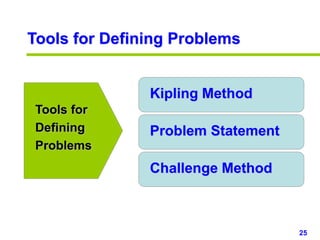
Tools for Defining Problems
Kipling Method
Problem Statement
Challenge Method
Tools for
Defining
Problems
26www.studyMarketing.org
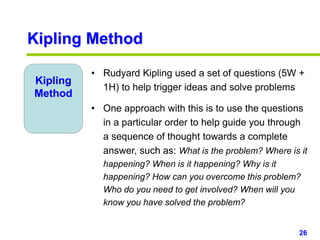
Kipling Method
Kipling
Method
• Rudyard Kipling used a set of questions (5W +
1H) to help trigger ideas and solve problems
• One approach with this is to use the questions
in a particular order to help guide you through
a sequence of thought towards a complete
answer, such as: What is the problem? Where is it
happening? When is it happening? Why is it
happening? How can you overcome this problem?
Who do you need to get involved? When will you
know you have solved the problem?
27www.studyMarketing.org
Kipling
Method
• Any questions work because we are
conditioned to answer questions that we are
asked. They challenge us and social rules say
it is impolite not to reply.
• The Kipling questions work because they are
short and direct. They are also largely
general, and 'What' can be applied to many
different situations, making them a flexible
resource.
Kipling Method
28www.studyMarketing.org
Problem Statement
Problem
Statement
• When starting to solve a creative problem it is
a good idea to define the problem you are
trying to solve.
• Start by discussing the overall context and
situation in which the creative activity is
aimed.
29www.studyMarketing.org
Problem
Statement
• Write down more than one draft of the
problem statement. Remember that defining
the problem is almost a complete project in
itself and you may benefit from going through
iterative stages of convergence and
divergence.
• Listen and write down everybody's opinion of
what the problem really is. Find the points of
agreement and then discuss the differences.
Problem Statement
30www.studyMarketing.org
Problem
Statement
• Stating the problem may seem obvious, yet
many creative efforts fail because the
problem is either unclear or it is focused in
the wrong place.
• The way you state a problem is half the
problem and half the solution. Once you have
identified a good problem statement,
sometimes the solution is so obvious that you
need little, if any, creative thought afterwards.
Problem Statement
31www.studyMarketing.org
Challenge Method
• Use it to force yourself or other people out of
a thinking rut.
• Use it to test out ideas for validity.
• Use it to challenge the problem or situation
you are considering when initially defining the
problem.
Challenge
Method
32www.studyMarketing.org
• Select all or part of the problem domain that
you are going to challenge. Perhaps it is
something that has been particularly difficult to
be creative around.
• Find something to challenge and question it
deeply. You can challenge many things,
including:
• Concepts - and broad ideas
• Assumptions - and beliefs that are not
questioned
Challenge
Method
Challenge Method
33www.studyMarketing.org
Challenge
Method
• Boundaries - across which you do not yet
cross
• 'Impossible' - things that are assumed
cannot happen
• 'Can't be done' - things that are assumed
cannot be done
• 'Essentials' - things that you assume cannot
be disposed of
• Sacred cows - that cannot be challenged
Challenge Method
34www.studyMarketing.org
Challenge
Method
• One way in which we deal with the complexity
of the world is to make assumptions about
many things. Our pattern-matching ability is a
great help in allowing us to take short-cuts but
it often ends up in us not noticing many things.
• If we do not take deliberate and conscious
action, our subconscious will let many
assumptions pass by unnoticed.
Challenge Method
35www.studyMarketing.org
Tools for Creating New Ideas
36www.studyMarketing.org
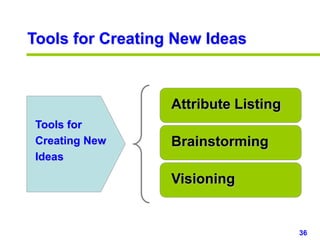
Tools for Creating New Ideas
Attribute Listing
Brainstorming
Visioning
Tools for
Creating New
Ideas
37www.studyMarketing.org
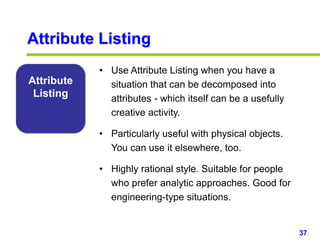
Attribute Listing
Attribute
Listing
• Use Attribute Listing when you have a
situation that can be decomposed into
attributes - which itself can be a usefully
creative activity.
• Particularly useful with physical objects.
You can use it elsewhere, too.
• Highly rational style. Suitable for people
who prefer analytic approaches. Good for
engineering-type situations.
38www.studyMarketing.org
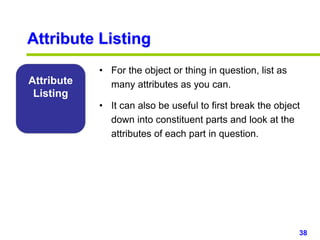
Attribute
Listing
• For the object or thing in question, list as
many attributes as you can.
• It can also be useful to first break the object
down into constituent parts and look at the
attributes of each part in question.
Attribute Listing
39www.studyMarketing.org
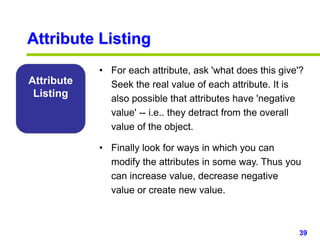
Attribute
Listing
• For each attribute, ask 'what does this give'?
Seek the real value of each attribute. It is
also possible that attributes have 'negative
value' -- i.e.. they detract from the overall
value of the object.
• Finally look for ways in which you can
modify the attributes in some way. Thus you
can increase value, decrease negative
value or create new value.
Attribute Listing
40www.studyMarketing.org
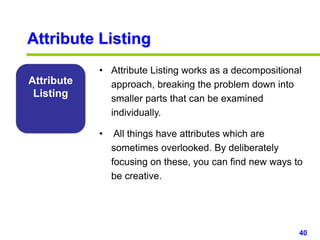
Attribute
Listing
• Attribute Listing works as a decompositional
approach, breaking the problem down into
smaller parts that can be examined
individually.
• All things have attributes which are
sometimes overlooked. By deliberately
focusing on these, you can find new ways to
be creative.
Attribute Listing
41www.studyMarketing.org
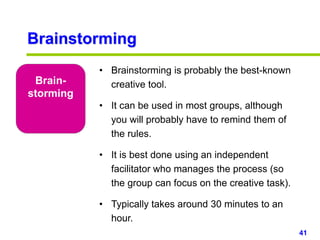
Brainstorming
Brain-
storming
• Brainstorming is probably the best-known
creative tool.
• It can be used in most groups, although
you will probably have to remind them of
the rules.
• It is best done using an independent
facilitator who manages the process (so
the group can focus on the creative task).
• Typically takes around 30 minutes to an
hour.
42www.studyMarketing.org
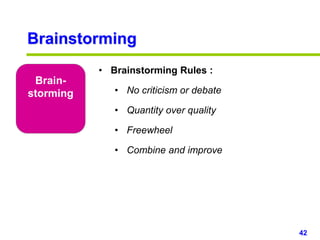
Brain-
storming
• Brainstorming Rules :
• No criticism or debate
• Quantity over quality
• Freewheel
• Combine and improve
Brainstorming
43www.studyMarketing.org
Brain-
storming
• Brainstorming works when people use
each other's ideas to trigger their own
thinking. Our minds are highly
associative, and one thought easily
triggers another.
• If we use the thoughts of others, then
these will stop us getting trapped by our
own thinking structures.
Brainstorming
44www.studyMarketing.org
Visioning
Visioning
• A vision is a 'motivating view of the future'.
It creates pull. It gives direction.
• Imagine brilliant and innovative future.
Think about what you are trying to
achieve.
• Go out into the future. Look around and
see what is there.
45www.studyMarketing.org
Visioning
Visioning
• Use dynamic and emotive words to paint
motivating pictures. Use words like 'sharp',
'now' and 'value'.
• Phrase it in the present tense to make it
more immediate. Use 'is' rather than 'will'.
• Use active verbs that talk about what is
happening.
• Test it with others to ensure it works for
them too.
46www.studyMarketing.org
Visioning
Visioning
• Visioning works because we are an
imaginative species and are motivated by
what we perceive as a possible or desired
future.
47www.studyMarketing.org
Creating a Creative Climate
48www.studyMarketing.org
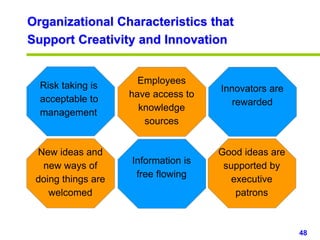
Organizational Characteristics that
Support Creativity and Innovation
Risk taking is
acceptable to
management
New ideas and
new ways of
doing things are
welcomed
Information is
free flowing
Employees
have access to
knowledge
sources
Good ideas are
supported by
executive
patrons
Innovators are
rewarded
49www.studyMarketing.org
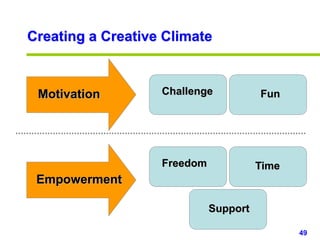
Creating a Creative Climate
Motivation Challenge
Empowerment
Fun
Freedom Time
Support
50www.studyMarketing.org
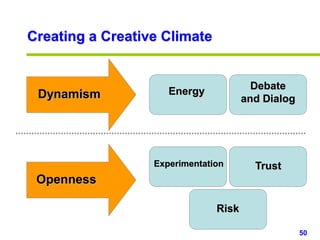
Creating a Creative Climate
Dynamism Energy
Openness
Debate
and Dialog
Experimentation Trust
Risk
51www.studyMarketing.org
References/Recommended Further Readings:
1. David A. Whetten and Kim S. Cameron, Developing Management
Skills, Harpers Collins Publisher. You can obtain this excellent book at this link:
http://www.amazon.com/Developing-Management-Skills-David-
Whetten/dp/0131747428/ref=pd_bbs_sr_1?ie=UTF8&s=books&qid=1219800012&sr=1-1
2. Floyd Hurt, Rousing Creativity, Crisp Publication. Link:
http://www.amazon.com/Crisp-Rousing-Creativity-
Professional/dp/1560525479/ref=sr_1_1?ie=UTF8&s=books&qid=1219802592&sr=1-1
3. www.creatingminds.org
52www.studyMarketing.org
End of Material

Creative thinking skills for hr managers PPT Slides