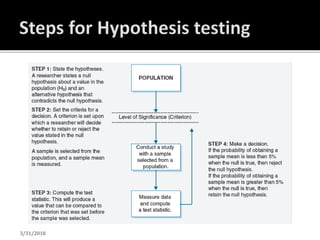

DEVELOPING AND TESTING
Indra P Sharma
Master of Clinical Optometry (Year II)
Amity Medical School, Amity University Haryana
3/31/2018
3/31/2018
3/31/2018
3/31/2018
3/31/2018
3/31/2018
In simple terms, it is a intelligent guess, provisional idea or
supposition that needs to be either proved or rejected
statistically.
3/31/2018
 Provide clarity to the research problem and research objectives
 Describe, explain or predict the expected results or outcome of the
research.
 Indicate the type of research design.
 Direct the research study process
 Identify the population of the research study that is to be
investigated or examined.
 Facilitate data collection, data analysis and data interpretation
3/31/2018
No research is complete without a hypothesis.
3/31/2018
3/31/2018
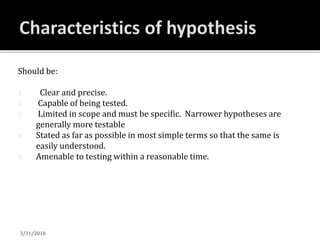
Should be:
1. Clear and precise.
2. Capable of being tested.
3. Limited in scope and must be specific. Narrower hypotheses are
generally more testable
4. Stated as far as possible in most simple terms so that the same is
easily understood.
5. Amenable to testing within a reasonable time.
3/31/2018
3/31/2018
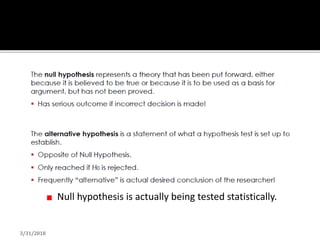
Null hypothesis is actually being tested statistically.
3/31/2018
 We want to know whether myopes or hyperopes have more IQ.
 Null Hypothesis:
 The null hypothesis might be that the there is NO difference in
IQ between mypoes and hyperopes.
 We would write H0: There is NO significant difference in IQ
between myopes and hyperopes.
 H0: µ myope IQ = µ hyperope IQ
3/31/2018
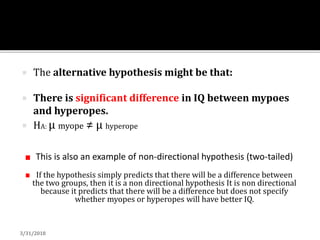
 The alternative hypothesis might be that:
 There is significant difference in IQ between mypoes
and hyperopes.
 HA: µ myope ≠ µ hyperope
This is also an example of non-directional hypothesis (two-tailed)
If the hypothesis simply predicts that there will be a difference between
the two groups, then it is a non directional hypothesis It is non directional
because it predicts that there will be a difference but does not specify
whether myopes or hyperopes will have better IQ.
3/31/2018
 The alternative hypothesis might alo be that be that:
 Case 1: Myopes are more intelligent than hyperopes.
 HA: µ myope IQ > µ hyperope IQ
 Case 2: Myopes are less intelligent than hyperopes.
 HA: µ myope IQ < µ hyperope IQ
This is also an example of directional hypothesis(one-tailed)
3/31/2018
 This is due to the fact that the null hypothesis relates to the
statement being tested, whereas the alternative hypothesis
relates to the statement to be accepted if the null is rejected.
 The final conclusion, once the test has been carried out, is
always given in terms of the null hypothesis. We either ‘ Accept
Ho’ or ‘reject Ho (in favor of HA)‘
 We NEVER conclude ‘reject HA', or even 'accept HA'.
 If we conclude ‘Accept H0', this does not necessarily mean that
the null hypothesis is true, it only suggests that there is not
sufficient evidence to reject H0 in favor of HA; rejecting the null
hypothesis then, suggests that the alternative hypothesis may
be true.
3/31/2018
 In a criminal trial the judge has to decide
between
The defendant is innocent
And
The defendant is NOT innocent
The basis of the judgment should be
NO INNOCENT SHOULD BE CONVICTED
3/31/2018
 The judge has two hypotheses:
 First: The defendant is innocent
(put under test and the evidences attempt to
contradict it). Null hypothesis
 Second : The defendant is guilty
(as an alternative to the first i.e. true if we fail to
prove the truthiness of the first).
Alternative hypothesis
3/31/2018
 First: There may be enough evidences to conclude
that the defendant is innocent.
 We ACCEPT the null hypothesis.
 Conclusion: Defendent is innocent.
 Second: The evidences may not be sufficient to
prove the innocence of the defendant.
 We reject the null hypothesis
 Conclusion: Since there is no sufficient evidence to
prove that defendent is not innocent, he may be
considered guilty.
 Rem: It is not same as saying he is guilty.
3/31/2018
3/31/2018
3/31/2018
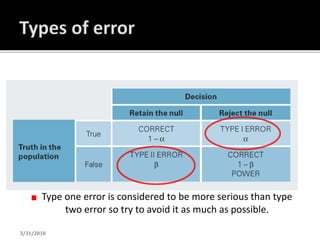
 We just decide whether to retain or reject the null
hypothesis.
 Because we are observing a sample and not an entire
population, it is possible that a conclusion may be wrong.
There are four possiblities:
 1. The decision to retain the null hypothesis could be correct. √
 2. The decision to retain the null hypothesis could be incorrect.
 3. The decision to reject the null hypothesis could be correct. √
 4. The decision to reject the null hypothesis could be incorrect.
3/31/2018
Type one error is considered to be more serious than type
two error so try to avoid it as much as possible.
3/31/2018
 Doing the IQ test 100 times:
 97 times :Myope have more IQ
 3 times : Hyperope have more IQ
 Null Hypothesis
H0: µ myope IQ > µ hyperope IQ
 Should we ACCEPT or REJECT the null
hypothesis ?
3/31/2018
 To accept/ reject the null hypothesis will be determined by
the level of significance.
 To determine whether a result is statistically significant, a
researcher would have to calculate a p-value.
 The critical value should be pre-determined.
3/31/2018
 If you set your significance level as 5%
(p=0.05) – You will accept null hypothesis even if 5%
of your result is against null hypothesis.
 = We accept null hypothesis.
 If you set your significance level as 1%
(p=0.01) – You will accept null hypothesis only even if
1% of your result is against null hypothesis.
 = We accept reject null hypothesis.
3/31/2018
 In clinical research we prefer significance at 5 %.
 The null hypothesis is rejected if the p-value is less than
the significance level. (p<0.05)
 If p-value is more than 0.05 (p>0.05) accept null
hypothesis.
3/31/2018
3/31/2018
 5 % level of significance means that researcher is willing
to take as much as a 5 per cent risk of rejecting the null
hypothesis when it (H0) happens to be true.
 Thus the significance level is the maximum value of the
probability of rejecting null hypothesis when it is true and
is usually determined in advance before testing the
hypothesis.
3/31/2018
 Hypothesis is an intelligent guess.
 Develop a null hypothesis before starting the
research.
 Hypothesis gives direction to the research(avoids
wandering around)
 Level of significance is the value set as a criterion
for accepting or rejecting a null hypothesis.
3/31/2018
 Thank you 
3/31/2018

Research Hypothesis

  • 1.
    DEVELOPING AND TESTING IndraP Sharma Master of Clinical Optometry (Year II) Amity Medical School, Amity University Haryana 3/31/2018
  • 2.
  • 3.
  • 4.
  • 5.
  • 6.
  • 7.
    In simple terms,it is a intelligent guess, provisional idea or supposition that needs to be either proved or rejected statistically. 3/31/2018
  • 8.
     Provide clarityto the research problem and research objectives  Describe, explain or predict the expected results or outcome of the research.  Indicate the type of research design.  Direct the research study process  Identify the population of the research study that is to be investigated or examined.  Facilitate data collection, data analysis and data interpretation 3/31/2018
  • 9.
    No research iscomplete without a hypothesis. 3/31/2018
  • 10.
  • 11.
    Should be: 1. Clearand precise. 2. Capable of being tested. 3. Limited in scope and must be specific. Narrower hypotheses are generally more testable 4. Stated as far as possible in most simple terms so that the same is easily understood. 5. Amenable to testing within a reasonable time. 3/31/2018
  • 12.
  • 13.
    Null hypothesis isactually being tested statistically. 3/31/2018
  • 14.
     We wantto know whether myopes or hyperopes have more IQ.  Null Hypothesis:  The null hypothesis might be that the there is NO difference in IQ between mypoes and hyperopes.  We would write H0: There is NO significant difference in IQ between myopes and hyperopes.  H0: µ myope IQ = µ hyperope IQ 3/31/2018
  • 15.
     The alternativehypothesis might be that:  There is significant difference in IQ between mypoes and hyperopes.  HA: µ myope ≠ µ hyperope This is also an example of non-directional hypothesis (two-tailed) If the hypothesis simply predicts that there will be a difference between the two groups, then it is a non directional hypothesis It is non directional because it predicts that there will be a difference but does not specify whether myopes or hyperopes will have better IQ. 3/31/2018
  • 16.
     The alternativehypothesis might alo be that be that:  Case 1: Myopes are more intelligent than hyperopes.  HA: µ myope IQ > µ hyperope IQ  Case 2: Myopes are less intelligent than hyperopes.  HA: µ myope IQ < µ hyperope IQ This is also an example of directional hypothesis(one-tailed) 3/31/2018
  • 17.
     This isdue to the fact that the null hypothesis relates to the statement being tested, whereas the alternative hypothesis relates to the statement to be accepted if the null is rejected.  The final conclusion, once the test has been carried out, is always given in terms of the null hypothesis. We either ‘ Accept Ho’ or ‘reject Ho (in favor of HA)‘  We NEVER conclude ‘reject HA', or even 'accept HA'.  If we conclude ‘Accept H0', this does not necessarily mean that the null hypothesis is true, it only suggests that there is not sufficient evidence to reject H0 in favor of HA; rejecting the null hypothesis then, suggests that the alternative hypothesis may be true. 3/31/2018
  • 18.
     In acriminal trial the judge has to decide between The defendant is innocent And The defendant is NOT innocent The basis of the judgment should be NO INNOCENT SHOULD BE CONVICTED 3/31/2018
  • 19.
     The judgehas two hypotheses:  First: The defendant is innocent (put under test and the evidences attempt to contradict it). Null hypothesis  Second : The defendant is guilty (as an alternative to the first i.e. true if we fail to prove the truthiness of the first). Alternative hypothesis 3/31/2018
  • 20.
     First: Theremay be enough evidences to conclude that the defendant is innocent.  We ACCEPT the null hypothesis.  Conclusion: Defendent is innocent.  Second: The evidences may not be sufficient to prove the innocence of the defendant.  We reject the null hypothesis  Conclusion: Since there is no sufficient evidence to prove that defendent is not innocent, he may be considered guilty.  Rem: It is not same as saying he is guilty. 3/31/2018
  • 21.
  • 22.
  • 23.
     We justdecide whether to retain or reject the null hypothesis.  Because we are observing a sample and not an entire population, it is possible that a conclusion may be wrong. There are four possiblities:  1. The decision to retain the null hypothesis could be correct. √  2. The decision to retain the null hypothesis could be incorrect.  3. The decision to reject the null hypothesis could be correct. √  4. The decision to reject the null hypothesis could be incorrect. 3/31/2018
  • 24.
    Type one erroris considered to be more serious than type two error so try to avoid it as much as possible. 3/31/2018
  • 25.
     Doing theIQ test 100 times:  97 times :Myope have more IQ  3 times : Hyperope have more IQ  Null Hypothesis H0: µ myope IQ > µ hyperope IQ  Should we ACCEPT or REJECT the null hypothesis ? 3/31/2018
  • 26.
     To accept/reject the null hypothesis will be determined by the level of significance.  To determine whether a result is statistically significant, a researcher would have to calculate a p-value.  The critical value should be pre-determined. 3/31/2018
  • 27.
     If youset your significance level as 5% (p=0.05) – You will accept null hypothesis even if 5% of your result is against null hypothesis.  = We accept null hypothesis.  If you set your significance level as 1% (p=0.01) – You will accept null hypothesis only even if 1% of your result is against null hypothesis.  = We accept reject null hypothesis. 3/31/2018
  • 28.
     In clinicalresearch we prefer significance at 5 %.  The null hypothesis is rejected if the p-value is less than the significance level. (p<0.05)  If p-value is more than 0.05 (p>0.05) accept null hypothesis. 3/31/2018
  • 29.
  • 30.
     5 %level of significance means that researcher is willing to take as much as a 5 per cent risk of rejecting the null hypothesis when it (H0) happens to be true.  Thus the significance level is the maximum value of the probability of rejecting null hypothesis when it is true and is usually determined in advance before testing the hypothesis. 3/31/2018
  • 31.
     Hypothesis isan intelligent guess.  Develop a null hypothesis before starting the research.  Hypothesis gives direction to the research(avoids wandering around)  Level of significance is the value set as a criterion for accepting or rejecting a null hypothesis. 3/31/2018
  • 32.
     Thank you 3/31/2018