MD III Class of 2023
1st June 2021
Dr. Frank, FCOphth ECSA
Session 5
INTRODUCTION
• Three forms are recognized (primarily a function of the Cone system:
• SPATIAL ACUITY: ability to resolve 2 points in space
• Location and Brightness effect
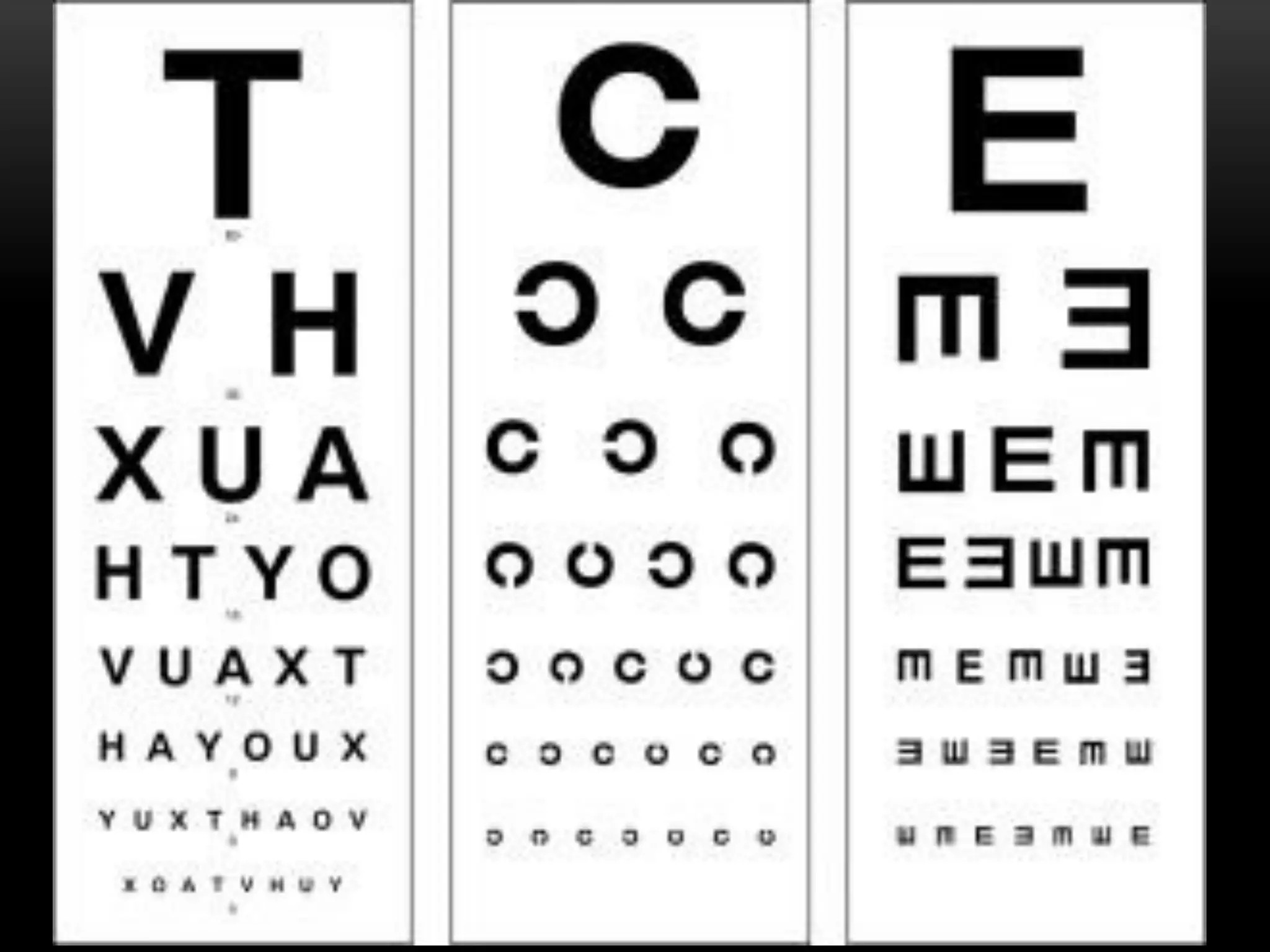
• Assessed using Snellen eye chart- relative to ability of the normal population to
distinguish the letter at 6 meters (6/6 vision is normal)
• TEMPORAL ACUITY: ability to distinguish visual events in time
• SPECTRAL ACUITY: ability to distinguish differences in the wavelength of the stimuli
INTRODUCTION CONT’D…
• Human eye is a complex optical instrument
• Properties may vary from person to person
• Several refractive surfaces with different refractive index
VISUAL ACUITY (VA)
• In the visual system, Acuity refers to the ’ability to discriminate
fine details of the visual scene’
• An objective measure of what the person can see
• Tested at 6m/20ft using Snellen Charts: very little
accommodation
• Each eye tested separately, OD first
• Pinhole test (PH): simple optical test to detect refractive
errors
• Need for Near vision and Distance vision testing
• Is part of routine examination-all patients
6/7/2021 4
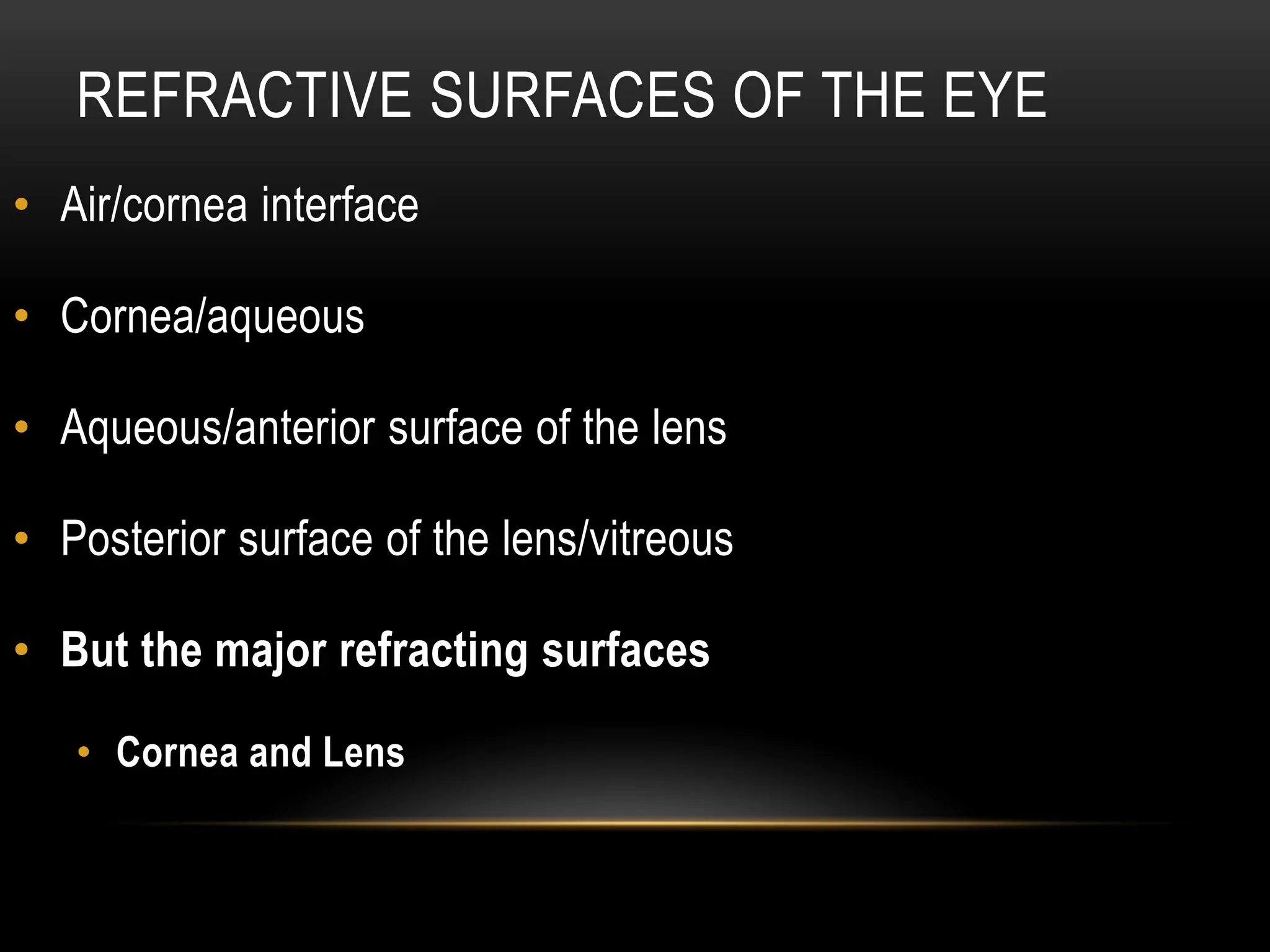
REFRACTIVE SURFACES OF THE EYE
• Air/cornea interface
• Cornea/aqueous
• Aqueous/anterior surface of the lens
• Posterior surface of the lens/vitreous
• But the major refracting surfaces
• Cornea and Lens
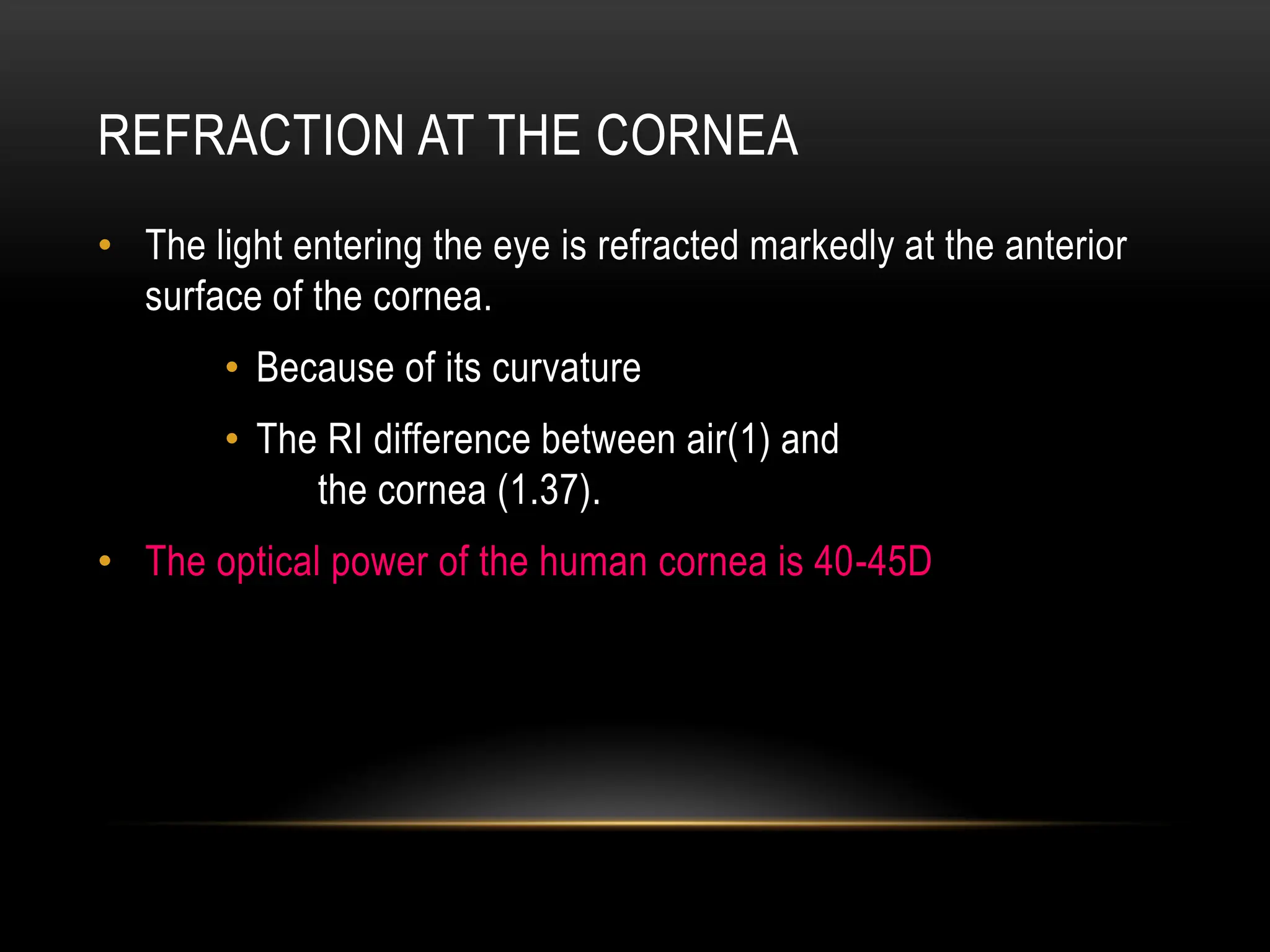
REFRACTION AT THE CORNEA
• The light entering the eye is refracted markedly at the anterior
surface of the cornea.
• Because of its curvature
• The RI difference between air(1) and
the cornea (1.37).
• The optical power of the human cornea is 40-45D
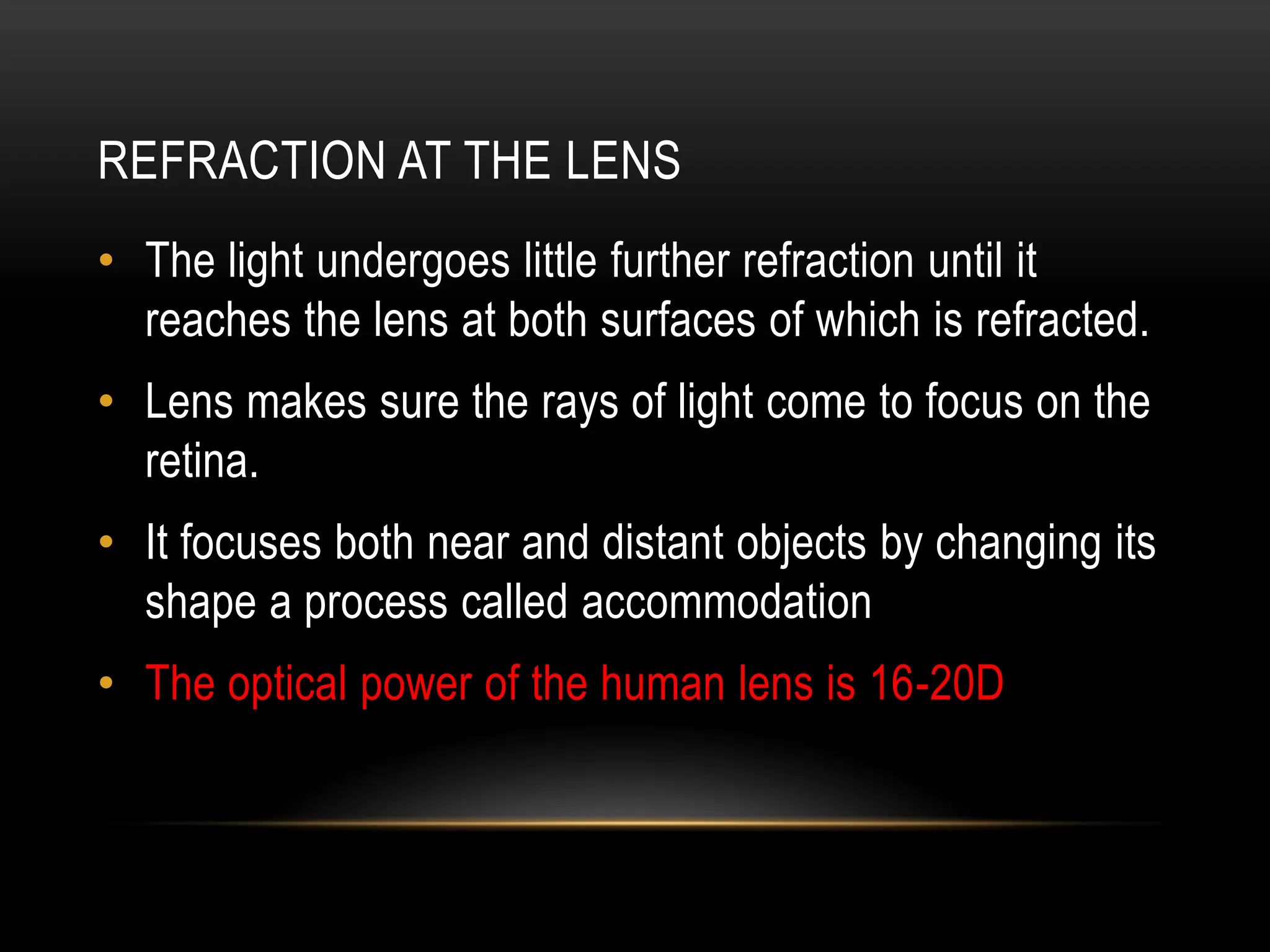
REFRACTION AT THE LENS
• The light undergoes little further refraction until it
reaches the lens at both surfaces of which is refracted.
• Lens makes sure the rays of light come to focus on the
retina.
• It focuses both near and distant objects by changing its
shape a process called accommodation
• The optical power of the human lens is 16-20D
C
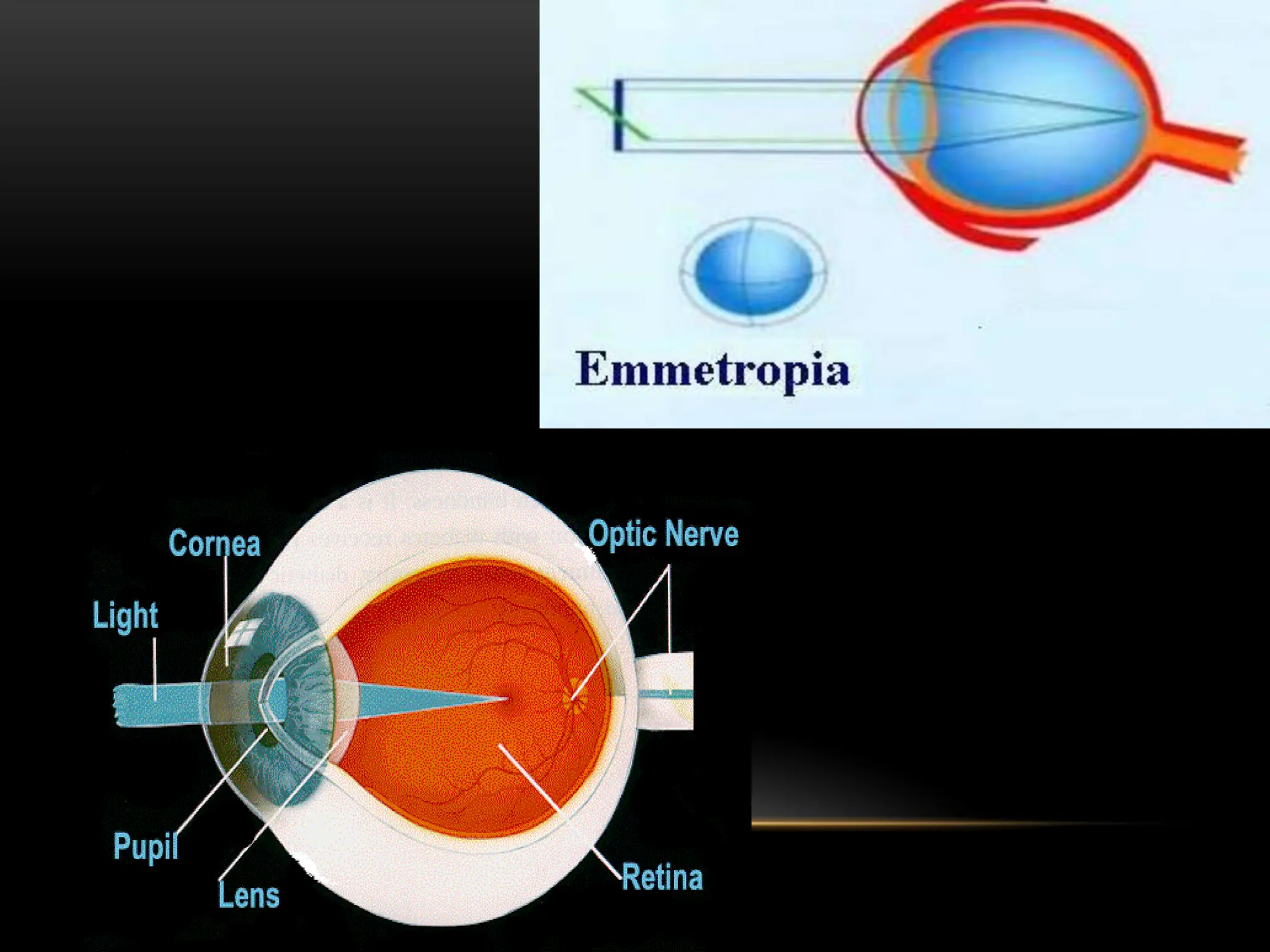
EMMETROPIC EYE
• An eye without RE
• Parallel rays of light are brought to focus on the fovea without
the use of accommodation
AMETROPIC EYE
• An Eye with Refractive Errors
• Refractive state of the eye is determined by Four
components:
• Corneal power (Mean, 43D)
• ACD (mean,3.4mm)
• Crystalline lens power (mean, 21D)
• Axial length (mean, 24)
REFRACTIVE ERRORS
• Occurs when the eye cannot clearly focus the images from the
outside world.
• The result of refractive errors is blurred vision, which is
sometimes so severe that it causes visual impairment.
• Uncorrected refractive error accounts for half of the global
burden of avoidable vision impairment and nearly a third of the
global burden of avoidable blindness.
• WHO estimates that 153 million people worldwide live with
visual impairment due to uncorrected refractive errors.
TYPES OF REFRACTIVE ERRORS
• Myopia
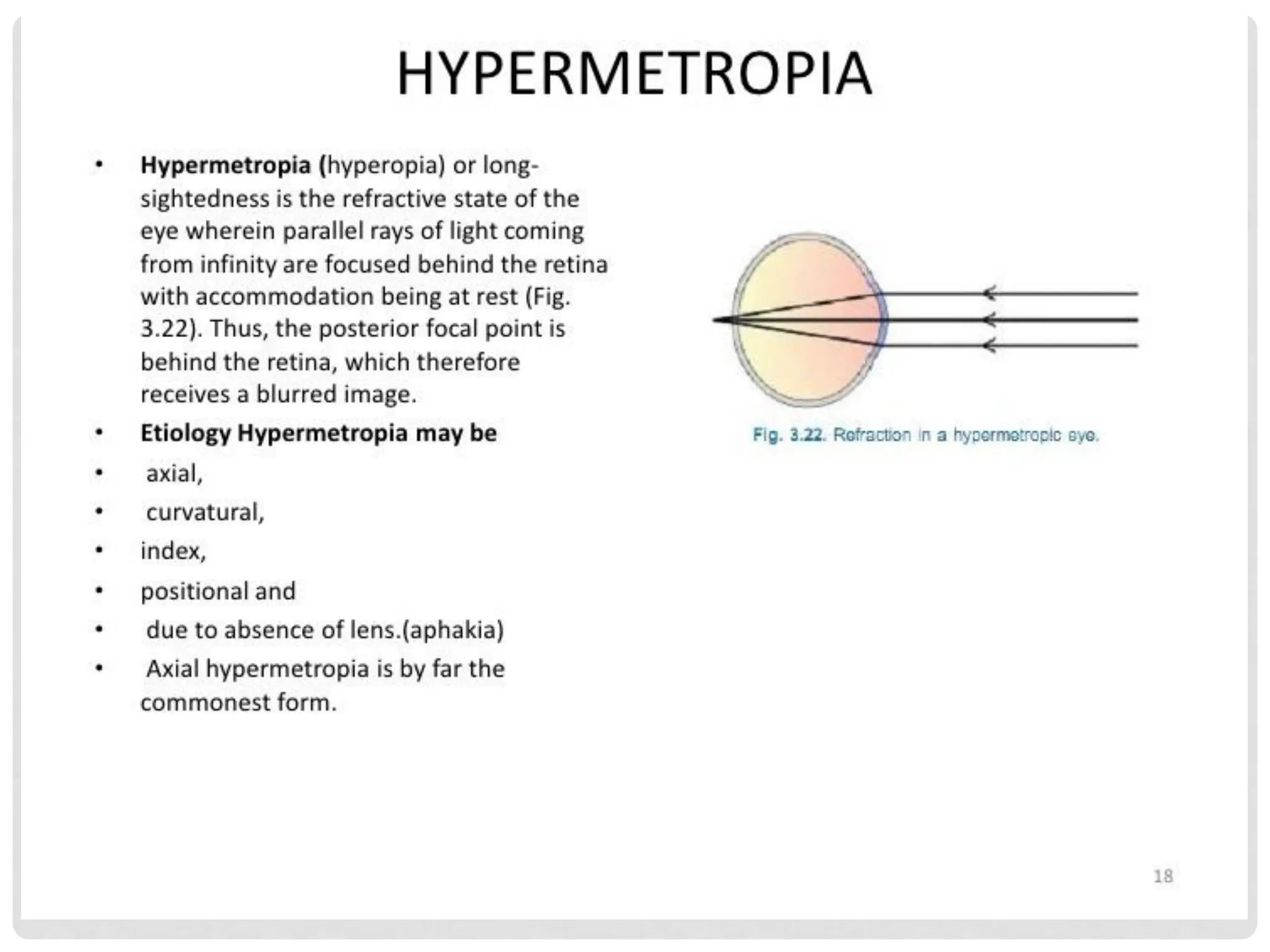
• Hyperopia ( Hypermetropia)
• Astigmatism
• Aphakia
• Presbyopia
CAUSES OF REFRACTIVE ERRORS
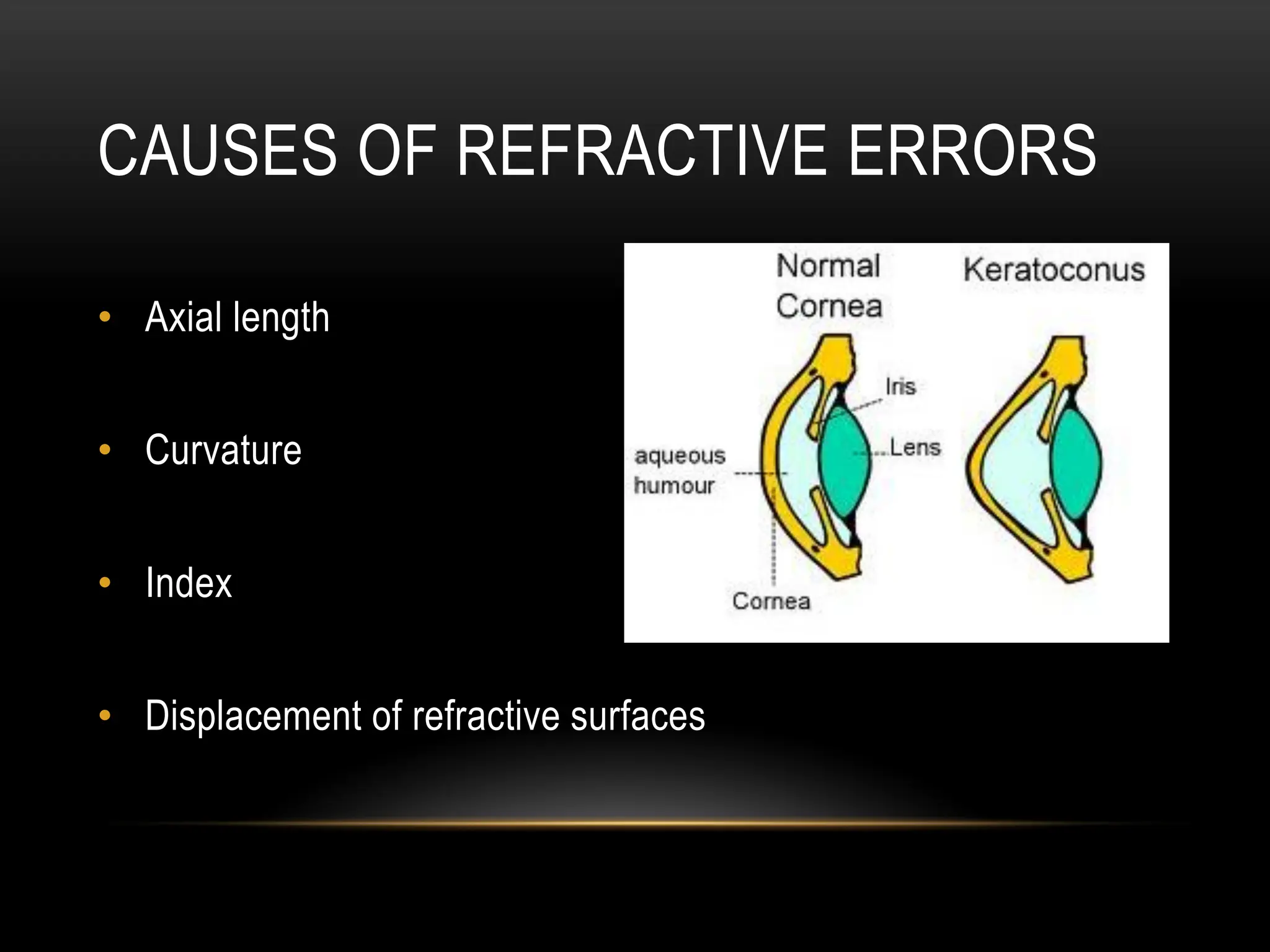
• Axial length
• Curvature
• Index
• Displacement of refractive surfaces
DIAGNOSIS OF R.E
• History from patient: Cant see far/near/headaches/blurry
• Physical Examination: VA, IOP
• Retinoscope
• Pin Hole (For Screening)
• SLE
• Fundoscopy
• CVFT
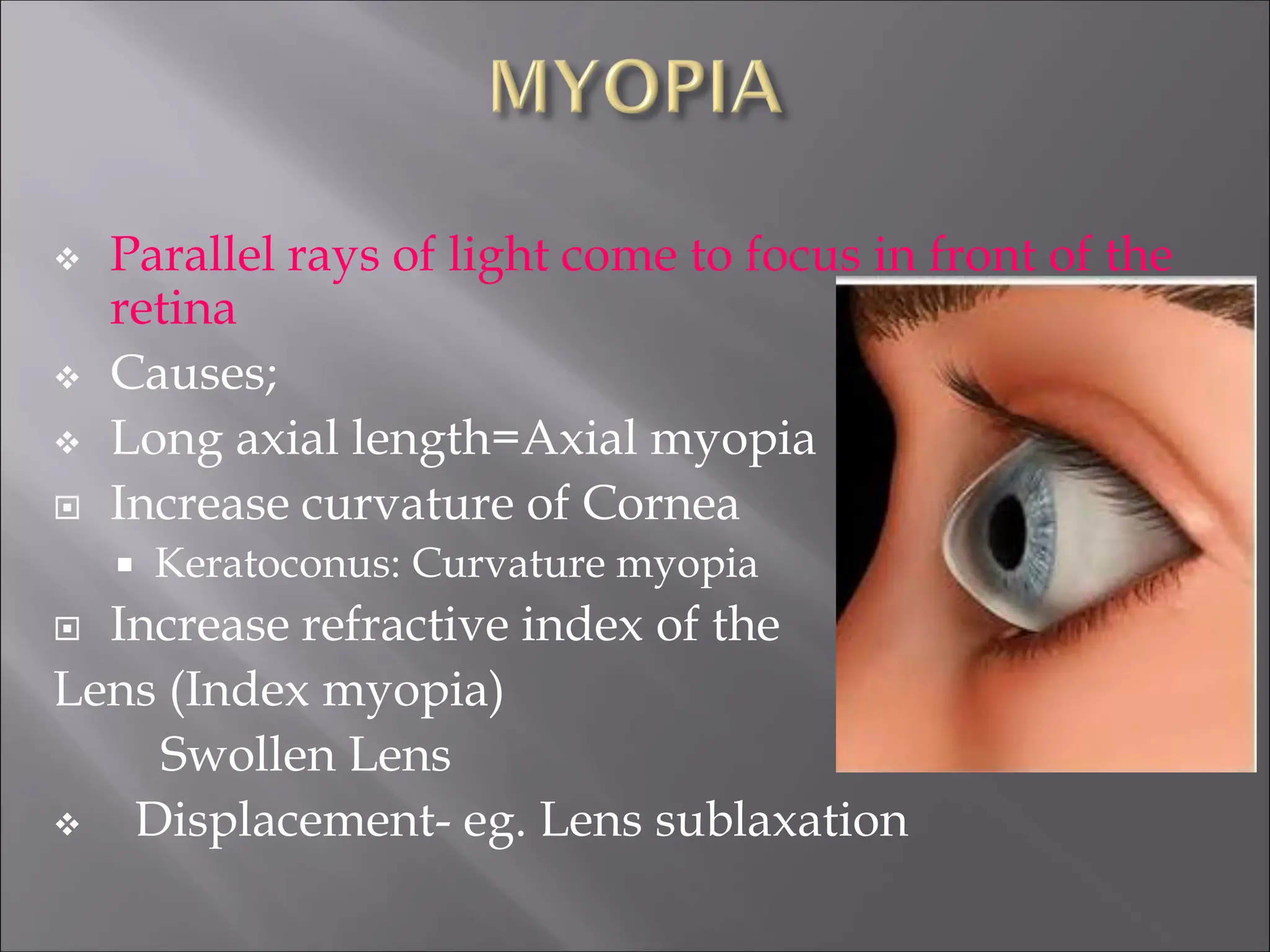
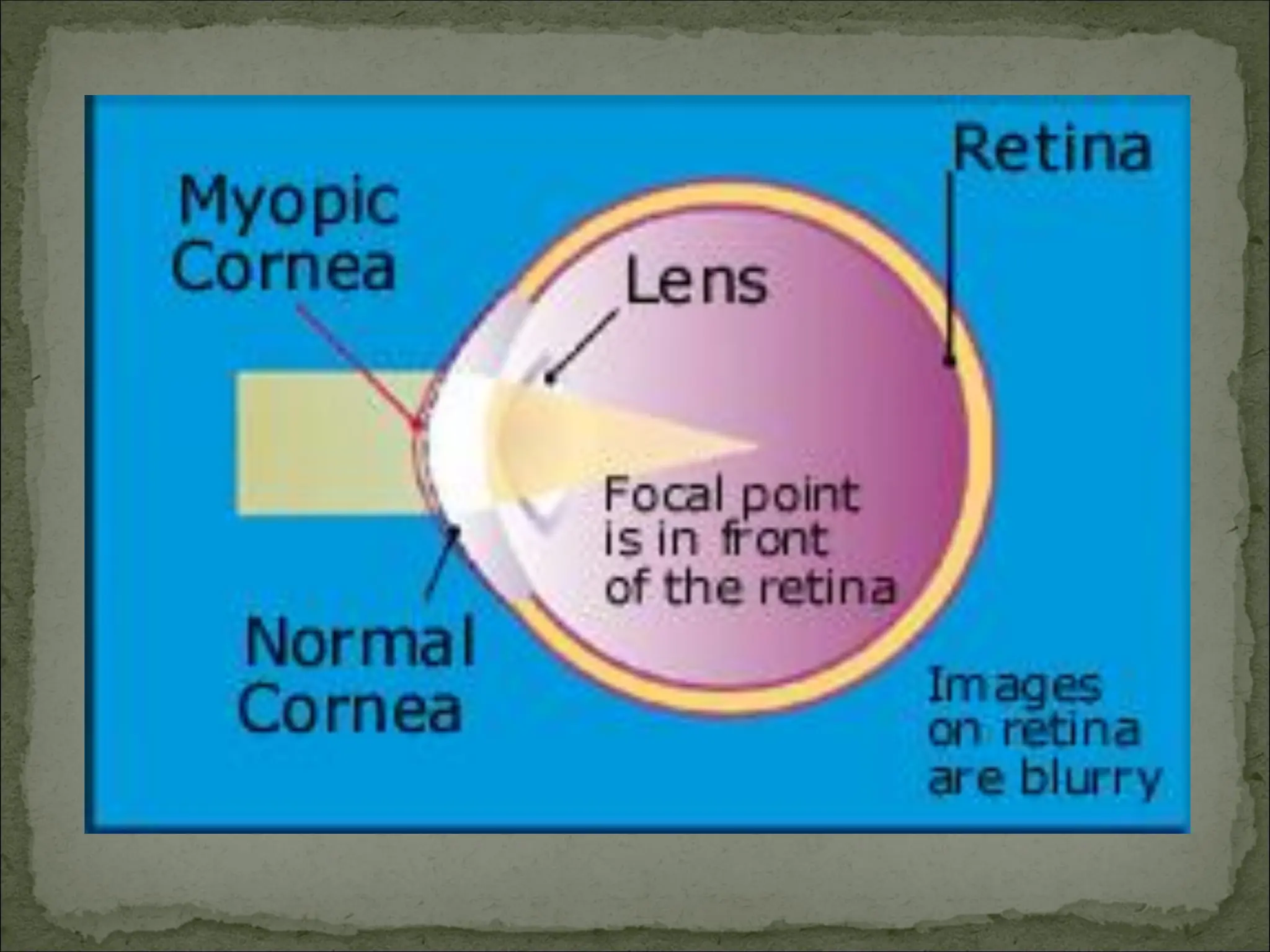
 Parallel rays of light come to focus in front of the
retina
 Causes;
 Long axial length=Axial myopia
 Increase curvature of Cornea
 Keratoconus: Curvature myopia
 Increase refractive index of the
Lens (Index myopia)
Swollen Lens
 Displacement- eg. Lens sublaxation
CLINICAL FEATURES
• Poor distant vision hence shortsighted
• Squinting
• Eyelid squeezing/ blinking
• Asthenopic symptoms
• Eye fatigue
• Headache
• Photophobia
o Pathological myopia(progressive)
o more than 6D
o 2% of population
o affects more females X2
 Complications; Retinal hole, RD, degeneration
 Hereditary: 10 - 25%
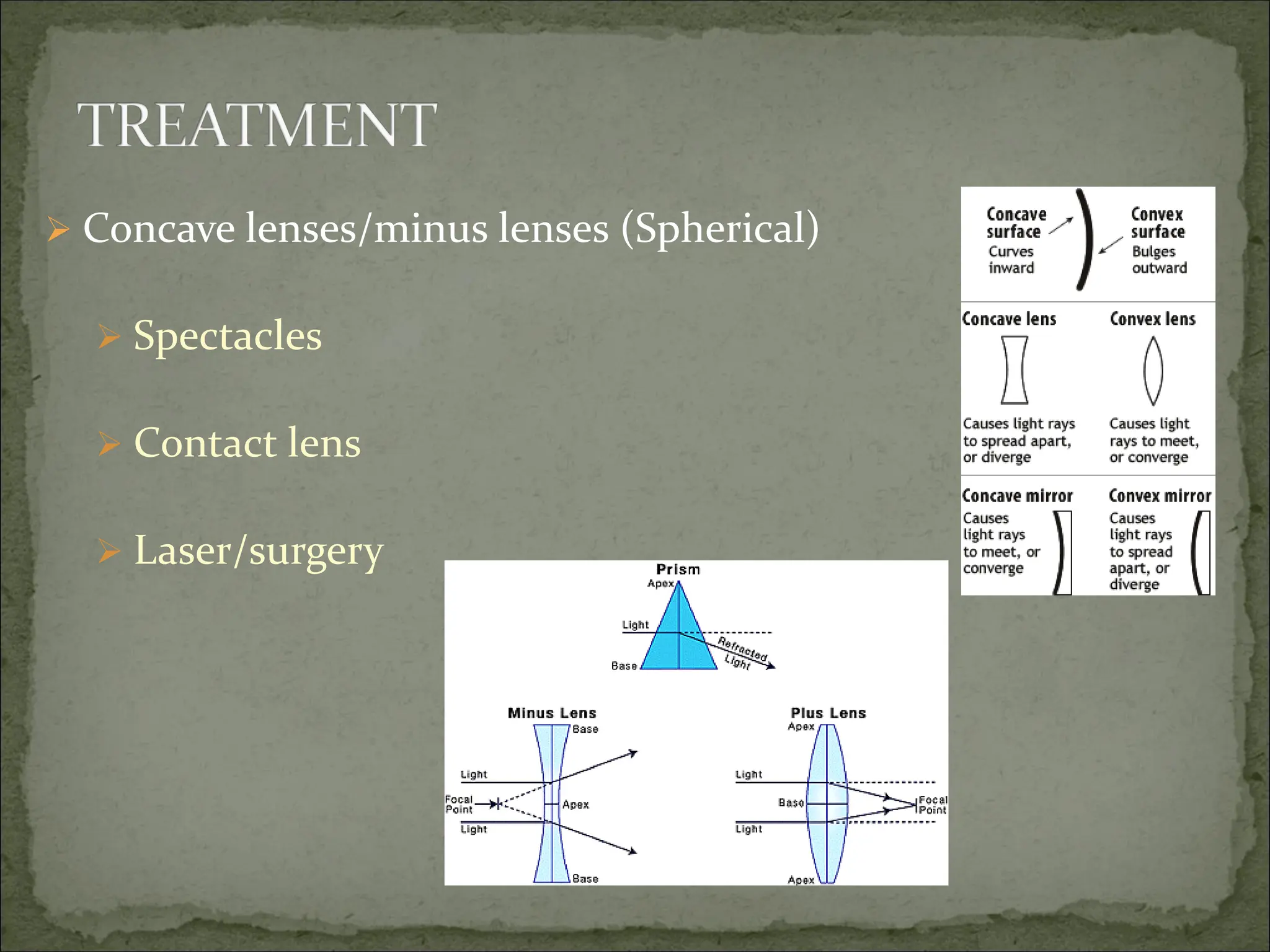
 Concave lenses/minus lenses (Spherical)
 Spectacles
 Contact lens
 Laser/surgery
CLINICAL FEATURES
• Poor near vision hence long-sightedness
• Eye strain/pain
• Headache
• Convergent squint
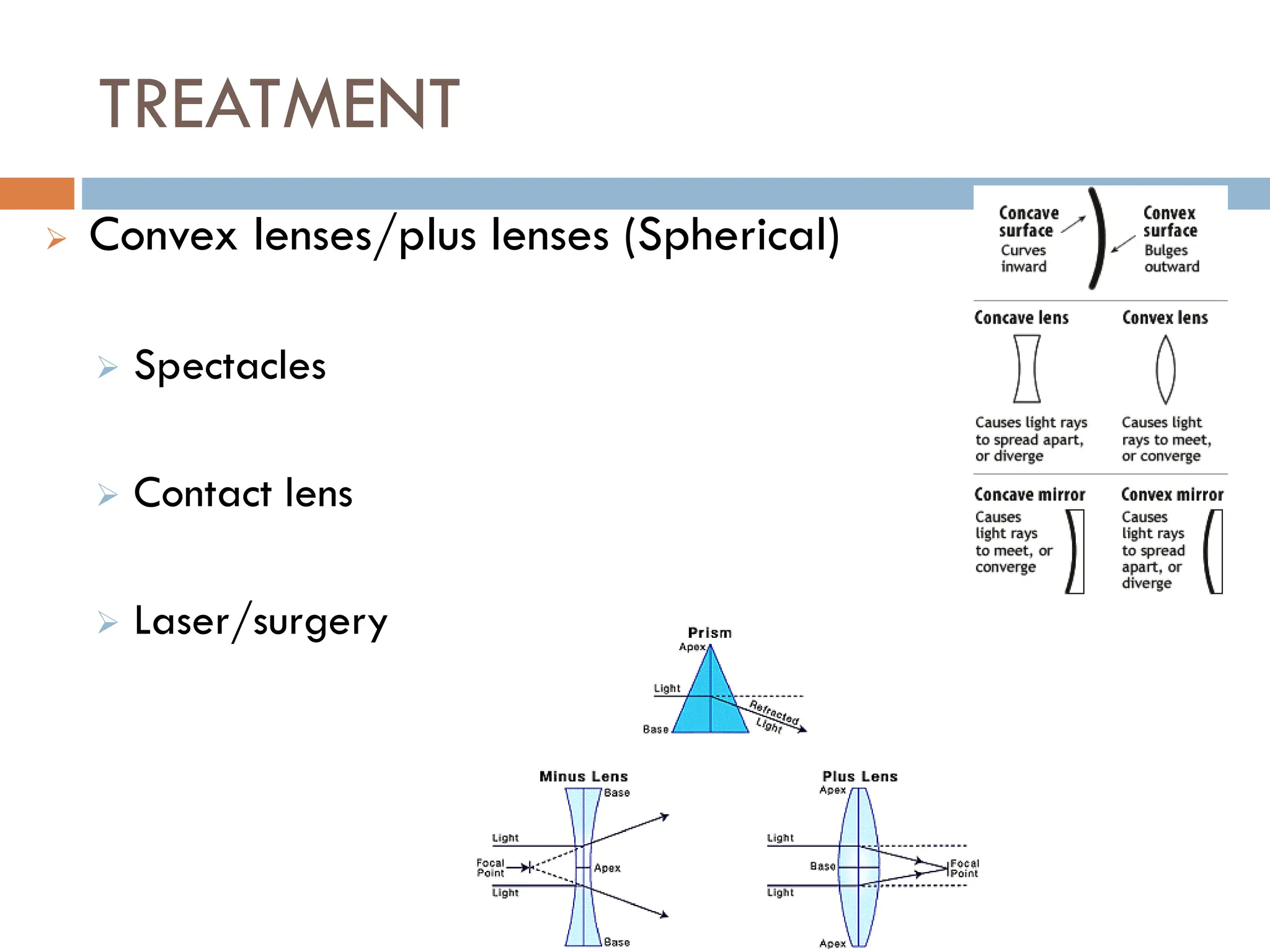
TREATMENT
 Convex lenses/plus lenses (Spherical)
 Spectacles
 Contact lens
 Laser/surgery
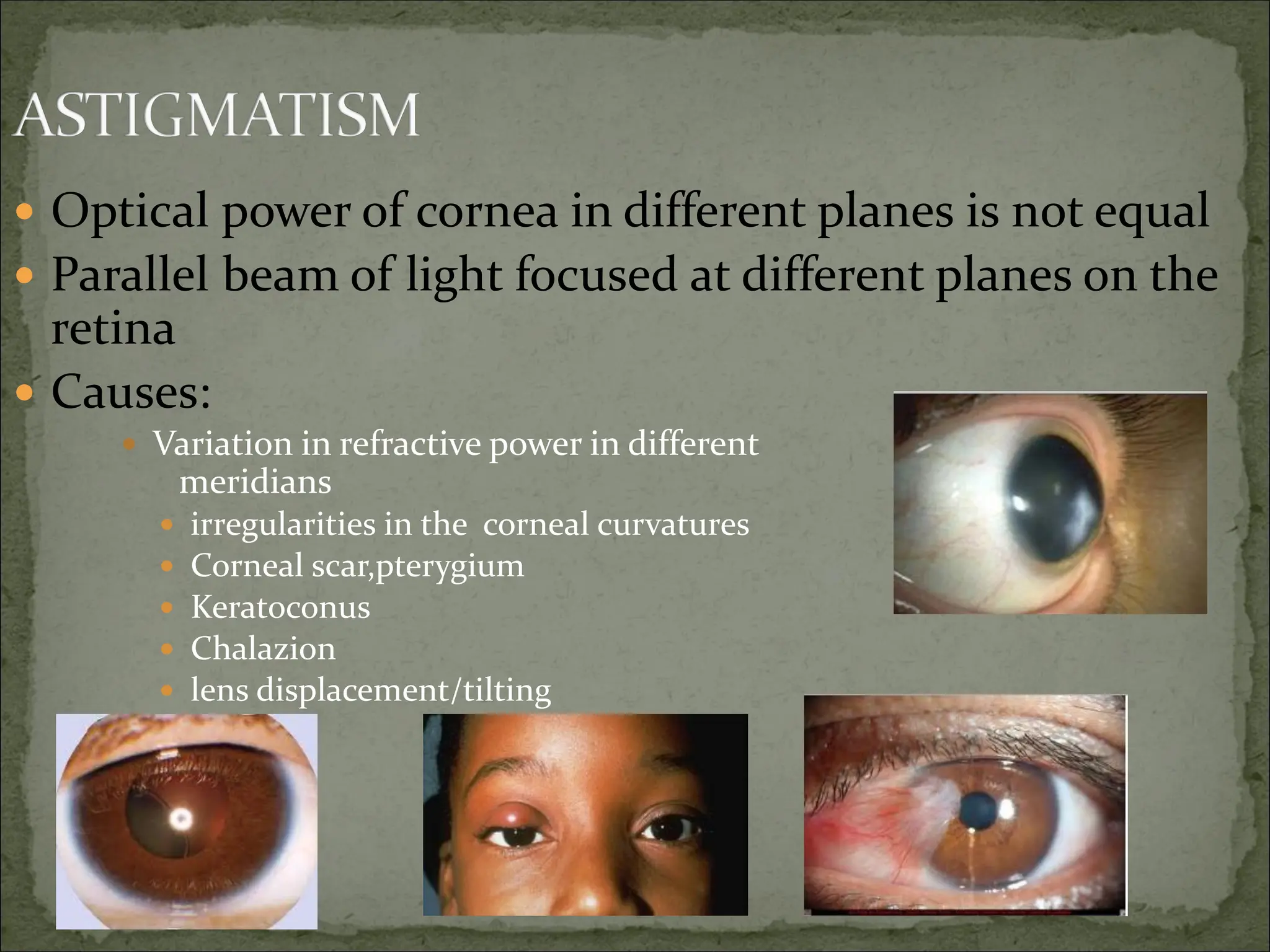
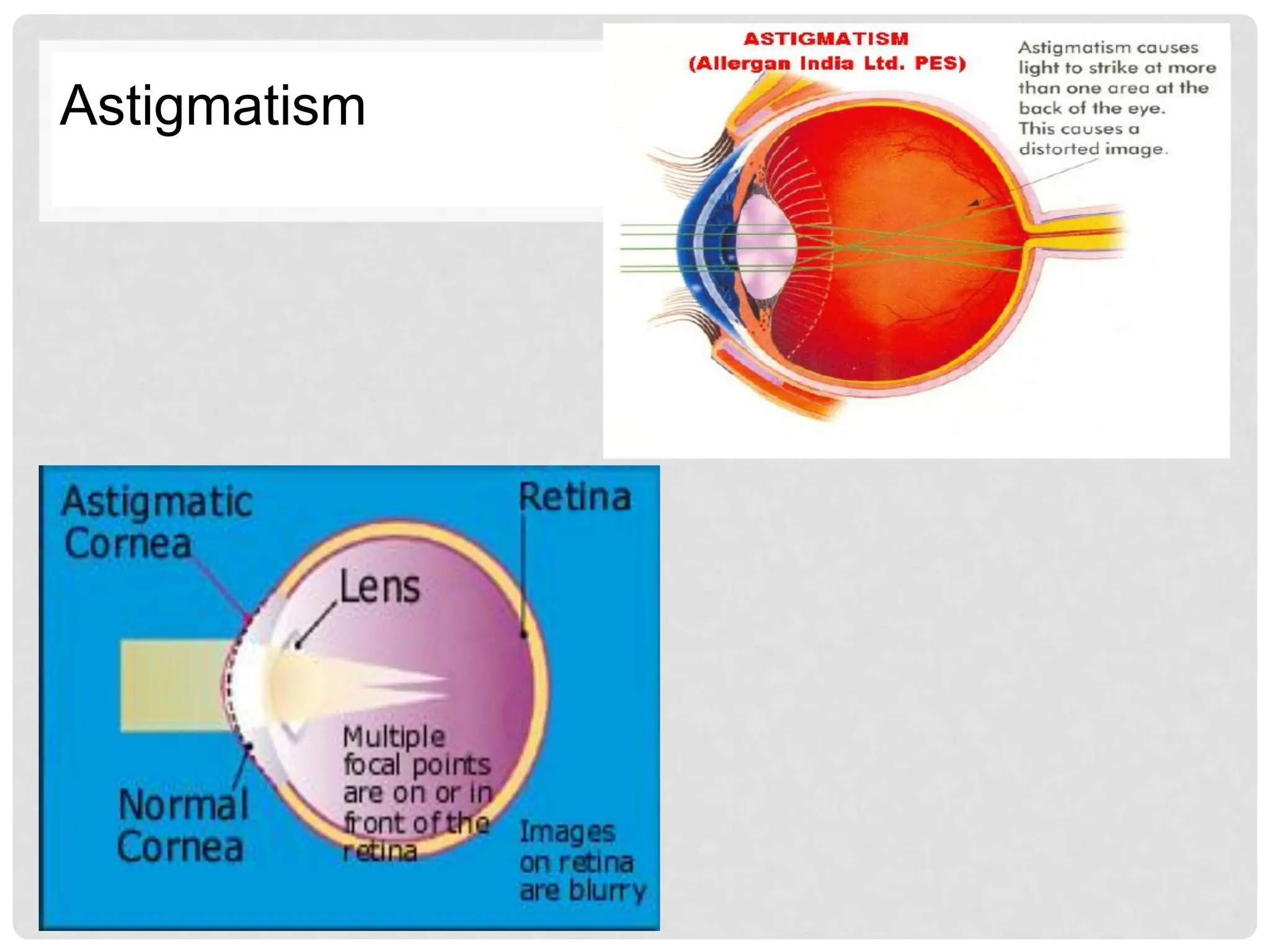
 Optical power of cornea in different planes is not equal
 Parallel beam of light focused at different planes on the
retina
 Causes:
 Variation in refractive power in different
meridians
 irregularities in the corneal curvatures
 Corneal scar,pterygium
 Keratoconus
 Chalazion
 lens displacement/tilting
Astigmatism
SYMPTOMS AND TREATMENT
 Symptoms
• Poor vision can be either at
distant or near
• Asthenopia
• Fatigue
• Headache
 Treatment
• Cylinder lenses
• Spectacles
• Contact lens
• Corneal transplant
• Refractive Surgery
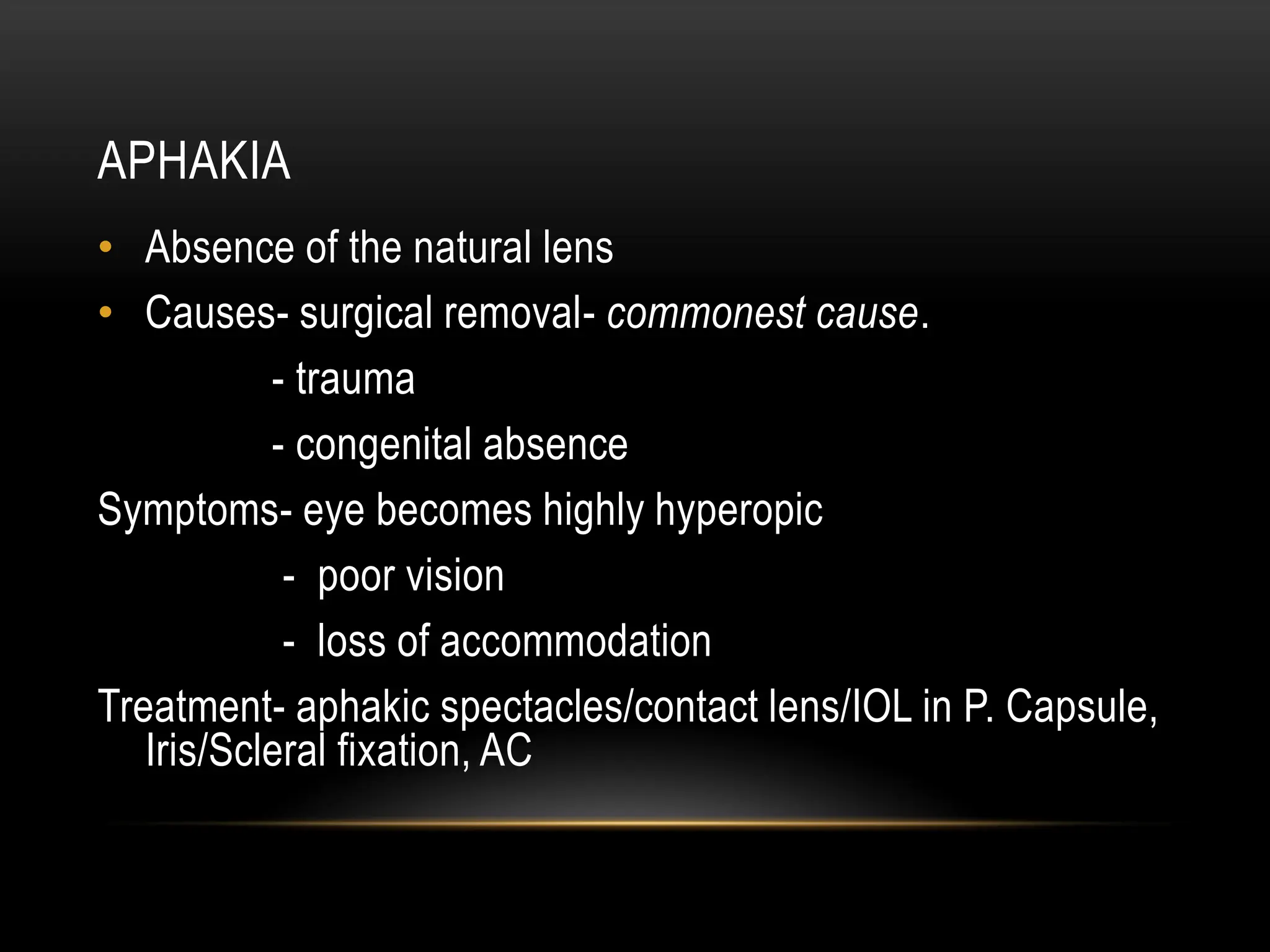
APHAKIA
• Absence of the natural lens
• Causes- surgical removal- commonest cause.
- trauma
- congenital absence
Symptoms- eye becomes highly hyperopic
- poor vision
- loss of accommodation
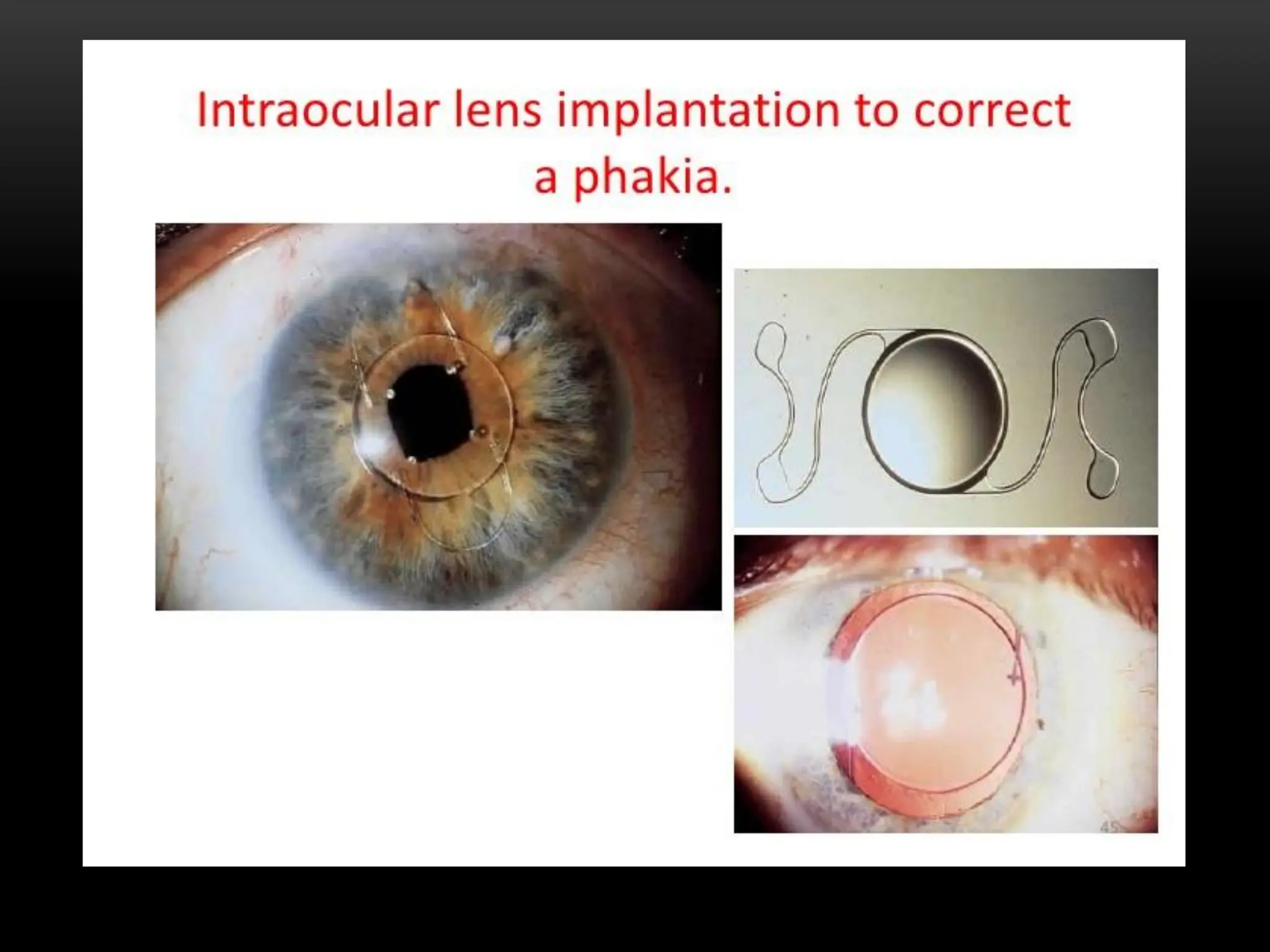
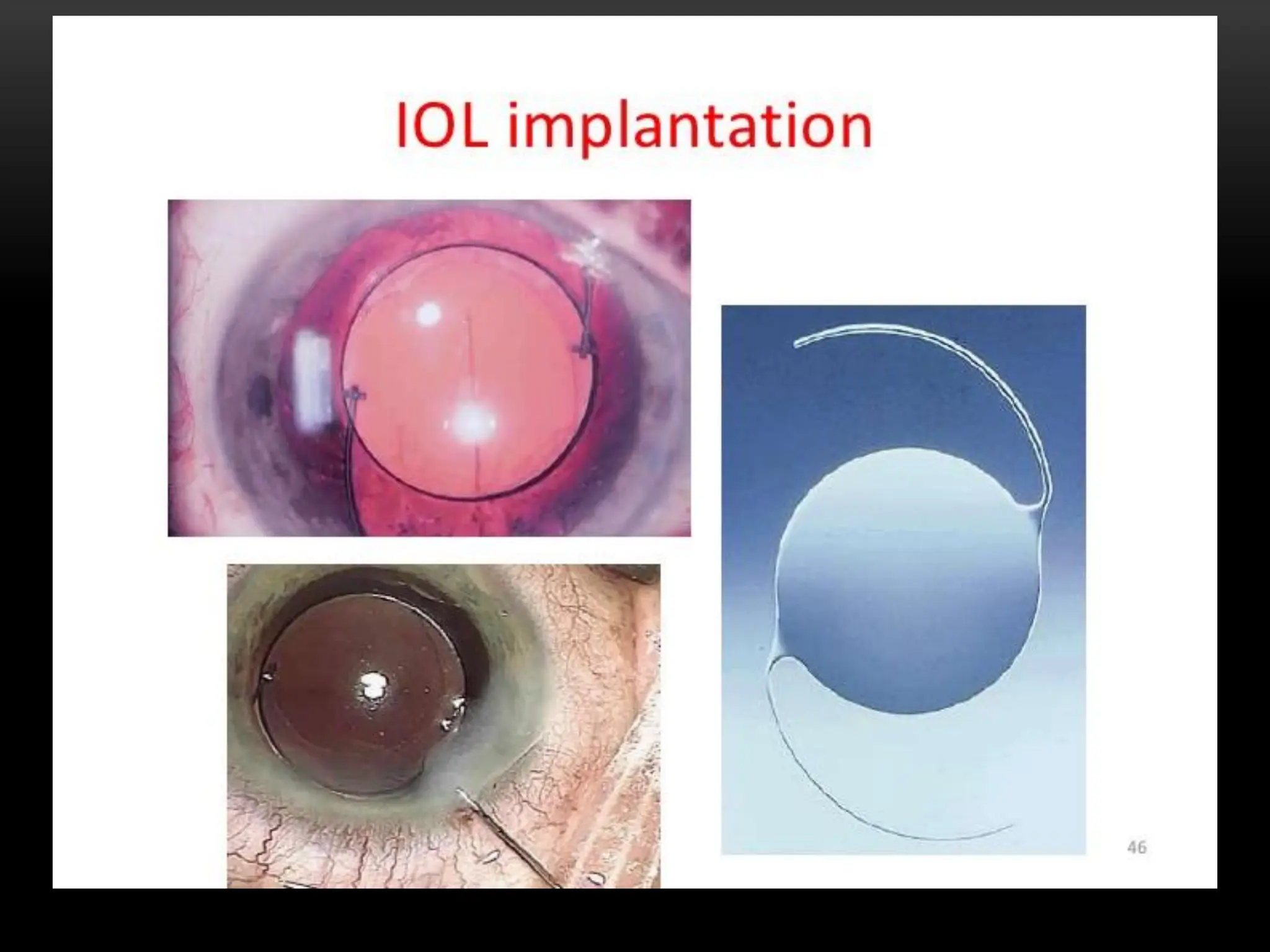
Treatment- aphakic spectacles/contact lens/IOL in P. Capsule,
Iris/Scleral fixation, AC
PRESBYOPIA
 Definition: loss of accommodation with age due to loss of
elasticity of the lens and weakness in the ciliary muscles
 Symptoms –begin at the age of 40 years
- Inability to read small prints initially at near
- worse in dim illumination
 Treatment-reading glasses (convex lenses)
SUMMARY
• Major Refraction surfaces of the eye?
• Types of Lenses
• Types of RE
• Causes of RE
• Commonest?
• Diagnosis?
• Management?
• RE due to Old age?
Questions/Additions??
What is your RE??
READING ASSIGNMENT
1. Definition of Blindness and ‘WHO’ Visual
impairment categories
2. Other Visual acuity notations
3. Mobile Visual acuity devices
4. Digital Eye syndrome and Prevention
Thank you…
REFERENCE BOOKS FOR OPHTHALMOLOGY
1. Brad Bowling, Kanski's Clinical Ophthalmology- A systematic
approach
2. Vaughan and Asbury's General Ophthalmology
3. Comprehensive Opthalmology by A. K Khurana
4. ABC of Eyes by Shah and Khaw
5. N.R.Galloway, et al - Common Eye Diseases and their
Management
6. Eye Diseases in Hot climates
7. Basic Ophthalmology: Essential for Medical Students
5 Refractive Errors and Visual acuity 2021.pdf

  • 1.
    MD III Classof 2023 1st June 2021 Dr. Frank, FCOphth ECSA Session 5
  • 2.
    INTRODUCTION • Three formsare recognized (primarily a function of the Cone system: • SPATIAL ACUITY: ability to resolve 2 points in space • Location and Brightness effect • Assessed using Snellen eye chart- relative to ability of the normal population to distinguish the letter at 6 meters (6/6 vision is normal) • TEMPORAL ACUITY: ability to distinguish visual events in time • SPECTRAL ACUITY: ability to distinguish differences in the wavelength of the stimuli
  • 3.
    INTRODUCTION CONT’D… • Humaneye is a complex optical instrument • Properties may vary from person to person • Several refractive surfaces with different refractive index
  • 4.
    VISUAL ACUITY (VA) •In the visual system, Acuity refers to the ’ability to discriminate fine details of the visual scene’ • An objective measure of what the person can see • Tested at 6m/20ft using Snellen Charts: very little accommodation • Each eye tested separately, OD first • Pinhole test (PH): simple optical test to detect refractive errors • Need for Near vision and Distance vision testing • Is part of routine examination-all patients 6/7/2021 4
  • 7.
    REFRACTIVE SURFACES OFTHE EYE • Air/cornea interface • Cornea/aqueous • Aqueous/anterior surface of the lens • Posterior surface of the lens/vitreous • But the major refracting surfaces • Cornea and Lens
  • 8.
    REFRACTION AT THECORNEA • The light entering the eye is refracted markedly at the anterior surface of the cornea. • Because of its curvature • The RI difference between air(1) and the cornea (1.37). • The optical power of the human cornea is 40-45D
  • 9.
    REFRACTION AT THELENS • The light undergoes little further refraction until it reaches the lens at both surfaces of which is refracted. • Lens makes sure the rays of light come to focus on the retina. • It focuses both near and distant objects by changing its shape a process called accommodation • The optical power of the human lens is 16-20D
  • 10.
  • 11.
    EMMETROPIC EYE • Aneye without RE • Parallel rays of light are brought to focus on the fovea without the use of accommodation
  • 13.
    AMETROPIC EYE • AnEye with Refractive Errors • Refractive state of the eye is determined by Four components: • Corneal power (Mean, 43D) • ACD (mean,3.4mm) • Crystalline lens power (mean, 21D) • Axial length (mean, 24)
  • 14.
    REFRACTIVE ERRORS • Occurswhen the eye cannot clearly focus the images from the outside world. • The result of refractive errors is blurred vision, which is sometimes so severe that it causes visual impairment. • Uncorrected refractive error accounts for half of the global burden of avoidable vision impairment and nearly a third of the global burden of avoidable blindness. • WHO estimates that 153 million people worldwide live with visual impairment due to uncorrected refractive errors.
  • 15.
    TYPES OF REFRACTIVEERRORS • Myopia • Hyperopia ( Hypermetropia) • Astigmatism • Aphakia • Presbyopia
  • 16.
    CAUSES OF REFRACTIVEERRORS • Axial length • Curvature • Index • Displacement of refractive surfaces
  • 17.
    DIAGNOSIS OF R.E •History from patient: Cant see far/near/headaches/blurry • Physical Examination: VA, IOP • Retinoscope • Pin Hole (For Screening) • SLE • Fundoscopy • CVFT
  • 18.
     Parallel raysof light come to focus in front of the retina  Causes;  Long axial length=Axial myopia  Increase curvature of Cornea  Keratoconus: Curvature myopia  Increase refractive index of the Lens (Index myopia) Swollen Lens  Displacement- eg. Lens sublaxation
  • 20.
    CLINICAL FEATURES • Poordistant vision hence shortsighted • Squinting • Eyelid squeezing/ blinking • Asthenopic symptoms • Eye fatigue • Headache • Photophobia o Pathological myopia(progressive) o more than 6D o 2% of population o affects more females X2  Complications; Retinal hole, RD, degeneration  Hereditary: 10 - 25%
  • 21.
     Concave lenses/minuslenses (Spherical)  Spectacles  Contact lens  Laser/surgery
  • 23.
    CLINICAL FEATURES • Poornear vision hence long-sightedness • Eye strain/pain • Headache • Convergent squint
  • 24.
    TREATMENT  Convex lenses/pluslenses (Spherical)  Spectacles  Contact lens  Laser/surgery
  • 25.
     Optical powerof cornea in different planes is not equal  Parallel beam of light focused at different planes on the retina  Causes:  Variation in refractive power in different meridians  irregularities in the corneal curvatures  Corneal scar,pterygium  Keratoconus  Chalazion  lens displacement/tilting
  • 26.
  • 27.
    SYMPTOMS AND TREATMENT Symptoms • Poor vision can be either at distant or near • Asthenopia • Fatigue • Headache  Treatment • Cylinder lenses • Spectacles • Contact lens • Corneal transplant • Refractive Surgery
  • 28.
    APHAKIA • Absence ofthe natural lens • Causes- surgical removal- commonest cause. - trauma - congenital absence Symptoms- eye becomes highly hyperopic - poor vision - loss of accommodation Treatment- aphakic spectacles/contact lens/IOL in P. Capsule, Iris/Scleral fixation, AC
  • 31.
    PRESBYOPIA  Definition: lossof accommodation with age due to loss of elasticity of the lens and weakness in the ciliary muscles  Symptoms –begin at the age of 40 years - Inability to read small prints initially at near - worse in dim illumination  Treatment-reading glasses (convex lenses)
  • 32.
    SUMMARY • Major Refractionsurfaces of the eye? • Types of Lenses • Types of RE • Causes of RE • Commonest? • Diagnosis? • Management? • RE due to Old age? Questions/Additions??
  • 33.
  • 34.
    READING ASSIGNMENT 1. Definitionof Blindness and ‘WHO’ Visual impairment categories 2. Other Visual acuity notations 3. Mobile Visual acuity devices 4. Digital Eye syndrome and Prevention
  • 35.
  • 36.
    REFERENCE BOOKS FOROPHTHALMOLOGY 1. Brad Bowling, Kanski's Clinical Ophthalmology- A systematic approach 2. Vaughan and Asbury's General Ophthalmology 3. Comprehensive Opthalmology by A. K Khurana 4. ABC of Eyes by Shah and Khaw 5. N.R.Galloway, et al - Common Eye Diseases and their Management 6. Eye Diseases in Hot climates 7. Basic Ophthalmology: Essential for Medical Students