Myers’ PSYCHOLOGY
              (7th Ed)


       Chapter 6
      Perception
     James A. McCubbin, PhD
       Clemson University


        Worth Publishers
Perception
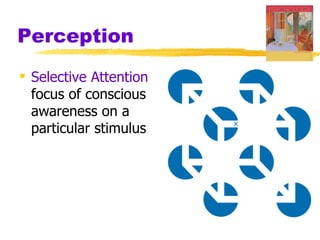
 Selective Attention
  focus of conscious
  awareness on a
  particular stimulus
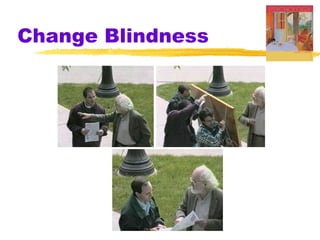
Change Blindness
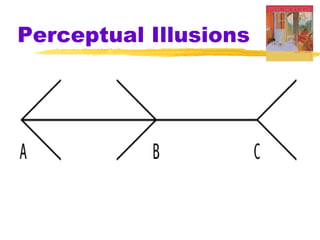
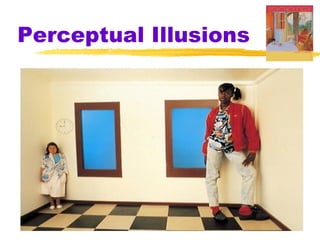
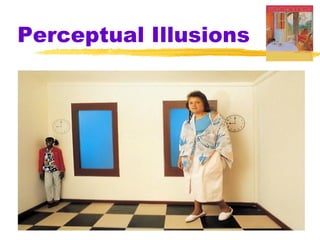
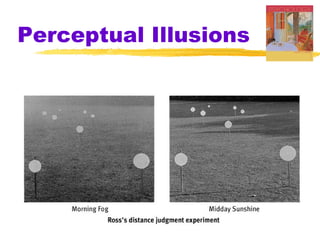
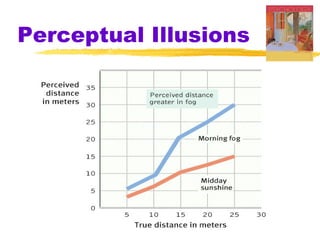
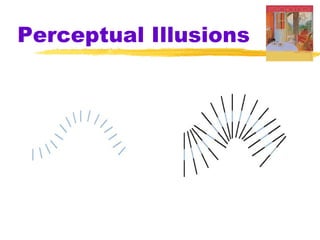
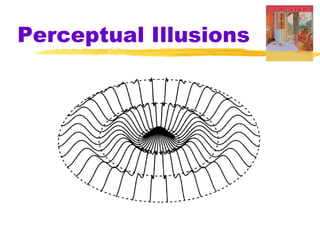
Perceptual Illusions
Perceptual Organization:
Gestalt

 Visual Capture
   tendency for vision to dominate the
    other senses
 Gestalt--an organized whole
   tendency to integrate pieces of
    information into meaningful wholes
Perceptual Organization:
Gestalt
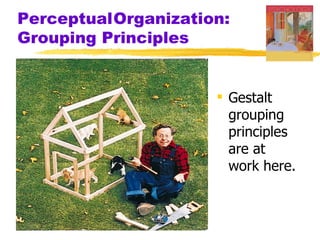
 Grouping
   the perceptual tendency to organize stimuli
    into coherent groups
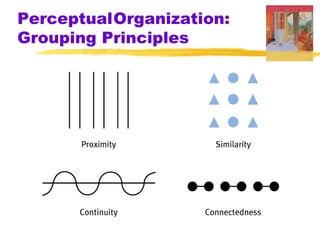
 Grouping Principles
     proximity--group nearby figures together
     similarity--group figures that are similar
     continuity--perceive continuous patterns
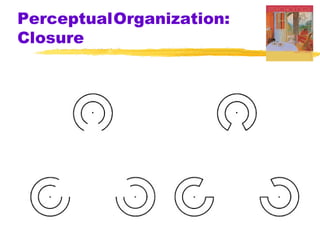
     closure--fill in gaps
     connectedness--spots, lines, and areas are
      seen as unit when connected
Perceptual Organization:
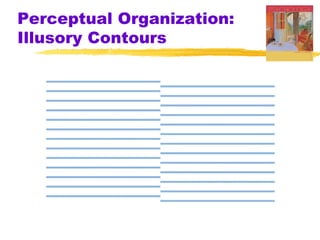
Illusory Contours
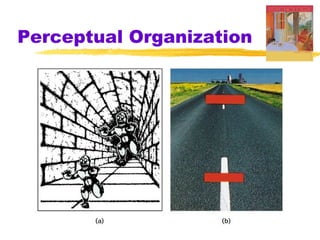
Perceptual Organization

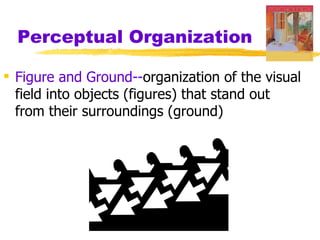
 Figure and Ground--organization of the visual
  field into objects (figures) that stand out
  from their surroundings (ground)
PerceptualOrganization:
Grouping Principles
PerceptualOrganization:
Closure


                      Gestalt
                       grouping
                       principles
                       are at
                       work here.
PerceptualOrganization:
Grouping Principles


                      Gestalt
                       grouping
                       principles
                       are at
                       work here.
Perceptual Organization:
Depth Perception
 Depth Perception
   ability to see objects in three dimensions
   allows us to judge distance
 Binocular cues
   retinal disparity
      images from the two eyes differ
      closer the object, the larger the disparity
   convergence
      neuromuscular cue
      two eyes move inward for near objects
Perceptual Organization:
Depth Perception


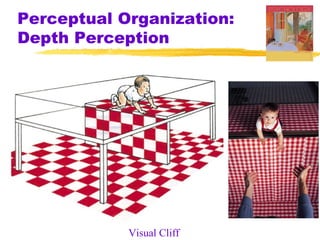
            Visual Cliff
Perceptual Organization:
Depth Perception

 Monocular Cues
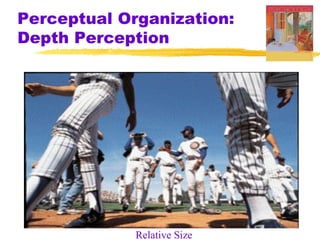
   relative size
     smaller image is more distant
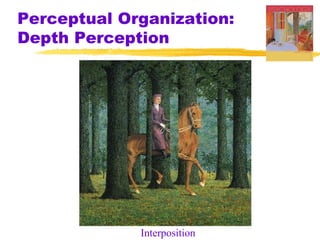
   interposition
     closer object blocks distant object
   relative clarity
     hazy object seen as more distant
   texture     coarse --> close
                fine --> distant
Perceptual Organization:
Depth Perception


             Relative Size
Perceptual Organization:
Depth Perception


             Interposition
Perceptual Organization:
Depth Perception
 Monocular Cues (cont.)
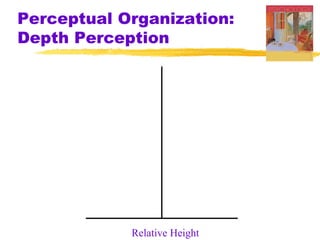
   relative height
     higher objects seen as more distant
   relative motion
     closer objects seem to move faster
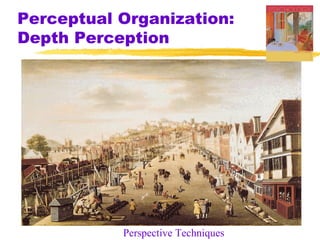
   linear perspective
     parallel lines converge with distance
   relative brightness
     closer objects appear brighter
Perceptual Organization:
Depth Perception


            Relative Height
Perceptual Organization:
Depth Perception


           Perspective Techniques
Perceptual Organization:
Depth Perception


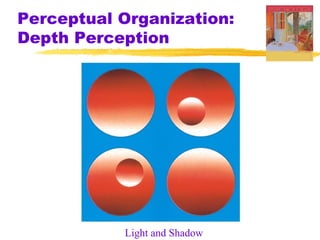
           Light and Shadow
Perceptual Organization:
Depth Perception


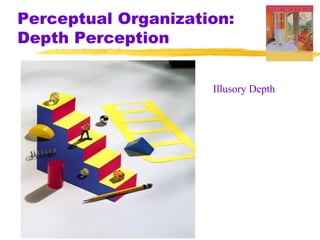
                     Illusory Depth
Perceptual Constancy
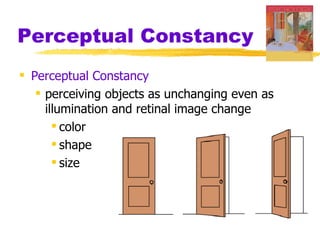
 Perceptual Constancy
    perceiving objects as unchanging even as
     illumination and retinal image change
        color
        shape
        size
Perceptual Organization
Perceptual Organization:
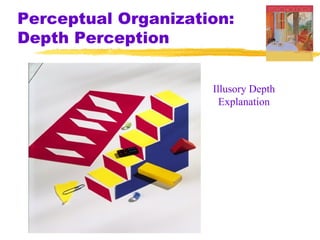
Depth Perception


                     Illusory Depth
                       Explanation
Perceptual Organization:
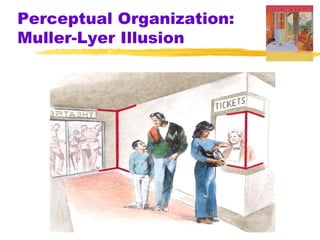
Muller-Lyer Illusion
Perceptual Organization:
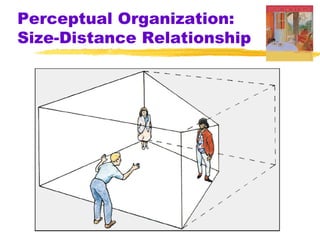
Size-Distance Relationship
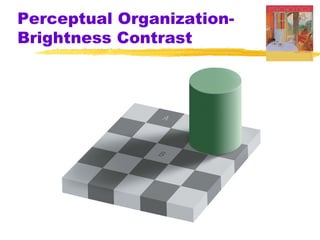
Perceptual Organization-
Brightness Contrast
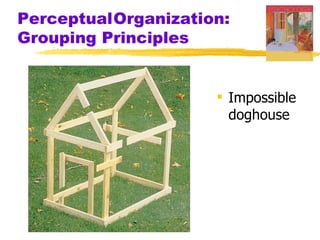
PerceptualOrganization:
Grouping Principles


                      Impossible
                       doghouse
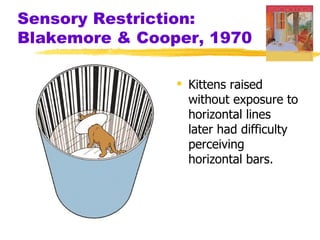
Sensory Restriction:
Blakemore & Cooper, 1970

                 Kittens raised
                  without exposure to
                  horizontal lines
                  later had difficulty
                  perceiving
                  horizontal bars.
Perceptual
Interpretation

 Perceptual Adaptation
   (vision) ability to adjust to an
    artificially displaced visual field
      prism glasses
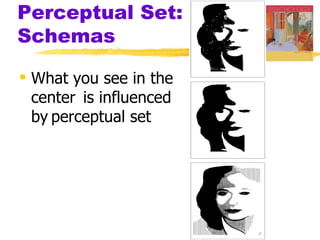
 Perceptual Set
   a mental predisposition to perceive
    one thing and not another
Perceptual Set:
Schemas

 What you see in the
  center is influenced
  by perceptual set
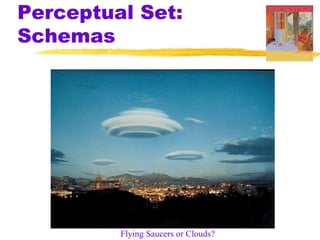
Perceptual Set:
Schemas


         Flying Saucers or Clouds?
Perception and the
Human Factor
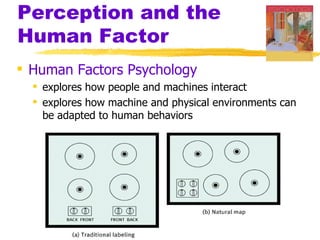
 Human Factors Psychology
   explores how people and machines interact
   explores how machine and physical environments can
    be adapted to human behaviors
Perceptual Set:
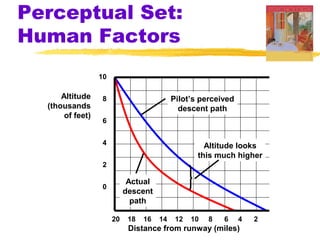
Human Factors
                  10

      Altitude     8                        Pilot’s perceived
  (thousands                                  descent path
       of feet)
                   6


                   4                                 Altitude looks
                                                   this much higher
                   2

                             Actual
                   0
                            descent
                              path

                       20    18   16   14    12   10   8   6    4   2
                             Distance from runway (miles)
Is There Extrasensory
Perception?
 Extrasensory Perception
   controversial claim that perception can occur
    apart from sensory input
     telepathy
     clairvoyance
     precognition
 Parapsychology
   the study of paranormal phenomena
     ESP
     psychokinesis

Ch6 ppt