MRS TAFADZWA
What are they?
 Perception
 Process by which organism selects and
interprets sensory input so that it acquires
meaning (Do something about it)
 How do you study it?
 Bottom Up: Stimuli to concept
 Top Down: Concept to stimuli
 Sensation
 Process in which the sense organ’s receptor cells
are stimulated and relay initial information to
the brain for further processing
Sensation requires transduction – which is the
change of physical energy to neural energy
The Perceptual Process
.
The steps in this process are arranged in a circle to emphasize the fact that the process
is dynamic and continually changing. Blue arrows point to stimuli; green to
processing; red to perceptual responses. Arrows A, B, and C indicate three important
relationships that researchers measure.
Perceiving Forms, Patterns, and Objects
 Feature detection theory - bottom-up
processing
 In bottom up process – (data driven process)
the perception is constructed out of the
elements-the bits and pieces of the stimulus
being with the image that falls on the retina
 Form perception - top-down processing
 In top-down process - sensory information
is interpreted in light of existing knowledge,
concept, ideas and expectation.
 Gestalt psychologists: the whole is more
than the sum of its parts
Figure 4.17 Bottom-up versus top-down processing
Double vision
Perceptual Organization
 Figure-ground
 We perceive a
foreground object
(figure) against a
background (ground)
 Animals may look like
the background they
inhabit as a way of
destroying figure-
ground distinction
Cont…
 In vision, the central figure is usually in front
of or on top of what we perceive as
background
 It has a distinct shape and is more striking in
our perceptions and memory than the
background
 However, we receive ambiguous clues about
what an object is and what is background
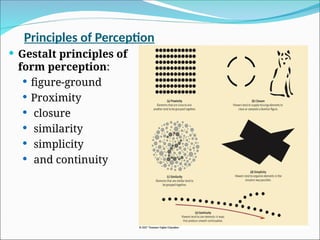
Principles of Perception
 Gestalt principles of
form perception:
 figure-ground
 Proximity
 closure
 similarity
 simplicity
 and continuity
Cont…
Figure 4.18 The principle of figure and ground
Figure 4.21 A famous reversible figure
Perceptual Constancies in Vision
 Perceptual constancies – stable perceptions amid
changing stimuli
 Size: is the tendency to perceive that the size of the
object remains the relatively constant even though
images in our retina change in size with variations
in distance
 Shape: tendency to perceive and recognize people
and other objects from many different angles
 Brightness: the tendency to perceive objects as
having constant brightness even when they are
observed under varying levels of illumination
 Location in space: tendency to view distance object
to be fuzzy and unclear even when we recognize
them
Perception of Distance and
Depth
 Monocular cues – those that require only one
eye
 Aerial perspective – nearby objects seem clear than
distant ones
 Texture gradient- closer objects appear to have
rough surfaces
 Linear perspective – parallel objects seem to get
closer as they get further
 Motion parallax – perception that nearby objects
appear to move rapidly in relation to our motion
 Superposition- near by objects block our view of
more distant objects
A scene in Tucson, Arizona containing a number of depth cues: occlusion
(the cactus occludes the hill, which occludes the mountain); perspective
convergence (the sides of the road converge in the distance); relative size
(the far motorcycle is smaller than the near one); and relative height (the
far motorcycle is higher in the field of view; the far cloud is lower).
A scene along the coast of California that illustrates atmospheric perspective.
•Atmospheric perspective - distance objects are fuzzy and have a blue tint
Figure 8.6 A texture gradient in Death Valley, California.
•Texture gradient - elements are more closely packed as distance
increases
(a) Occlusion indicates that the tapered glass is in front of the round glass and vase. (b) Overlap now
indicates that the vase is in front of the tapered glass, but there is something strange about this
picture. (c) The cast shadow under the vase provides additional information about its position in
space, which helps clear up the confusion.
Shadows - indicate where objects are located
Perception of Distance and Depth
 Binocular cues – those that require both eyes
 Retinal disparity – based on the diference in the
image cast by an object on the retinas of the
eyes as the object moves closer or further away
 Convergence – based on the inward movement
of the eyes as they attempt to focus on an object
that is drawing near
The Power of Misleading Cues:
Visual Illusions
 Optical Illusions - discrepancy between visual
appearance and physical reality
 Muller-Lyer Illusion and Impossible Figures-
in the muller-lyer illusion the lines are the
same length, but the line on the left, with its
reversed arrow head longs longer
 Experience compels us to perceive the vertical
lines in the muller-lyer illusion as the corners
of a room as seen from inside a house, at left,
and from out side at house at right. See figures
Figure 4.28 The Muller-Lyer illusion
Figure 4.29 Explaining the Muller-Lyer Illusion
The Ponzo Illusion
 In this illusion, the two horizontal lines are
the same length
 The converging lines strike us as being lines
receding into the distance, like the train tracks
 The rule of size constancy may give us some
insight onto this illusion
 From experience we assume that the
horizontal lines at the top is farther down the
track- that is farther away from us.
Moon Illusion
 Here the moon appear larger when it is in the
horizon than when it is overhead
 This is an illusion because the moon is the
same distance from us at the horizon as when
it is overhead
Individual Differences and Culture
in Perception
 Motivation
 Our desires or needs shape our current
perceptions
 Values
 Expectations
 Cognitive Style
 Experience and Culture
 Personality

LECT 7B. Perception lecture.ppt. ......

  • 1.
  • 2.
    What are they? Perception  Process by which organism selects and interprets sensory input so that it acquires meaning (Do something about it)  How do you study it?  Bottom Up: Stimuli to concept  Top Down: Concept to stimuli  Sensation  Process in which the sense organ’s receptor cells are stimulated and relay initial information to the brain for further processing Sensation requires transduction – which is the change of physical energy to neural energy
  • 3.
    The Perceptual Process . Thesteps in this process are arranged in a circle to emphasize the fact that the process is dynamic and continually changing. Blue arrows point to stimuli; green to processing; red to perceptual responses. Arrows A, B, and C indicate three important relationships that researchers measure.
  • 4.
    Perceiving Forms, Patterns,and Objects  Feature detection theory - bottom-up processing  In bottom up process – (data driven process) the perception is constructed out of the elements-the bits and pieces of the stimulus being with the image that falls on the retina  Form perception - top-down processing  In top-down process - sensory information is interpreted in light of existing knowledge, concept, ideas and expectation.  Gestalt psychologists: the whole is more than the sum of its parts
  • 5.
    Figure 4.17 Bottom-upversus top-down processing
  • 6.
  • 7.
    Perceptual Organization  Figure-ground We perceive a foreground object (figure) against a background (ground)  Animals may look like the background they inhabit as a way of destroying figure- ground distinction
  • 8.
    Cont…  In vision,the central figure is usually in front of or on top of what we perceive as background  It has a distinct shape and is more striking in our perceptions and memory than the background  However, we receive ambiguous clues about what an object is and what is background
  • 9.
    Principles of Perception Gestalt principles of form perception:  figure-ground  Proximity  closure  similarity  simplicity  and continuity
  • 10.
  • 11.
    Figure 4.18 Theprinciple of figure and ground
  • 12.
    Figure 4.21 Afamous reversible figure
  • 13.
    Perceptual Constancies inVision  Perceptual constancies – stable perceptions amid changing stimuli  Size: is the tendency to perceive that the size of the object remains the relatively constant even though images in our retina change in size with variations in distance  Shape: tendency to perceive and recognize people and other objects from many different angles  Brightness: the tendency to perceive objects as having constant brightness even when they are observed under varying levels of illumination  Location in space: tendency to view distance object to be fuzzy and unclear even when we recognize them
  • 14.
    Perception of Distanceand Depth  Monocular cues – those that require only one eye  Aerial perspective – nearby objects seem clear than distant ones  Texture gradient- closer objects appear to have rough surfaces  Linear perspective – parallel objects seem to get closer as they get further  Motion parallax – perception that nearby objects appear to move rapidly in relation to our motion  Superposition- near by objects block our view of more distant objects
  • 15.
    A scene inTucson, Arizona containing a number of depth cues: occlusion (the cactus occludes the hill, which occludes the mountain); perspective convergence (the sides of the road converge in the distance); relative size (the far motorcycle is smaller than the near one); and relative height (the far motorcycle is higher in the field of view; the far cloud is lower).
  • 16.
    A scene alongthe coast of California that illustrates atmospheric perspective. •Atmospheric perspective - distance objects are fuzzy and have a blue tint
  • 17.
    Figure 8.6 Atexture gradient in Death Valley, California. •Texture gradient - elements are more closely packed as distance increases
  • 18.
    (a) Occlusion indicatesthat the tapered glass is in front of the round glass and vase. (b) Overlap now indicates that the vase is in front of the tapered glass, but there is something strange about this picture. (c) The cast shadow under the vase provides additional information about its position in space, which helps clear up the confusion. Shadows - indicate where objects are located
  • 19.
    Perception of Distanceand Depth  Binocular cues – those that require both eyes  Retinal disparity – based on the diference in the image cast by an object on the retinas of the eyes as the object moves closer or further away  Convergence – based on the inward movement of the eyes as they attempt to focus on an object that is drawing near
  • 20.
    The Power ofMisleading Cues: Visual Illusions  Optical Illusions - discrepancy between visual appearance and physical reality  Muller-Lyer Illusion and Impossible Figures- in the muller-lyer illusion the lines are the same length, but the line on the left, with its reversed arrow head longs longer  Experience compels us to perceive the vertical lines in the muller-lyer illusion as the corners of a room as seen from inside a house, at left, and from out side at house at right. See figures
  • 21.
    Figure 4.28 TheMuller-Lyer illusion
  • 22.
    Figure 4.29 Explainingthe Muller-Lyer Illusion
  • 23.
    The Ponzo Illusion In this illusion, the two horizontal lines are the same length  The converging lines strike us as being lines receding into the distance, like the train tracks  The rule of size constancy may give us some insight onto this illusion  From experience we assume that the horizontal lines at the top is farther down the track- that is farther away from us.
  • 24.
    Moon Illusion  Herethe moon appear larger when it is in the horizon than when it is overhead  This is an illusion because the moon is the same distance from us at the horizon as when it is overhead
  • 25.
    Individual Differences andCulture in Perception  Motivation  Our desires or needs shape our current perceptions  Values  Expectations  Cognitive Style  Experience and Culture  Personality