Myers’ PSYCHOLOGY
              (7th Ed)


       Chapter 13
        Emotion
     James A. McCubbin, PhD
       Clemson University

        Worth Publishers
Emotion
 Emotion
  a response of the whole
   organism
    physiological arousal
    expressive behaviors
    conscious experience
Theories of Emotion

  Does your heart pound
   because you are afraid...
   or are you afraid because you
   feel your heart pounding?
James-Lange
Theory of Emotion
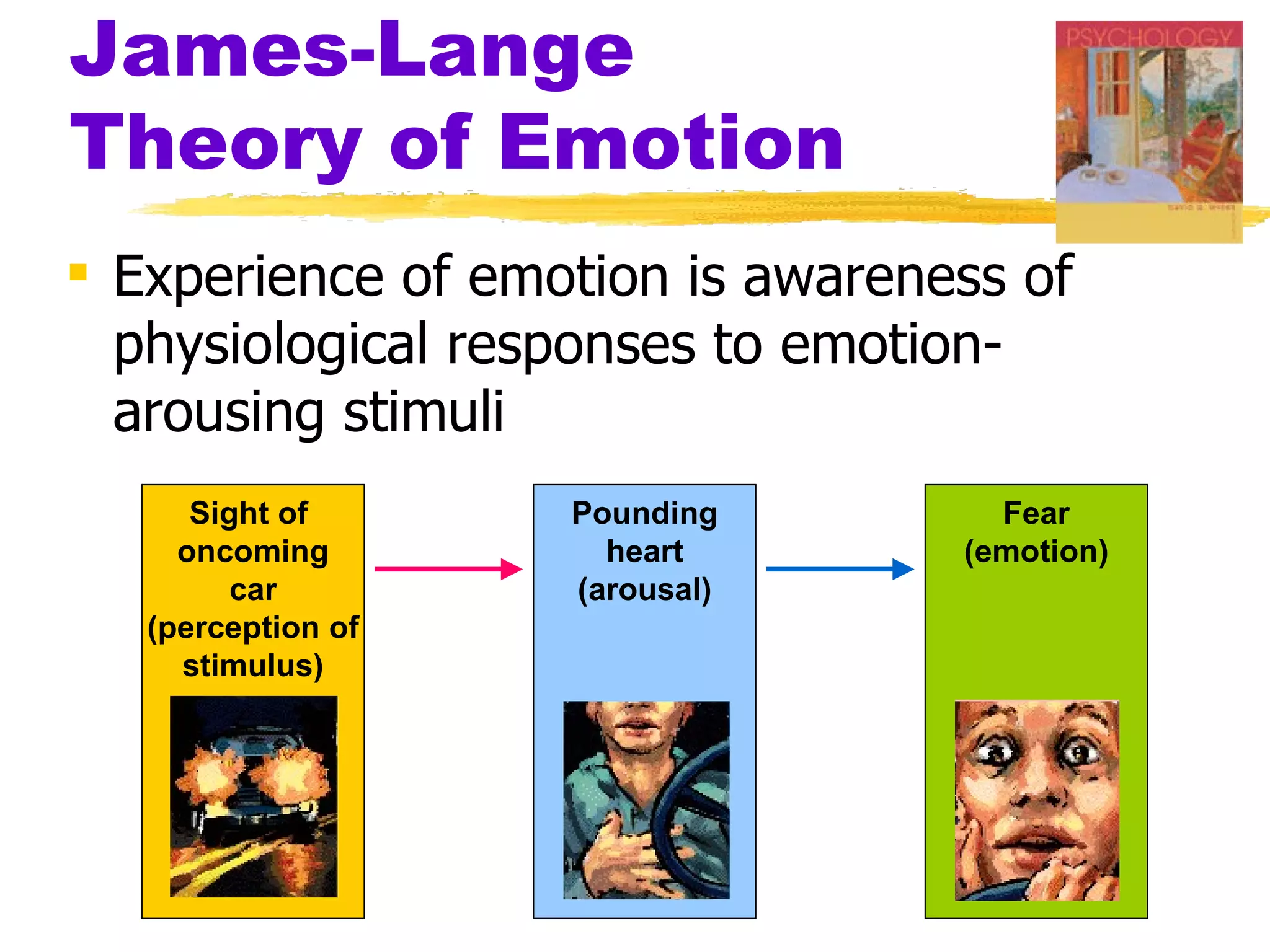
 Experience of emotion is awareness of
  physiological responses to emotion-
  arousing stimuli
      Sight of      Pounding        Fear
     oncoming         heart       (emotion)
         car        (arousal)
   (perception of
     stimulus)
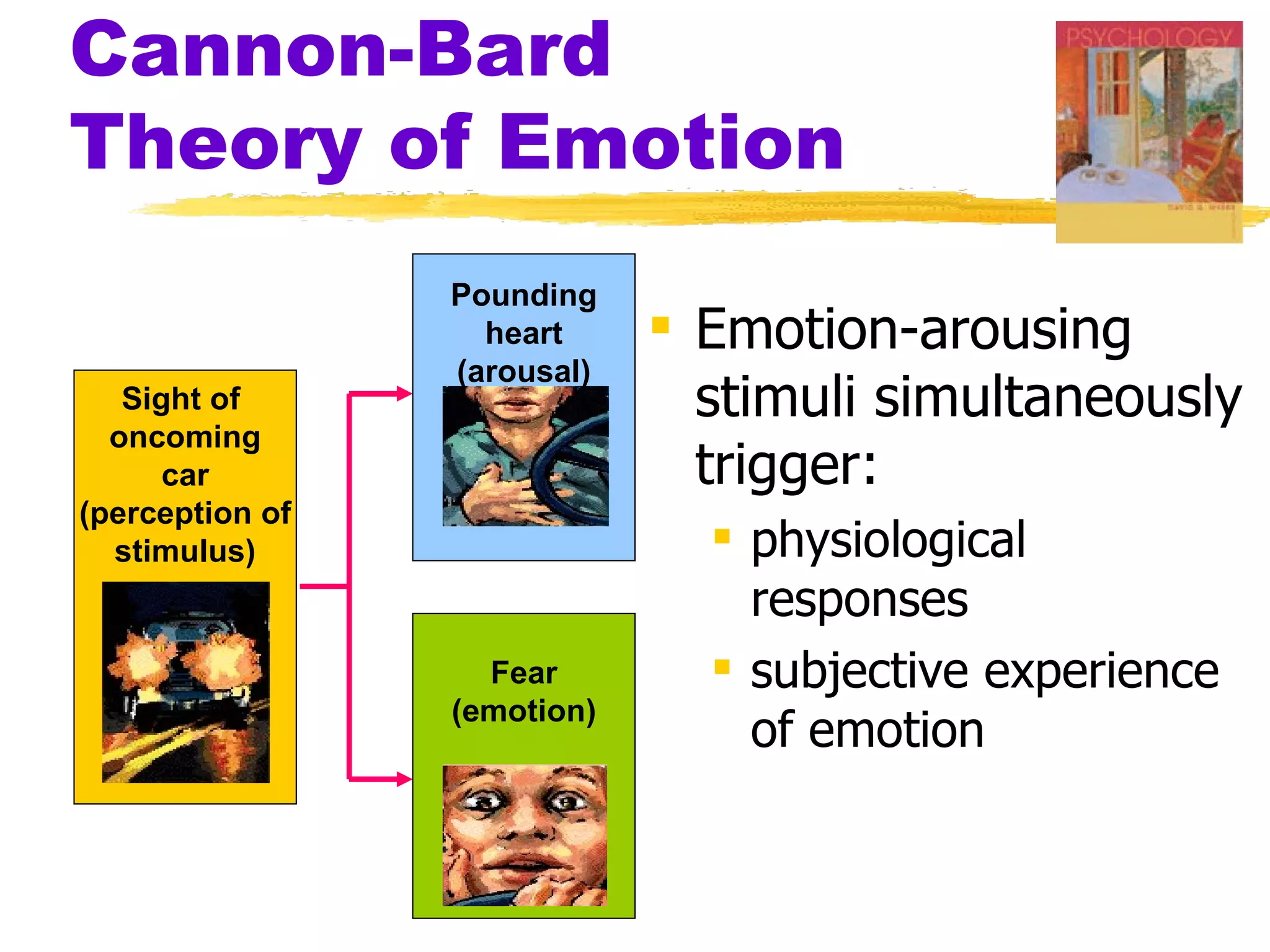
Cannon-Bard
Theory of Emotion
                 Pounding
                   heart      Emotion-arousing
                 (arousal)
   Sight of                    stimuli simultaneously
  oncoming
      car                      trigger:
(perception of
  stimulus)                     physiological
                                 responses
                   Fear         subjective experience
                 (emotion)
                                 of emotion
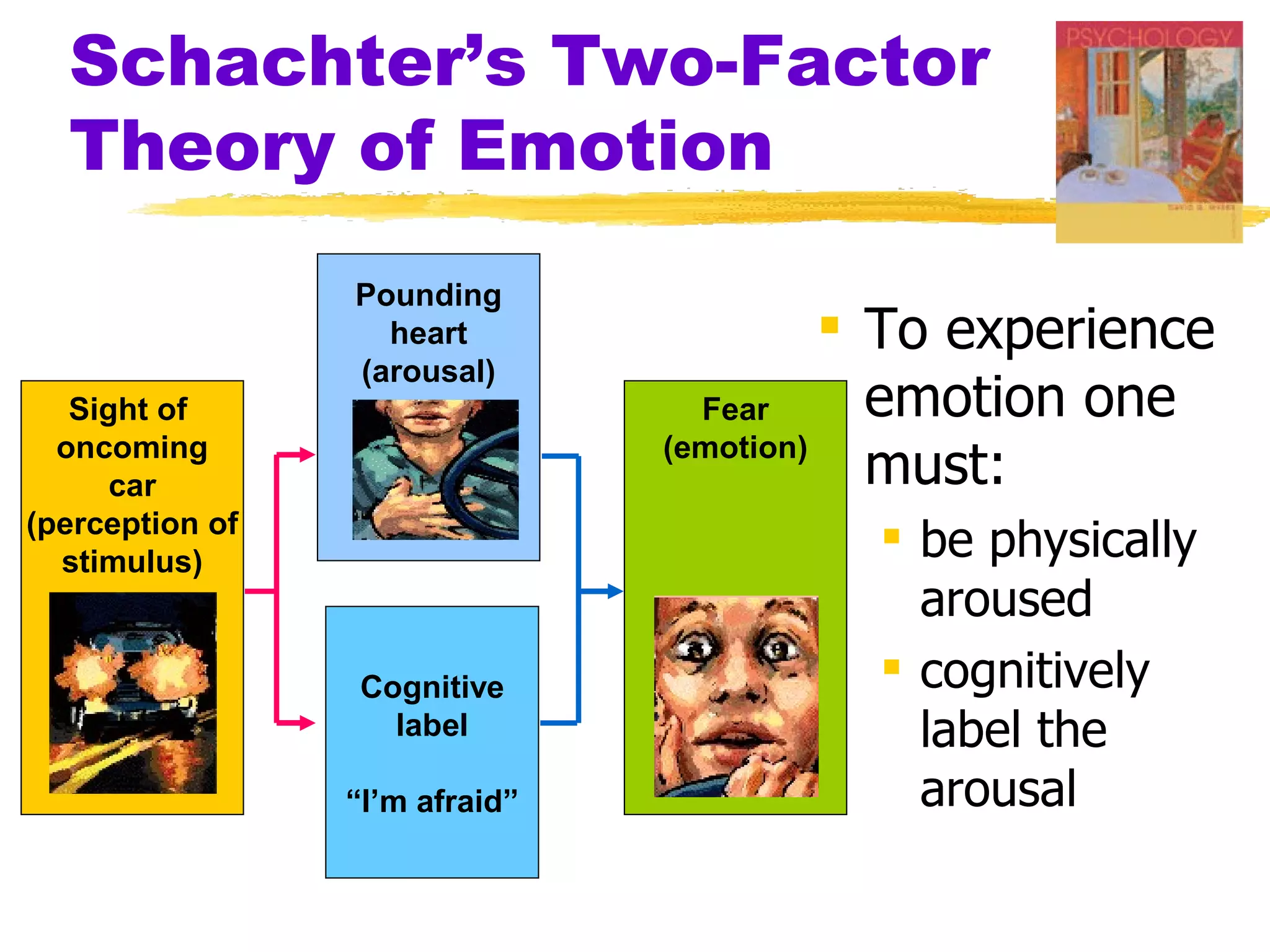
Schachter’s Two-Factor
  Theory of Emotion
                 Pounding
                   heart                   To experience
                 (arousal)
   Sight of                       Fear      emotion one
  oncoming
      car
                                (emotion)
                                            must:
(perception of
  stimulus)
                                          be physically
                                           aroused
                  Cognitive               cognitively
                    label                  label the
                 “I’m afraid”              arousal
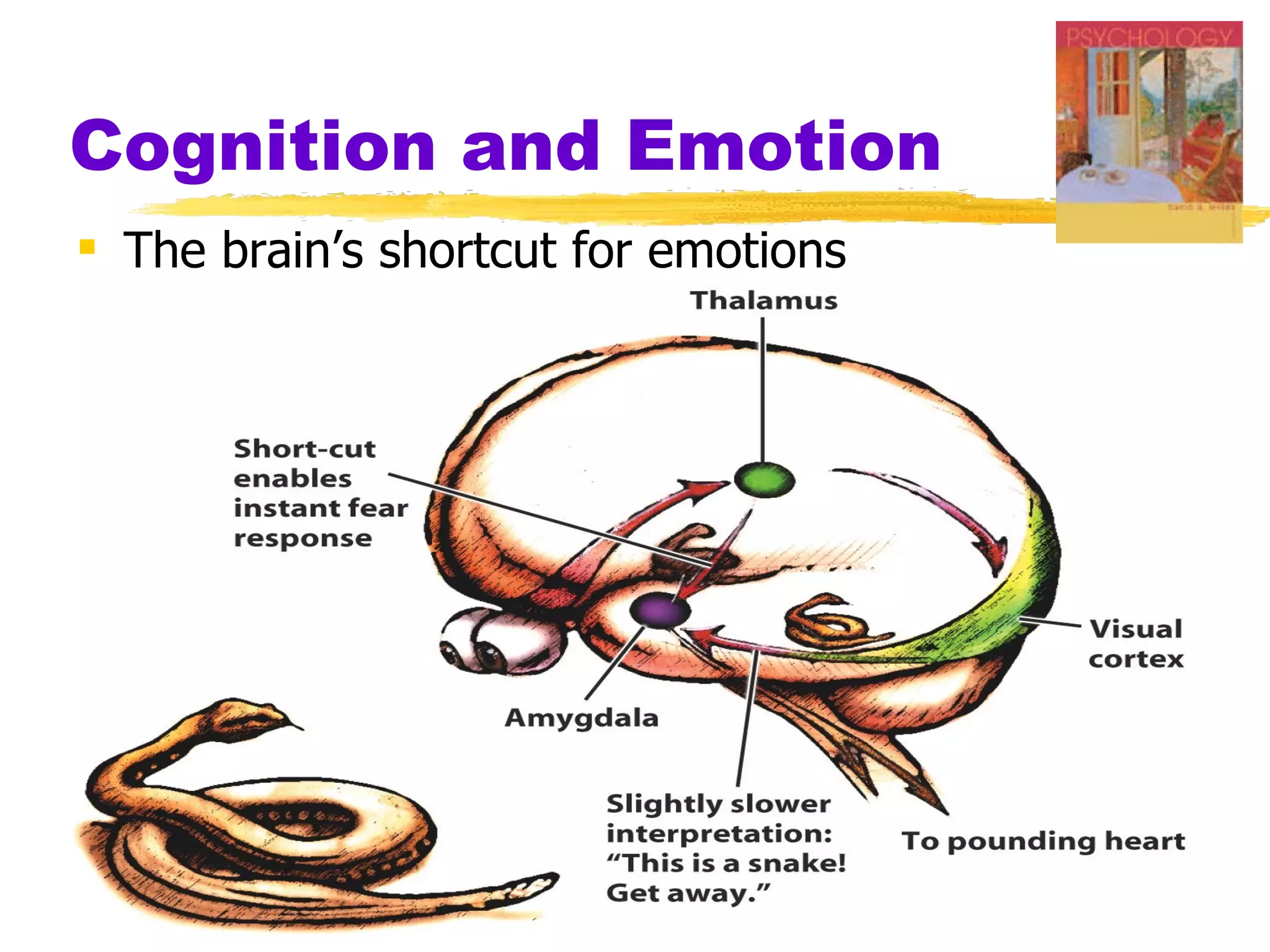
Cognition and Emotion
 The brain’s shortcut for emotions
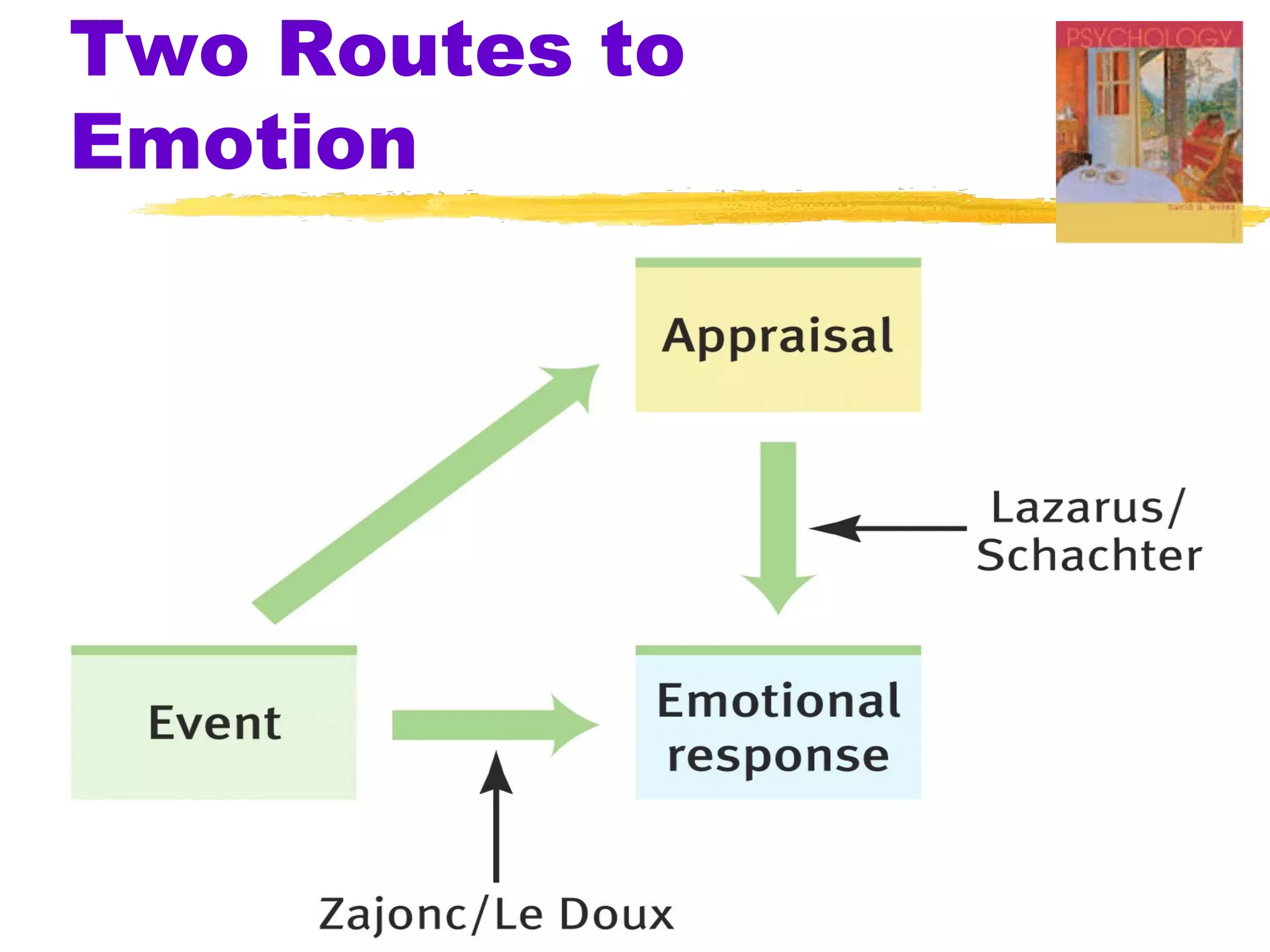
Two Routes to
Emotion
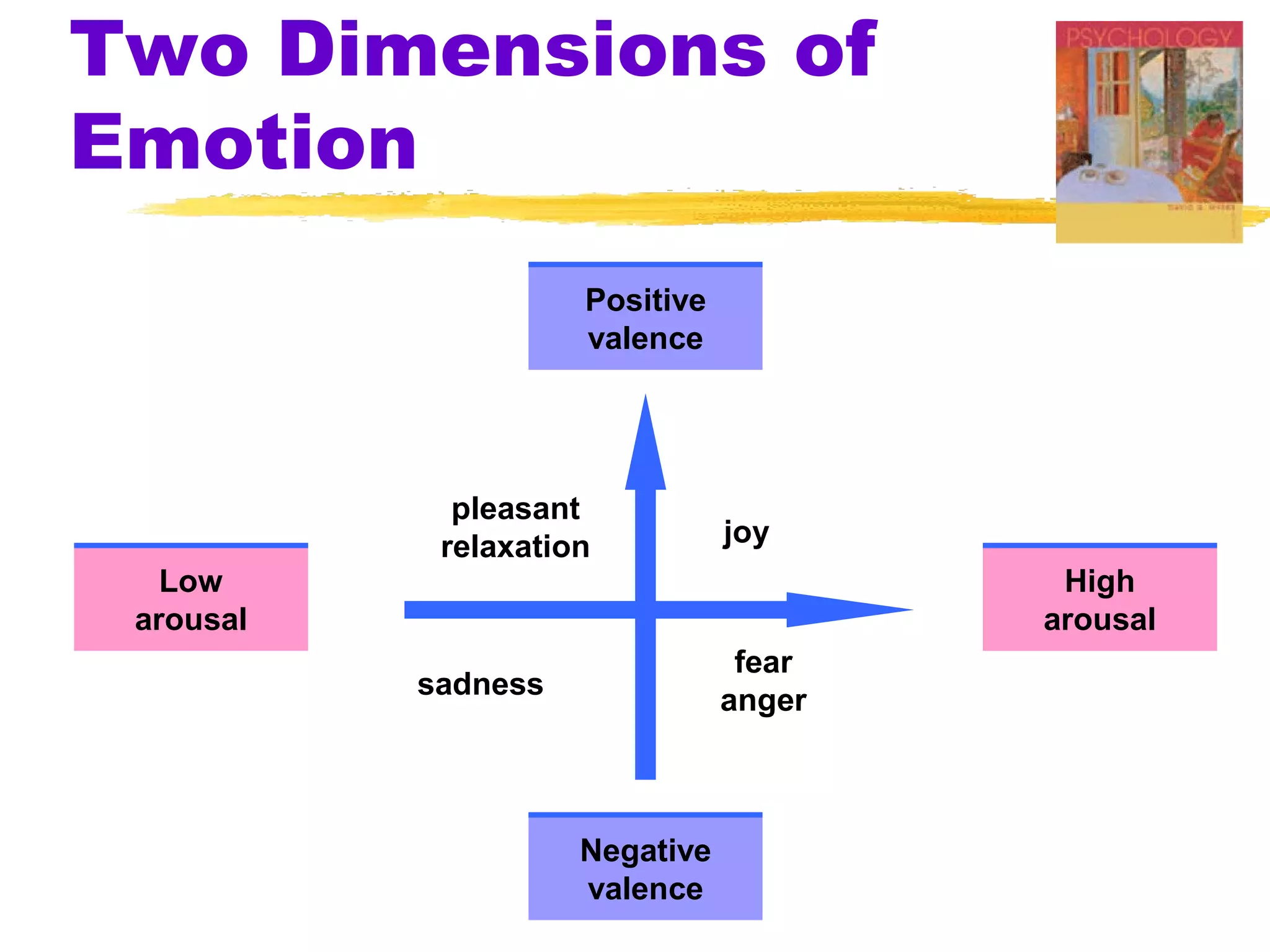
Two Dimensions of
Emotion
                     Positive
                     valence


             pleasant
            relaxation          joy
   Low                                   High
 arousal                                arousal
                                 fear
           sadness
                                anger


                     Negative
                     valence
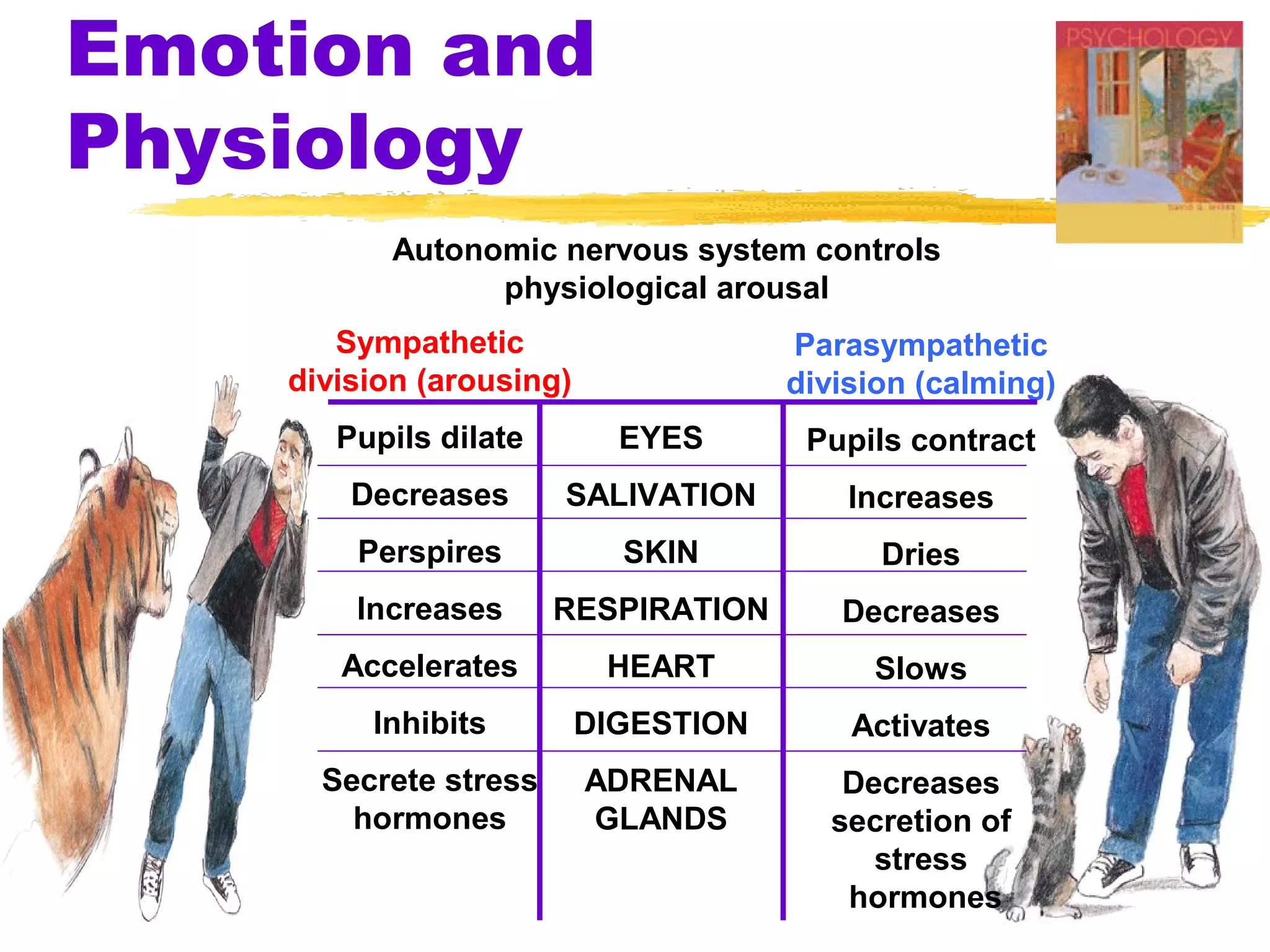
Emotion and
Physiology
          Autonomic nervous system controls
                physiological arousal
       Sympathetic                    Parasympathetic
    division (arousing)               division (calming)
       Pupils dilate        EYES       Pupils contract
        Decreases      SALIVATION         Increases
        Perspires           SKIN            Dries
        Increases      RESPIRATION       Decreases
       Accelerates         HEART           Slows
         Inhibits         DIGESTION       Activates
      Secrete stress      ADRENAL         Decreases
        hormones          GLANDS         secretion of
                                            stress
                                          hormones
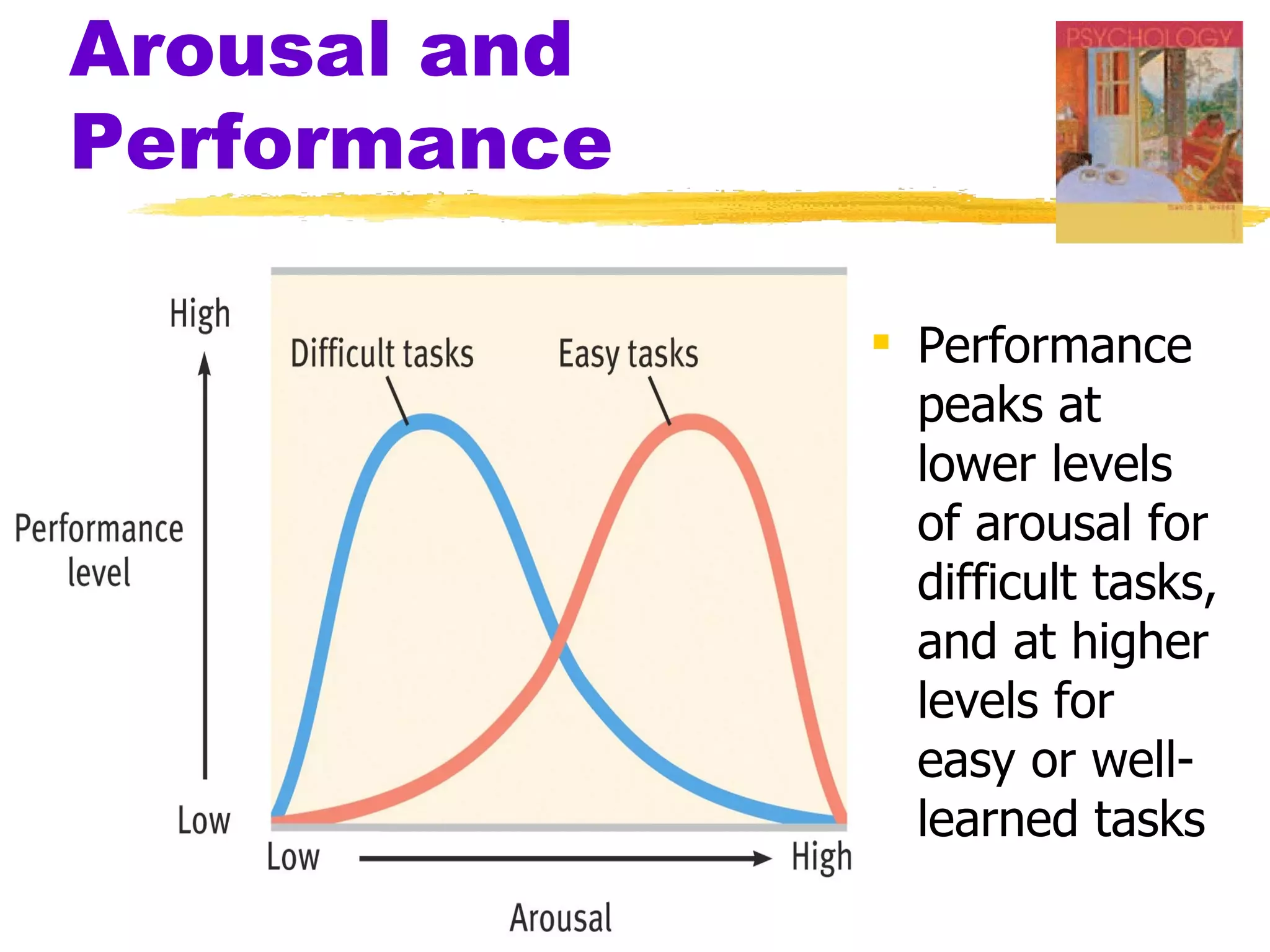
Arousal and
Performance

               Performance
                peaks at
                lower levels
                of arousal for
                difficult tasks,
                and at higher
                levels for
                easy or well-
                learned tasks
Emotion-
Lie Detectors

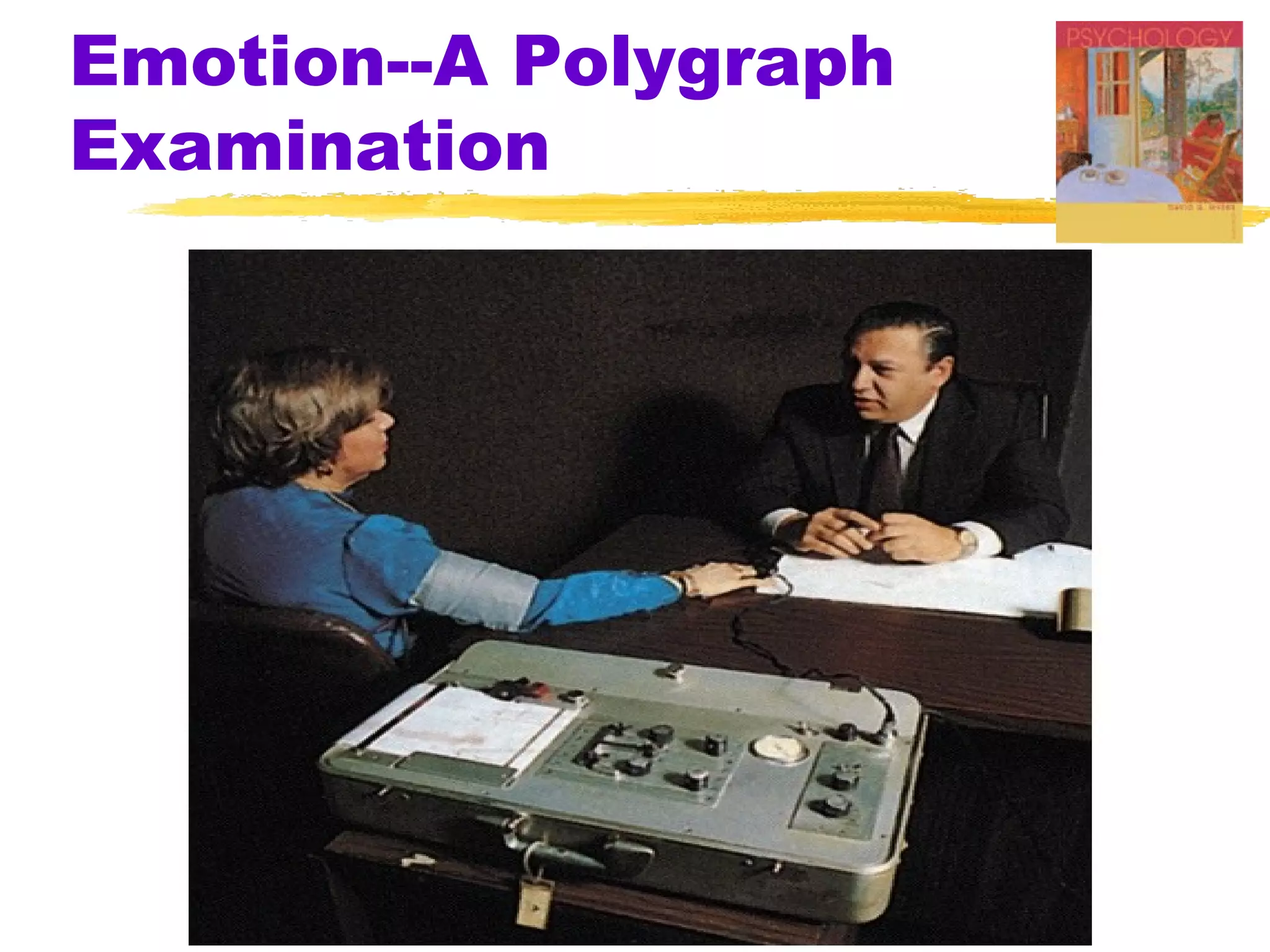
 Polygraph
   machine commonly used in attempts to
    detect lies
   measures several of the physiological
    responses accompanying emotion
     perspiration
     cardiovascular
     breathing changes
Emotion--A Polygraph
Examination
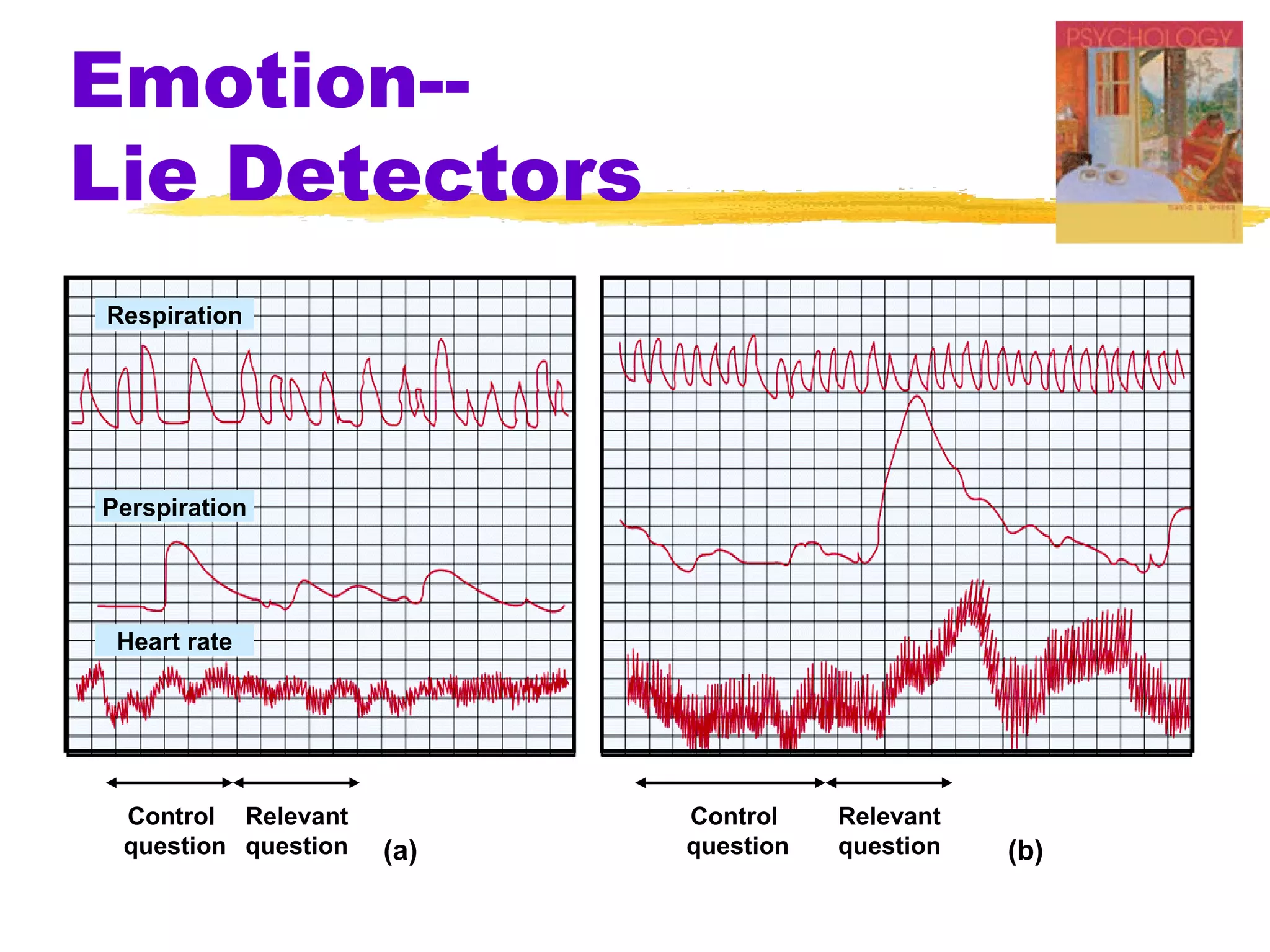
Emotion--Lie Detectors

  Control Question
    Up to age 18, did you ever physically
     harm anyone?
  Relevant Question
    Did [the deceased] threaten to harm
     you in any way?
  Relevant > Control --> Lie
Emotion--
Lie Detectors
Respiration


Perspiration


 Heart rate


 Control Relevant          Control    Relevant
 question question   (a)   question   question   (b)
Emotion--
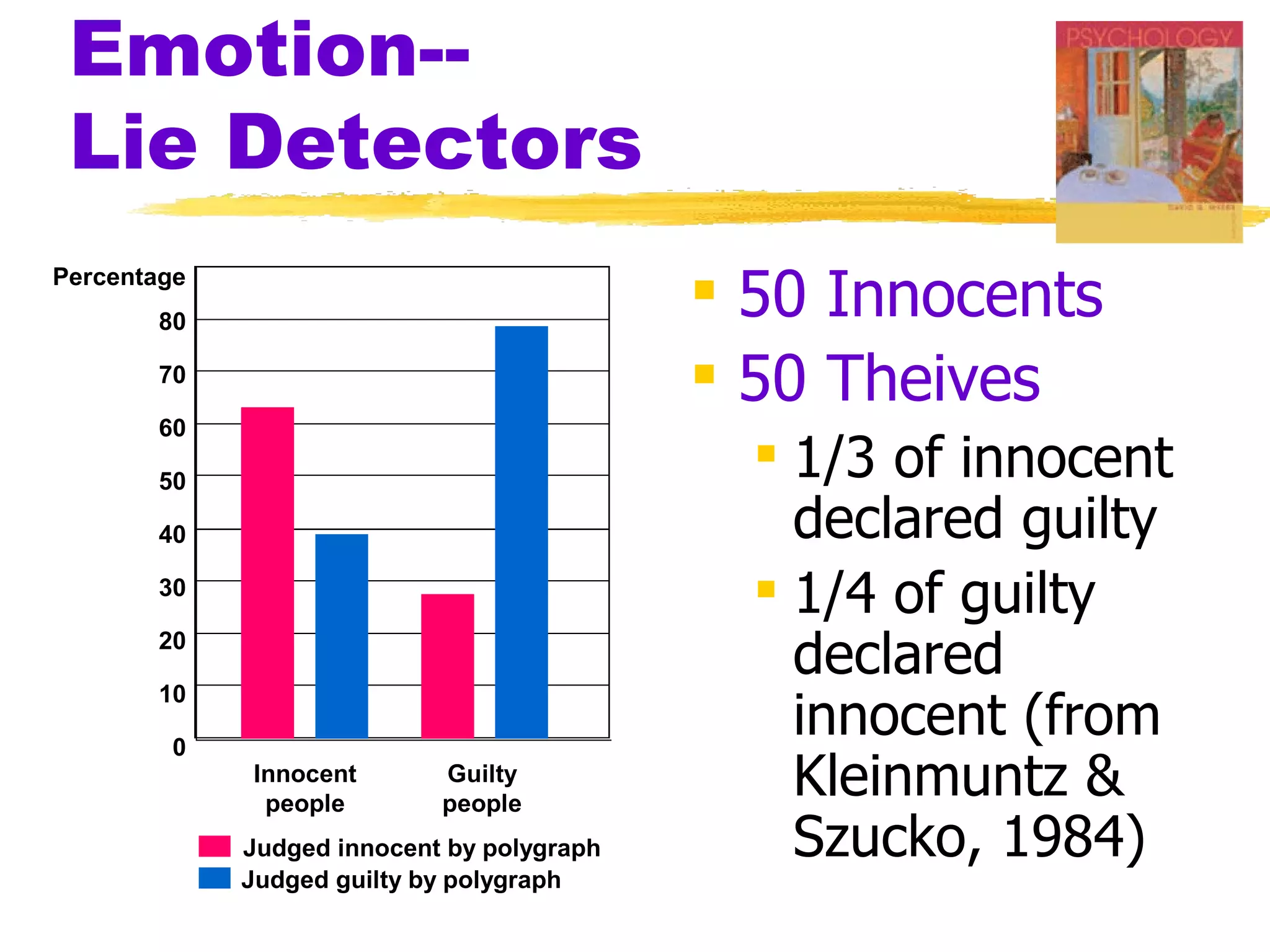
 Lie Detectors
Percentage
       80
                                             50 Innocents
       70
                                             50 Theives
       60

       50
                                               1/3 of innocent
       40                                       declared guilty
       30
                                               1/4 of guilty
       20
                                                declared
                                                innocent (from
       10

        0
             Innocent
              people
                            Guilty
                            people
                                                Kleinmuntz &
             Judged innocent by polygraph       Szucko, 1984)
             Judged guilty by polygraph
Emotion--
Lie Detectors
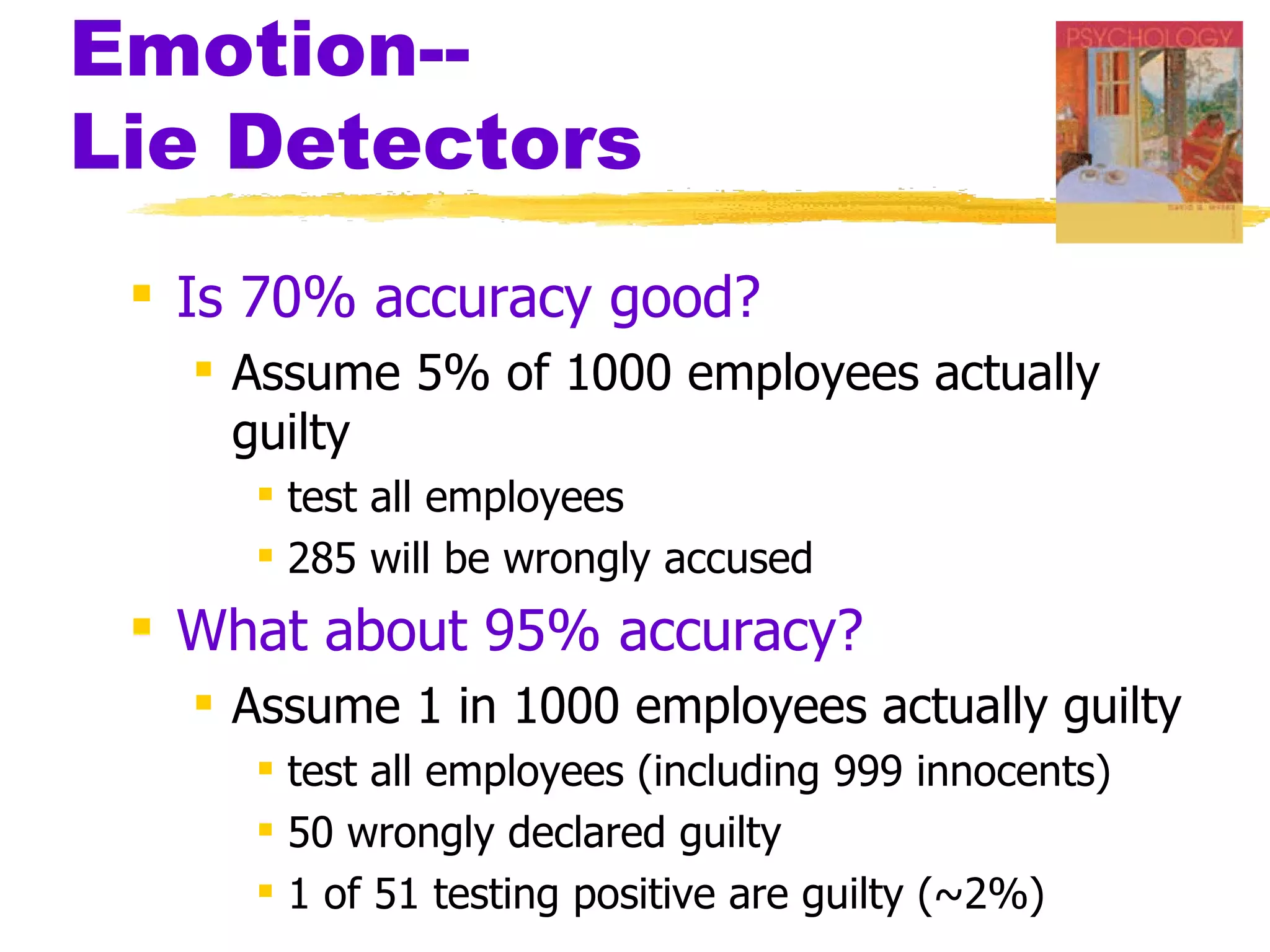
  Is 70% accuracy good?
    Assume 5% of 1000 employees actually
     guilty
      test all employees
      285 will be wrongly accused
  What about 95% accuracy?
    Assume 1 in 1000 employees actually guilty
      test all employees (including 999 innocents)
      50 wrongly declared guilty
      1 of 51 testing positive are guilty (~2%)
Expressed Emotion
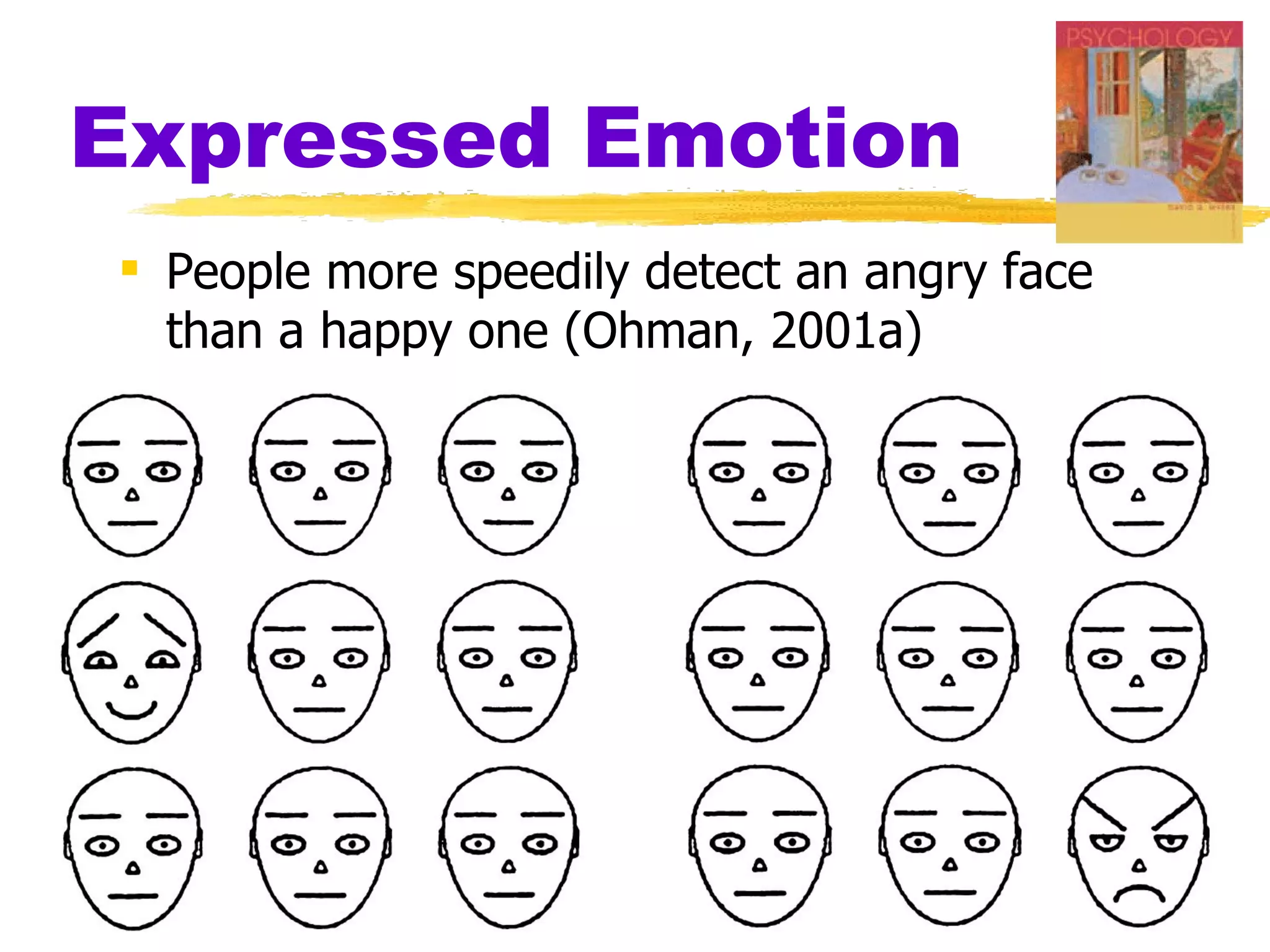
 People more speedily detect an angry face
  than a happy one (Ohman, 2001a)
Expressed Emotion
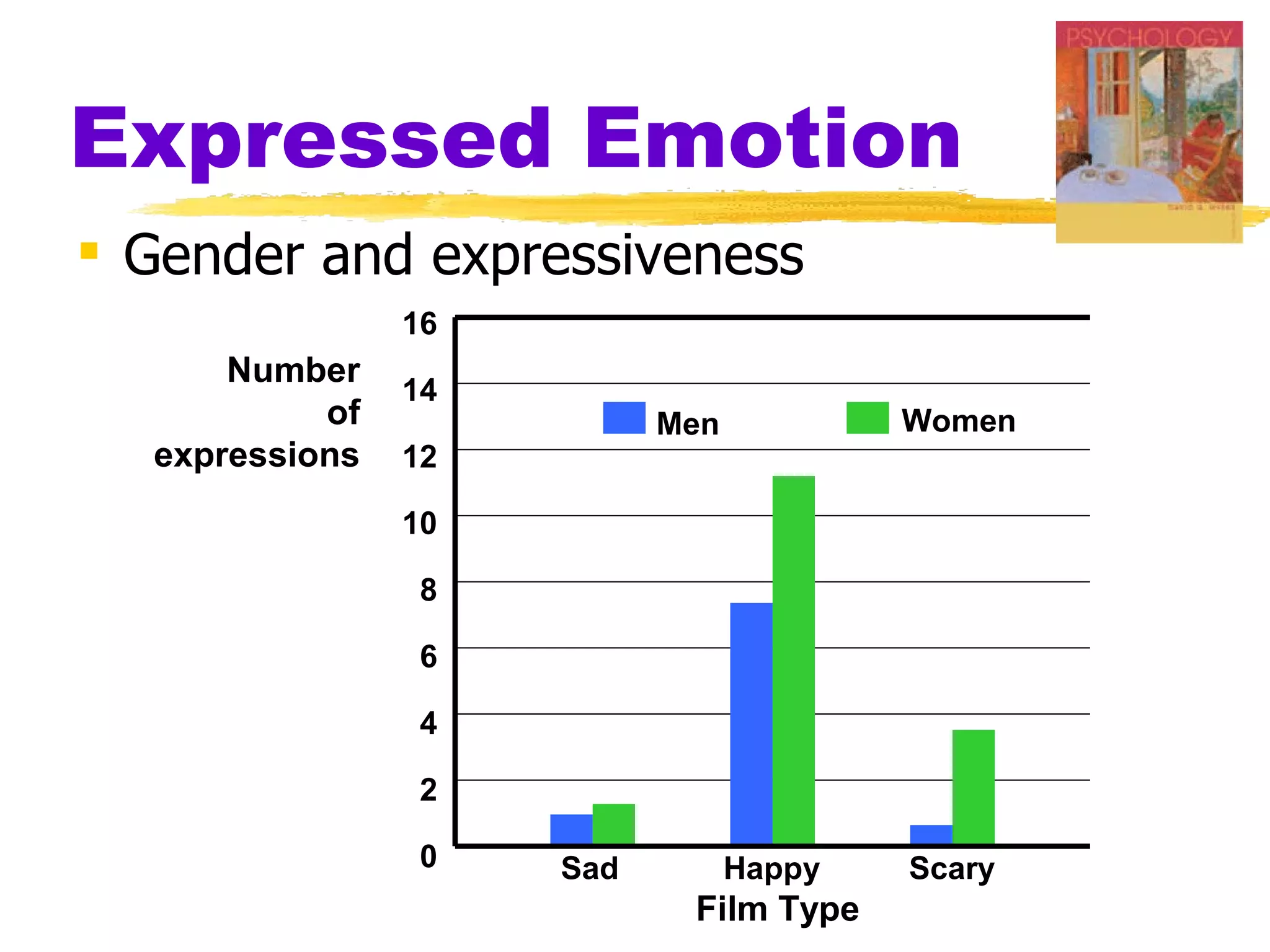
 Gender and expressiveness
                16
      Number
                14
           of              Men           Women
  expressions   12

                10

                 8

                 6

                 4

                 2

                 0   Sad         Happy   Scary
                            Film Type
Expressed Emotion
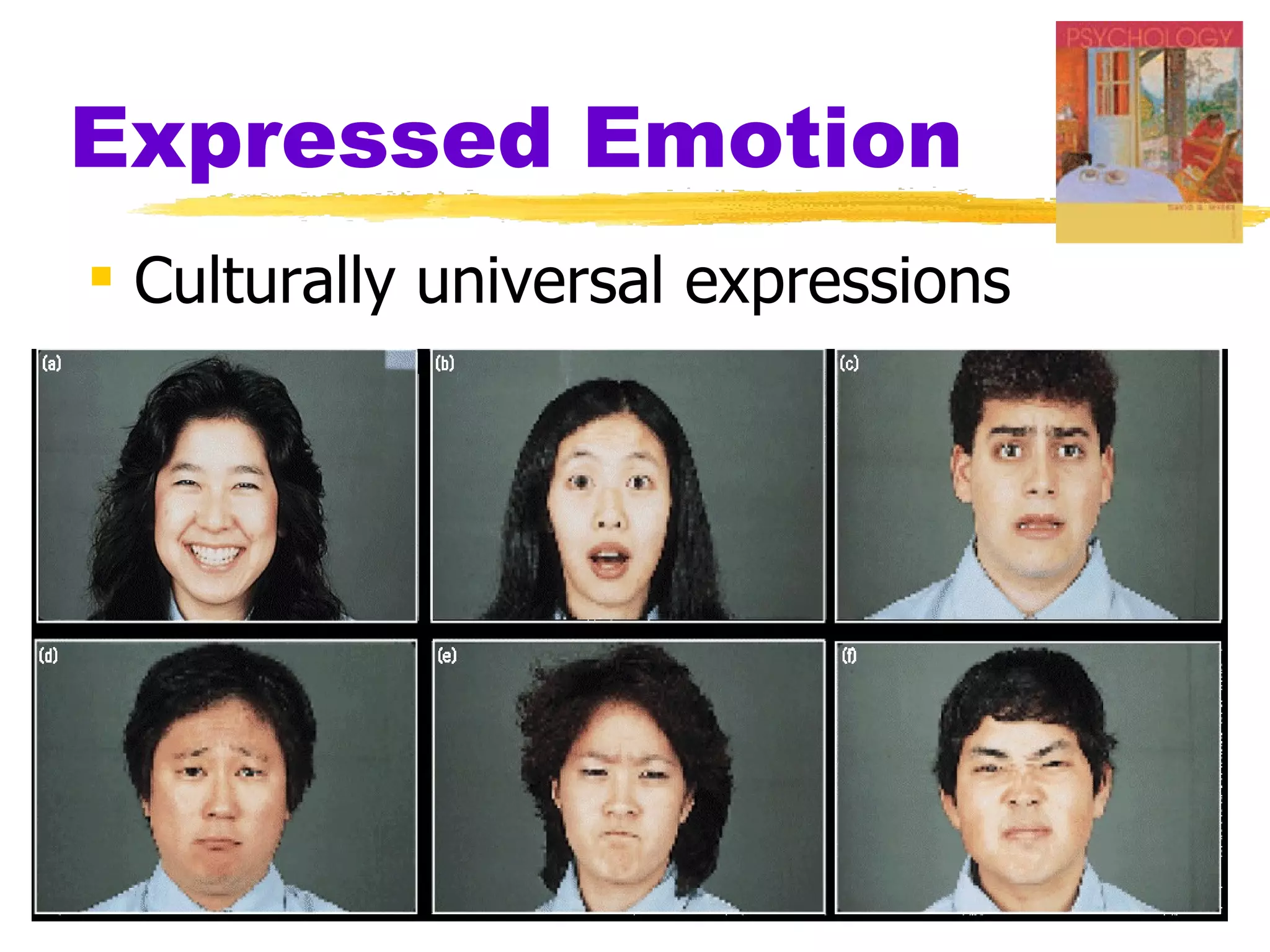
 Culturally universal expressions
Experienced Emotion
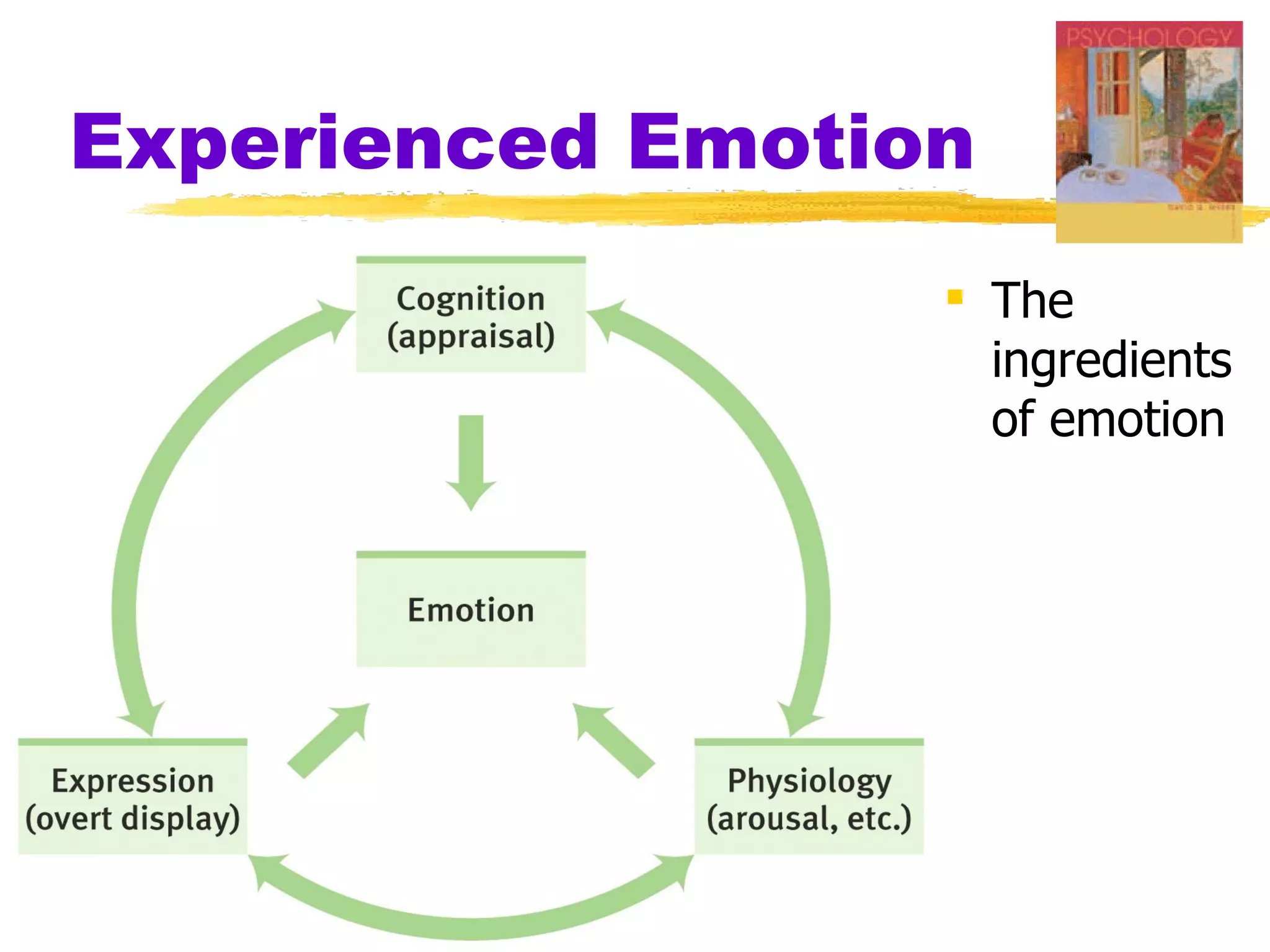
                   The
                    ingredients
                    of emotion
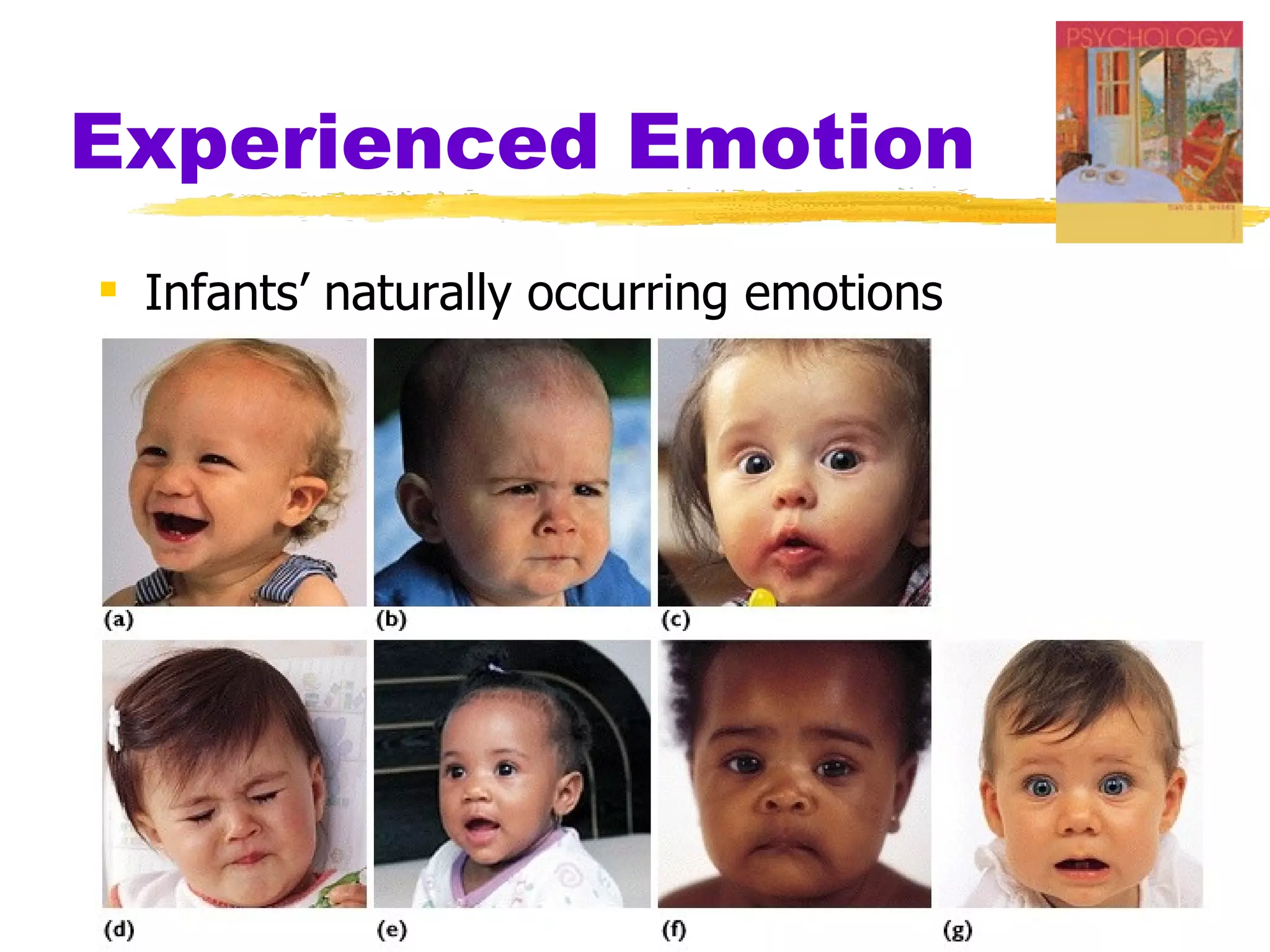
Experienced Emotion
 Infants’ naturally occurring emotions
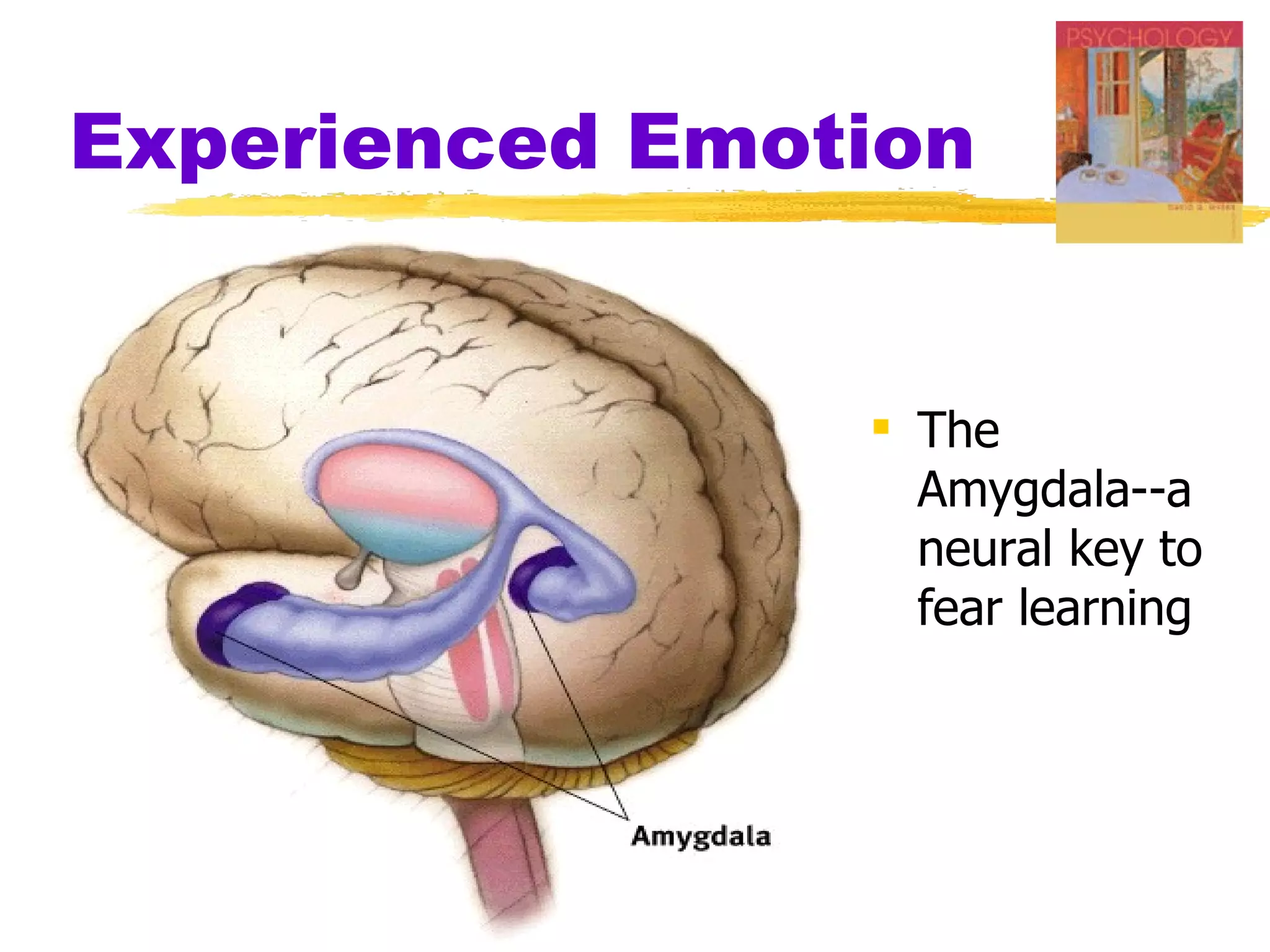
Experienced Emotion


                 The
                  Amygdala--a
                  neural key to
                  fear learning
Experienced Emotion

 Catharsis
   emotional release
   catharsis hypothesis
     “releasing” aggressive energy (through
      action or fantasy) relieves aggressive urges
 Feel-good, do-good phenomenon
   people’s tendency to be helpful when
    already in a good mood
Experienced Emotion

 Subjective Well-Being
  self-perceived happiness or
   satisfaction with life
  used along with measures of
   objective well-being
    physical and economic indicators
     to evaluate people’s quality of life
Experienced Emotion
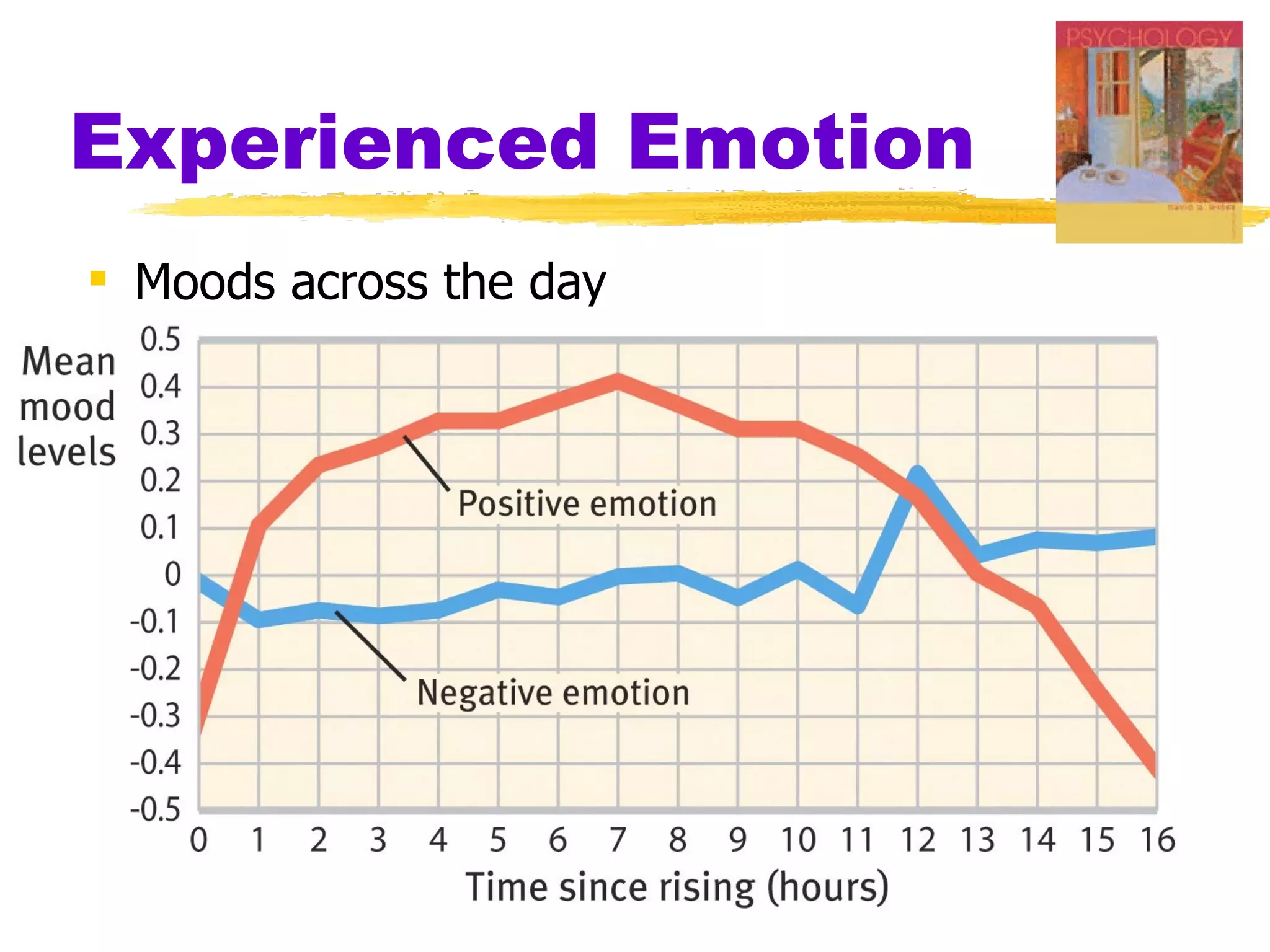
 Moods across the day
Experienced Emotion
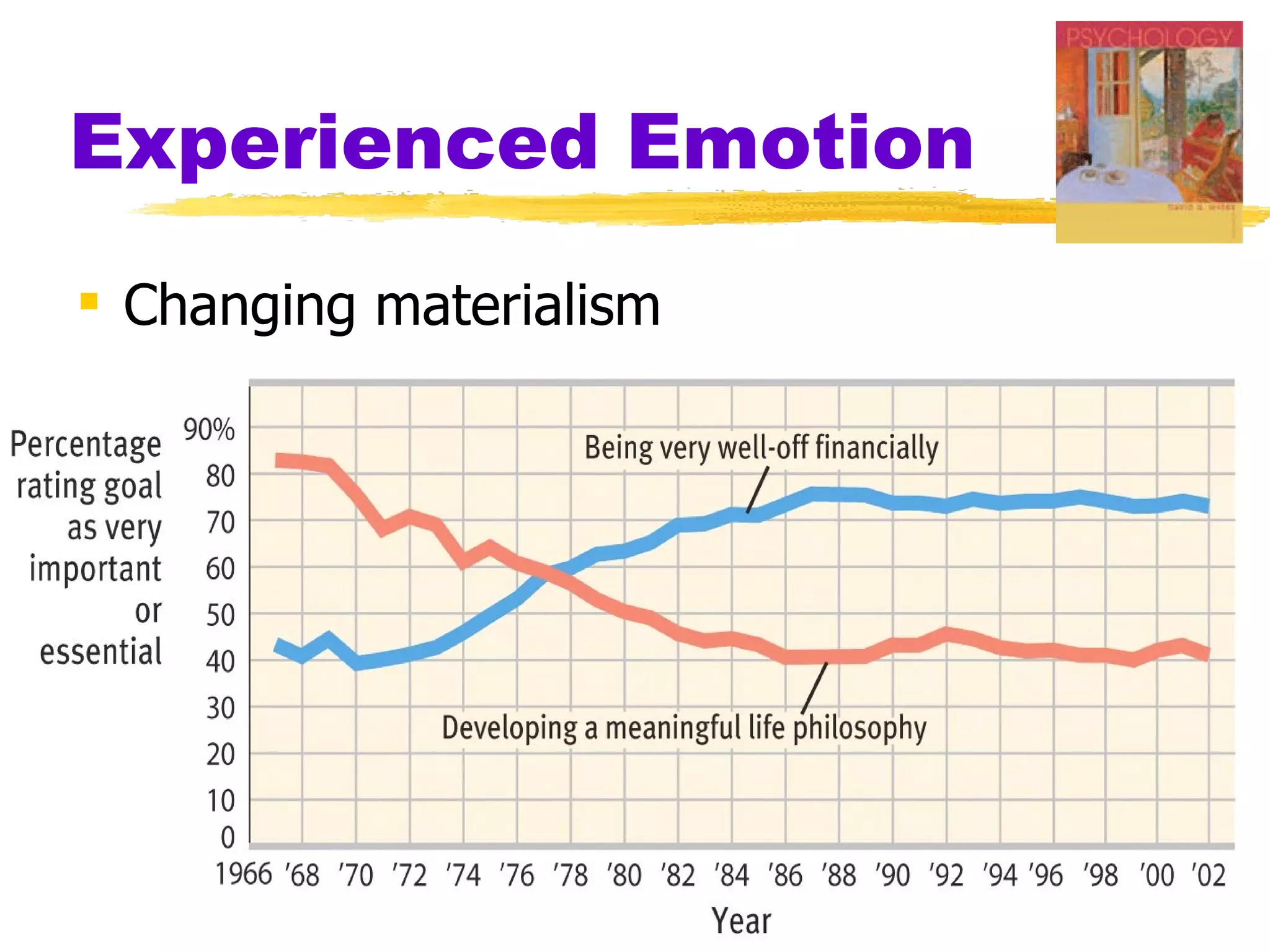
 Changing materialism
Experienced Emotion
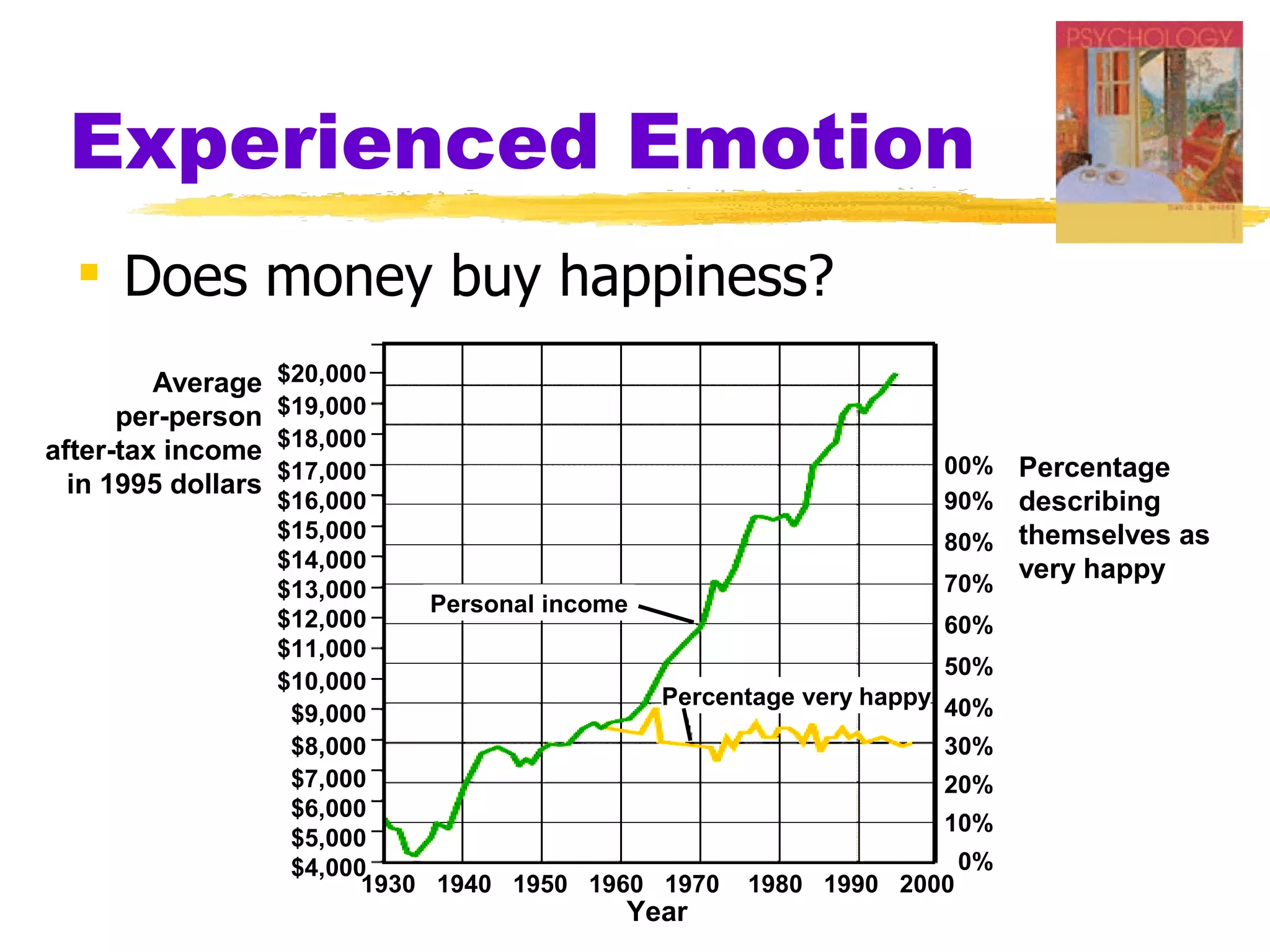
   Does money buy happiness?
         Average    $20,000
      per-person    $19,000
                    $18,000
after-tax income
                    $17,000                                          100%   Percentage
  in 1995 dollars
                    $16,000                                           90%   describing
                    $15,000                                           80%   themselves as
                    $14,000                                                 very happy
                    $13,000                                           70%
                                Personal income
                    $12,000                                           60%
                    $11,000
                                                                      50%
                    $10,000
                                                Percentage very happy 40%
                     $9,000
                     $8,000                                           30%
                     $7,000                                           20%
                     $6,000
                                                                      10%
                     $5,000
                     $4,000                                            0%
                           1930 1940 1950 1960 1970 1980 1990 2000
                                             Year
Experienced Emotion
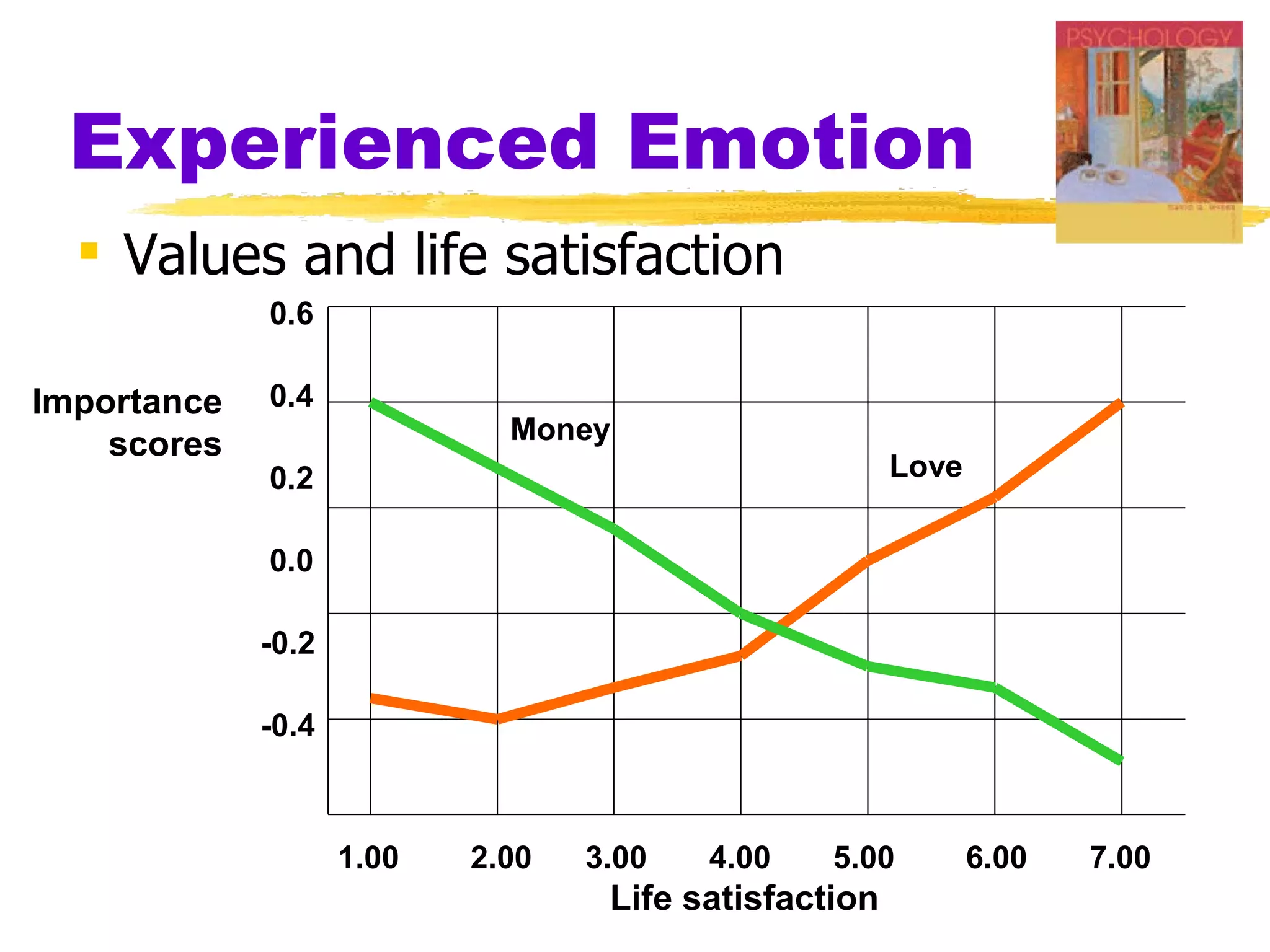
   Values and life satisfaction
             0.6

Importance   0.4
    scores                   Money
             0.2                                       Love

             0.0

             -0.2

             -0.4


                    1.00   2.00   3.00   4.00    5.00         6.00   7.00
                                   Life satisfaction
Experienced Emotion
 Adaptation-Level Phenomenon
   tendency to form judgments relative to a
    “neutral” level
      brightness of lights
      volume of sound
      level of income
   defined by our prior experience
 Relative Deprivation
   perception that one is worse off relative to
    those with whom one compares oneself
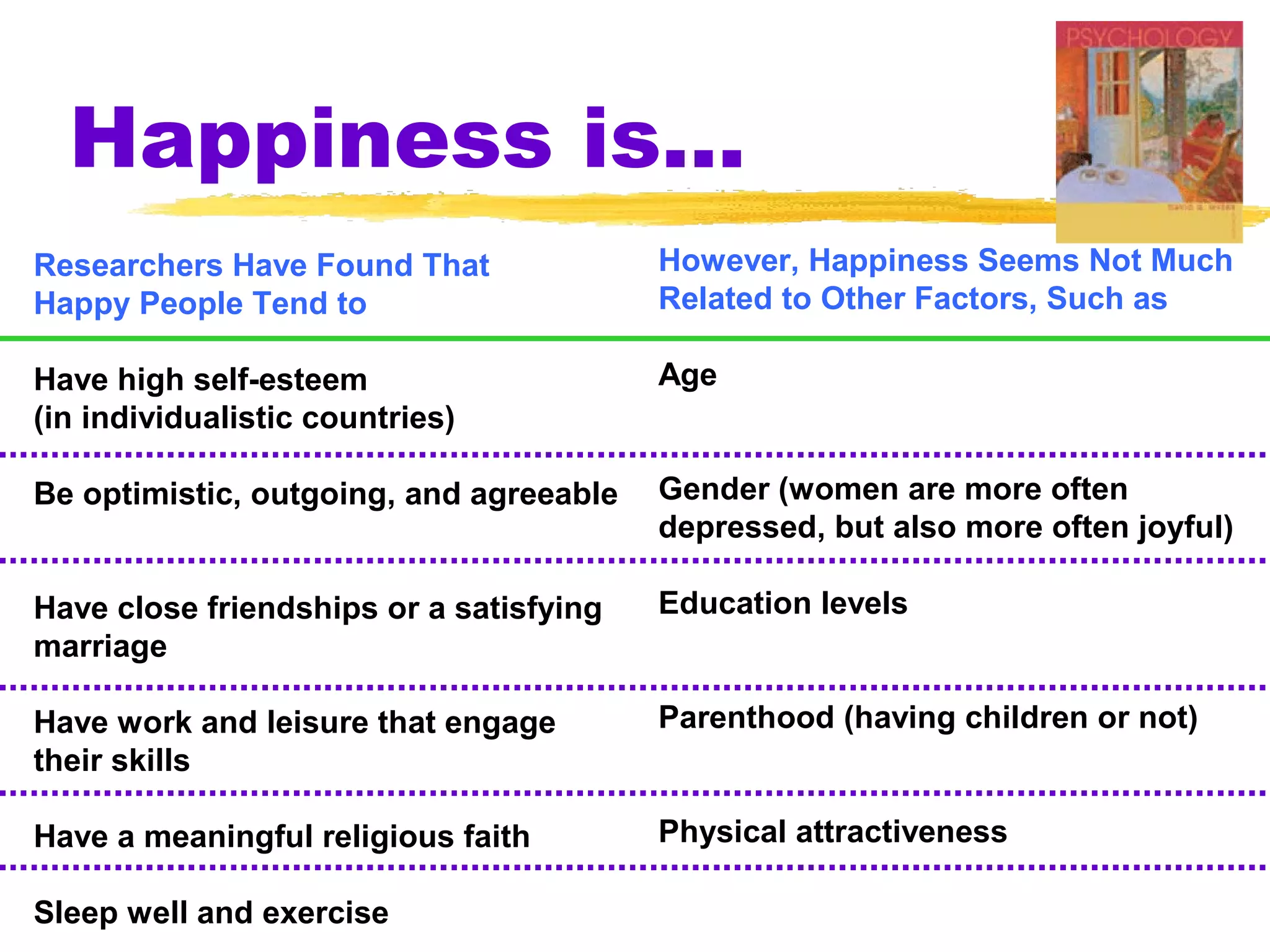
Happiness is...
Researchers Have Found That              However, Happiness Seems Not Much
Happy People Tend to                     Related to Other Factors, Such as

Have high self-esteem                    Age
(in individualistic countries)

Be optimistic, outgoing, and agreeable   Gender (women are more often
                                         depressed, but also more often joyful)

Have close friendships or a satisfying   Education levels
marriage

Have work and leisure that engage        Parenthood (having children or not)
their skills

Have a meaningful religious faith        Physical attractiveness

Sleep well and exercise

Ch13 ppt

  • 1.
    Myers’ PSYCHOLOGY (7th Ed) Chapter 13 Emotion James A. McCubbin, PhD Clemson University Worth Publishers
  • 2.
    Emotion  Emotion a response of the whole organism  physiological arousal  expressive behaviors  conscious experience
  • 3.
    Theories of Emotion  Does your heart pound because you are afraid... or are you afraid because you feel your heart pounding?
  • 4.
    James-Lange Theory of Emotion Experience of emotion is awareness of physiological responses to emotion- arousing stimuli Sight of Pounding Fear oncoming heart (emotion) car (arousal) (perception of stimulus)
  • 5.
    Cannon-Bard Theory of Emotion Pounding heart  Emotion-arousing (arousal) Sight of stimuli simultaneously oncoming car trigger: (perception of stimulus)  physiological responses Fear  subjective experience (emotion) of emotion
  • 6.
    Schachter’s Two-Factor Theory of Emotion Pounding heart  To experience (arousal) Sight of Fear emotion one oncoming car (emotion) must: (perception of stimulus)  be physically aroused Cognitive  cognitively label label the “I’m afraid” arousal
  • 7.
    Cognition and Emotion The brain’s shortcut for emotions
  • 8.
  • 9.
    Two Dimensions of Emotion Positive valence pleasant relaxation joy Low High arousal arousal fear sadness anger Negative valence
  • 10.
    Emotion and Physiology Autonomic nervous system controls physiological arousal Sympathetic Parasympathetic division (arousing) division (calming) Pupils dilate EYES Pupils contract Decreases SALIVATION Increases Perspires SKIN Dries Increases RESPIRATION Decreases Accelerates HEART Slows Inhibits DIGESTION Activates Secrete stress ADRENAL Decreases hormones GLANDS secretion of stress hormones
  • 11.
    Arousal and Performance  Performance peaks at lower levels of arousal for difficult tasks, and at higher levels for easy or well- learned tasks
  • 12.
    Emotion- Lie Detectors  Polygraph  machine commonly used in attempts to detect lies  measures several of the physiological responses accompanying emotion  perspiration  cardiovascular  breathing changes
  • 13.
  • 14.
    Emotion--Lie Detectors Control Question  Up to age 18, did you ever physically harm anyone?  Relevant Question  Did [the deceased] threaten to harm you in any way?  Relevant > Control --> Lie
  • 15.
    Emotion-- Lie Detectors Respiration Perspiration Heartrate Control Relevant Control Relevant question question (a) question question (b)
  • 16.
    Emotion-- Lie Detectors Percentage 80  50 Innocents 70  50 Theives 60 50  1/3 of innocent 40 declared guilty 30  1/4 of guilty 20 declared innocent (from 10 0 Innocent people Guilty people Kleinmuntz & Judged innocent by polygraph Szucko, 1984) Judged guilty by polygraph
  • 17.
    Emotion-- Lie Detectors Is 70% accuracy good?  Assume 5% of 1000 employees actually guilty  test all employees  285 will be wrongly accused  What about 95% accuracy?  Assume 1 in 1000 employees actually guilty  test all employees (including 999 innocents)  50 wrongly declared guilty  1 of 51 testing positive are guilty (~2%)
  • 18.
    Expressed Emotion  Peoplemore speedily detect an angry face than a happy one (Ohman, 2001a)
  • 19.
    Expressed Emotion  Genderand expressiveness 16 Number 14 of Men Women expressions 12 10 8 6 4 2 0 Sad Happy Scary Film Type
  • 20.
    Expressed Emotion  Culturallyuniversal expressions
  • 21.
    Experienced Emotion  The ingredients of emotion
  • 22.
    Experienced Emotion  Infants’naturally occurring emotions
  • 23.
    Experienced Emotion  The Amygdala--a neural key to fear learning
  • 24.
    Experienced Emotion  Catharsis  emotional release  catharsis hypothesis  “releasing” aggressive energy (through action or fantasy) relieves aggressive urges  Feel-good, do-good phenomenon  people’s tendency to be helpful when already in a good mood
  • 25.
    Experienced Emotion  SubjectiveWell-Being  self-perceived happiness or satisfaction with life  used along with measures of objective well-being  physical and economic indicators to evaluate people’s quality of life
  • 26.
  • 27.
  • 28.
    Experienced Emotion  Does money buy happiness? Average $20,000 per-person $19,000 $18,000 after-tax income $17,000 100% Percentage in 1995 dollars $16,000 90% describing $15,000 80% themselves as $14,000 very happy $13,000 70% Personal income $12,000 60% $11,000 50% $10,000 Percentage very happy 40% $9,000 $8,000 30% $7,000 20% $6,000 10% $5,000 $4,000 0% 1930 1940 1950 1960 1970 1980 1990 2000 Year
  • 29.
    Experienced Emotion  Values and life satisfaction 0.6 Importance 0.4 scores Money 0.2 Love 0.0 -0.2 -0.4 1.00 2.00 3.00 4.00 5.00 6.00 7.00 Life satisfaction
  • 30.
    Experienced Emotion  Adaptation-LevelPhenomenon  tendency to form judgments relative to a “neutral” level  brightness of lights  volume of sound  level of income  defined by our prior experience  Relative Deprivation  perception that one is worse off relative to those with whom one compares oneself
  • 31.
    Happiness is... Researchers HaveFound That However, Happiness Seems Not Much Happy People Tend to Related to Other Factors, Such as Have high self-esteem Age (in individualistic countries) Be optimistic, outgoing, and agreeable Gender (women are more often depressed, but also more often joyful) Have close friendships or a satisfying Education levels marriage Have work and leisure that engage Parenthood (having children or not) their skills Have a meaningful religious faith Physical attractiveness Sleep well and exercise