B Y C . S E T T L E Y
STUDY UNIT 8:
PERCEPTION & SENSATION
OUTCOMES
• Be able to:
• - Explain the concepts perception and sensation in
terms of the functioning of the sense organs
• - Discuss organisation under: form perception, depth
perception, perceptual consistency, perception of
movement
• - Describe the concept Illusion
• - Describe extra sensory perception (ESP)
• - Outline 3 main types of ESP
PERCEPTION
• The process through which we give meaning to the
information that our senses receive from the environment.
• It involves: the selection, organisation and interpretation of
stimuli ( Louw & Edwards, pg 11).
• Example 1: A plane crashes and we both see it happen. I see
something exciting and my adrenaline rushes. YOU see
something horrible and sad.
• Example 2 : We both see a bee. I see a terrifying insect and
want to run. YOU see a wonderful sign of nature.
• Perception is how your mind takes things in and makes sense
of them.
SENSATION
• Stimulation of our senses
• The process through which our senses gather
information from the environment( Louw & Edwards,
pg 11).
• Example 1: A burning sensation began in her throat
and she realized she was going to heave.
• Example 2 : There was no denying the sensation of
sweat dripping off her body.
SENSATION & PERCEPTION
• It is not separate processes, they are coordinated to give us
information which gives meaning and useful information about
the “world” around us.
• Sensations are a raw mechanism that allows us to see, hear, feel
(touch), smell or taste things that surround us.
• Perception is how we interpret what we see, hear, smell etc.
Perception is what makes us understand the sensations and
integrate them into our psyche.
• Sensations can be defined as the passive process of bringing
information from the outside world into the body and to the brain.
The process is passive in the sense that we do not have to be
consciously engaging in a "sensing" process.Perception can be
defined as the active process of selecting, organizing, and
interpreting the information brought to the brain by the senses.
• Read more:
http://www.alleydog.com/101notes/s&p.html#ixzz38HnLXtUz
ORGANISATION IN PERCEPTION
- 2nd stage in the perceptual process
- Mentally arrange stimuli
- Meaningful and comprehensible patterns
ORGANISATION IN PERCEPTION
ORGANISATIONAL PRINCIPLES:
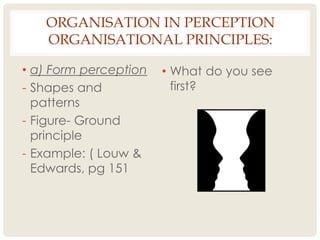
• a) Form perception
- Shapes and
patterns
- Figure- Ground
principle
- Example: ( Louw &
Edwards, pg 151
• What do you see
first?
FIGURE- GROUND REVERSAL
White vas/ two
dark faces?
FIGURE- GROUND REVERSAL
White set of legs? /
Black setof legs?
FIGURE- GROUND REVERSAL
• A man playing an
instrument?
• The face of a lady?
FORM PERCEPTION CONTINUED
( LOUW & EDWARDS, PG 151)
• Gestalt
psychologists
research
• German
psychologists
• Formed 5 principles
• Also called Gestalt
5 laws
• 1) Proximity
• 2) Closure
• 3) Similarity
• 4) Continuity
• 5) Simultaneous
Movements
GESTALT 5 LAWS CONTINUED
• 1) Proximity
• - refers to how close subjects are
• - visual field, grouped together
II II II
Three sets of two not 6 lines
GESTALT 5 LAWS CONTINUED
• 2) Closure
• - incomplete figures
• - perceived as complete figures
• - we tend to order our experience in a
manner that is regular, orderly,
symmetric, and simple
GESTALT 5 LAWS CONTINUED
Closure
GESTALT 5 LAWS CONTINUED
• 3) Similarity
- Similar elements
- Grouped together
- This similarity can occur in the form of shape, colour,
shading or other qualities
GESTALT 5 LAWS CONTINUED
similarity similarity
GESTALT 5 LAWS CONTINUED
• Continuity
• - broken figures
• - organised to appear continuous and flowing
• - where there is an intersection between objects,
individuals tend to perceive the two objects as two
single uninterrupted entities
• - Stimuli remain distinct even with overlap. We are
less likely to group elements with sharp abrupt
directional changes as being one object.
GESTALT 5 LAWS CONTINUED
• Simultaneous Movement
• - elements that move together
• - perceived as one unit
• - eg. birds flying together
are seen as a flock
not as individual birds
ORGANISATION IN PERCEPTION
ORGANISATIONAL PRINCIPLES:
• b) Perceptual Consistency
• Consists of
• 1) Size constancy
• - when an object looks the same at any distance
• - perceived size & distance
• 2) Shape constancy
• - size and shape constancy is important so that you will not see you
lovers lips - getting larger and larger as he/she is about to kiss you
SIZE CONSTANCY
• This scene depicts a
larger man chasing a
smaller man. Or does
it?
• The two men are
absolutely identical.
• What you see is
not always what you
perceive.
SIZE CONSTANCY
• According to optical principles,
for the same object, the size of
the image on the retina
changes as the distance from
the object to the observer
changes. The greater the
distance, the smaller the image
is sensed by the retina. When
someone is observing an
object, although the distance
of observation is different, the
perceptional size is similar to
the actual size. However,
sensory and perception
systems can be tricked by the
use of illusions. Size constancy is
related to distance,
experience, and environmen
SHAPE CONSTANCY
• Objects viewed from
different angles will produce
different shapes on our
retinas, but we know that
the shape of the object
remains constant
• Take a look at the doors
above. The one to the left
looks like a rectangle, The
one in the middle is shaped
like a parallelogram.
• The shape looks different in
our retinas, but our mind
maintains that the shape of
the door remains a
rectangle.
ORGANISATION IN PERCEPTION
ORGANISATIONAL PRINCIPLES:
• c) Depth Perception, pg 154
• - how far or near things are
• - is the visual ability to perceive the world in three
dimensions (3D)
• arises from a variety of depth cues
ORGANISATION IN PERCEPTION
ORGANISATIONAL PRINCIPLES
DEPTH PERCEPTION, PG 154
BINOCULAR CUES:
• Both eyes determined
• Convergence
• - When someone uses both eyes
to focus on the same object,
their eyes converge. The
convergence then stretches the
extraocular muscles, and
sensations from the extraocular
muscles help with depth and
distance perception
• Retinal disparity
• - Retinal disparity simply means
that each eye receives a slightly
different image due to the
different angle from which each
eye views an object.
ORGANISATION IN PERCEPTION
ORGANISATIONAL PRINCIPLES
DEPTH PERCEPTION, PG 154- 155
ORGANISATION IN PERCEPTION
ORGANISATIONAL PRINCIPLES, PG 156
• c) Perception of
Movement, pg 156
• Signals that make
the eyes turn
• 1) speed
adaptation
• 2) apparent
movement
ILLUSIONS PG 157
• Deceiving by producing a false or misleading
impression of reality.
• The state or condition of being deceived
• Misapprehension.
• In Psychology- a perception, as of visual stimuli
(optical illusion) that represents what is perceived in
a way different from the way it is in reality.
ILLUSIONS PG 157
EXTRA SENSORY PERCEPTION (ESP)
SEE STORY OF PILOT P 166
• 3 types:
• 1) Telepathy - perceiving another
person’s thoughts directly
• 2) Clairvoyance - perceiving objects and events
that lie outside the reach of the senses, such as the
content of a sealed envelope
• 3) Pre cognition – perceiving future events
PSYCHOKINESIS
• The direct influence of the mind on the physical
world, eg the moving of tables and chairs
• Controversy
WHY ARE PEOPLE SCEPTIC / REASONS
FOR SCEPTICISM ?
• Rarely able to prove the ESP under controlled scientific
conditions.
• Several experiments with “prestige” (important) has later
proved to have many methodological flaws
• History of ESP is full of cases of fraud and was proven as
such.
• Where ESP can be of great value it rarely helps- solving
crimes
• James Randi – a Magician offered a very large reward
20 years ago, for anybody to perform these claims on
stage. He proved them all fake, the reward still stands.
• ESP can be pure chance when you dream about
numbers and win. It does not state how many times you
have dreamt before and never won anything.
THE END
THANK YOU
REFERENCES
• Source Citation (MLA 7th Edition)
• "Depth Perception." The Gale Encyclopedia of
Psychology. Ed. Bonnie Strickland. 2nd ed. Detroit: Gale,
2001. 177. Gale Virtual Reference Library. Web. 24 July
2014.
• http://go.galegroup.com/ps/i.do?id=GALE%7CCX34060
00183&v=2.1&u=morenetuomcolum&it=r&p=GVRL&sw=
w&asid=4486e577b7a9bbb534e9ba4909d04112
• Teaching and Developing online. Blog Author: Darren
Cannell. Retrieved on 18 August 2014. Available at:
http://blog.darrencannell.com/2009_02_01_archive.html
• http://youtu.be/axW3IjULZv4

Perception.

  • 1.
    B Y C. S E T T L E Y STUDY UNIT 8: PERCEPTION & SENSATION
  • 2.
    OUTCOMES • Be ableto: • - Explain the concepts perception and sensation in terms of the functioning of the sense organs • - Discuss organisation under: form perception, depth perception, perceptual consistency, perception of movement • - Describe the concept Illusion • - Describe extra sensory perception (ESP) • - Outline 3 main types of ESP
  • 3.
    PERCEPTION • The processthrough which we give meaning to the information that our senses receive from the environment. • It involves: the selection, organisation and interpretation of stimuli ( Louw & Edwards, pg 11). • Example 1: A plane crashes and we both see it happen. I see something exciting and my adrenaline rushes. YOU see something horrible and sad. • Example 2 : We both see a bee. I see a terrifying insect and want to run. YOU see a wonderful sign of nature. • Perception is how your mind takes things in and makes sense of them.
  • 4.
    SENSATION • Stimulation ofour senses • The process through which our senses gather information from the environment( Louw & Edwards, pg 11). • Example 1: A burning sensation began in her throat and she realized she was going to heave. • Example 2 : There was no denying the sensation of sweat dripping off her body.
  • 5.
    SENSATION & PERCEPTION •It is not separate processes, they are coordinated to give us information which gives meaning and useful information about the “world” around us. • Sensations are a raw mechanism that allows us to see, hear, feel (touch), smell or taste things that surround us. • Perception is how we interpret what we see, hear, smell etc. Perception is what makes us understand the sensations and integrate them into our psyche. • Sensations can be defined as the passive process of bringing information from the outside world into the body and to the brain. The process is passive in the sense that we do not have to be consciously engaging in a "sensing" process.Perception can be defined as the active process of selecting, organizing, and interpreting the information brought to the brain by the senses. • Read more: http://www.alleydog.com/101notes/s&p.html#ixzz38HnLXtUz
  • 6.
    ORGANISATION IN PERCEPTION -2nd stage in the perceptual process - Mentally arrange stimuli - Meaningful and comprehensible patterns
  • 7.
    ORGANISATION IN PERCEPTION ORGANISATIONALPRINCIPLES: • a) Form perception - Shapes and patterns - Figure- Ground principle - Example: ( Louw & Edwards, pg 151 • What do you see first?
  • 8.
    FIGURE- GROUND REVERSAL Whitevas/ two dark faces?
  • 9.
    FIGURE- GROUND REVERSAL Whiteset of legs? / Black setof legs?
  • 10.
    FIGURE- GROUND REVERSAL •A man playing an instrument? • The face of a lady?
  • 11.
    FORM PERCEPTION CONTINUED (LOUW & EDWARDS, PG 151) • Gestalt psychologists research • German psychologists • Formed 5 principles • Also called Gestalt 5 laws • 1) Proximity • 2) Closure • 3) Similarity • 4) Continuity • 5) Simultaneous Movements
  • 12.
    GESTALT 5 LAWSCONTINUED • 1) Proximity • - refers to how close subjects are • - visual field, grouped together II II II Three sets of two not 6 lines
  • 14.
    GESTALT 5 LAWSCONTINUED • 2) Closure • - incomplete figures • - perceived as complete figures • - we tend to order our experience in a manner that is regular, orderly, symmetric, and simple
  • 15.
    GESTALT 5 LAWSCONTINUED Closure
  • 16.
    GESTALT 5 LAWSCONTINUED • 3) Similarity - Similar elements - Grouped together - This similarity can occur in the form of shape, colour, shading or other qualities
  • 17.
    GESTALT 5 LAWSCONTINUED similarity similarity
  • 18.
    GESTALT 5 LAWSCONTINUED
  • 19.
    GESTALT 5 LAWSCONTINUED • Continuity • - broken figures • - organised to appear continuous and flowing • - where there is an intersection between objects, individuals tend to perceive the two objects as two single uninterrupted entities • - Stimuli remain distinct even with overlap. We are less likely to group elements with sharp abrupt directional changes as being one object.
  • 20.
    GESTALT 5 LAWSCONTINUED
  • 21.
    GESTALT 5 LAWSCONTINUED • Simultaneous Movement • - elements that move together • - perceived as one unit • - eg. birds flying together are seen as a flock not as individual birds
  • 23.
    ORGANISATION IN PERCEPTION ORGANISATIONALPRINCIPLES: • b) Perceptual Consistency • Consists of • 1) Size constancy • - when an object looks the same at any distance • - perceived size & distance • 2) Shape constancy • - size and shape constancy is important so that you will not see you lovers lips - getting larger and larger as he/she is about to kiss you
  • 24.
    SIZE CONSTANCY • Thisscene depicts a larger man chasing a smaller man. Or does it? • The two men are absolutely identical. • What you see is not always what you perceive.
  • 25.
    SIZE CONSTANCY • Accordingto optical principles, for the same object, the size of the image on the retina changes as the distance from the object to the observer changes. The greater the distance, the smaller the image is sensed by the retina. When someone is observing an object, although the distance of observation is different, the perceptional size is similar to the actual size. However, sensory and perception systems can be tricked by the use of illusions. Size constancy is related to distance, experience, and environmen
  • 26.
    SHAPE CONSTANCY • Objectsviewed from different angles will produce different shapes on our retinas, but we know that the shape of the object remains constant • Take a look at the doors above. The one to the left looks like a rectangle, The one in the middle is shaped like a parallelogram. • The shape looks different in our retinas, but our mind maintains that the shape of the door remains a rectangle.
  • 27.
    ORGANISATION IN PERCEPTION ORGANISATIONALPRINCIPLES: • c) Depth Perception, pg 154 • - how far or near things are • - is the visual ability to perceive the world in three dimensions (3D) • arises from a variety of depth cues
  • 28.
    ORGANISATION IN PERCEPTION ORGANISATIONALPRINCIPLES DEPTH PERCEPTION, PG 154 BINOCULAR CUES: • Both eyes determined • Convergence • - When someone uses both eyes to focus on the same object, their eyes converge. The convergence then stretches the extraocular muscles, and sensations from the extraocular muscles help with depth and distance perception • Retinal disparity • - Retinal disparity simply means that each eye receives a slightly different image due to the different angle from which each eye views an object.
  • 29.
    ORGANISATION IN PERCEPTION ORGANISATIONALPRINCIPLES DEPTH PERCEPTION, PG 154- 155
  • 30.
    ORGANISATION IN PERCEPTION ORGANISATIONALPRINCIPLES, PG 156 • c) Perception of Movement, pg 156 • Signals that make the eyes turn • 1) speed adaptation • 2) apparent movement
  • 31.
    ILLUSIONS PG 157 •Deceiving by producing a false or misleading impression of reality. • The state or condition of being deceived • Misapprehension. • In Psychology- a perception, as of visual stimuli (optical illusion) that represents what is perceived in a way different from the way it is in reality.
  • 32.
  • 33.
    EXTRA SENSORY PERCEPTION(ESP) SEE STORY OF PILOT P 166 • 3 types: • 1) Telepathy - perceiving another person’s thoughts directly • 2) Clairvoyance - perceiving objects and events that lie outside the reach of the senses, such as the content of a sealed envelope • 3) Pre cognition – perceiving future events
  • 34.
    PSYCHOKINESIS • The directinfluence of the mind on the physical world, eg the moving of tables and chairs • Controversy
  • 35.
    WHY ARE PEOPLESCEPTIC / REASONS FOR SCEPTICISM ? • Rarely able to prove the ESP under controlled scientific conditions. • Several experiments with “prestige” (important) has later proved to have many methodological flaws • History of ESP is full of cases of fraud and was proven as such. • Where ESP can be of great value it rarely helps- solving crimes • James Randi – a Magician offered a very large reward 20 years ago, for anybody to perform these claims on stage. He proved them all fake, the reward still stands. • ESP can be pure chance when you dream about numbers and win. It does not state how many times you have dreamt before and never won anything.
  • 36.
  • 37.
    REFERENCES • Source Citation(MLA 7th Edition) • "Depth Perception." The Gale Encyclopedia of Psychology. Ed. Bonnie Strickland. 2nd ed. Detroit: Gale, 2001. 177. Gale Virtual Reference Library. Web. 24 July 2014. • http://go.galegroup.com/ps/i.do?id=GALE%7CCX34060 00183&v=2.1&u=morenetuomcolum&it=r&p=GVRL&sw= w&asid=4486e577b7a9bbb534e9ba4909d04112 • Teaching and Developing online. Blog Author: Darren Cannell. Retrieved on 18 August 2014. Available at: http://blog.darrencannell.com/2009_02_01_archive.html • http://youtu.be/axW3IjULZv4