Myers’ PSYCHOLOGY
              (7th Ed)


       Chapter 11
      Intelligence
     James A. McCubbin, PhD
       Clemson University

        Worth Publishers
Origins of Intelligence
Testing

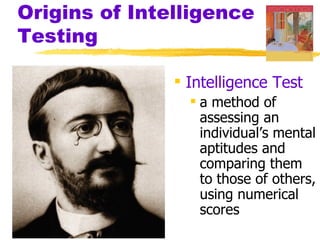
                Intelligence Test
                  a method of
                   assessing an
                   individual’s mental
                   aptitudes and
                   comparing them
                   to those of others,
                   using numerical
                   scores
Origins of Intelligence
Testing

  Mental Age
    a measure of intelligence test
     performance devised by Binet
    chronological age that most typically
     corresponds to a given level of
     performance
    child who does as well as the average
     8-year-old is said to have a mental age
     of 8
Origins of Intelligence
Testing

    Stanford-Binet
      the widely used American
       revision of Binet’s original
       intelligence test
        revised by Terman at Stanford
         University
Origins of Intelligence
Testing

   Intelligence Quotient (IQ)
     defined originally the ratio of
      mental age (ma) to chronological
      age (ca) multiplied by 100
       IQ = ma/ca x 100)
     on contemporary tests, the average
      performance for a given age is
      assigned a score of 100
What is Intelligence?

  Intelligence
    ability to learn from experience,
     solve problems, and use
     knowledge to adapt to new
     situations
What is Intelligence?
 Factor Analysis
   statistical procedure that identifies clusters of
    related items (called factors) on a test
   used to identify different dimensions of
    performance that underlie one’s total score
 General Intelligence (g)
   factor that Spearman and others believed
    underlies specific mental abilities
   measured by every task on an intelligence
    test
Are There Multiple
Intelligences?
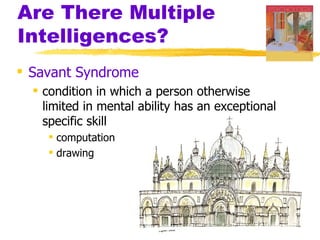
 Savant Syndrome
   condition in which a person otherwise
    limited in mental ability has an exceptional
    specific skill
      computation
      drawing
Are There Multiple
Intelligences?
 Social Intelligence
   the know-how involved in
    comprehending social situations and
    managing oneself successfully
 Emotional Intelligence
   ability to perceive, express, understand,
    and regulate emotions
Intelligence and
Creativity
 Creativity
   the ability to produce novel and
    valuable ideas
     expertise
     imaginative thinking skills
     venturesome personality
     intrinsic motivation
     creative environment
Brain Function and
 Intelligence
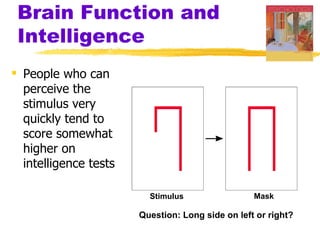
 People who can
  perceive the
  stimulus very
  quickly tend to
  score somewhat
  higher on
  intelligence tests

                         Stimulus                 Mask

                       Question: Long side on left or right?
Assessing Intelligence

 Aptitude Test
   a test designed to predict a person’s
    future performance
   aptitude is the capacity to learn
 Achievement Test
   a test designed to assess what a person
    has learned
Assessing Intelligence

   Wechsler Adult Intelligence Scale
    (WAIS)
     most widely used intelligence test
     subtests
        verbal
        performance (nonverbal)
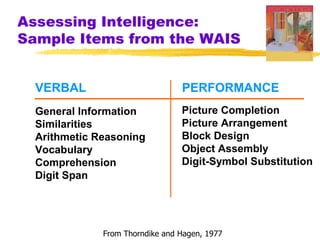
Assessing Intelligence:
Sample Items from the WAIS


  VERBAL                         PERFORMANCE
  General Information            Picture Completion
  Similarities                   Picture Arrangement
  Arithmetic Reasoning           Block Design
  Vocabulary                     Object Assembly
  Comprehension                  Digit-Symbol Substitution
  Digit Span


              From Thorndike and Hagen, 1977
Assessing Intelligence
 Standardization
   defining meaningful scores by comparison
    with the performance of a pretested
    “standardization group”
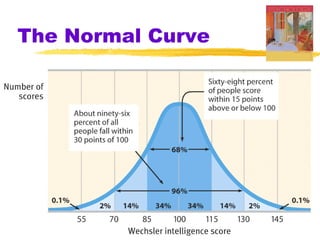
 Normal Curve
   the symmetrical bell-shaped curve that
    describes the distribution of many physical
    and psychological attributes
   most scores fall near the average, and fewer
    and fewer scores lie near the extremes
The Normal Curve
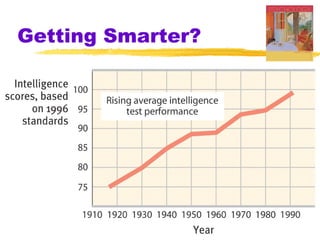
Getting Smarter?
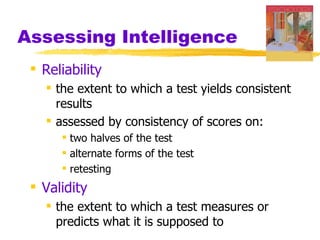
Assessing Intelligence
  Reliability
    the extent to which a test yields consistent
     results
    assessed by consistency of scores on:
       two halves of the test
       alternate forms of the test
       retesting
  Validity
    the extent to which a test measures or
     predicts what it is supposed to
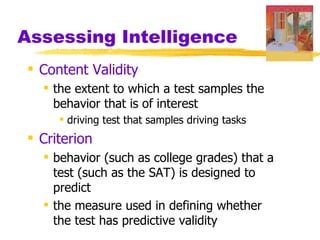
Assessing Intelligence
 Content Validity
   the extent to which a test samples the
    behavior that is of interest
      driving test that samples driving tasks
 Criterion
   behavior (such as college grades) that a
    test (such as the SAT) is designed to
    predict
   the measure used in defining whether
    the test has predictive validity
Assessing Intelligence

 Predictive Validity
   success with which a test predicts the
    behavior it is designed to predict
   assessed by computing the correlation
    between test scores and the criterion
    behavior
   also called criterion-related validity
Assessing Intelligence
  Football 10     Greater correlation
linemen’s
            9
                   over broad range
                   of body weights
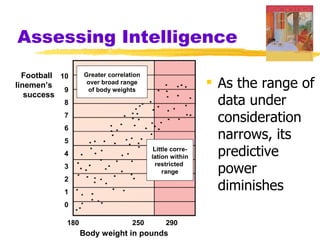
                                                          As the range of
   success
            8                                              data under
            7
                                                           consideration
            6
            5
                                                           narrows, its
            4
                                         Little corre-
                                        lation within      predictive
            3                             restricted
                                             range         power
            2
            1
                                                           diminishes
            0

            180                   250        290
                  Body weight in pounds
The Dynamics of
Intelligence

 Mental Retardation
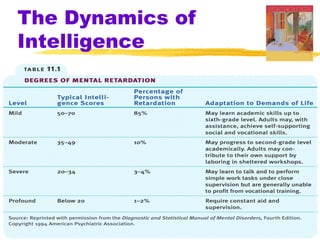
   a condition of limited mental ability
   indicated by an intelligence score below 70
   produces difficulty in adapting to the demands
    of life
   varies from mild to profound
 Down Syndrome
   retardation and associated physical disorders
    caused by an extra chromosome in one’s
    genetic makeup
The Dynamics of
Intelligence
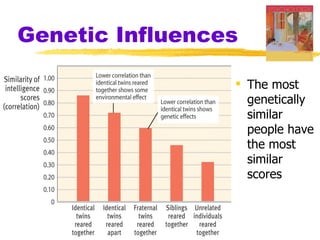
Genetic Influences

                  The most
                   genetically
                   similar
                   people have
                   the most
                   similar
                   scores
Genetic Influences

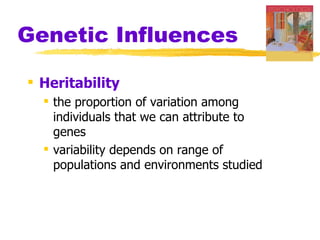
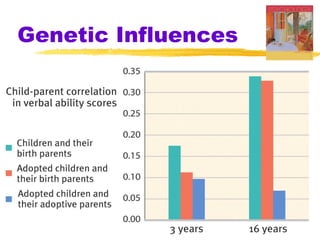
 Heritability
   the proportion of variation among
    individuals that we can attribute to
    genes
   variability depends on range of
    populations and environments studied
Genetic Influences
Environmental
Influences
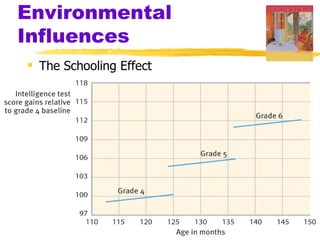
 The Schooling Effect
Group Differences
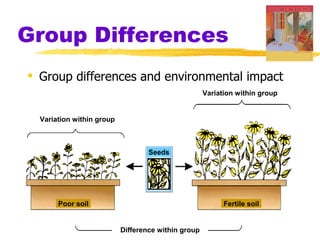
 Group differences and environmental impact
                                                     Variation within group


  Variation within group


                                   Seeds


       Poor soil                                           Fertile soil


                           Difference within group
Group Differences
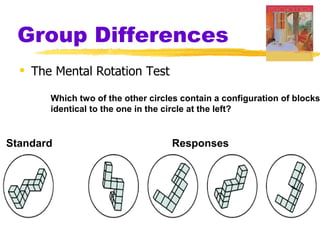
   The Mental Rotation Test

       Which two of the other circles contain a configuration of blocks
       identical to the one in the circle at the left?


Standard                           Responses
Group Differences

 Stereotype Threat
  A self-confirming concern that one
   will be evaluated based on a
   negative stereotype

Ch11 ppt

  • 1.
    Myers’ PSYCHOLOGY (7th Ed) Chapter 11 Intelligence James A. McCubbin, PhD Clemson University Worth Publishers
  • 2.
    Origins of Intelligence Testing  Intelligence Test  a method of assessing an individual’s mental aptitudes and comparing them to those of others, using numerical scores
  • 3.
    Origins of Intelligence Testing  Mental Age  a measure of intelligence test performance devised by Binet  chronological age that most typically corresponds to a given level of performance  child who does as well as the average 8-year-old is said to have a mental age of 8
  • 4.
    Origins of Intelligence Testing  Stanford-Binet  the widely used American revision of Binet’s original intelligence test  revised by Terman at Stanford University
  • 5.
    Origins of Intelligence Testing  Intelligence Quotient (IQ)  defined originally the ratio of mental age (ma) to chronological age (ca) multiplied by 100  IQ = ma/ca x 100)  on contemporary tests, the average performance for a given age is assigned a score of 100
  • 6.
    What is Intelligence?  Intelligence  ability to learn from experience, solve problems, and use knowledge to adapt to new situations
  • 7.
    What is Intelligence? Factor Analysis  statistical procedure that identifies clusters of related items (called factors) on a test  used to identify different dimensions of performance that underlie one’s total score  General Intelligence (g)  factor that Spearman and others believed underlies specific mental abilities  measured by every task on an intelligence test
  • 8.
    Are There Multiple Intelligences? Savant Syndrome  condition in which a person otherwise limited in mental ability has an exceptional specific skill  computation  drawing
  • 9.
    Are There Multiple Intelligences? Social Intelligence  the know-how involved in comprehending social situations and managing oneself successfully  Emotional Intelligence  ability to perceive, express, understand, and regulate emotions
  • 10.
    Intelligence and Creativity  Creativity  the ability to produce novel and valuable ideas  expertise  imaginative thinking skills  venturesome personality  intrinsic motivation  creative environment
  • 11.
    Brain Function and Intelligence  People who can perceive the stimulus very quickly tend to score somewhat higher on intelligence tests Stimulus Mask Question: Long side on left or right?
  • 12.
    Assessing Intelligence  AptitudeTest  a test designed to predict a person’s future performance  aptitude is the capacity to learn  Achievement Test  a test designed to assess what a person has learned
  • 13.
    Assessing Intelligence  Wechsler Adult Intelligence Scale (WAIS)  most widely used intelligence test  subtests  verbal  performance (nonverbal)
  • 14.
    Assessing Intelligence: Sample Itemsfrom the WAIS VERBAL PERFORMANCE General Information Picture Completion Similarities Picture Arrangement Arithmetic Reasoning Block Design Vocabulary Object Assembly Comprehension Digit-Symbol Substitution Digit Span From Thorndike and Hagen, 1977
  • 15.
    Assessing Intelligence  Standardization  defining meaningful scores by comparison with the performance of a pretested “standardization group”  Normal Curve  the symmetrical bell-shaped curve that describes the distribution of many physical and psychological attributes  most scores fall near the average, and fewer and fewer scores lie near the extremes
  • 16.
  • 17.
  • 18.
    Assessing Intelligence Reliability  the extent to which a test yields consistent results  assessed by consistency of scores on:  two halves of the test  alternate forms of the test  retesting  Validity  the extent to which a test measures or predicts what it is supposed to
  • 19.
    Assessing Intelligence  ContentValidity  the extent to which a test samples the behavior that is of interest  driving test that samples driving tasks  Criterion  behavior (such as college grades) that a test (such as the SAT) is designed to predict  the measure used in defining whether the test has predictive validity
  • 20.
    Assessing Intelligence  PredictiveValidity  success with which a test predicts the behavior it is designed to predict  assessed by computing the correlation between test scores and the criterion behavior  also called criterion-related validity
  • 21.
    Assessing Intelligence Football 10 Greater correlation linemen’s 9 over broad range of body weights  As the range of success 8 data under 7 consideration 6 5 narrows, its 4 Little corre- lation within predictive 3 restricted range power 2 1 diminishes 0 180 250 290 Body weight in pounds
  • 22.
    The Dynamics of Intelligence Mental Retardation  a condition of limited mental ability  indicated by an intelligence score below 70  produces difficulty in adapting to the demands of life  varies from mild to profound  Down Syndrome  retardation and associated physical disorders caused by an extra chromosome in one’s genetic makeup
  • 23.
  • 24.
    Genetic Influences  The most genetically similar people have the most similar scores
  • 25.
    Genetic Influences  Heritability  the proportion of variation among individuals that we can attribute to genes  variability depends on range of populations and environments studied
  • 26.
  • 27.
  • 28.
    Group Differences  Groupdifferences and environmental impact Variation within group Variation within group Seeds Poor soil Fertile soil Difference within group
  • 29.
    Group Differences  The Mental Rotation Test Which two of the other circles contain a configuration of blocks identical to the one in the circle at the left? Standard Responses
  • 30.
    Group Differences  StereotypeThreat  A self-confirming concern that one will be evaluated based on a negative stereotype