 Types of Perceptual constancy:
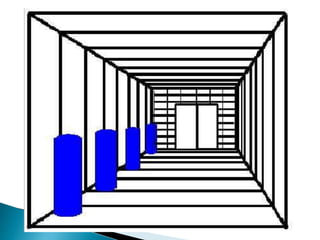
(a) Size constancy
(b) Brightness constancy
(a) Shape constancy
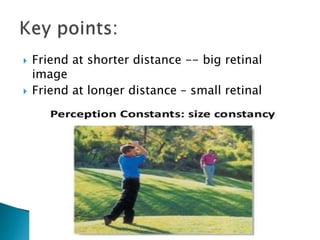
 Friend at shorter distance -- big retinal
image
 Friend at longer distance – small retinal
image
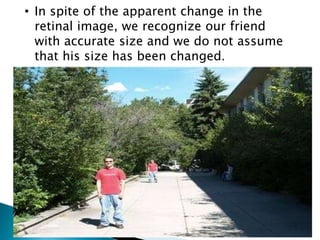
• In spite of the apparent change in the
retinal image, we recognize our friend
with accurate size and we do not assume
that his size has been changed.
“The way you think about or
understand someone or something”.
There are four types of
Perception:
Object Perception.
Depth and Space
Perception.
Perception of Movement.
“Form perception
allows us to see a two
dimensional image as a
three dimensional image”.
Organization is the basic
characteristics of every
perceptual act. We achieve
the sensory information in
the form of figures. This
process is known as the
Perceptual organization.
Perceptual organization is based on
two things:
Figure
Ground
An object which is
selected and attracted by
the individual and
becomes the center of
his
attention is called figure.
The other objects in
the field which are not
attended and are not
the focus of his
attention are called
ground
 Law of nearness or proximity
 Law of similarity or likeness
 Law of continuity
 Law of closure
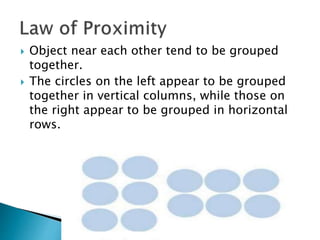
 Object near each other tend to be grouped
together.
 The circles on the left appear to be grouped
together in vertical columns, while those on
the right appear to be grouped in horizontal
rows.
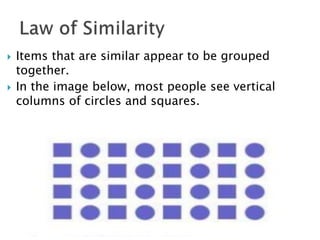
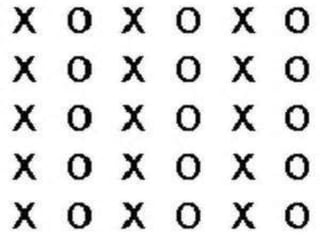
 Items that are similar appear to be grouped
together.
 In the image below, most people see vertical
columns of circles and squares.
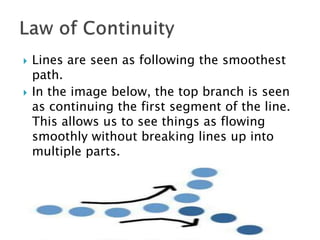
 Lines are seen as following the smoothest
path.
 In the image below, the top branch is seen
as continuing the first segment of the line.
This allows us to see things as flowing
smoothly without breaking lines up into
multiple parts.
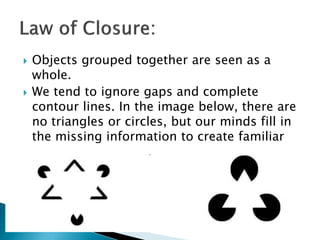
 Objects grouped together are seen as a
whole.
 We tend to ignore gaps and complete
contour lines. In the image below, there are
no triangles or circles, but our minds fill in
the missing information to create familiar
shapes and images.
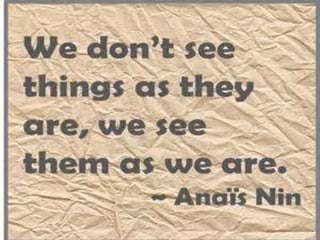
“Perceptions are
stronger than
believes but
these are always
Role of size constancy in perception

Role of size constancy in perception

  • 1.
     Types ofPerceptual constancy: (a) Size constancy (b) Brightness constancy (a) Shape constancy
  • 2.
     Friend atshorter distance -- big retinal image  Friend at longer distance – small retinal image
  • 3.
    • In spiteof the apparent change in the retinal image, we recognize our friend with accurate size and we do not assume that his size has been changed.
  • 6.
    “The way youthink about or understand someone or something”.
  • 7.
    There are fourtypes of Perception: Object Perception. Depth and Space Perception. Perception of Movement.
  • 8.
    “Form perception allows usto see a two dimensional image as a three dimensional image”.
  • 9.
    Organization is thebasic characteristics of every perceptual act. We achieve the sensory information in the form of figures. This process is known as the Perceptual organization.
  • 10.
    Perceptual organization isbased on two things: Figure Ground
  • 11.
    An object whichis selected and attracted by the individual and becomes the center of his attention is called figure.
  • 12.
    The other objectsin the field which are not attended and are not the focus of his attention are called ground
  • 15.
     Law ofnearness or proximity  Law of similarity or likeness  Law of continuity  Law of closure
  • 16.
     Object neareach other tend to be grouped together.  The circles on the left appear to be grouped together in vertical columns, while those on the right appear to be grouped in horizontal rows.
  • 17.
     Items thatare similar appear to be grouped together.  In the image below, most people see vertical columns of circles and squares.
  • 19.
     Lines areseen as following the smoothest path.  In the image below, the top branch is seen as continuing the first segment of the line. This allows us to see things as flowing smoothly without breaking lines up into multiple parts.
  • 20.
     Objects groupedtogether are seen as a whole.  We tend to ignore gaps and complete contour lines. In the image below, there are no triangles or circles, but our minds fill in the missing information to create familiar shapes and images.
  • 22.