INTERPRETATION IN VISUAL PERCEPTION
PERCEPTUAL SET

The predisposition / readiness to perceive stimuli in
 line with our expectations, ignoring other stimuli or
 other possible interpretations.
Perceptual Set = Expectancy
  Various psychological factors create an EXPECTATION to
   organise &/or interpret information in a particular way.


  Turn to page 125 in your text and complete the simple activity
PERCEPTUAL SET

Perceptual set can:
  ENHANCE visual perception by correctly anticipating a stimulus
   hence interpreting it more quickly
  Lead to MISINTERPRETATION of a stimulus by incorrect
   anticipation or expectation
Perceptual set can be influenced by:
  Context
  Past Experience
  Motivation
  Emotional state
  Cultural factors
Perceptual Set

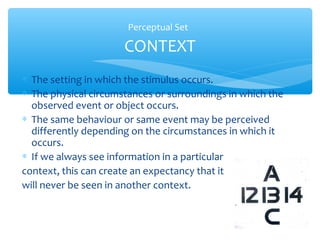
                      CONTEXT
∗ The setting in which the stimulus occurs.
∗ The physical circumstances or surroundings in which the
  observed event or object occurs.
∗ The same behaviour or same event may be perceived
  differently depending on the circumstances in which it
  occurs.
∗ If we always see information in a particular
context, this can create an expectancy that it
will never be seen in another context.
Perceptual Set

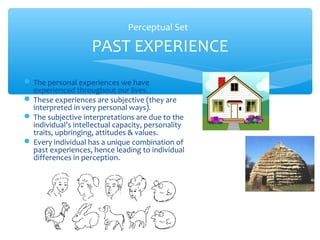
                    PAST EXPERIENCE
 The personal experiences we have
  experienced throughout our lives.
 These experiences are subjective (they are
  interpreted in very personal ways).
 The subjective interpretations are due to the
  individual’s intellectual capacity, personality
  traits, upbringing, attitudes & values.
 Every individual has a unique combination of
  past experiences, hence leading to individual
  differences in perception.
Perceptual Set
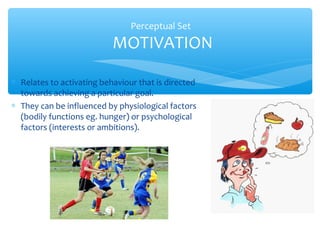
                           MOTIVATION

∗ Relates to activating behaviour that is directed
  towards achieving a particular goal.
∗ They can be influenced by physiological factors
  (bodily functions eg. hunger) or psychological
  factors (interests or ambitions).
Perceptual Set
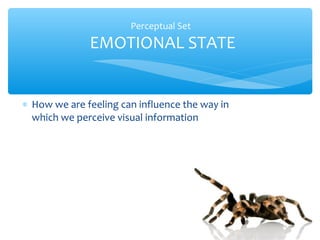
              EMOTIONAL STATE


∗ How we are feeling can influence the way in
  which we perceive visual information
Perceptual Set

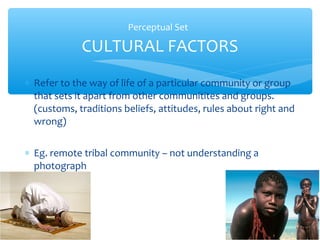
             CULTURAL FACTORS
∗ Refer to the way of life of a particular community or group
  that sets it apart from other communitites and groups.
  (customs, traditions beliefs, attitudes, rules about right and
  wrong)


∗ Eg. remote tribal community – not understanding a
  photograph
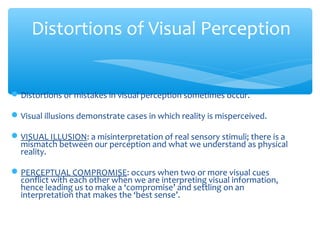
Distortions of Visual Perception


 Distortions or mistakes in visual perception sometimes occur.

 Visual illusions demonstrate cases in which reality is misperceived.

 VISUAL ILLUSION: a misinterpretation of real sensory stimuli; there is a
  mismatch between our perception and what we understand as physical
  reality.

 PERCEPTUAL COMPROMISE: occurs when two or more visual cues
  conflict with each other when we are interpreting visual information,
  hence leading us to make a ‘compromise’ and settling on an
  interpretation that makes the ‘best sense’.
Illusions
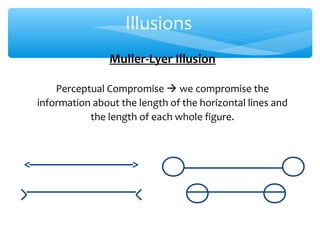
                Muller-Lyer Illusion

    Perceptual Compromise  we compromise the
information about the length of the horizontal lines and
           the length of each whole figure.
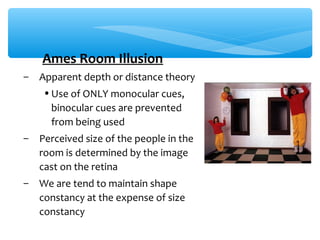
Ames Room Illusion
– Apparent depth or distance theory
    • Use of ONLY monocular cues,
      binocular cues are prevented
      from being used
– Perceived size of the people in the
  room is determined by the image
  cast on the retina
– We are tend to maintain shape
  constancy at the expense of size
  constancy
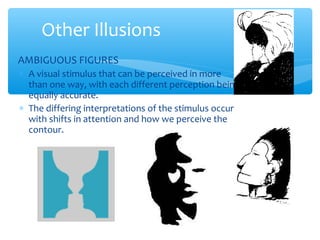
Other Illusions
∗ AMBIGUOUS FIGURES
 ∗ A visual stimulus that can be perceived in more
   than one way, with each different perception being
   equally accurate.
 ∗ The differing interpretations of the stimulus occur
   with shifts in attention and how we perceive the
   contour.
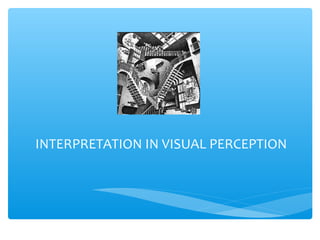
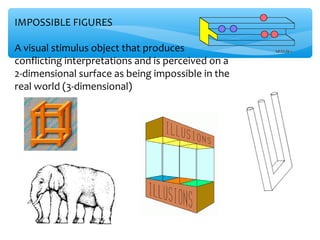
IMPOSSIBLE FIGURES

A visual stimulus object that produces
conflicting interpretations and is perceived on a
2-dimensional surface as being impossible in the
real world (3-dimensional)

Perceptual set and illusions 2013

  • 1.
  • 2.
    PERCEPTUAL SET The predisposition/ readiness to perceive stimuli in line with our expectations, ignoring other stimuli or other possible interpretations. Perceptual Set = Expectancy Various psychological factors create an EXPECTATION to organise &/or interpret information in a particular way. Turn to page 125 in your text and complete the simple activity
  • 3.
    PERCEPTUAL SET Perceptual setcan: ENHANCE visual perception by correctly anticipating a stimulus hence interpreting it more quickly Lead to MISINTERPRETATION of a stimulus by incorrect anticipation or expectation Perceptual set can be influenced by: Context Past Experience Motivation Emotional state Cultural factors
  • 4.
    Perceptual Set CONTEXT ∗ The setting in which the stimulus occurs. ∗ The physical circumstances or surroundings in which the observed event or object occurs. ∗ The same behaviour or same event may be perceived differently depending on the circumstances in which it occurs. ∗ If we always see information in a particular context, this can create an expectancy that it will never be seen in another context.
  • 5.
    Perceptual Set PAST EXPERIENCE  The personal experiences we have experienced throughout our lives.  These experiences are subjective (they are interpreted in very personal ways).  The subjective interpretations are due to the individual’s intellectual capacity, personality traits, upbringing, attitudes & values.  Every individual has a unique combination of past experiences, hence leading to individual differences in perception.
  • 6.
    Perceptual Set MOTIVATION ∗ Relates to activating behaviour that is directed towards achieving a particular goal. ∗ They can be influenced by physiological factors (bodily functions eg. hunger) or psychological factors (interests or ambitions).
  • 7.
    Perceptual Set EMOTIONAL STATE ∗ How we are feeling can influence the way in which we perceive visual information
  • 8.
    Perceptual Set CULTURAL FACTORS ∗ Refer to the way of life of a particular community or group that sets it apart from other communitites and groups. (customs, traditions beliefs, attitudes, rules about right and wrong) ∗ Eg. remote tribal community – not understanding a photograph
  • 9.
    Distortions of VisualPerception  Distortions or mistakes in visual perception sometimes occur.  Visual illusions demonstrate cases in which reality is misperceived.  VISUAL ILLUSION: a misinterpretation of real sensory stimuli; there is a mismatch between our perception and what we understand as physical reality.  PERCEPTUAL COMPROMISE: occurs when two or more visual cues conflict with each other when we are interpreting visual information, hence leading us to make a ‘compromise’ and settling on an interpretation that makes the ‘best sense’.
  • 10.
    Illusions Muller-Lyer Illusion Perceptual Compromise  we compromise the information about the length of the horizontal lines and the length of each whole figure.
  • 11.
    Ames Room Illusion –Apparent depth or distance theory • Use of ONLY monocular cues, binocular cues are prevented from being used – Perceived size of the people in the room is determined by the image cast on the retina – We are tend to maintain shape constancy at the expense of size constancy
  • 12.
    Other Illusions ∗ AMBIGUOUSFIGURES ∗ A visual stimulus that can be perceived in more than one way, with each different perception being equally accurate. ∗ The differing interpretations of the stimulus occur with shifts in attention and how we perceive the contour.
  • 13.
    IMPOSSIBLE FIGURES A visualstimulus object that produces conflicting interpretations and is perceived on a 2-dimensional surface as being impossible in the real world (3-dimensional)