PERCEPTIO
N
Meaning
 Perception (from the Latin perceptio, percipio) is the
organization, identification, and interpretation of sensory
information in order to represent and understand the
environment.
 All perception involves signals in the nervous system,
which in turn result from physical or chemical stimulation of
the sense organs.
Definitions
 Charles G. Morris: “All the processes involved in
creating meaningful patterns out of jumble of sensory
impressions fall under the general category of
perception”
 James Rowland Angell-Perception has sometimes
been defined as the consciousness of particular
material things present to sense."
 Edmund fantino and G.S Renold-”Perception is
organizing process by which we interpret our sensory
input”.
Nature of perception
 Perception is a process.
 Perception is an information extractor.
 Perception is preparation to response.
 Perception involves sensation.
 Perception provides organization.
 Perception is highly individualistic in nature.
Principles of Perceptual Organization:
Some of most basic perceptual process operates
according to a series of principles that describe how we
organize bits and pieces of information into meaningful
wholes. These are known as Gestalt laws of organization.
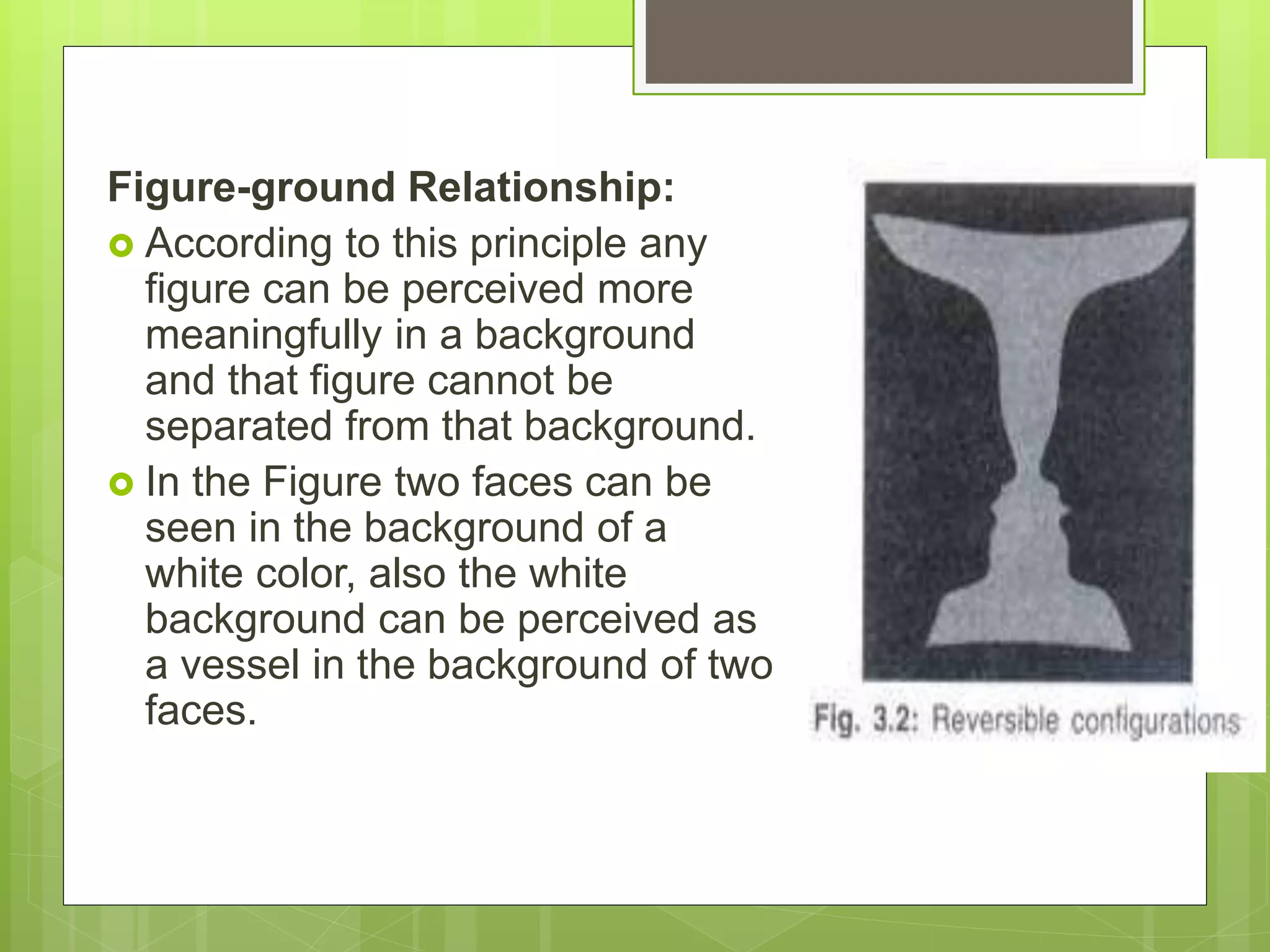
Figure-ground Relationship:
 According to this principle any
figure can be perceived more
meaningfully in a background
and that figure cannot be
separated from that background.
 In the Figure two faces can be
seen in the background of a
white color, also the white
background can be perceived as
a vessel in the background of two
faces.
Grouping of Stimuli in Perceptual Organization:
 As said above, according to gestalt principle, the
objects can be perceived meaningfully when they
are grouped together.
 There are some principles which are followed by us
in order to make our perception more meaningful.
They are as follows:
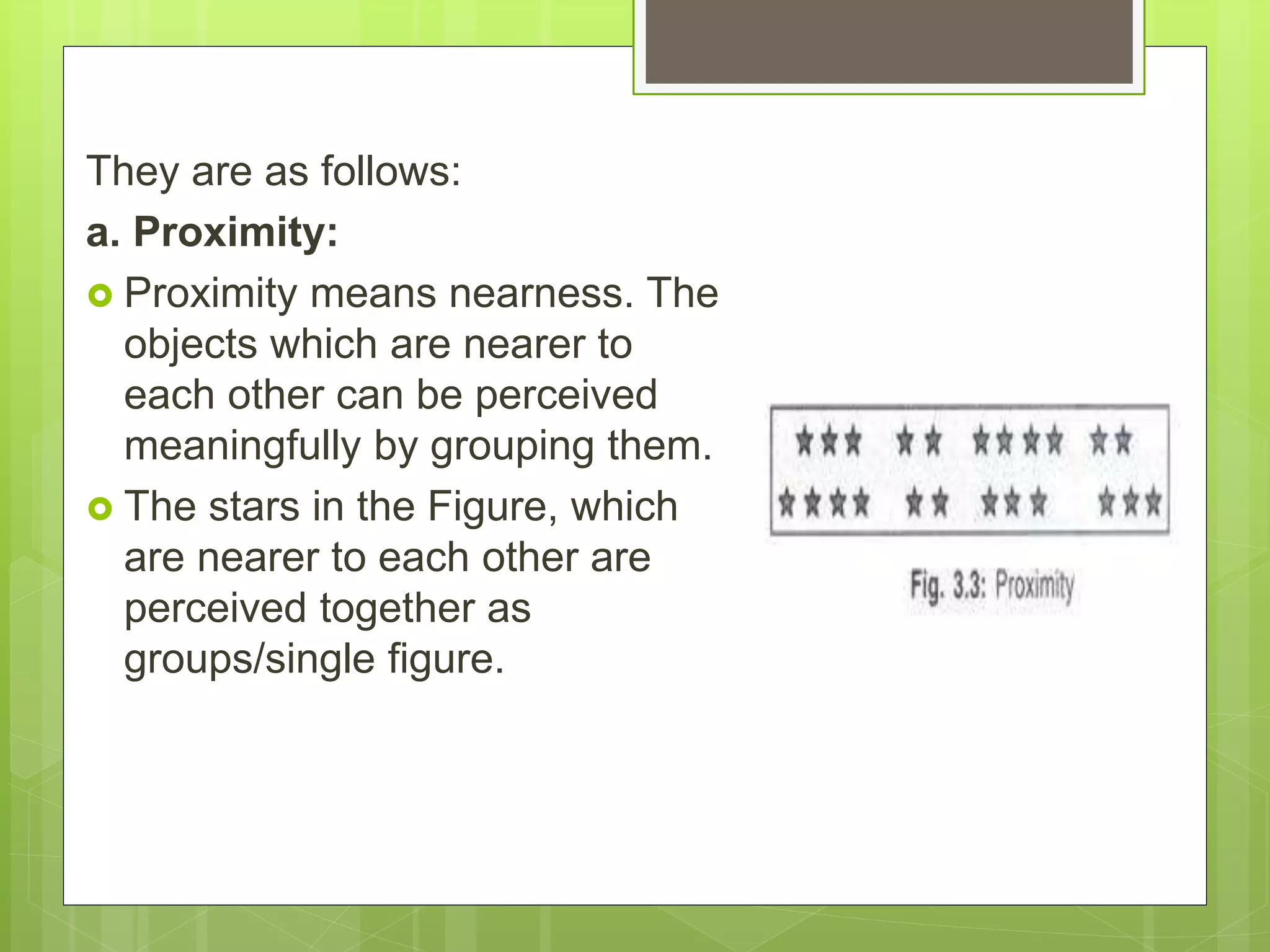
a. Proximity:
 Proximity means nearness. The
objects which are nearer to
each other can be perceived
meaningfully by grouping them.
 The stars in the Figure, which
are nearer to each other are
perceived together as
groups/single figure.
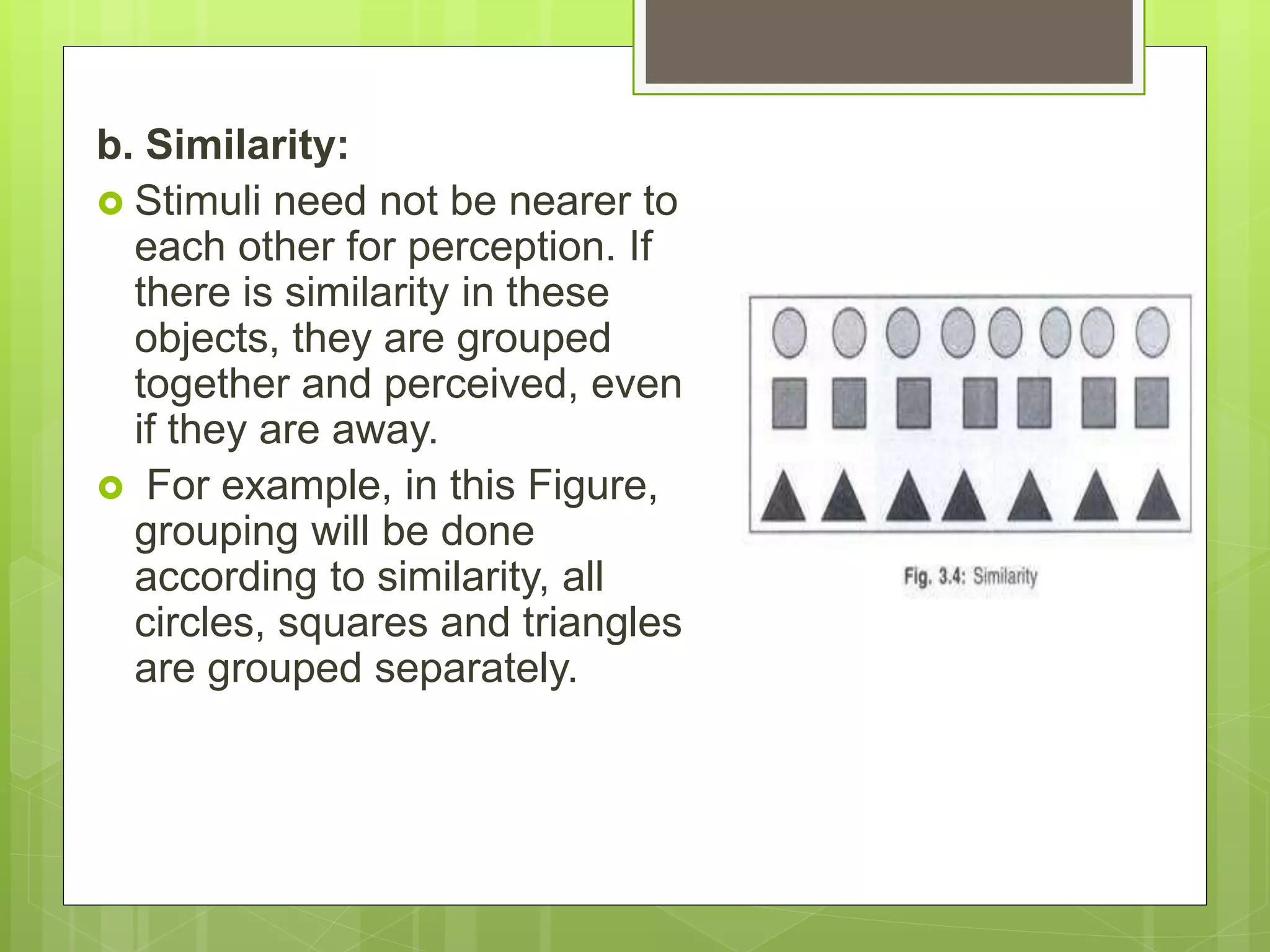
b. Similarity:
 Stimuli need not be nearer to
each other for perception. If
there is similarity in these
objects, they are grouped
together and perceived, even
if they are away.
 For example, in this Figure,
grouping will be done
according to similarity, all
circles, squares and triangles
are grouped separately.
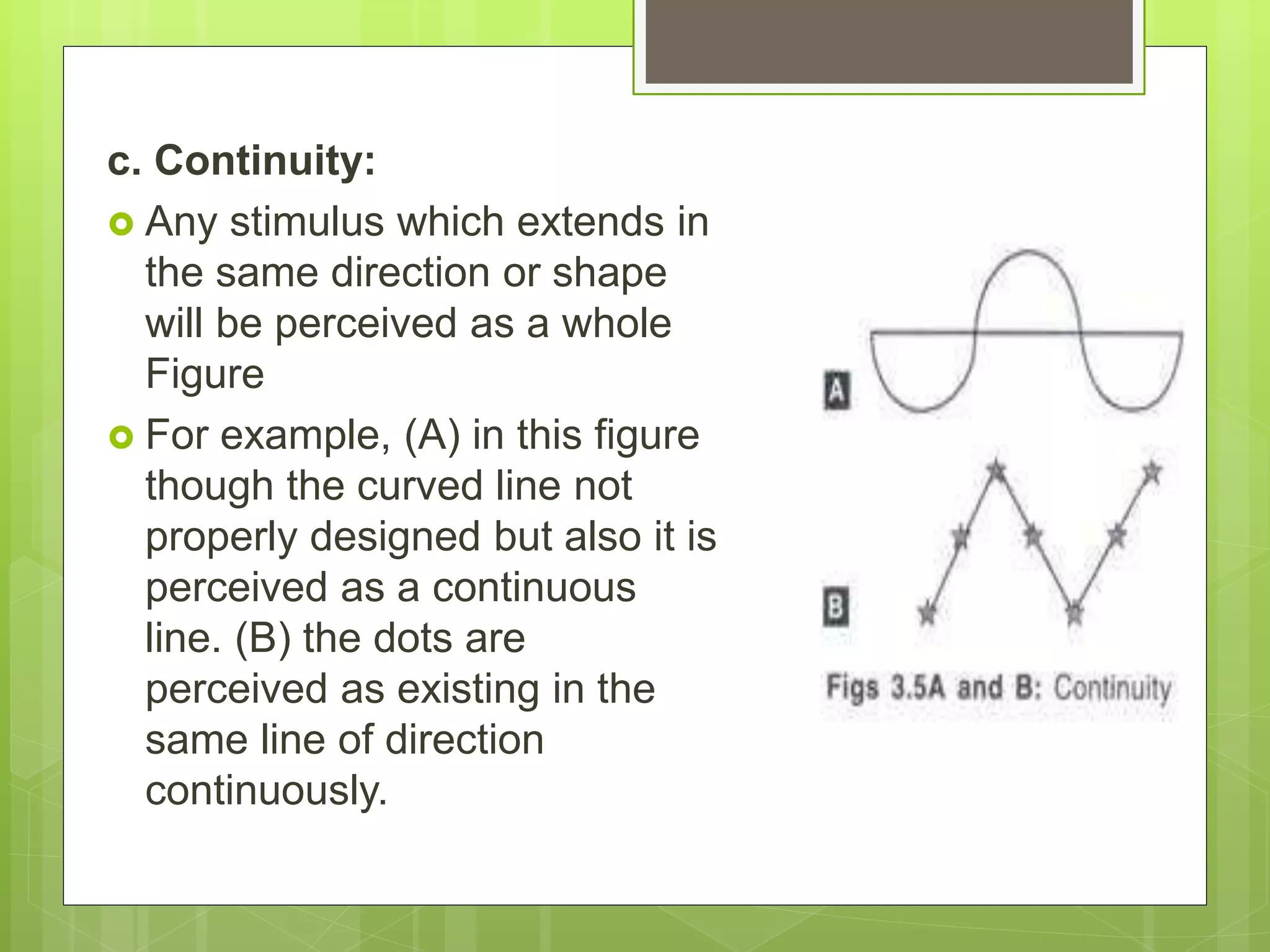
c. Continuity:
 Any stimulus which extends in
the same direction or shape
will be perceived as a whole
Figure
 For example, (A) in this figure
though the curved line not
properly designed but also it is
perceived as a continuous
line. (B) the dots are
perceived as existing in the
same line of direction
continuously.
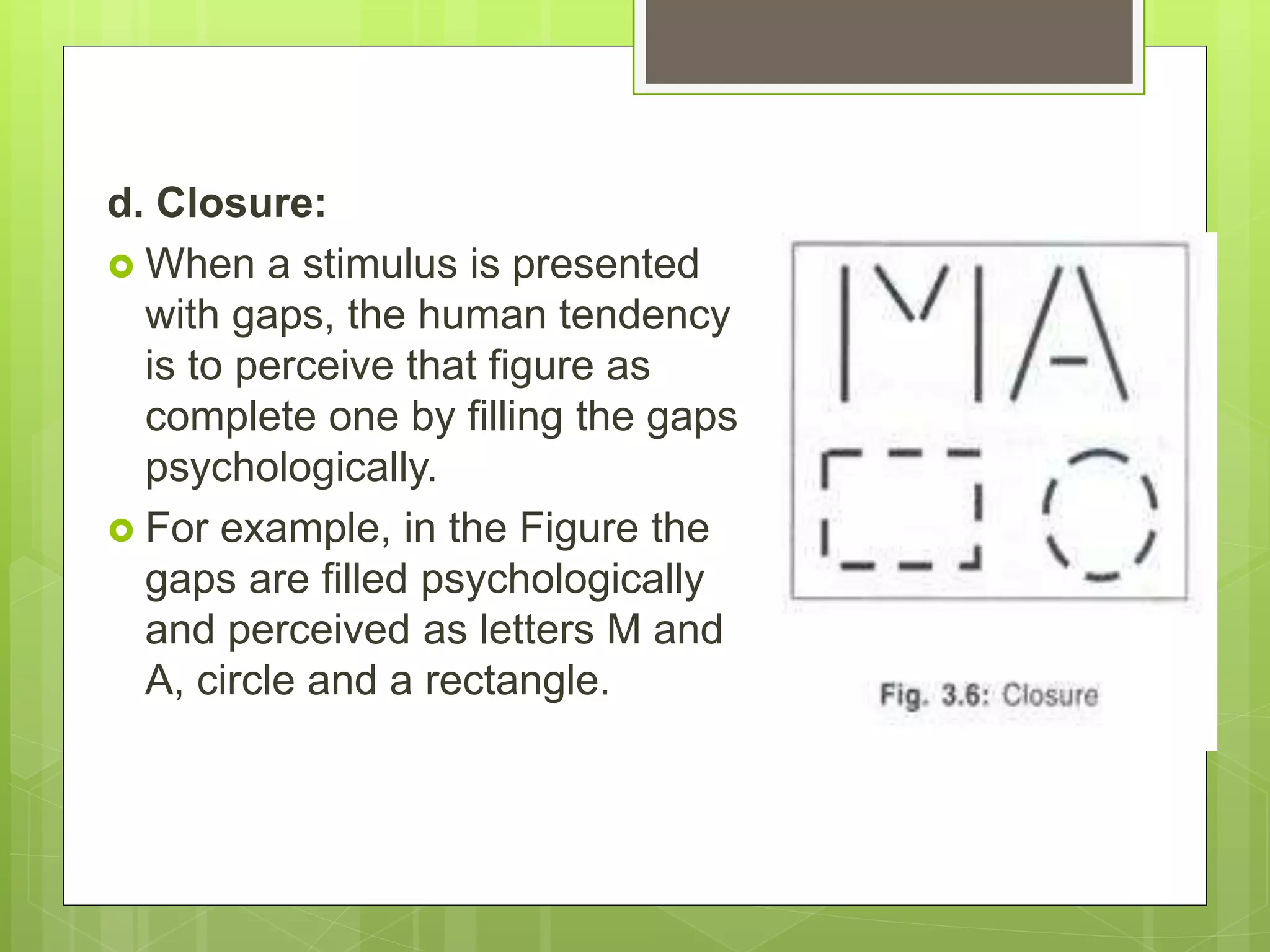
d. Closure:
 When a stimulus is presented
with gaps, the human tendency
is to perceive that figure as
complete one by filling the gaps
psychologically.
 For example, in the Figure the
gaps are filled psychologically
and perceived as letters M and
A, circle and a rectangle.
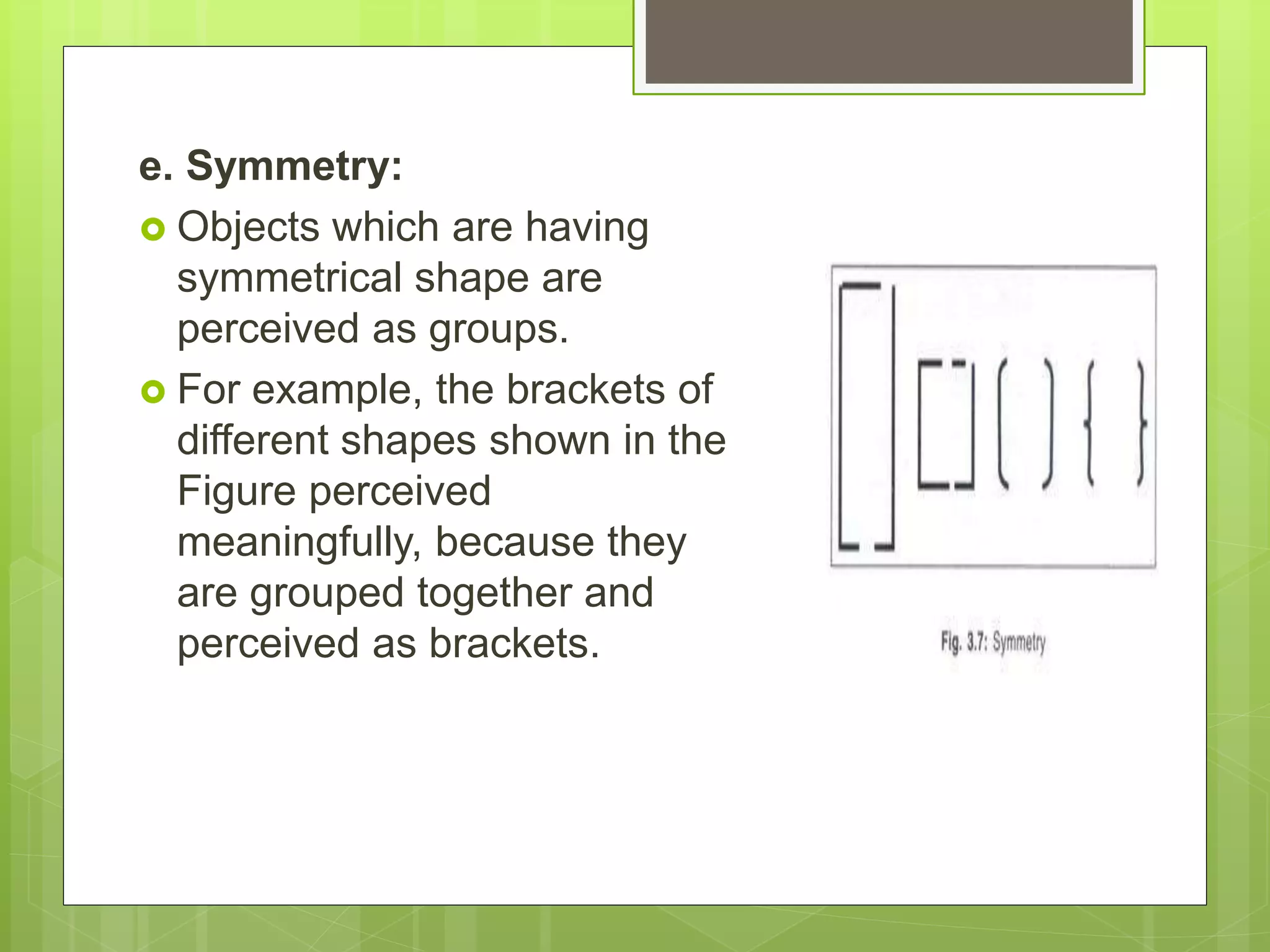
e. Symmetry:
 Objects which are having
symmetrical shape are
perceived as groups.
 For example, the brackets of
different shapes shown in the
Figure perceived
meaningfully, because they
are grouped together and
perceived as brackets.
Perceptual Constancy:
 This refers to stableness in perception. We have a
tendency to perceive the objects as relatively stable and
unchanging in shape and size, in spite of a change in the
image that we receive.
Types of perceptual constancy:
 There are different types of perceptual constancies. They
are shape and size, brightness and color, size
constancy.
Perception of space
Depth Perception:
 Ability of a person to perceive the distance is known
as depth perception. This is very important ability to
judge the distance between us and other people,
objects and vehicles moving particularly when we
are on roads.
Cues:
 Depth perception is possible due to certain cues.
These cues help us to understand the distance
between one person and the other person or object.
There is two types cues
 Monocular
 binocular
a. Monocular cues:
 These are the cues that can operate when only one
eye is looking. Some of such cues are:
Linear perspective:
 The distances separating the images of far objects
appear to be smaller.
Aerial perspective:
 The nearer objects appear clearer than the distant
objects.
Interposition:
 When one object obstructs our view of another, the
front one appears nearer than the partly covered one.
Gradient structure:
 A gradient is a continuous change in something- a
change without abrupt transitions. As the distance
increases, the texture becomes finer and finer.
 This happens very gradually and gives a cue about
the depth or distance.
b. Binocular cues:
 Sometimes the depth can be perceived when both eyes
are used. This is called binocular cue. There are 2
binocular cues:
1. Retinal disparity:
 The image of the object which falls on both the retinas
differs. Disparity will be more when the object is closer
than when it is far away. Depending upon the
correspondence between the distance and the amount of
disparity, the depth can be perceived.
2. Convergence or divergence of eyeballs:
 When the object moves nearer and nearer to our eyes,
our eyeballs converge, and as the object moves away
from us the eyeballs diverge. This process acts as a
binocular cue to perceive the depth.
Factors influencing perception
 Sense organs: perception depends upon the
sense organs or receptors on which the stimuli act
and sensory neurons transmit the nerve current
from the receptors to the sensory area of the brain.
 For ex: if cones are not developed in the retina,
color cannot be perceived.
 Brain : perception depends upon the functioning
capacity of sensory area and the association
areas of the brain. For ex: if the auditory area is
destroyed we can not have auditory perception.
 Memory images of the past experience: it helps
in the comprehension of the object or stimulus
before us. Generally perception involves the
integration of sensory experience in the light of
past experience and present psychological
condition.
 Personal interest and mind set : we perceive
those things quickly and clearly which are
concerned with our interest and mind set.
 Acquired interests: our acquired interest also
determine the object or objects which we perceive.
A person who has a hobby of collecting stamps will
quickly notice any unusual stamp on a letter.
 Needs and desires : our needs or desires also
modify our perceptions. Besides these, our beliefs,
opinions and cultural ideals also modify our
perception of things, situation and objects.
 Illusion:
 illusion is a misinterpretation of actual perception. When
the interpretation of a particular stimulus goes wrong
perception or illusion.
 For ex: a rope in the dark is perceived as a snake.
Types of perceptual illusion
1. Illusions of size.
2. Illusion of length. – Muller layer illusion
3. Illusion of perspective.
4. Illusion of curvature.
5. The horizontal – vertical illusion.
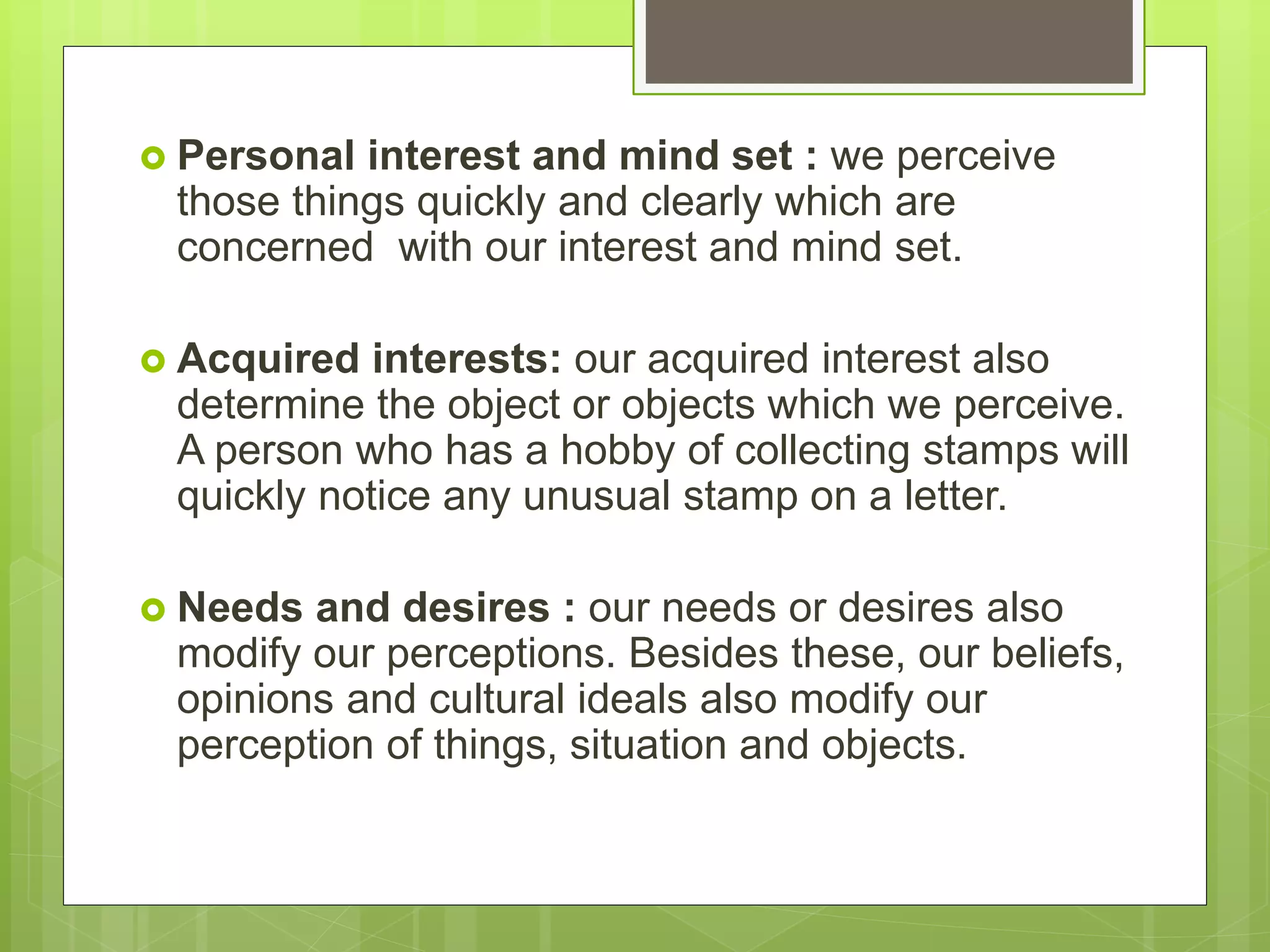
Illusion of Size
A large background always
Makes the objects in the
frame of reference
Looks smaller in the
Comparison to smaller
background where they
perceived as larger.
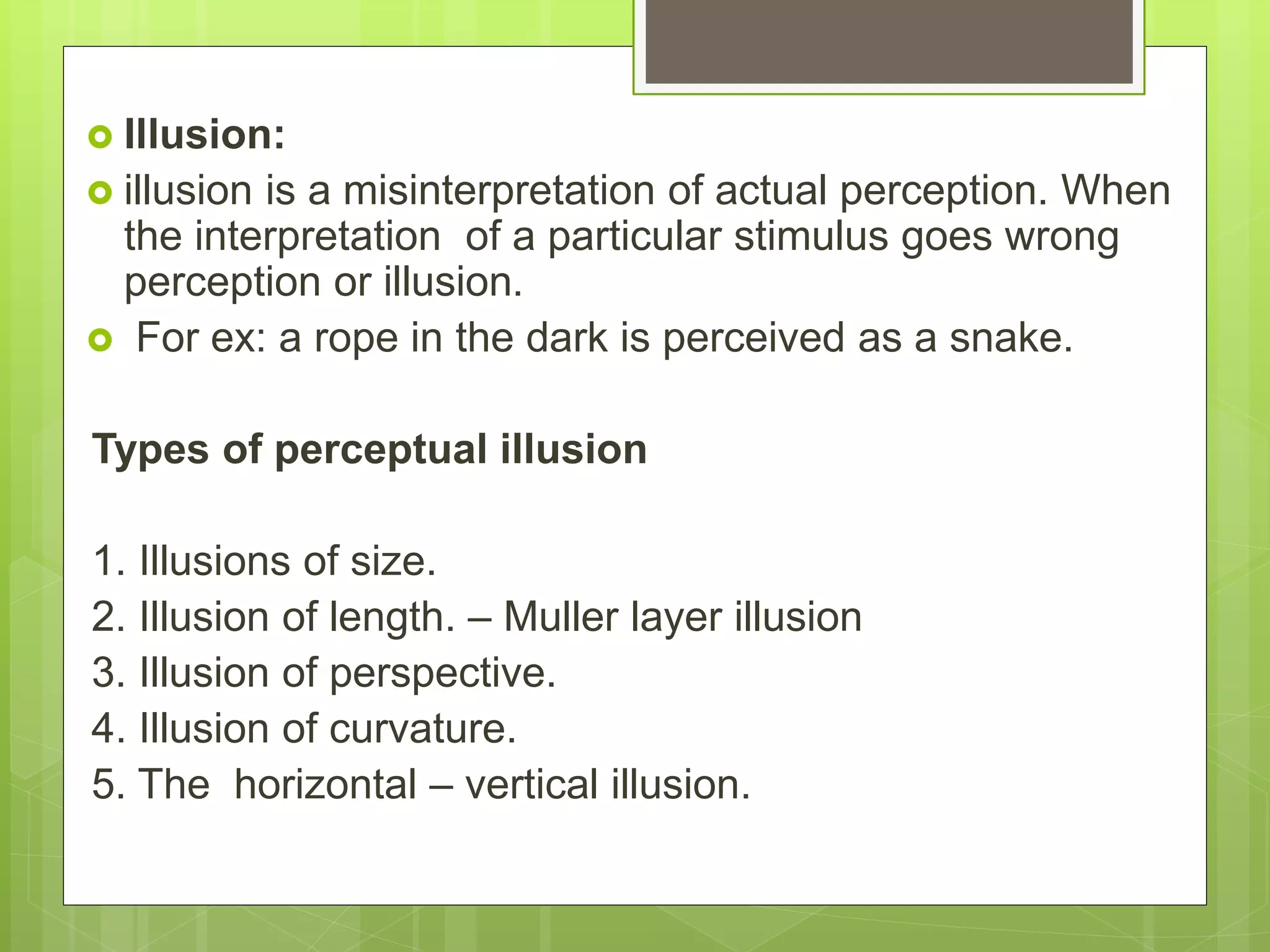
Illusion of length
Both these lines are identical,
Yet The one line is perceived as
Longer. This is called
Muller layer illusion.
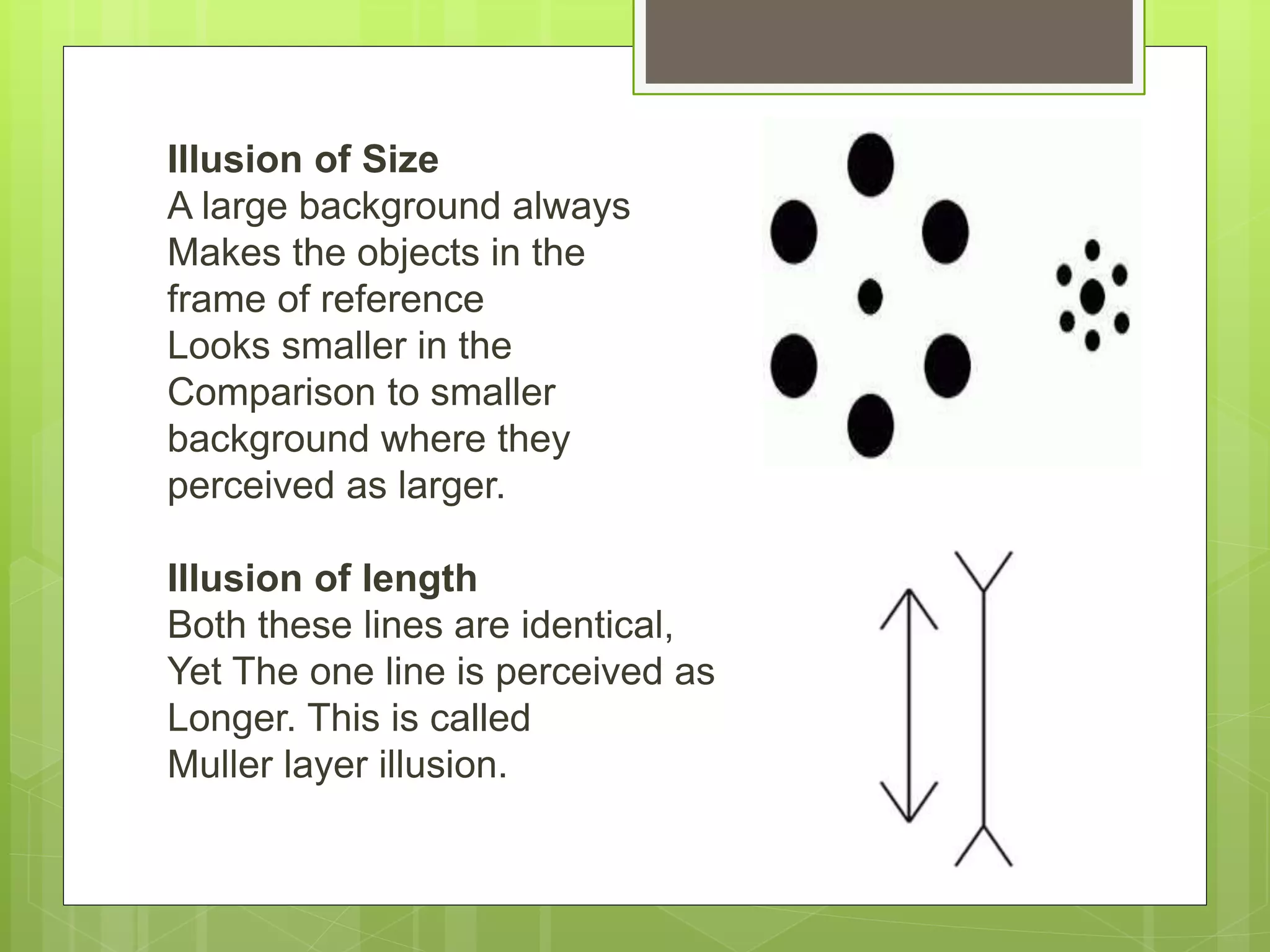
Illusion of perspective:
The two rectangular
Pieces kept between the
Railroad tracks is larger
in size? Although they are
Same but the top one looks
Longer than the bottom one.
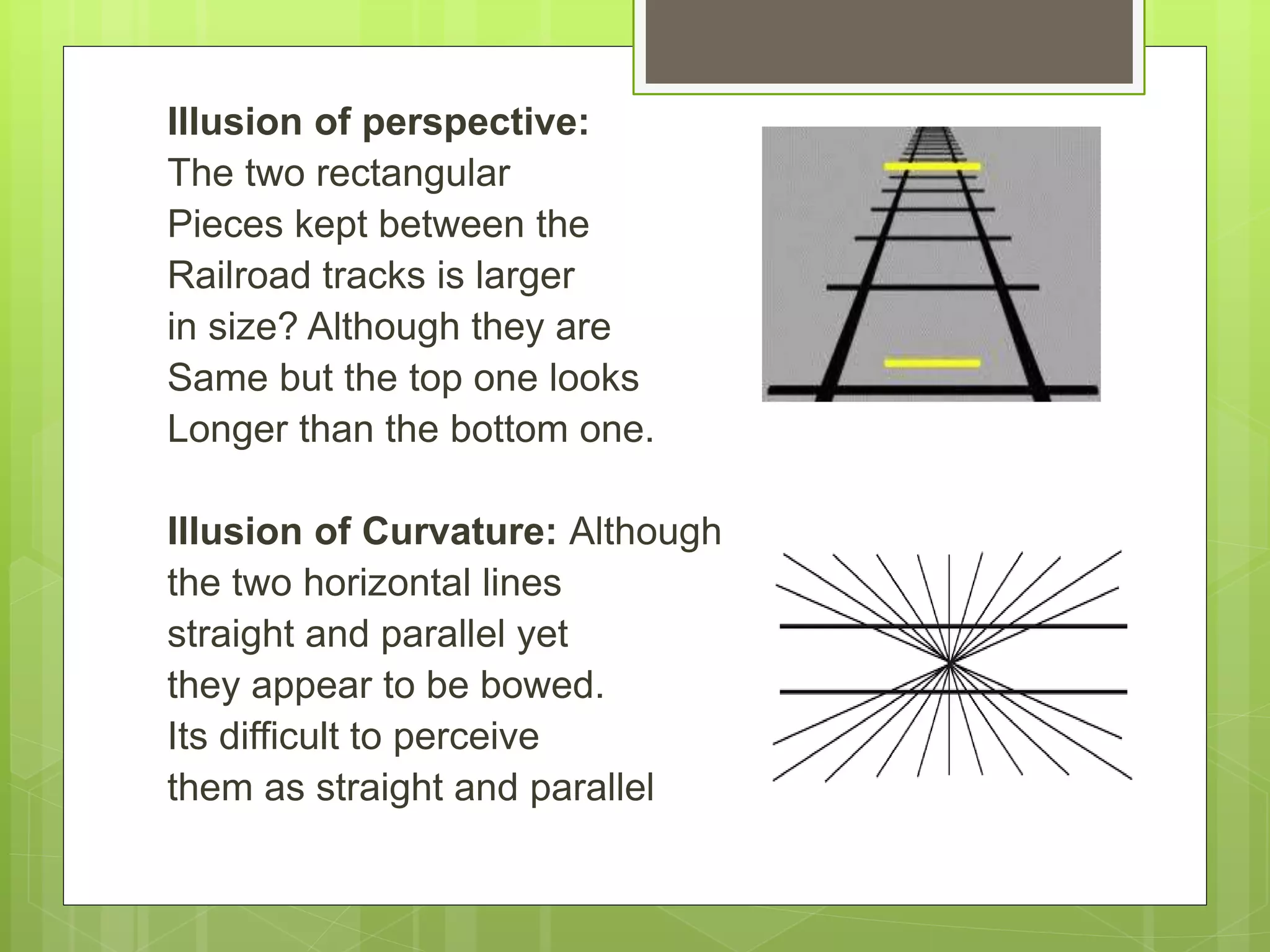
Illusion of Curvature: Although
the two horizontal lines
straight and parallel yet
they appear to be bowed.
Its difficult to perceive
them as straight and parallel
The horizontal – vertical illusion.
The horizontal and vertical lines are physically
equal in length. The vertical line is most often
perceives as longer than horizontal line.
Hallucination:
 Hallucinations are misinterpretations in the absence of
sensory stimulus.
 Hallucination is visual, verbal or physical illusion that is
persons sees, hears or feels and mistakes for reality.
 Hallucinations are false or distorted sensory experiences
that appear to be real perceptions.
Types of hallucination
 Visual
 Auditory
 Tactual
 Olfactory
 Gustatory
Thank you

perception.pptx

  • 1.
  • 2.
    Meaning  Perception (fromthe Latin perceptio, percipio) is the organization, identification, and interpretation of sensory information in order to represent and understand the environment.  All perception involves signals in the nervous system, which in turn result from physical or chemical stimulation of the sense organs.
  • 3.
    Definitions  Charles G.Morris: “All the processes involved in creating meaningful patterns out of jumble of sensory impressions fall under the general category of perception”  James Rowland Angell-Perception has sometimes been defined as the consciousness of particular material things present to sense."  Edmund fantino and G.S Renold-”Perception is organizing process by which we interpret our sensory input”.
  • 4.
    Nature of perception Perception is a process.  Perception is an information extractor.  Perception is preparation to response.  Perception involves sensation.  Perception provides organization.  Perception is highly individualistic in nature.
  • 5.
    Principles of PerceptualOrganization: Some of most basic perceptual process operates according to a series of principles that describe how we organize bits and pieces of information into meaningful wholes. These are known as Gestalt laws of organization.
  • 6.
    Figure-ground Relationship:  Accordingto this principle any figure can be perceived more meaningfully in a background and that figure cannot be separated from that background.  In the Figure two faces can be seen in the background of a white color, also the white background can be perceived as a vessel in the background of two faces.
  • 7.
    Grouping of Stimuliin Perceptual Organization:  As said above, according to gestalt principle, the objects can be perceived meaningfully when they are grouped together.  There are some principles which are followed by us in order to make our perception more meaningful.
  • 8.
    They are asfollows: a. Proximity:  Proximity means nearness. The objects which are nearer to each other can be perceived meaningfully by grouping them.  The stars in the Figure, which are nearer to each other are perceived together as groups/single figure.
  • 9.
    b. Similarity:  Stimulineed not be nearer to each other for perception. If there is similarity in these objects, they are grouped together and perceived, even if they are away.  For example, in this Figure, grouping will be done according to similarity, all circles, squares and triangles are grouped separately.
  • 10.
    c. Continuity:  Anystimulus which extends in the same direction or shape will be perceived as a whole Figure  For example, (A) in this figure though the curved line not properly designed but also it is perceived as a continuous line. (B) the dots are perceived as existing in the same line of direction continuously.
  • 11.
    d. Closure:  Whena stimulus is presented with gaps, the human tendency is to perceive that figure as complete one by filling the gaps psychologically.  For example, in the Figure the gaps are filled psychologically and perceived as letters M and A, circle and a rectangle.
  • 12.
    e. Symmetry:  Objectswhich are having symmetrical shape are perceived as groups.  For example, the brackets of different shapes shown in the Figure perceived meaningfully, because they are grouped together and perceived as brackets.
  • 13.
    Perceptual Constancy:  Thisrefers to stableness in perception. We have a tendency to perceive the objects as relatively stable and unchanging in shape and size, in spite of a change in the image that we receive. Types of perceptual constancy:  There are different types of perceptual constancies. They are shape and size, brightness and color, size constancy.
  • 14.
    Perception of space DepthPerception:  Ability of a person to perceive the distance is known as depth perception. This is very important ability to judge the distance between us and other people, objects and vehicles moving particularly when we are on roads. Cues:  Depth perception is possible due to certain cues. These cues help us to understand the distance between one person and the other person or object.
  • 15.
    There is twotypes cues  Monocular  binocular a. Monocular cues:  These are the cues that can operate when only one eye is looking. Some of such cues are: Linear perspective:  The distances separating the images of far objects appear to be smaller.
  • 16.
    Aerial perspective:  Thenearer objects appear clearer than the distant objects. Interposition:  When one object obstructs our view of another, the front one appears nearer than the partly covered one. Gradient structure:  A gradient is a continuous change in something- a change without abrupt transitions. As the distance increases, the texture becomes finer and finer.  This happens very gradually and gives a cue about the depth or distance.
  • 17.
    b. Binocular cues: Sometimes the depth can be perceived when both eyes are used. This is called binocular cue. There are 2 binocular cues: 1. Retinal disparity:  The image of the object which falls on both the retinas differs. Disparity will be more when the object is closer than when it is far away. Depending upon the correspondence between the distance and the amount of disparity, the depth can be perceived.
  • 18.
    2. Convergence ordivergence of eyeballs:  When the object moves nearer and nearer to our eyes, our eyeballs converge, and as the object moves away from us the eyeballs diverge. This process acts as a binocular cue to perceive the depth.
  • 19.
    Factors influencing perception Sense organs: perception depends upon the sense organs or receptors on which the stimuli act and sensory neurons transmit the nerve current from the receptors to the sensory area of the brain.  For ex: if cones are not developed in the retina, color cannot be perceived.
  • 20.
     Brain :perception depends upon the functioning capacity of sensory area and the association areas of the brain. For ex: if the auditory area is destroyed we can not have auditory perception.  Memory images of the past experience: it helps in the comprehension of the object or stimulus before us. Generally perception involves the integration of sensory experience in the light of past experience and present psychological condition.
  • 21.
     Personal interestand mind set : we perceive those things quickly and clearly which are concerned with our interest and mind set.  Acquired interests: our acquired interest also determine the object or objects which we perceive. A person who has a hobby of collecting stamps will quickly notice any unusual stamp on a letter.  Needs and desires : our needs or desires also modify our perceptions. Besides these, our beliefs, opinions and cultural ideals also modify our perception of things, situation and objects.
  • 22.
     Illusion:  illusionis a misinterpretation of actual perception. When the interpretation of a particular stimulus goes wrong perception or illusion.  For ex: a rope in the dark is perceived as a snake. Types of perceptual illusion 1. Illusions of size. 2. Illusion of length. – Muller layer illusion 3. Illusion of perspective. 4. Illusion of curvature. 5. The horizontal – vertical illusion.
  • 23.
    Illusion of Size Alarge background always Makes the objects in the frame of reference Looks smaller in the Comparison to smaller background where they perceived as larger. Illusion of length Both these lines are identical, Yet The one line is perceived as Longer. This is called Muller layer illusion.
  • 24.
    Illusion of perspective: Thetwo rectangular Pieces kept between the Railroad tracks is larger in size? Although they are Same but the top one looks Longer than the bottom one. Illusion of Curvature: Although the two horizontal lines straight and parallel yet they appear to be bowed. Its difficult to perceive them as straight and parallel
  • 25.
    The horizontal –vertical illusion. The horizontal and vertical lines are physically equal in length. The vertical line is most often perceives as longer than horizontal line.
  • 26.
    Hallucination:  Hallucinations aremisinterpretations in the absence of sensory stimulus.  Hallucination is visual, verbal or physical illusion that is persons sees, hears or feels and mistakes for reality.  Hallucinations are false or distorted sensory experiences that appear to be real perceptions. Types of hallucination  Visual  Auditory  Tactual  Olfactory  Gustatory
  • 27.