What is a
Puritan?
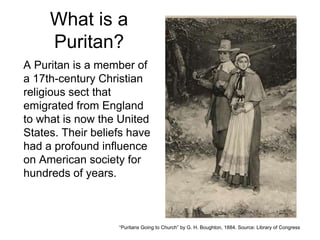
A Puritan is a member of
a 17th-century Christian
religious sect that
emigrated from England
to what is now the United
States. Their beliefs have
had a profound influence
on American society for
hundreds of years.
“Puritans Going to Church” by G. H. Boughton, 1884. Source: Library of Congress
But where did they come
from?
What does it mean to be a
Puritan?
Some background
information
Before about 1500, the Roman
Catholic Church was the major
religious and political
organization for most of Europe.
There was no separation
between Church and State. Kings
were considered to be divinely
appointed according to God’s will.
Sin and crime were the same
things.
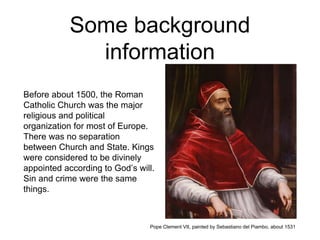
Pope Clement VII, painted by Sebastiano del Piambo, about 1531
The Protestant
ReformationStarting around 1500, various groups
around Europe began to question the
power of the Roman Catholic church.
Some wanted to start new churches;
others wanted the Roman Catholic
church to change its practices or give up
some of its power.
In England, King Henry the VIII wanted
to have his marriage annulled so he
could marry someone else. When Pope
Clement VII refused to annul his
marriage, Henry VIII declared that the
Roman Catholic Church in England was
now the Church of England, and its head
was the King and not the Pope. Then he
went ahead with his next marriage, and
also took over all the Roman Catholic
church properties in England.
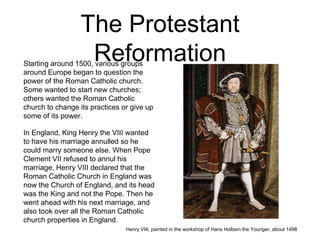
Henry VIII, painted in the workshop of Hans Holbein the Younger, about 1498
• The Puritans were people who felt that the Church
of England was still too much like the Roman
Catholic church, which they thought was corrupt and
superstitious.
• The Puritans wanted to PURIFY the Church of
England, to make further changes until the Church
was perfect.
• Some people thought the only solution was to
SEPARATE from the Church of England and start a
new, pure Christian church. Those people were
Separatists.
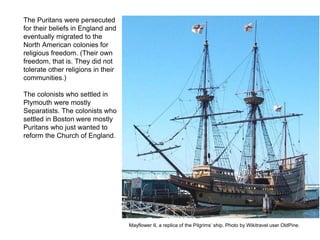
The Puritans were persecuted
for their beliefs in England and
eventually migrated to the
North American colonies for
religious freedom. (Their own
freedom, that is. They did not
tolerate other religions in their
communities.)
The colonists who settled in
Plymouth were mostly
Separatists. The colonists who
settled in Boston were mostly
Puritans who just wanted to
reform the Church of England.
Mayflower II, a replica of the Pilgrims’ ship. Photo by Wikitravel user OldPine.
Puritan beliefs• Living in complete agreement with the Bible. Education
was important because everyone needs to be able to read
the Bible for themselves. They also believed in keeping
spiritual journals where they wrote about what God was
telling them.
• God deals with individuals personally and intervenes in
their lives. God sends messages to his people through
daily events. (For example, a terrible storm might mean
your town displeased God.)
• The Puritans saw themselves as a new version of the
Biblical Israelites. God was leading them out of
England/Egypt and into America/the Promised Land. They
were fulfilling God’s plan.
• God has already decided who will go to heaven (be
saved) and who won’t. It’s up to God; it’s not based
on your life choices. Your eternal fate is predestined.
• Your job in life is to please God and try to find out if
He has chosen you to be saved. (In Puritan terms,
are you one of the “Elect”?)
• God showed who His Elect were by how well they
behaved and how well they prospered. Therefore, if
you wanted to believe you were Elect, you would
behave very well and work very hard. This attitude
has been called the root of the “Protestant Work
Ethic.”
• Puritans did not tolerate dissent or non-Puritan
religions.
• Puritans did not tolerate idleness or excessive
celebration.
• Puritans used public punishments like whipping and
humiliation to enforce the rules. They also executed
people, usually by hanging them.
• Church leaders and government leaders were
closely connected, sometimes the same people;
there was still no separation of church and state.
The Puritans are still an important symbol in American
culture, but what is their meaning to Americans today?
Hopefully our readings will help us explore that question.

Puritanism

  • 1.
    What is a Puritan? APuritan is a member of a 17th-century Christian religious sect that emigrated from England to what is now the United States. Their beliefs have had a profound influence on American society for hundreds of years. “Puritans Going to Church” by G. H. Boughton, 1884. Source: Library of Congress
  • 2.
    But where didthey come from? What does it mean to be a Puritan?
  • 3.
    Some background information Before about1500, the Roman Catholic Church was the major religious and political organization for most of Europe. There was no separation between Church and State. Kings were considered to be divinely appointed according to God’s will. Sin and crime were the same things. Pope Clement VII, painted by Sebastiano del Piambo, about 1531
  • 4.
    The Protestant ReformationStarting around1500, various groups around Europe began to question the power of the Roman Catholic church. Some wanted to start new churches; others wanted the Roman Catholic church to change its practices or give up some of its power. In England, King Henry the VIII wanted to have his marriage annulled so he could marry someone else. When Pope Clement VII refused to annul his marriage, Henry VIII declared that the Roman Catholic Church in England was now the Church of England, and its head was the King and not the Pope. Then he went ahead with his next marriage, and also took over all the Roman Catholic church properties in England. Henry VIII, painted in the workshop of Hans Holbein the Younger, about 1498
  • 5.
    • The Puritanswere people who felt that the Church of England was still too much like the Roman Catholic church, which they thought was corrupt and superstitious. • The Puritans wanted to PURIFY the Church of England, to make further changes until the Church was perfect. • Some people thought the only solution was to SEPARATE from the Church of England and start a new, pure Christian church. Those people were Separatists.
  • 6.
    The Puritans werepersecuted for their beliefs in England and eventually migrated to the North American colonies for religious freedom. (Their own freedom, that is. They did not tolerate other religions in their communities.) The colonists who settled in Plymouth were mostly Separatists. The colonists who settled in Boston were mostly Puritans who just wanted to reform the Church of England. Mayflower II, a replica of the Pilgrims’ ship. Photo by Wikitravel user OldPine.
  • 7.
    Puritan beliefs• Livingin complete agreement with the Bible. Education was important because everyone needs to be able to read the Bible for themselves. They also believed in keeping spiritual journals where they wrote about what God was telling them. • God deals with individuals personally and intervenes in their lives. God sends messages to his people through daily events. (For example, a terrible storm might mean your town displeased God.) • The Puritans saw themselves as a new version of the Biblical Israelites. God was leading them out of England/Egypt and into America/the Promised Land. They were fulfilling God’s plan.
  • 8.
    • God hasalready decided who will go to heaven (be saved) and who won’t. It’s up to God; it’s not based on your life choices. Your eternal fate is predestined. • Your job in life is to please God and try to find out if He has chosen you to be saved. (In Puritan terms, are you one of the “Elect”?) • God showed who His Elect were by how well they behaved and how well they prospered. Therefore, if you wanted to believe you were Elect, you would behave very well and work very hard. This attitude has been called the root of the “Protestant Work Ethic.”
  • 9.
    • Puritans didnot tolerate dissent or non-Puritan religions. • Puritans did not tolerate idleness or excessive celebration. • Puritans used public punishments like whipping and humiliation to enforce the rules. They also executed people, usually by hanging them. • Church leaders and government leaders were closely connected, sometimes the same people; there was still no separation of church and state.
  • 10.
    The Puritans arestill an important symbol in American culture, but what is their meaning to Americans today? Hopefully our readings will help us explore that question.