English Constitutionalism: Royal Absolutism 1603-1649
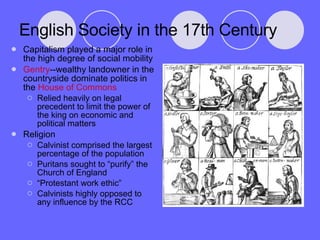
English Society in the 17th Century Capitalism played a major role in the high degree of social mobility Gentry --wealthy landowner in the countryside dominate politics in the  House of Commons Relied heavily on legal precedent to limit the power of the king on economic and political matters Religion Calvinist comprised the largest percentage of the population Puritans sought to “purify” the Church of England “ Protestant work ethic” Calvinists highly opposed to any influence by the RCC
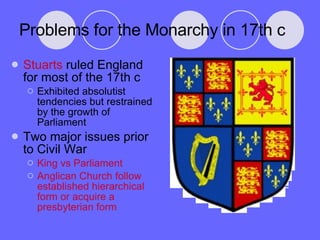
Problems for the Monarchy in 17th c Stuarts  ruled England for most of the 17th c Exhibited absolutist tendencies but restrained by the growth of Parliament Two major issues prior to Civil War King vs Parliament Anglican Church follow established hierarchical form or acquire a presbyterian form
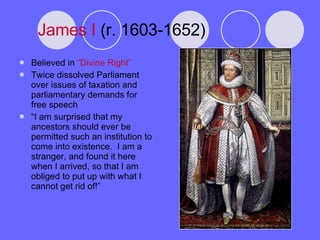
James I  (r. 1603-1652) Believed in  “Divine Right” Twice dissolved Parliament over issues of taxation and parliamentary demands for free speech “ I am surprised that my ancestors should ever be permitted such an institution to come into existence.  I am a stranger, and found it here when I arrived, so that I am obliged to put up with what I cannot get rid of!”
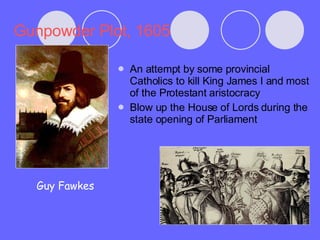
Gunpowder Plot, 1605 An attempt by some provincial Catholics to kill King James I and most of the Protestant aristocracy Blow up the House of Lords during the state opening of Parliament Guy Fawkes
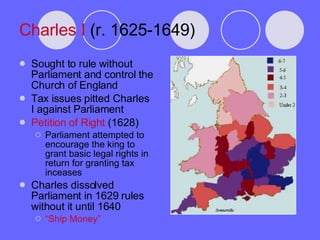
Charles I  (r. 1625-1649) Sought to rule without Parliament and control the Church of England Tax issues pitted Charles I against Parliament Petition of Right  (1628) Parliament attempted to encourage the king to grant basic legal rights in return for granting tax inceases Charles dissolved Parliament in 1629 rules without it until 1640 “ Ship Money”
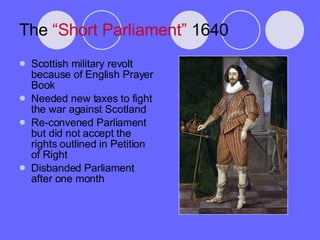
The  “Short Parliament”  1640 Scottish military revolt because of English Prayer Book Needed new taxes to fight the war against Scotland Re-convened Parliament but did not accept the rights outlined in Petition of Right Disbanded Parliament after one month
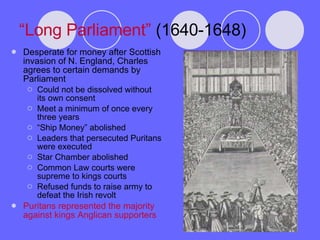
“ Long Parliament”  (1640-1648) Desperate for money after Scottish invasion of N. England, Charles agrees to certain demands by Parliament Could not be dissolved without its own consent Meet a minimum of once every three years “ Ship Money” abolished Leaders that persecuted Puritans were executed Star Chamber abolished Common Law courts were supreme to kings courts Refused funds to raise army to defeat the Irish revolt Puritans represented the majority against kings Anglican supporters

Constitutionalism England 1603 1649

  • 1.
  • 2.
    English Society inthe 17th Century Capitalism played a major role in the high degree of social mobility Gentry --wealthy landowner in the countryside dominate politics in the House of Commons Relied heavily on legal precedent to limit the power of the king on economic and political matters Religion Calvinist comprised the largest percentage of the population Puritans sought to “purify” the Church of England “ Protestant work ethic” Calvinists highly opposed to any influence by the RCC
  • 3.
    Problems for theMonarchy in 17th c Stuarts ruled England for most of the 17th c Exhibited absolutist tendencies but restrained by the growth of Parliament Two major issues prior to Civil War King vs Parliament Anglican Church follow established hierarchical form or acquire a presbyterian form
  • 4.
    James I (r. 1603-1652) Believed in “Divine Right” Twice dissolved Parliament over issues of taxation and parliamentary demands for free speech “ I am surprised that my ancestors should ever be permitted such an institution to come into existence. I am a stranger, and found it here when I arrived, so that I am obliged to put up with what I cannot get rid of!”
  • 5.
    Gunpowder Plot, 1605An attempt by some provincial Catholics to kill King James I and most of the Protestant aristocracy Blow up the House of Lords during the state opening of Parliament Guy Fawkes
  • 6.
    Charles I (r. 1625-1649) Sought to rule without Parliament and control the Church of England Tax issues pitted Charles I against Parliament Petition of Right (1628) Parliament attempted to encourage the king to grant basic legal rights in return for granting tax inceases Charles dissolved Parliament in 1629 rules without it until 1640 “ Ship Money”
  • 7.
    The “ShortParliament” 1640 Scottish military revolt because of English Prayer Book Needed new taxes to fight the war against Scotland Re-convened Parliament but did not accept the rights outlined in Petition of Right Disbanded Parliament after one month
  • 8.
    “ Long Parliament” (1640-1648) Desperate for money after Scottish invasion of N. England, Charles agrees to certain demands by Parliament Could not be dissolved without its own consent Meet a minimum of once every three years “ Ship Money” abolished Leaders that persecuted Puritans were executed Star Chamber abolished Common Law courts were supreme to kings courts Refused funds to raise army to defeat the Irish revolt Puritans represented the majority against kings Anglican supporters