JOHN LOCKE’S
POLITICALTHEORY
Prepared by Raizza Corpuz
■ He used many of his ideas concerning epistemological stance to
back up his political theories.
■ Reading different articles, writings about him states that many
writer thought that he contradicts himself in his work.
■ Knowledge was not innate nor revealed, nor resting on authority.
* Any state is better than anarchy.
* Power comes from the people, rulers were agents acting in the
common good.
* Political rights are not given to the property less.
* Men being by nature all free, equal, and independent, no one can be
put out of this estate and subjected to the political power of another
without his consent
The State of Nature
■ Naturally all men are in a state of equality; without
subordination or subjection
■ They should have the freedom to do their actions and use
their possessions as they see fit
-no person should have more than another
■ It states that everyone is equal and they have to follow
the same rules as everyone else
Property
■ Every man has the right to own his own property
*the labour of his body and of his hands are properly his
■ Men can own land but it has limits also
*as much land as a man can work himself is his
"Nothing was made by God for man to spoil or destroy"
Civil Society
■ People in the society have liberty but there cannot be
liberty without laws.
■ Liberty is acting accordingly to a man’s own will and
instructed by laws.
■ that people in society have liberty but there cannot be
liberty without laws
Social Contract
■ In order for man to live in society together, all the men
must agree live by the same rules.
-The original contract is agreed on during the first entering
into the community.
-A son doesn't necessarily receives his father's possessions
unless he is part of this community.
■ in order for man to live in society, he must live by the
same rules as everyone else
The End of Society and Government
■ Fears and continuous danger makes man want to enter a
government, although he is free
■ The legislature is directed to carry out the laws in order to
secure safety peace of the people
The Legislature Power
-The legislature is the supreme power of the
commonwealth but it has limitations as well.
- the government that protects them, in order to keep it
running
-The society must pay taxes pay taxes. ( a majority
consent)
The Separation of Power
■ -The making and executing the laws needs to be separate because
there is much power in the hands of man to have power over the
people. (executive, federative, and legislative)
■ the power of the people
-If society is unhappy with the legislature, they can reform it
The Possibility of Resistance
■ Once a government or legislature is established a society
there will always be a need for it.
-The commonwealth or the people who give it form, life,
and liberty.
-The government may dissolve is the supreme executive
power neglects and abandons the governmental laws.
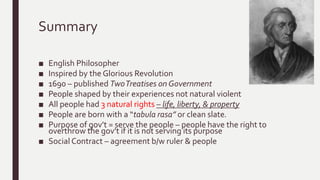
Summary
■ English Philosopher
■ Inspired by the Glorious Revolution
■ 1690 – published TwoTreatises on Government
■ People shaped by their experiences not natural violent
■ All people had 3 natural rights – life, liberty, & property
■ People are born with a “tabula rasa” or clean slate.
■ Purpose of gov’t = serve the people – people have the right to
overthrow the gov’t if it is not serving its purpose
■ Social Contract – agreement b/w ruler & people

John Locke's Political Theory

  • 1.
  • 2.
    ■ He usedmany of his ideas concerning epistemological stance to back up his political theories. ■ Reading different articles, writings about him states that many writer thought that he contradicts himself in his work. ■ Knowledge was not innate nor revealed, nor resting on authority. * Any state is better than anarchy. * Power comes from the people, rulers were agents acting in the common good. * Political rights are not given to the property less. * Men being by nature all free, equal, and independent, no one can be put out of this estate and subjected to the political power of another without his consent
  • 3.
    The State ofNature ■ Naturally all men are in a state of equality; without subordination or subjection ■ They should have the freedom to do their actions and use their possessions as they see fit -no person should have more than another ■ It states that everyone is equal and they have to follow the same rules as everyone else
  • 4.
    Property ■ Every manhas the right to own his own property *the labour of his body and of his hands are properly his ■ Men can own land but it has limits also *as much land as a man can work himself is his "Nothing was made by God for man to spoil or destroy"
  • 5.
    Civil Society ■ Peoplein the society have liberty but there cannot be liberty without laws. ■ Liberty is acting accordingly to a man’s own will and instructed by laws. ■ that people in society have liberty but there cannot be liberty without laws
  • 6.
    Social Contract ■ Inorder for man to live in society together, all the men must agree live by the same rules. -The original contract is agreed on during the first entering into the community. -A son doesn't necessarily receives his father's possessions unless he is part of this community. ■ in order for man to live in society, he must live by the same rules as everyone else
  • 7.
    The End ofSociety and Government ■ Fears and continuous danger makes man want to enter a government, although he is free ■ The legislature is directed to carry out the laws in order to secure safety peace of the people The Legislature Power -The legislature is the supreme power of the commonwealth but it has limitations as well. - the government that protects them, in order to keep it running -The society must pay taxes pay taxes. ( a majority consent)
  • 8.
    The Separation ofPower ■ -The making and executing the laws needs to be separate because there is much power in the hands of man to have power over the people. (executive, federative, and legislative) ■ the power of the people -If society is unhappy with the legislature, they can reform it
  • 9.
    The Possibility ofResistance ■ Once a government or legislature is established a society there will always be a need for it. -The commonwealth or the people who give it form, life, and liberty. -The government may dissolve is the supreme executive power neglects and abandons the governmental laws.
  • 10.
    Summary ■ English Philosopher ■Inspired by the Glorious Revolution ■ 1690 – published TwoTreatises on Government ■ People shaped by their experiences not natural violent ■ All people had 3 natural rights – life, liberty, & property ■ People are born with a “tabula rasa” or clean slate. ■ Purpose of gov’t = serve the people – people have the right to overthrow the gov’t if it is not serving its purpose ■ Social Contract – agreement b/w ruler & people