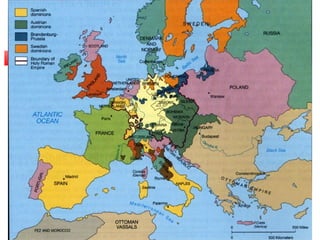
Thirty Years War
Peace of Westphalia: 
1648
Introduction 
 HRE is a mix of Czech, Bohemian, 
French and German (Majority), evenly 
split between Protestant and Catholic 
 Isolationist perspectives of Lutheran 
states led to cultural decline 
 suspicious of the outside world and 
suffered from cultural isolation 
 Universities attracted fewer students as 
intellectual energies were spent 
defending dogmas 
 Witch burning 
 Commercial activity is in decline 
 Banking and financial interests were 
shifting west
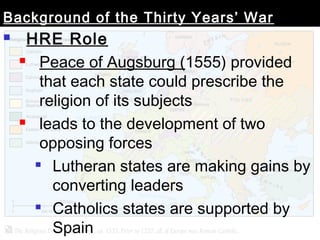
Background of the Thirty Years’ War 
 HRE Role 
 Peace of Augsburg (1555) provided 
that each state could prescribe the 
religion of its subjects 
 leads to the development of two 
opposing forces 
 Lutheran states are making gains by 
converting leaders 
 Catholics states are supported by 
Spain
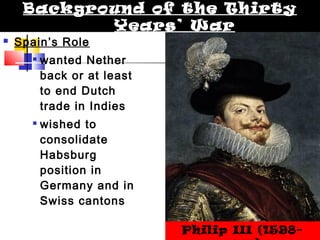
Background of the Thirty 
 Spain’s Role 
Years’ War 
 wanted Nether 
back or at least 
to end Dutch 
trade in Indies 
 wished to 
consolidate 
Habsburg 
position in 
Germany and in 
Swiss cantons 
Philip III (1598- 
1621)
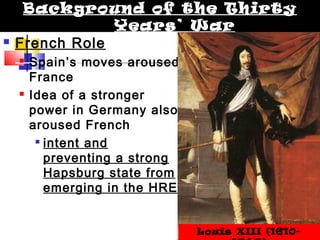
Background of the Thirty 
 French Role 
Years’ War 
 Spain’s moves aroused 
France 
 Idea of a stronger 
power in Germany also 
aroused French 
 intent and 
preventing a strong 
Hapsburg state from 
emerging in the HRE 
Louis XIII (1610- 
1643)
Background of the Thirty 
Years’ War 
 Complexity of the Thirty Years’ War 
 Fought over religion, constitutional issues, 
centralization v independence of German 
states 
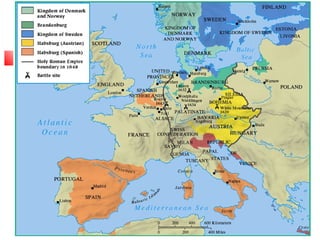
 Between the French and Hapsburgs, Spain 
and Dutch 
 Fought mostly on German soil 
 Divided into 4 or 5 phases 
 Bohemian (1618-1625) 
 Danish (1625-1629) 
 Swedish(1630-1635) 
Swedish-French(1635-1648)
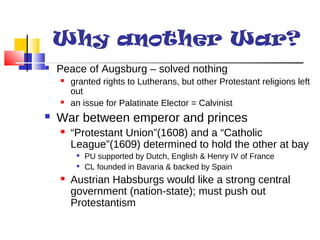
Why another War? 
 Peace of Augsburg – solved nothing 
 granted rights to Lutherans, but other Protestant religions left 
out 
 an issue for Palatinate Elector = Calvinist 
 War between emperor and princes 
 “Protestant Union”(1608) and a “Catholic 
League”(1609) determined to hold the other at bay 
 PU supported by Dutch, English & Henry IV of France 
 CL founded in Bavaria & backed by Spain 
 Austrian Habsburgs would like a strong central 
government (nation-state); must push out 
Protestantism
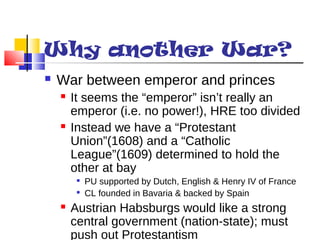
Why another War? 
 War between emperor and princes 
 It seems the “emperor” isn’t really an 
emperor (i.e. no power!), HRE too divided 
 Instead we have a “Protestant 
Union”(1608) and a “Catholic 
League”(1609) determined to hold the 
other at bay 
 PU supported by Dutch, English & Henry IV of France 
 CL founded in Bavaria & backed by Spain 
 Austrian Habsburgs would like a strong 
central government (nation-state); must 
push out Protestantism
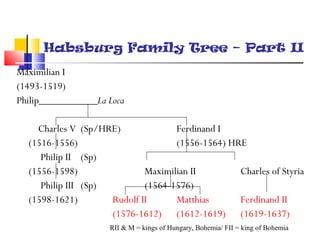
Habsburg Family Tree – Part II 
Maximilian I 
(1493-1519) 
Philip___________La Loca 
Charles V (Sp/HRE) Ferdinand I 
(1516-1556) (1556-1564) HRE 
Philip II (Sp) 
(1556-1598) Maximilian II Charles of Styria 
Philip III (Sp) (1564-1576) 
(1598-1621) Rudolf II Matthias Ferdinand II 
(1576-1612) (1612-1619) (1619-1637) 
RII & M = kings of Hungary, Bohemia/ FII = king of Bohemia
Phase I: 
Bohemian Phase 1618-1625 
 HRE – Matthias (Ferdinand’s grdson) dying, 
successor to Empire 
 Logical choice: cousin, Ferdinand II 
 BUT electors are mainly Protestant and 
Ferdinand is Catholic 
 Ferdinand ALSO king of Bohemia! 
 Bohemians (Czechs / Germans) – together 
with Slovaks = mainly Protestant vs. Catholic 
king
Bohemia revolts 
 Defenestration of Prague: Mathias’ reps 
thrown out the window (land on dung) 
 Mathias send in troops to restore order & is 
deposed 
 Mathias dies & Ferdinand II should reign 
 Bohemians elect “Frederick of the Palatinate” 
 So War: Ferdinand and Catholic League vs. 
Frederick and Protestant Union 
 Ferdinand crowned as HRE and defeats 
Frederick at Battle of White Mountain 1620
Outcomes of Phase I 
 Spain dig-in in Rhineland; prepare to take on 
French and Dutch 
 Ferdinand II gets elected king of Bohemia & 
confiscates 50% of nobles’ estates 
 some goes to churches, monasteries & orders 
 some goes to mercenaries = new aristocracy 
 Jesuits re-Catholicize Bohemia 
 missions, schools, court proceedings, executions 
 Protestantism expunged in Austria 
 Protestant Union dissolved in 1621
Phase II: 
Danish Phase 1625-1630 
Danish Lutherans vs. Habsburg power! 
 Denmark’s King Christian IV (a.k.a. Duke of 
Holstein) vs. Ferdinand II 
 religious as well as political agenda 
 some Dutch, English, French backing 
 Ferdinand wins under gen. Wallenstein who 
plunders Germany and Danes (Spanish cousins of 
HRE help) 
 Wallenstein actually reaches Baltic & Danish Pen.
Results of Phase II 
 Germany is completely engulfed by the 
Counter Reformation 
 Palatinate, northern Lutheran states, 
Bohemia & Austria = re-Catholicized 
 1629 HRE issues “Edict of Restitution”: All 
Catholic states pre Peace of Augsburg 
(1555) are restored as Catholic
Results of Phase II 
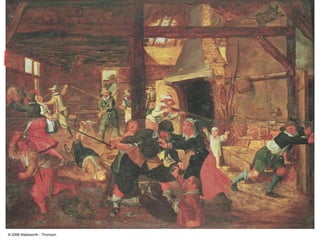
 Terror sweeps Germany, France, Denmark & 
Sweden 
 Germans fear for Protestantism 
 as do Danish, who are also dealing with 
Wallenstein 
 French (Richelieu) dealing with internal conflicts, 
can’t take Ferdinand II alone, so... 
 engage Swedes, by ending their conflict with 
Poland and paying them 1 million livre/year for 
40,000 troops (Dutch pay 50,000 florins a month)
Phase III: 
Swedish 1630-1635 
 Swedish King Gustavus Adolphus: great ruler 
 united Sweden 
 conducted overseas operations 
 increased land holdings bu acquiring areas of 
Poland & Russia 
 creates Europes most modern army 
 1630 lands in Germany to take over fight for 
Protestantism 
 in the meantime...Richelieu has turned Catholic 
states against FII (fear of centralization)
Phase III – Swedish 
1630-1635 
 Glorious Victories (military backing from 
Saxony) 
 1631 Breitenfeld 
 1632 Lützen (GA dies in battle) 
 Oxenstierna (GA’s Chancellor) picks up fight 
 penetrates Bohemia as far south as the Danube 
 Internal Discord 
 Wallenstein upset with power of Spanish and 
gives up fight; begins private peace talks with 
Swedes & Saxons; assassinated by one of his 
own
Phase III – Swedish 
1630-1635 
 Internal Discord (con’t.) 
 Saxons (ind. of Swedes) enter into talks w/ 
Emperor 
 1635 Peace of Prague: annuls Edict of 
Restitution, many other German states 
sign treaty & pull support of Swedes 
 Swedes left isolated in Germany 
 French/Spanish not ready to give
Phase IV: French-Swedish / 
International Phase 1635-1648 
 Richelieu not happy the Habsburgs won 
again … so … he declares war on Spain 
(Habsburg – Philip IV – helping HRE)! 
 Portugal & Catalonia declare independence from 
Sp. 
 Netherlands, Savoy also enter on Swedish 
side! 
 Battles go both ways, Richelieu, Ferdinand II, 
Louis XIII, Wallenstein all die early 1640’s 
 Germany grows to resent this foreign invasion 
 Exhaustion – and Peace of Westphalia 1648
The Peace of Westphalia (1648) 
 The 30 Years’ War officially ended in 1648 with the Peace of 
Westphalia 
 The treaties recognized the sovereignty of the 300+ German 
princes 
 The treaties disallowed papal meddling in German religious 
affairs 
 The treaties upheld the Peace of Augsburg, added Calvinism to 
the list of religions allowed in German states and nullified the 
Edict of Restitution
Immediate Results of the 
30 Years’ War 
 After the Peace in 1648, the northern states in 
Germany remained primarily Protestant while the 
southern states in Germany remained primarily 
Catholic 
 The United Provinces and Switzerland won 
recognition as independent states 
 German princes won the right to form alliances and 
sign treaties as long as they didn’t declare war on 
the Holy Roman Empire 
 Sweden won cash and land in the Baltic region 
 France won the region of Alsace
Political Fallout from the 30 Years’ 
War 
 Because Spain lost territory and France gained 
territory, France stood alone as the most powerful 
nation on the continent 
 France also benefited from the fragmentation of the 
Holy Roman Empire and the weakening of the 
Habsburg family influence
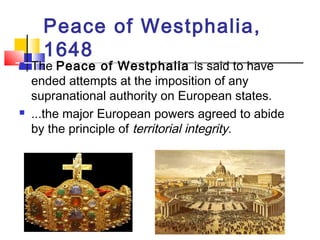
Peace of Westphalia, 
1648 
 The Peace of Westphalia is said to have 
ended attempts at the imposition of any 
supranational authority on European states. 
 ...the major European powers agreed to abide 
by the principle of territorial integrity.
WESTPHALIAN SYSTEM 
 The principle of the sovereignty of states 
 The principle of (legal) equality 
between states 
 The principle of non-intervention of one 
state in the internal affairs of another state
The Peace of Westphalia (1648) 
 Political Provisions: 
 Each Ger. prince became free from any kind of 
control by the HR Emperor. 
 The United Provinces [Dutch Neths.] became 
officially independent  so. part remained a Sp. 
possession. 
 Fr. rcvd. most of the Ger-speaking province of 
Alsace. 
 Sweden  got lands in No. Ger. on the Baltic & 
Black Sea coasts. 
 Switzerland became totally independent of the 
HR Emperor  Swiss Confederation. 
 Sweden won a voice in the Diet of the HR Emp. 
 Brandenburg got important terrs. on No. Sea & 
in central Germany.
The Peace of Westphalia (1648) 
 Religious Provisions: 
 Calvinists would have the same privileges 
as the Lutherans had in the Peace of 
Augsburg. 
 The ruler of each state could determine 
its official religion, BUT [except in the 
hereditary lands of the Habsburgs], he 
must permit freedom of private worship.
Thirty years war Peace of Westphalia

Thirty years war Peace of Westphalia

  • 1.
  • 2.
  • 3.
    Introduction  HREis a mix of Czech, Bohemian, French and German (Majority), evenly split between Protestant and Catholic  Isolationist perspectives of Lutheran states led to cultural decline  suspicious of the outside world and suffered from cultural isolation  Universities attracted fewer students as intellectual energies were spent defending dogmas  Witch burning  Commercial activity is in decline  Banking and financial interests were shifting west
  • 5.
    Background of theThirty Years’ War  HRE Role  Peace of Augsburg (1555) provided that each state could prescribe the religion of its subjects  leads to the development of two opposing forces  Lutheran states are making gains by converting leaders  Catholics states are supported by Spain
  • 6.
    Background of theThirty  Spain’s Role Years’ War  wanted Nether back or at least to end Dutch trade in Indies  wished to consolidate Habsburg position in Germany and in Swiss cantons Philip III (1598- 1621)
  • 7.
    Background of theThirty  French Role Years’ War  Spain’s moves aroused France  Idea of a stronger power in Germany also aroused French  intent and preventing a strong Hapsburg state from emerging in the HRE Louis XIII (1610- 1643)
  • 8.
    Background of theThirty Years’ War  Complexity of the Thirty Years’ War  Fought over religion, constitutional issues, centralization v independence of German states  Between the French and Hapsburgs, Spain and Dutch  Fought mostly on German soil  Divided into 4 or 5 phases  Bohemian (1618-1625)  Danish (1625-1629)  Swedish(1630-1635) Swedish-French(1635-1648)
  • 9.
    Why another War?  Peace of Augsburg – solved nothing  granted rights to Lutherans, but other Protestant religions left out  an issue for Palatinate Elector = Calvinist  War between emperor and princes  “Protestant Union”(1608) and a “Catholic League”(1609) determined to hold the other at bay  PU supported by Dutch, English & Henry IV of France  CL founded in Bavaria & backed by Spain  Austrian Habsburgs would like a strong central government (nation-state); must push out Protestantism
  • 10.
    Why another War?  War between emperor and princes  It seems the “emperor” isn’t really an emperor (i.e. no power!), HRE too divided  Instead we have a “Protestant Union”(1608) and a “Catholic League”(1609) determined to hold the other at bay  PU supported by Dutch, English & Henry IV of France  CL founded in Bavaria & backed by Spain  Austrian Habsburgs would like a strong central government (nation-state); must push out Protestantism
  • 12.
    Habsburg Family Tree– Part II Maximilian I (1493-1519) Philip___________La Loca Charles V (Sp/HRE) Ferdinand I (1516-1556) (1556-1564) HRE Philip II (Sp) (1556-1598) Maximilian II Charles of Styria Philip III (Sp) (1564-1576) (1598-1621) Rudolf II Matthias Ferdinand II (1576-1612) (1612-1619) (1619-1637) RII & M = kings of Hungary, Bohemia/ FII = king of Bohemia
  • 13.
    Phase I: BohemianPhase 1618-1625  HRE – Matthias (Ferdinand’s grdson) dying, successor to Empire  Logical choice: cousin, Ferdinand II  BUT electors are mainly Protestant and Ferdinand is Catholic  Ferdinand ALSO king of Bohemia!  Bohemians (Czechs / Germans) – together with Slovaks = mainly Protestant vs. Catholic king
  • 14.
    Bohemia revolts Defenestration of Prague: Mathias’ reps thrown out the window (land on dung)  Mathias send in troops to restore order & is deposed  Mathias dies & Ferdinand II should reign  Bohemians elect “Frederick of the Palatinate”  So War: Ferdinand and Catholic League vs. Frederick and Protestant Union  Ferdinand crowned as HRE and defeats Frederick at Battle of White Mountain 1620
  • 15.
    Outcomes of PhaseI  Spain dig-in in Rhineland; prepare to take on French and Dutch  Ferdinand II gets elected king of Bohemia & confiscates 50% of nobles’ estates  some goes to churches, monasteries & orders  some goes to mercenaries = new aristocracy  Jesuits re-Catholicize Bohemia  missions, schools, court proceedings, executions  Protestantism expunged in Austria  Protestant Union dissolved in 1621
  • 16.
    Phase II: DanishPhase 1625-1630 Danish Lutherans vs. Habsburg power!  Denmark’s King Christian IV (a.k.a. Duke of Holstein) vs. Ferdinand II  religious as well as political agenda  some Dutch, English, French backing  Ferdinand wins under gen. Wallenstein who plunders Germany and Danes (Spanish cousins of HRE help)  Wallenstein actually reaches Baltic & Danish Pen.
  • 17.
    Results of PhaseII  Germany is completely engulfed by the Counter Reformation  Palatinate, northern Lutheran states, Bohemia & Austria = re-Catholicized  1629 HRE issues “Edict of Restitution”: All Catholic states pre Peace of Augsburg (1555) are restored as Catholic
  • 19.
    Results of PhaseII  Terror sweeps Germany, France, Denmark & Sweden  Germans fear for Protestantism  as do Danish, who are also dealing with Wallenstein  French (Richelieu) dealing with internal conflicts, can’t take Ferdinand II alone, so...  engage Swedes, by ending their conflict with Poland and paying them 1 million livre/year for 40,000 troops (Dutch pay 50,000 florins a month)
  • 20.
    Phase III: Swedish1630-1635  Swedish King Gustavus Adolphus: great ruler  united Sweden  conducted overseas operations  increased land holdings bu acquiring areas of Poland & Russia  creates Europes most modern army  1630 lands in Germany to take over fight for Protestantism  in the meantime...Richelieu has turned Catholic states against FII (fear of centralization)
  • 21.
    Phase III –Swedish 1630-1635  Glorious Victories (military backing from Saxony)  1631 Breitenfeld  1632 Lützen (GA dies in battle)  Oxenstierna (GA’s Chancellor) picks up fight  penetrates Bohemia as far south as the Danube  Internal Discord  Wallenstein upset with power of Spanish and gives up fight; begins private peace talks with Swedes & Saxons; assassinated by one of his own
  • 22.
    Phase III –Swedish 1630-1635  Internal Discord (con’t.)  Saxons (ind. of Swedes) enter into talks w/ Emperor  1635 Peace of Prague: annuls Edict of Restitution, many other German states sign treaty & pull support of Swedes  Swedes left isolated in Germany  French/Spanish not ready to give
  • 23.
    Phase IV: French-Swedish/ International Phase 1635-1648  Richelieu not happy the Habsburgs won again … so … he declares war on Spain (Habsburg – Philip IV – helping HRE)!  Portugal & Catalonia declare independence from Sp.  Netherlands, Savoy also enter on Swedish side!  Battles go both ways, Richelieu, Ferdinand II, Louis XIII, Wallenstein all die early 1640’s  Germany grows to resent this foreign invasion  Exhaustion – and Peace of Westphalia 1648
  • 24.
    The Peace ofWestphalia (1648)  The 30 Years’ War officially ended in 1648 with the Peace of Westphalia  The treaties recognized the sovereignty of the 300+ German princes  The treaties disallowed papal meddling in German religious affairs  The treaties upheld the Peace of Augsburg, added Calvinism to the list of religions allowed in German states and nullified the Edict of Restitution
  • 25.
    Immediate Results ofthe 30 Years’ War  After the Peace in 1648, the northern states in Germany remained primarily Protestant while the southern states in Germany remained primarily Catholic  The United Provinces and Switzerland won recognition as independent states  German princes won the right to form alliances and sign treaties as long as they didn’t declare war on the Holy Roman Empire  Sweden won cash and land in the Baltic region  France won the region of Alsace
  • 26.
    Political Fallout fromthe 30 Years’ War  Because Spain lost territory and France gained territory, France stood alone as the most powerful nation on the continent  France also benefited from the fragmentation of the Holy Roman Empire and the weakening of the Habsburg family influence
  • 27.
    Peace of Westphalia, 1648  The Peace of Westphalia is said to have ended attempts at the imposition of any supranational authority on European states.  ...the major European powers agreed to abide by the principle of territorial integrity.
  • 28.
    WESTPHALIAN SYSTEM The principle of the sovereignty of states  The principle of (legal) equality between states  The principle of non-intervention of one state in the internal affairs of another state
  • 29.
    The Peace ofWestphalia (1648)  Political Provisions:  Each Ger. prince became free from any kind of control by the HR Emperor.  The United Provinces [Dutch Neths.] became officially independent  so. part remained a Sp. possession.  Fr. rcvd. most of the Ger-speaking province of Alsace.  Sweden  got lands in No. Ger. on the Baltic & Black Sea coasts.  Switzerland became totally independent of the HR Emperor  Swiss Confederation.  Sweden won a voice in the Diet of the HR Emp.  Brandenburg got important terrs. on No. Sea & in central Germany.
  • 30.
    The Peace ofWestphalia (1648)  Religious Provisions:  Calvinists would have the same privileges as the Lutherans had in the Peace of Augsburg.  The ruler of each state could determine its official religion, BUT [except in the hereditary lands of the Habsburgs], he must permit freedom of private worship.