John Locke’s Treatise on Government
Overview Who was John Locke? What was Locke’s view of man in the state of nature? What was the social contract according to Locke? What were Locke’s ideas concerning government?
John Locke (1632-1704) Physician and Political Philosopher Affiliated with the Whig party Wrote in reaction to the revolutions following Cromwellian England Famous works: Essay Concerning Human Understanding Two Treatises of Civil Government
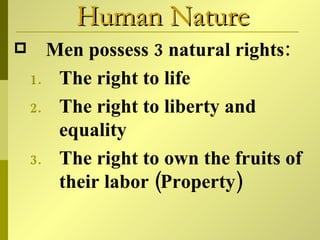
Human Nature Men possess 3 natural rights: The right to life The right to liberty and equality The right to own the fruits of their labor (Property)
The State of Nature In the state of nature, men enjoy absolute liberty. There exists an underlying “natural law” that ensures men can enjoy this liberty i.e. that man ought not to harm his fellows or their property
The State of Nature  (again) Thus, men judge for themselves how to use their own rights Naturally, this means that men can come into conflict Under such conditions, men’s natural rights end up abused Hence properties are not secure
Civil Society Society arises because men seek to leave the state of nature To do so, they surrender their freedoms (rights) to a power that will preserve their property That power is also charged with punishing offenses against rights
Civil  Society  (cont’d) Civil society is a political society The surrendering of freedoms to a higher power offers the political character The right to have the laws of civil society enforced provides the civil character
Civil  Society  (yikes!) Civil society is a society of laws Laws enhance human freedom and preserve property The bias is that these laws must preserve as much of man’s natural freedom as possible. The creation of civil society is the nature of the social contract
Social Contract The social contract creates a commonwealth for the people Establishment of laws Designation of a supreme power By virtue of the contract, “majority wins” The contract entails  consent
Commonwealth Men surrender their freedoms to enjoy them more securely Hence, the commonwealth is charged with the preservation of property through laws Thus legislative power must be supreme in the commonwealth
Limitations  Laws must always be directed towards the common good The legislature can only operate according to standing laws and authorized officials Nobody,  not even the rulers , is above the law.
Limitations  (more) The legislature may not deprive a person of property without his/her consent  Principle of non-delegation of powers Separation between legislative and executive functions
“ People Power” Legislative power (etc.) is only fiduciary power for specific  ends People still possess the power to remove or alter the legislature Abusive rulers command no allegiance over their subjects

Locke

  • 1.
  • 2.
    Overview Who wasJohn Locke? What was Locke’s view of man in the state of nature? What was the social contract according to Locke? What were Locke’s ideas concerning government?
  • 3.
    John Locke (1632-1704)Physician and Political Philosopher Affiliated with the Whig party Wrote in reaction to the revolutions following Cromwellian England Famous works: Essay Concerning Human Understanding Two Treatises of Civil Government
  • 4.
    Human Nature Menpossess 3 natural rights: The right to life The right to liberty and equality The right to own the fruits of their labor (Property)
  • 5.
    The State ofNature In the state of nature, men enjoy absolute liberty. There exists an underlying “natural law” that ensures men can enjoy this liberty i.e. that man ought not to harm his fellows or their property
  • 6.
    The State ofNature (again) Thus, men judge for themselves how to use their own rights Naturally, this means that men can come into conflict Under such conditions, men’s natural rights end up abused Hence properties are not secure
  • 7.
    Civil Society Societyarises because men seek to leave the state of nature To do so, they surrender their freedoms (rights) to a power that will preserve their property That power is also charged with punishing offenses against rights
  • 8.
    Civil Society (cont’d) Civil society is a political society The surrendering of freedoms to a higher power offers the political character The right to have the laws of civil society enforced provides the civil character
  • 9.
    Civil Society (yikes!) Civil society is a society of laws Laws enhance human freedom and preserve property The bias is that these laws must preserve as much of man’s natural freedom as possible. The creation of civil society is the nature of the social contract
  • 10.
    Social Contract Thesocial contract creates a commonwealth for the people Establishment of laws Designation of a supreme power By virtue of the contract, “majority wins” The contract entails consent
  • 11.
    Commonwealth Men surrendertheir freedoms to enjoy them more securely Hence, the commonwealth is charged with the preservation of property through laws Thus legislative power must be supreme in the commonwealth
  • 12.
    Limitations Lawsmust always be directed towards the common good The legislature can only operate according to standing laws and authorized officials Nobody, not even the rulers , is above the law.
  • 13.
    Limitations (more)The legislature may not deprive a person of property without his/her consent Principle of non-delegation of powers Separation between legislative and executive functions
  • 14.
    “ People Power”Legislative power (etc.) is only fiduciary power for specific ends People still possess the power to remove or alter the legislature Abusive rulers command no allegiance over their subjects