Jack Garrity
3. Great
Brittan a
Limited
Monarchy
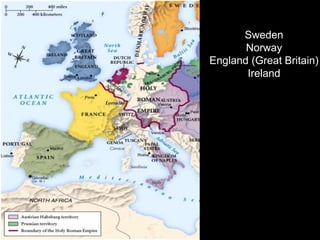
Sweden
Norway
England (Great Britain)
Ireland
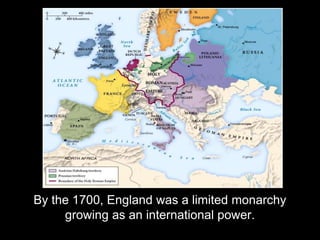
By the 1700, England was a limited monarchy
growing as an international power.
By the 17th Century, England developed
freedom of thought, religion, speech, and a
limited monarchy.
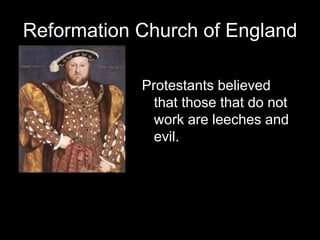
Reformation Church of England
Elizabeth’s father King Henry VIII (1509-1547)
had started the Church of England.
Reformation Church of England
The Pope would not allow him to divorce
Queen Catherin, daughter of Isabella of
Spain.
Reformation Church of England
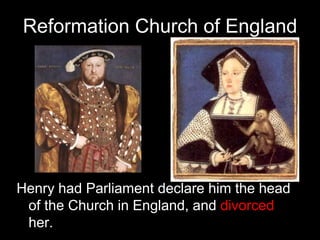
Henry had Parliament declare him the head
of the Church in England, and divorced
her.
Reformation Church of England
Henry’s Protestant Church
expropriated the money,
killed and destroyed
much of the Roman
Catholic Church in
England.
Reformation of England
Protestant ideas
focused on improving
this world, not just
praying for heaven as
the Roman Catholics
taught.
Reformation Church of England
Protestants thought that
everyone should read
the Bible, which
spread literacy and
education.
Reformation of England
Protestant idea ( your
job was your calling
from God) spread
throughout England,
making people more
productive.
Reformation Church of England
Protestants believed
that those that do not
work are leeches and
evil.
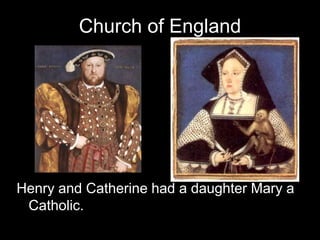
Church of England
Henry and Catherine had a daughter Mary a
Catholic.
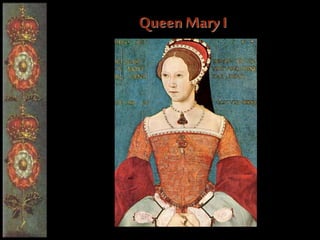
Queen Mary I
#2--Anne Boleyn [1501-1536]
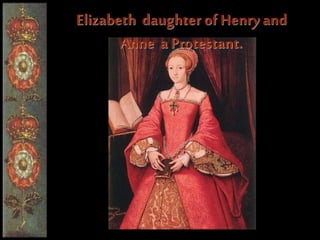
Elizabeth daughter of Henry and
Anne a Protestant.
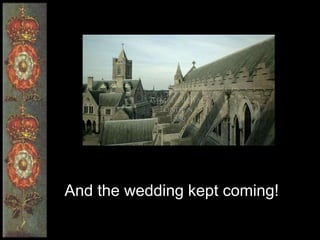
And the wedding kept coming!
#3--Jane Seymour [1508-1537]
#4--Anne of Cleves [1515-
1557]
#5--Katherine Howard
[1525-1542]
#6--Katherine Parr [1512-
1548]
Henry’s Deathbed
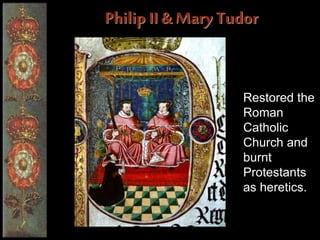
Philip II & MaryTudor
Restored the
Roman
Catholic
Church and
burnt
Protestants
as heretics.
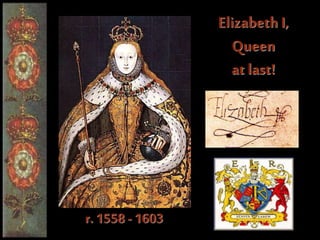
Elizabeth I,
Queen
at last!
r. 1558 -1603
Elizabeth I,
Queen
at last! A
Protestant
Queen,who
wisely
allowed
freedom of
religion.r. 1558 -1603
Queen Elizabeth I [1533-1603]
Freedom of religion
(thought) and the
parliament system of
government
encourages new
ideas.
Reformation Church of England
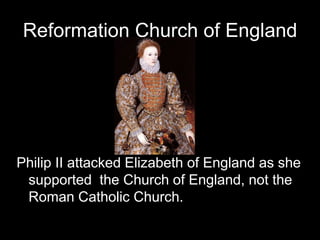
Philip II attacked Elizabeth of England as she
supported the Church of England, not the
Roman Catholic Church.
Church of England
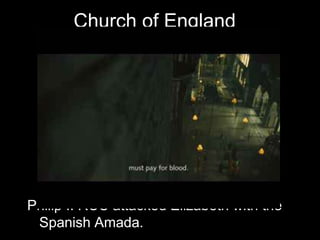
Philip II RCC attacked Elizabeth with the
Spanish Amada.
The English Crowns’ powers had been
limited by the Noble and merchant
classes.
Parliament
Background
(1215-1603)
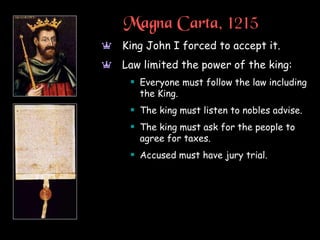
Magna Carta, 1215
a King John I forced to accept it.
a Law limited the power of the king:
 Everyone must follow the law including
the King.
 The king must listen to nobles advise.
 The king must ask for the people to
agree for taxes.
 Accused must have jury trial.
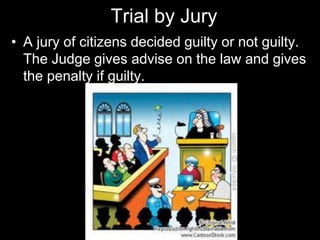
Trial by Jury
• A jury of citizens decided guilty or not guilty.
The Judge gives advise on the law and gives
the penalty if guilty.
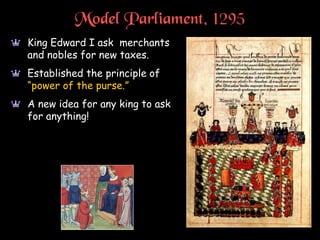
Model Parliament, 1295
a King Edward I ask merchants
and nobles for new taxes.
a Established the principle of
“power of the purse.”
a A new idea for any king to ask
for anything!
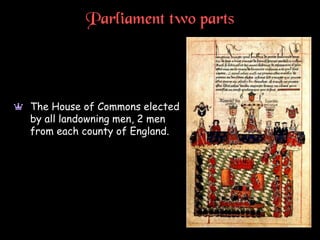
Parliament two parts
a The House of Commons elected
by all landowning men, 2 men
from each county of England.
T he Elizabethan
“Bargain”
a 1533 – 1603
a Parliament:
 has the power to tax.
 Can debate and amend
laws called bills.
a The Monarch:
 Had the royal
prerogative
[right/choice]
on foreign
policy,
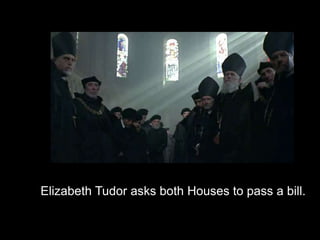
Elizabeth Tudor asks both Houses to pass a bill.
• By the 17th Century, England developed
freedom of thought, religion, speech, and
a limited monarchy.
• By the 18th Century they had a new
economic system capitalism.
• MercantilismToAdamSmith.ppt
• EnEnd
The
Early Stuarts
(1603-1649)
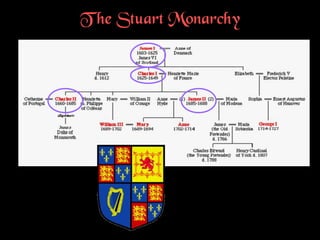
T he Stuart Monarchy
James I [r. 1603-1625]
James I’s speech to the
House of Commons:
I am surprised that my
ancestors should ever be
permitted such an
institution to come into
existence. I am a stranger,
and found it here when I
arrived, so that I am
obliged to put up with what
I cannot get rid of!
James I [r. 1603-1625]
a Wanted absolute power.
a He quickly alienated a
Parliament grown
accustomed under the
Tudors to act on the
premise that monarch and
Parliament TOGETHER
ruled England as a “balance
polity.”
James I [r. 1603-1625]
a He alienated the Puritans by
his strong defense of the
Anglican Church.
a Many of England’s gentry
[mostly rich landowners
below the level of the
nobility] became Puritans.
 These Puritan gentry
formed an important and
large part of the House of
Commons.
 It was NOT WISE to
alienate them!
Gunpowder Plot, 1605
a An attempt by some provincial
Catholics to kill King James I and
most of the Protestant
aristocracy.
a Blow up the House of Lords during
the state opening of Parliament.
Guy Fawkes
Executions of the Gunpowder Plotters
James I [r. 1603-1625]
a Problems he faced:
 Large royal debt.
 He wasn’t English  he
didn’t understand English
customs [esp. English law!]
 Believed in Divine Right of
Kings.
 Pro-Catholic sympathies.
 Clashed with Parliament
 He raised money
without Parliament’s
consent!
King James
Bible,
1611
Charles I [r. 1625-1649]
a Pro-ceremonies and
rituals.
a Uniformity of church
services imposed by a
church court.
 Anglican Book of
Common Prayer for
both England AND
Scotland.
a Seen as too pro-
Catholic by the Puritans.
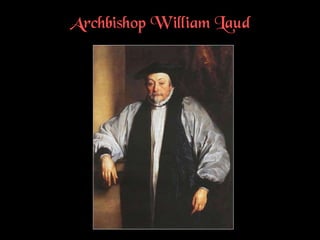
Archbishop William Laud
Charles I & Parliament
a Constantly at war with Spain and France.
 Always need £, but how to get it??
a Usually Parliament would give Charles £ from taxes to
fund his wars.
a Periodically, Parliament would deny funds.
 In return, Charles would dissolve Parliament and try to
rule England without it  find funds in other ways.
 Forced “loans,” selling aristocratic titles, etc.
Ship Money Assessments, 1636
[per square mile]
a A medieval tax for
coastal cities for
defense.
a Charles applied them
to inland counties as
well.
a This got him around
the need to call
Parliament into
session.
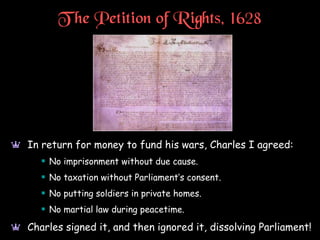
T he Petition of Rights, 1628
a In return for money to fund his wars, Charles I agreed:
 No imprisonment without due cause.
 No taxation without Parliament’s consent.
 No putting soldiers in private homes.
 No martial law during peacetime.
a Charles signed it, and then ignored it, dissolving Parliament!
T he “Short” Parliament
a “Short Parliament”
 No Parliament in 20 yrs.
 Rebellion in Scotland
over Laud issues.
 Charles need £ war
with France.
a Calls Parliament into
session in 1640
 MPs demand more
protection of property.
 Charles dismisses them
after 3 weeks. Charles I by Van Dyck
(1633)
T he “Long” Parliament
a In session from 1640 to 1660.
 Laud executed.
 Triennial Act passed 
Parliament must be called in
session at least once every 3 yrs.
 Parliament can’t be adjourned
without its own consent!
a Charles enters the House of
Commons to end the session and
arrest 5 MPs unsuccessful
a Charles heads north to form an
army!
The
Civil War
(1642-1649)
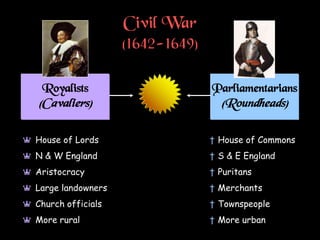
Civil War
(1642-1649)
Royalists
(Cavaliers)
Parliamentarians
(Roundheads)
a House of Lords
a N & W England
a Aristocracy
a Large landowners
a Church officials
a More rural
† House of Commons
† S & E England
† Puritans
† Merchants
† Townspeople
† More urban
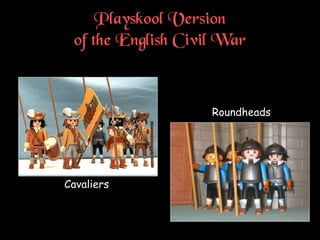
Playskool Version
of the English Civil War
Cavaliers
Roundheads
Allegiance of
Members
of the
Long
Parliament
(1640-1660)
Oliver Cromwell [1599-1658]
† Officer of the Parliamentary army [cavalry]  the New
Model Army.
† Led the army that defeated royal forces and now
controlled the government.
† He wore…a plain cloth-suit, which seemed to have been
made by a poor tailor; his shirt
was plain, and not very clean; and I
remember a speck or two of
blood upon his collar…his face was
swollen and red, his voice sharp and
untunable, and his speech full of
passion. [Sir Philip Warwick,
a Royalist, 1640]
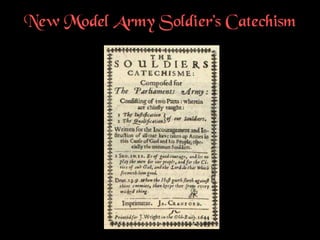
New Model Army Soldier’s Catechism
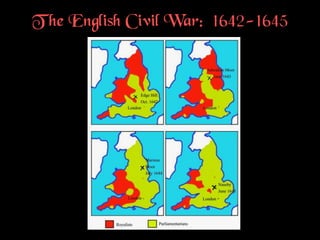
T he English Civil War: 1642-1645
T he Battle of Naseby [re-enactment], 1645
a Charles I is defeated at Marston Moor, Naseby,
and Preston.
a He is handed over to Parliament.
The
Interregnum
(1649-1660)
T he “Interregnum” Period [1649-1660]
† The Commonwealth (1649-1653)
† The Protectorate (1654-1660)
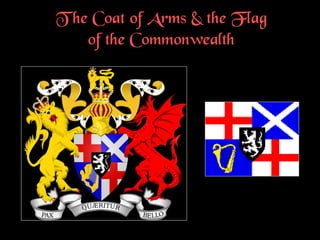
T he Coat of Arms & the Flag
of the Commonwealth
Pride’s Purge, 1648
† Cromwell purges the House of Commons of moderates
[anyone who isn’t anti-monarchy].
† The results is the “Rump” Parliament.
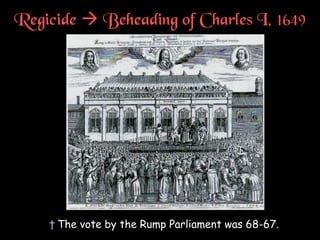
Regicide  Beheading of Charles I, 1649
† The vote by the Rump Parliament was 68-67.
T he Puritan Commonwealth [1649-1653]
† Cromwell rules with the Rump
Parliament.
† Constitutional Republic
 Created a constitution 
Instrument of Government
 An executive [Cromwell]
 A Council of State  annually
elected the committee of
Parliament.
 No monarch.
† Europe is appalled  other
nations don’t recognize it.
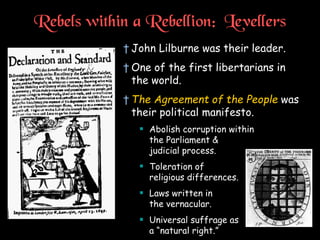
Rebels within a Rebellion: Levellers
† John Lilburne was their leader.
† One of the first libertarians in
the world.
† The Agreement of the People was
their political manifesto.
 Abolish corruption within
the Parliament &
judicial process.
 Toleration of
religious differences.
 Laws written in
the vernacular.
 Universal suffrage as
a “natural right.”
Rebels within a Rebellion: Diggers
† Agrarian “communists” led by Gerrard
Winstanley and William Everard 
seen as the “true Levellers.”
† With Charles I gone, they felt that
land should now be distributed to the
poor.
† Food prices had reached record highs
in the 1640s.
† They alarmed the Commonwealth
government and angered the local
landowners who wanted to claim
confiscated aristocratic lands for
themselves.
Cromwell Dissolves the “Rump”
Parliament in 1653
T he Protectorate [1653-1660]
† Cromwell tears up the ineffective
Constitution.
† Dismisses the Rump Parliament
and rules with the support of the
military.
 Declares martial law.
 Military dictator.
† Religious tolerance for all [esp.
for Jews], except for Catholics.
† Crushes a rebellion in Scotland.
† Crushes a rebellion among the Catholics of Ireland  kills
40% of all ethnic Irish!
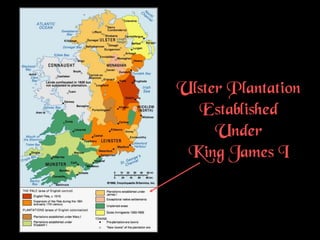
Ulster Plantation
Established
Under
King James I
Ulster Plantation: 1609-1660
% Of Land Owned by Catholics in Ireland
[in green]
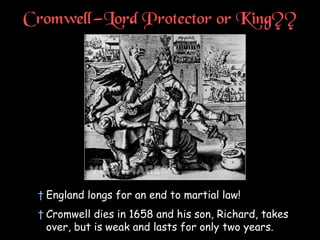
Cromwell—Lord Protector or King??
† England longs for an end to martial law!
† Cromwell dies in 1658 and his son, Richard, takes
over, but is weak and lasts for only two years.
The
Restoration
(1660-1688)
Parliament could no more exist without the Crown
than the Crown without Parliament. This was the
most important lesson of the English Civil War!
King Charles II [r. 1660-1685]
a Had charm, poise, & political
skills [unlike his father!].
a Restored the theaters and
reopened the pubs and
brothels closed during the
Restoration.
a Favored religious toleration.
a Had secret Catholic
sympathies.
a Realized that he could not
repeat the mistakes his
father had made.
King Charles II [r. 1660-1685]
a 1661  “Cavalier” Parliament [filled with
Royalists]
 Disbanded the Puritan army.
 Pardoned most Puritan rebels.
 Restored the authority of the Church of England.
a 1662  Clarendon Code [Act of Uniformity]
 All clergy & church officials had to conform to the
Anglican Book of Common Prayer.
 It forbade “non-conformists” to worship publicly,
teach their faith, or attend English universities.
Great London Plague, 1665
Great London Fire, 1666
King Charles II [r. 1660-1685]
a 1673  Test Act
 Parliament excluded all but Anglicans from
civilian and military positions.
[to the Anglican gentry, the Puritans were
considered “radicals” and the Catholics were
seen as “traitors!”]
a 1679  Habeas Corpus Act
 Any unjustly imprisoned persons could obtain a
writ of habeas corpus compelling the govt. to
explain why he had lost his liberty.
Charles II’s Foreign Policy
1665 – 1667: Second Anglo-Dutch War
a To Charles II, Louis XIV is an ideal ally against
the Dutch.
a 1670  Treaty of Dover
King James II [r. 1685-1688]
a Was a bigoted convert
to Catholicism without
any of Charles II’s
shrewdness or ability to
compromise.
a Alienated even the
Tories.
a Provoked the revolution
that Charles II had
succeeded in avoiding!
King James II [r. 1685-1688]
a Introduced Catholics into the
High Command of both the
army and navy.
a Camped a standing army a few
miles outside of London.
a Surrounded himself with
Catholic advisors & attacked
Anglican control of the
universities.
a Claimed the power to suspend or dispense with Acts of
Parliament.
a 1687  Declaration of Liberty of Conscience
 He extended religious toleration without
Parliament’s approval or support.
The
Glorious
Revolution
1688
T he “Glorious” Revolution: 1688
a Whig & Tory leaders offered the throne jointly to
James II’s daughter Mary [raised a Protestant] & her
husband, William of Orange.
 He was a vigorous enemy of Louis XIV.
 He was seen as a champion of the Protestant cause.
English Bill of Rights [1689]
a It settled all of the
major issues between
King & Parliament.
a It served as a model
for the U. S. Bill of
Rights.
a It also formed a base
for the steady
expansion of civil
liberties in the 18c and
early 19c in England.
English Bill of Rights [1689]
a Main provisions:
1. The King could not suspend the operation of laws.
2. The King could not interfere with the ordinary course of
justice.
3. No taxes levied or standard army maintained in peacetime
without Parliament’s consent.
4. Freedom of speech in Parliament.
5. Sessions of Parliament would be held frequently.
6. Subjects had the right of bail, petition, and freedom from
excessive fines and cruel and unusual punishment.
7. The monarch must be a Protestant.
8. Freedom from arbitrary arrest.
9. Censorship of the press was dropped.
10.Religious toleration.
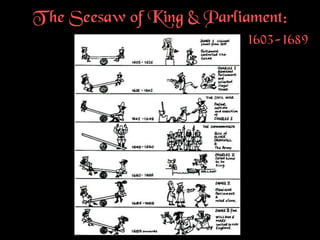
T he Seesaw of King & Parliament:
1603-1689

19.1 northerneurope

  • 1.
  • 2.
  • 3.
    By the 1700,England was a limited monarchy growing as an international power.
  • 4.
    By the 17thCentury, England developed freedom of thought, religion, speech, and a limited monarchy.
  • 5.
    Reformation Church ofEngland Elizabeth’s father King Henry VIII (1509-1547) had started the Church of England.
  • 6.
    Reformation Church ofEngland The Pope would not allow him to divorce Queen Catherin, daughter of Isabella of Spain.
  • 7.
    Reformation Church ofEngland Henry had Parliament declare him the head of the Church in England, and divorced her.
  • 8.
    Reformation Church ofEngland Henry’s Protestant Church expropriated the money, killed and destroyed much of the Roman Catholic Church in England.
  • 10.
    Reformation of England Protestantideas focused on improving this world, not just praying for heaven as the Roman Catholics taught.
  • 11.
    Reformation Church ofEngland Protestants thought that everyone should read the Bible, which spread literacy and education.
  • 12.
    Reformation of England Protestantidea ( your job was your calling from God) spread throughout England, making people more productive.
  • 13.
    Reformation Church ofEngland Protestants believed that those that do not work are leeches and evil.
  • 14.
    Church of England Henryand Catherine had a daughter Mary a Catholic.
  • 15.
  • 16.
  • 17.
    Elizabeth daughter ofHenry and Anne a Protestant.
  • 18.
    And the weddingkept coming!
  • 19.
  • 20.
    #4--Anne of Cleves[1515- 1557]
  • 21.
  • 22.
  • 23.
  • 24.
    Philip II &MaryTudor Restored the Roman Catholic Church and burnt Protestants as heretics.
  • 25.
  • 26.
    Elizabeth I, Queen at last!A Protestant Queen,who wisely allowed freedom of religion.r. 1558 -1603
  • 27.
    Queen Elizabeth I[1533-1603] Freedom of religion (thought) and the parliament system of government encourages new ideas.
  • 28.
    Reformation Church ofEngland Philip II attacked Elizabeth of England as she supported the Church of England, not the Roman Catholic Church.
  • 29.
    Church of England PhilipII RCC attacked Elizabeth with the Spanish Amada.
  • 30.
    The English Crowns’powers had been limited by the Noble and merchant classes.
  • 31.
  • 32.
    Magna Carta, 1215 aKing John I forced to accept it. a Law limited the power of the king:  Everyone must follow the law including the King.  The king must listen to nobles advise.  The king must ask for the people to agree for taxes.  Accused must have jury trial.
  • 33.
    Trial by Jury •A jury of citizens decided guilty or not guilty. The Judge gives advise on the law and gives the penalty if guilty.
  • 34.
    Model Parliament, 1295 aKing Edward I ask merchants and nobles for new taxes. a Established the principle of “power of the purse.” a A new idea for any king to ask for anything!
  • 35.
    Parliament two parts aThe House of Commons elected by all landowning men, 2 men from each county of England.
  • 36.
    T he Elizabethan “Bargain” a1533 – 1603 a Parliament:  has the power to tax.  Can debate and amend laws called bills. a The Monarch:  Had the royal prerogative [right/choice] on foreign policy,
  • 37.
    Elizabeth Tudor asksboth Houses to pass a bill.
  • 38.
    • By the17th Century, England developed freedom of thought, religion, speech, and a limited monarchy. • By the 18th Century they had a new economic system capitalism. • MercantilismToAdamSmith.ppt
  • 39.
  • 40.
  • 41.
    T he StuartMonarchy
  • 42.
    James I [r.1603-1625] James I’s speech to the House of Commons: I am surprised that my ancestors should ever be permitted such an institution to come into existence. I am a stranger, and found it here when I arrived, so that I am obliged to put up with what I cannot get rid of!
  • 43.
    James I [r.1603-1625] a Wanted absolute power. a He quickly alienated a Parliament grown accustomed under the Tudors to act on the premise that monarch and Parliament TOGETHER ruled England as a “balance polity.”
  • 44.
    James I [r.1603-1625] a He alienated the Puritans by his strong defense of the Anglican Church. a Many of England’s gentry [mostly rich landowners below the level of the nobility] became Puritans.  These Puritan gentry formed an important and large part of the House of Commons.  It was NOT WISE to alienate them!
  • 45.
    Gunpowder Plot, 1605 aAn attempt by some provincial Catholics to kill King James I and most of the Protestant aristocracy. a Blow up the House of Lords during the state opening of Parliament. Guy Fawkes
  • 46.
    Executions of theGunpowder Plotters
  • 47.
    James I [r.1603-1625] a Problems he faced:  Large royal debt.  He wasn’t English  he didn’t understand English customs [esp. English law!]  Believed in Divine Right of Kings.  Pro-Catholic sympathies.  Clashed with Parliament  He raised money without Parliament’s consent!
  • 48.
  • 49.
    Charles I [r.1625-1649] a Pro-ceremonies and rituals. a Uniformity of church services imposed by a church court.  Anglican Book of Common Prayer for both England AND Scotland. a Seen as too pro- Catholic by the Puritans.
  • 50.
  • 51.
    Charles I &Parliament a Constantly at war with Spain and France.  Always need £, but how to get it?? a Usually Parliament would give Charles £ from taxes to fund his wars. a Periodically, Parliament would deny funds.  In return, Charles would dissolve Parliament and try to rule England without it  find funds in other ways.  Forced “loans,” selling aristocratic titles, etc.
  • 52.
    Ship Money Assessments,1636 [per square mile] a A medieval tax for coastal cities for defense. a Charles applied them to inland counties as well. a This got him around the need to call Parliament into session.
  • 53.
    T he Petitionof Rights, 1628 a In return for money to fund his wars, Charles I agreed:  No imprisonment without due cause.  No taxation without Parliament’s consent.  No putting soldiers in private homes.  No martial law during peacetime. a Charles signed it, and then ignored it, dissolving Parliament!
  • 54.
    T he “Short”Parliament a “Short Parliament”  No Parliament in 20 yrs.  Rebellion in Scotland over Laud issues.  Charles need £ war with France. a Calls Parliament into session in 1640  MPs demand more protection of property.  Charles dismisses them after 3 weeks. Charles I by Van Dyck (1633)
  • 55.
    T he “Long”Parliament a In session from 1640 to 1660.  Laud executed.  Triennial Act passed  Parliament must be called in session at least once every 3 yrs.  Parliament can’t be adjourned without its own consent! a Charles enters the House of Commons to end the session and arrest 5 MPs unsuccessful a Charles heads north to form an army!
  • 56.
  • 57.
    Civil War (1642-1649) Royalists (Cavaliers) Parliamentarians (Roundheads) a Houseof Lords a N & W England a Aristocracy a Large landowners a Church officials a More rural † House of Commons † S & E England † Puritans † Merchants † Townspeople † More urban
  • 58.
    Playskool Version of theEnglish Civil War Cavaliers Roundheads
  • 59.
  • 60.
    Oliver Cromwell [1599-1658] †Officer of the Parliamentary army [cavalry]  the New Model Army. † Led the army that defeated royal forces and now controlled the government. † He wore…a plain cloth-suit, which seemed to have been made by a poor tailor; his shirt was plain, and not very clean; and I remember a speck or two of blood upon his collar…his face was swollen and red, his voice sharp and untunable, and his speech full of passion. [Sir Philip Warwick, a Royalist, 1640]
  • 61.
    New Model ArmySoldier’s Catechism
  • 62.
    T he EnglishCivil War: 1642-1645
  • 63.
    T he Battleof Naseby [re-enactment], 1645 a Charles I is defeated at Marston Moor, Naseby, and Preston. a He is handed over to Parliament.
  • 64.
  • 65.
    T he “Interregnum”Period [1649-1660] † The Commonwealth (1649-1653) † The Protectorate (1654-1660)
  • 66.
    T he Coatof Arms & the Flag of the Commonwealth
  • 67.
    Pride’s Purge, 1648 †Cromwell purges the House of Commons of moderates [anyone who isn’t anti-monarchy]. † The results is the “Rump” Parliament.
  • 68.
    Regicide  Beheadingof Charles I, 1649 † The vote by the Rump Parliament was 68-67.
  • 69.
    T he PuritanCommonwealth [1649-1653] † Cromwell rules with the Rump Parliament. † Constitutional Republic  Created a constitution  Instrument of Government  An executive [Cromwell]  A Council of State  annually elected the committee of Parliament.  No monarch. † Europe is appalled  other nations don’t recognize it.
  • 70.
    Rebels within aRebellion: Levellers † John Lilburne was their leader. † One of the first libertarians in the world. † The Agreement of the People was their political manifesto.  Abolish corruption within the Parliament & judicial process.  Toleration of religious differences.  Laws written in the vernacular.  Universal suffrage as a “natural right.”
  • 71.
    Rebels within aRebellion: Diggers † Agrarian “communists” led by Gerrard Winstanley and William Everard  seen as the “true Levellers.” † With Charles I gone, they felt that land should now be distributed to the poor. † Food prices had reached record highs in the 1640s. † They alarmed the Commonwealth government and angered the local landowners who wanted to claim confiscated aristocratic lands for themselves.
  • 72.
    Cromwell Dissolves the“Rump” Parliament in 1653
  • 73.
    T he Protectorate[1653-1660] † Cromwell tears up the ineffective Constitution. † Dismisses the Rump Parliament and rules with the support of the military.  Declares martial law.  Military dictator. † Religious tolerance for all [esp. for Jews], except for Catholics. † Crushes a rebellion in Scotland. † Crushes a rebellion among the Catholics of Ireland  kills 40% of all ethnic Irish!
  • 74.
  • 75.
  • 76.
    % Of LandOwned by Catholics in Ireland [in green]
  • 77.
    Cromwell—Lord Protector orKing?? † England longs for an end to martial law! † Cromwell dies in 1658 and his son, Richard, takes over, but is weak and lasts for only two years.
  • 78.
    The Restoration (1660-1688) Parliament could nomore exist without the Crown than the Crown without Parliament. This was the most important lesson of the English Civil War!
  • 79.
    King Charles II[r. 1660-1685] a Had charm, poise, & political skills [unlike his father!]. a Restored the theaters and reopened the pubs and brothels closed during the Restoration. a Favored religious toleration. a Had secret Catholic sympathies. a Realized that he could not repeat the mistakes his father had made.
  • 80.
    King Charles II[r. 1660-1685] a 1661  “Cavalier” Parliament [filled with Royalists]  Disbanded the Puritan army.  Pardoned most Puritan rebels.  Restored the authority of the Church of England. a 1662  Clarendon Code [Act of Uniformity]  All clergy & church officials had to conform to the Anglican Book of Common Prayer.  It forbade “non-conformists” to worship publicly, teach their faith, or attend English universities.
  • 81.
  • 82.
  • 83.
    King Charles II[r. 1660-1685] a 1673  Test Act  Parliament excluded all but Anglicans from civilian and military positions. [to the Anglican gentry, the Puritans were considered “radicals” and the Catholics were seen as “traitors!”] a 1679  Habeas Corpus Act  Any unjustly imprisoned persons could obtain a writ of habeas corpus compelling the govt. to explain why he had lost his liberty.
  • 84.
    Charles II’s ForeignPolicy 1665 – 1667: Second Anglo-Dutch War a To Charles II, Louis XIV is an ideal ally against the Dutch. a 1670  Treaty of Dover
  • 85.
    King James II[r. 1685-1688] a Was a bigoted convert to Catholicism without any of Charles II’s shrewdness or ability to compromise. a Alienated even the Tories. a Provoked the revolution that Charles II had succeeded in avoiding!
  • 86.
    King James II[r. 1685-1688] a Introduced Catholics into the High Command of both the army and navy. a Camped a standing army a few miles outside of London. a Surrounded himself with Catholic advisors & attacked Anglican control of the universities. a Claimed the power to suspend or dispense with Acts of Parliament. a 1687  Declaration of Liberty of Conscience  He extended religious toleration without Parliament’s approval or support.
  • 87.
  • 88.
    T he “Glorious”Revolution: 1688 a Whig & Tory leaders offered the throne jointly to James II’s daughter Mary [raised a Protestant] & her husband, William of Orange.  He was a vigorous enemy of Louis XIV.  He was seen as a champion of the Protestant cause.
  • 89.
    English Bill ofRights [1689] a It settled all of the major issues between King & Parliament. a It served as a model for the U. S. Bill of Rights. a It also formed a base for the steady expansion of civil liberties in the 18c and early 19c in England.
  • 90.
    English Bill ofRights [1689] a Main provisions: 1. The King could not suspend the operation of laws. 2. The King could not interfere with the ordinary course of justice. 3. No taxes levied or standard army maintained in peacetime without Parliament’s consent. 4. Freedom of speech in Parliament. 5. Sessions of Parliament would be held frequently. 6. Subjects had the right of bail, petition, and freedom from excessive fines and cruel and unusual punishment. 7. The monarch must be a Protestant. 8. Freedom from arbitrary arrest. 9. Censorship of the press was dropped. 10.Religious toleration.
  • 91.
    T he Seesawof King & Parliament: 1603-1689